Leggy Growth on Curry Leaf Plant: Causes, Checks & Fixes
Quick answer
Leggy growth on Curry Leaf Plant means stretched stems with long gaps between compound leaves-almost always from too little direct sun, not disease. First step: move the pot to a south- or east-facing window with several hours of direct sun before repotting, fertilizing, or pinching. If the plant wilts in a dark room while soil stays wet, inspect roots for rot-that pattern is more urgent than stretch alone.
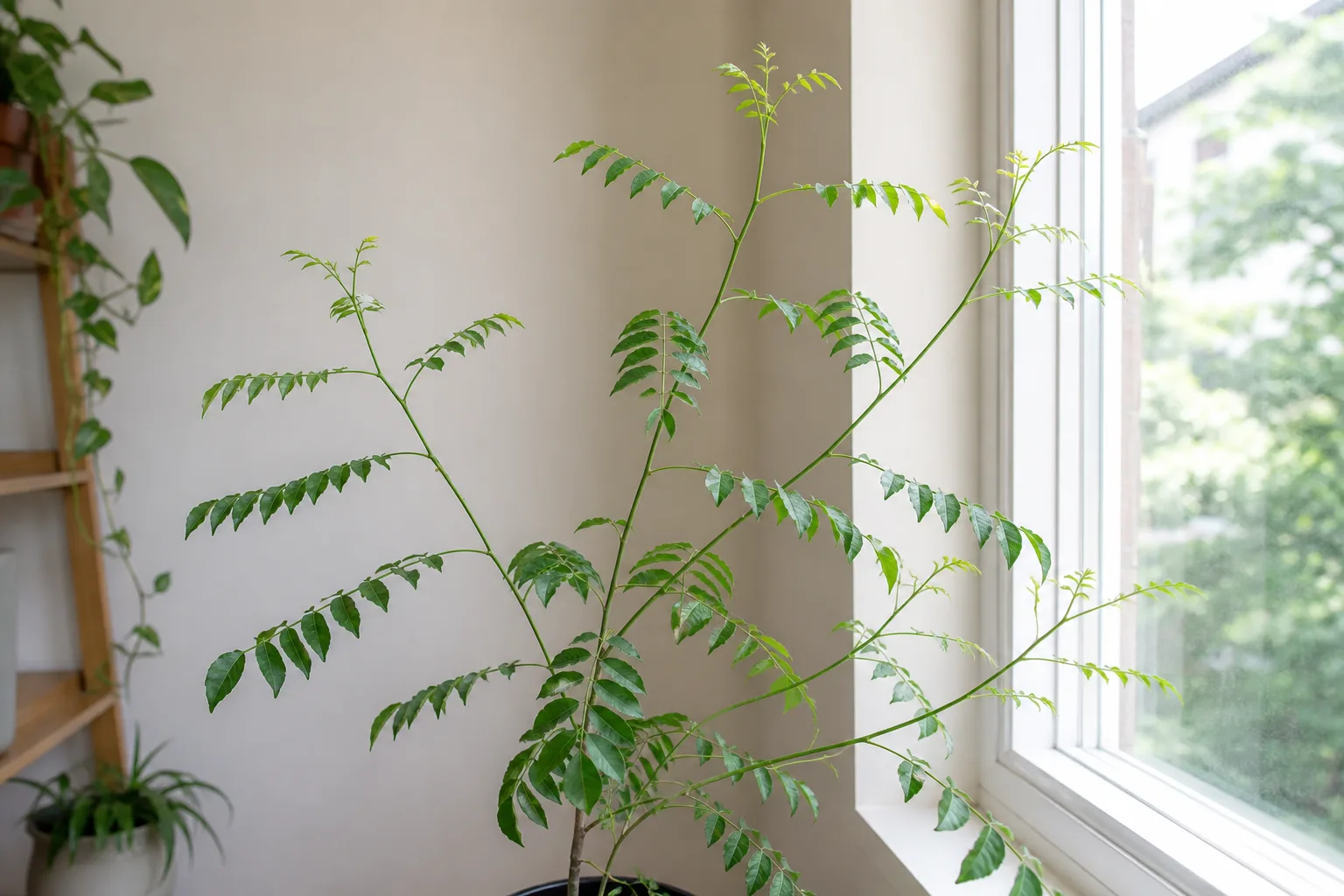
Leggy Growth on Curry Leaf Plant: Causes, Checks & Fixes
This guide covers leggy growth on Curry Leaf Plant. See also the general Leggy Growth guide, watering, and light pages for this plant.
Leggy Growth on Curry Leaf Plant: Causes, Checks & Fixes
Quick answer
Leggy growth on Curry Leaf Plant (Murraya koenigii, also called curry patta, kadi patta, and sweet neem) is etiolation-the plant stretching toward light because it is a sun-loving tropical tree grown in a dim indoor corner. Stems develop long gaps between compound leaf pairs, new leaflets open small and pale, the canopy leans toward the window, and the citrus leaf aroma weakens-the culinary reason most people grow this plant fades before the plant looks dead.
First step: move the pot to your brightest appropriate spot today-typically a south- or east-facing windowsill with several hours of direct sun. Do not repot, fertilize, or pinch until placement improves and you see tighter new growth. If the plant wilts while soil stays wet in the same dark corner, inspect roots for rot before assuming stretch alone-see root rot and wilting.
This page is the stretch-and-pinch anchor: internode measurement, aroma confirmation, node-pruning for a bushy harvest shape, and telling etiolation from iron yellowing or rot overlap. For window placement, acclimation steps, and iron-deficiency lookalikes, see not enough light and the light guide.
Leggy growth vs not enough light vs slow growth on Curry Leaf Plant
These three problems overlap on curry leaf, but they answer different questions. Use this table to pick the right guide before you start cutting or Curry Leaf Plant repotting guide.
| What you searched for | What it emphasizes | Best guide |
|---|---|---|
| Long stems, wide internode gaps, window lean, weak harvest scent | Visible stretch pattern and how to prune back into a bushy harvest shape | This page - leggy growth |
| Dim room, wrong window, winter light drop, acclimation | Where to place the pot, grow-light setup, iron yellowing | Not enough light |
| Adequate sun but little new growth | Watering, temperature, dormancy, root health-not structural stretch | Slow growth |
| General sun hours and seasonal moves | Ongoing light routine for a culinary tree | Light guide |
Leggy growth and not enough light share the same root cause-insufficient light-but leggy growth is the symptom page for growers who already see elongated internodes and want a numbered pinch-recovery workflow. The not-enough-light guide owns comprehensive placement when you are still diagnosing whether the window is the problem.
What leggy growth looks on Curry Leaf Plant
Healthy curry leaf forms a bushy, harvest-ready shrub with relatively short spaces between leaf pairs along each stem. Leggy growth breaks that pattern in ways you can measure, not just guess.
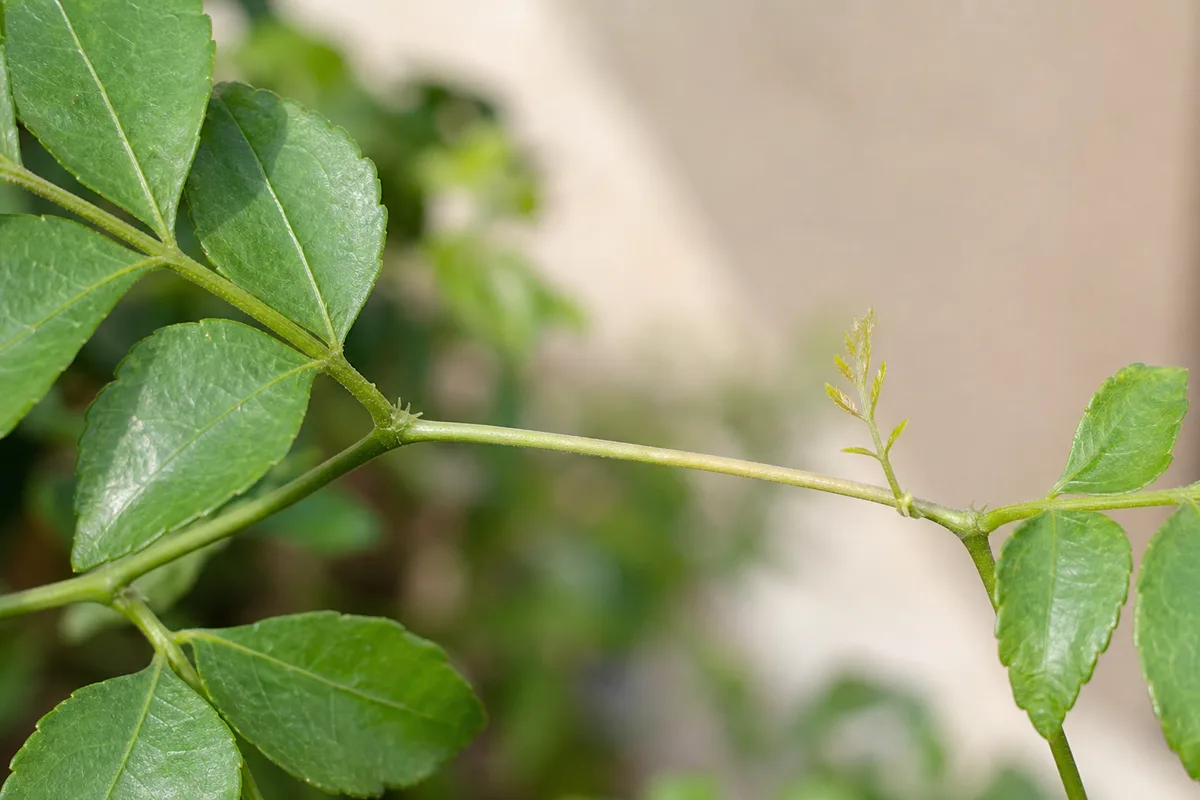
Elongated bare internode on a curry leaf stem - compare the wide gap between compound leaf pairs with tighter spacing on older sun-grown sections below.
Core stretch signs:
- Elongated internodes - etiolation produces elongated, spindly stems with gaps between compound leaf pairs on new stems widening to 2–5 cm or more while older sun-grown sections below may stay under 1 cm
- Lean toward the brightest source - the whole pot tilts or stems arch toward the light
- Small, pale new leaflets - fresh compound leaves lack the glossy dark green of sun-grown foliage
- Open, sparse canopy - weak stems flop outward instead of holding a tight harvest shape
- Muted aroma - crushed fresh leaves smell noticeably weaker than sun-fed growth; on a culinary tree, scent often drops before stretch looks dramatic
- Slow tip production - the young shoots you harvest arrive infrequently
Internode measurement: Run your finger along the newest upright stem. Count the gap between the base of one compound leaf and the next. If that gap is two to three times wider than compact growth lower on the same stem-and the plant leans toward glass-etiolation fits better than iron deficiency or underwatering on Curry Leaf Plant.
This differs from iron-deficiency yellowing (interveinal yellow on new leaves with green veins in alkaline soil), sunburn (crisp brown patches after sudden outdoor exposure), and overwatering collapse (sour wet soil with limp stems). See the lookalike table below for a full split.
Recovery snapshot: south-window Murraya after light and node pinch
A common indoor pattern: a grocery-store curry leaf arrives in a small pot already etiolated from nursery shade. By late February it sits on a north kitchen counter with internodes near 4 cm on the newest stem and a faint smell when leaves are crushed. After moving to a south windowsill in early March-without repotting or fertilizer-the first compact compound leaf opened three weeks later with internodes under 1 cm and noticeably sharper aroma on a fresh crush. In week five, stems were pinched 5–10 mm above outward-facing nodes; side shoots filled a bushier harvest silhouette by week eleven. The old 4 cm internode sections from February never shortened-only new branching and tighter spacing proved recovery.
Why Curry Leaf Plant gets leggy
Curry leaf evolved in bright tropical and subtropical forests in India and Sri Lanka. It is grown in full sun to part shade-but indoor “part shade” is still far brighter than a middle-of-room shelf. Light intensity drops sharply with distance from glass; north windows and winter short days commonly trigger stretch.
Why stretch hurts harvest quality more here than on ornamental foliage plants: You grow Murraya for compound leaves you pinch and cook, not for a single decorative silhouette. Long internodes mean fewer leaf pairs per stem length, weaker aroma per harvest, and a sparse center that is awkward to cut from. A leggy curry leaf plant can stay alive while becoming a poor kitchen crop.
Contributing factors beyond dim corners:
- Over-fertilizing in dim rooms can push weak elongated shoots the plant cannot support with dense foliage
- Natural upward tree habit without pinching produces a lanky silhouette even when light is borderline-see the pruning guide
- Leaf-only harvesting without node cuts removes foliage but leaves the terminal bud stretching upward
- Grocery-store single-stem format in a small pot often arrives already etiolated from nursery shade
How to confirm the cause
Work through these checks before repotting, fertilizing, or heavy pruning. Full window-direction and shadow-test detail lives in the not-enough-light guide.
- Internode comparison - measure gaps on the newest stem versus an older sun-grown section on the same plant; widening gaps on fresh tissue confirm stretch
- Aroma test - crush a fresh leaf from new growth and one from older lower foliage; weak scent on new tissue alongside visual stretch confirms stress beyond a single pale leaflet
- Direct sun hours - fewer than six hours of direct sun on leaves during active growth strongly points to legginess; plants lacking sufficient light develop long spaces between leaf nodes and lean toward the brightest source
- Pot moisture - soil staying wet for days in shade suggests low transpiration compounding the problem; see overwatering if saucers hold water
- Rule out iron yellowing - veins staying green on yellow new leaves points to soil pH, not etiolation alone; see yellow leaves
Two-week placement test: Move the pot to your brightest safe spot and change nothing else for fourteen days. Pass: the next compound leaves emerge with shorter internode gaps within two to three weeks. Fail: continued stretch means follow the light guide for placement and grow-light specs-do not pinch yet.
First fix for Curry Leaf Plant
Move the pot to the brightest location with direct sun and leave everything else alone for one to two weeks.
South or east windows with unobstructed glass are the usual indoor default. Acclimation from deep shade to harsh afternoon sun is covered in the not-enough-light guide-increase exposure gradually over seven to fourteen days if you move outdoors for summer. Do not fertilize until new growth shows tighter spacing and darker leaflets.
After light improves, pinch stretched stems just above a healthy node to encourage branching-details in the step-by-step recovery below and the pruning guide.
Grow-light setup when stretch continues after a window move
If internodes keep widening after two weeks at your brightest window-or each autumn when days shorten-add supplemental light rather than accepting pale, sparse winter growth. Full fixture specs and seasonal strategy are in the light guide; the essentials for a leggy plant:
- Fixture: Full-spectrum LED grow panel sized to the canopy footprint-not a decorative accent bulb
- Distance: Six to twelve inches above the top leaflets for small countertop trees; raise the fixture if leaflets feel hot or curl upward after hours under the lamp
- Wattage: 20–40 watt LED panels often suffice for 20–30 cm pots; larger specimens need proportionally wider coverage, not just a higher watt number on one corner
- Duration: Twelve to fourteen hours daily on a timer, combined with whatever natural window sun you have
- Cap: Keep total daily light under about sixteen hours when supplementing-plants need a dark period
- Adjust: Lower the fixture slightly if petioles still lean toward the bulb after one week; raise it if new leaflets bleach
Curry leaf sits in the high-light category alongside citrus and succulents in extension foot-candle tables-roughly the 500–1,000+ foot-candle zone at south-facing glass, not the 25–100 foot-candle zone suited to snake plants. A north window or a shelf six feet from glass rarely holds compact Murraya without supplementation.
Step-by-step recovery
Once the pot is in better light, follow this sequence. Pinching before light improves wastes the plant’s energy on weak shoots that will stretch again.
- Week 1 - Relocate only. Move to the brighter spot. Rotate the pot a quarter turn every few days so growth does not lean hard to one side. Hold off on fertilizer and hard pruning.
- Week 2 - Read new growth. Inspect the smallest new leaflets and stem spacing. Compact new foliage with gaps under about 1 cm means the fix is working. Continued wide gaps mean move closer to the window or add a grow light-do not pinch yet.
- Week 3 - Prune stretched material. Cut leggy stems back to just above a healthy leaf node with clean scissors-5 to 10 mm above the node where a compound leaf meets the stem, matching the pruning guide cut placement. Remove the top one-third to one-half of severely stretched shoots if lower nodes are still green and firm. Old stretched internodes will not compact on their own.
- Ongoing - Harvest and pinch lightly. Regular tip pinching during warm months keeps curry leaf dense and encourages fresh aromatic shoots. Take stem tips above nodes, not individual leaflets only, so side buds break below the cut.
- Winter - Supplement if stretch returns. If internodes widen each autumn, keep the plant at the brightest window or run a grow light through short-day months instead of accepting pale, sparse winter growth.
Do not jump the plant from a dim room to harsh all-day outdoor sun. Increase exposure gradually over seven to fourteen days if you move it outside for summer-protect from direct sunlight during hot weather so leaflets do not sunburn.
Recovery timeline
| Stage | Expectation |
|---|---|
| 1–2 weeks after light fix | New tips emerge; leaning slows; internode gaps on the freshest growth begin to shorten |
| 3–4 weeks | Leaflets larger, aroma stronger on new growth when crushed |
| After pinching (week 3+) | Side shoots fill a bushier harvest shape over 6–8 weeks |
| Old stretched stems | Remain long permanently unless pruned back-judge success by new growth, not old tissue |
| Failure signal | New growth still pale and widely spaced after four weeks in a clearly brighter spot-location is still too dim |
Lookalike symptoms and causes to rule out
Several other problems mimic leggy growth on curry leaf. Separating them prevents wrong fixes.
| What you see | More likely cause | Urgency | Where to go |
|---|---|---|---|
| Long stems, wide internodes, weak scent, window lean | Leggy growth / etiolation | Low - fixable over weeks | Stay on this page |
| Yellow new leaves with green veins | Iron deficiency / alkaline soil | Medium | Yellow leaves |
| Yellow lower leaves, wet soil for days, sour smell | Overwatering / root stress | High if wilting | Root rot · Overwatering |
| Wilting with wet soil in a dark room | Root rot overlap | High - inspect roots same week | Wilting · Root rot |
| Bleached or crispy patches on sun-facing leaflets | Sunburn after sudden move | Medium | Not enough light acclimation section |
| Sparse center but good light on south sill | Infrequent pruning / harvest | Low | Pruning guide |
| Little new growth despite bright window | Slow growth / dormancy / roots | Medium | Slow growth |
| Stippling and webbing on soft new shoots | Spider mites | Medium - isolate and treat | Spider mites |
| Clusters on tender tips | Aphids | Medium | Aphids |
Mistakes to avoid
Do not fertilize heavily in unchanged dim light-nutrients do not replace photons and can burn roots on a stressed plant. Do not repot hoping a bigger pot fixes stretch; more wet soil in the same dim spot often worsens growth. Do not increase watering because growth looks weak-dim plants drink less. Do not expect old stems to shrink without pruning. Do not pinch before light improves-you will get another round of weak, elongated shoots. Do not move straight into harsh midday sun to “fix” legginess quickly; unfiltered peak summer sun can scorch leaflets within days. Do not stake tall weak stems instead of correcting light and pruning back to nodes.
How to prevent leggy growth next time
Keep six or more hours of direct sun when possible per the light guide. Rotate weekly, pinch tips above nodes during warm months, and supplement with a grow light in winter. Match watering to how fast the pot dries in your actual light level per the watering guide-brighter light uses more water; dim corners need longer dry intervals.
Track new internode spacing monthly. Gaps staying under about 1 cm on fresh growth mean the spot still works. Widening gaps mean move the pot before the habit becomes woody and sparse.
When to worry
Pure stretch is gradual and fixable. Escalate quickly if you see:
- Wilting with wet soil and sour smell in a dark location - inspect roots for rot; this is more urgent than simple etiolation. See root rot.
- Pest coating on soft new growth - weak stretched tissue attracts aphids and spider mites; improve light, isolate, and treat pests after stabilizing placement.
- No tightening of internodes after four weeks in a clearly brighter spot - the location is still too dim; add grow-light intensity or duration per the light guide.
- Sudden widespread leaf drop after a drastic move - may be shock from a harsh environment change; stabilize light and avoid extra stress.
If the plant has been in deep shade for many months and is mostly bare stems with few leaflets, it may still recover with bright light and pruning-but restarting from a fresh cutting or root sucker is sometimes faster for harvest-focused growers.
Related curry leaf problems
- Overview - full care context for Murraya koenigii
- Not enough light - window placement, grow lights, iron lookalikes
- Light guide - sun hours and seasonal moves
- Pruning - node placement and harvest shape
- Watering - match drinks to light level
- Yellow leaves - iron deficiency vs stretch
- Root rot - when wilting meets wet soil in dim rooms
- Wilting - collapse patterns beyond stretch
- Slow growth - when light is adequate but shoots stall
- Aphids · Spider mites - pests on weak new tissue
Conclusion
Leggy curry leaf is etiolation-long internodes, pale leaflets, fading aroma, and window lean from too little direct sun-not a mystery disease. Move the pot to your brightest window first, confirm tighter new growth with the two-week placement test, then pinch stretched stems 5–10 mm above healthy nodes to rebuild a bushy harvest shape. Old elongated tissue will not shrink back; new compound leaves and stronger scent tell you the fix is working. Match watering to your light level, add a grow light when windows fall short, and use the related guides above when stretch overlaps rot, iron yellowing, or pests.
When to use this page vs other Curry Leaf Plant guides
- Curry Leaf Plant watering guide - Use for routine moisture checks before assuming leggy growth is the main issue.
- Curry Leaf Plant problems hub - Browse all 16 common issues on this species.
- Not Enough Light on Curry Leaf Plant - Different entry point when symptoms overlap with leggy growth.
- Slow Growth on Curry Leaf Plant - Different entry point when symptoms overlap with leggy growth.
- Yellow Leaves on Curry Leaf Plant - Different entry point when symptoms overlap with leggy growth.