Curry Leaf Plant Fertilizer (*Murraya koenigii*): When, How
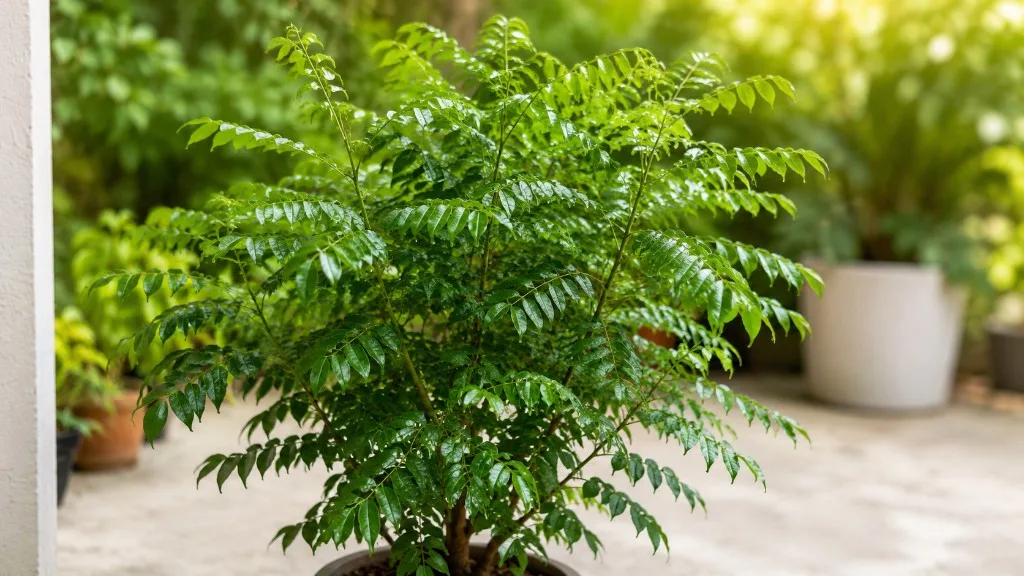
Curry Leaf Plant Fertilizer (*Murraya koenigii*): When, How & Mistakes
Curry Leaf Plant Fertilizer (*Murraya koenigii*): When, How & Mistakes
Every time you strip a handful of Murraya koenigii leaflets for tadka, you export nitrogen and trace minerals out of the pot - not into a compost pile where they might return, but into a frying pan. That is the central fact behind curry leaf plant fertilizer: this is a foliage crop grown for repeated harvest, not a slow ornamental you feed once and forget. Get the rhythm wrong and you get pale, sparse stems that stall after every prune. Get it right and you get reddish new shoots, deep green aromatic leaflets, and side branches that fill in within weeks of a hard trim.
The practical default for most home containers: balanced or slightly nitrogen-lean water-soluble fertilizer at half the label strength, applied every three to four weeks from mid-spring through early fall while the plant is actively growing, with no fertilizer from late fall through winter unless strong grow lights keep new leaves forming. Water onto moist soil only. Pair liquid feeding with modest compost, farmyard manure, or neem cake top-dressings when you prefer organic inputs - but treat those as slow soil builders, not a license to skip reading growth signals.
This guide is the dedicated feeding reference for curry leaf. For light intensity that drives nutrient use, see the curry leaf light guide. For dry-down timing that must align with feeding, see curry leaf watering. For harvest-linked pruning that triggers regrowth, see curry leaf pruning. For mix and pH that affect nutrient uptake, see curry leaf soil. The curry leaf overview covers the full care hub.
Why Harvesting Changes Your Feeding Schedule
Murraya koenigii belongs to Rutaceae - the citrus family - and behaves like a small tropical tree-shrub that wants to push leaves continuously when warmth, full sun, and water align. Kerala Agricultural University field guidance specifies roughly 150 g nitrogen, 25 g phosphorus, and 50 g potassium per plant per year, with extra nitrogen to enhance vegetative growth (KAU - Murraya koenigii). Tamil Nadu Agricultural University applies 20 kg of farmyard manure per plant after each harvest, mixed into the soil (TNAU - Curry Leaf). Field-scale numbers do not drop straight into a 25 cm terracotta pot, but the principle is identical: picking leaves removes nutrients the plant must replace.
Nutrients Lost With Every Tadka Pick
A balcony grower who harvests weekly through summer drains nitrogen faster than someone who picks occasionally for special dishes. Container mix holds a finite nutrient bank; watering leaches soluble fractions; harvest removes the rest. Under-fertilizing in peak harvest season shows up as slower regrowth after pruning, uniformly pale new leaflets, and smaller leaves than the previous flush - especially on plants in full sun that transpire heavily. Over-correcting with full-strength doses burns roots and leaves white salt crust on the rim - the dominant mistake on container curry leaf.
Named TNAU cultivars - Sen Kaampa, Dharwad-1, and Dharwad-2 - differ in yield and leaf quality in commercial plantings (TNAU - Curry Leaf), but home feeding logic stays the same: match frequency to harvest intensity and light, not to a generic houseplant calendar.
When to Fertilize: Active Growth, Taper, and Winter Pause
Feed when the curry leaf plant is actively producing new leaflets along reddish stems and extending side shoots after pruning. Stop when growth slows sharply - even if old leaves still look green. Outdoors in USDA Zones 10–12, that rhythm tracks warm weather and long days. In temperate climates where the plant moves indoors, heated rooms and supplemental light can extend the window, but most overwintering specimens still slow from late fall through early spring.
KAU notes that where minimum temperature drops below roughly 13°C (55°F), shoot growth is slightly affected (KAU - Murraya koenigii) - a useful signal that feeding should taper before you force nutrients onto roots that cannot use them.
Spring Through Early Autumn Active Growth
Start feeding when you see fresh growth at stem tips - new leaflets unfurling, side shoots filling in after a trim, roots active if you gently check the drainage hole. Outdoors in temperate climates, that usually means mid-spring through early autumn. During this window, half-strength balanced liquid every three to four weeks suits most containers. Fast growers in full sun on a hot balcony that you harvest weekly may need every two to three weeks at half strength; established in-ground shrubs in compost-rich beds may need only monthly liquid or organic top-dressing.
Winter Pause and Late-Fall Taper
Taper in early to mid-fall as day length drops. Give a final half-strength feed in early fall if new growth is still visible, then stop from late fall through winter for typical indoor setups. University of Maryland Extension lists excessive or frequent fertilizer as a primary cause of high soluble salts indoors, with brown leaf tips and marginal necrosis among the first symptoms (University of Maryland Extension - Fertilizer Toxicity). Winter feeding on a plant that is not using nutrients is how those salts accumulate.
Monthly Feeding Calendar for Temperate Climates
Use this table as a starting point - then adjust for your harvest rhythm, pot size, and light level.
| Month | Growth phase | Feeding guidance |
|---|---|---|
| March–April | Waking up, new shoots | Start half-strength liquid when active growth visible |
| May–August | Peak foliage production | Every 3–4 weeks; every 2–3 weeks if full sun + weekly harvest |
| September | Slowing slightly | Reduce to every 4–6 weeks or taper off |
| October | Wind-down | Final light feed if still growing, then pause |
| November–February | Low growth indoors | No fertilizer for typical setups |
A curry leaf on a sunny July patio that dries its pot every two days uses nutrients faster than one in a north-facing window. Watch new aromatic leaflets on reasonably spaced stems - that is your confirmation the schedule fits.
Best Fertilizer Types: Balanced NPK, Organics, and Neem Cake
The best curry leaf plant fertilizer for most homes is a complete, water-soluble, balanced or slightly nitrogen-lean formula with adequate nitrogen for repeated leaf production, moderate phosphorus for root function, and potassium for overall vigor. Micronutrients on the label - iron, magnesium, manganese - matter because pale new growth on well-watered plants sometimes traces to trace-element gaps, especially if soil pH drifts alkaline.
Avoid shopping by the word “curry leaf” on the bottle unless you trust the brand’s dosing guidance. A standard balanced indoor or all-purpose garden formula used conservatively outperforms most specialty products at full label strength.
Balanced Liquids and NPK Ratios
10-10-10 or 20-20-20 water-soluble fertilizer diluted to half strength is the default across horticultural sources for curry leaf. Equal ratios keep feeding simple when your main goal is steady foliage, not flowers or fruit - though mature plants may produce small black berries secondary to leaf harvest. Some references prefer a slightly nitrogen-leaning ratio such as 6-2-4 or 8-2-4 for rapid leaf recovery after heavy picking. IAFT notes that nitrogenous fertilizers are applied in greater quantities to enhance vegetative growth in commercial plantings (IAFT - Curry Leaves) - at home that means balanced or foliage-weighted formulas, not bloom boosters.
Organic liquids - fish emulsion, compost tea, seaweed extract - work at half strength or weaker. Fish emulsion smells indoors and can attract fungus gnats if over-applied on constantly damp soil; use it on a patio or near an open window, dilute well, and apply only when the root zone is moist but not soggy. Logee’s recommends top-dressing with organic fertilizer every six weeks or applying liquid at half the recommended dosage once a week during the active growing season (Logee’s - Curry Leaf Plant).
Neem Cake, Compost, and What to Skip
Neem cake supplies slow-release nitrogen and doubles as a mild soil amendment. IAFT recommends 1–2 kg of neem cake per plant per year for in-ground culture to help control soil-borne pests (IAFT - Curry Leaves). For containers, scale down: roughly 10–30 g top-dressed into the top 2–3 cm of mix once or twice per warm season, or 200–500 g split across warm months for established in-ground shrubs - always worked lightly into the surface, never piled against the stem. Neem cake is not a complete substitute during heavy harvest; pair it with compost or occasional half-strength liquid NPK.
Compost or farmyard manure at repotting or as a spring top layer builds long-term fertility the way TNAU and KAU field protocols recommend. Logee’s and IAFT both describe slightly acidic, well-drained soil as ideal (Logee’s - Curry Leaf Plant; IAFT - Curry Leaves). Skip slow-release granules in small indoor pots, foliar feeding, fertilizer-pesticide combos, and high-phosphorus bloom boosters - this is a foliage crop, and excess phosphorus adds salt without improving leaf production.
How Much and How Often: Conservative vs. Aggressive Schedules
If you remember one number, make it half strength - never full label strength on a container-grown curry leaf unless you have experience flushing salts regularly. Houseplant labels assume a range of species and pot sizes. Curry leaf sits in the moderate feeder category - hungrier than succulents, less salt-tolerant than a tomato in a large outdoor planter, but still vulnerable in small pots with moist soil.
Example: if the bottle says 1 tablespoon per gallon for outdoor vegetables, use 1½ teaspoons per gallon (half strength) for container curry leaf on a three- to four-week schedule. If it says 1 teaspoon per gallon for houseplants, use ½ teaspoon per gallon. Measure with a spoon or syringe - eyeballing concentrates errors because different products use different scoops.
Logee’s Weekly vs. Home Grower 3–4 Week Default
Logee’s - a long-established nursery grower - recommends liquid fertilizer at half the recommended dosage once a week during the active growing season, or organic top-dress every six weeks (Logee’s - Curry Leaf Plant). That weekly cadence suits plants in bright greenhouses with strong light, warm temperatures, and active harvest. Most home growers in moderate indoor light, smaller pots, and hard tap water do better starting every three to four weeks at half strength and only moving toward biweekly or weekly feeding if the plant keeps pushing deep green new leaves with no salt crust.
| Your setup | Suggested interval | Strength | Rationale |
|---|---|---|---|
| Full sun patio, weekly harvest, warm room | Every 1–2 weeks | Half label | Matches Logee’s nursery cadence |
| Bright window or grow light, regular harvest | Every 2–3 weeks | Half label | Active but not greenhouse intensity |
| Moderate light, occasional picking | Every 3–4 weeks | Half label | Conservative home default |
| Rich mix + neem cake or spring compost top-dress | Every 4–6 weeks | Half label | Slow organics already in soil |
| Winter indoors, low light | Skip | - | Prevent salt buildup |
| Winter under grow lights, continuous new shoots | Every 6–8 weeks | Half label | Exception only with proof of growth |
When in doubt, less is more. Curry leaf tolerates a skipped month far better than a double dose after pale leaves.
Step-by-Step Safe Feeding Routine
Safe feeding is mostly about order of operations. The fertilizer brand matters less than whether the soil was moist first, whether the plant was stressed, and whether salts were already accumulating.
- Check the calendar and the plant. Confirm active growth - new leaflets or side shoots. If it is winter and nothing is growing, stop here.
- Inspect for salt crust or tip burn. White residue on the soil or pot rim means skip feeding and flush instead.
- Water with plain water if the top layer feels dry. Bring the root zone to evenly moist before any fertilizer touches it. Never pour fertilizer onto dry soil.
- Mix fertilizer at half strength in room-temperature water in a watering can with a narrow spout.
- Apply slowly and evenly across the soil surface, directing solution away from the stem base. Stop when a little water drains from the bottom.
- Discard drainage from the saucer within 30 minutes.
- Mark the date on a calendar or plant note so you do not double-feed in an enthusiastic week.
Morning feeding after the plant has hydrated is common practice because roots are active and any splashed foliage has the day to dry - though the moist-soil rule matters more than the clock.
Pre-Feed Checks and the Moist-Soil Rule
Before every feed, run a quick three-point check: soil moisture, newest leaf color, and season. Check soil moisture first - water with plain water if dry, then feed the next day. If the mix is wet, wait. Pale or dropping new leaves usually mean light or water problems, not hunger. Feed only during active growth; off-season feeding reliably causes tip burn.
Signs of Deficiency vs. Over-Fertilizing and Salt Burn
Under-fertilizing is real but less common than over-fertilizing on container curry leaf, especially when plants start in nutrient-enriched potting mix with compost blended in. Most “hungry” diagnoses are actually low light, inconsistent watering, root rot on Curry Leaf Plant from poor drainage, or natural stress after transplanting.
True deficiency shows gradually on new growth: slower leaf production in peak season, uniformly pale new leaflets, smaller leaves than the previous generation, or weak recovery after harvest. Lower-leaf yellowing with healthy new growth usually means senescence or water stress, not hunger. Increase frequency at half strength - never double the dose overnight.
Over-fertilizing is the dominant fertilizer problem. Watch for brown crispy tips (especially after feeding), white salt crust on soil or pot rims, sudden wilt or leaf drop despite moist soil, burnt edges on new leaflets, and stalled growth after feeding. High soluble salts cause osmotic stress - burn looks like drought even when soil is wet (University of Maryland Extension - Fertilizer Toxicity). Hard water plus fertilizer doubles the mineral load; flush containers every six to eight weeks during active feeding as a preventive habit.
How to Flush After Over-Feeding
If you suspect burn, stop fertilizing immediately and leach the soil.
- Move the pot to a sink, tub, or outdoor spot where copious drainage is acceptable.
- Water slowly with plain room-temperature water until water runs freely from the drainage holes. Let it drain completely.
- Repeat two to three times over 30–60 minutes, allowing full drainage between passes. UMD recommends irrigating with clear water at a volume at least that of the pot size (University of Maryland Extension - Fertilizer Toxicity).
- Pause all feeding for 4–6 weeks while you monitor new growth.
- Resume at half strength only when new leaves emerge without burnt margins and salt crust is gone.
Badly burned leaves will not green up again - judge recovery by new growth, not old damage. In-ground curry leaf often recovers faster because rain and irrigation leach salts naturally.
After Repotting, Pruning, and Heavy Harvest
Wait three to four weeks after repotting into fresh mix before the first liquid feed - the new soil already carries nutrients. Hold food after drought, cold below roughly 10°C (50°F), pests, or injury until stable new growth appears. After heavy harvest or hard pruning, stay on your normal half-strength schedule - do not double the dose to “push” regrowth. Containers need more frequent, lighter feeds; in-ground trees in compost-rich soil often need only organic top-dressing and occasional summer liquid. Cuttings and seedlings need no fertilizer until roots establish; then use quarter to half strength at wide intervals.
KAU notes that leaves from plants sprayed with dimethoate should be harvested only after 10 days (KAU - Murraya koenigii) - relevant if you combine pest sprays with feeding season.
Winter Chlorosis, Leaf Drop, and Grow-Light Exceptions
Logee’s describes interveinal yellowing (chlorosis) on leaves during winter, often linked to cool temperatures and a shift toward dormancy (Logee’s - Curry Leaf Plant). That yellowing is not a signal to feed more - it is a signal that the plant is slowing down. Increasing fertilizer on chlorotic winter leaves stacks salts while roots are idle. If you can raise temperatures and add supplemental light, you may slow or prevent dormancy; if the plant drops leaves and stands as a bare stem, cut back on watering and wait for spring - the leaves will regrow when days lengthen (Logee’s - Curry Leaf Plant).
Exception: if you grow under strong grow lights in a warm room and the plant keeps producing new shoots all winter, feed lightly at half strength every six to eight weeks and watch closely for salt crust. Even then, skipping winter feeds is safer than forcing growth with nutrients the roots cannot process.
Common Curry Leaf Plant Fertilizer Mistakes
The failures that show up most often are predictable: full label strength in containers, feeding at every watering that stacks salts, dry-soil application that burns roots, winter feeding on a plant showing chlorosis or leaf drop, ignoring white salt crust, feeding stressed or newly repotted plants, relying on neem cake alone during heavy harvest without balanced liquid supplement, using bloom booster or high-phosphorus feeds that do not match a foliage crop’s needs, and adding more fertilizer when pale leaves actually mean too little light or too much water. Remember that curry leaf is not curry powder - the leaves are the crop; berries are secondary. A curry leaf in rich garden soil and a windowsill pot in lean mix are not the same - match the schedule to the root zone, the season, and how aggressively you harvest.
Conclusion
The feeding rhythm that keeps Murraya koenigii producing cook-worthy leaves is tied to harvest, not to a wall calendar. Pick often in full sun and you earn the right to feed more often at half strength - perhaps approaching Logee’s weekly nursery cadence. Pick occasionally from a moderate-light windowsill and the safer default is every three to four weeks with a winter pause, salt flushes when crust appears, and neem cake or compost as slow backup rather than the whole program. Align fertilizer with light, water, and soil drainage first; nutrients only work when those three are already in range. When new shoots emerge glossy and aromatic after a trim, your harvest-linked feeding plan is doing its job.
When to use this page vs other Curry Leaf Plant guides
- Curry Leaf Plant overview - Start here for whole-plant context before deep-diving this topic.
- Curry Leaf Plant problems hub - Jump to symptom-specific fix guides when this care topic does not resolve the issue.