Begonia Maculata Care: Light, Water, Soil, and More
Begonia maculata
Begonia maculata needs bright indirect light, watering every 7–10 days (top 3 cm dry between waterings), 60–80% humidity, and monthly feeding during the growing season.
Begonia Maculata Care: Light, Water, Soil, and More
Start with wateringThe most common care mistake for Begonia MaculataWatering guide → →Begonia Maculata care essentials
Light
bright indirect light
Water
Every 7–10 days summer (top 3 cm dry). Every 10–14 days winter. Room-temperature water. Never wet the leaves.
Soil
Light, well-draining potting mix with 20% perlite. pH 6.0–7.0.
Humidity
45–60%
Temperature
18–27°C (65–80°F)
Fertilizer
Use balanced liquid fertilizer at half strength and stop if the plant is stressed, newly repotted, or not actively growing.
About Begonia Maculata
Begonia Maculata is native to Southeast Brazil, typically reaches 60–150 cm tall indoors indoors, with fast during growing season growth. Begonia Maculata has a upright growth habit and part of the Begoniaceae family. It is also known as Polka Dot Begonia, Trout Begonia, and Spotted Begonia.
| Detail | Information |
|---|---|
| Also known as | Polka Dot Begonia, Trout Begonia, Spotted Begonia |
| Native region | Southeast Brazil |
| Mature size | 60–150 cm tall indoors |
| Growth rate | Fast during growing season |
| Growth habit | Upright |
| Scientific name | Begonia maculata |
| Family | Begoniaceae |
Begonia Maculata Care: Light, Water, Soil, and More
What Polka Dot Begonia Actually Is
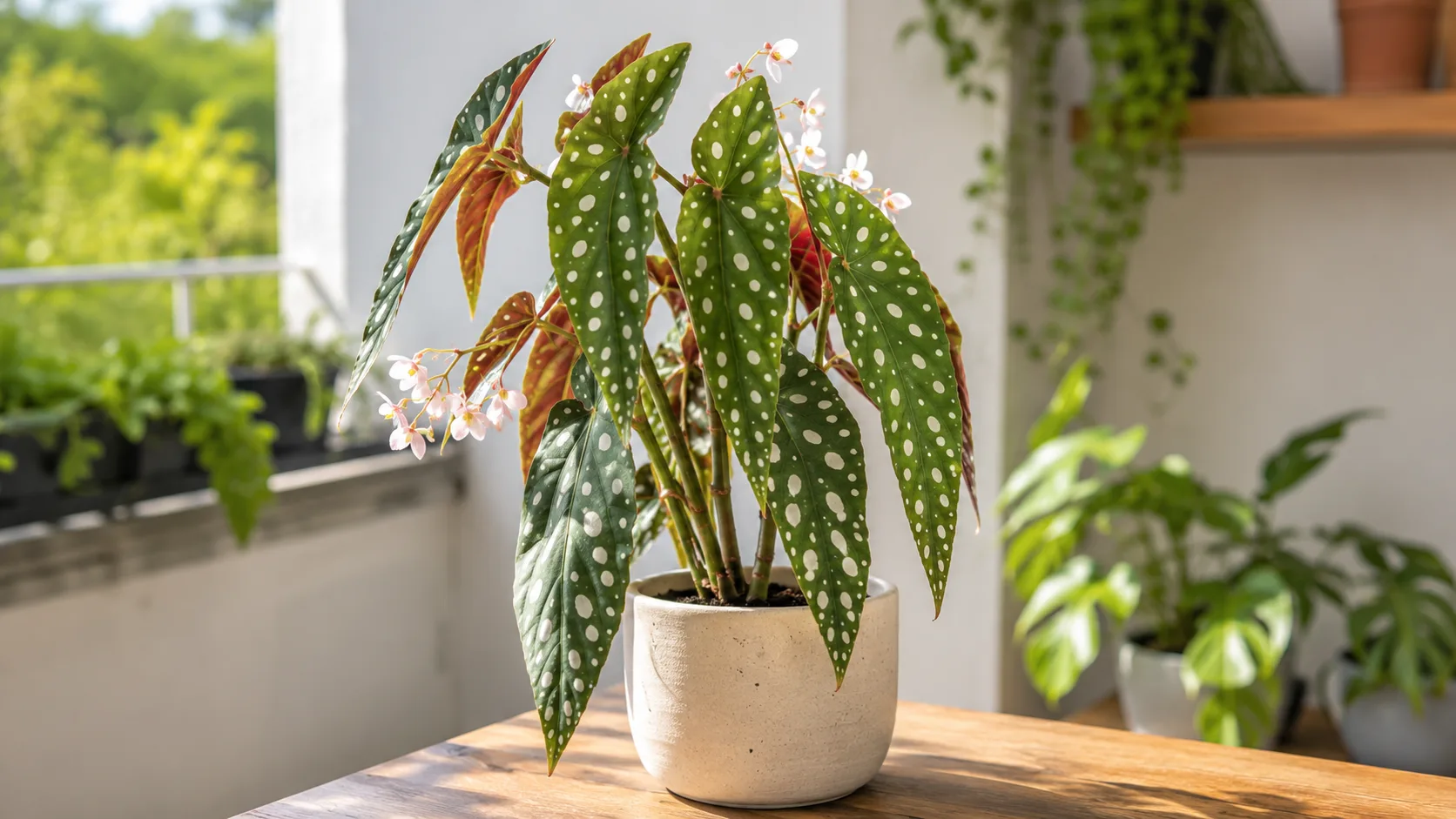
Begonia maculata is a cane-stemmed tropical begonia prized for wing-shaped leaves painted with silver polka dots on deep green, with reddish undersides that flash when the stems move. It is sold under common names including polka dot begonia, spotted begonia, and often grouped with angel wing begonias, though that label covers several cane types rather than one single species. The accepted botanical name is Begonia maculata Raddi, and it belongs to the family Begoniaceae, a group whose members share fibrous roots, sensitivity to wet crowns, and a strong preference for warm, humid, filtered-light conditions.
The plant’s native home is the tropical rainforests of Brazil, where it grows as an understory perennial beneath a bright but shaded canopy. That origin is the single most useful fact for indoor care. In commerce, Begonia maculata is often marketed as an easy statement plant because it grows quickly and looks dramatic on a shelf. In practice, it is less forgiving than a pothos or snake plant because it evolved for steady warmth, filtered light, and consistent humidity rather than the dry, drafty, irregular conditions many homes provide. Understanding that mismatch explains most of the complaints you see online: leaf drop after a move, crispy edges in winter, rot after one heavy watering, or a leggy stem reaching toward a dim corner.
Indoors, a healthy specimen typically reaches 12–24 inches (30–60 cm) tall and wide in the first year or two, though mature plants in bright, humid conditions can push toward 3–5 feet (90–150 cm) over time. Growth is fast during the warm, bright months and noticeably slower when light and temperature drop. The upright cane habit means the plant often becomes top-heavy unless you prune, stake, or rotate it regularly. White or pale pink flower clusters may appear in spring and summer when conditions are right, though many growers value the foliage far more than the blooms.
Cane Begonias and the Angel Wing Connection
Cane begonias are defined by their bamboo-like stems and asymmetric, wing-shaped leaves rather than by a single species name. Begonia maculata is one of the most popular cane types sold as a houseplant, alongside cultivars such as Begonia ‘Lucerna’ and various spotted hybrids labeled “angel wing.” Retail tags often blur these names, which matters because different cane begonias can have slightly different tolerances for light and dryness even though the core care pattern is similar.
What cane begonias share is a propagation method: stem cuttings, not leaf sections. Rex and rhizomatous begonias can be propagated from leaf pieces, but cane types root from stem segments with intact nodes. They also share a vulnerability pattern. Problems usually start at the roots or at the leaf surface when humidity, airflow, and moisture get out of balance. If your plant came without a botanical tag, treat it as a cane begonia and follow cane rules: airy soil, even moisture, no wet leaves, Begonia Maculata light guide, and stem-cuttings-only propagation.
Begonia Maculata at a Glance
A quick reference card for the plant, in plain English:
- Botanical name: Begonia maculata Raddi
- Common names: Polka dot begonia, spotted begonia, angel wing begonia (informal group name)
- Family: Begoniaceae
- Type: Evergreen perennial; upright cane stems with wing-shaped, spotted foliage
- Native range: Tropical rainforests of Brazil
- Mature size indoors: Typically 12–24 inches (30–60 cm) tall and wide; can grow taller with age and good conditions
- Light: Bright indirect light; avoid harsh direct sun on unacclimated leaves
- Water: Keep evenly moist during active growth; let the top inch of mix dry slightly between waterings; reduce in winter
- Soil: Light, well-draining potting mix with added perlite; target pH roughly 6.0–7.0
- Humidity: Prefers 50% or higher; tolerates average home humidity with careful watering and airflow
- Temperature: Comfortable at 65–75 °F (18–24 °C); avoid sustained exposure below 60 °F (15 °C) and hot drafts
- Toxicity to pets: Toxic to dogs and cats (ASPCA lists Begonia spp.); soluble calcium oxalates
- Propagation: Stem cuttings in water or airy soil; best in spring and early summer
Light: Bright Indirect Without Scorching Sun
Begonia maculata needs bright, indirect light to keep its spots crisp, its stems compact, and its growth steady. In its native rainforest, the plant receives strong ambient light filtered through canopy leaves, not the amplified direct beam that hits a south-facing windowsill. Indoors, that translates to a spot where the plant clearly “sees” the sky but does not sit in hot afternoon sun passing through glass.
BBC Gardeners’ World recommends a warm, bright position a couple of feet from an east- or west-facing window as an ideal starting point, with protection from direct sun that can scorch foliage. Too little light produces a familiar cascade of problems: elongated internodes, smaller new leaves, faded spotting, and a plant that stays wet too long because it is not using water at the pace its potting mix expects. Too much direct light shows up as bleached patches, brown scorched areas on sun-facing leaves, or curling during the brightest hours of the day.
A practical test beats guessing by room brightness. Look at the newest leaf or stem segment after the plant has been in a spot for two to three weeks. Healthy new growth should be firm, well-spotted, and proportionate to older leaves. Stretching, pale green growth, or leaves that lean sharply toward the window mean the plant wants more light. Sudden bleaching after a move means it wants less, or needs gradual acclimation over seven to ten days.
Best Window Placement and Grow Lights
East-facing windows are often the easiest win for polka dot begonia because the plant gets gentle direct morning sun followed by bright indirect light the rest of the day. North-facing windows can work if the view is open and the plant sits close enough to receive real daylight, but growth will be slower and watering intervals must shrink accordingly. West- and south-facing windows are usable with sheer curtains, a few feet of distance from the glass, or placement where trees or buildings filter the afternoon beam.
If your home lacks a suitable window, a full-spectrum grow light on a 10–12 hour timer, positioned roughly 12–18 inches above the canopy, can keep the plant compact through dark months. Watch leaf temperature near the fixture; begonias dislike heat stress as much as they dislike dim corners. Rotate the pot a quarter turn every week or two so the cane does not lean permanently toward the light source.
Watering: Even Moisture, Never Soggy Roots
Watering is the line between a thriving polka dot begonia and a plant that drops half its leaves after one bad week. Begonia maculata prefers consistent moisture during active growth, not the soak-and-dry cycle of a succulent and not the permanently damp conditions of a true bog plant. The practical rule most credible guides converge on: water when the top inch (2.5 cm) of potting mix feels dry, then water thoroughly until a small amount runs from the drainage hole. (Gardenia.net)
Use your finger, a wooden chopstick, or a moisture meter to check the root zone before every watering. If the deeper mix still feels damp, wait. If the top inch is dry and the pot feels lighter than it did after the last watering, it is time to water. Always empty the saucer within fifteen minutes so the roots are not sitting in runoff. Begonias are prone to root rot on Begonia Maculata when the mix stays saturated for days, especially in cooler, dimmer conditions when the plant is using water slowly.
Room-temperature water is preferable to cold tap water straight from the pipe, which can shock warm roots. Water at the soil surface rather than showering the foliage when you can; wet leaves combined with stagnant air invite fungal issues such as powdery mildew and leaf spot. BBC Gardeners’ World explicitly advises avoiding misting the leaves directly and avoiding splashing foliage during watering for this reason. (BBC Gardeners’ World)
Seasonal Watering Adjustments
The same Begonia Maculata watering guide that works in July will overwater the plant in January. During spring and summer, when light is strong and the plant is pushing new cane segments quickly, expect to water roughly every 7–10 days in a typical indoor pot, though your actual interval depends on pot size, soil composition, humidity, and how close the plant sits to a window. During fall and winter, growth slows, days shorten, and the mix stays wet longer. Stretch the interval toward every 10–14 days or longer, and let the top inch dry more reliably before watering again.
| Season | Plant state | Approximate interval | What to check before watering |
|---|---|---|---|
| Spring (active growth) | New leaves and cane segments emerging | Every 7–10 days | Top inch dry; pot feels lighter |
| Summer (peak growth) | Fast upright growth; may need staking | Every 7–10 days, sometimes more in hot rooms | Same; watch for wilting in extreme heat |
| Fall (slowing) | Growth tapering; light dropping | Every 10–14 days | Top inch dry; reduce if nights cool |
| Winter (slow growth) | Minimal new growth; lower light | Every 10–14+ days | Top inch dry; never water on autopilot |
These are starting points, not calendar commandments. A plant under a grow light in a warm room may drink on a summer rhythm all year. A plant in a cool north window may need winter spacing even in March. Let the pot and the newest growth tell you when to adjust.
Soil and Drainage for Fibrous Roots
Begonia maculata has fibrous roots that need oxygen as much as moisture. Heavy, peat-compacted indoor mixes that stay wet for days are the most common substrate mistake. The goal is a light, well-draining potting mix that holds moisture briefly, drains freely, and retains enough structure to avoid collapsing into a dense block after a few months.
A reliable home recipe is standard peat- or coco-based potting mix amended with roughly 20–30% perlite by volume. Some growers add a small amount of vermiculite or orchid bark for additional air space. Gardenia.net notes that mixes suitable for African violets, typically containing peat, perlite, and vermiculite, work well because they maintain the slightly acidic to neutral conditions begonias prefer. (Gardenia.net) Target pH roughly 6.0–7.0; in a hobbyist setup, a quality indoor mix usually sits close enough that pH adjustment is unnecessary.
Every pot must have a drainage hole. Decorative cache pots without drainage are a fast path to root rot unless you are extremely disciplined about lifting the inner pot to water and drain. Refresh the mix every one to two years during Begonia Maculata repotting guide, because even good components break down, compact, and hold water longer over time. If water runs straight through the pot without soaking in, or the mix smells sour, replace it regardless of the calendar.
Humidity and Temperature in a Home
Because Begonia maculata evolved in a humid rainforest understory, it performs best with moderate humidity and stable indoor temperatures. Many homes sit at 30–40% in heated or air-conditioned seasons, which is workable but explains why leaf edges crisp, new growth stalls, or spider mites appear in winter. A humidifier near the plant is the most reliable fix. Pebble trays and grouping plants raise humidity modestly in the immediate vicinity, as cane begonias do when stood on gravel trays. Bright bathrooms and kitchens can work if they also provide adequate light, which is the limiting factor more often than humidity in those rooms.
Misting is a poor substitute. The moisture evaporates within minutes, and repeated wetting of leaf surfaces increases fungal risk. BBC Gardeners’ World recommends improving humidity through room placement or pebble trays while avoiding direct leaf misting. (BBC Gardeners’ World) If you must raise humidity quickly after a leaf-tip crisis, prioritize a humidifier over a spray bottle.
Temperature stability matters as much as humidity. Ideal range is 65–75 °F (18–24 °C) during the day. Sustained exposure below 60 °F (15 °C) stresses the plant and can trigger leaf drop. Hot air from radiators, fireplace heat, or direct AC vents causes rapid desiccation and uneven moisture use. Keep the plant out of the path of drafts from frequently opened doors, especially in winter when cold air hits warm foliage within seconds.
Fertilizer During Active Growth
Begonia maculata is a moderate feeder, not a heavy one. During spring and summer, when new cane segments and leaves are appearing regularly, a balanced water-soluble houseplant fertilizer at half the label strength, applied once every four weeks, is enough for most indoor plants. BBC Gardeners’ World recommends monthly feeding with a balanced fertilizer through spring and summer. (BBC Gardeners’ World)
Apply fertilizer to already-moist soil so the solution distributes through the root zone without burning dry roots. If your potting mix includes a starter fertilizer charge, skip supplemental feeding for the first month after repotting. Pause feeding entirely in late fall and winter, after repotting, during pest recovery, and whenever the plant is dropping leaves or showing root stress. Feeding a plant that cannot use nutrients adds salt to the mix and can worsen leaf-tip burn, especially in dry air or with hard tap water.
If leaf tips brown despite good watering and humidity, flush the pot with plain water until runoff runs clear, let it drain fully, then resume a lighter feeding schedule. Salt buildup from fertilizer and mineral-rich water is a common secondary cause of crispy margins on begonias.
Pruning and Staking for Bushy Shape
Left alone, Begonia maculata grows upward on cane stems that can become leggy or top-heavy. Pinching or pruning the growing tips in late spring and summer encourages branching and a bushier silhouette. Use clean, sharp scissors or pruning shears, cutting just above a leaf node. The American Begonia Society notes that dormant growth points at nodes are where new stems emerge after pruning, which is why cuts should be precise rather than torn. (American Begonia Society)
Staking becomes useful when stems lean or the root ball is still small relative to the top growth. A discreet bamboo stake and soft plant ties support the cane without crushing the stem. Rotate the pot weekly so growth stays balanced rather than permanently leaning toward the window. Avoid heavy pruning in the darkest winter months when recovery is slow; light tip pinching is fine, but removing large sections of active cane during low-light periods can stall the plant for weeks.
Save healthy pruned sections for propagation rather than discarding them. A pruning cut and a propagation cutting are the same tool on cane begonias, which makes maintenance and plant multiplication efficient once you know the method.
Repotting Without Shock
Most Begonia maculata plants need repotting roughly once a year to every two years, or whenever roots circle the drainage holes, the pot dries out within a day of watering, or water runs straight through without absorbing. The best timing is early to mid-spring, as active growth resumes and the plant can rebuild its root system quickly in warm, bright conditions.
Move up only one pot size at a time, typically 1–2 inches (2.5–5 cm) wider in diameter. Oversized pots hold excess wet mix that fibrous roots cannot use, and that unused volume is where rot starts. Use fresh, airy mix, maintain the same planting depth, and water lightly for the first week after repotting so any broken roots can heal without sitting in saturated substrate. Hold off on fertilizer until you see confident new growth.
If the plant is healthy but the mix has compacted, you can sometimes refresh the substrate by slipping the root ball out, removing the bottom third of old mix, and repotting into the same container with fresh soil. That is gentler than a full root disturbance and solves many slow-draining pots without forcing the plant into a larger wet zone.
Propagation by Stem Cuttings
The reliable home propagation method for Begonia maculata is stem cuttings, not leaf sections. Cane begonias root from stem segments with healthy nodes, and the American Begonia Society emphasizes cutting just below a node that has not previously produced a flower, because bloom-scarred nodes may not generate new growth reliably. (American Begonia Society)
The standard workflow:
- Choose a healthy stem with firm leaves and no pest damage. Spring and early summer cuttings root fastest.
- Cut a 4–6 inch (10–15 cm) section just below a healthy node using sterilized scissors or pruners.
- Remove the lower leaves so one or two nodes are bare and can contact the rooting medium.
- Root in water or airy soil (details below). Keep the cutting in bright indirect light and warm conditions around 65–75 °F (18–24 °C).
- Wait for roots. Cane begonias often root in 2–4 weeks in warm, bright conditions. Gentle resistance when you tug the stem suggests roots have formed.
- Pot up into the standard well-draining mix once roots are roughly ½ inch (1 cm) long if started in water, or once new leaf growth appears if started in soil.
Work with a well-hydrated parent plant, but avoid propagating from stressed, wilted, or pest-infested stems. Cuttings inherit the parent’s condition, and weak material fails at a much higher rate.
Water Propagation vs Soil Propagation
Water propagation is visually satisfying: place the bare node in a clear jar of room-temperature water, change the water every few days, and watch roots form. Pot into airy mix once roots reach about ½ inch (1 cm); waiting until roots are several inches long makes transplanting harder because water roots are fragile. Keep the transition humid and avoid direct sun on the new plant for the first week.
Soil propagation skips the jar step. Insert the cutting into a lightly moist mix heavy on perlite, cover loosely with a clear bag or propagator to raise humidity, and ventilate daily to prevent mold. Soil propagation can be slower to observe but produces roots adapted to substrate from the start, which some growers prefer for long-term stability.
Both methods work. Choose based on your patience and how much humidity control you can provide. Either way, avoid soggy conditions; the fastest way to lose a begonia cutting is a waterlogged or cold rooting zone.
Flowers and Blooming Indoors
When conditions align, Begonia maculata produces hanging clusters of small white or pale pink flowers with yellow centers, usually in late spring through summer. Blooms are a sign that light, moisture, humidity, and nutrition are balanced enough for the plant to spend energy on reproduction. Many indoor specimens flower modestly or intermittently, and that is normal rather than a failure.
You do not need to deadhead aggressively for plant health, though removing spent flower clusters keeps the display tidy. If you want more flowers, prioritize bright indirect light, consistent moisture, monthly half-strength feeding in summer, and humidity above 50%. If the plant never blooms but foliage looks excellent, consider that a win; the polka dot leaves are the main reason most people buy it.
Avoid letting flower stems dominate pruning decisions if your goal is a fuller plant. Flowers emerge from specific nodes, and repeatedly cutting bloom-scarred sections for propagation can reduce the nodes available for new cane growth. Balance ornamental blooms with structural pruning based on the shape you want.
Common Problems and How to Diagnose Them
Most Begonia maculata problems are environmental rather than mysterious. The plant telegraphs stress on its leaves and stems weeks before the roots fail completely, which gives you time to correct course if you read the signals accurately.
Yellow leaves usually trace to one of several causes: overwatering on Begonia Maculata and early root stress, underwatering on Begonia Maculata, sudden light change after a move, cold draft exposure, natural aging of lower leaves, or pest damage. Check moisture first, then light and temperature, then inspect leaf undersides and stem joints before changing your entire routine.
Brown patches on leaves often indicate sun scorch if they appear on the side facing the window, especially after a sudden move to a brighter spot. Crispy brown leaf edges more often point to low humidity, underwatering, or salt buildup from fertilizer and hard water. Flush the pot and review humidity before assuming the plant needs more water.
Wilting with wet soil is a red flag for root rot or damaged roots, not a call for more water. Unpot, inspect roots (healthy roots are pale and firm; rotted roots are dark and mushy), trim damage with sterilized tools, repot into fresh airy mix, and water sparingly until new growth resumes.
Powdery mildew shows as white powder on leaf surfaces, often when humidity is high but airflow is poor. Remove affected leaves, improve air circulation, avoid wetting foliage, and reduce excessive feeding. Severe cases may need a fungicide labeled for ornamental plants; follow the product label exactly.
Leaf drop after purchase or repotting is common. The plant is reacting to changed light, humidity, or root disturbance. Stabilize conditions, avoid further moves, and wait two to four weeks before making dramatic changes unless rot is present.
Pests: Spider Mites, Mealybugs, and Fungus Gnats
Spider mites thrive in dry air and appear as fine webbing on leaf undersides with stippled, dull foliage. Raise humidity, rinse foliage gently in the shower, and treat with insecticidal soap if populations persist. Mealybugs look like white cotton tufts in leaf axils and stem joints; dab them with 70% isopropyl alcohol on a cotton swab and follow up weekly until clear. Scale appears as immobile brown bumps on stems; scrape gently and treat similarly.
Fungus gnats are usually a symptom of overly wet surface soil, not a primary attack on healthy roots. Let the top inch dry more reliably, avoid organic mulch on the surface, and use sticky traps for adults while correcting the watering rhythm. Persistent gnats in an otherwise healthy plant often mean the mix is staying too wet too long.
Inspect weekly. Catching pests early on begonias is far easier than rescuing a plant after mites or mealybugs have spread through every cane segment.
Pet Safety: Toxicity You Cannot Ignore
Begonia maculata is not safe for households with cats or dogs that chew plants. The ASPCA lists Begonia species as toxic to dogs and cats, with soluble calcium oxalates as the toxic principle. Clinical signs in pets include vomiting and salivation; the ASPCA notes the most toxic parts are underground, though foliage and stems still carry oxalates and can cause oral irritation if chewed. (ASPCA)
This is not a plant to treat as “probably fine” because a cat ignored your pothos. Oxalate crystals irritate mouth and gastrointestinal tissues on contact. Keep the plant on a high shelf, in a closed room, or behind a physical barrier the pet cannot bypass. Hanging baskets help only if the trailing stems stay out of reach.
If you suspect ingestion, contact your veterinarian or the ASPCA Animal Poison Control Center at (888) 426-4435 (a consultation fee may apply). Do not wait for severe symptoms to appear before asking for guidance. For pet-safe dramatic foliage, look to genuinely non-toxic alternatives confirmed through current ASPCA listings rather than informal blog claims.
Conclusion
Begonia maculata rewards growers who treat it as a Brazilian rainforest understory plant, not a generic indestructible houseplant. Bright indirect light, evenly moist but never soggy soil, humidity at or above 50%, stable warmth, and an airy potting mix form the foundation. Pinch growing tips for bushiness, stake tall canes before they lean, repot on a modest schedule into slightly larger pots, and propagate from stem cuttings taken below healthy, non-bloomed nodes when you want backups or fuller pots.
Most failures trace to a short list of causes: watering on autopilot through winter, placing the plant in harsh direct sun, letting the roots sit in wet mix, or ignoring dry air until spider mites arrive. Read the newest leaves first when diagnosing trouble, and change one variable at a time rather than overwatering, moving, and repotting in the same week.
The polka dot begonia is worth the attention. Its spotted wings and red-backed leaves are among the most distinctive foliage displays you can grow indoors, and once the environment matches what the plant actually wants, care becomes routine rather than rescue work. Keep it away from chewing pets, trust the pot over the calendar for watering, and you will have a plant that grows fast enough to feel rewarding and precise enough to make you a better observer of every other houseplant in the room.
When to use this page vs other Begonia Maculata guides
- Begonia Maculata overview - Canonical hub for this species - care topics and problems branch from here.
- Begonia Maculata problems - Symptom-first path when you already know something is wrong.
Related Begonia Maculata guides
- Begonia Maculata watering
- Begonia Maculata light
- Begonia Maculata soil
- Begonia Maculata propagation
- Begonia Maculata fertilizer
- Begonia Maculata repotting
- Begonia Maculata pruning
- Root Rot on Begonia Maculata
- Brown Tips on Begonia Maculata
- Yellow Leaves on Begonia Maculata
- Overwatering on Begonia Maculata
- Underwatering on Begonia Maculata
How to care for Begonia Maculata?
How much light does Begonia Maculata need?
bright indirect light
- bright indirect light - bright indirect light.
When should you water Begonia Maculata?
Every 7–10 days summer (top 3 cm dry). Every 10–14 days winter. Room-temperature water. Never wet the leaves.
- Top 2 cm finger test; water thoroughly then allow to drain - Every 7–10 days summer (top 3 cm dry).
- Drain excess water - Room-temperature water.
What soil works best for Begonia Maculata?
Light, well-draining potting mix with 20% perlite. pH 6.0–7.0.
- potting mix - Light, well-draining potting mix with 20% perlite.
- perlite - Light, well-draining potting mix with 20% perlite.
- orchid bark - Chunky bark pieces that create air pockets and mimic epiphytic growing conditions.
Grower notes for Begonia Maculata
What matters most with Begonia Maculata
Begonia Maculata is easiest to grow when you judge the whole plant: new growth, root-zone moisture, light exposure, and how quickly the pot dries after watering. In practice, the care checkpoint is simple: bright indirect light. Pair that with light, well-draining potting mix with 20% perlite; pH 6.0–7.0, and avoid changing water, pot size, and placement all at once.
Best placement in a real home
Begonia Maculata belongs where bright indirect light is realistic for most of the day, not only where the pot looks good. Every 7–10 days summer (top 3 cm dry). Every 10–14 days winter. Room-temperature water. Never wet the leaves. If the pot stays wet longer than expected, move the plant into better light or reassess the mix before watering again. Humidity target: 45–60%. Temperature comfort zone: 18–27°C (65–80°F).
Before you buy this plant
Choose Begonia Maculata with firm new growth, clean leaf undersides, and soil that does not smell sour or feel compacted. Be cautious if you see root-rot, sticky residue, collapsed crowns, or a pot that is wet in poor light. Cosmetic old-leaf damage is less worrying than weak roots or active pests.
First month after bringing it home
Do not repot Begonia Maculata on day one unless the mix is failing or pests are obvious. Quarantine it, learn how fast the pot dries, and keep care boring while it adjusts. Watch especially for root-rot and brown-tips. If problems appear, correct the condition first rather than stacking fertilizer, repotting, and pruning together.
Safety note for Begonia Maculata
Begonia Maculata is not a plant to keep within reach of pets or children. The database flags it for cats and dogs. Use gloves if sap or plant tissue is irritating, and pick a pet-safe alternative for floor pots or low shelves.
How to tell Begonia Maculata is settling in
Also sold as Polka Dot Begonia, Trout Begonia, and Spotted Begonia, this plant should be judged by stable new growth rather than label names alone. If you plan to multiply it later, common methods include Stem cuttings and Leaf cuttings (less reliable). Repot only when you see roots circling pot base and rapid water uptake. If brown-tips shows up early, inspect light, watering, and roots before assuming the plant is permanently weak.
Toxic to cats and dogs
Begonia is listed as toxic to cats and dogs by ASPCA - greatest toxicity in underground parts. Keep away from pets.
Toxic to cats and dogs; contains soluble calcium oxalates. Tubers are most toxic.
Watering Begonia Maculata
For Begonia Maculata, top 2 cm finger test; water thoroughly then allow to drain and water every 7–10 days in summer; less in winter. Ease off in winter but do not let fully dry.
| Detail | Information |
|---|---|
| How often | Every 7–10 days in summer; less in winter |
| How to check | Top 2 cm finger test; water thoroughly then allow to drain |
| Seasonal changes | Ease off in winter but do not let fully dry |
Signs of overwatering
- yellowing lower leaves
- mushy stem base
- leaf drop
Signs of underwatering
- wilting
- leaf curling
- dry light soil
Soil & potting for Begonia Maculata
Use a mix of potting mix, perlite, orchid bark for Begonia Maculata. Essential; waterlogging causes root rot quickly. Target soil pH around 6.0–7.0. Repot every 1–2 years, ideally in spring.
| Detail | Information |
|---|---|
| Recommended mix | potting mix, perlite, orchid bark |
| Drainage | Essential; waterlogging causes root rot quickly |
| Soil pH | 6.0–7.0 |
| Repotting frequency | Every 1–2 years |
| Best season to repot | Spring |
Signs it needs repotting
- roots circling pot base
- rapid water uptake
Humidity & temperature for Begonia Maculata
Begonia Maculata prefers 45–60%, though normal home humidity is usually fine. Keep temperatures around 18–27°C (65–80°F).
| Detail | Information |
|---|---|
| Humidity | 45–60% - normal home humidity is fine. |
| Ideal temperature | 18–27°C (65–80°F) |
Fertilizer & pruning for Begonia Maculata
Use use balanced liquid fertilizer at half strength and stop if the plant is stressed, newly repotted, or not actively growing. for Begonia Maculata.
| Detail | Information |
|---|---|
| Fertilizer type | Use balanced liquid fertilizer at half strength and stop if the plant is stressed, newly repotted, or not actively growing. |
Common problems on Begonia Maculata
Root Rot
MediumLikely cause: Overwatering - cane stems become mushy at the base.
Quick fix: Allow top 3 cm to dry between waterings. Trim any soft stem sections. Repot in fresh draining mix.
Full fix guide →Brown Tips
MediumLikely cause: Low humidity below 50% causing leaf edge desiccation.
Quick fix: Humidifier targeting 60–80% RH. Switch to filtered water.
Full fix guide →Yellow Leaves
MediumLikely cause: Common on this plant type; confirm with recent watering, light, and root checks.
Quick fix: Inspect the plant and correct the most likely care stressor before stacking treatments.
Full fix guide →Overwatering
MediumLikely cause: Common on this plant type; confirm with recent watering, light, and root checks.
Quick fix: Inspect the plant and correct the most likely care stressor before stacking treatments.
Full fix guide →Underwatering
MediumLikely cause: Common on this plant type; confirm with recent watering, light, and root checks.
Quick fix: Inspect the plant and correct the most likely care stressor before stacking treatments.
Full fix guide →Spider Mites
MediumLikely cause: Common on this plant type; confirm with recent watering, light, and root checks.
Quick fix: Inspect the plant and correct the most likely care stressor before stacking treatments.
Full fix guide →Mealybugs
MediumLikely cause: Common on this plant type; confirm with recent watering, light, and root checks.
Quick fix: Inspect the plant and correct the most likely care stressor before stacking treatments.
Full fix guide →Aphids
MediumLikely cause: Common on this plant type; confirm with recent watering, light, and root checks.
Quick fix: Inspect the plant and correct the most likely care stressor before stacking treatments.
Full fix guide →Leggy Growth
MediumLikely cause: Common on this plant type; confirm with recent watering, light, and root checks.
Quick fix: Inspect the plant and correct the most likely care stressor before stacking treatments.
Full fix guide →Slow Growth
MediumLikely cause: Common on this plant type; confirm with recent watering, light, and root checks.
Quick fix: Inspect the plant and correct the most likely care stressor before stacking treatments.
Full fix guide →Wilting
MediumLikely cause: Common on this plant type; confirm with recent watering, light, and root checks.
Quick fix: Inspect the plant and correct the most likely care stressor before stacking treatments.
Full fix guide →Drooping Leaves
MediumLikely cause: Common on this plant type; confirm with recent watering, light, and root checks.
Quick fix: Inspect the plant and correct the most likely care stressor before stacking treatments.
Full fix guide →Low Humidity
MediumLikely cause: Common on this plant type; confirm with recent watering, light, and root checks.
Quick fix: Inspect the plant and correct the most likely care stressor before stacking treatments.
Full fix guide →Not Enough Light
MediumLikely cause: Common on this plant type; confirm with recent watering, light, and root checks.
Quick fix: Inspect the plant and correct the most likely care stressor before stacking treatments.
Full fix guide →Fungus Gnats
MediumLikely cause: Common on this plant type; confirm with recent watering, light, and root checks.
Quick fix: Inspect the plant and correct the most likely care stressor before stacking treatments.
Full fix guide →Mold on Soil
MediumLikely cause: Common on this plant type; confirm with recent watering, light, and root checks.
Quick fix: Inspect the plant and correct the most likely care stressor before stacking treatments.
Full fix guide →Curling Leaves
MediumLikely cause: Common curling leaves pattern on Begonia Maculata under indoor care stress.
Quick fix: Inspect roots, watering, light, and pests; adjust one variable and monitor new growth.
Full fix guide →Brown Leaves
MediumLikely cause: Common brown leaves pattern on Begonia Maculata under indoor care stress.
Quick fix: Inspect roots, watering, light, and pests; adjust one variable and monitor new growth.
Full fix guide →Black Spots
MediumLikely cause: Common black spots pattern on Begonia Maculata under indoor care stress.
Quick fix: Inspect roots, watering, light, and pests; adjust one variable and monitor new growth.
Full fix guide →Holes in Leaves
MediumLikely cause: Common holes in leaves pattern on Begonia Maculata under indoor care stress.
Quick fix: Inspect roots, watering, light, and pests; adjust one variable and monitor new growth.
Full fix guide →Pale Leaves
MediumLikely cause: Common pale leaves pattern on Begonia Maculata under indoor care stress.
Quick fix: Inspect roots, watering, light, and pests; adjust one variable and monitor new growth.
Full fix guide →Distorted Leaves
MediumLikely cause: Common distorted leaves pattern on Begonia Maculata under indoor care stress.
Quick fix: Inspect roots, watering, light, and pests; adjust one variable and monitor new growth.
Full fix guide →Scale Insects
MediumLikely cause: Common scale insects pattern on Begonia Maculata under indoor care stress.
Quick fix: Inspect roots, watering, light, and pests; adjust one variable and monitor new growth.
Full fix guide →Thrips
MediumLikely cause: Common thrips pattern on Begonia Maculata under indoor care stress.
Quick fix: Inspect roots, watering, light, and pests; adjust one variable and monitor new growth.
Full fix guide →Whiteflies
MediumLikely cause: Common whiteflies pattern on Begonia Maculata under indoor care stress.
Quick fix: Inspect roots, watering, light, and pests; adjust one variable and monitor new growth.
Full fix guide →Leaf Miners
MediumLikely cause: Common leaf miners pattern on Begonia Maculata under indoor care stress.
Quick fix: Inspect roots, watering, light, and pests; adjust one variable and monitor new growth.
Full fix guide →Caterpillars
MediumLikely cause: Common caterpillars pattern on Begonia Maculata under indoor care stress.
Quick fix: Inspect roots, watering, light, and pests; adjust one variable and monitor new growth.
Full fix guide →Nitrogen Deficiency
MediumLikely cause: Common nitrogen deficiency pattern on Begonia Maculata under indoor care stress.
Quick fix: Inspect roots, watering, light, and pests; adjust one variable and monitor new growth.
Full fix guide →Iron Deficiency
MediumLikely cause: Common iron deficiency pattern on Begonia Maculata under indoor care stress.
Quick fix: Inspect roots, watering, light, and pests; adjust one variable and monitor new growth.
Full fix guide →Magnesium Deficiency
MediumLikely cause: Common magnesium deficiency pattern on Begonia Maculata under indoor care stress.
Quick fix: Inspect roots, watering, light, and pests; adjust one variable and monitor new growth.
Full fix guide →Potassium Deficiency
MediumLikely cause: Common potassium deficiency pattern on Begonia Maculata under indoor care stress.
Quick fix: Inspect roots, watering, light, and pests; adjust one variable and monitor new growth.
Full fix guide →Calcium Deficiency
MediumLikely cause: Common calcium deficiency pattern on Begonia Maculata under indoor care stress.
Quick fix: Inspect roots, watering, light, and pests; adjust one variable and monitor new growth.
Full fix guide →