Yellow Leaves on Begonia Maculata: Causes, Checks & Fixes
Quick answer
Yellow leaves on Begonia Maculata usually mean wet soil, dry air, low light, or normal aging on lower cane leaves-not a single disease. First step: lift the pot and press your finger into the top 2–3 cm of mix to separate heavy wet soil from a light dry pot before changing anything else.
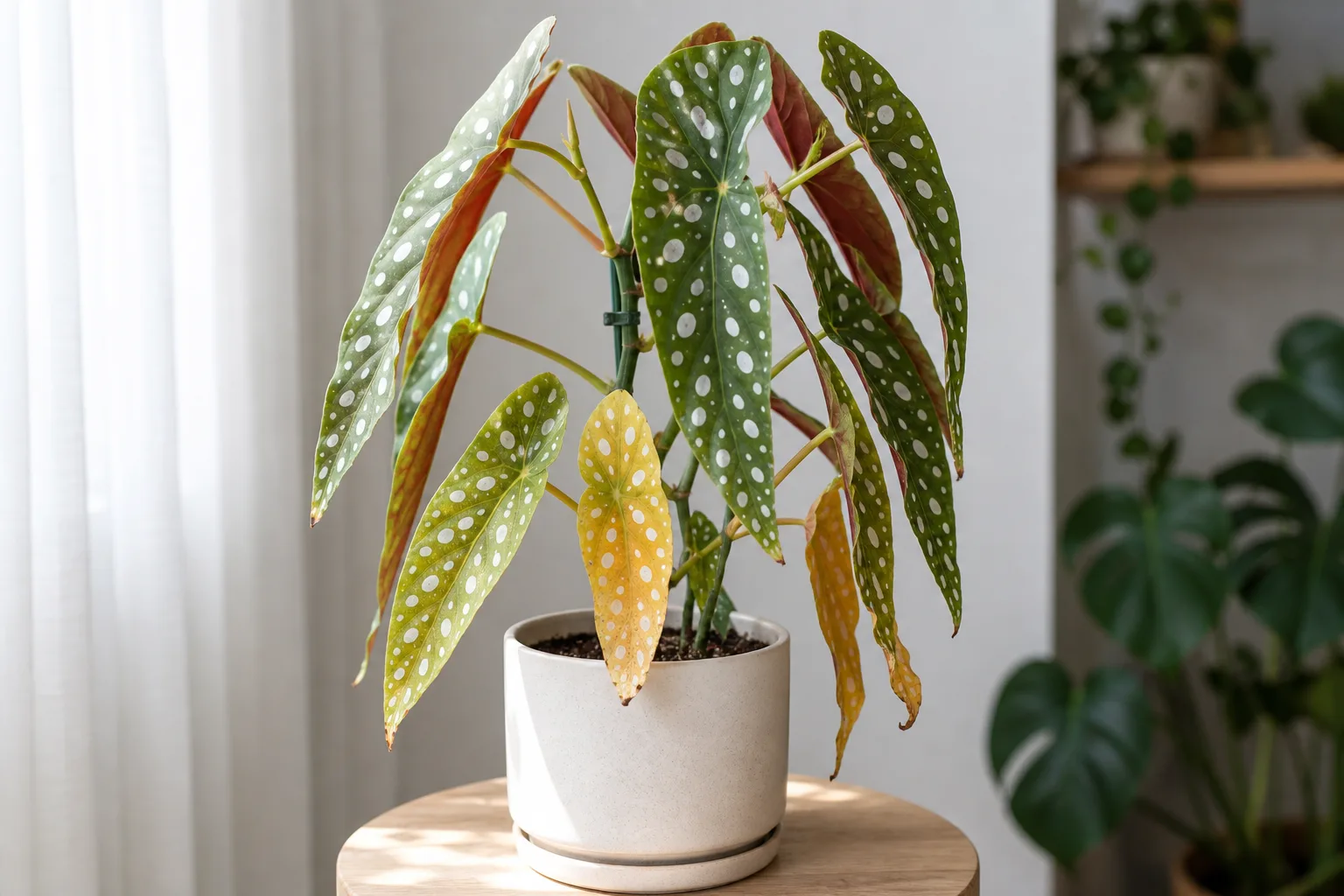
Yellow Leaves on Begonia Maculata: Causes, Checks & Fixes
This guide covers yellow leaves on Begonia Maculata. See also the general Yellow Leaves guide, watering, and light pages for this plant.
Yellow Leaves on Begonia Maculata: Causes, Checks & Fixes
Quick answer
Yellow leaves on Begonia maculata - the polka dot begonia or angel wing begonia - are a symptom, not one diagnosis. This cane begonia grows on upright bamboo-like stems with swollen nodes; new spotted leaves emerge from the top and side nodes while the oldest angel-wing blades on lower cane segments naturally senesce. That architecture matters: a single yellow leaf near the soil on an otherwise healthy tall cane is often harmless aging, while multiple limp yellow leaves on a heavy wet pot usually means root stress from overwatering.
First step: lift the pot for weight and press your finger into the top 2–3 cm of mix. A light pot with dry upper soil and slightly curled but firm leaves points toward underwatering. A heavy, cool pot with damp clinging mix and soft lower foliage means stop watering-not fertilizer, not Begonia Maculata repotting guide on day one. Only after you know wet versus dry should you branch to humidity, light, pests, or age.
What yellow leaves look like on Begonia Maculata
Yellowing on maculata follows patterns tied to cane growth, not random blotches across the plant.
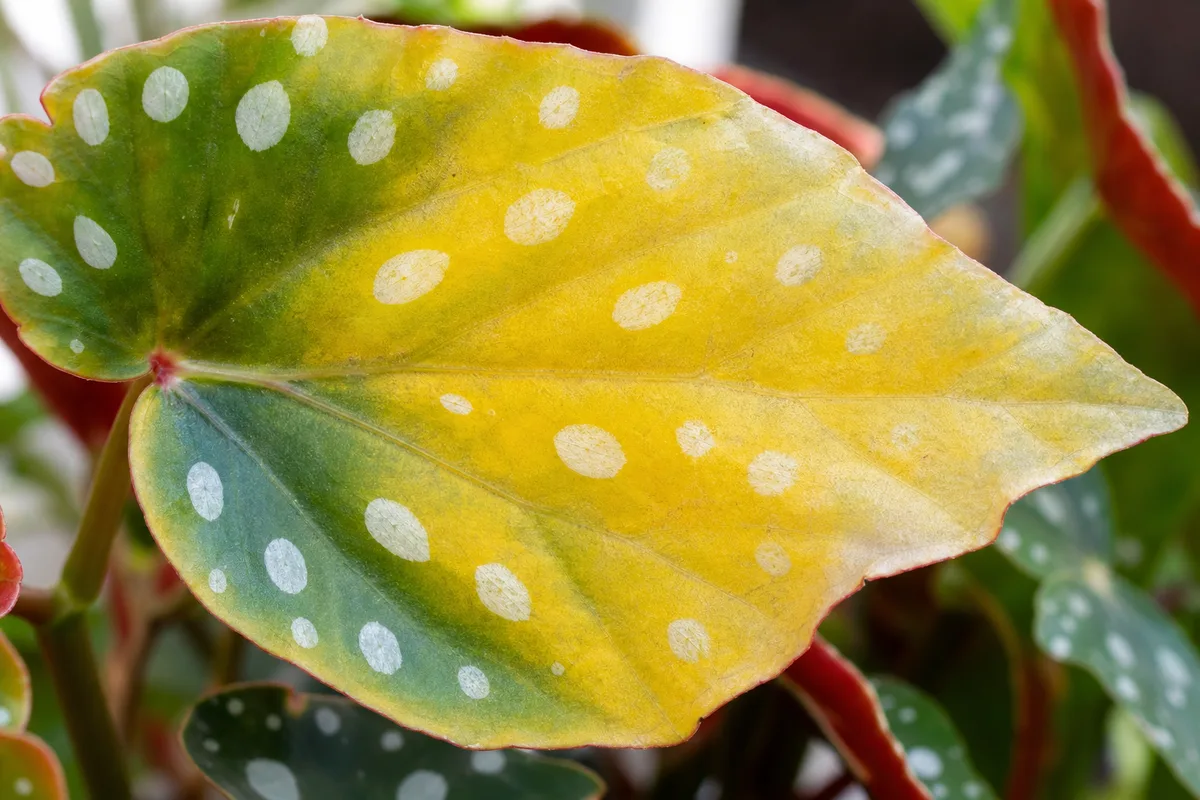
Yellow Leaves symptoms on Begonia Maculata - compare with healthy tissue on the same plant.
Normal lower-cane senescence
The lowest one or two angel-wing leaves on an older stem segment turn evenly yellow, then brown and drop while canes stay firm, silver polka dots on upper leaves stay crisp, and new spotted growth opens from higher nodes. This slow pattern over weeks or months on an established plant is normal cane begonia turnover-not a crisis.
Overwatering and root-stress yellowing
Lower leaves yellow or pale first while silver dots fade on affected blades. Leaves feel soft and limp even though surface mix is damp-damaged roots cannot move water upward efficiently, so owners often misread the wilt as thirst. The pot stays heavy and cool for days. You may see transparent water-soaked patches (edema-style stress) on thin spotted leaves before wider chlorosis, small fungus gnats near constantly damp soil, or a sour smell at the drainage hole.
Dry air and humidity stress
Chronic low humidity more often starts with crispy brown margins on wing tips, but prolonged dry winter air can dull silver spotting on new leaves and progress to pale or yellow blades while soil moisture is still moderate. Damage clusters near heat vents, radiators, or bright windows that accelerate transpiration. See low humidity on maculata when edges crisp before the whole leaf yellows.
Low light chlorosis
In dim corners, upper leaves may pale or yellow while stems stretch toward the window. Plants not receiving enough light often have light green foliage and drop older leaves. On maculata, washed-out spotting and long gaps between nodes often accompany the yellowing-read not enough light if new growth looks leggy and pale.
Underwatering yellowing
When the mix pulls away from the pot and the plant goes bone dry, older leaves may yellow and crisp from the margins inward while petioles collapse and the pot feels light. Whole-cane wilt that recovers after one thorough soak fits thirst better than a single lower leaf fading on a moderately moist pot.
Pest-related chlorosis
Spider mites cause fine stippling, dull foliage, and webbing on undersides in warm dry rooms-yellowing often starts as mottled pale dots, not uniform lower-leaf drop. Mealybugs in leaf axils can yellow adjacent tissue and leave sticky residue. Inspect before assuming a watering fix.
Cold draft and chilling injury
Exposure to cold air from AC vents, winter windows, or transport can spot or yellow leaves on tropical cane begonias. Chilling injury can cause discolored leaves or spots; wet soil plus cold roots worsens decline. Move off the draft line and keep slightly drier until stable.
Why Begonia Maculata gets yellow leaves
Maculata yellows for reasons that fit its biology as a humidity-sensitive cane begonia from Brazilian rainforest understory.
Overwatering in slow-drying indoor pots is the most common fixable cause. Begonias are highly susceptible to root rot when overwatered. Fibrous roots in dense nursery peat plus dim office light can stay saturated for weeks while roots lose oxygen-chlorosis on lower leaves follows.
Natural cane senescence happens because maculata invests in new top growth; lower stem leaves have a finite lifespan. Tall plants with firm canes and one fading bottom leaf are often just shedding spent tissue.
Low humidity and bright windows increase transpiration through large wing-shaped blades. When air drops below roughly 45–50% RH in heated homes, margins desiccate first; severe stress can yellow whole leaves without underwatering the root zone.
Insufficient light reduces photosynthesis; maculata in a dim corner may pale and yellow upper foliage while wet mix dries slowly-compounding overwatering risk in winter.
Salt buildup from overfeeding can yellow or brown leaf tips and margins. As plants are watered and fertilized, salts build up in the soil; begonias in small pots are sensitive. Do not fertilize a yellowing stressed plant without confirming moisture and light first.
Pests and disease-mites, mealybugs, powdery mildew, bacterial leaf spot-can yellow or mottle foliage. Wet foliage from heavy misting in stagnant air invites mildew on spotted begonias; keep leaves dry when watering from below or at the soil line.
Lookalike symptoms to rule out
| What you see | Likely cause | Key differentiator |
|---|---|---|
| One yellow lower leaf + firm canes + normal dry-down | Normal senescence | Slow; upper spotted growth healthy |
| Multiple limp yellow lower leaves + heavy wet pot | Overwatering | Stop water; canes still firm |
| Yellow + soft mushy cane at soil line + sour smell | Root rot | Unpot immediately |
| Crispy margins first + moderate soil moisture | Low humidity | Hygrometer below 50% RH |
| Pale stretched upper leaves + slow-drying wet mix | Not enough light | Improve indirect light |
| Yellow + light dry pot + limp petioles | Underwatering | Water once after confirming dryness |
| Stippling + webbing on undersides | Spider mites | Isolate; treat pests |
| Translucent patches then yellow on wet cycles | Edema / early overwatering | Dry-down; do not mist heavily |
| Uniform wilt on wet OR dry soil | Wilting hub | Confirm soil before acting |
How to confirm the cause
Work through these five checks in order:
- Pot weight and top 2–3 cm moisture - Heavy, cool pot with damp clinging mix supports overwatering. Light pot with dry upper layer supports underwatering. This single pair of checks routes most maculata yellow-leaf cases.
- Which leaves and where on the cane - Bottom-only, slow yellowing on lower stem segments with firm canes fits aging. Even yellowing climbing the cane or hitting new growth on wet soil does not.
- Cane firmness at the soil line - Squeeze the lowest segment gently. Firm cane with wet mix means dry-down may be enough. Soft, denting tissue means escalate to root rot treatment-not another watering tweak.
- Humidity and placement - Hygrometer at leaf height below 45–50% RH, or pot within a few feet of a heat vent, supports dry-air stress. Crispy brown tips without a light pot often confirm humidity over thirst.
- Pests and light - Check undersides for mites, mealybugs, or stickiness. Note whether new growth is leggy and pale in a dim corner.
If checks point to wet soil, read the overwatering guide for the full dry-down protocol. If the pot is light and dry, see underwatering. Do not fertilize until you know which branch fits.
First fix for Begonia Maculata
Your first fix depends on what the five checks confirmed-pick one path before stacking treatments.
If the pot is heavy and the top mix is wet
Stop all watering until the top 2–3 cm of mix dries and the pot feels noticeably lighter. That pause returns oxygen to fibrous roots before you assess drainage or repot. This is the same first move as the overwatering guide-do not add water because angel-wing leaves look limp on already-wet soil.
If the pot is light and the upper mix is dry
Water thoroughly once with room-temperature water until excess runs from drainage holes, then drain the saucer completely. Resume the top-2–3-cm dry-down rhythm from the watering guide. One soak after confirmed dryness is not overwatering; calendar watering on dry soil is underwatering.
If only one lower leaf is yellow on firm canes
Snip the spent leaf at the petiole base and continue normal care checks. No repot, no fertilizer, no humidity overhaul unless other symptoms appear.
If margins are crispy but soil moisture is normal
Move off vent paths and raise RH to at least 50% at leaf height with a cool-mist humidifier-see low humidity fixes. Do not increase watering when the mix is already wet.
If upper leaves are pale and stretched in dim light
Move to brighter indirect light-never hot direct sun on stressed spotted foliage. Pair with corrected watering; dim wet corners are a common maculata failure mode.
If you find stippling, webbing, or mealybugs
Isolate the plant and treat the confirmed pest before adjusting fertilizer or repotting. Pest chlorosis will not resolve with watering alone.
Do not repot, fertilize, or mist heavily on day one unless inspection shows mushy roots, blocked drainage, or a confirmed pest that requires it.
Recovery timeline
Fully yellow angel-wing leaves will not re-green. Remove them once canes stabilize so the plant redirects energy to new spotted growth from nodes.
Stabilization after correcting the primary stressor-usually one to two weeks once wet soil dries on schedule or dry soil receives a proper drink. Yellowing should slow; canes should stay firm.
New spotted leaves unfurling from cane tips or nodes are the best success signal. Expect them in three to eight weeks during warm active growth, sometimes longer if recovery started in a cool winter room. Judge success by new growth, not old leaf color.
Worsening signs: lowest cane softens after dry-down, many leaves yellow within days on wet soil, sour smell intensifies, or stippling spreads despite watering fixes-those need root rot inspection or pest treatment, not patience alone.
What not to do
Do not fertilize a yellowing maculata hoping to green it up-salt stress and wet roots both yellow foliage, and feed on stressed roots slows recovery. Do not water more because leaves look limp while soil is already wet; that converts yellow leaves into rot.
Avoid repotting into a much larger pot on day one to “help drying”-extra wet mix volume slows evaporation in low light. Do not mist heavily as a humidity substitute; wet spotted foliage in stagnant air invites powdery mildew. Do not assume every yellow leaf is aging when the pot is heavy and multiple blades are limp.
When trimming yellow leaves or handling wet mix, wear gloves and wash hands after-Begonia species are toxic to cats and dogs.
When to worry
Escalate immediately if the lowest cane dents under light pressure, the mix smells strongly sour, or a quick root check shows brown mushy tissue. Those signs mean yellowing has progressed toward root rot-dry-down alone is no longer enough.
Also act promptly if yellowing climbs to new top growth on wet soil, mites or mealybugs are confirmed, or cold-damaged leaves keep spreading after you moved the plant-those paths need targeted treatment, not waiting.
If canes stay firm, yellowing slows after one proper dry cycle or one thorough watering on a dry pot, and new node growth looks healthy, you are on track. One slow yellow lower leaf on a tall cane can wait.
How to prevent yellow leaves on Begonia Maculata
Match care to cane begonia biology: RHS cane begonia guidance calls for moist but well-drained compost, partial shade, and moderate humidity-not a constantly wet dim corner.
Water on soil checks, not calendar dates. Allow the top 2–3 cm of mix to dry before the next drink per the watering guide. In dim winter rooms that may mean two to three weeks between drinks; in bright summer growth, every five to seven days.
Keep RH at or above 50% at leaf height in heated dry months-humidifier beats misting for spotted foliage. Provide Begonia Maculata light guide so the plant photosynthesizes normally and the mix dries predictably. Remove spent lower leaves promptly to reduce pest hiding spots. Flush salts occasionally if you fertilize frequently during active growth.
Quarantine new begonias and lift the pot weekly during your first month-early heaviness is easier to fix than a collapsed cane.
Begonia Maculata care cross-check
| Care factor | Yellow-leaf risk when wrong | Quick check |
|---|---|---|
| Watering rhythm | Calendar watering in winter | Top 2–3 cm dry + lighter pot before next drink |
| Drainage | Cachepot standing water | Saucer empty; holes open |
| Humidity | Heating vents, winter RH below 45% | Hygrometer at canopy; crisp margins |
| Light | Dim corner + slow-drying wet mix | Leggy pale new growth |
| Senescence | Panic over one lower leaf | Firm canes; healthy top nodes |
| Fertilizer | Feed on wet stressed roots | Hold feed until stable new growth |
Related Begonia Maculata problems
- Begonia Maculata overview - Light, watering, humidity, and general care
- Overwatering - Wet heavy pot with limp lower leaves
- Underwatering - Light pot and dry mix lookalike
- Root rot - Soft cane base with sour wet soil
- Low humidity - Crispy margins before full yellowing
- Not enough light - Pale leggy upper growth
- Wilting - Symptom overlap on wet versus dry soil
- Spider mites - Stippling and webbing in dry heat
- Watering Begonia Maculata - Primary prevention hub
Conclusion
Yellow leaves on Begonia Maculata reward a simple diagnostic order: wet heavy pot versus light dry pot, then which leaves on which cane segment, then humidity, light, and pests. Cane begonias naturally shed lower angel-wing leaves while pushing spotted growth from the top-do not treat that like root failure. When multiple blades yellow on saturated mix, stop watering and let the top 2–3 cm dry before anything else. Polka dot begonia forgives brief drought and one spent lower leaf far more willingly than it forgives a wet, shaded pot left on autopilot.
When to use this page vs other Begonia Maculata guides
- Begonia Maculata watering guide - Use for routine moisture checks before assuming yellow leaves is the main issue.
- Begonia Maculata problems hub - Browse all 16 common issues on this species.
- Overwatering on Begonia Maculata - Different entry point when symptoms overlap with yellow leaves.
- Underwatering on Begonia Maculata - Different entry point when symptoms overlap with yellow leaves.
- Not Enough Light on Begonia Maculata - Different entry point when symptoms overlap with yellow leaves.