Leggy Growth on Begonia Maculata: Causes, Checks & Fixes
Quick answer
Leggy Begonia Maculata shows long red cane internodes, a leaf tuft at the top, and faded silver spots-usually from dim light plus unchecked apical stretch. First step: move to bright indirect light within about two feet of an east- or west-facing window, then watch new leaf spacing for two weeks before pinching or cutting back bare canes.
Leggy Growth on Begonia Maculata: Causes, Checks & Fixes
This guide covers leggy growth on Begonia Maculata. See also the general Leggy Growth guide, watering, and light pages for this plant.
Leggy Growth on Begonia Maculata: Causes, Checks & Fixes
Quick answer
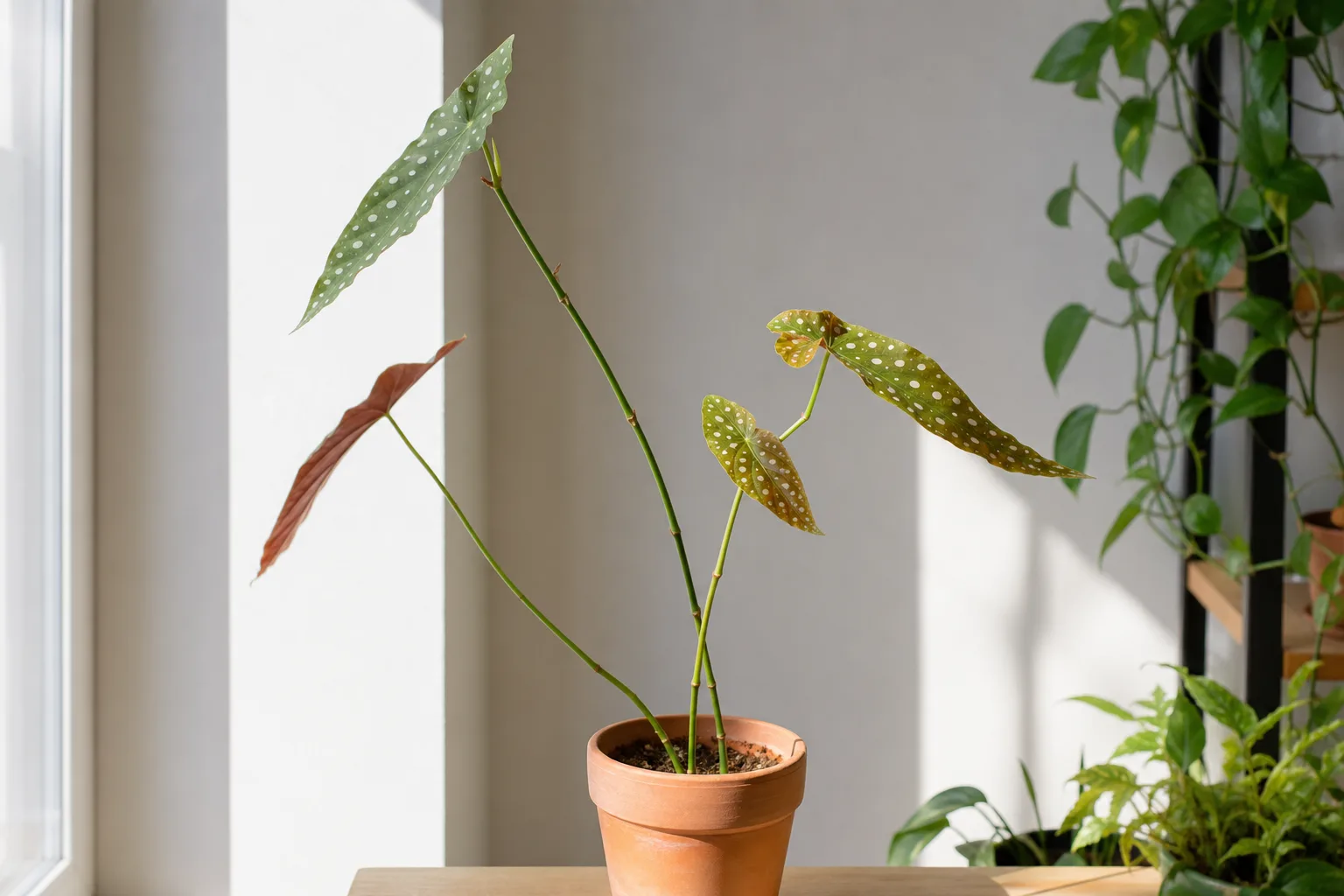
Leggy growth on Begonia Maculata (Begonia maculata, polka dot begonia) is etiolation on cane stems-the plant stretching toward light because photosynthesis income is too low for compact tissue. Red bamboo-like canes develop long bare internodes, new angel-wing leaves arrive smaller and farther apart, silver spots fade, and the plant often carries a leaf crown at the tip while the lower cane goes naked.
First step: move the pot to bright indirect light within about two feet of an east- or west-facing window where leaves never sit in hot midday sun. Give it two weeks and read the next new leaves, not the old stretched stems. If internodes on fresh growth tighten, add tip pinching or a hard cutback on bare canes per our Begonia Maculata pruning guide. Do not repot, fertilize, or soak soil on day one.
Low light is the usual root cause-see not enough light on Begonia Maculata for window placement, lux targets, and the full light-move protocol. This page focuses on recognizing cane legginess, confirming it, and correcting structure with light plus node-based cuts.
What leggy growth looks like on Begonia Maculata
On this upright cane begonia, legginess is an architecture problem before it is a watering problem. Watch for these patterns on the red segmented stems:
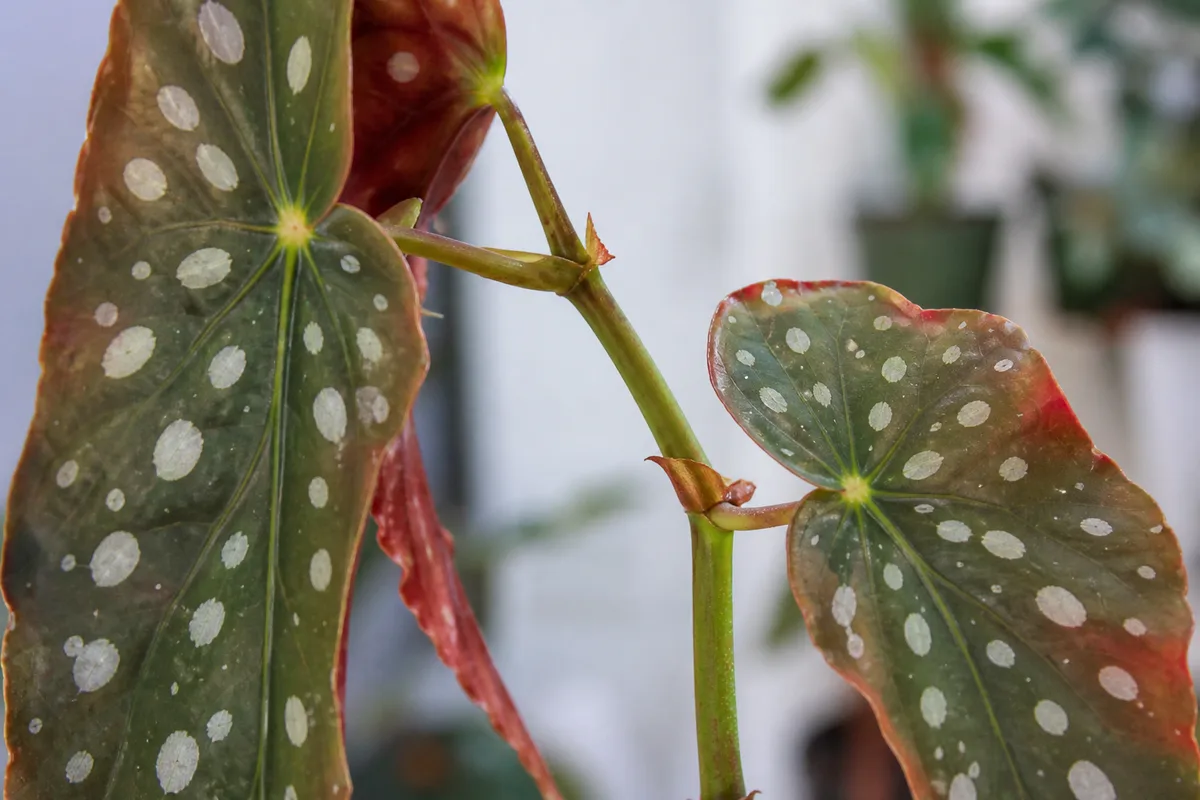
Leggy Growth symptoms on Begonia Maculata - compare with healthy tissue on the same plant.
- Ladder-like internodes - visible gaps between leaf pairs along the cane; new sections look like rungs instead of a compact bush
- Bare lower cane - leaves only near the growing tip while 30 cm (12 inches) or more of smooth red stem sits leafless below
- Smaller, thinner new leaves - the angel-wing shape stays, but blades are shorter and less rigid than older growth from a brighter period
- Dull or faded spotting - silver polka dots lose contrast; the upper surface may look flat dark green instead of crisp green-and-silver
- Window lean - stems and leaves angle toward the brightest side of the room
- Weak flop risk - the leaf crown outweighs thin stretched stems; staking may be needed temporarily even though stakes do not create branches
Normal lookalikes: A healthy Begonia Maculata in bright indirect light still grows quickly and may reach 60–90 cm (2–3 feet) indoors-that is genetic height on firm canes, not etiolation. Winter slowdown with firm canes and soil drying on schedule is seasonal rest. Fast young growth after Begonia Maculata repotting guide in a bright window can look tall but shows short internodes and vivid spots-the opposite of dim-room stretch.
Why Begonia Maculata gets leggy growth
Apical dominance on cane stems
Cane begonias like B. maculata grow from a terminal bud at each stem tip. NC State Extension describes cane types as upright, usually unbranched stems with thickened nodes resembling bamboo. Left alone, each cane extends upward while side buds beside lower leaf scars stay quiet-the classic “stick with a leaf tuft on top.”
In strong filtered light, internodes stay relatively short and spotting stays vivid. In low light, the plant reaches toward the window, internodes elongate, new leaves shrink, and the lower cane goes bare. Staking prevents tipping but does not branch canes; only node cuts plus brighter light fix bare lower stems. The American Begonia Society notes that judicious tip pinching during the growing season keeps vigorous cane begonias in bounds and encourages new basal growth.
Insufficient bright indirect light (primary cause)
Polka dot begonia evolved in Brazilian Atlantic rainforest understory, but that still means bright, filtered daylight-not the dim corners where snake plants survive. When light drops below roughly 1,000 lux at the leaves for much of the day, cane begonias stretch between leaf nodes to hunt photons.
Common placement mistakes: north-facing rooms as the only light source, pots more than six feet from any window, blocked glass, winter daylight shrink without supplementation, and decor-first placement on bookcases.
Secondary contributors
- No pinching while young - waiting until the plant hits the ceiling forces rescue cuts instead of routine tip pinches
- Overfertilizing in dim light - excess nitrogen can push soft, floppy elongation when light cannot support dense tissue
- One-sided exposure - rotation neglected so one cane races toward the pane while the far side stays sparse
- Low light plus slow transpiration - the same Begonia Maculata watering guide that worked in summer sun can leave roots sitting moist in a dark corner, compounding stress while stems stretch
Lookalike symptoms to rule out
| What you see | More likely cause | Quick check |
|---|---|---|
| Long internodes + window lean + dull spots | Leggy etiolation (this page) | Shadow test; compare new leaf spacing |
| Same stretch signs but you have not checked windows yet | Not enough light | Full light-placement audit |
| Wilting with wet soil and soft stem base | overwatering on Begonia Maculata / root rot on Begonia Maculata | Smell mix; inspect roots |
| Wilting with dry, light pot | underwatering on Begonia Maculata | Weight pot; finger-test depth |
| Crispy brown patches on sun-facing leaves | Too much direct sun | Move back from glass |
| Sticky leaves + webbing | Spider mites | Inspect undersides |
| Firm cane, slow growth, winter only | Seasonal rest | Resumes in spring with stable care |
Leggy etiolation is the best fit when stretch, bare lower cane, lean, and faded spots cluster together without mushy roots or pest sign.
How to confirm the cause
Work through these checks in order:
- Window direction and distance - Measure from pot to glass. East or west within about two feet is the usual target; north alone is often insufficient without a grow lamp. See our Begonia Maculata light guide for lux targets (2,000–4,000 lux at peak).
- Shadow test at midday - Hold your hand between window and plant. A soft, defined shadow suggests usable indirect light; almost no shadow means the spot is too dim for compact cane growth.
- Internode spacing trend - Compare the gap between the last two leaf pairs to pairs from six months ago. Widening spacing confirms etiolation, not normal fast growth.
- Cane architecture - Trace each stem: is foliage clustered at the tip with long bare sections below? That pattern points to chronic stretch, not a single bad week.
- Soil dry-down speed - If mix stays wet for many days while canes keep elongating, light may be limiting water use-do not respond with more water.
- Two-week trial move - Shift to the brightest safe indirect location. If the next leaves emerge closer together, light was the limiter; proceed to pinching once new growth looks compact.
If the plant wilts with dry soil in a bright window, suspect underwatering-not legginess. If bleached patches appear after a move, you overshot into direct sun; pull back and diffuse.
The first fix to try
Move the pot to bright indirect light within about two feet of an east- or west-facing window, or to your brightest filtered exposure with a sheer curtain if midday rays hit the leaves.
That single change is the first fix. Begonia Maculata will not stay compact on a credenza across the room. Gardeners’ World recommends a bright spot out of direct sunlight-typically near an east- or west-facing window indoors.
After the move:
- Wait two weeks before repotting, fertilizing, or structural pruning
- Rotate the pot a quarter turn every few days for the first month
- Recheck watering - brighter light usually means faster dry-down at the top 3 cm; resume finger tests rather than the old calendar schedule
If no suitable window exists, add a full-spectrum grow light 15–30 cm (6–12 inches) above the top leaves for 10–14 hours daily on a timer, as outlined on our light guide.
Second fix: tip pinch or hard cutback on bare canes
Once new growth shows tighter internodes for two or three leaf pairs, correct the shape:
Tip pinching (mild to moderate legginess)
Every two to four weeks during spring and summer, remove the top 2.5–5 cm (1–2 inches) of each dominant cane, just above a healthy node. NC State Extension recommends pinching tips to promote new growth and keep cane begonias contained. Use fingernails on soft young tips or clean snips on firmer stems. You remove the terminal bud while leaving side buds intact below.
Start when the plant is still bushy-not after it becomes a ceiling-high wand. Pinch before flower clusters form in late spring through summer so you do not remove developing blooms, per American Begonia Society timing guidance.
Hard cutback (severe bare cane)
When a cane carries 30 cm (12 inches) or more of bare internode with leaves only at the tip, pinching the tip is not enough. Cut the cane down to a lower node that still has at least one healthy leaf or visible bud-one-quarter to one-half inch (6–12 mm) above that node, not mid-internode.
Limit live-tissue removal to one-third of the plant per session. Stage aggressive reshaping over two or three sessions spaced two to three weeks apart. Full step-by-step cuts, tool hygiene, and the one-third rule live on our Begonia Maculata pruning page.
Recovery timeline
Judge progress on new tissue, not old stretched canes.
- Week 1–2 - Lean may stop worsening; the plant orients toward the new light source
- Week 3–4 - Next leaf pair should show shorter internodes and fuller blade size if light was the main issue; side shoots may swell beside nodes after pinching
- Week 6–8 - Spot contrast and stem thickness improve on successive leaves; the plant looks noticeably fuller with regular tip pinches
- Old stretched canes - Permanent unless you prune for shape after the plant is stable; stretched tissue will not revert
If new leaves stay small and far apart after a month in verified bright indirect light, rule out root problems, chronic overwatering, or pests-not more light alone.
What not to do
- Pinch or hard-prune before improving light - new shoots will simply stretch again in shade
- Stake as the only fix - a stake stops flop but does not branch a bare cane
- Hard-prune in a dim winter corner - cut ends blacken and buds may not break until spring
- Water more because the plant “looks sad” in a dark room - you may waterlog idle roots
- Fertilize heavily to force bushiness - without adequate light, extra nitrogen produces weak floppy stems
- Judge success on old leaves - watch the next nodes only
- Stack repotting, heavy pruning, and pesticide on the same day - make one care correction at a time so you can read the plant’s response
How to prevent leggy growth next time
- Place in bright indirect light from day one - polka dot begonia is a poor long-term fit for low-light rooms; target 2,000–4,000 lux during active growth per our light guide
- Pinch tips every two to four weeks during spring and summer while stems are young-prevention beats rescue cutbacks
- Rotate weekly once growth is even - prevents one-sided cane development
- Supplement before winter - add a timer-driven grow light when days shorten so internodes do not elongate every December
- Adjust watering whenever you move the plant - light and water use move together on this species
- Limit fertilizer in dim months - feed only when new leaves open steadily in adequate light
When to use this page vs other Begonia Maculata guides
- Begonia Maculata watering guide - Use for routine moisture checks before assuming leggy growth is the main issue.
- Begonia Maculata problems hub - Browse all 16 common issues on this species.
- Not Enough Light on Begonia Maculata - Different entry point when symptoms overlap with leggy growth.
- Slow Growth on Begonia Maculata - Different entry point when symptoms overlap with leggy growth.
- Yellow Leaves on Begonia Maculata - Different entry point when symptoms overlap with leggy growth.
Related Begonia Maculata guides
- Begonia Maculata overview
- Begonia Maculata watering
- Begonia Maculata light
- Begonia Maculata soil
- Not Enough Light on Begonia Maculata
- Slow Growth on Begonia Maculata
- Yellow Leaves on Begonia Maculata
- Begonia Maculata problems
When to worry
Escalate beyond a simple light move plus pinch if:
- Canes soften at the base while soil stays wet - unpot and inspect for rot; improve light and dry the root zone
- The plant tips and snaps repeatedly despite staking - hard cutback to a lower node may be required once light is adequate
- No tighter internodes after four weeks in verified bright indirect light - rule out roots, pests, and chronic overwatering
- New growth after pruning stays pale and floppy - light may still be insufficient, or you removed more than one-third of live tissue in one session
Begonia Maculata can recover from moderate legginess when light improves early. A plant left years in deep shade may survive but rarely regains dense spotting without hard cutbacks and supplemental lighting.
Conclusion
Leggy Begonia Maculata is the plant outrunning its light supply-building cane height instead of branching. Bright indirect light is the root fix; tip pinching or hard cutback above nodes is the structural follow-up once new growth compacts. Old stretched internodes never shrink-read success on the next leaf pairs sitting closer together.
For the full light-placement audit, start with not enough light on Begonia Maculata. For scissors technique and seasonal timing, see Begonia Maculata pruning. Get light and nodes right, and the polka dots return on compact new canes.