Iron Deficiency on African Violet: Causes, Checks & Fixes
Quick answer
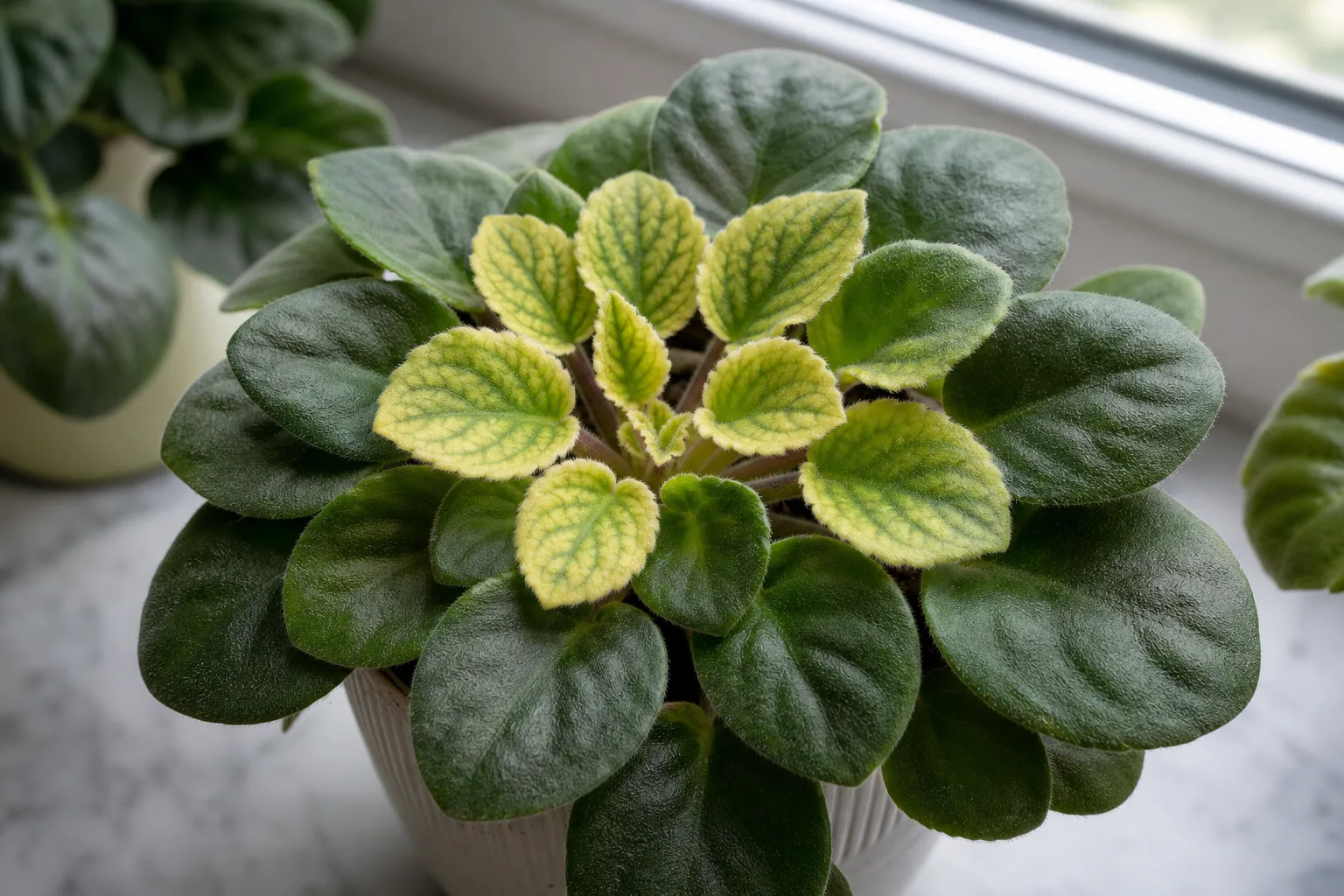
Iron deficiency on African Violet shows as bright yellow between dark green veins on the smallest new crown leaves-interveinal chlorosis-while older foliage may still look fine. High soil pH or skipped feeding usually blocks iron uptake. First fix: flush the pot with plain room-temperature water to leach salts, then resume African violet fertilizer at one-quarter strength.
Iron Deficiency on African Violet: Causes, Checks & Fixes
This guide covers iron deficiency on African Violet. See also the general Iron Deficiency guide, watering, and light pages for this plant.
Iron Deficiency on African Violet: Causes, Checks & Fixes
Quick answer
Your African violet stopped blooming and the tiniest center leaves now show bright yellow between dark green veins-that interveinal chlorosis on crown growth is the classic sign of iron uptake failure on Saintpaulia, not a whole-rosette fade. Iron is immobile in plant tissue, so the plant cannot pull it from older leaves to feed new growth; when soil pH drifts high or salts accumulate, roots stop absorbing iron even if it is in the fertilizer bag.
High soil pH, salt buildup, softened water, and long gaps without feeding are the usual blockers on this shallow-rooted houseplant. If bloom stalks stalled while only the crown pales, nutrition is worth checking before you chase light changes.
First move: flush the pot with plain room-temperature water until excess drains freely, then wait one week before resuming diluted African violet fertilizer.
What iron deficiency looks like on African Violet
The signature pattern is yellow between green veins on young center leaves, not uniform fading across the whole rosette. Leaf size in the crown may shrink and new growth slows. Flowering often pauses because the plant cannot build chlorophyll in fresh tissue-collectors often notice iron trouble when a previously steady bloomer goes quiet while the crown looks sick.
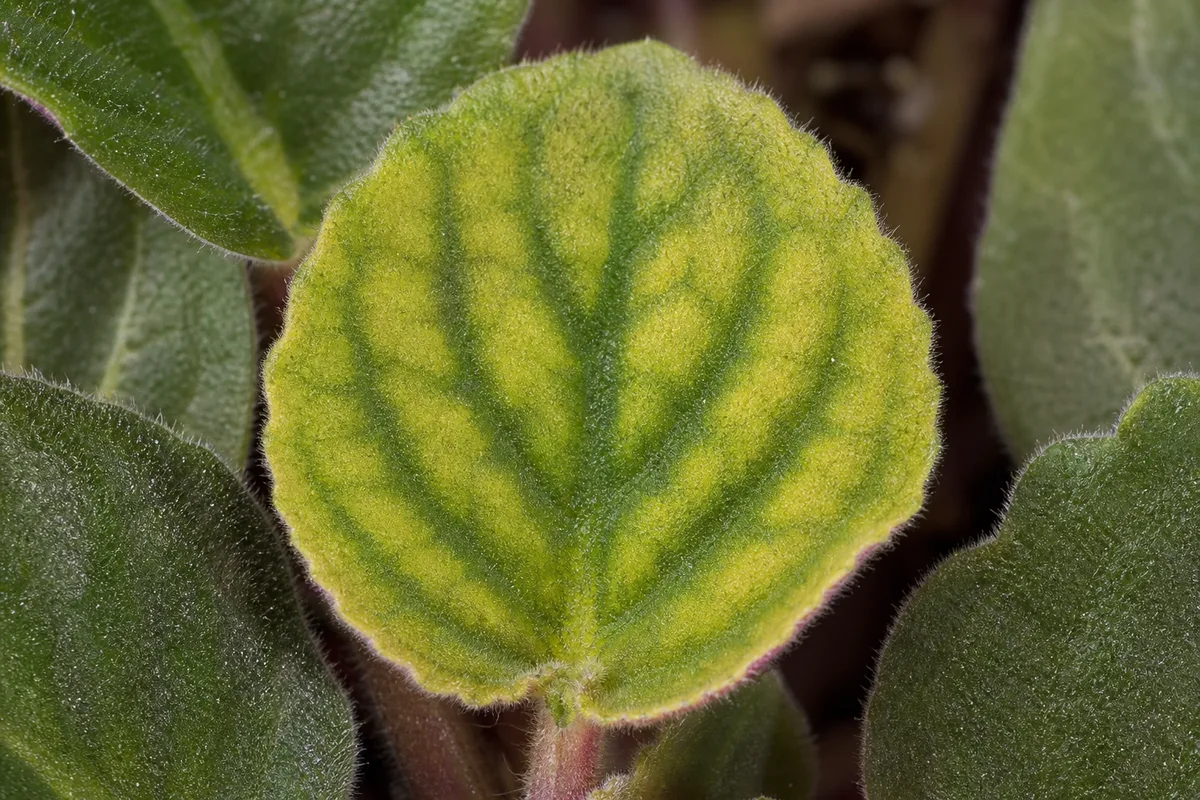
Iron Deficiency symptoms on African Violet - compare with healthy tissue on the same plant.
On standard rosettes, the pattern is easy to spot on the smallest leaflets at the center. Miniature and trailing cultivars pack leaves tighter; tilt the pot under a desk lamp and part the crown gently so you can see whether yellow sits between veins or covers whole leaves.
Compare with nitrogen, calcium, overwatering, and light bleach
Work through leaf position before adding supplements-this is the fastest way to avoid treating the wrong nutrient:
| Pattern | Where it shows | What it usually means |
|---|---|---|
| Yellow between dark green veins on smallest crown leaves | Center of the rosette | Iron deficiency - immobile micronutrient blocked by pH or salts |
| Uniform pale green or yellow margins on oldest outer leaves | Bottom ring; crown still relatively green | Nitrogen deficiency - mobile nutrient pulled inward |
| Pale young leaves with backward-hooking tips and stuck buds | Crown center | Calcium deficiency - hooked tips, not flat interveinal yellow |
| Mottled chlorosis between veins on older leaves | Lower ring | Magnesium deficiency - different leaf age than iron |
| Yellow lower leaves plus sour wet soil, limp crown, mushy roots | Often whole plant looks unthrifty | Overwatering or root rot - not a neat vein pattern |
| Entire leaves bleach pale, not vein-specific | Exposed crown leaves | Too much direct light - move to African Violet light guide |
Manganese deficiency mimics iron on young leaves with interveinal chlorosis. Without a lab test, treat both as a pH and feeding imbalance: correct soil chemistry and resume proper feeding rather than guessing which micronutrient to dump in at full strength.
Why African Violet gets iron deficiency
African Violet needs iron to make chlorophyll in actively growing leaves, even though iron is a micronutrient. The most common problem is not missing iron in the bag of fertilizer-it is that roots cannot absorb it.
High soil pH is the leading cause. African violets prefer slightly acidic mix around 5.8 to 6.2. When pH drifts alkaline from hard tap water, old peat breaking down, or repeated top-watering without flushing, iron becomes insoluble and roots cannot take it up even when it is present in the soil.
Skipped or weak feeding matters because African violets require a mild fertilizer each time they are watered. Months without fertilizer, or only plain-water flushes with no follow-up feed, depletes available iron in a small pot.
Salt and mineral buildup from hard water, softened water, or heavy fertilizer doses raises electrical conductivity and shifts pH. Softened water is especially risky because added sodium alters both pH and salt levels in the root zone. See salt build up when white crust appears on the pot rim.
Excess phosphorus or zinc can block iron uptake. Too much phosphorus can cause micronutrient deficiencies when bloom-boosting formulas are used every watering, or when water is high in certain minerals.
Old, compacted mix loses structure and buffering capacity. A pot that has not been refreshed in more than a year is a common background factor when crown chlorosis appears. Annual African Violet repotting guide into fresh African violet soil keeps pH in range.
How to confirm the cause
Work through these checks in order before adding supplements:
- Leaf age pattern - Yellow between veins on the smallest crown leaves supports iron trouble. Yellow only on the lowest, oldest leaves points to nitrogen deficiency instead. Hooked tips on pale crown leaves suggest calcium deficiency.
- Soil moisture and roots - Firm white roots and soil that dries on schedule fit deficiency. Mushy roots, constant wetness, and a limp crown suggest rot-fertilizer will not fix that.
- Feeding history - Have you skipped fertilizer for two months or more? Have you flushed repeatedly without resuming a mild feed?
- Water type - Softened, heavily chlorinated, or very hard tap water raises the odds of pH drift and salt buildup.
- Mix age and pH - Potting soil older than twelve months, white crust on the rim, or a tight sour-smelling root ball all support a chemistry problem. Test moist mix from the root zone with a garden-center pH kit; readings above 6.5 warrant repotting, not acid guessing.
- Recent changes - One pale new leaf right after repotting may be transplant stress. Widespread crown chlorosis with feeding gaps confirms a nutrient imbalance.
If every new leaf in the center is chlorotic, roots are firm, and you have not fed properly in months, iron deficiency-or the closely related manganese pattern-is a strong working diagnosis.
First fix for African Violet
Flush the pot with plain room-temperature water until at least a cup of excess drains from the bottom, then let the plant dry normally before the next watering.
This single step leaches salts and minerals that may be locking out iron without stacking repotting, iron chelate, and full-strength fertilizer on the same day. Do not use softened water for African violets; use distilled, rainwater, or reverse-osmosis water if your tap water is hard or softened.
Wait about one week. Do not fertilize during this pause-the flush is the intervention.
After that week, moisten dry soil with plain water first if needed, then apply African violet fertilizer at one-quarter the label rate and let excess drain. Use a formula made for African violets with nitrogen that is not derived from urea, which can burn fine roots and make uptake worse. Full fertilizer routine details cover quarter-strength schedules and monthly flush sequencing.
If mix is more than a year old, heavily crusted with salts, or smells sour, repot into fresh African violet soil as the next step-not on the same day as the first flush. Follow the repotting guide for gentle crown handling on an iron-stressed plant; damaged roots during repot can set recovery back weeks. Make one change at a time and watch new crown leaves for two to three weeks.
When flush and feed are not enough
If new crown leaves stay pale between veins after a flush, repot into fresh mix, and four weeks of proper quarter-strength feeding-with firm roots and no sour soil-escalate carefully:
- Confirm pH with a soil test kit on moist mix. If pH remains above 6.5, repot again into mix guaranteed for African violets rather than adding chelated iron to alkaline soil.
- Chelated iron in the watering can - Apply a water-soluble chelated iron product at half the label rate mixed into room-temperature water, with excess draining freely. Chelated iron stays soluble across a wider pH range than raw iron salts. Test on one plant for two weeks before treating the collection.
- Do not foliar-spray velvet leaves - African violet foliage is densely hairy and velvety. Wetting the crown with iron sprays traps moisture, risks spotting, and can damage sensitive leaves. Root uptake through diluted chelate in the watering can is the safer route for African Violet overview.
Persistent crown chlorosis with firm roots and good care usually means water chemistry or mix pH still needs correction-not more product stacked on the same day.
Recovery timeline
Judge recovery by new growth, not old spotted leaves. The next ring of crown leaves should show greener tissue between the veins within two to four weeks once pH and feeding stabilize. Older chlorotic leaves often stay yellow-remove them only if they brown, curl, or crowd the rosette.
If new leaves remain pale after a flush, a repot into fresh mix, and four weeks of proper quarter-strength feeding, inspect roots for damage and consider whether manganese deficiency or chronic overwatering is involved. Blooming often resumes one to two bloom cycles after crown color normalizes-do not expect flowers while every new leaf is still chlorotic.
What not to do
Do not pour full-strength iron supplement or general houseplant fertilizer onto dry soil-that can salt-burn shallow African violet roots and cause fertilizer burn. Do not treat crown chlorosis as overwatering and keep soil soggy; wet mushy tissue needs less water, not more iron. Do not repot into heavy garden soil or standard potting mix without perlite-it worsens drainage and pH problems. Do not use softened water thinking it is gentler; it often makes nutrient lockout worse. Do not spray iron directly on fuzzy crown leaves.
How to prevent iron deficiency next time
Repot into fresh African violet mix about once a year to keep pH in the 5.8 to 6.2 range and maintain airy roots. Feed at one-quarter label strength each time you water during active growth, and flush monthly with plain water to prevent salt buildup-then resume diluted feeding at the next cycle.
Use room-temperature distilled, rainwater, or reverse-osmosis water when tap water is hard or softened. Choose African violet fertilizer without urea nitrogen and avoid bloom-heavy phosphorus formulas at every watering. Stable temperature and bright indirect light help the plant use nutrients efficiently, but feeding and water chemistry are what keep iron available in the first place.
What to read next on African Violet nutrients
- Nitrogen deficiency - uniform fade on oldest outer leaves first
- Calcium deficiency - hooked tips and stuck buds at the crown
- Magnesium deficiency - interveinal chlorosis on older leaves
- Salt build up - white crust and pH drift from hard water
- African violet fertilizer - quarter-strength schedules and urea-free formulas
- African violet soil - pH, peat mix, and annual repot timing
- African violet repotting - gentle handling when the crown is stressed
How this guide was reviewed: Written by sai-ananth and reviewed by the LeafyPixels Review Board on 2026-06-17. Iron chlorosis patterns, pH lockout, and feeding protocols cross-checked with African Violet Society of America, University of Minnesota Extension, UF/IFAS, and Optimara diagnosis resources cited inline above. See methodology note in frontmatter.
When to use this page vs other African Violet guides
- African Violet watering guide - Use for routine moisture checks before assuming iron deficiency is the main issue.
- African Violet problems hub - Browse all 52 common issues on this species.