Aphids on African Violet: Causes, Checks & Fixes
Quick answer
Aphids on African Violet cluster on new leaves and flower buds inside the rosette. Do not rinse fuzzy foliage-first step is isolate the plant and dab each visible insect with a cotton swab soaked in 70% isopropyl alcohol.
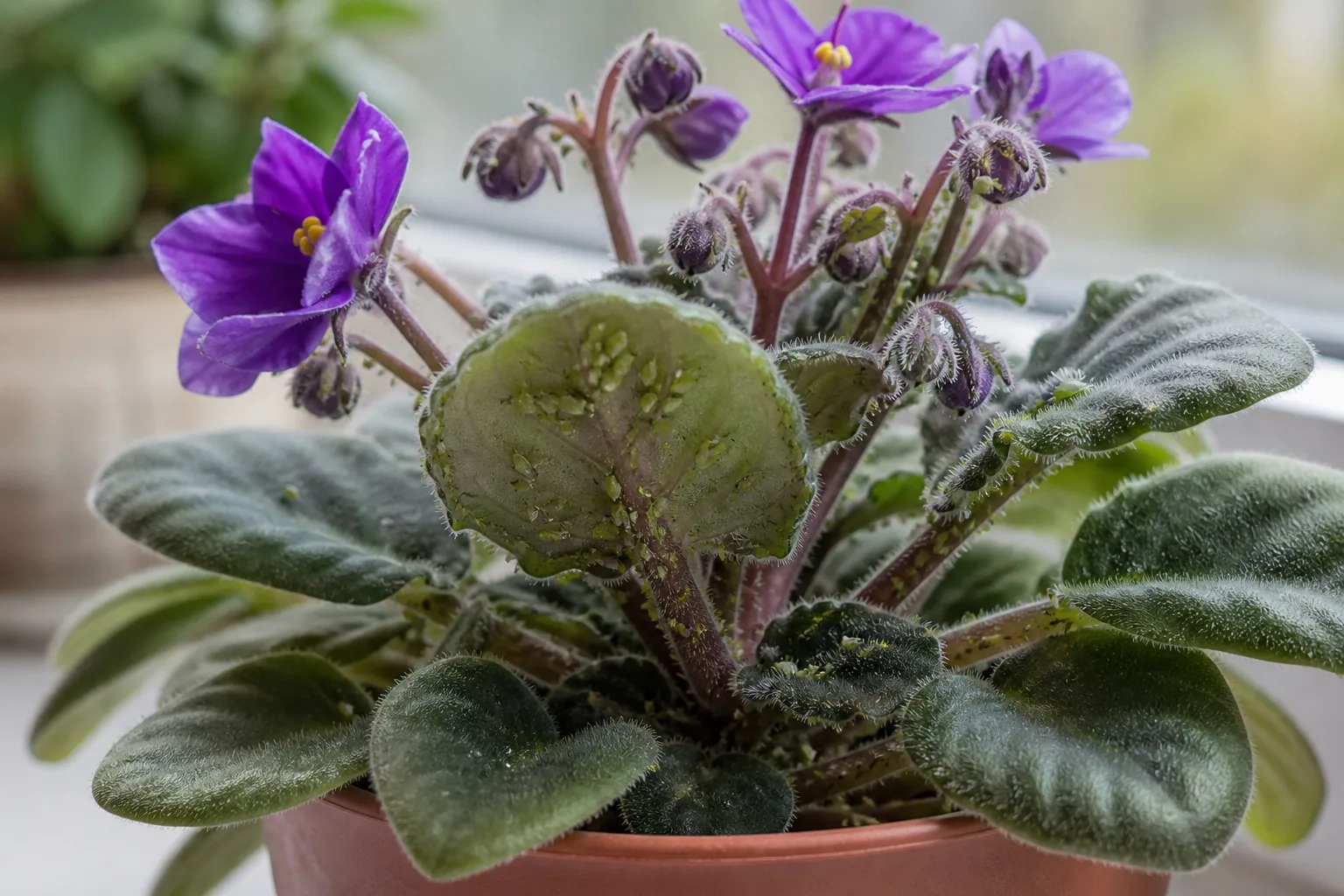
Aphids on African Violet: Causes, Checks & Fixes
This guide covers aphids on African Violet. See also the general Aphids guide, watering, and light pages for this plant.
Aphids on African Violet: Causes, Checks & Fixes
Quick answer
You found small insects on your Saintpaulia buds or crown-and your first instinct may be to rinse the plant under the tap. Stop. Do not shower fuzzy African Violet leaves or spray soap into the rosette center. Cold water causes permanent ring spots on foliage, and a wet crown invites crown rot in a plant that must stay dry on top.
First step: isolate the plant, then dab every visible aphid with a cotton swab soaked in 70% isopropyl alcohol. Work from buds inward toward the crown, wipe away honeydew as you go, and repeat every three to four days until two consecutive checks find no live insects.
For species baseline and culture, see the African violet overview.
Why African Violet gets aphids - and why they’re hard to spot
Aphids usually arrive on a new grocery-store violet, a show-plant purchase, a cutting from a friend, or a neighboring houseplant with a low-level infestation. They are not picky indoors: when better hosts are scarce, they will feed on African Violet even though aphids do not like to feed on violets as a first choice.
Several traits of African Violet culture make aphid problems harder to spot and harder to treat than on smooth-leaved houseplants:
- The compact rosette shelters insects between overlapping fuzzy leaves and inside flower clusters where you rarely look during routine care.
- Continuous bloom cycles give aphids fresh tender tissue year-round-buds are often colonized before outer leaves show damage.
- Bottom-watering keeps soil healthy but means you may not inspect stem tips and buds unless you lift inner leaves during weekly watering checks.
- Moderate feeding matters: over-fertilized violets with soft, fast leaf growth are especially attractive. Align feeding with the fertilizer guide once the plant is pest-free.
Because African violet leaves must stay dry, you cannot rely on the strong water rinse that works well on rubber plants or pothos-any treatment has to target insects without soaking the crown.
What aphids look like on African Violet
Photo check: Compare your plant to these field marks before treating.
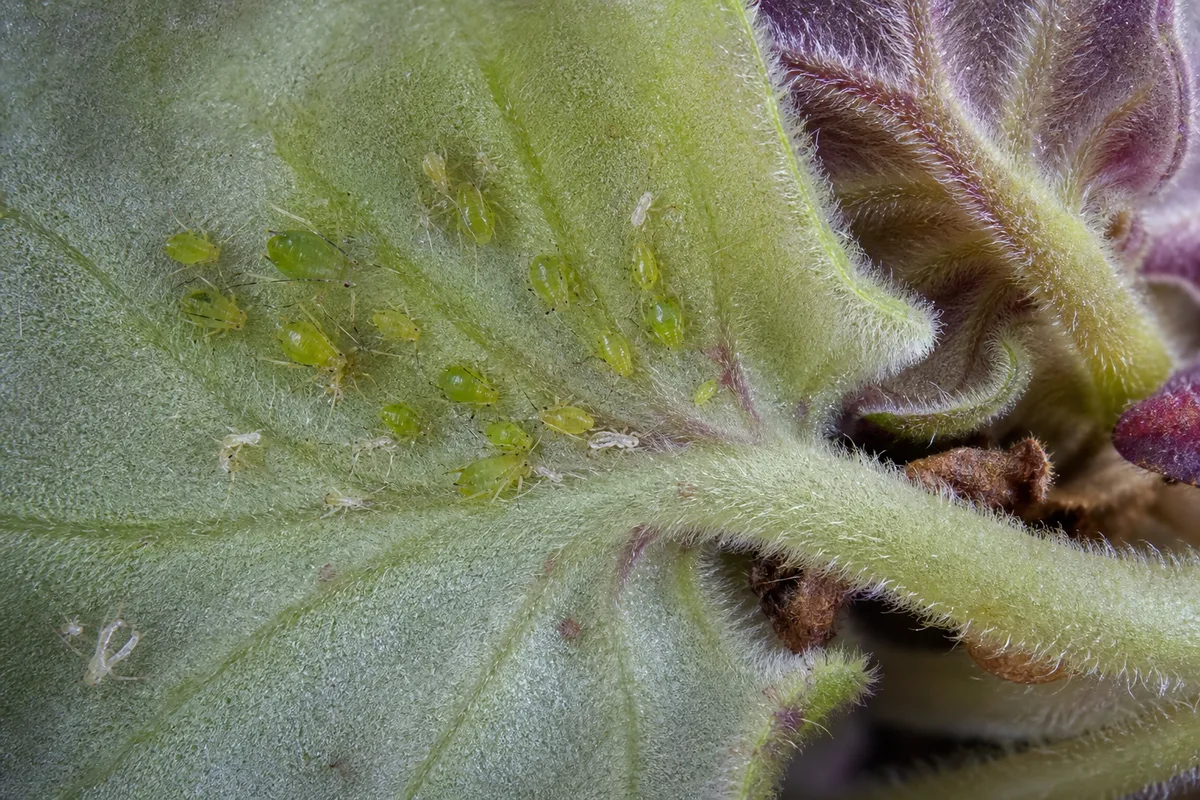
Aphids symptoms on African Violet - compare with healthy tissue on the same plant.
| What you see | Likely meaning |
|---|---|
| Soft green, black, or pink bumps clustered inside a partially open bud | Aphids on tender bloom tissue |
| Shiny sticky patches on upper leaf surfaces below buds | Honeydew dripping from infested flowers above |
| Tiny black speckles that wipe off with alcohol but return | Sooty mold following honeydew-not a separate fungal disease while aphids remain |
| White flecks on petals | Often shed aphid exoskeletons from molting-not powdery mildew |
Aphids are soft-bodied, pear-shaped insects roughly 1/16 to 1/8 inch long. They may be green, black, brown, pink, or red, and they often cluster on the undersides of young crown leaves, along flower stalks, and inside partially open buds. Mature outer leaves are frequently untouched while the center of the plant looks crowded with insects.
Honeydew-a shiny, sticky residue on leaf surfaces-is a common secondary sign. On African Violet, honeydew may appear on upper leaf surfaces where droplets fall from buds above. Sooty mold can follow, showing as tiny black speckles that wipe off with alcohol but return if aphids remain.
Heavy feeding can curl leaf edges, pale the foliage, deform flowers, and slow new growth. Buds may fail to open or look twisted before you ever notice insects on older leaves.
Confirm aphids vs. thrips, mealybugs, and whiteflies
Work in good light with a magnifying glass. Use the table below when more than one pest could fit.
| Symptom | Most likely pest | Quick check |
|---|---|---|
| Sticky buds + soft pear-shaped insects in crown center | Aphids | Crush one-green or pink smear on swab |
| Yellow pollen dust on petals + silver-gray streaks on leaves | Thrips | Tap bloom over white paper; insects jump quickly |
| White cottony masses in leaf axils, not exposed bumps on buds | Mealybugs | Clusters stay put; crush pink or orange |
| Small white insects fly up when plant is disturbed | Whiteflies | Cloud on disturbance; aphids stay put |
| Fine webbing + stippled older leaves | Spider mites | Mites on undersides; dry-air stress common |
| Gnats from soil surface; blooms look clean | Fungus gnats | Insects emerge from mix, not from flowers |
Four-step crown and bud inspection
Check in this order:
- Flower buds and open blooms-aphids often colonize petals before leaves show damage.
- The crown center where new leaves emerge.
- Undersides of the two innermost leaf rows.
- Neighboring African Violets and any plants on the same shelf.
Crush one insect with a swab. Aphids leave a green or pink smear; perlite, dust, or mineral spots do not. Tap a bud over white paper-live aphids are slow-moving compared with thrips, which jump quickly.
If you see sticky leaves but no insects, check for ants farming aphids on nearby plants before assuming the violet is clear.
First fix: isolate and alcohol-dab safely
Move the plant away from your collection first. Isolation helps prevent further spread of aphids to other pots on the same windowsill or wick tray.
Then dab every visible aphid with a cotton swab soaked in 70% isopropyl alcohol. Work bud to crown to inner leaves. Wipe honeydew from leaf surfaces with a fresh swab so sooty mold does not take hold. Remove a heavily infested flower stalk rather than trying to soak insects out of a tight bud cluster.
Repeat the alcohol pass every three to four days until two consecutive checks find no live insects. Aphids reproduce quickly; one treatment rarely clears an established colony.
Why water rinses fail on fuzzy leaves
Smooth-leaved houseplants tolerate a strong shower that knocks aphids loose. African Violet does not. Cold water on foliage causes permanent ring spots, and water pooling in the rosette invites crown rot. If you rinse after alcohol treatment at all, hold the plant upside-down and rinse with lukewarm water so foliage dries within an hour-or skip rinsing entirely when only a few insects were present.
On a violet rosette, this means your entire treatment plan must be contact-based and crown-dry, not a soak-and-spray protocol copied from pothos or fiddle-leaf fig guides.
Neem oil test-patch for heavier infestations
For heavier infestations after a week of dabbing, neem oil is listed for aphid control on African violets among less-toxic options. Optimara recommends neem as a contact spray on leaf undersides where aphids cluster-cover undersides thoroughly because neem has limited residual effect when sprayed.
On fuzzy foliage, always test one leaf first and wait 48 hours. Phytotoxicity can show as dull spots or edge burn, especially under grow lights. Apply during mild indoor temperatures, keep spray off open blooms when possible, and never mist the crown center. Repeat on a three- to seven-day cycle per label until live insects are gone.
Insecticidal soap on African Violet
Insecticidal soap is among the least-toxic sprays Clemson HGIC lists for aphids on African violets, but soap works only on direct contact-it has no residual effect and must reach the insect’s body.
For African Violet, that means:
- Dilute per label; never use household dish soap.
- Test one outer leaf; wait 48 hours before treating the rest.
- Mist leaf undersides only, not the fuzzy upper surfaces or crown.
- Repeat every three days because new aphids hatch from eggs the spray missed.
Soap is a reasonable step between alcohol dabbing and stronger chemistry when populations persist on inner leaves but the crown stays firm.
Contact vs. systemic treatments
| Approach | How it works on African Violet | Crown-safety notes |
|---|---|---|
| Alcohol dab | Kills on contact; best for light infestations in buds | Keep crown dry; safest first option |
| Insecticidal soap / neem | Contact kill on sprayed surfaces | Undersides only; test patch first; repeat on schedule |
| Soil-applied imidacloprid granules | Systemic uptake through roots | Clemson lists imidacloprid granules for mealybugs and related pests on African violets; use only on firm, rot-free plants; avoid if crown is soft; may affect blooms-read label |
| Household aerosol sprays | Variable | Many contain additives that damage African violet foliage; prefer soluble powders mixed to label if chemical escalation is necessary |
Do not fertilize while the plant is under pest stress. Soft new growth from extra nitrogen gives aphids more food exactly when you want the plant to recover slowly.
Recovery timeline and bloom expectations
Light infestations often clear within one to two weeks of consistent alcohol dabbing. Check buds and new growth weekly for at least a month because eggs hatch on staggered schedules.
Judge success by new leaves opening without curl, flower stalks staying clean, and no fresh honeydew-not by whether old damaged petals look perfect again. Badly distorted or yellowed leaves may never fully recover; remove them once the plant is insect-free and producing healthy new growth.
Signs the problem is worsening include sooty mold spreading, ants visiting the pot, stunted center growth, and aphids appearing on plants that sit within a few feet of the original host. Many aphids carry viruses that can permanently damage African Violets if populations are left untreated-cross-check mosaic virus symptoms if new leaves show mottling after a heavy infestation.
What not to do
Do not spray cold water or soap directly on fuzzy leaves or into the crown. Wet crowns invite rot in tight rosettes-a worse emergency than aphids alone.
Do not return the violet to a shared shelf until you have checked it clear for two full weeks. Do not assume one alcohol session finished the job-indoor aphid populations rarely collapse without repeated treatment.
Do not propagate from a heavily infested plant until it has been insect-free for several weeks-cuttings can carry crawlers into your propagation tray. See the propagation guide for clean-start practices.
How to prevent aphids next time
Quarantine every new African Violet for at least two weeks before placing it near your collection, and inspect plants carefully for pests during that period. Inspect buds and crown centers under magnification every few days while the plant stays isolated.
Fold pest checks into bottom-watering: when the pot sits in its reservoir, lift inner leaves, look at stem tips, and scan open flowers. Healthy, moderately fed plants with steady growth are less attractive than over-fertilized specimens pushing soft tissue.
Keep air moving gently around pots-stagnant, overcrowded shelves make it easier for pests to move plant to plant without you noticing. When buying, examine buds and new growth closely; a clean outer row of leaves can hide an infested center.
When to escalate - viruses, chronic infestations, and disposal
Escalate treatment when alcohol dabbing for seven to ten days still finds live insects on new growth, honeydew returns within days of wiping, or aphids jump to neighboring violets despite isolation.
Try neem or insecticidal soap on undersides before stronger chemistry. If you use labeled contact insecticides, Clemson HGIC advises spraying outdoors in shade during mild temperatures and bringing plants back inside only when dry-never soak the crown during transport or spray.
Consider discarding when:
- New leaves show virus-like mottling or distortion that worsens after the infestation clears-see mosaic virus.
- The crown feels soft, smells sour, or new center leaves blacken-route to crown rot instead of repeated spraying.
- Three properly timed treatment cycles (alcohol plus contact spray) fail and aphids return on every new leaf.
For chronic indoor infestations that survive repeated treatment across your collection, contact your local cooperative extension office for identification help and region-appropriate pesticide guidance.
Related African Violet guides
- African violet overview - light, watering, and bloom culture basics
- Thrips on African Violet - pollen dust and silver streaks without soft bud clusters
- Mealybugs on African Violet - cottony masses in leaf axils
- Whiteflies on African Violet - insects that fly on disturbance
- Crown rot on African Violet - soft rosette center after wet crown sprays
- African violet fertilizer - hold feed until new growth looks normal after pest stress
Related tool
Use the Pest Identifier Tool to narrow causes for aphids on this plant before changing multiple variables at once.