Mealybugs on African Violet: Causes, Checks & Fixes
Quick answer
Mealybugs on African Violet hide in the tight rosette center and leaf axils. First step: isolate the plant and dab every visible insect with a cotton swab soaked in 70% isopropyl alcohol.
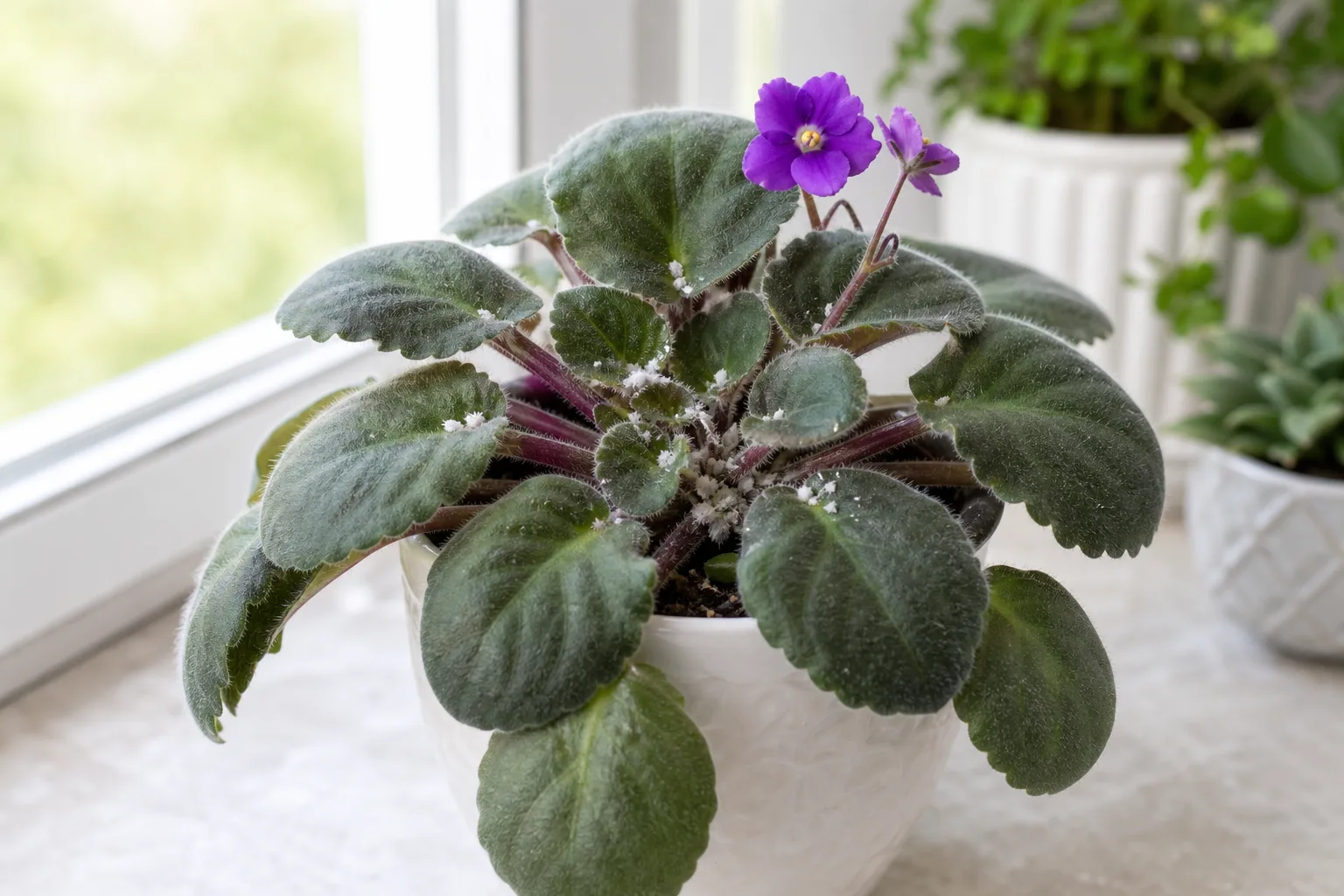
Mealybugs on African Violet: Causes, Checks & Fixes
This guide covers mealybugs on African Violet. See also the general Mealybugs guide, watering, and light pages for this plant.
Mealybugs on African Violet: Causes, Checks & Fixes
Quick answer
Mealybugs on African Violet are sap-sucking insects that look like tiny cotton balls tucked into the rosette. They feed in the exact places you inspect least during routine bottom-watering: leaf axils, petiole bases, and the crown center where new leaves emerge.
First step: move the plant away from your collection, then dab every visible mealybug with a cotton swab soaked in 70% isopropyl alcohol. Do not shower fuzzy leaves or spray the crown with cold water-that causes permanent ring spots on African Violet foliage and can invite crown rot in a wet rosette.
Why African Violet gets mealybugs
Mealybugs usually arrive on a new purchase, a shared cutting, or a neighboring houseplant that already had a low-level infestation. Indoor conditions favor them: year-round mild temperatures and the absence of outdoor predators let populations build quietly on houseplants.
African Violet culture gives mealybugs extra cover. The compact rosette shelters insects between overlapping fuzzy leaves and inside tight crown folds-exactly where they nest in the compact rosette centre. Because you bottom-water to keep foliage dry, you may not look closely at stem joints unless you lift leaves during weekly care.
Over-fertilized violets pushing soft new growth are especially attractive. Nitrogen fertilizer combined with regular watering stimulates tender tissue where mealybugs prefer to lay eggs. Crowded shelves also make it easy for crawlers to move pot to pot without you noticing.
A second type-soil or ground mealybugs-deserves separate attention on African Violet. Ground mealybug infestations are most often reported on African violet and gardenias. These root-zone pests look like tiny white grains on the soil surface or rootball and can persist even when leaf surfaces look clean.
What mealybugs look like on African Violet
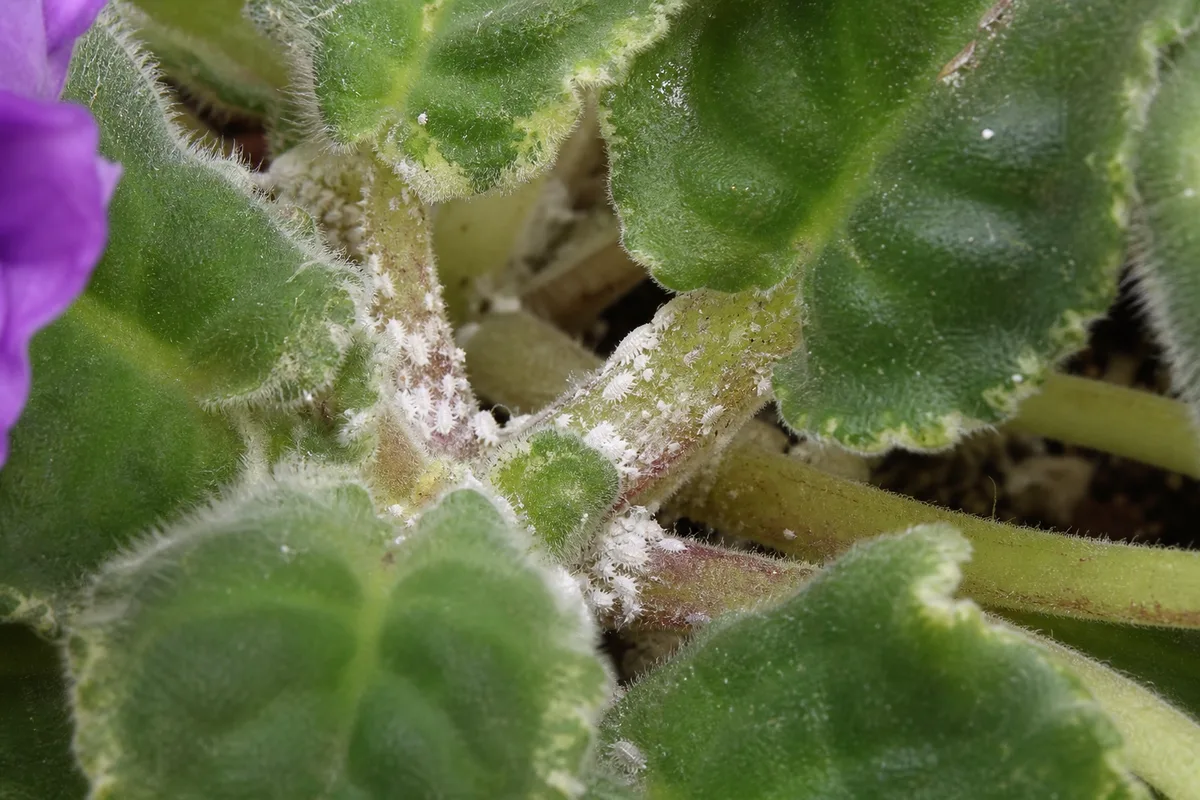
White cottony mealybug clusters nestled in an African violet leaf axil and crown fold - crush one with alcohol on a swab to confirm pink or orange tissue.
Leaf mealybugs appear as white, powdery, cotton-like specks roughly 1/16 to 1/4 inch long on leaf undersides, in leaf axils, along petioles, and in or near the crown. They may sit alone or in small clusters. Mature outer leaves can look fine while the center of the plant holds the heaviest population.
Soil mealybugs resemble small grains of rice on the soil surface, around the main stem, or on the rootball when you slip the plant from its pot. They lack the obvious cotton filaments of aboveground species.
Feeding damage shows up as stunted or distorted leaves, slowed center growth, and yellowing on heavily fed foliage. Honeydew-a shiny, sticky residue-may coat upper leaf surfaces where droplets fall from infested buds above. Sooty mold can follow, appearing as dark speckles that wipe off with alcohol but return if insects remain.
Bud drop and twisted new leaves sometimes appear before you notice cottony masses on older foliage. Heavy infestations can kill individual leaves or the whole plant if left untreated.
How to confirm the cause
Work in good light with a magnifying glass. Check in this order:
- The crown center where new leaves emerge-mealybugs cluster here first.
- Leaf axils and petiole bases on the two innermost leaf rows.
- Undersides of leaves touching the crown.
- Soil surface and pot rim for white rice-like grains (soil mealybugs).
- Neighboring African Violets and any plants on the same shelf.
Press a cotton swab against a white speck and roll it gently. Mealybugs crush to a pink or orange smear; perlite, dust, or dried hard-water spots do not. Natural leaf fuzz on African Violet is evenly distributed across the blade-mealybugs cluster at joints and along veins, not uniformly.
Lookalikes to rule out
Powdery mildew forms a flat white film across leaf surfaces rather than discrete cottony bumps in axils.
Scale insects attach as flat, immobile disks on stems; mealybugs look fluffy and can be rolled off with a swab.
Spider mites leave fine webbing and stippled leaves, not waxy cotton clusters.
Thrips cause silvery streaks and scatter quickly when disturbed; mealybugs stay put.
If leaves are sticky but you see no cottony masses, check for ants farming mealybugs on a nearby plant before assuming the violet is clear.
First fix for African Violet
Move the plant away from your collection first. Isolation stops crawlers from spreading to other pots on the same windowsill.
Then dab every visible mealybug with a cotton swab dipped in rubbing (isopropyl) alcohol. A fine artist’s brush works for insects deep in the crown where a swab cannot reach. Work from the center outward-crown, inner axils, then petiole bases. Wipe honeydew from leaf surfaces with a fresh swab so sooty mold does not take hold.
Repeat as needed every week until two consecutive checks find no live insects. One pass rarely clears an established colony because eggs hatch on staggered schedules and crawlers reinfest sheltered axils.
If alcohol is not enough
For heavier leaf infestations after two weeks of dabbing, insecticidal soap or neem oil applied carefully to leaf undersides can supplement contact kills-test one leaf first and wait 48 hours because fuzzy foliage is sensitive to sprays. Take the plant outside during mild temperatures to spray if you use a labeled product, and keep spray off the open crown when possible.
Do not submerge the crown or rinse with cold tap water. If you must rinse after treatment, hold the pot so water runs away from the rosette center and use lukewarm water so foliage dries within an hour-or skip rinsing when only a few insects were present.
If you suspect soil mealybugs
When white grains appear on soil or roots but leaf dabbing does not stop new damage, treat the root zone. Repot in fresh mix blended with diatomaceous earth or discard heavily infested soil after gently washing the rootball. Soil mealybugs hide below the surface; leaf-only treatment will not reach them.
Recovery timeline
Light leaf infestations often decline within two to three weeks of consistent alcohol dabbing. Plan on at least three to four weekly passes before calling the plant clear-repeat weekly until the infestation is gone.
Judge success by clean new center growth, unsticky foliage, and no fresh cottony clusters-not by whether old distorted leaves look perfect again. Badly stunted or yellowed leaves may never fully recover; remove them once the plant is insect-free and producing healthy new growth.
Signs the problem is worsening include sooty mold spreading, ants visiting the pot, white grains multiplying on soil, and mealybugs appearing on plants within a few feet of the original host. Mealybugs can pass viruses onto host plants as they feed-persistent stunting after insects are gone warrants checking for virus symptoms separately.
What not to do
Do not spray cold water or soap directly on fuzzy leaves. Cold water on foliage causes permanent ring spots, and wet crowns invite rot in tight rosettes.
Do not fertilize while the plant is under pest stress. Soft new growth from extra nitrogen gives mealybugs more food exactly when you want recovery to slow.
Do not return the violet to a shared shelf until you have checked it clear for two full weeks. Do not assume one alcohol session finished the job-indoor mealybug populations rarely collapse without repeated treatment.
Do not compost infested leaf trimmings indoors where crawlers can spread to other pots.
How to prevent mealybugs next time
Quarantine every new African Violet for at least two weeks before placing it near your collection. Inspect a new plant carefully, including the bottom of the pot, for mealybug eggs and soil mealybugs during that period.
Fold pest checks into your normal bottom-watering routine: lift inner leaves, scan crown centers under magnification, and look at the soil surface around the stem. Healthy, moderately fed plants with steady growth are less attractive than over-fertilized specimens pushing soft tissue.
Keep air moving gently around pots-stagnant, overcrowded shelves make it easier for crawlers to move plant to plant without you noticing. When buying, examine inner crown growth closely; a clean outer row of leaves can hide an infested center.
When to use this page vs other African Violet guides
- African Violet watering guide - Use for routine moisture checks before assuming mealybugs is the main issue.
- African Violet problems hub - Browse all 52 common issues on this species.
- Yellow Leaves on African Violet - Different entry point when symptoms overlap with mealybugs.
- Spider Mites on African Violet - Different entry point when symptoms overlap with mealybugs.
- White Spots on African Violet - Different entry point when symptoms overlap with mealybugs.