African Violet Light Requirements Indoors
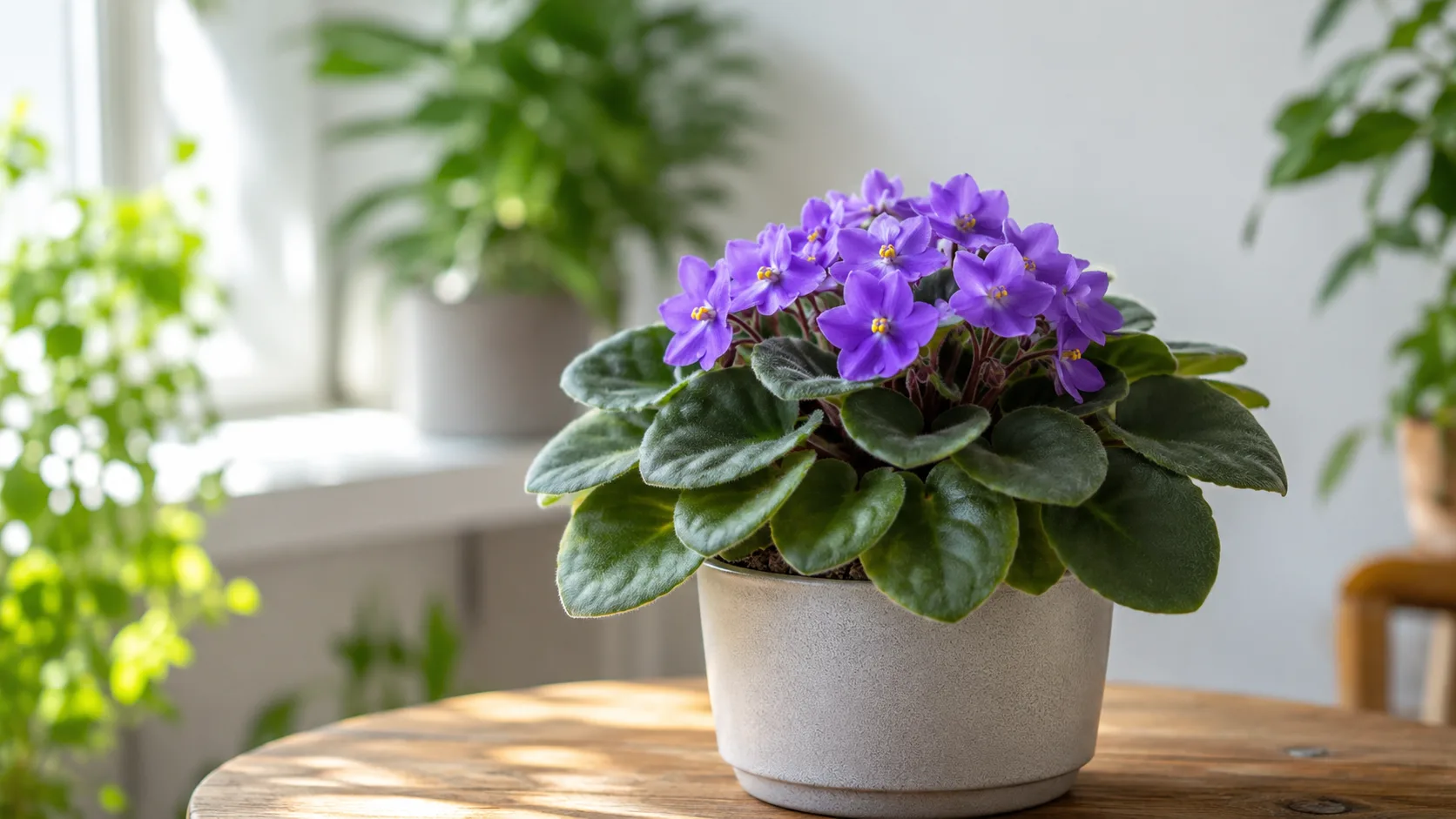
African Violet Light Requirements Indoors
African Violet Light Requirements Indoors
The Short Answer
African violets need bright, indirect light for most of the day, plus a regular period of darkness at night. For many indoor growers, the practical target is about 12 to 16 hours of gentle light and 8 hours of darkness, especially when the goal is steady blooming. University sources vary slightly on the ideal range: University of Minnesota Extension recommends 14 to 16 hours of light and 8 to 10 hours of darkness for flowering, while University of Florida IFAS says African violets generally need 8 to 12 hours of light, up to 16 hours, and 8 hours of darkness per day. (University of Minnesota Extension)
The safest light is bright but filtered, not harsh direct afternoon sun. A healthy African violet should sit in enough light to keep its leaves compact, medium green, and slightly outward-facing, but not so much that the leaves bleach, yellow, cup downward, or develop scorched patches. East, north, northeast, and northwest windows often work well because they give usable brightness without the strongest afternoon sun. The Smithsonian also notes that African violets naturally grow protected by forest canopy, which explains why filtered light suits them better than exposed direct sun. (Smithsonian Gardens)
A simple rule works for most homes: place the plant where it receives bright daylight without hot sun touching the leaves for long periods. If your room is dim, use an LED or fluorescent grow light on a timer. If your plant grows flat and tight with pale leaves, reduce the light or increase the distance from the fixture. If it stretches upward, leans, grows long leaf stems, or refuses to bloom, give it more light or a longer daily light period.
Why African Violets Need Bright but Gentle Light
African violets are often described as “low-light plants,” but that phrase causes problems. They can survive in lower indoor light better than many flowering houseplants, but survival is not the same as blooming. A plant may stay alive on a desk or shelf for months and still produce no flowers because it is not receiving enough usable light to support strong growth and bloom cycles. For African violets, the sweet spot is not darkness or direct sun; it is consistent, bright, indirect light.
The reason this matters is that African violet leaves are adapted to collect light efficiently. Their fuzzy, fleshy leaves help them handle filtered environments, but those same leaves can suffer when exposed to intense heat or strong direct sunlight through glass. Indoor sunlight can be surprisingly harsh in a south or west window, especially during warm months. A leaf that looks fine in morning sun may scorch in afternoon sun because the heat load and light intensity are different.
Light also affects the plant’s shape. An African violet getting balanced light usually forms a neat rosette, with leaves arranged evenly around the crown. A plant that gets light from one side may lean, grow asymmetrically, or stretch toward the window. A plant that gets too much overhead light may grow tight, hard, and flattened. Watching the plant’s shape often gives a better answer than guessing from the window direction alone.
What Their Native Habitat Tells Us
African violets are commonly associated with Saintpaulia, though modern taxonomy places them within Streptocarpus sect. Saintpaulia. Kew’s Plants of the World Online lists accepted Streptocarpus ionanthus subspecies from Tanzania, including plants native to the East Usambara Mountains and wet tropical habitats. (Plants of the World Online) This matters for indoor care because these plants did not evolve as desert succulents or full-sun bedding plants. They come from environments where moisture, shade, and filtered light are part of the natural setting.
That does not mean an African violet wants a dark corner. Forest-filtered light can still be bright, especially compared with the light levels inside a room several feet away from a window. Many homes are much dimmer than people realize. Human eyes adjust quickly, so a corner that looks bright enough to read in may still be weak for a flowering plant. This is why African violets often bloom near windows or under grow lights but stall on interior shelves.
The useful takeaway is simple: imitate canopy light, not cave shade. Give the plant a bright position, but soften the sun when it becomes hot or direct. A sheer curtain, a position beside rather than directly against a bright window, or a well-timed grow light can all create the kind of light African violets use well.
Why “Bright Indirect Light” Is Not Enough Guidance
“Bright indirect light” is accurate, but it is incomplete. It does not tell you how many hours the plant receives, whether the light changes in winter, how far the plant sits from the window, or whether a grow light is too close. Two people can both say they have bright indirect light and mean completely different conditions. One may have an east window with four hours of soft morning brightness; another may have a plant eight feet from a shaded north window.
For African violets, the better question is: Is the plant receiving enough gentle light for enough hours without leaf stress? This combines intensity, duration, distance, direction, and plant response. A weaker light for a longer period can sometimes perform better than a stronger light for too short a period. University of Florida IFAS makes this point directly, noting that a plant with the right light level for too short a time may do worse than one given weaker light for a longer period. (Ask IFAS - Powered by EDIS)
This is why timers are so useful with grow lights. They remove guesswork from duration. It is also why rotating the plant helps with window growing. Better African violet lighting is rarely about one dramatic fix; it is usually about giving the plant consistent light, then reading the leaves and flowers over several weeks.
How Many Hours of Light African Violets Need
African violets generally bloom best when light is both adequate and consistent. A common indoor target is 12 to 16 hours of light per day, followed by a meaningful dark period. University of Minnesota Extension recommends 14 to 16 hours of light and 8 to 10 hours of darkness daily for flowering. Smithsonian Gardens gives a general rule of 10 to 12 hours of strong light each day. University of Florida IFAS gives a flexible range of 8 to 12 hours, up to 16 hours, with 8 hours of darkness. (University of Minnesota Extension)
Those ranges are not contradictions as much as practical growing windows. A plant in a bright east window may not need the same schedule as a plant grown entirely on a shelf under LEDs. A mature, healthy plant may bloom with less intervention than a weak plant recovering from poor care. A mini African violet under a close grow light may react differently from a large standard variety sitting farther away from a fixture. The plant’s response should guide fine-tuning.
If you are starting from scratch, set a grow light timer for 12 to 14 hours daily and observe the plant for three to four weeks. If leaves stretch upward and blooms do not appear, increase the duration slightly or move the light closer. If leaves bleach, yellow, curl downward, or look stiff and crowded, reduce intensity or duration. Make one change at a time so you know what actually helped.
The Daily Light and Darkness Range
The most reliable daily rhythm is bright light during the day and darkness at night. African violets do not need light around the clock. In fact, leaving grow lights on all night is one of the easiest ways to create stressed plants that look tired, tight, or reluctant to bloom. A timer is inexpensive and removes the temptation to manually switch lights on and off inconsistently.
A practical schedule is 7 a.m. to 9 p.m. for 14 hours of light, or 8 a.m. to 8 p.m. for 12 hours of light. The exact clock time matters less than the consistency. What matters is that the plant receives enough daily light and then gets a real night period. If the plant sits in a room where lamps stay on late, normal household lighting is usually not intense enough to replace a grow light, but constant bright lighting directly over the plant can interfere with a stable rhythm.
For window-grown plants, duration depends on the season and exposure. An east-facing window may provide excellent morning light but less total intensity in winter. A north-facing window may work beautifully in summer but become too weak in darker months. If flowering slows in winter while the plant otherwise looks healthy, light duration is one of the first things to check.
Why Darkness Matters for Blooming
African violets need darkness as part of a healthy daily cycle. Multiple extension and horticultural sources recommend a defined dark period, commonly around 8 hours, for flowering. (University of Minnesota Extension) The dark period allows the plant’s normal physiological processes to continue without constant light stress. It also gives the grower a clean structure: light during the day, rest at night, repeat.
The mistake is thinking more light always means more flowers. Up to a point, more usable light can improve blooming. Beyond that point, the plant does not become “extra productive”; it becomes stressed. Leaves may flatten, tighten, yellow, or show burnt areas. Flowers may fade faster. The crown may look crowded, and new leaves may emerge smaller than expected.
A better mindset is balance. African violets bloom when they have enough energy, stable conditions, and no major stress. Light is central, but it works with water, temperature, humidity, nutrition, pot size, and root health. A plant under perfect light can still fail if it is overwatered or exhausted, but when everything else is reasonable, light is often the missing bloom trigger.
Best Window Placement for African Violets
The best window for an African violet is usually one that gives bright, cool, indirect light without strong afternoon sun burning the leaves. University of Minnesota Extension specifically says north, northwest, and northeast exposures work well. Penn State Extension also emphasizes bright light without direct sunlight. (University of Minnesota Extension) In many homes, east windows are also excellent because morning sun is gentler than late-day sun.
Window placement is not only about compass direction. Trees, buildings, balcony overhangs, tinted glass, climate, season, and distance from the window all change the result. A north window in an open, bright apartment may outperform an east window blocked by another building. A west window in winter may be useful, while the same window in summer may scorch leaves. The plant’s behavior is the final test.
Place the African violet close enough to receive bright light but not so close that leaves press against cold or hot glass. Rotate the pot a quarter turn every few days or once a week to keep the rosette even. If the plant leans strongly toward the window, it wants more even light. If the window side of the plant gets pale or scorched, the light is too intense on that side.
East, North, Northeast, and Northwest Windows
An east-facing window is often the easiest natural-light location. It gives morning sun, which is usually cooler and less damaging than afternoon sun. Many African violets can handle some direct early morning light, especially if the window is not extremely hot. If the leaves remain medium green and the plant blooms regularly, an east window is doing its job.
A north-facing window is usually safe from harsh direct sun, but it may be too dim in winter or in rooms blocked by trees or buildings. If the plant grows healthy leaves but rarely blooms, the north window may not be bright enough for flowering. In that case, move the plant closer to the glass, supplement with a grow light, or choose a brighter exposure. Do not assume “safe from sunburn” automatically means “enough to bloom.”
Northeast and northwest windows can be excellent compromise positions. They often provide bright ambient light with limited harsh sun. They are especially useful for growers who have scorched plants in south or west windows but see poor blooming in darker rooms. The best placement is usually near the window, not deep inside the room.
When South or West Windows Can Work
South and west windows are not automatically wrong, but they require more caution. In many climates, they provide the strongest direct light and heat, especially during afternoon hours. Direct sun through glass can burn African violet leaves, leaving tan, brown, or bleached patches that do not heal. Once a leaf is scorched, the damaged tissue remains until the leaf is removed.
A south window can work in winter when sunlight is weaker, or if the plant is set back from the glass and protected with a sheer curtain. A west window can work if the afternoon sun is filtered or brief. The goal is not to avoid brightness; the goal is to avoid hot, intense sun sitting directly on the foliage. If you can feel heat building on the leaves, the plant is probably too exposed.
A sheer curtain is often the simplest fix. It turns harsh direct light into filtered light while keeping the area bright. Moving the plant to the side of the window rather than directly in the sunbeam can also help. When in doubt, check the leaves after a few sunny days. African violets give clear feedback if the light is too strong.
Natural Light vs Grow Lights
Natural light is simple, free, and often enough when the window is right. Grow lights are more controlled, consistent, and useful when windows are too dim, seasonal, or uneven. Neither option is automatically better. The better choice is the one that gives your African violet stable, bright, gentle light without heat stress.
A window-grown African violet often looks more natural because light changes through the day. However, window light can be inconsistent. Winter days are shorter, clouds reduce intensity, and a plant that bloomed in one apartment may stall in another. Natural light also comes from one direction, so rotation is important for even growth.
Grow lights solve many of those problems. They allow you to grow African violets on shelves, in offices, or away from suitable windows. They also make it easier to give a precise light duration. University of Minnesota Extension notes that fluorescent or LED grow lights may be used alone or to supplement natural light, while Virginia Cooperative Extension provides guidance for plants grown entirely under fluorescent light. (University of Minnesota Extension)
| Setup | Best For | Main Advantage | Main Risk |
|---|---|---|---|
| East window | Most homes with morning light | Gentle natural brightness | Too little light in winter |
| North window | Bright rooms, hot climates | Low scorch risk | Weak blooming if too dim |
| South window with curtain | Winter or filtered exposure | Strong usable light | Leaf burn if unfiltered |
| West window with curtain | Bright rooms needing filtering | Good intensity | Afternoon heat stress |
| LED grow light | Shelves, offices, dark homes | Control and consistency | Too close or too long |
| Fluorescent grow light | Traditional plant stands | Proven for violets | Bulb aging and heat management |
When Natural Light Is Enough
Natural light is enough when the plant grows compact, symmetrical leaves and produces blooms without stretching. The leaves should not reach sharply upward, and the stems should not elongate as if the plant is searching for light. Flowering should occur repeatedly under stable care, not just once after purchase. Many store-bought African violets bloom from greenhouse conditions, then stop at home because indoor light is weaker than what they were grown under.
A good natural-light setup usually keeps the plant close to the window. The phrase “near a window” can be misleading because light drops quickly with distance. A plant one foot from a bright window receives far more light than one six feet away. If your African violet is on a coffee table across the room, it may look decorative but receive too little light to bloom.
Use the plant as the judge. If new leaves are smaller, darker, and more upright than older leaves, increase light. If the plant blooms well but leaves on one side stretch, rotate it. If the plant looks healthy but flowers are rare, supplementing natural light for a few extra hours per day can make a major difference.
When Artificial Light Is Better
Artificial light is better when your home does not provide a reliable bright window. It is also useful for collectors growing multiple plants, people in apartments with shaded windows, and anyone who wants more predictable blooming. A grow light does not need to be expensive or complicated, but it does need to be close enough, gentle enough, and timed correctly.
LED lights are now common because they are efficient, widely available, and cooler than many older fixtures. Fluorescent lights also work and have a long history with African violet growers. The African Violet Society of America discusses fluorescent and LED options and notes that growers have used different light types successfully, including combinations that provide a fuller spectrum. (African Violet Society of America)
The biggest advantage of grow lights is repeatability. You can set the timer, adjust the distance, and watch how the plant responds. If you move homes, change seasons, or rearrange a room, the grow light setup stays more stable than window light. That stability is especially helpful for plants that are slow to rebloom after purchase.
How to Use LED or Fluorescent Grow Lights
A good African violet grow light setup gives even light across the plant, runs on a timer, and avoids heat buildup. The light should be close enough to be useful but not so close that leaves bleach, scorch, or grow tight. With LEDs, exact distance depends heavily on fixture strength. A small low-power shelf light may need to be closer than a powerful full-spectrum panel.
Virginia Cooperative Extension says African violets grown entirely under fluorescent light should receive about 600 foot-candles for 12 to 16 hours per day, and notes that this can be provided by two 40-watt fluorescent tubes placed 12 to 15 inches above the plants. (Virginia Tech Publications) That guidance is especially useful for traditional fluorescent setups. With LEDs, use it as a concept rather than a rigid rule, because LED output varies widely.
If you use a light meter or app, treat readings as helpful but not perfect. Lux and foot-candle readings can vary by device, spectrum, and measurement angle. They are still useful for comparing one shelf to another or checking whether a plant is getting much less light than its neighbor. The plant’s growth response remains the most reliable long-term measurement.
Distance, Duration, and Timer Setup
Start most African violets under a grow light at a moderate distance, then adjust by symptoms. For many small LED shelf lights, a starting point of about 10 to 14 inches above the leaves is reasonable, but stronger lights may need more distance. Fluorescent tubes are commonly used around 12 to 15 inches above the plants in extension guidance. (Virginia Tech Publications) The goal is even illumination across the rosette, not a spotlight blasting the crown.
Set the timer for 12 to 14 hours at first. If the plant is healthy but not blooming after several weeks, increase toward 14 to 16 hours. If leaves become pale, tight, or scorched, reduce the duration or raise the light. Avoid the common mistake of changing distance, duration, fertilizer, and watering all at once. When you adjust one variable at a time, the plant’s response becomes easier to read.
Keep the fixture consistent. A plant that spends weekdays under long light and weekends in darkness may struggle to settle into a healthy rhythm. If you travel or forget switches, a timer is not optional; it is the simplest way to prevent uneven care. African violets reward consistency more than dramatic intervention.
Spectrum, Heat, and Fixture Choice
African violets do not need a strange purple light to grow well. A full-spectrum white LED or a balanced fluorescent setup can work. The key is whether the plant receives enough usable light for photosynthesis without heat stress. Red and blue wavelengths matter for plant growth, but for home growers, a reputable full-spectrum grow light is usually simpler and more pleasant than overly intense colored lights.
Heat matters because African violet leaves are sensitive. A fixture that feels hot near the leaf surface can cause stress even when the light level itself might be acceptable. LEDs usually produce less radiant heat than older incandescent bulbs, which is one reason they are popular for plant shelves. Incandescent bulbs are generally poor choices because they produce more heat and less efficient plant-usable light compared with fluorescent or LED options.
Choose a fixture that spreads light evenly over the whole plant. Uneven light creates uneven growth, with one side compact and the other side stretched. If you grow several African violets on a shelf, the plants at the edges may receive less light than the plants in the center. Rotate positions occasionally so one plant is not always stuck in the weakest spot.
Signs Your African Violet Is Getting Too Little Light
Too little light usually shows up as stretching, poor blooming, and darker foliage. The leaves may grow upward instead of lying in a balanced rosette. Petioles, the small leaf stems, may become longer as the plant reaches for light. The center may look open and loose rather than compact. The plant may look alive but never quite strong.
The most frustrating symptom is no flowers. African violets are bought for blooms, so a plant that grows leaves but never flowers often feels mysterious. In many cases, the problem is not age or bad luck; it is insufficient light. SDSU Extension notes that without the correct amount of light, African violets will not bloom, and too little light can cause yellowing leaves and elongated leaves and stems. (SDSU Extension)
Do not fix low light by placing the plant suddenly in harsh direct sun. That can trade one problem for another. Increase light gradually by moving the plant closer to a suitable window, adding a sheer-curtained brighter exposure, or using a grow light for a controlled duration. After adjustment, judge the new growth rather than old leaves. Existing stretched leaves may not shrink back, but new leaves should grow more compactly.
A plant recovering from low light needs patience. Flowers may not appear immediately because the plant first has to rebuild energy and produce stronger growth. Give the new setup several weeks before deciding it failed. If the plant still does not bloom after better light, then check pot size, fertilizer, root health, temperature, and crown condition.
Signs Your African Violet Is Getting Too Much Light
Too much light often shows up as pale, yellow-green, bleached, or scorched leaves. The leaves may curl downward, flatten tightly against the pot, or look stiff and crowded near the crown. Brown or tan patches may appear where sunlight hit the leaf directly. Flowers can fade quickly or develop damaged edges. SDSU Extension warns that too much light can cause sunburn, brown spots on leaves and flowers, downward leaf curl, and variegated varieties turning entirely green. (SDSU Extension)
The difference between bright light and too much light is stress. A well-lit African violet looks energetic, with firm leaves and regular bloom. An overlit plant looks pressured. The center may become tight, the leaves may lose their rich color, and the whole plant may seem flattened. If the issue is direct sun, the damage may appear only on the side facing the window.
Move an overlit plant out of direct sun or raise the grow light. If the plant is in a south or west window, add a sheer curtain or shift it to an east or north exposure. If it is under LEDs, reduce the schedule by one or two hours or increase the distance from the fixture. Do not remove every damaged leaf at once if that would strip the plant. Remove badly damaged leaves gradually while healthy new growth develops.
Too much light can be confused with fertilizer issues, aging leaves, or heat stress. The clue is the pattern. Sunburn often appears on exposed leaf surfaces. Overly intense overhead grow lights often affect the crown and upper leaves. Nutrient problems may appear more generally across the plant. When the symptoms line up with the light source, adjust the light first.
Seasonal Light Adjustments
African violet light care changes through the year, even if the plant never moves. The sun’s angle shifts, day length changes, trees leaf out, and indoor heating or cooling changes the plant’s stress level. A window that is ideal in January may be too hot in May. A north window that works in July may be too dim in December. Seasonal awareness prevents many common bloom problems.
The safest habit is to inspect the plant at the start of each season. Look at leaf color, leaf angle, bloom frequency, and the direction of growth. Check whether direct sun now reaches the plant at a different time of day. A plant that was protected by a roofline in summer may receive a direct beam in winter when the sun is lower. A plant that had bright winter light may get shaded in spring when outdoor trees fill in.
Seasonal adjustment does not always mean moving the plant. Sometimes it means adding a curtain, moving it a few inches, rotating more often, or running a grow light for two extra hours. Small changes are safer than dramatic moves. African violets prefer stable conditions, so adjust with purpose and then wait for the plant to respond.
Winter Light Problems
Winter often causes reduced blooming because days are shorter and light is weaker. Even plants near windows may receive fewer usable hours. Smithsonian Gardens notes that African violets may benefit from southern exposure during winter when sunlight is weaker. (Smithsonian Gardens) This is a practical exception to the usual warning about strong sun: winter sun may be useful when summer sun would be excessive.
If your African violet stops blooming in winter but otherwise looks healthy, supplement with a grow light rather than overcorrecting with fertilizer. Extra fertilizer cannot replace missing light. A timer set for 12 to 14 hours can stabilize the plant through darker months. If the plant sits on a cold windowsill, keep leaves away from cold glass and avoid drafts. Light and temperature work together; a cold, dim plant will slow down.
Winter watering also changes. Less light usually means slower water use. If you increase grow light hours, the plant may use water more normally, but do not assume the old summer African Violet watering guide still fits. Check the potting mix before watering. Many winter problems blamed on light are actually a combination of weak light and wet roots.
Summer Sun Problems
Summer creates the opposite problem: stronger sun, more heat, and faster stress. A west or south window that seemed fine in cooler months may scorch leaves when afternoon light intensifies. Even east windows can become hot in some climates if the plant sits directly against glass. Watch for pale patches, downward curling leaves, or flowers fading quickly.
A sheer curtain is usually enough to turn dangerous direct sun into useful filtered light. You can also move the plant slightly back from the window, but be careful: light intensity drops quickly with distance. Moving the plant from direct sun to deep shade may stop the burn but also reduce blooming. The better fix is filtered brightness.
Summer is also a good time to check whether outdoor shade has changed. Trees may block more light, or reflective surfaces may increase brightness. If the plant’s rosette becomes uneven, rotate it more consistently. If the leaves are warm to the touch during the brightest part of the day, the plant is likely receiving too much heat along with the light.
Troubleshooting Bloom Problems Caused by Light
When an African violet will not bloom, start with light because it is one of the most common causes and one of the easiest to correct. A plant needs enough light to build energy, but it also needs a dark period and freedom from stress. If the plant is healthy, watered correctly, and not pest-infested, poor flowering often points to insufficient light duration or weak intensity.
Use this diagnostic approach before making major changes. First, look at the leaves. Dark, reaching, elongated leaves suggest too little light. Pale, tight, scorched, or downward-curled leaves suggest too much. Second, check the daily schedule. A plant getting only a few hours of usable light may not bloom well, while a plant under lights all night may be stressed. Third, check the position. A plant far from a window may receive far less light than the room appears to have.
| Problem | Likely Light Cause | Practical Fix |
|---|---|---|
| Healthy leaves but no blooms | Light too weak or too short | Add grow light or increase duration gradually |
| Long leaf stems, upright leaves | Plant reaching for light | Move closer to bright indirect light |
| Pale or bleached leaves | Light too intense | Filter sun or raise grow light |
| Brown leaf patches | Direct sun scorch | Move out of sunbeam; use sheer curtain |
| Tight, flattened crown | Grow light too close or too long | Increase distance or reduce hours |
| Plant leans to one side | One-directional light | Rotate regularly |
| Blooms fade quickly | Excess light, heat, or low humidity | Reduce direct exposure and check temperature |
After correcting light, give the plant time. African violets do not instantly replace old growth or produce buds overnight. Watch the newest leaves in the crown. If they emerge healthier and better shaped, the plant is moving in the right direction. Buds may follow once the plant has rebuilt enough strength.
Avoid stacking fixes. Many growers respond to no blooms by moving the plant, increasing fertilizer, African Violet repotting guide, changing water, and adding lights all in the same week. That creates stress and makes the true cause impossible to identify. Change the light first if symptoms point there, then wait. A calm, measured correction works better than panic care.
Conclusion
African violet light is not complicated once you stop treating “bright indirect light” as a complete instruction. The plant needs enough gentle brightness for enough hours, followed by a consistent dark period. For most indoor growers, that means a bright east, north, northeast, or northwest window, or an LED or fluorescent grow light running roughly 12 to 16 hours a day with about 8 hours of darkness. The exact setup can vary, but the plant’s leaves will tell you whether you are close.
If your African violet is not blooming, stretching, or growing dark upright leaves, increase the light gradually. If it has pale leaves, scorched patches, downward curl, or a tight flattened crown, soften the light or move the fixture farther away. Use a sheer curtain for harsh sun, a timer for grow lights, and rotation for even growth. Make one change at a time and judge the new growth rather than expecting damaged leaves to repair themselves.
The best light setup is the one your plant can use without stress. When the balance is right, African violets grow as compact rosettes, hold healthy leaf color, and bloom far more reliably. Good light will not fix every care problem, but without it, the rest of your care has a lower ceiling. Get the light right first, and the plant becomes much easier to understand.
When to use this page vs other African Violet guides
- African Violet overview - Start here for whole-plant context before deep-diving this topic.
- African Violet problems hub - Jump to symptom-specific fix guides when this care topic does not resolve the issue.
- Leggy Growth on African Violet - Escalate here when light adjustments are not enough.
- Leaf Drop on African Violet - Escalate here when light adjustments are not enough.
Related African Violet guides
- African Violet overview
- African Violet watering
- African Violet soil
- African Violet propagation
- African Violet fertilizer
- African Violet repotting
- Leggy Growth on African Violet
- Leaf Drop on African Violet
- African Violet problems
Related tool
Try the Plant Problem Diagnosis Tool with african-violet pre-selected to estimate needs for your setup.