Mosaic Virus on African Violet: Causes, Checks & Fixes
Quick answer
On African violet (*Saintpaulia* spp.), persistent mosaic mottling plus distortion on new center growth often points to a virus such as INSV. Isolate the plant first-there is no cure for systemic infection, and confirmed infected plants should be discarded to protect the collection.
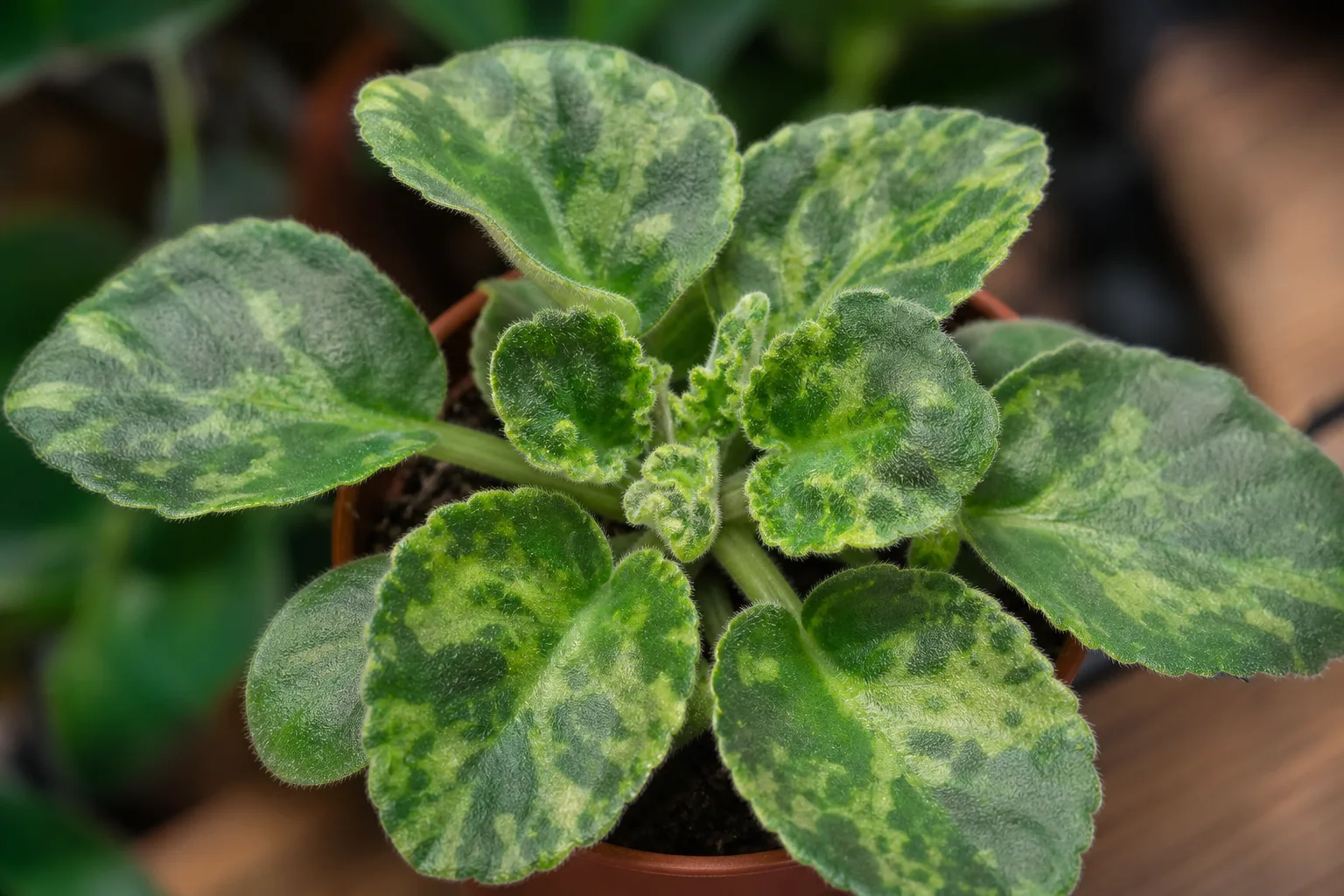
Mosaic Virus on African Violet: Causes, Checks & Fixes
This guide covers mosaic virus on African Violet. See also the general Mosaic Virus guide, watering, and light pages for this plant.
Mosaic Virus on African Violet: Causes, Checks & Fixes
Quick answer
For African violet growers (Saintpaulia spp.), the biggest practical risk is treating true virus symptoms as a minor care issue and letting spread continue in a vegetatively propagated collection. Documented African violet virus diseases include impatiens necrotic spot virus (INSV), tobacco mosaic virus, and anemone mosaic virus, and the symptom pattern can include mottling, rings, distortion, and stunting (APS).
First fix: isolate the plant immediately. There is no curative spray for systemic plant virus infection, so containment comes before all other steps (University of Maryland Extension).
Photo check (what to compare): Progressive light-and-dark mottling on new center leaves over 2–4 weeks suggests virus suspicion. A single pale water-spot blemish on one outer leaf after cold overhead watering usually does not-see cold damage on African Violet for that pattern. Original labeled photos for this page are planned; use the differential table below until they are published.
What mosaic-like symptoms look like on African violet
Common red flags on rosette-forming African violets include irregular light-and-dark green mottling, ring-shaped marks, distorted center leaves, blackened petioles, stunted crown growth, and loss of vigor. These match reported virus-type symptoms in indoor ornamentals (University of Maryland Extension). INSV reports in African violet collections also describe rings, mottling, and crown distortion that can be mistaken for other problems (AVSA INSV guidance).
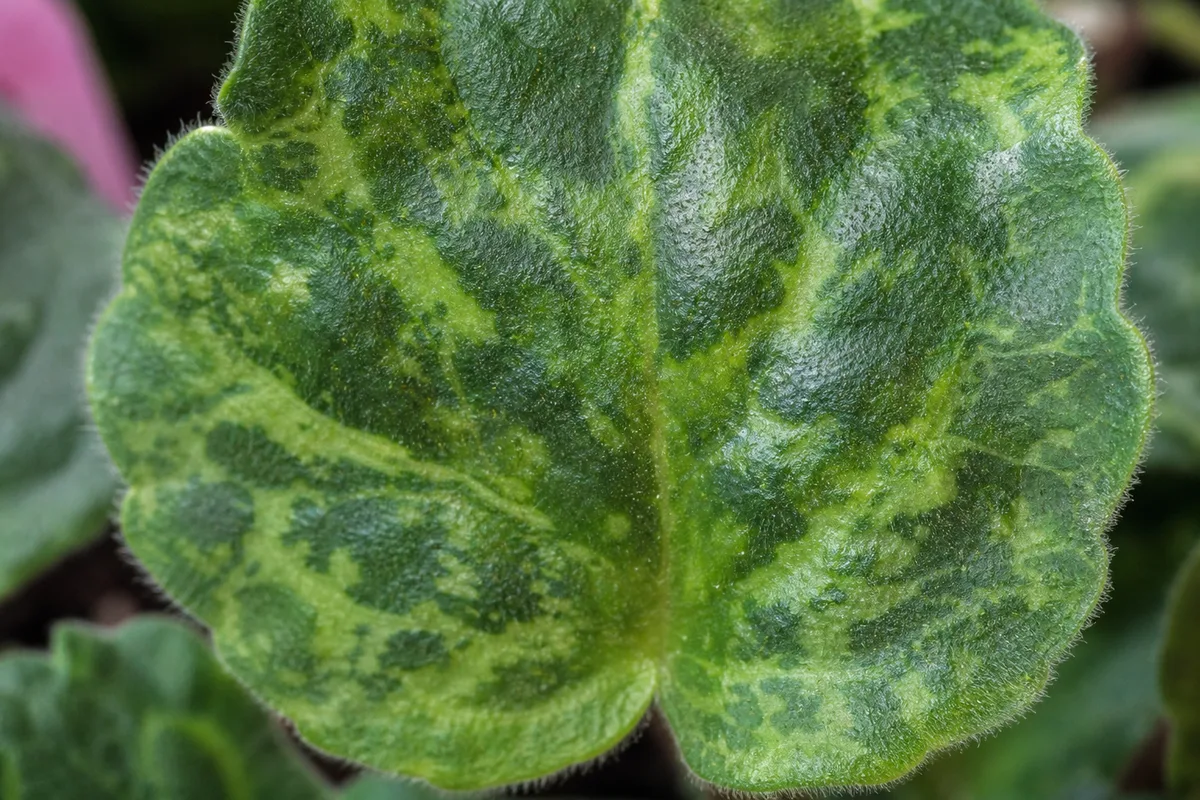
Mosaic Virus symptoms on African Violet - compare with healthy tissue on the same plant.
The key pattern is persistence and spread to new center growth over time. On African violet, center-growth distortion is a higher-specificity signal than older-leaf mottling alone because the rosette keeps producing new leaves from the crown-if each new leaf arrives distorted, systemic infection is more likely than a one-off blemish.
Photo check: INSV-style mottling often shows irregular green patches mixed with lighter tissue across several consecutive center leaves. Cold-water ring spots tend to stay on the leaves that were splashed and do not march inward on every new leaf.
Some virus-infected violets can look healthy for months before stress triggers visible symptoms (AVSA INSV guidance). That dormancy is why show purchases and gifted cuttings deserve quarantine even when they arrive looking perfect.
Why African violet collections are vulnerable
African violets are often grown close together, propagated vegetatively from leaf cuttings, and exchanged between hobby growers and show exhibitors. One infected mother plant can produce dozens of infected daughters before symptoms appear-far costlier than on seed-grown annuals where each plant is independent.
INSV is especially important because western flower thrips can spread it and hundreds of ornamental species are susceptible, including African violet. Thrips larvae acquire the virus while feeding on infected tissue; adults transmit it to healthy plants after brief feeding (Penn State Extension).
Virus spread in home collections usually happens through:
- infected incoming plants or leaf cuttings from shows, swaps, or online sellers
- thrips feeding activity-especially western flower thrips for INSV (thrips on African Violet for ID and treatment)
- sap transfer on fingers or tools during grooming and propagation
- keeping symptomatic plants in the same space as healthy stock on shared trays or light stands
In real collections, the trigger event is often a new acquisition, a shared tray, or unnoticed thrips pressure before symptoms become obvious.
How virus spreads in home collections
Mechanical sap transfer matters on African violet because growers routinely remove spent blooms, snap suckers, and take leaf cuttings-each cut is a potential transfer point if tools or hands touched infected tissue (University of Maryland Extension).
Thrips add a second route that bypasses your scissors entirely. Inspect incoming plants for thrips, especially on white and yellow flowers, and isolate new stock until you are confident it is thrips-free. If thrips appear on a violet with suspicious mottling, treat the vector and assume virus risk until testing or extended observation rules it out.
Do not propagate leaf cuttings from plants under observation even if older outer leaves look normal-virus may not spread evenly through the rosette, and tospoviruses do not distribute uniformly in infected plants, so asymptomatic tissue can still carry infection.
Confirm the cause before final decisions
Visual checks alone are not enough for high-confidence diagnosis. Extension guidance warns that virus symptoms overlap with many non-viral problems and can vary with plant age, season, and strain. Some infected plants show no symptoms at all.
Five-step confirmation checklist
- Isolate first, diagnose second. Move the suspect violet away from all others immediately-preferably another room or a sealed container (AVSA INSV guidance).
- Inspect nearby plants and vectors. Check leaf undersides, flowers, and surrounding plants for thrips. Run the tap test described on thrips on African Violet.
- Track new center growth for 2–4 weeks. If fresh center leaves continue to show mottling or distortion, suspicion increases. Stable or improving new growth after a single blemish event points away from virus.
- Rule out care lookalikes. Check watering method, recent cold-water splash on leaves, fertilizer history, and cyclamen mite signs-see the lookalike table below.
- Use testing when stakes are high. For valuable cultivars or uncertain cases, submit samples through extension channels or use pathogen-specific ImmunoStrip kits after isolating the plant (AVSA INSV guidance; UMass Extension).
Symptom differential table
| Pattern | Progression | Likely cause | First action |
|---|---|---|---|
| Mottling on new center leaves for 2+ weeks | Spreads to each new leaf | Virus suspicion (INSV common) | Isolate; test or discard per matrix below |
| Single pale ring or spot on one outer leaf | Does not repeat on new growth | Cold damage from water splash | Fix watering; monitor 2 weeks |
| Distorted tight center, no mottling | Slow; may include webbing or dust | Cyclamen mite or thrips | Inspect with lens; treat pest |
| Even yellowing on older leaves only | Improves after feed correction | Nutrient stress - see yellow leaves | Adjust fertilizer; retest pattern |
| Progressive crown collapse with wet rosette | Fast after overhead wetting | Crown rot | Stop crown moisture; discard if mushy |
Test vs. discard decision matrix
| Situation | Plant value | Recommended action |
|---|---|---|
| Progressive center mottling + thrips present | Any | Discard immediately after isolating neighbors; treat thrips on exposed plants |
| Progressive center distortion, no thrips seen | Common grocery-store violet | Discard - cost of testing usually exceeds replacement |
| Progressive center distortion, no thrips seen | Rare show cultivar | Isolate + extension lab test before final discard decision |
| Single outer-leaf blemish, clean new center growth | Any | Monitor 2–4 weeks; do not propagate until pattern is clear |
| Show or club purchase with any suspicious mottling | Any | Isolate 4–6 weeks minimum; test if symptoms persist on new growth |
| Confirmed positive test (kit or lab) | Any | Discard immediately; do not compost indoors |
Home ImmunoStrip kits can give a same-day answer, but select tissue carefully-a nickel-sized sample from symptomatic green tissue adjacent to necrotic areas works best, because tospoviruses do not spread evenly through the plant. Early infections can produce false negatives; retest or submit to extension if symptoms keep progressing despite a negative kit.
Extension lab submission (when to use it)
Contact your local cooperative extension office for county-specific forms and shipping instructions. General expectations:
- Sample type: Whole small plants or multiple symptomatic leaves including center growth-not only the worst single leaf. Bag separately from healthy collection material.
- Timing: Submit as soon as symptoms are established on new growth; do not wait for the plant to collapse.
- What results change: A positive result confirms discard and triggers 6–8 week (or longer) neighbor monitoring. A negative result from a reputable lab still warrants continued isolation if center distortion persists-visual symptoms and lab timing can disagree on early infections.
- Scope: Extension labs can test for multiple viruses (INSV, tomato spotted wilt, cucumber mosaic, tobacco mosaic) when you do not know which pathogen is involved (AVSA INSV guidance).
Lookalikes to rule out on African violet
Several common issues mimic mosaic virus-each has a dedicated guide on this site:
- Cold damage: often appears after overhead watering with cold water; usually localized to splashed leaves and does not progress on every new center leaf.
- Thrips or cyclamen mite injury: can cause distorted new growth; look for pollen dust on blooms, silver streaks, or tight stunted center without mottling-see stunted growth when the crown stays small and twisted.
- Nutrient imbalance or root stress: may produce chlorosis on older leaves but usually improves after care correction-start with yellow leaves if outer leaves fade evenly.
- Mechanical damage: isolated scars or torn tissue, not progressive systemic mottling on consecutive center leaves.
When in doubt, treat the plant as potentially infectious until proven otherwise.
First fix to try
Isolate the plant immediately and stop all propagation from it. This single action prevents the highest-risk mistakes while you confirm diagnosis.
Then perform secondary actions in order:
- sanitize tools, trays, and hands after handling suspect tissue
- inspect and manage thrips pressure in the whole growing area-follow the weekly treatment cycle on thrips on African Violet
- separate new or questionable plants from core stock for at least 4–6 weeks before they join the main collection
- plan testing or discard based on the decision matrix above
This order matters because acting on vectors and contact spread is more protective than trying random sprays first. There is no curative chemistry for plant viruses (RHS).
What recovery really means for your collection
An infected African violet does not recover back to healthy tissue. Virus-infected leaves and crowns do not heal with fertilizer, fungicides, or repotting. Infected plants are managed through removal, not cure.
For a collection, recovery means:
- no new symptomatic plants during monitoring
- reduced or absent thrips pressure
- clean new growth on quarantined neighbors
- no symptom progression on plants kept under observation
Use a minimum 6–8 week observation window for exposed nearby plants before you consider the episode contained. Extend to 12 weeks if thrips were present, plants shared a tray, or the source was a show purchase with progressive center distortion.
Documented quarantine outcome (text case note): A grower isolated a show-purchased violet with early center mottling, discarded it after a positive ImmunoStrip, and monitored six neighbors on the same shelf. After eight weeks, all neighbors showed clean center growth and negative tap tests for thrips-containment succeeded without further losses. That timeline is typical when isolation and vector control happen early, not a guarantee for every collection.
What not to do
- do not take leaf cuttings from a symptomatic plant-or from plants under observation with outer leaves that still look fine
- do not return a suspect plant to the main shelf because it “looks better today”
- do not rely on fungicides or nutrient products to solve likely virus symptoms
- do not compost confirmed infected tissue in indoor compost bins used for potting media
- do not trust a single negative home test when center distortion keeps progressing on new leaves
Plant-virus management is exclusion, sanitation, and vector control-not curative chemistry (RHS).
How to prevent mosaic virus next time
Build prevention into your African violet routine:
- Quarantine all incoming violets for 4–6 weeks. Keep show, club, and shop purchases separate before joining your main collection-longer if thrips or mottling appeared on arrival.
- Control thrips continuously. INSV spread is tightly linked to thrips transmission (UMass Extension). Use sticky traps and bloom inspections per thrips on African Violet.
- Keep tools and hands clean between plants. Mechanical transfer matters for some viruses (University of Maryland Extension).
- Do not propagate uncertain plants. Wait until symptoms are explained or virus is ruled out-see African violet propagation for quarantine rules before taking cuttings.
- Remove confirmed infected plants promptly. Delayed removal increases risk to healthy stock.
When to worry - discard vs. monitor
| Signal | Urgency | Action |
|---|---|---|
| Mottling on every new center leaf for 2+ weeks | High | Discard or lab-test immediately; do not propagate |
| Thrips + any mottling on same plant | High | Discard suspect; treat all exposed violets for thrips |
| Show purchase with progressive center distortion | High | Discard unless cultivar is irreplaceable-then test first |
| Single outer-leaf spot after cold watering | Low | Monitor; compare to cold damage |
| Negative test but distortion continues on new growth | Medium | Re-isolate; resample or discard-early tests can miss infection |
| Clean center growth on neighbors after 8 weeks | Reassuring | Continue routine checks; keep traps up |
If multiple plants in the same tray develop matching center mottling within a few weeks, assume collection spread and escalate to discard-plus-vector-control rather than waiting for individual test results on every pot.
Related African violet guides
- African violet overview - light, watering, and collection culture basics
- African violet propagation - quarantine before taking leaf cuttings
- Thrips on African Violet - INSV vector ID and weekly treatment cycle
- Cold damage on African Violet - water-spot lookalike after cold overhead watering
- Stunted growth on African Violet - cyclamen mite and crown tightness without mottling
- Crown rot on African Violet - soft rosette center after wet crown conditions
- Yellow leaves on African Violet - nutrient fade on older leaves vs. virus mottling on center growth
Before you discard or test
Persistent center-growth mottling on African violet means isolate first, rule out cold-water and mite lookalikes, then test or discard based on plant value and thrips presence-not fertilizer, fungicide, or hoping older leaves outgrow the pattern. When thrips and mottling appear together, treat the collection as exposed and act on containment before symptoms spread to every neighbor on the shelf.