Whiteflies on African Violet: Causes, Checks & Fixes
Quick answer
Whiteflies on African Violet cluster on fuzzy leaf undersides and fly up when you brush the rosette. First step: isolate the plant immediately-do not rinse fuzzy leaves or wet the crown. Treat undersides with labeled neem oil or insecticidal soap every five to seven days while monitoring with yellow sticky traps.
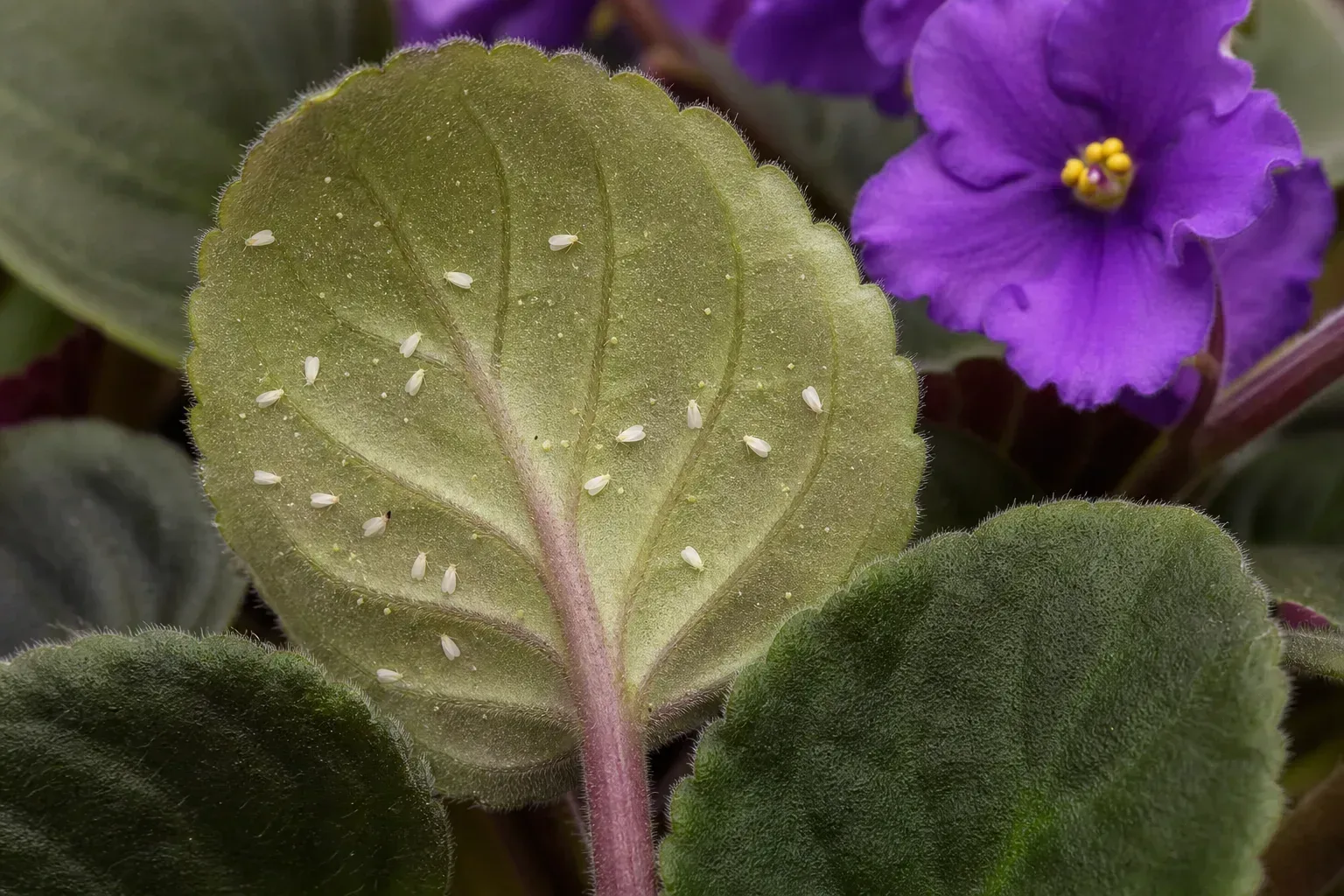
Whiteflies on African Violet: Causes, Checks & Fixes
This guide covers whiteflies on African Violet. See also the general Whiteflies guide, watering, and light pages for this plant.
Whiteflies on African Violet: Causes, Checks & Fixes
Quick answer
Whiteflies on African Violet (Saintpaulia spp.) are tiny white flying insects that feed on the juices of African Violets, particularly on the undersides of the leaves. Disturb the rosette and they rise in a brief cloud-one of the clearest pest signals on a compact houseplant.
Immature nymphs look like flat, pale disks glued to leaf backs. Both stages excrete sticky honeydew that can coat upper leaf surfaces and support sooty mold. Heavy feeding slows center growth and yellows older foliage.
First step: move the violet away from your collection the same day you see flying white insects. Do not shower fuzzy leaves or spray the open crown with cold water-that causes permanent ring spots and can invite crown rot in a wet rosette. Once isolated, treat every leaf underside with labeled neem oil or insecticidal soap on a five- to seven-day schedule while yellow sticky traps catch adults.
Why African Violet gets whiteflies - and why they’re hard to spot
Whiteflies usually arrive on a new purchase, a shared cutting from a show table, or a neighboring houseplant that already had a low-level infestation. Warm indoor rooms let them reproduce throughout the year because there is no cold season to break the cycle and few natural enemies on a windowsill.
African Violet culture gives whiteflies extra cover. The compact rosette shelters insects between overlapping fuzzy leaves on undersides-the exact zone you skip when you bottom-water to keep foliage dry. A quick glance at the pretty top row of leaves can miss a heavy population clinging underneath.
Common entry routes on African Violet:
- New plants without quarantine - Eggs and nymphs hide on newest growth before adults emerge and fly.
- Shared cuttings or show plants - Leaf props and gift violets can carry nymphs on undersides you never inspected.
- Crowded winter shelves - When collections move closer under grow lights, flying adults colonize the next pot within days.
- Over-fertilized soft growth - Nitrogen-heavy feeding pushes tender new leaves that sap feeders prefer.
- Nearby infested houseplants - Hibiscus, poinsettia, and fuchsia are whitefly favorites, but adults do not discriminate once they are indoors.
A slight infestation from one plant can quickly spread to other plants-treat every violet on the same shelf, not only the one where you first saw adults.
What whiteflies look like on African Violet
Adult whiteflies are about 1/16 to 1/8 inch long, white, and moth-like with powdery wings. Nymphs are tiny flat ovals stuck to leaf undersides-they do not fly and are easy to miss until populations build.
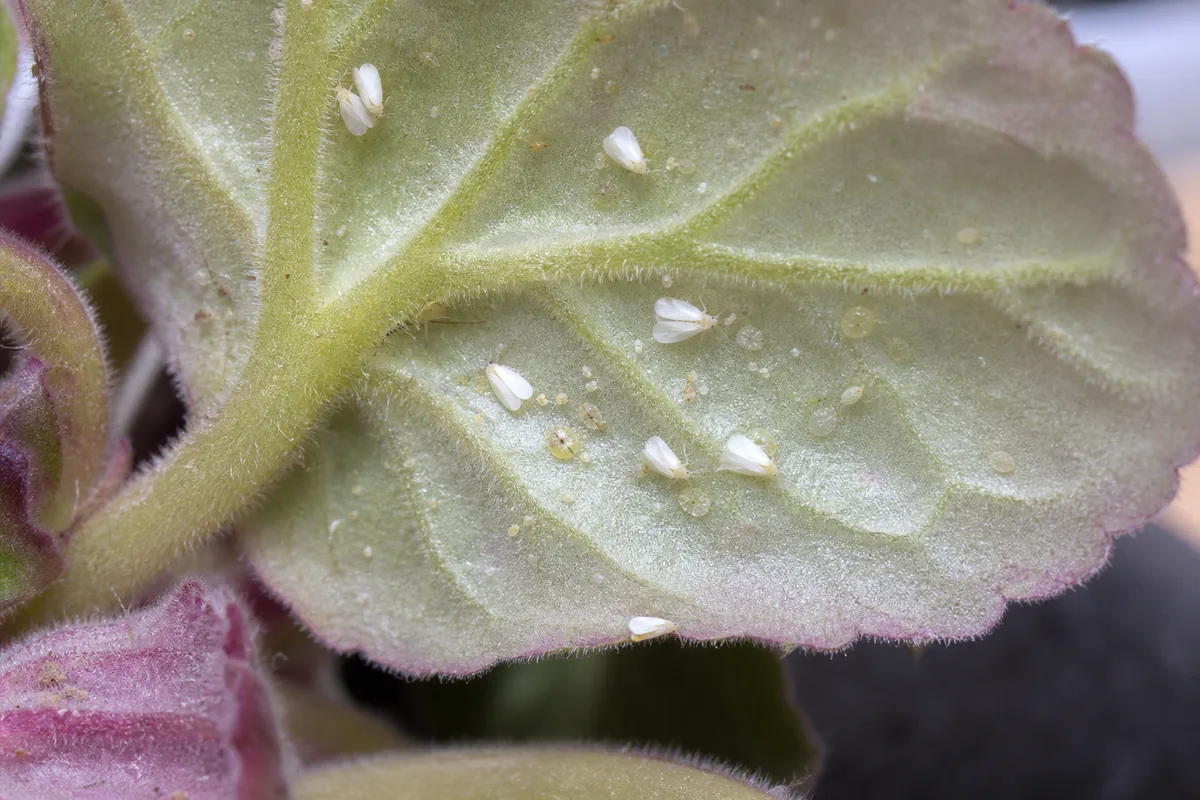
Whiteflies symptoms on African Violet - compare with healthy tissue on the same plant.
Typical signs on a violet rosette:
- A white cloud of insects rising when you brush leaves or move the pot
- Flat immobile specks on fuzzy leaf backs, especially near veins and petiole bases
- Sticky honeydew on upper leaf surfaces where droplets fall from infested undersides above
- Black sooty mold as dark speckles on honeydew-coated foliage
- Yellowing or pale older leaves when feeding is heavy on the outer row
- Slowed center growth when nymphs cluster on young leaves still expanding
On variegated or ruffled cultivars, check the pale sections of new leaves first-feeding damage often shows as yellow halos before the whole leaf dulls.
Unlike mealybugs, whiteflies lack cottony wax and actively fly when disturbed. Unlike fungus gnats, they stay on foliage, not at the soil surface. Unlike thrips, they do not leave silvery scrape marks or black frass specks-though heavy honeydew can look similar until you trigger the flight response.
Confirm whiteflies vs. thrips, mealybugs, and fungus gnats
Work through these checks in good light with a magnifying glass before reaching for spray:
- Disturbance test - Brush the rosette gently. Whiteflies fly up briefly; mealybugs and scale stay attached.
- Underside inspection - Lift outer leaves and examine every fuzzy back, starting with the two innermost rows where sap is richest. Nymphs look like flat disks; adults cluster near veins.
- Honeydew check - Rub a sticky upper leaf with a damp cotton swab. Honeydew wipes off tacky; normal leaf fuzz or dust does not feel uniformly sticky across multiple leaves.
- Yellow sticky trap - Place a trap near the pot for 48 hours. Flying adults stick to yellow cards, confirming active whitefly presence even when counts look low.
- Neighbor scan - Check other African Violets and any plants on the same shelf, especially flowering houseplants whiteflies favor.
- Recent history - Note new purchases, shared cuttings, open windows, or plants returned from a show in the past month.
Four-step underside inspection for fuzzy leaves
Because you bottom-water to protect the crown, pest checks must be deliberate:
- Set the pot on a white paper towel so fallen insects are visible.
- Tilt the rosette and lift each outer leaf with a soft brush or your fingertip-never pull hard enough to snap petioles.
- Scan fuzzy backs with a magnifier, working from the center outward.
- Log which leaves carry nymphs so you can judge whether counts drop between spray sessions.
If you see flying white adults plus flat nymphs on undersides with sticky honeydew, whiteflies are confirmed. Yellow lower leaves alone, without insects or stickiness on new growth, points to overwatering on African Violet or low light-not whiteflies.
Symptom lookalike comparison
| Sign | Whiteflies | Mealybugs | Thrips | Fungus gnats |
|---|---|---|---|---|
| Disturbed response | White cloud flies up | Cottony clusters stay put | Slender insects scatter | Dark flies at soil only |
| Primary location | Fuzzy leaf undersides | Crown, axils, petioles | Leaf blades, buds | Soil surface, pot rim |
| Sticky residue | Honeydew on uppers | Honeydew in axils | Minimal | None on leaves |
| Flat immobile stage | Pale disks on undersides | Waxy oval under cotton | None | Larvae in wet soil |
For mealybug confirmation steps, see mealybugs on African Violet. For silvery streaks and bud scarring, see thrips.
First fix: isolate and treat undersides safely
Move the violet away from every other plant, then apply labeled insecticidal soap or neem oil to all leaf undersides-keeping spray off the open crown.
Whiteflies spread the moment you disturb them. Isolation stops adults from colonizing neighboring violets before you treat the source plant. On African Violet, the first fix is not a water rinse-the standard pothos protocol is unsafe on fuzzy foliage.
Why water rinses fail on African Violet
Pothos growers often shower vines to knock down nymphs. That approach backfires on Saintpaulia:
- Cold water causes permanent ring spots on fuzzy leaves-pale or yellow rings that never heal.
- Water pooling in the crown invites Pythium crown rot in a tight rosette.
- Wet foliage under grow lights burns faster on hairy leaves than on smooth pothos blades.
If you must remove honeydew, dab upper surfaces with a barely damp swab. Do not submerge the rosette or run tap water over the center.
Neem oil and insecticidal soap protocol for fuzzy foliage
After isolation:
- Test one leaf - Spray a single lower leaf underside and wait 48 hours. Fuzzy foliage can spot or dull if the product or timing is wrong.
- Choose a labeled product - Use insecticidal soap or neem oil listed for houseplants. Do not use homemade dish-soap mixes; commercial formulas are made to reduce leaf burn.
- Treat in dim light - Apply in the evening or away from LED grow lights so oil does not magnify light on wet hairs.
- Coat undersides thoroughly - Hold each leaf gently and spray the back where nymphs feed. Adults rest there between flights.
- Shield the crown - Tilt leaves outward so runoff does not pool where new growth emerges. A paper cone over open blooms protects petals from drift.
- Repeat every five to seven days - Eradication usually requires four to five applications at five- to seven-day intervals because eggs and pupae resist many sprays. One pass rarely clears a full generation.
- Add yellow sticky traps - Use sticky traps to capture adult whiteflies near the pot and monitor whether counts fall between sessions.
Clemson Extension lists both insecticidal soap and neem oil among the least-toxic options for whiteflies on African Violet when applied according to label directions. Take the plant to a shaded outdoor spot during mild weather if the label allows, then bring it back once foliage is dry.
What not to do the same day
Do not return the violet to a shared shelf after one treatment. Do not fertilize a pest-hit plant-soft new growth attracts whiteflies faster. Do not spray the crown center or soak fuzzy leaves with cold tap water.
Step-by-step recovery
After isolation and the first underside spray:
- Set yellow sticky traps near the pot to catch adults and track progress between treatments.
- Inspect undersides every three to four days - Log nymph counts on the same leaves to see whether numbers drop.
- Repeat soap or neem on label intervals through at least four cycles-typically three to four weeks total.
- Dab honeydew from upper leaf surfaces with a fresh swab so sooty mold does not spread while insects remain.
- Remove only fully yellowed outer leaves once the plant is insect-free-do not strip the rosette while nymphs still cling to neighbors.
- Treat every violet on the same shelf - Whiteflies spread quickly, so if even one Violet has them, all are at risk.
- Hold quarantine until traps stay clean and undersides show no new flat nymphs for two full weeks.
For chronic infestations that survive repeated least-toxic sprays, contact your local extension office for region-specific pesticide options labeled for indoor ornamentals.
Recovery timeline and bloom expectations
Adult counts on sticky traps should drop within one to two weeks of consistent treatment. Full control takes three to four weeks with label-interval repeats because of the whitefly lifecycle-you must control the immatures on the undersides of the leaves to eliminate an infestation, and eggs hatch, nymphs feed for weeks, then pupate before new adults emerge.
Yellowed or honeydew-coated older leaves may stay blemished; judge recovery by clean new center growth and unsticky foliage-not by perfect outer leaves. Open blooms may fade faster while the plant is under stress; new buds can still form once nymphs are controlled.
Signs the problem is worsening include adults flying every time you water, sooty mold spreading across the rosette, whiteflies appearing on multiple violets simultaneously, and sticky traps refilling within days after four spray cycles.
What not to do
Do not spray only the tops of leaves-nymphs on undersides keep the cycle going. Do not use homemade soap mixes that can damage fuzzy African Violet foliage. Do not shower the plant like pothos to knock down insects. Do not return the plant to the collection until you see no new adults on traps for two weeks. Do not compost infested leaf trimmings where crawlers can reach other pots.
How to prevent whiteflies next time
Quarantine every new African Violet for at least two weeks before placing it near your collection. Inspect fuzzy undersides during that period-not just the showy top row.
Fold pest checks into your normal bottom-watering routine: lift inner leaves, scan undersides under magnification, and glance at the soil surface around the stem. Water the plant from the bottom to avoid getting water on the leaves, which also keeps the crown dry during routine care. Winter indoor crowding accelerates spread when shelves tighten under grow lights-leave air space between pots.
Use yellow sticky traps as early monitors near susceptible collections, not only after infestations explode. Avoid nitrogen spikes during warm months; steady, moderate feeding per the African violet overview produces less whitefly-friendly soft tissue.
When buying, examine inner leaf undersides closely-a clean outer row can hide nymphs on fuzzy backs below.
When to worry - discard vs. treat for collection protection
Escalate treatment when:
- Adults fly from multiple leaves every time you brush the rosette
- Honeydew coats more than a few leaves or triggers widespread sooty mold
- Center growth stalls for two or more weeks despite feeding
- Sticky traps refill within days after four to five weekly spray cycles
- Whiteflies appear on several violets on the same shelf simultaneously
A handful of nymphs on one leaf after a quarantine miss is not a lost cause-isolate, treat undersides persistently, and monitor traps. Discard when the entire rosette carries nymphs on every underside, adults reappear daily after a full treatment course, and protecting a large collection matters more than saving one small pot. Propagate only from a node that remained visibly clean through two weeks of checks.
Conclusion
Whiteflies on African Violet are manageable when caught early, but they punish the shortcuts that work on smooth-leaved houseplants. Isolate immediately, treat fuzzy undersides with labeled soap or neem on a repeat schedule, and keep the crown dry throughout recovery. Judge success by clean new center growth and empty sticky traps-not by whether older leaves look perfect again. Weekly underside checks during bottom-watering keep whiteflies from becoming a collection-wide problem.
For related sap feeders, compare aphids and mealybugs. For baseline culture-mix, light, and watering method-start with the African violet overview.
When to use this page vs other African Violet guides
- African Violet watering guide - Use for routine moisture checks before assuming whiteflies is the main issue.
- African Violet problems hub - Browse all 52 common issues on this species.