Black Spots on African Violet: Causes, Checks & Fixes
Quick answer
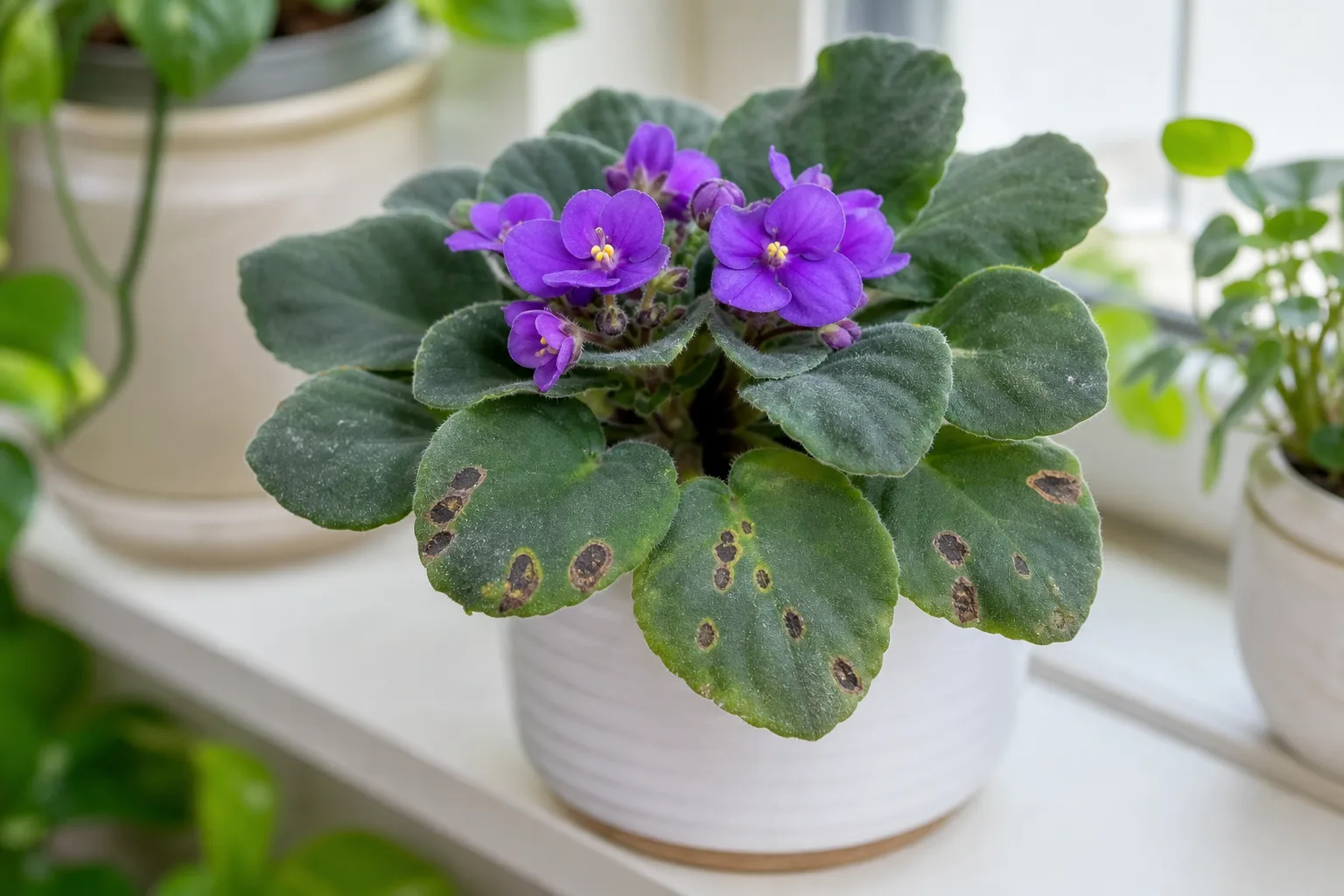
Black spots on African Violet usually come from Rhizoctonia leaf spot, foliar nematodes, Botrytis, or cold-water ring injury-not one single disease. First step: isolate the plant and remove every spotted leaf with a sterile blade.
Black Spots on African Violet: Causes, Checks & Fixes
This guide covers black spots on African Violet. See also the general Black Spots guide, watering, and light pages for this plant.
Black Spots on African Violet: Causes, Checks & Fixes
Quick answer
Black spots on African Violet leaves are not one disease-they are a symptom shared by several fungal and nematode diseases that hit African Violet overview differently than smooth-leaved houseplants. The most common causes are Rhizoctonia leaf spot, foliar nematodes, Botrytis blight, and cold-water ring injury. Your first move is to isolate the plant and cut off every spotted or mushy leaf with a sterile blade. Do not mist or top-water until you know which pattern you are dealing with.
Why African Violet gets black spots
African Violet evolved in cool, humid cloud-forest conditions, but its velvety leaves trap moisture longer than glossy foliage does. When humidity climbs above the 40–60% sweet spot, leaves stay damp between crowded rosettes, and fungal spores germinate on wet tissue. Rhizoctonia favors moist leaves and often starts on lower foliage before moving up the rosette. Botrytis enters through dead flowers, yellowing lower leaves, or damaged petioles in cool, stagnant air. Foliar nematodes spread when water splashes between plants, leaving tan sunken patches that darken as they enlarge.
Cold-water injury is cultural, not infectious, but it produces permanent dark lesions that owners often label as black spots. Splashing water much colder than the leaf surface collapses palisade cells within seconds, creating ring patterns on fuzzy leaves. Because African Violets are almost always watered from trays in home care, any return to overhead watering or cold tap water on warm leaves reopens this problem quickly.
What black spots look like on African Violet
Rhizoctonia produces the most distinctive pattern: oval or peanut-shaped lesions with a clearly defined pale outline and a mottled brown or yellow center, usually no larger than a quarter inch. Spots often appear on the lowest leaves first, then advance upward if humidity and wet foliage persist.
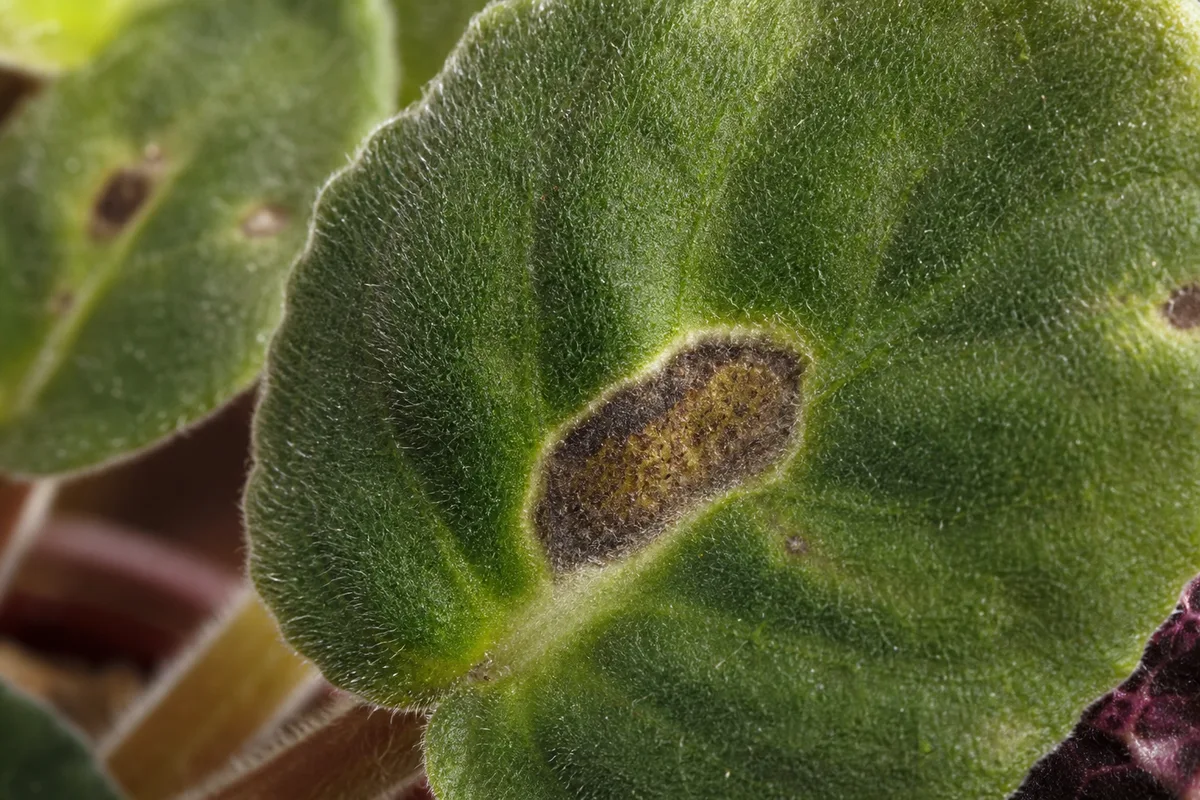
Peanut-shaped outlined lesions with mottled brown centers on African Violet velvety leaves - typical Rhizoctonia leaf spot pattern distinct from cold-water ring injury.
Foliar nematode damage looks different on close inspection. Small tan, sunken areas form on the underside of leaves between veins. As they enlarge, the patches turn dry and dull black while the plant stalls. You will not see fuzzy mold-just flattened, necrotic tissue.
Botrytis-related black spots start water-soaked and soft, then darken and may show gray-brown fuzzy growth on flowers or petioles before the leaf blade collapses. This overlaps with blight but presents as discrete dark patches rather than a melting crown.
Cold-water ring spot shows white, yellow, or bleached rings, lines, or arcs on the upper leaf surface-not isolated dry black dots. Salt or fertilizer burn tends to crisp leaf margins and tips rather than scattered black patches on the blade interior.
Thrips can leave tiny black fecal specks on lower leaf surfaces alongside silvery stippling. Mechanical bruising from handling fuzzy leaves creates a single scar that does not spread-unlike fungal spots that multiply over days.
How to confirm the cause
Work through pattern, location, and timing before treating.
Check the leaf surface first. Fuzzy gray-brown growth or water-soaked enlarging spots point to Botrytis. Peanut-shaped outlined lesions with mottled centers point to Rhizoctonia. Tan sunken areas on undersides between veins suggest foliar nematodes. Rings or arcs that appeared within hours of watering point to cold-water injury.
Check leaf position. Lower-leaf spots spreading upward in humid conditions favor fungus. Spots confined to leaves you recently splashed favor culture. Nematode damage often appears on multiple leaves but stays between veins on undersides.
Check your recent care. Did you top-water, mist, or move the plant to a bathroom shelf above 60% humidity? Did fading flowers sit in the crown? Shared tools or trays between violets without cleaning raise nematode and fungal risk.
If spots appeared overnight after watering, suspect ring spot or Botrytis on wet tissue-not nematodes, which spread more slowly. When in doubt, isolate first and watch whether new center leaves stay clean for two weeks after leaf removal and bottom-watering only.
First fix for African Violet
Isolate the plant immediately-this single step limits splash and airborne spread while you diagnose. Remove every leaf showing spots, mushy tissue, or greasy dark patches at the petiole base using a sterile blade. Bag discarded leaves; do not compost them indoors or leave them on a shared tray.
After removal, move the pot to a brighter location with steady 65–75°F temperatures and gentle airflow between rosettes. Switch to bottom-watering with room-temperature water for 30 minutes, then drain completely. Let the top inch of soil dry before the next session.
If you suspect foliar nematodes-tan sunken undersides spreading slowly between veins-discard the plant and sterilize the pot before reuse. Nematodes persist in soil and on tools; saving one infected violet risks the collection. For widespread Rhizoctonia or Botrytis after sanitation, a fungicide labeled for African Violets may protect remaining healthy tissue, but environmental correction comes first.
Recovery timeline
Isolated fungal cases often stabilize within two to three weeks once infected leaves are gone and foliage stays dry. Judge recovery by the center rosette: new leaves should emerge firm and spot-free. Old spotted tissue never greens up again-remove it and wait for clean replacement growth.
Cold-water ring spots are permanent on damaged leaves but preventable on new growth once you bottom-water only. Nematode-infected plants rarely recover worth saving; two weeks of clean new growth after aggressive leaf removal is the minimum before returning a plant to a shared shelf.
Signs the problem is worsening include spots on newly opened center leaves within days, petioles turning greasy and dark, or leaves detaching with a soft crown. Those patterns mean escalation-likely crown rot overlap-and may require discarding the plant to protect neighbors.
Lookalike symptoms to rule out
Powdery mildew coats leaves in fine white dust rather than discrete black necrotic spots. Crown rot from overwatering on African Violet shows a water-soaked, collapsing center without the peanut-shaped Rhizoctonia outline. Bacterial blight produces greasy dark rot at the crown and roots, not dry outlined leaf spots.
Fertilizer or salt burn creates crisp brown edges after repeated top-watering with hard water-not scattered interior black patches. Cyclamen mite damage distorts and stunts new growth with brittle leaves; mite issues rarely present as clean round black dots alone.
What not to do
Do not mist velvety leaves or top-water with cold tap water while spots are active. Do not return an isolated plant to a crowded humid shelf before two weeks of clean new growth. Do not reuse potting mix from a nematode- or Rhizoctonia-affected pot without pasteurizing or replacing it.
Do not compost infected African Violet leaves indoors or wipe alcohol across large leaf areas-both can spread pathogens or burn fuzzy tissue. Do not stack African Violet repotting guide, fertilizing, and fungicide application on the same day; fix moisture and airflow first.
How to prevent black spots next time
Bottom-water from a tray of room-temperature water and drain fully after each session. Maintain 40–60% humidity and 65–75°F with space between pots so air moves across leaf crowns. Remove fading flowers and yellowing lower leaves weekly before they rot in the dense rosette.
Use a light, well-aerated African violet mix in a pot only slightly larger than the root ball-oversized pots stay wet too long and favor Rhizoctonia at the soil line. Quarantine new plants for two weeks and sanitize scissors between violets when removing leaves.
When you must top-water occasionally to flush salts, use room-temperature water and keep foliage dry before the plant returns to direct light. Consistent bottom-watering is the single habit that prevents most black-spot lookalikes on this species.
When to worry
Seek aggressive action when spots multiply on center leaves within a week, the crown darkens and softens, or several violets on one tray develop similar lesions at once. Foliar nematodes and advanced Rhizoctonia crown rot can kill entire rosettes and spread through shared water, tools, and potting media.
A few outlined spots on one lower leaf after a humid spell is manageable with isolation and leaf removal. A plant that continues producing spotted new growth despite dry foliage and bottom-watering is unlikely to recover and should be discarded before infecting the collection.
When to use this page vs other African Violet guides
- African Violet watering guide - Use for routine moisture checks before assuming black spots is the main issue.
- African Violet problems hub - Browse all 52 common issues on this species.
- Overwatering on African Violet - Different entry point when symptoms overlap with black spots.
- White Spots on African Violet - Different entry point when symptoms overlap with black spots.
- Leaf Drop on African Violet - Different entry point when symptoms overlap with black spots.