Magnesium Deficiency on African Violet: Causes, Checks &
Quick answer
Magnesium deficiency on African Violet shows as yellowing between green veins on older outer leaves while the crown still blooms. Confirm the leaf-age pattern and soil pH, then apply one dilute Epsom salt drench-not more general fertilizer.
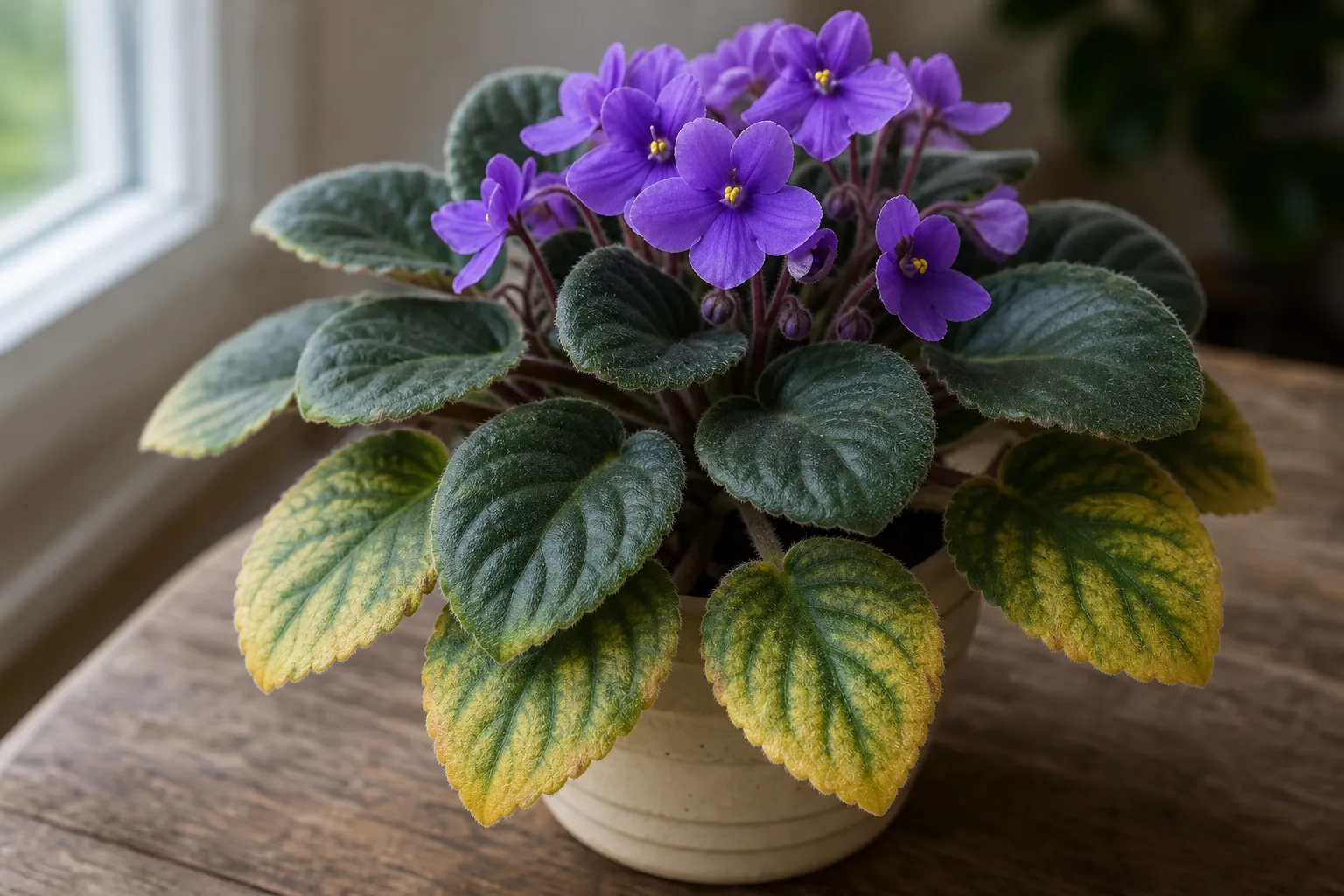
Magnesium Deficiency on African Violet: Causes, Checks & Fixes
This guide covers magnesium deficiency on African Violet. See also the general Magnesium Deficiency guide, watering, and light pages for this plant.
Magnesium Deficiency on African Violet: Causes, Checks & Fixes
Quick answer
Picture a standard Saintpaulia rosette still pushing blooms while the lowest three leaves show yellow tissue between dark green veins-the outer ring looks tired even though the crown is active. That bottom-up, vein-contrast pattern on African violet fits magnesium shortage, especially after months of potassium-heavy bloom booster or skipped balanced feeding.
This is the opposite of iron deficiency, where interveinal chlorosis hits the tiniest new crown leaves first. It also differs from nitrogen deficiency, which tends to wash out whole older leaves evenly rather than leaving crisp green veins.
First fix: confirm the outer-leaf interveinal pattern and firm roots, then apply one quarter-teaspoon Epsom salt dissolved in one gallon of room-temperature water as a soil drench. Resume balanced African violet fertilizer at quarter label strength at the next normal watering-not a full-strength rescue dose.
Guide by sai-ananth. Reviewed by the LeafyPixels Review Board.
Why African Violet gets magnesium deficiency
Magnesium is essential for chlorophyll production and photosynthesis in African violets. Because magnesium is mobile, the plant pulls it from older leaves to feed new center growth when supply runs short-so deficiency shows on the outside ring while blooms may continue.
Common triggers on this shallow-rooted houseplant:
- Potassium-heavy feeding without magnesium - bloom-boosting formulas high in K can unbalance uptake over a full season
- Skipped or weak balanced feeding - months without a complete violet formula depletes mobile magnesium in small pots
- pH drift - soil pH outside 5.8–6.2 blocks magnesium absorption even when magnesium is present in the mix
- Salt accumulation - minerals concentrate in wick reservoirs and pot rims, shifting pH and electrical conductivity; see salt build up when white crust appears
- Old, compacted mix - peat-based African violet soil past twelve months loses structure and buffering capacity
Excess magnesium from repeated Epsom applications can antagonize calcium uptake-another reason to confirm the diagnosis before treating weekly.
Wick-watering and salt traps
Wick systems should occasionally receive top watering to flush accumulated fertilizer salts. If you wick-water exclusively, magnesium symptoms on lower leaves may reflect lockout from concentrated salts rather than a true shortage-monthly top-leaching with plain water is part of diagnosis, not optional maintenance.
What magnesium deficiency looks like on African Violet
The hallmark is pale yellow tissue between dark green veins on older, larger outer leaves. Chlorosis begins at tips and margins of lowermost leaves and progresses between veins toward the center of each leaflet. In advanced cases, brown dead areas fill the tissue between veins and affected leaves become brittle.
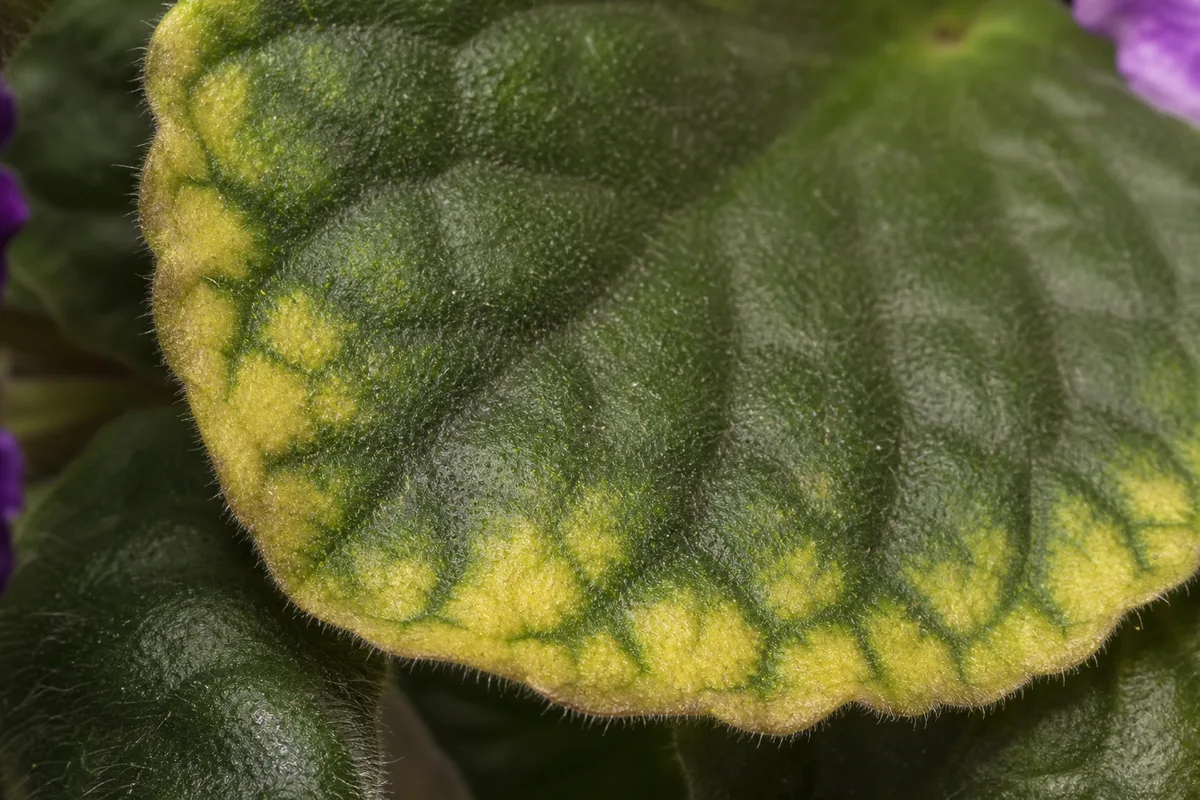
Magnesium Deficiency symptoms on African Violet - compare with healthy tissue on the same plant.
On a standard rosette, the visual impact is easy to miss at first-the plant still flowers while the outer ring yellows, which makes bloom display look uneven on show plants. Trailing cultivars may hide outer-leaf damage under newer growth longer; lift stems gently to inspect the oldest leaves near the pot rim.
Mild shortage may show only as lighter green outer leaves before full interveinal yellowing develops. Growth slows because the plant cannot build chlorophyll efficiently in the tissue it is sacrificing.
Compare with iron, manganese, and nitrogen deficiency
| Nutrient issue | Where symptoms start | Pattern on leaves | Read next if this fits better |
|---|---|---|---|
| Magnesium (Mg) | Older outer leaves first | Yellow between green veins (interveinal chlorosis) | You are in the right guide |
| Iron (Fe) | Youngest crown leaves first | Interveinal chlorosis on tiniest new growth | Iron deficiency |
| Manganese (Mn) | Upper stem and newer leaves | Light green between veins, small brown patches on crown tissue | Iron deficiency checklist (similar crown pattern) |
| Nitrogen (N) | Older leaves first | More even yellowing of whole leaf, less vein contrast | Nitrogen deficiency |
| Potassium (K) | Older leaves first | Marginal yellowing and tip/edge scorch, not vein striping | Potassium deficiency |
Interveinal chlorosis on older, larger leaves points to magnesium, while the same pattern on younger crown leaves points to iron, manganese, or zinc trouble. Leaf age is the fastest home test on a violet rosette.
How to confirm the cause
Work through these checks in order before adding supplements:
- Map leaf age first. Mobile nutrients like magnesium show deficiency on older leaves first. Yellow between veins on the smallest crown leaves instead suggests iron deficiency.
- Inspect vein contrast under bright light. Clean yellow-between-green-veins on outer leaves supports magnesium; uniform pale washout fits nitrogen better.
- Review fertilizer history. Long gaps without feed, or repeated bloom-boosters without a balanced violet formula, raise the odds. Check your label for magnesium in the guaranteed analysis.
- Test or estimate pH. Optimum African violet soil pH ranges from 5.8 to 6.2. A simple slurry test-one part mix plus one part distilled water, wait fifteen minutes, dip a strip-helps when corrected feeding fails after three weeks.
- Check for salt crust and root health. White deposits on the rim suggest salt build up. Mushy roots and sour wet mix cause general yellowing, not neat vein contrast-rule out root rot before fertilizing.
- Watch overlap with calcium lockout. If the crown shows hooked tips and stuck buds while outer leaves chlorose, read calcium deficiency-African Violet repotting guide may be the primary fix, not Epsom salt alone.
If outer-leaf interveinal chlorosis is clear, roots are firm, and pH is plausible, magnesium deficiency is a strong working diagnosis.
First fix for African Violet
Apply one quarter-teaspoon Epsom salt (magnesium sulfate) dissolved in one gallon of room-temperature water as a single soil drench on already-moist mix.
Use magnesium sulfate only when deficiency is confirmed, not as routine feeding. Moisten dry soil with plain water first if needed, pour the drench until excess drains freely, and keep water off the crown. Do not use cold water on African violet leaves or crowns-cold water causes permanent ring spots.
At the next scheduled watering-typically one week later-resume a balanced, urea-free African violet fertilizer at one-quarter label strength. Correct pH if testing shows drift above 6.5 or below 5.5.
Epsom salt repeat schedule and stop criteria
| Timing | Action | What to watch |
|---|---|---|
| Day 0 | One Epsom drench (¼ tsp per gallon) on moist mix | Outer leaves will not re-green-ignore them |
| Week 1 | Resume quarter-strength balanced violet feed | New center leaves should stay green, not pale |
| Weeks 2–4 | Maintain normal diluted feeding; flush monthly if you feed often | Next leaf ring should show normal color |
| After 4 weeks | Stop Epsom if new growth is green | If new leaves still chlorose, switch to iron/manganese or pH correction |
| Only if needed | One repeat Epsom drench after 4+ weeks | Never exceed two drenches without confirming magnesium again |
Repeated weekly Epsom without confirmation risks blocking calcium uptake and worsening crown problems. If mix is older than twelve months or heavily crusted, repot into fresh African violet soil as the next step-not on the same day as the first drench.
Why not foliar Epsom spray
Soil drench is the standard correction on gesneriads. Velvet African violet leaves spot when wet, and foliar magnesium sprays add moisture to a plant that prefers dry foliage. Cold or hard water on leaves causes permanent damage on African violets. Reserve any spray experiment for a single test leaf on a non-show plant.
Recovery timeline
New leaves should show normal green color between veins within two to four weeks after magnesium and pH are corrected. Outer leaves with brown necrotic patches will not fully recover-judge progress by the next ring of center growth, not by waiting for damaged outer tissue to heal.
| Week | What changed on the plant |
|---|---|
| 0 | Outer three leaves show yellow between green veins; blooms still open |
| 1 | Epsom drench applied; no visible repair on week-0 leaves (normal) |
| 2–3 | Next leaf ring opens with intact green between veins |
| 4+ | Steady crown growth; outer scars remain but do not spread |
If yellowing persists on new center leaves after one drench, four weeks of proper feeding, and a monthly flush, suspect iron deficiency or chronic pH drift rather than repeating Epsom salt.
What not to do
Do not pile on high-nitrogen fertilizer hoping outer leaves re-green-that can worsen fertilizer burn and salt buildup. Do not apply Epsom salt weekly without confirmed deficiency; excess magnesium antagonizes calcium. Do not repot and fertilize on the same day when the plant is already stressed-make one change at a time. Do not foliar-feed with cold tap water. Do not assume every yellow outer leaf needs magnesium when white salt crust is present-flush first.
How to prevent magnesium deficiency next time
Feed with a balanced, urea-free violet formula at one-quarter strength each watering during active growth-see the fertilizer guide for label checks. Flush monthly with plain water to prevent salt accumulation, then resume diluted feeding at the next cycle. Repot into fresh mix about once a year to keep pH in the slightly acidic range African violets prefer.
Avoid relying on bloom-boosters every watering without a balanced formula in rotation. If you wick-water, schedule monthly top-flushes. Match pot size to the root ball-oversized pots stay wet and stall nutrient uptake.
What to read next on African Violet nutrients
- Iron deficiency - crown interveinal chlorosis when outer leaves look fine
- Calcium deficiency - hooked crown tips and stuck buds; excess Epsom can worsen this
- Potassium deficiency - marginal scorch on older leaves, not vein striping
- Nitrogen deficiency - uniform pale outer ring without green vein contrast
- Salt build up - white crust mimicking nutrient trouble
- African violet fertilizer - formula, strength, and urea warnings
- African violet soil - pH, mix ingredients, and repot timing
How this guide was reviewed: Written by sai-ananth and reviewed by the LeafyPixels Review Board on 2026-06-17. Nutrient symptom patterns and feeding protocols cross-checked with African Violet Society of America, University of Minnesota Extension, UF/IFAS, Iowa State Extension, and Optimara diagnosis resources cited inline above. See methodology note in frontmatter.
When to use this page vs other African Violet guides
- African Violet watering guide - Use for routine moisture checks before assuming magnesium deficiency is the main issue.
- African Violet problems hub - Browse all 52 common issues on this species.
- Yellow Leaves on African Violet - Different entry point when symptoms overlap with magnesium deficiency.
- Brown Tips on African Violet - Different entry point when symptoms overlap with magnesium deficiency.
Related African Violet guides
- African Violet overview
- African Violet watering
- African Violet light
- African Violet soil
- Yellow Leaves on African Violet
- Brown Tips on African Violet
- African Violet problems
- Aphids on African Violet