Asparagus Fern Care Guide: setaceus & Sprengeri Indoors
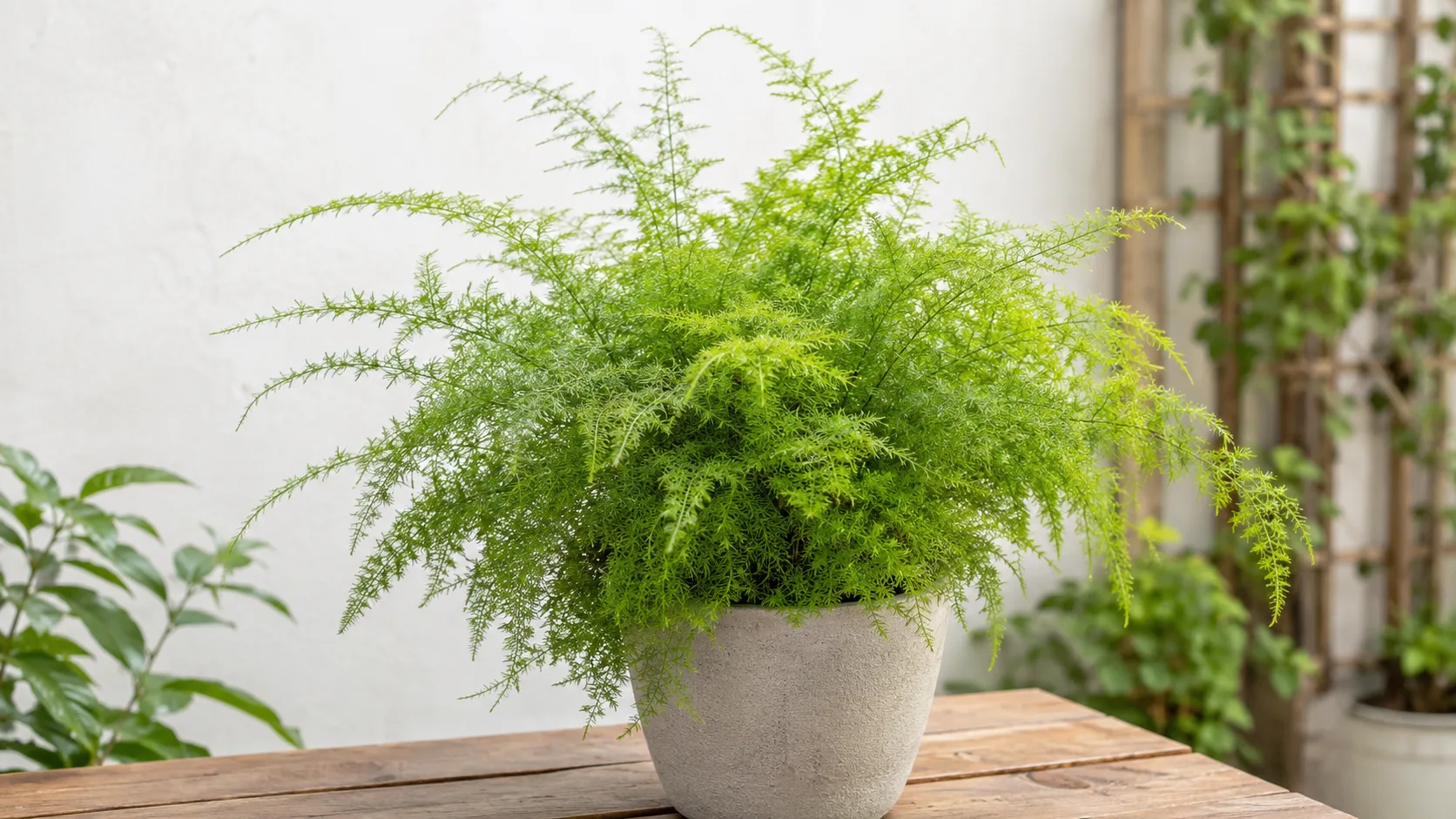
Asparagus setaceus
Asparagus Fern needs bright indirect light and evenly moist soil. Keep humidity moderate and never let roots dry out completely. Note: not a true fern, and toxic to cats and dogs.
Asparagus Fern Care Guide: setaceus & Sprengeri Indoors
Start with wateringThe most common care mistake for Asparagus FernWatering guide →Asparagus Fern care essentials
Light
bright indirect light
Water
Keep soil evenly moist but not soggy; do not let it fully dry out.
Soil
Standard well-draining potting mix with added perlite.
Humidity
40–60%
Temperature
15–24°C (60–75°F)
Fertilizer
Use balanced liquid fertilizer at full strength and stop if the plant is stressed, newly repotted, or not actively growing. Fertilizing in winter.
About Asparagus Fern
Asparagus Fern is native to Southern Africa, typically reaches 60–180 cm as a climbing vine; 30–60 cm as a bushy houseplant indoors, with fast growth. Asparagus Fern has a bushy growth habit and part of the Asparagaceae family. It is also known as Lace Fern, Common Asparagus Fern, and Asparagus plumosus.
| Detail | Information |
|---|---|
| Also known as | Lace Fern, Common Asparagus Fern, Asparagus plumosus |
| Native region | Southern Africa |
| Mature size | 60–180 cm as a climbing vine; 30–60 cm as a bushy houseplant |
| Growth rate | Fast |
| Growth habit | Bushy |
| Scientific name | Asparagus setaceus |
| Family | Asparagaceae |
Asparagus Fern Care Guide: setaceus & Sprengeri Indoors
Walk into almost any houseplant shop and you will find at least one plant labeled “asparagus fern.” What you will not find on the label is that the name is wrong, the species on the tag may be one of three, and the plant can quietly make a cat sick. This guide sorts that out, then gives you a practical, indoor-tested care routine for Asparagus setaceus (the plumosa or lace fern most people picture) and the Asparagus densiflorus ‘Sprengeri’ group, with the foxtail close behind.
The goal here is straightforward: by the end of the article you should know what your asparagus fern actually is, how to set light, water, humidity, soil, and temperature so it stays lush, what to do when leaves go yellow or start dropping, how to propagate it, and exactly what to think about before putting it on a low shelf near a curious pet or planting it in the yard in a warm climate.
For related Asparagus Fern care, see Mealybugs on Asparagus Fern, Aphids on Asparagus Fern.
What “Asparagus Fern” Actually Is (Not a True Fern)
The single most useful thing to know about an asparagus fern is that it is not a fern. It is a member of the Asparagaceae family and is more closely related to the asparagus you eat than to a Boston fern. The Missouri Botanical Garden Plant Finder listing for Asparagus densiflorus ‘Sprengeri’ describes it as a “herbaceous evergreen perennial” with tuberous roots, while the University of Wisconsin Horticulture notes that the genus Asparagus has roughly 300 species originating in southern Africa, especially the Cape of Good Hope region.
What looks like a soft, feathery “leaf” is actually a flattened, photosynthetic stem called a cladode (sometimes written cladophyll). The true leaves have been reduced to tiny, dry, scale-like structures along the stem. The cladodes do the work of leaves: catching light, photosynthesizing, and losing as little water as possible. That is why the plant tolerates short dry spells better than it tolerates being kept wet, and why direct sun scorches the foliage quickly - those flat stems are not built to dissipate intense midday light.
The other botanical feature that matters indoors is the root system. Asparagus ferns grow a network of tuberous roots (sometimes called tuberous rhizomes) that store water and energy. That is the reason a forgotten, under-watered plant can look terrible for a few weeks and then bounce back once it is soaked. It is also the reason a chronically over-watered plant collapses fast: the tubers rot, and the storage system is gone.
One more piece of the “fern” misnomer is worth noting: true ferns reproduce by spores on the underside of their fronds. Asparagus ferns reproduce by seed (in dioecious male and female plants) and vegetatively by division of those tuberous roots. If you see a “fern” producing small white flowers and red or black berries indoors, you are looking at an asparagus relative, not a fern.
The Three Houseplants That Share the Name
Three different species of Asparagus are commonly sold as “asparagus fern,” and the care details vary enough between them to be worth knowing which one you have. The North Carolina Extension Gardener Plant Toolbox and CABI Compendium both note the long-standing taxonomic confusion between A. setaceus and the names A. plumosus and A. aethiopicus. A widely cited revision (Jessop, 1966) treats A. plumosus as a synonym of A. setaceus; some authors disagree and separate them by cladode arrangement (cladodes in one plane vs. radiating in many planes). For indoor care, the practical differences are small, but the species matter for invasiveness, berry color, and overall look.
Asparagus setaceus (Plumosa / Lace Fern)
This is the classic “asparagus fern” with very fine, feathery, triangular sprays that look almost like soft plastic baby’s breath. It is the most commonly sold hanging-basket or shelf plant, with wiry stems that can scramble several feet in length. Mature indoor size is usually 60–180 cm when given something to climb, or 30–60 cm as a bushy pot plant. Flowers are small, greenish-white, and inconspicuous; berries ripen to black or bluish-black and contain one to three black seeds.
Asparagus densiflorus ‘Sprengeri’
‘Sprengeri’ is the arching, slightly shaggy form, with dense emerald needle-like cladodes on long, lax stems that spill out of a pot. The Missouri Botanical Garden Plant Finder lists it as reaching 1.5–3 ft. tall and spreading 2–3 ft. wide, with bright red berries and small fragrant white or pale pink flowers. The stems carry small spines at the leaf axils, which is worth knowing if you handle it bare-handed. The University of Florida IFAS notes that common asparagus-fern is not recommended for Florida landscapes and requires management to prevent escape.
Asparagus aethiopicus and ‘Myers’ (Foxtail)
Asparagus aethiopicus is the species the UF IFAS Center for Aquatic and Invasive Plants flags as a FISC Category I invasive in Florida, with showy red berries and bird-dispersed seed. The cultivar ‘Myers’ (sometimes sold as Asparagus densiflorus ‘Myers’) is the foxtail fern, with upright, plume-like spears of tightly packed cladodes that resemble a fluffy tail. A. aethiopicus and A. densiflorus ‘Sprengeri’ are often confused in trade; CABI’s A. aethiopicus datasheet treats ‘Sprengeri’ as belonging to the A. aethiopicus complex. The care is essentially the same; the difference is mostly cosmetic and ecological.
Light: Bright, Indirect, and Stable
Asparagus ferns are shade-adapted understory plants. Indoors, the goal is to mimic that position: bright, indirect light for most of the day, with at most a short dose of direct morning sun. The Missouri Botanical Garden listing specifically calls out that direct hot afternoon sun can yellow the foliage. NC State Extension also warns that direct sun can scorch foliage on related asparagus ferns.
A practical placement: within 3–6 ft of an east- or north-facing window, or behind a sheer curtain at a south- or west-facing window. A quarter-turn of the pot once a week keeps growth even, since the cladodes lean toward the strongest light source. If the only bright spot is a south-facing window, a light-filtering curtain or a few feet of setback from the glass is usually enough to prevent bleaching.
Low light is survivable, but the plant tells you what it thinks. Leggy, sparse growth with elongated internodes is the classic low-light signal: the stems stretch to find more light, and the cladode clusters thin out. Under a 14–16 hour LED or fluorescent cycle placed 8–12 inches above the foliage, the plant can grow well when there is no good window available.
The opposite problem is just as common. Bleached, pale green, or yellowing cladodes with crispy tips mean the plant is getting too much direct sun or a sudden light change. Move it back, sheer the light, and prune the most damaged stems to encourage regrowth from the tuberous base. Hard changes in light intensity are a more reliable cause of stress than the steady level itself.
Watering: Even Moisture Without Soggy Soil
Asparagus ferns want evenly moist but never waterlogged soil, and the easiest way to get that wrong is to water on a calendar. Pot size, mix composition, humidity, light, and season all change how fast the pot dries. A typical starting point from several extension sources is to water when the top inch of soil feels dry to the touch, roughly every 5–7 days in the active growing season and every 10–14 days in winter, but treat that interval as a starting point, not a final answer.
The tubers on the roots give the plant a real buffer against short dry spells, so a missed watering is rarely fatal. Soggy soil is a different story: the tubers rot, the plant loses its water-storage system, and recovery is hard. The two practical signals of overwatering on Asparagus Fern are yellowing cladodes with soft, mushy stems and a pot that stays heavy for days after watering. If the soil smells sour or the drainage holes leak dark, slimy runoff, the tubers are already compromised.
How to Read Soil Moisture by Touch
The finger test is the most reliable method for most homes. Insert your index finger to the first knuckle (about 2.5 cm). If the soil at that depth feels dry, water thoroughly until it runs from the drainage holes. If it still feels cool and slightly damp, wait. Lift the pot before and after a watering a few times to learn how heavy a freshly-watered pot feels versus one that needs water. A dry pot is meaningfully lighter.
For water itself, use room-temperature, filtered, rainwater, or distilled water if your tap water is hard. Asparagus ferns are sensitive to fluoride, chlorine, and dissolved salts; over time these accumulate in the pot and burn the cladode tips, producing the brown, crispy edges that look like low-humidity damage but are actually a salt problem. If switching water sources is not practical, flush the pot thoroughly with plain water every month or two to wash salts through the drainage holes. Always empty the saucer within 30 minutes of watering so the pot is never sitting in runoff.
In winter, lean dry. The plant’s growth slows, the tubers carry more of the water load, and the cool, dim conditions mean a wet pot stays wet for longer. Cut back gradually, do not stop watering entirely, and resume a normal rhythm when new growth is clearly visible in spring.
Humidity and Temperature Indoors
These plants are native to humid coastal forests in southern Africa, so it is no surprise that moderate to high humidity is what they actually want. The most commonly cited target is 50% relative humidity, with the plant tolerating a floor of about 30–40% in most homes before showing stress. Below 30%, the cladode tips start to desiccate, going brown and papery, and the plant becomes more attractive to spider mites.
The simplest way to raise humidity at the pot is a pebble tray: a shallow tray of pebbles with water kept just below the top of the stones so the pot sits above, not in, the water. Grouping plants together is the next-easiest move; a shared transpiration cycle raises the local humidity a few points. A small cool-mist humidifier is the most reliable fix in dry winter homes.
What does not work well is misting the foliage. The humidity bump from a misting is brief, the wet cladodes invite fungal issues like Colletotrichum leaf spot, and you do little to raise the ambient humidity in the room. Skip the spray bottle and put the effort into a pebble tray or humidifier.
Temperature is the easy one. Average indoor comfort - roughly 65–75°F (18–24°C) - is exactly what the plant wants. The Missouri Botanical Garden lists Sprengeri for indoor culture in warm, humid, Asparagus Fern light guide. Sustained cold below about 50°F (10°C) stalls growth, discolors foliage, and can kill top growth. The risk in most homes is not cold air per se but sudden cold drafts from an open window in winter, an air-conditioning vent pointed straight at the plant, or a window ledge that gets icy overnight. Move the pot a few feet back from the glass in deep winter and you are usually fine.
Soil and Pot Choice
Asparagus ferns want a well-draining, organically rich potting mix that holds enough moisture for the tubers but never sits waterlogged. The Missouri Botanical Garden recommends a well-drained, peaty potting mixture.
A workable recipe: two parts quality all-purpose potting mix, one part perlite, and one part peat or coco coir. The peat or coir keeps the mix from drying out too fast, and the perlite keeps air around the roots so the tubers do not rot.
The target pH is slightly acidic to neutral, roughly 6.0 to 7.0. Most bagged indoor mixes already sit in that range, and a hobbyist rarely needs to adjust it. pH becomes relevant only if you are using very alkaline tap water or very peat-heavy mix and noticing persistent chlorosis; a cheap probe takes the guesswork out.
For pots, the rule is the same as for most houseplants: drainage holes, not decorative sealed containers. Terracotta breathes, which is helpful in humid homes where the mix stays wet; plastic is fine if you are a slightly-underwatering on Asparagus Fern kind of plant owner, since it dries more slowly. Go up only one pot size at a time when you repot. A pot that is too large holds water the root system cannot use, and that is the most common cause of root rot on Asparagus Fern after a repot.
Fertilizer Schedule and Strength
Asparagus ferns are not hungry. The houseplant care consensus is a balanced water-soluble fertilizer, diluted to half strength, applied monthly from spring through early fall, and paused in winter when the plant is not actively growing. The Missouri Botanical Garden recommends monthly feeding during the growing season at reduced strength.
Two cautions. First, never feed a dry plant. Always water first, then apply the fertilizer solution to already-moist soil so the salts move through the root zone without burning. Second, pause feeding after a major repot, while the plant is recovering from pests or root work, and during the deepest part of winter. A plant that is not growing cannot use the nutrients, and the unused salts accumulate in the mix, eventually showing up as brown leaf tips and a crusty white rim around the pot rim. If you see that, flush the pot thoroughly with plain water and skip the next feeding.
If you prefer a low-input approach, a single spring application of a slow-release granular fertilizer at the labeled rate is usually enough to carry most asparagus ferns through the active season. Watch the foliage: healthy new growth is the only score that matters.
Asparagus Fern repotting guide Without Losing the Plant
Asparagus ferns only need repotting every two to three years, sometimes longer, and they tolerate being a little root-bound. The signs that it is time are physical: roots circling the surface or coming through the drainage holes, water running straight through the pot without soaking in, or a plant that has become top-heavy for its container. Compacted, sour-smelling mix is also a sign, regardless of timing.
The best time is early in the active growing season, just as the plant is pushing out new spears. That gives the plant a full warm, bright season to fill the new pot with roots. Repotting in deep winter or during a heat wave both slow recovery. Go up only one pot size at a time (about 1–2 inches of additional diameter), use fresh well-draining mix, and water lightly for the first week so any torn roots can heal before the mix stays wet.
Wear gloves if you can. The stems and roots carry small spines that can irritate skin, and several species are flagged as potential skin irritants on contact, especially for people with sensitive skin. UF IFAS specifically recommends caution when handling Asparagus aethiopicus ‘Sprengeri’ because of skin irritation from the thorns.
Propagation by Division and Seed
The two methods that work for home growers are division and seed. Both are reliable; division is faster, seed is more interesting.
Division is the easiest method and is the right choice when the plant is large and the tuberous root mass has multiple growth points. Water the plant the day before so the tubers are plump. Tip the pot on its side, ease the root ball out, and gently shake off loose mix. You will see the tubers and rhizomes clearly: each connected cluster with its own stems can become a new plant. Use a clean, sharp knife to cut the mass into sections, keeping as much root and tuber attached to each piece as possible. Replant each section in its own pot at the same depth as before, water lightly, and keep in bright, indirect light with stable humidity until new growth appears.
Seed is the slower route and depends on having a female plant that has been pollinated. Asparagus ferns are dioecious in several species, which means male and female flowers are on separate plants, so a single indoor plant rarely sets viable seed. If you do have berries, A. setaceus produces black berries and A. densiflorus / A. aethiopicus produce red berries when ripe. Clean the pulp off, sow the black seeds just below the surface of a moist seed-starting mix, keep them warm (around 70°F) and humid under a dome or plastic cover, and wait. Germination is slow and irregular, often a month or more, so this is a project for patient plant owners rather than a quick multiplication tool.
Do not propagate from a stressed, diseased, or heavily pest-infested plant. Cuttings and divisions inherit the parent’s problems, and weak propagules fail at a much higher rate than healthy ones. Recover the parent first, then take material from the new growth.
Toxicity to Pets and People
The short version: asparagus ferns are toxic to cats and dogs, mildly toxic to humans, and irritating to skin on contact in some people. This is not a plant to keep within reach of a curious pet, and not a plant to nibble on regardless of species.
Cats and Dogs
The ASPCA’s toxic and non-toxic plant database lists Asparagus densiflorus cv sprengeri as toxic to dogs and toxic to cats, with the clinical signs being allergic dermatitis with repeated dermal exposure and gastric upset (vomiting, abdominal pain, or diarrhea) from berry ingestion.
Additional common names on that ASPCA entry include asparagus, emerald feather, emerald fern, Sprengeri fern, plumosa fern, lace fern, racemose asparagus, and shatavari - useful if your plant came in under a different name.
The toxic agents are steroidal saponins, including sapogenin, which are also present in other Asparagaceae species. Most exposures are mild and self-limiting, with symptoms typically resolving within about 24 hours, but small dogs and cats are at higher risk per body weight, and the berries are more concerning than the foliage because they concentrate the compounds. If you suspect your pet has eaten any part of an asparagus fern, the ASPCA Poison Control line is 888-426-4435 and your veterinarian should be the next call; do not try to induce vomiting at home unless a vet specifically tells you to.
The practical implication for an indoor plant owner is simple. If you have cats that chew on plants, this is a poor choice. Hang it well out of reach, put it in a closed terrarium, or pick a different plant. The risk is not catastrophic, but the consequences are predictable, and “mild” is not a word you want to hear from a vet about your pet.
Humans, Toddlers, and Skin Contact
For people, the risk is mostly skin contact. The thorns and sap can cause contact dermatitis in sensitive individuals, especially with repeated handling. UF IFAS specifically warns about skin irritation from A. aethiopicus ‘Sprengeri’. If you are repotting, pruning, or otherwise handling a large plant, gloves are a good idea, and washing hands afterward is enough for most people. Ingestion of berries or foliage by a toddler can produce the same gastrointestinal upset seen in pets, again usually mild; the call is to poison control (1-800-222-1222 in the US) and your pediatrician, not to wait and see.
Common Problems and Real Fixes
Most asparagus fern problems are environmental and present as a small set of recognizable symptoms. The diagnostic is the same in every case: check the soil moisture, then the light, then the plant closely for pests, then the water source. Most issues resolve in 2–3 weeks once the cause is corrected, but recovery from severe overwatering or pest pressure can take longer.
Yellow leaves. This is the most common complaint and has multiple causes. If the soil is wet and the stems are soft and mushy, overwatering is the prime suspect - unpot, trim any black or mushy tubers, and repot in fresh mix. If the cladodes are dry, papery, and crispy, the plant is underwatered or the humidity is too low. Pale, stretched growth with long internodes points to insufficient light. Spotty or stippled yellowing, especially with fine webbing on the undersides, is spider mite damage. A flat, uniform yellow with green veins on new growth suggests an iron or magnesium deficiency, though this is uncommon in a reasonable potting mix.
Leaf drop. Asparagus ferns drop cladodes in response to stress, and the most common indoor triggers are dry soil, low humidity, and sudden changes in light or temperature. The Missouri Botanical Garden flags leaf drop as “a nuisance when kept indoors, especially in winter.” Consistency is the fix: keep the Asparagus Fern watering guide stable, raise humidity before winter, and avoid moving the plant to a dramatically different spot.
Brown, crispy cladode tips. This is almost always low humidity or mineral buildup from tap water. Raise humidity to 50% or higher, switch to filtered, rain, or distilled water if possible, flush the pot monthly, and trim the brown tips with sterile scissors for cosmetics. New growth should come in clean.
Spider mites. These are the most common pest, especially in dry winter air. Signs are fine webbing on the undersides of stems and cladodes, stippled yellow-white flecks, and a bronze or dusty look on the foliage. They thrive in dry conditions. The fix is to raise humidity, give the plant a strong shower to physically dislodge as many mites as possible, then treat with insecticidal soap or a horticultural oil. Neem oil works for most growers, but a few extension sources note that oil-based products can occasionally cause phytotoxicity on the delicate cladodes, so test a small area first and follow the label.
Mealybugs, scale, and aphids. Cottony white clusters in the leaf axils are mealybugs; hard brown bumps along the stems are scale. Both respond to a cotton swab dipped in 70% isopropyl alcohol applied directly to each cluster, followed by insecticidal soap once a week for three cycles. Quarantine the plant while you treat it; all three of these pests spread to neighbors quickly.
Root rot. This is the serious one. It starts with overwatering or a pot that holds water, and shows up as foul-smelling, blackened, mushy roots, plus wilting foliage on a plant in wet soil. The fix is to unpot immediately, cut away every soft or black root and tuber with sterile pruners, and repot in fresh, fast-draining mix. Withhold water for about a week, then resume a careful rhythm. A plant that has lost a large portion of its tubers may not recover; prevention is far easier than cure.
Fungus gnats. Small dark flies hovering near the soil surface are fungus gnats, and they are almost always a sign that the surface of the mix is staying too wet. Let the top inch dry out between waterings, top-dress with a thin layer of sand or perlite, and use a hydrogen peroxide drench (1 part 3% H₂O₂ to 4 parts water) to kill larvae in the top layer of mix. Sticky yellow traps catch the adults.
Flowers, Berries, and Invasiveness
Mature, well-grown asparagus ferns will flower. The flowers are small, white to pinkish-white, often fragrant, and borne in short racemes along the stems, usually in spring through fall on plants with enough light. Because the plants are dioecious in several species, only pollinated female flowers produce berries. The University of Wisconsin Horticulture notes that plants grown in temperate climates often do not bloom indoors at all, and that fruiting is a function of light, age, and having both sexes present.
When berries do form, the color depends on the species: red on A. densiflorus and A. aethiopicus, black or bluish-black on A. setaceus. Each berry contains 1–3 small black seeds. Birds love the berries, and that is the single biggest reason asparagus ferns have become invasive in warm regions.
The invasiveness question is the one most generic care articles skip, and it is worth taking seriously. The University of Florida IFAS Center for Aquatic and Invasive Plants lists Asparagus aethiopicus as a FISC Category I invasive species in Florida, and the CABI Compendium entry on A. aethiopicus documents invasiveness in Australia, New Zealand, Florida, Cuba, and the Bahamas, where the plant forms dense colonies that displace native understory. The Missouri Botanical Garden Plant Finder page for ‘Sprengeri’ explicitly says the plant is “considered invasive in Australia and parts of the United States including Florida, Hawaii, and southern California” and recommends checking local regulations before adding it to a landscape.
The practical takeaway: keep Asparagus Fern overview in a pot indoors unless you are sure it is appropriate for your region. If you live in USDA zones 9–11 and want to grow it outside, expect to manage it actively. Never compost the tubers or berry-laden trimmings in a way that lets them reach natural areas. Bird-dispersed seed is the main vector, and the tuberous roots are the survival mechanism that makes eradication hard.
Conclusion
An asparagus fern is a forgiving, fast-growing, beautiful houseplant once you stop treating it like a fern and start treating it like a soft-leaved relative of edible asparagus. The care is simple: bright, indirect light, evenly moist but never soggy soil, 50% humidity, average indoor temperatures above 50°F, half-strength fertilizer in the active season, and a fresh well-draining mix every two to three years. The complications are mostly outside the pot: the plant is toxic to cats and dogs, mildly toxic to humans, and ecologically invasive in much of the warm-climate world.
If you can give it steady light, a stable watering rhythm, and a place out of reach of curious pets, it will reward you with years of feathery growth. If you cannot, a true fern or a non-toxic alternative is the more honest choice. The label says “fern” for marketing reasons; the plant is an Asparagus, and once you treat it that way, the care is straightforward.
When to use this page vs other Asparagus Fern guides
- Asparagus Fern overview - Canonical hub for this species - care topics and problems branch from here.
- Asparagus Fern problems - Symptom-first path when you already know something is wrong.
Related Asparagus Fern guides
- Asparagus Fern watering
- Asparagus Fern light
- Asparagus Fern soil
- Asparagus Fern propagation
- Asparagus Fern fertilizer
- Asparagus Fern repotting
- Asparagus Fern pruning
- Yellow Leaves on Asparagus Fern
- Spider Mites on Asparagus Fern
- Brown Tips on Asparagus Fern
- Root Rot on Asparagus Fern
- Overwatering on Asparagus Fern
How to care for Asparagus Fern?
How much light does Asparagus Fern need?
bright indirect light
- bright indirect light - bright indirect light.
When should you water Asparagus Fern?
Keep soil evenly moist but not soggy; do not let it fully dry out.
- Top 2 cm should feel barely moist before watering again - Keep soil evenly moist but not soggy; do not let it fully dry out.
- Drain excess water - Empty the saucer after watering so the roots are not sitting in standing water.
What soil works best for Asparagus Fern?
Standard well-draining potting mix with added perlite.
- potting mix - Standard well-draining potting mix with added perlite.
- perlite - Standard well-draining potting mix with added perlite.
Grower notes for Asparagus Fern
What matters most with Asparagus Fern
Asparagus Fern is less forgiving of dry air and missed watering than tough foliage plants. The trick is steady moisture with oxygen, not a swampy pot. In practice, the care checkpoint is simple: bright indirect light. Pair that with standard well-draining potting mix with added perlite, and avoid changing water, pot size, and placement all at once.
Best placement in a real home
Asparagus Fern belongs where bright indirect light is realistic for most of the day, not only where the pot looks good. Keep soil evenly moist but not soggy; do not let it fully dry out. If the pot stays wet longer than expected, move the plant into better light or reassess the mix before watering again. Humidity target: 40–60%. Temperature comfort zone: 15–24°C (60–75°F).
Before you buy this plant
Choose Asparagus Fern with firm new growth, clean leaf undersides, and soil that does not smell sour or feel compacted. Be cautious if you see yellow-leaves, sticky residue, collapsed crowns, or a pot that is wet in poor light. Cosmetic old-leaf damage is less worrying than weak roots or active pests.
First month after bringing it home
Do not repot Asparagus Fern on day one unless the mix is failing or pests are obvious. Quarantine it, learn how fast the pot dries, and keep care boring while it adjusts. Watch especially for yellow-leaves, spider-mites, and brown-tips. If problems appear, correct the condition first rather than stacking fertilizer, repotting, and pruning together.
Safety note for Asparagus Fern
Asparagus Fern is not a plant to keep within reach of pets or children. The database flags it for cats and dogs. Use gloves if sap or plant tissue is irritating, and pick a pet-safe alternative for floor pots or low shelves.
How to tell Asparagus Fern is settling in
Also sold as Lace Fern, Common Asparagus Fern, and Asparagus plumosus, this plant should be judged by stable new growth rather than label names alone. If you plan to multiply it later, common methods include Division and Seed. Repot only when you see roots or tubers breaking through pot walls and very fast water uptake. If spider-mites shows up early, inspect light, watering, and roots before assuming the plant is permanently weak.
Is it pet safe?
Asparagus Fern is toxic to cats and dogs.
Berries are toxic to cats and dogs. Repeated skin contact with foliage can cause contact dermatitis. ASPCA lists as toxic.
Watering Asparagus Fern
For Asparagus Fern, top 2 cm should feel barely moist before watering again and water every 5–7 days in summer; every 10–14 days in winter. Reduce slightly in winter but never let fully dry.
| Detail | Information |
|---|---|
| How often | Every 5–7 days in summer; every 10–14 days in winter |
| How to check | Top 2 cm should feel barely moist before watering again |
| Seasonal changes | Reduce slightly in winter but never let fully dry |
Signs of overwatering
- yellowing fronds
- root rot
- mushy base tubers
Signs of underwatering
- yellowing then dropping needle-like cladodes
- dry crumbly soil
Soil & potting for Asparagus Fern
Use a mix of potting mix, perlite for Asparagus Fern. Good; tubers store some water but drainage is still essential. Target soil pH around 6.0–7.0. Repot every 1–2 years, ideally in spring.
| Detail | Information |
|---|---|
| Recommended mix | potting mix, perlite |
| Drainage | Good; tubers store some water but drainage is still essential |
| Soil pH | 6.0–7.0 |
| Repotting frequency | Every 1–2 years |
| Best season to repot | Spring |
Signs it needs repotting
- roots or tubers breaking through pot walls
- very fast water uptake
Humidity & temperature for Asparagus Fern
Asparagus Fern prefers 40–60%, though normal home humidity is usually fine. Keep temperatures around 15–24°C (60–75°F).
| Detail | Information |
|---|---|
| Humidity | 40–60% - normal home humidity is fine. |
| Ideal temperature | 15–24°C (60–75°F) |
Fertilizer & pruning for Asparagus Fern
Use use balanced liquid fertilizer at full strength and stop if the plant is stressed, newly repotted, or not actively growing. Fertilizing in winter. for Asparagus Fern.
| Detail | Information |
|---|---|
| Fertilizer type | Use balanced liquid fertilizer at full strength and stop if the plant is stressed, newly repotted, or not actively growing. Fertilizing in winter. |
Common problems on Asparagus Fern
Yellow Leaves
MediumLikely cause: Too dry, insufficient light, or root-bound
Quick fix: Water more consistently; repot if root-bound
Full fix guide →Spider Mites
MediumLikely cause: Dry indoor air
Quick fix: Mist foliage; treat with insecticidal soap or neem oil
Full fix guide →Brown Tips
LowLikely cause: Low humidity or direct sun
Quick fix: Move away from direct sun; mist occasionally
Full fix guide →Root Rot
MediumLikely cause: Common on this plant type; confirm with recent watering, light, and root checks.
Quick fix: Inspect the plant and correct the most likely care stressor before stacking treatments.
Full fix guide →Overwatering
MediumLikely cause: Common on this plant type; confirm with recent watering, light, and root checks.
Quick fix: Inspect the plant and correct the most likely care stressor before stacking treatments.
Full fix guide →Underwatering
MediumLikely cause: Common on this plant type; confirm with recent watering, light, and root checks.
Quick fix: Inspect the plant and correct the most likely care stressor before stacking treatments.
Full fix guide →Mealybugs
MediumLikely cause: Common on this plant type; confirm with recent watering, light, and root checks.
Quick fix: Inspect the plant and correct the most likely care stressor before stacking treatments.
Full fix guide →Aphids
MediumLikely cause: Common on this plant type; confirm with recent watering, light, and root checks.
Quick fix: Inspect the plant and correct the most likely care stressor before stacking treatments.
Full fix guide →Leggy Growth
MediumLikely cause: Common on this plant type; confirm with recent watering, light, and root checks.
Quick fix: Inspect the plant and correct the most likely care stressor before stacking treatments.
Full fix guide →Slow Growth
MediumLikely cause: Common on this plant type; confirm with recent watering, light, and root checks.
Quick fix: Inspect the plant and correct the most likely care stressor before stacking treatments.
Full fix guide →Wilting
MediumLikely cause: Common on this plant type; confirm with recent watering, light, and root checks.
Quick fix: Inspect the plant and correct the most likely care stressor before stacking treatments.
Full fix guide →Drooping Leaves
MediumLikely cause: Common on this plant type; confirm with recent watering, light, and root checks.
Quick fix: Inspect the plant and correct the most likely care stressor before stacking treatments.
Full fix guide →Low Humidity
MediumLikely cause: Common on this plant type; confirm with recent watering, light, and root checks.
Quick fix: Inspect the plant and correct the most likely care stressor before stacking treatments.
Full fix guide →Not Enough Light
MediumLikely cause: Common on this plant type; confirm with recent watering, light, and root checks.
Quick fix: Inspect the plant and correct the most likely care stressor before stacking treatments.
Full fix guide →Fungus Gnats
MediumLikely cause: Common on this plant type; confirm with recent watering, light, and root checks.
Quick fix: Inspect the plant and correct the most likely care stressor before stacking treatments.
Full fix guide →Mold on Soil
MediumLikely cause: Common on this plant type; confirm with recent watering, light, and root checks.
Quick fix: Inspect the plant and correct the most likely care stressor before stacking treatments.
Full fix guide →Curling Leaves
MediumLikely cause: Common curling leaves pattern on Asparagus Fern under indoor care stress.
Quick fix: Inspect roots, watering, light, and pests; adjust one variable and monitor new growth.
Full fix guide →Brown Leaves
MediumLikely cause: Common brown leaves pattern on Asparagus Fern under indoor care stress.
Quick fix: Inspect roots, watering, light, and pests; adjust one variable and monitor new growth.
Full fix guide →Black Spots
MediumLikely cause: Common black spots pattern on Asparagus Fern under indoor care stress.
Quick fix: Inspect roots, watering, light, and pests; adjust one variable and monitor new growth.
Full fix guide →Holes in Leaves
MediumLikely cause: Common holes in leaves pattern on Asparagus Fern under indoor care stress.
Quick fix: Inspect roots, watering, light, and pests; adjust one variable and monitor new growth.
Full fix guide →Pale Leaves
MediumLikely cause: Common pale leaves pattern on Asparagus Fern under indoor care stress.
Quick fix: Inspect roots, watering, light, and pests; adjust one variable and monitor new growth.
Full fix guide →Distorted Leaves
MediumLikely cause: Common distorted leaves pattern on Asparagus Fern under indoor care stress.
Quick fix: Inspect roots, watering, light, and pests; adjust one variable and monitor new growth.
Full fix guide →Scale Insects
MediumLikely cause: Common scale insects pattern on Asparagus Fern under indoor care stress.
Quick fix: Inspect roots, watering, light, and pests; adjust one variable and monitor new growth.
Full fix guide →Thrips
MediumLikely cause: Common thrips pattern on Asparagus Fern under indoor care stress.
Quick fix: Inspect roots, watering, light, and pests; adjust one variable and monitor new growth.
Full fix guide →Whiteflies
MediumLikely cause: Common whiteflies pattern on Asparagus Fern under indoor care stress.
Quick fix: Inspect roots, watering, light, and pests; adjust one variable and monitor new growth.
Full fix guide →Leaf Miners
MediumLikely cause: Common leaf miners pattern on Asparagus Fern under indoor care stress.
Quick fix: Inspect roots, watering, light, and pests; adjust one variable and monitor new growth.
Full fix guide →Caterpillars
MediumLikely cause: Common caterpillars pattern on Asparagus Fern under indoor care stress.
Quick fix: Inspect roots, watering, light, and pests; adjust one variable and monitor new growth.
Full fix guide →Nitrogen Deficiency
MediumLikely cause: Common nitrogen deficiency pattern on Asparagus Fern under indoor care stress.
Quick fix: Inspect roots, watering, light, and pests; adjust one variable and monitor new growth.
Full fix guide →Iron Deficiency
MediumLikely cause: Common iron deficiency pattern on Asparagus Fern under indoor care stress.
Quick fix: Inspect roots, watering, light, and pests; adjust one variable and monitor new growth.
Full fix guide →Magnesium Deficiency
MediumLikely cause: Common magnesium deficiency pattern on Asparagus Fern under indoor care stress.
Quick fix: Inspect roots, watering, light, and pests; adjust one variable and monitor new growth.
Full fix guide →Potassium Deficiency
MediumLikely cause: Common potassium deficiency pattern on Asparagus Fern under indoor care stress.
Quick fix: Inspect roots, watering, light, and pests; adjust one variable and monitor new growth.
Full fix guide →Calcium Deficiency
MediumLikely cause: Common calcium deficiency pattern on Asparagus Fern under indoor care stress.
Quick fix: Inspect roots, watering, light, and pests; adjust one variable and monitor new growth.
Full fix guide →