Aglaonema Red Valentine Care Guide: Light, Water, Soil
Aglaonema commutatum 'Red Valentine'
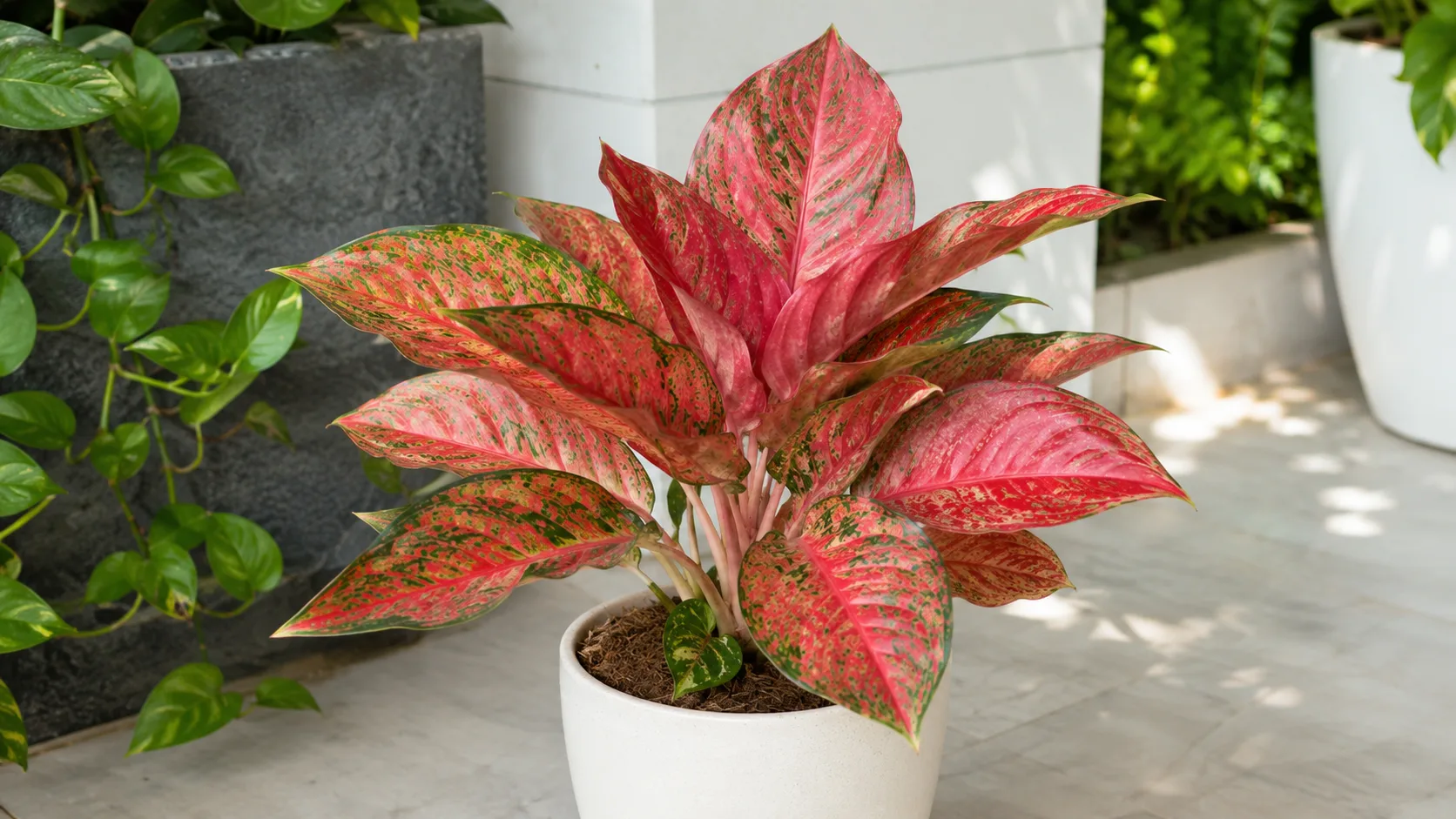
Aglaonema Red Valentine keeps its vibrant red colour in brighter indirect light. It's easy to care for and very forgiving of occasional neglect.
Aglaonema Red Valentine Care Guide: Light, Water, Soil, Toxicity
Start with wateringThe most common care mistake for Aglaonema Red ValentineWatering guide →Aglaonema Red Valentine care essentials
Light
medium to bright indirect light, low indirect light (colour fades)
Water
Water when top half of soil dries.
Soil
Well-draining potting mix with perlite.
Humidity
Average to moderate humidity (40–60%)
Temperature
18°C to 27°C (65–80°F)
Fertilizer
Feed lightly during active growth. Use monthly in spring and summer..
About Aglaonema Red Valentine
Aglaonema Red Valentine has a upright growth habit.
| Detail | Information |
|---|---|
| Growth habit | Upright |
| Scientific name | Aglaonema commutatum 'Red Valentine' |
Aglaonema Red Valentine Care Guide: Light, Water, Soil, Toxicity
Aglaonema ‘Red Valentine’ is the cultivar people reach for when they want a Chinese Evergreen that actually looks like something. Where most Aglaonemas earn their reputation with green and silver foliage that disappears into a room, ‘Red Valentine’ announces itself: broad, glossy leaves splashed with rose-pink, deep red, and fresh green, often on the same plant at the same time. It is a tissue-cultured Thai-style hybrid of Aglaonema commutatum, and it behaves like one. The trade-off for the color is that it needs more light than the generic “low-light Chinese Evergreen” label suggests, and like every Aglaonema, it carries insoluble calcium oxalate crystals that make it unsafe for cats, dogs, horses, and curious toddlers. This guide covers identity, origin, appearance, toxicity, basic care, and how it compares to its closest look-alike, so you can decide whether ‘Red Valentine’ fits your home and how to grow it well if it does.
What is Aglaonema Red Valentine?
Aglaonema Red Valentine is a named cultivar of Aglaonema commutatum, a species in the Araceae family that has been commercially cultivated as an indoor foliage plant since the 1930s. The cultivar is sold under the botanical name Aglaonema commutatum ‘Red Valentine’ and is most often labeled at retail as Red Valentine Chinese Evergreen. It belongs to the same broad category of colorful Thai-influenced Aglaonema hybrids that includes ‘Siam Aurora’, ‘Lady Valentine’, and the ‘Anyamanee’ type, all of which are products of interspecific breeding programs run primarily in Thailand, China, and the Philippines rather than the University of Florida’s Apopka program that produced the silver-leaved Bay series.
Botanical identity, family, and origin
The plant sits in the genus Aglaonema within Araceae, the aroid family that also includes Monstera, Philodendron, Spathiphyllum (peace lily), Anthurium, and Dieffenbachia. The shared chemistry is what links their care needs and their hazards. Aroids tend to want chunky, well-aerated substrate, suffer when their roots stay wet, and produce inflorescences consisting of a spadix wrapped in a spathe, even when grown indoors. They also tend to concentrate calcium oxalate raphides in their tissues, which is the reason every Aglaonema - ‘Red Valentine’ included - is listed as toxic by the ASPCA. The Royal Horticultural Society recognizes Aglaonema commutatum and its hybrid ‘Silver Queen’ with an Award of Garden Merit as a houseplant, and lists Aglaonema ‘Valentine’ as an accepted cultivar name, though ‘Red Valentine’ itself is not on the current AGM list.
Red Valentine is a commercial ornamental selection rather than a wild-collected species. Aglaonema commutatum itself is native to the Philippines and northeastern Sulawesi and has been introduced across tropical Asia, but the colorful Thai-style hybrids were developed through interspecific hybridization involving A. commutatum, A. nitidum, A. costatum, and A. rotundum, with parent species including forms from Sumatra and New Guinea. Australian horticulturist Angus Stewart described the wave of Thai-hybrid Aglaonemas, including ‘Red Valentine’, ‘Legacy’, and ‘Siam Aurora’, as products of large-scale tissue-culture production that made the cultivars commercially viable for the first time in the 2010s.
Large-scale production of ‘Red Valentine’ is now done through tissue culture, which is why the cultivar is widely available and inexpensive. A 2022 BMC Genomics paper studying anthocyanin biosynthesis in A. commutatum ‘Red Valentine’ noted that commercial seedlings are produced almost entirely through tissue culture, and that “reduced proportion of red foliage during large-scale production of A. commutatum seedlings is a frequent occurrence” - meaning that growers sometimes see plants where the foliage reverts toward green. A 2022 PLOS One chloroplast-genome study of five variegated Aglaonema cultivars confirmed that ‘Red Valentine’ is genetically distinct from the visually similar ‘Lady Valentine’, even though the two are routinely confused in commerce and online shops.
Appearance, size, and why the color changes
Red Valentine grows as a compact, upright-to-bushy clump with broad, ovate to lanceolate leaves held on long petioles. New leaves typically emerge bright pink or rosy-red and deepen, mature, or shift toward green as they age. The pink-to-red coloration is produced by anthocyanin pigments in the upper leaf tissue; the same pigment class that makes red maple leaves and red cabbage red. The cultivar is prized precisely because anthocyanin expression in Aglaonema Red Valentine overview is unusually strong, but anthocyanin expression is also light-dependent and can fade when a plant is moved to lower light or when leaf tissue ages.
Mature size and growth habit
Indoors, Red Valentine typically reaches 40 to 60 cm (roughly 16 to 24 inches) in both height and spread at maturity, with a dense clumping habit and a slow to moderate growth rate. Under ideal conditions - Aglaonema Red Valentine light guide, warm temperatures, regular feeding, and a slightly root-bound but not stressed root system - plants can push toward 75 to 90 cm (about 30 to 36 inches) tall and wide over several years. The plant reaches a typical indoor mature size in roughly 2 to 3 years from a 6-inch nursery pot, although tissue-cultured starter plants may take a year longer to fill in. The compact habit makes it well suited to desks, side tables, and grouped foliage displays where a single plant needs to carry a strong color note.
Why new leaves are pink and old leaves turn greener
A Red Valentine leaf is not a static object. The newest leaves in the center of the rosette emerge saturated pink or rosy-red, often with a fresh green margin. As each leaf expands and matures, anthocyanin levels can drop, chlorophyll builds up, and the leaf often reads as a darker, more green-dominant blade with pink veins or pink splotches. Older leaves, especially lower leaves in lower light, can read as mostly green with a pink midrib. The 2022 BMC Genomics study identified a cluster of structural and regulatory genes that drive anthocyanin biosynthesis in this cultivar, and showed that anthocyanin levels respond to light exposure and developmental stage. This is why a plant in a bright east-facing window looks dramatically more colorful than the same plant on a north-facing shelf two months later.
A separate, but related, issue is anthocyanin reversion in tissue-cultured plants. The same BMC Genomics paper documented cases where tissue-cultured ‘Red Valentine’ plants spontaneously produced two mutant forms, ‘Hong Yan’ and ‘Hong Jian’, with altered red expression. Plants that revert in production are usually culled, but a small percentage reach retail. If a plant you bring home loses its pink over a few months despite good light, it may be a reversion rather than a care problem.
Is Aglaonema Red Valentine toxic to pets and people?
Yes. Red Valentine is toxic to cats, dogs, horses, and humans if any part of the plant is chewed or swallowed. The toxic principle is the same as for every Aglaonema: insoluble calcium oxalate crystals, packaged as microscopic needle-shaped raphides, embedded in the plant tissue. The ASPCA lists Chinese Evergreen (Aglaonema) as toxic to dogs, cats, and horses, with clinical signs of “oral irritation, pain and swelling of mouth, tongue and lips, excessive drooling, vomiting (not horses), difficulty swallowing.” The Pet Poison Helpline gives the same clinical picture and notes that, very rarely, swelling of the upper airway can occur and may compromise breathing. The Merck Veterinary Manual describes the mechanism as mechanical rather than chemical: chewing the plant releases raphides that physically penetrate the soft tissue of the mouth, tongue, and throat, producing immediate burning and irritation.
Insoluble calcium oxalate raphides are bundles of needle-like crystals held in specialized cells called idioblasts. When the plant tissue is crushed - by chewing, in other words - the idioblasts rupture and fire the raphides into the mouth. The crystals embed in the mucous membranes, and a separate set of cells releases a proteolytic enzyme that worsens the irritation. The pain is mechanical (the crystals are physically stuck in soft tissue) rather than a chemical poisoning, which is why rinsing the mouth with milk or another calcium-containing dairy product can help: the calcium binds the oxalate and helps clear the crystals from the oral cavity and esophagus. Unlike soluble oxalate plants (such as rhubarb leaves and certain Halogeton species), insoluble oxalates do not cause kidney injury in small ingestions.
Clinical signs in cats, dogs, and humans
In cats and dogs, the first signs appear within minutes of chewing: intense oral pain, pawing at the mouth, hypersalivation, head-shaking, and vocalizing, often followed by vomiting and difficulty swallowing. Visible swelling of the lips, tongue, or throat is common. Symptoms typically fade within 12 to 24 hours, and full recovery is expected with supportive care. In humans, the sap can produce skin and eye irritation in sensitive individuals, and chewing any part of the plant produces the same oral burning and swelling. Wash hands after pruning or Aglaonema Red Valentine repotting guide, keep cuttings away from children, and call a veterinarian or the ASPCA Animal Poison Control Center (888-426-4435) immediately if a pet is suspected of having chewed the plant. Most importantly, do not wait for symptoms to worsen; airway swelling, while rare, is the one outcome that becomes life-threatening.
Red Valentine vs. Lady Valentine and other pink Aglaonemas
Red Valentine and Lady Valentine are the two pink Aglaonemas that show up most often in retail listings, and they are routinely confused. The 2022 PLOS One chloroplast-genome analysis sequenced both cultivars and confirmed they are genetically distinct, but the difference is essentially invisible to a buyer: both have broad, glossy, ovate to lanceolate leaves with rose-pink to red coloration and a green margin or green flecks, and both reach similar mature sizes in the 40 to 90 cm range. Lady Valentine is sometimes marketed as a slightly more compact plant with a cooler, more salmon-pink cast, while Red Valentine is typically described as leaning toward a deeper red as leaves mature, but the variation between individual plants and the effect of light on color are larger than the difference between the two cultivars.
Within the broader pink-and-red Aglaonema group, ‘Siam Aurora’ is more often red-and-green with crisp margins and less pink dominance; ‘Anjamani’ leans deeper red; ‘Two-Tone Moonstone’ has heavier pink mottling; ‘Super Red Star’ is almost entirely red; ‘Anyamanee’ is a pink-veined Thai type. For practical care, all of these share the same requirements as ‘Red Valentine’: bright indirect light, well-draining substrate, and the same toxicity profile.
Light requirements that actually keep the pink color
Red Valentine wants bright, indirect light for most of the day, and it is more light-hungry than the generic “low-light Chinese Evergreen” label implies. An east-facing window with morning sun, a west-facing window set back 1 to 2 meters, or a south-facing window with a sheer curtain are all good fits. The plant will tolerate lower light for a while, but the cost is gradual: anthocyanin expression drops, new leaves emerge greener, internodes stretch, and the plant stops producing the saturated pink that made it worth buying in the first place. A spot that delivers roughly 200 to 400 foot-candles of indirect light is the practical target.
The “low-light Chinese Evergreen” myth, corrected
Green-leaved Aglaonemas such as ‘Silver Bay’ and ‘Maria’ genuinely tolerate low light because they are not investing energy in producing anthocyanin pigments. The colorful Thai-style hybrids are a different story. The Joy Us Garden houseplant reference, drawing on direct experience with Pink Aglaonema in a desert climate, is blunt: “This colorful aglaonema isn’t a low-light plant. It needs bright natural light, a moderate to high exposure, to bring out and keep that beautiful pink foliage.” Plants grown in low light will turn greener rather than pink, grow more slowly, and lean toward the light source. If you only have a low-light spot and you want a Chinese Evergreen, choose a green or silver cultivar. If you want a ‘Red Valentine’ to look like a ‘Red Valentine’, put it somewhere genuinely bright.
Rotate the pot a quarter turn every few weeks so the plant does not lean, and avoid direct midday or afternoon sun, which will bleach or scorch the leaves. Pale, washed-out patches on the upper leaf surface usually mean too much direct light; long petioles and small, dark green leaves usually mean not enough.
Aglaonema Red Valentine watering guide and how to read the pot
Water Red Valentine when the top 2 to 3 cm (about an inch) of the substrate is dry, then water thoroughly until water runs from the drainage holes. In practice, that works out to roughly every 7 to 10 days during active growth in a typical indoor environment with bright light, dropping to every 14 to 21 days in winter when the plant is not actively pushing new leaves. The exact interval depends on pot size, substrate, light, humidity, and season, so a calendar answer is a starting point, not a final one. Stick a finger or a wooden chopstick into the mix; if the top inch is dry and the deeper mix is starting to approach dry, water. If the deeper mix is still damp, wait.
In active growth (spring through early fall, in most homes), the plant uses water predictably and the pot dries on a steady rhythm. In the dimmer, cooler months, growth slows and the same watering rhythm that worked in summer will start to overwater the plant. Stretch the interval, check moisture more carefully, and do not feed a plant that is not actively growing. Resume the normal rhythm only when new leaves are visibly emerging from the center of the clump.
Water quality and fluoride sensitivity
Red Valentine, like most Aglaonemas, is sensitive to fluoride and chlorine in municipal tap water. Long-term buildup shows up as brown, crispy leaf tips and dead leaf margins, even when the watering rhythm is correct. Two practical fixes: let tap water sit out overnight before using it (this allows chlorine to dissipate; it does not remove fluoride), or switch to filtered, distilled, or rainwater. Flushing the pot thoroughly with plain water every 4 to 6 weeks also helps wash accumulated salts and fluoride through the substrate rather than letting them concentrate at the root zone.
Best soil mix and pot choice
The right substrate is a chunky, well-draining, lightly fertile aroid mix that holds some moisture but never stays wet. A reliable homemade recipe is roughly 40% standard indoor potting soil, 30% perlite or pumice, 20% orchid bark or coco chips, and 10% coco coir or peat. The structure matters more than the brand: the mix should drain freely, hold air around the roots, and dry from the top down within a week or so of a thorough watering. A heavy, peat-only indoor mix compacts over time, and compacted substrate is one of the fastest paths to root problems in Aglaonemas.
The target pH is slightly acidic to near-neutral, around 5.6 to 6.5. Most off-the-shelf aroid mixes already sit in that range, so pH adjustment is rarely necessary. Use a pot with drainage holes; a decorative cachepot is fine as long as the plant itself is never left sitting in runoff. Terracotta breathes and helps prevent overwatering on Aglaonema Red Valentine; plastic is more forgiving in dry homes because it does not dry out as fast. Repot every 1 to 2 years, or whenever the substrate has visibly compacted, roots are circling the drainage holes, or water runs straight through without soaking in. Go up only one pot size at a time; an oversized pot holds too much water for the root system to use, which is the most common cause of root rot on Aglaonema Red Valentine after repotting.
Humidity, temperature, and airflow
Red Valentine prefers 50% to 70% relative humidity but tolerates average household levels in the 30% to 50% range. The dry-air warning signs are the same as for most aroids: brown leaf tips, brown leaf margins, and a slow build-up of stress that invites spider mites. A small humidifier near the plant, grouping it with other tropicals, or a pebble tray with water below the pot will all help. Misting the leaves is a short-term fix and can encourage fungal leaf spots if water sits on the foliage overnight, so it is not the best long-term humidity strategy.
Temperature should stay between about 18 and 27 °C (65 to 80 °F). Avoid cold drafts from windows in winter, hot air from radiators and heating vents, and direct AC output. The plant will tolerate short dips into the mid-teens, but prolonged exposure below about 15 °C (60 °F) can chill-damage the foliage and slow growth dramatically. Airflow matters as well: a small fan or a less crowded shelf reduces the risk of fungal leaf spots and discourages fungus gnats in the substrate.
Fertilizer, repotting, and long-term maintenance
Red Valentine is not a heavy feeder. A balanced, water-soluble houseplant fertilizer at one-quarter to one-half of the label rate, applied every 4 to 6 weeks during active growth, is enough. Always apply to already-moist soil so the solution can move through the root zone without burning the roots. Skip feeding in winter, in the first month after repotting (most fresh substrates contain a starter charge), and any time the plant is recovering from a pest or root issue. Pause rather than push; the plant will catch up in spring.
Repot in spring or early summer, just as the plant is waking up. Go up only one pot size (about 2 cm wider in diameter), refresh the substrate, and water lightly for the first week to let any damaged roots heal. If the plant is already at the maximum size you want, you can refresh the substrate in the same pot: knock off as much of the old mix as you can, trim any circling roots, and repot back into the same container with fresh substrate.
Propagation: stem cuttings and division
The two practical home methods for Red Valentine are stem cuttings and division, both of which depend on having a healthy parent plant and a clean, sharp tool. Work with a parent that is well-watered, in active growth, and free of pests or disease. The best time is spring or early summer, when the cutting can root quickly in warm, bright conditions.
For stem cuttings, choose a healthy stem with at least two to three leaves and a visible node (the slightly swollen point on the stem where leaves attach and where new roots originate). Cut 1 cm below the node at a 45° angle with a sterile blade, remove the lowest leaf to expose the node, and optionally dip the cut end in rooting hormone. Root in a clear glass of water with the node submerged, or plant directly into a pre-moistened mix of 50% peat-free coco coir, 30% perlite, and 20% orchid bark. Water-propagated cuttings typically root in 4 to 6 weeks; soil-propagated cuttings take about the same time, but you cannot see progress, so check by gently tugging after a month. A clear plastic dome or a loosely tied plastic bag over the pot keeps humidity high and speeds rooting; remove it once new leaves appear.
For division, remove the parent from its pot, tease the root ball apart, and identify natural separations where the plant has already produced an offset with its own roots and shoots. Pot each division into its own container at the same depth as before, water in, and keep the new plants in bright, indirect light with stable humidity for the first few weeks. Division is faster and more reliable than cuttings, but it requires a mature, multi-stemmed plant.
Common problems and how to fix them
| Symptom | Most likely cause | What to do |
|---|---|---|
| Yellow leaves, soft stems | Overwatering, poor drainage | Check roots for rot; trim mushy parts; repot in fresh, well-draining mix; water less often |
| Brown, crispy leaf tips | Low humidity, fluoride in tap water, salt buildup | Raise humidity; switch to filtered or rainwater; flush the pot monthly |
| Pink color fading to green | Insufficient light, age, anthocyanin reversion | Move to brighter, indirect light; expect older leaves to read greener; cull or accept a reversion |
| Bleached, yellow patches on upper leaves | Too much direct sun | Move 1 to 2 m back from a hot window or add a sheer curtain |
| Long petioles, small leaves, leaning | Not enough light | Increase indirect light gradually over 1 to 2 weeks |
| White cottony spots in leaf axils | Mealybugs | Dab with 70% isopropyl alcohol on a cotton swab; follow up with insecticidal soap every 7 to 10 days |
| Fine webbing, stippled leaves | Spider mites | Rinse the plant in the shower; raise humidity; treat with insecticidal soap or neem oil |
| Sticky residue on leaves | Honeydew from sap-sucking insects | Wipe leaves, identify the source pest, treat as above |
| Small dark flies hovering over the substrate | Fungus gnats | Let the top of the substrate dry between waterings; use sticky yellow traps; replace the top 1 cm of mix with fresh, dry mix |
| Mushy base, sudden collapse | Root or stem rot from overwatering | Unpot immediately, trim rotten tissue, repot in dry mix, withhold water until new growth appears |
| Brown or black leaf spots with yellow halos | Fungal leaf spot | Remove affected leaves, improve airflow, avoid overhead watering, treat with a copper-based fungicide if it spreads |
One problem worth flagging separately is anthocyanin reversion. If a plant in genuinely good light loses its pink color rapidly, look for unusually long internodes, all-green new growth, and a general greening of mature leaves at the same time. Anthocyanin reversion is genetic rather than cultural, and the plant will not color up again on the same growth. Healthy green growth is still healthy growth, and the plant can be kept as a foliage plant; the alternative is to replace it with a confirmed-vivid specimen.
Does Aglaonema Red Valentine clean the air?
Partially, and with caveats. The 1989 NASA closed-chamber study by B.C. Wolverton and colleagues, A Study of Interior Landscape Plants for Indoor Air Pollution Abatement, found that Aglaonema modestum (the species most often called Chinese Evergreen) removed benzene and formaldehyde from sealed test chambers. A 2025 Scientific Reports paper extended that work and showed that Aglaonema cultivars can remove up to 92% of benzene from a sealed 1 m³ chamber within 12 hours under controlled conditions, and a 2021 Frontiers in Built Environment field study in the UAE confirmed measurable reductions in VOCs and formaldehyde when planting volumes reached about 10% of the room volume.
What the data do not support is the retail claim that a few houseplants meaningfully clean the air in a real, ventilated home or office. Air exchange rates in typical buildings replace indoor air many times per hour, and the modest filtering capacity of a handful of plants cannot keep up. Red Valentine is a beautiful, easy-to-grow houseplant. It is not a substitute for ventilation, an air purifier, or source control of VOCs. If you want one for its color and form, enjoy it. If you buy it for air purification, you will need a forest.
Conclusion
Aglaonema ‘Red Valentine’ is a tissue-cultured Aglaonema commutatum hybrid in the Araceae family, grown for its rose-pink to red variegation and compact 40 to 60 cm indoor size. It is toxic to cats, dogs, horses, and humans because of insoluble calcium oxalate raphides, and it is not a true low-light plant despite the Chinese Evergreen label: it needs bright, indirect light to keep the anthocyanin-driven pink vivid. Water when the top inch of substrate is dry, use a chunky, well-draining aroid mix with perlite and orchid bark, maintain 50% to 70% humidity, feed lightly during active growth, and propagate from stem cuttings with a node or by division in spring. Expect older leaves to read greener than new growth, expect some pigment variability from leaf to leaf and from clone to clone, and keep the plant out of reach of pets and small children. If you can give it bright, indirect light and a stable indoor environment, it is one of the more rewarding foliage plants a home grower can own.
When to use this page vs other Aglaonema Red Valentine guides
- Aglaonema Red Valentine overview - Canonical hub for this species - care topics and problems branch from here.
- Aglaonema Red Valentine problems - Symptom-first path when you already know something is wrong.
Related Aglaonema Red Valentine guides
- Aglaonema Red Valentine watering
- Aglaonema Red Valentine light
- Aglaonema Red Valentine soil
- Aglaonema Red Valentine propagation
- Aglaonema Red Valentine fertilizer
- Aglaonema Red Valentine repotting
- Aglaonema Red Valentine pruning
- Yellow Leaves on Aglaonema Red Valentine
- Brown Tips on Aglaonema Red Valentine
- Root Rot on Aglaonema Red Valentine
- Overwatering on Aglaonema Red Valentine
- Underwatering on Aglaonema Red Valentine
How to care for Aglaonema Red Valentine?
How much light does Aglaonema Red Valentine need?
medium to bright indirect light, low indirect light (colour fades)
- medium to bright indirect light, low indirect light (colour fades) - medium to bright indirect light, low indirect light (colour fades).
When should you water Aglaonema Red Valentine?
Water when top half of soil dries.
- Check top 2 inches - Water when top half of soil dries.
- Drain excess water - Water when top half of soil dries.
What soil works best for Aglaonema Red Valentine?
Well-draining potting mix with perlite.
- Well-draining mix - Well-draining potting mix with perlite.
Grower notes for Aglaonema Red Valentine
What makes Red Valentine different
Aglaonema Red Valentine carries larger pink-red sections, so leaf scorch and fading are more visible than on green Aglaonemas. Give it bright filtered light if you want color, but protect it from direct sun that can mark the pale tissue.
What matters most with Aglaonema Red Valentine
Aglaonema Red Valentine should be judged by color stability and firm new leaves, not fast growth. Variegated aglaonemas often grow slowly, so a compact plant with clean crowns is better than a tall soft plant pushed in low light. In practice, the care checkpoint is simple: medium to bright indirect light, low indirect light (colour fades). Pair that with well-draining potting mix with perlite, and avoid changing water, pot size, and placement all at once.
Best placement in a real home
Aglaonema Red Valentine belongs where medium to bright indirect light, low indirect light (colour fades) is realistic for most of the day, not only where the pot looks good. Water when top half of soil dries. If the pot stays wet longer than expected, move the plant into better light or reassess the mix before watering again. Humidity target: Average to moderate humidity (40–60%).. Temperature comfort zone: 18°C to 27°C (65–80°F).
Before you buy this plant
Choose Aglaonema Red Valentine with firm new growth, clean leaf undersides, and soil that does not smell sour or feel compacted. Be cautious if you see yellow-leaves, sticky residue, collapsed crowns, or a pot that is wet in poor light. Cosmetic old-leaf damage is less worrying than weak roots or active pests.
First month after bringing it home
Do not repot Aglaonema Red Valentine on day one unless the mix is failing or pests are obvious. Quarantine it, learn how fast the pot dries, and keep care boring while it adjusts. Watch especially for yellow-leaves. If problems appear, correct the condition first rather than stacking fertilizer, repotting, and pruning together.
Safety note for Aglaonema Red Valentine
Aglaonema Red Valentine is not a plant to keep within reach of pets or children. Treat it as an inaccessible display plant. Use gloves if sap or plant tissue is irritating, and pick a pet-safe alternative for floor pots or low shelves.
How to tell Aglaonema Red Valentine is settling in
If you plan to multiply it later, common methods include Stem cuttings and Division.
Is it pet safe?
Aglaonema Red Valentine is toxic to cats and dogs.
Toxic - calcium oxalate crystals cause oral irritation.
Watering Aglaonema Red Valentine
Water when top half of soil dries.
Soil & potting for Aglaonema Red Valentine
Well-draining potting mix with perlite.
Humidity & temperature for Aglaonema Red Valentine
Aglaonema Red Valentine prefers average to moderate humidity (40–60%), though normal home humidity is usually fine. Keep temperatures around 18°C to 27°C (65–80°F).
| Detail | Information |
|---|---|
| Humidity | Average to moderate humidity (40–60%) - normal home humidity is fine. |
| Ideal temperature | 18°C to 27°C (65–80°F) |
Fertilizer & pruning for Aglaonema Red Valentine
Use feed lightly during active growth. Use monthly in spring and summer.. for Aglaonema Red Valentine.
| Detail | Information |
|---|---|
| Fertilizer type | Feed lightly during active growth. Use monthly in spring and summer.. |
Common problems on Aglaonema Red Valentine
Yellow Leaves
MediumLikely cause: Overwatering.
Quick fix: Let soil dry before watering.
Full fix guide →Brown Tips
MediumLikely cause: Common on this plant type; confirm with recent watering, light, and root checks.
Quick fix: Inspect the plant and correct the most likely care stressor before stacking treatments.
Full fix guide →Root Rot
MediumLikely cause: Common on this plant type; confirm with recent watering, light, and root checks.
Quick fix: Inspect the plant and correct the most likely care stressor before stacking treatments.
Full fix guide →Overwatering
MediumLikely cause: Common on this plant type; confirm with recent watering, light, and root checks.
Quick fix: Inspect the plant and correct the most likely care stressor before stacking treatments.
Full fix guide →Underwatering
MediumLikely cause: Common on this plant type; confirm with recent watering, light, and root checks.
Quick fix: Inspect the plant and correct the most likely care stressor before stacking treatments.
Full fix guide →Spider Mites
MediumLikely cause: Common on this plant type; confirm with recent watering, light, and root checks.
Quick fix: Inspect the plant and correct the most likely care stressor before stacking treatments.
Full fix guide →Mealybugs
MediumLikely cause: Common on this plant type; confirm with recent watering, light, and root checks.
Quick fix: Inspect the plant and correct the most likely care stressor before stacking treatments.
Full fix guide →Aphids
MediumLikely cause: Common on this plant type; confirm with recent watering, light, and root checks.
Quick fix: Inspect the plant and correct the most likely care stressor before stacking treatments.
Full fix guide →Leggy Growth
MediumLikely cause: Common on this plant type; confirm with recent watering, light, and root checks.
Quick fix: Inspect the plant and correct the most likely care stressor before stacking treatments.
Full fix guide →Slow Growth
MediumLikely cause: Common on this plant type; confirm with recent watering, light, and root checks.
Quick fix: Inspect the plant and correct the most likely care stressor before stacking treatments.
Full fix guide →Wilting
MediumLikely cause: Common on this plant type; confirm with recent watering, light, and root checks.
Quick fix: Inspect the plant and correct the most likely care stressor before stacking treatments.
Full fix guide →Drooping Leaves
MediumLikely cause: Common on this plant type; confirm with recent watering, light, and root checks.
Quick fix: Inspect the plant and correct the most likely care stressor before stacking treatments.
Full fix guide →Low Humidity
MediumLikely cause: Common on this plant type; confirm with recent watering, light, and root checks.
Quick fix: Inspect the plant and correct the most likely care stressor before stacking treatments.
Full fix guide →Not Enough Light
MediumLikely cause: Common on this plant type; confirm with recent watering, light, and root checks.
Quick fix: Inspect the plant and correct the most likely care stressor before stacking treatments.
Full fix guide →Fungus Gnats
MediumLikely cause: Common on this plant type; confirm with recent watering, light, and root checks.
Quick fix: Inspect the plant and correct the most likely care stressor before stacking treatments.
Full fix guide →Mold on Soil
MediumLikely cause: Common on this plant type; confirm with recent watering, light, and root checks.
Quick fix: Inspect the plant and correct the most likely care stressor before stacking treatments.
Full fix guide →Curling Leaves
MediumLikely cause: Common curling leaves pattern on Aglaonema Red Valentine under indoor care stress.
Quick fix: Inspect roots, watering, light, and pests; adjust one variable and monitor new growth.
Full fix guide →Brown Leaves
MediumLikely cause: Common brown leaves pattern on Aglaonema Red Valentine under indoor care stress.
Quick fix: Inspect roots, watering, light, and pests; adjust one variable and monitor new growth.
Full fix guide →Black Spots
MediumLikely cause: Common black spots pattern on Aglaonema Red Valentine under indoor care stress.
Quick fix: Inspect roots, watering, light, and pests; adjust one variable and monitor new growth.
Full fix guide →Holes in Leaves
MediumLikely cause: Common holes in leaves pattern on Aglaonema Red Valentine under indoor care stress.
Quick fix: Inspect roots, watering, light, and pests; adjust one variable and monitor new growth.
Full fix guide →Pale Leaves
MediumLikely cause: Common pale leaves pattern on Aglaonema Red Valentine under indoor care stress.
Quick fix: Inspect roots, watering, light, and pests; adjust one variable and monitor new growth.
Full fix guide →Distorted Leaves
MediumLikely cause: Common distorted leaves pattern on Aglaonema Red Valentine under indoor care stress.
Quick fix: Inspect roots, watering, light, and pests; adjust one variable and monitor new growth.
Full fix guide →Scale Insects
MediumLikely cause: Common scale insects pattern on Aglaonema Red Valentine under indoor care stress.
Quick fix: Inspect roots, watering, light, and pests; adjust one variable and monitor new growth.
Full fix guide →Thrips
MediumLikely cause: Common thrips pattern on Aglaonema Red Valentine under indoor care stress.
Quick fix: Inspect roots, watering, light, and pests; adjust one variable and monitor new growth.
Full fix guide →Whiteflies
MediumLikely cause: Common whiteflies pattern on Aglaonema Red Valentine under indoor care stress.
Quick fix: Inspect roots, watering, light, and pests; adjust one variable and monitor new growth.
Full fix guide →Leaf Miners
MediumLikely cause: Common leaf miners pattern on Aglaonema Red Valentine under indoor care stress.
Quick fix: Inspect roots, watering, light, and pests; adjust one variable and monitor new growth.
Full fix guide →Caterpillars
MediumLikely cause: Common caterpillars pattern on Aglaonema Red Valentine under indoor care stress.
Quick fix: Inspect roots, watering, light, and pests; adjust one variable and monitor new growth.
Full fix guide →Nitrogen Deficiency
MediumLikely cause: Common nitrogen deficiency pattern on Aglaonema Red Valentine under indoor care stress.
Quick fix: Inspect roots, watering, light, and pests; adjust one variable and monitor new growth.
Full fix guide →Iron Deficiency
MediumLikely cause: Common iron deficiency pattern on Aglaonema Red Valentine under indoor care stress.
Quick fix: Inspect roots, watering, light, and pests; adjust one variable and monitor new growth.
Full fix guide →Magnesium Deficiency
MediumLikely cause: Common magnesium deficiency pattern on Aglaonema Red Valentine under indoor care stress.
Quick fix: Inspect roots, watering, light, and pests; adjust one variable and monitor new growth.
Full fix guide →Potassium Deficiency
MediumLikely cause: Common potassium deficiency pattern on Aglaonema Red Valentine under indoor care stress.
Quick fix: Inspect roots, watering, light, and pests; adjust one variable and monitor new growth.
Full fix guide →Calcium Deficiency
MediumLikely cause: Common calcium deficiency pattern on Aglaonema Red Valentine under indoor care stress.
Quick fix: Inspect roots, watering, light, and pests; adjust one variable and monitor new growth.
Full fix guide →