Spider Mites on Aglaonema Red Valentine: Causes, Checks &
Quick answer
Spider mites on Aglaonema Red Valentine cause fine stippling and bronzing on glossy pink-and-red leaves, often in dry air beside a bright east or west window. First step: isolate the plant away from your collection, then inspect leaf undersides along petiole bases before rinsing or spraying.
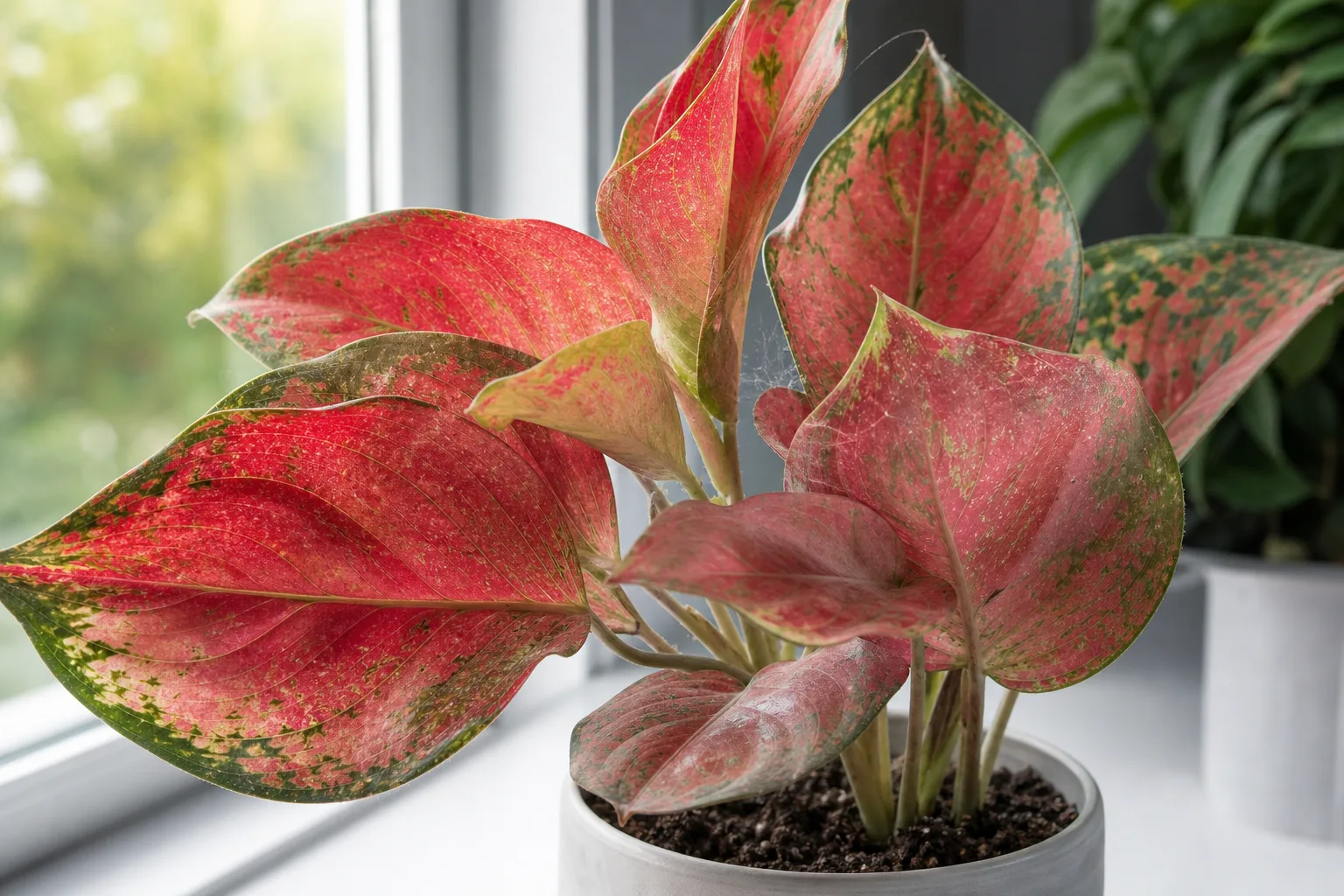
Spider Mites on Aglaonema Red Valentine: Causes, Checks & Fixes
This guide covers spider mites on Aglaonema Red Valentine. See also the general Spider Mites guide, watering, and light pages for this plant.
Spider Mites on Aglaonema Red Valentine: Causes, Checks & Fixes
Quick answer
Spider mites on Aglaonema Red Valentine (Aglaonema commutatum ‘Red Valentine’) are tiny sap-sucking arachnids that colonize the undersides of broad, glossy leaves-often starting where pink variegation meets the green margin or at the base of upright petioles in the compact rosette. They thrive in the same warm, dry microclimates Red Valentine owners create to keep anthocyanin pink color: bright east or west windows, winter heating, and AC drafts that pull humidity below what the foliage prefers.
Early damage looks like fine yellow or white stippling on pink zones, dull bronzing as feeding continues, and delicate webbing at leaf bases-not the papery brown tips you see from dry vent air alone or the margin burn from fluoride-heavy tap water.
First step: isolate the plant away from other houseplants on a separate surface. Spider mites crawl short distances and drift on air currents between pots in grouped foliage displays. Wash your hands before touching healthy plants, then inspect undersides along petiole joints with a magnifier before rinsing or spraying.
What spider mites look like on Aglaonema Red Valentine
Red Valentine’s smooth, lance-shaped leaves make mite damage easier to spot than on velvety plants-but pink anthocyanin zones can mask early stippling until bronzing spreads.
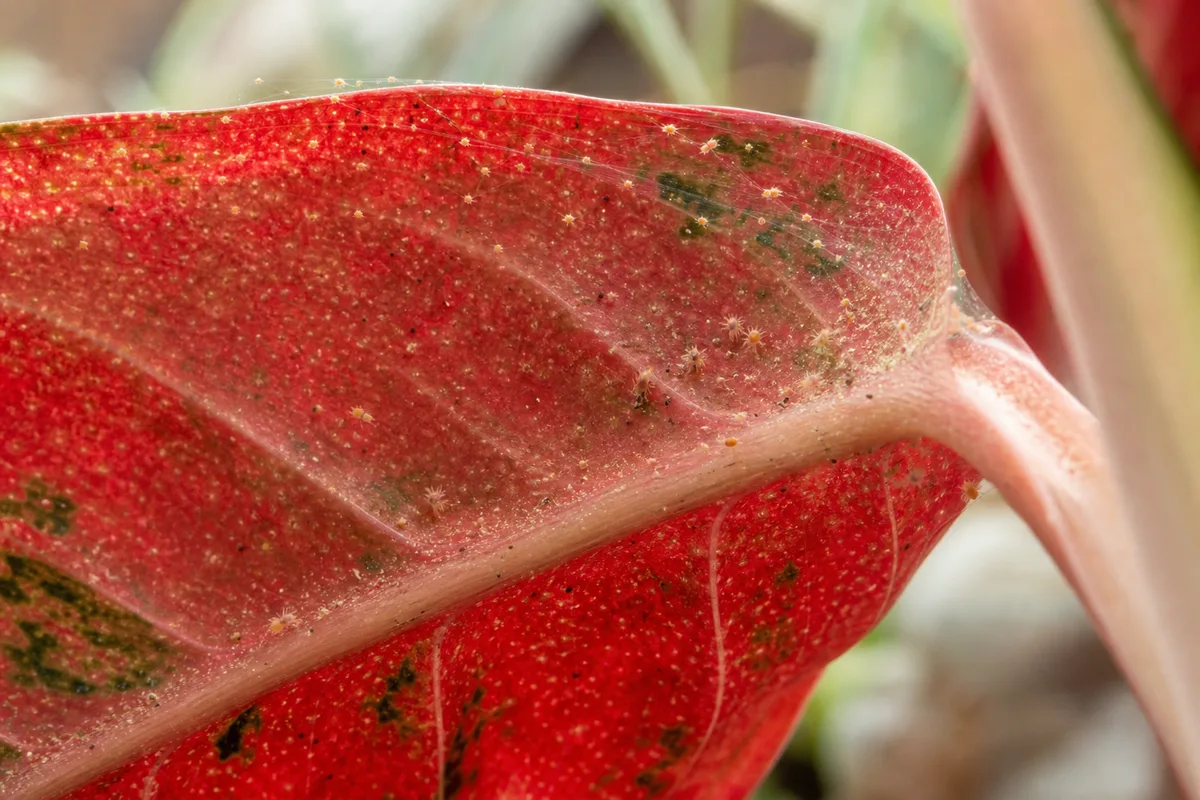
Spider Mites symptoms on Aglaonema Red Valentine - compare with healthy tissue on the same plant.
Stippling on variegated tissue. Feeding punctures cells and creates chlorotic dots, often visible first as tiny pale specks on rose-pink or red margins. Upper surfaces may later look dull or unevenly bronzed while the green center still reads healthy. Heavy feeding turns entire leaves tan or brown at the edges before they crisp and drop.
Fine webbing at petiole bases. Unlike the white cottony clusters of mealybugs, spider mites produce fine silk between petioles, at the junction where the leaf blade meets the stem, and along the lower leaf surface along veins. Webbing often appears before you notice the mites themselves.
The mites. Spider mites are very tiny arachnids-about 1/50 inch long-too small to identify clearly without magnification. On a hand lens, look along veins on the underside for pale green, yellow, or reddish moving specks and cast skins.
Pink fade vs. mite bronzing. Insufficient light causes Red Valentine to lose pink color as new leaves emerge greener and growth slows-a pattern described in the Red Valentine overview. Mite damage adds stippling, webbing, and bronzing on existing pink tissue rather than uniform greening across the plant.
Growth slowdown. Center growth may stall and lower leaves may yellow and drop as feeding drains the plant. This can resemble nutrient stress or underwatering, but check undersides before changing fertilizer or watering rhythm.
Lookalike symptoms on Red Valentine
| Symptom pattern | Likely cause | Key differentiator |
|---|---|---|
| Fine stippling + webbing on undersides | Spider mites | Moving specks on tap test; bronze silk at petiole bases |
| Silvery streaks on leaves; insects jump when disturbed | Thrips | No dense bronze webbing; different feeding marks |
| Papery brown tips, oldest leaves first, no stippling | Low humidity | Vent-facing damage; no webbing or moving specks |
| Brown tips on new pink leaves, white soil crust | Fluoride / tap water | Margin burn without underside stippling |
| Uniform pink fading, stretched stems | Not enough light | No webbing; new leaves greener, not stippled |
| White cottony clusters in leaf axils | Mealybugs | Waxy blobs, not vein stippling |
| Soft crown, sour smell | Crown rot / root rot | Mushy tissue, not firm leaves with moving specks |
Why Aglaonema Red Valentine gets spider mites
Spider mites are not a sign that you failed as a grower. They are one of the most common houseplant pests indoors, especially when air is warm and humidity drops. Red Valentine culture creates several conditions mites exploit:
The bright-window paradox. This cultivar needs roughly 200 to 400 foot-candles of bright, indirect light to maintain pink color-typically an east-facing window, a west-facing sill set back from glass, or a filtered south exposure. Glass intensifies heat and dries air beside the pane, especially in winter when heating runs. That combination favors mite reproduction faster than in cooler, humid rooms.
Dry winter rooms. Heating vents, radiator shelves, and cold AC drafts produce hot, low-humidity microclimates. Spider mites reproduce fastest in warm, dry air-indoor winter conditions are ideal for population explosions. The same dry air that triggers low-humidity tip burn also weakens Red Valentine’s defenses and invites mites.
Compact upright architecture. Red Valentine grows as a dense clump with broad leaves on long petioles. Mites shelter in the tight angles where petioles meet the stem and along lower leaf surfaces you may not see during routine top-down watering. The watering guide focuses on soil moisture; mite checks require deliberately lifting leaves.
Crowded collections. Red Valentine is often grouped with other tropicals for humidity and visual impact. Touching leaves between pots, shared watering sessions, and hands moving from pot to pot spread mites faster than on isolated specimens.
Stressed plants. A Red Valentine that is underwatered, over-fertilized, or sitting in excessive window heat shows damage sooner-but healthy plants in dry air get mites too. Environmental correction helps prevention; it does not replace treatment once mites are established.
How to confirm the cause
Work in bright light with a magnifying glass. Check in this order:
- Tap test - Hold a suspect leaf over white paper and tap firmly. Spider mites fall as tiny moving specks. Static dust does not crawl.
- Underside scan - Lift outer leaves and inspect the lower surface along main veins and petiole bases. Look for stippling, cast skins, and fine webbing.
- Webbing color and location - Bronze or gray silk between petioles and on stems supports spider mites. White cotton in axils points to mealybugs.
- Pink fade cross-check - If color is fading without stippling or webbing, rule out insufficient light before treating as mites.
- Environment check - Is the pot on a west sill above a radiator, beside a heat vent, or in a room below 40% humidity? Dry warmth supports spider mites.
- Neighbor plants - Inspect every plant on the same shelf or windowsill. Mites often appear on multiple pots before one Red Valentine looks badly damaged.
Confirmed diagnosis: moving specks on tap test plus stippling and/or bronze webbing on leaf undersides. Suspected: stippling only, without mites visible-retest in two days with magnification before treating the whole collection.
First fix for Aglaonema Red Valentine
Move the infested plant away from all other houseplants immediately. Place it on a separate surface, wash your hands, and avoid touching healthy plants until you finish inspecting and treating the isolated plant.
That single isolation step stops the fastest route of spread-contact between leaves on adjacent pots and mites carried on hands or tools.
After isolation: rinse and treat on a repeat schedule
Raise humidity around the pot, not by soaking the crown. Set the pot on a pebble tray, run a room humidifier, or group plants with space between them to raise ambient moisture. Red Valentine tolerates average household humidity but benefits from steadier air in heated winter rooms. Do not let water sit in the crown center overnight-Chinese evergreens are sensitive to crown saturation even though leaves are smooth, not fuzzy.
Rinse or shower leaf undersides. Red Valentine’s glossy, smooth leaves tolerate a lukewarm shower or sink spray aimed at undersides-unlike fuzzy-leaved plants where wet crowns cause rot. Tilt the pot, shield soil with plastic if needed, and let foliage dry before evening. Because this cultivar is fluoride-sensitive, use filtered or rested tap water if you plan more than two or three rinse cycles; repeated hard tap water can worsen brown tips on pink margins.
Treat with horticultural oil or insecticidal soap. Apply products labeled for houseplants and mites, coating the underside of each leaf thoroughly. Test one leaf first and wait 48 hours-variegated foliage under bright window light can react to some sprays. Reapply every five to seven days for at least three cycles, because most contact products do not kill eggs. Continue until tap tests and underside checks show no live mites for two consecutive weekly inspections.
Remove heavily infested lower leaves. Snip bronzed, web-covered lower leaves at the petiole base with clean scissors. Bag and discard them. This lowers pest load and improves spray coverage on remaining foliage.
Treat the collection if mites are on multiple pots. Spider mites on one shelf often means neighbors are infested at low levels even without obvious webbing. Inspect and treat all plants in the group, not only the worst-looking Red Valentine.
Pet safety during treatment
Red Valentine is toxic to cats and dogs if chewed-it contains insoluble calcium oxalate crystals like every Chinese evergreen. Keep treated plants away from pets until sprays have dried completely, ventilate the room during application, and store pesticides out of reach. If a pet chews any part of the plant, contact your veterinarian or the ASPCA Animal Poison Control Center (888-426-4435).
Recovery timeline
Light infestations often decline within two to three weeks once isolation, humidity improvement, and repeat underside treatments begin. Plan on three to four treatment cycles at five- to seven-day intervals before calling the plant clear.
Judge recovery by new center leaves opening without stippling, no fresh bronze webbing after a week without treatment, and tap tests that show no moving specks-not by whether old bronzed leaves return to pink. Damaged leaves do not fully heal; stippled pink tissue stays marked until you remove the leaf after the plant is mite-free.
Red Valentine’s slow to moderate growth rate means clean new pink leaves may take four to six weeks to emerge after the last active mites are gone-especially in winter when the plant is not pushing foliage quickly. Stabilize watering and humidity so recovery is not interrupted by root stress or dry-air setbacks.
Signs the problem is worsening include webbing spreading to multiple petioles, lower leaves dropping in clusters, mites appearing on plants you already treated, and stippling reaching newly unfurling pink leaves within days.
What not to do
Do not assume broad-spectrum insecticides labeled for insects will kill mites-mites need miticides, horticultural oils, or insecticidal soaps. Some insecticides kill mite predators and can worsen outbreaks.
Do not stop after one spray. Eggs hatch on staggered schedules; a single application rarely clears an established colony indoors where natural predators are absent.
Do not soak the crown center or leave the plant dripping wet overnight. Smooth Red Valentine leaves tolerate underside rinsing, but water trapped where petioles meet the stem invites crown problems.
Do not use the fuzzy-leaf overnight-wet warning as an excuse to avoid rinsing entirely-this cultivar has smooth foliage; the constraint is crown saturation and fluoride tip burn from repeated tap rinses, not velvety leaf spotting.
Do not fertilize heavily while the plant is under pest stress. Recovery comes from eliminating mites and stabilizing environment, not from pushing soft new growth with nitrogen.
Do not return Red Valentine to a shared shelf until two consecutive weekly checks-tap test plus underside inspection-show no live mites and no new webbing.
How to prevent spider mites next time
Quarantine every new plant for at least two weeks before placing it near Red Valentine. During isolation, lift leaves and inspect undersides with a magnifier every few days.
Fold mite checks into your watering routine: when the top 2 to 3 cm of mix is dry and you are about to water, tilt outer leaves and scan the lower surface of the outer row. Winter is when dry heat makes outbreaks most likely-increase vigilance from November through March.
Keep pots out of the hottest dry microclimates while preserving Aglaonema Red Valentine light guide. If a west window runs hot in afternoon sun, use a sheer curtain or shift the plant slightly inward. Move Red Valentine off radiator covers and away from heating vents.
Maintain moderate humidity in the room without saturating the crown. A pebble tray or small humidifier near the plant helps more than occasional misting, which gives only a brief humidity bump and can leave spots on pink new growth if you use hard tap water.
Space plants so leaves do not touch between pots. A small gap makes it harder for mites to walk from one rosette to another and gives you room to inspect.
When buying, reject plants with dull, bronzed, or stippled lower leaves even if the pink top looks fine. A clean outer appearance can hide an established underside infestation.
When to worry
Escalate treatment or consider discarding the plant when:
- Bronze webbing covers most of the foliage and two mites still crawl on tap tests after three full treatment cycles
- Mites reappear on neighboring plants within a week of finishing treatment-your isolation or collection-wide protocol was incomplete
- The plant has lost most lower leaves but center growth is collapsing, not recovering
- You cannot keep pets away from a heavily treated plant in a small apartment
A badly defoliated Red Valentine that still shows active webbing after repeated treatment may not be worth saving in a shared collection. Discarding one heavily infested plant in a sealed bag protects the rest of a grouped display from reinfestation. Keep the pot bagged and remove it from the home rather than composting indoors.
Conclusion
Spider mites on Aglaonema Red Valentine are a dry-air pest problem on a light-hungry pink cultivar-not a mystery plague. The bright windows that keep anthocyanin color also dry leaf margins and speed mite reproduction in winter. Confirm moving specks and underside webbing, isolate first, rinse or spray undersides every five to seven days for at least three cycles, and cross-check low humidity, brown tips, and not enough light before you blame mites for every faded pink leaf. For cultivar context, see the Red Valentine overview and watering guide.
This guide was written by sai-ananth, reviewed by the LeafyPixels Review Board on 2026-06-16, and checked against UF/IFAS Extension, University of Minnesota Extension, Clemson HGIC, NC State Extension, ASPCA, and LeafyPixels Red Valentine care data.
Related Red Valentine problems
- Low humidity - tip burn without stippling or mites
- Brown tips - fluoride and tap-water margin burn
- Mealybugs - white cottony clusters in leaf axils
- Aphids - sticky new growth on soft shoots
- Not enough light - pink fade without stippling
- Red Valentine overview - full care hub
When to use this page vs other Aglaonema Red Valentine guides
- Aglaonema Red Valentine watering guide - Use for routine moisture checks before assuming spider mites is the main issue.
- Aglaonema Red Valentine problems hub - Browse all 16 common issues on this species.
- Low Humidity on Aglaonema Red Valentine - Different entry point when symptoms overlap with spider mites.
- Slow Growth on Aglaonema Red Valentine - Different entry point when symptoms overlap with spider mites.