Mealybugs on Aglaonema Red Valentine: Causes, Checks & Fixes
Quick answer
Mealybugs on Aglaonema Red Valentine hide in tight crown crotches and leaf axils on pink-red variegated foliage. First step: isolate the pot and dab every visible cottony cluster with a cotton swab dipped in 70% isopropyl alcohol-after spot-testing one pale pink leaf for burn.
Mealybugs on Aglaonema Red Valentine: Causes, Checks & Fixes
This guide covers mealybugs on Aglaonema Red Valentine. See also the general Mealybugs guide, watering, and light pages for this plant.
Mealybugs on Aglaonema Red Valentine: Causes, Checks & Fixes
Quick answer
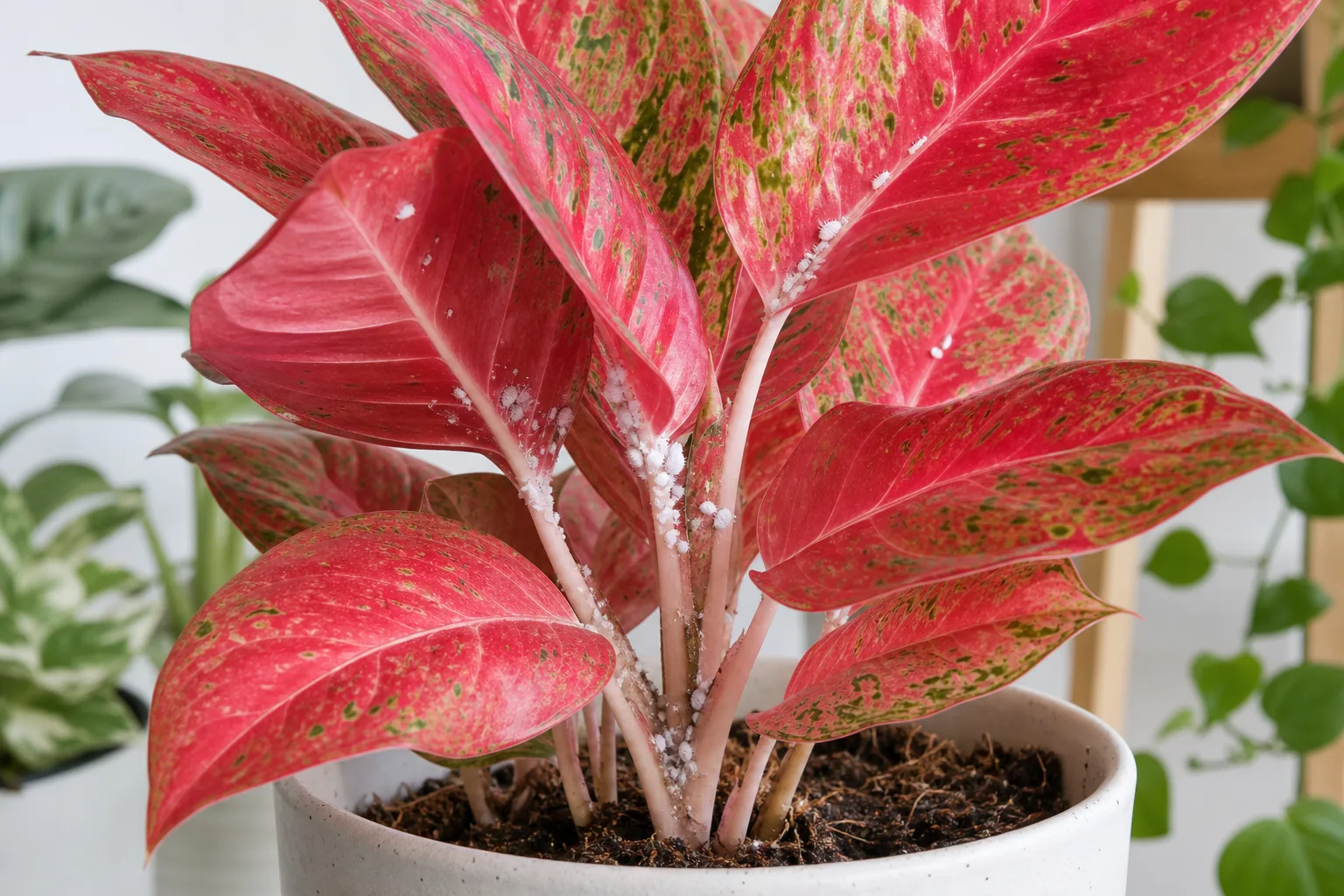
Mealybugs on your Aglaonema Red Valentine (Aglaonema commutatum ‘Red Valentine’) are sap-sucking insects that settle in the tight rosette where pink-tipped leaves overlap the central stem-not on the broad variegated blades where you might first notice sticky residue or sooty mold. The wax looks like bits of cotton wool tucked into leaf axils and crown crotches, not like the plant’s natural pink-red color pattern.
First step: isolate the pot away from other houseplants and dab every visible cottony cluster with a cotton swab dipped in 70% isopropyl alcohol. Spot-test one pale pink variegated leaf first and wait 24 hours before treating the whole plant-Red Valentine’s lighter tissue can burn more easily than solid green Chinese evergreen leaves. Work in a ventilated room; alcohol fumes build quickly in enclosed spaces. Do not shower, repot, or fertilize on day one.
What mealybugs look like on Aglaonema Red Valentine
Mealybug damage on Red Valentine follows a pattern tied to this slow-growing, variegated cultivar:
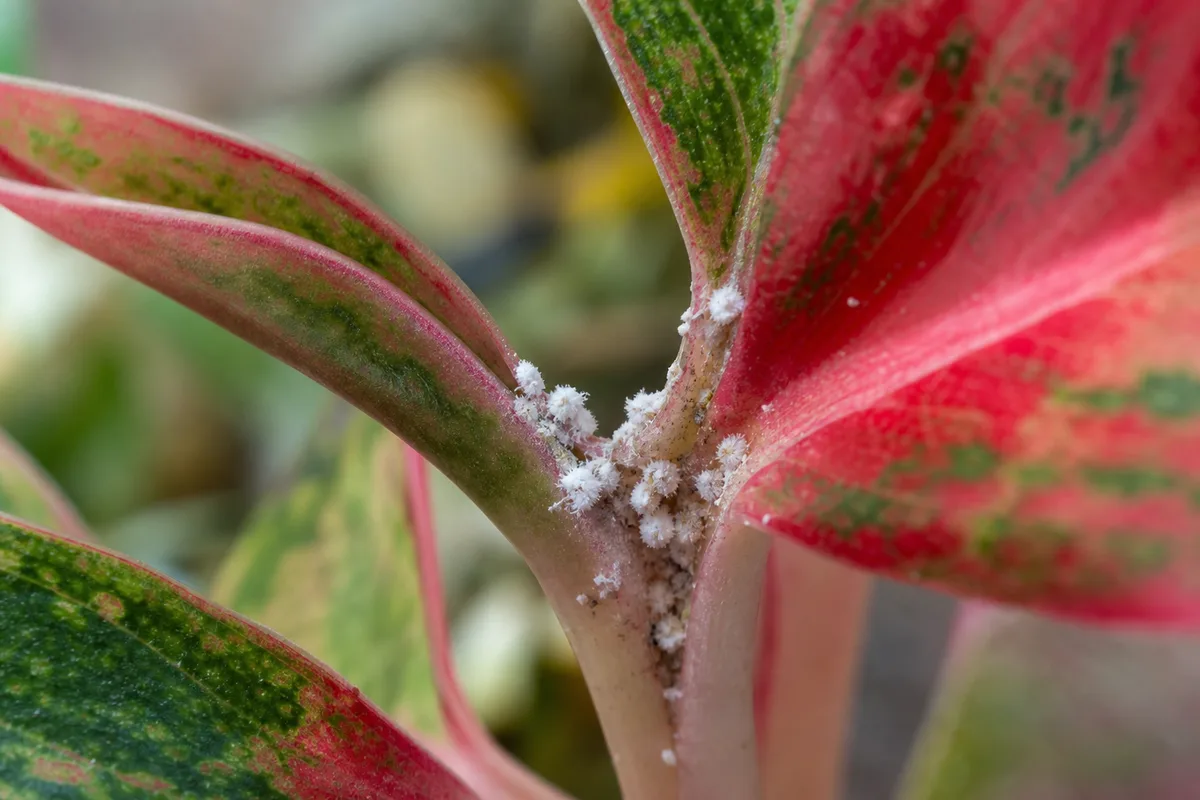
Mealybugs symptoms on Aglaonema Red Valentine - compare with healthy tissue on the same plant.
- White cottony masses along petiole bases, inside the crown where the newest pink-tipped leaf is opening, and under overlapping blades where leaves meet the stem.
- Waxy filaments extending from clusters on older cane sections below the leafy crown-easy to miss when your eye is drawn to the showy pink-red foliage above.
- Pink or gray bodies visible if you wipe away the wax with a swab-adult females are wingless and about 1/16 inch long beneath the fluff.
- Honeydew leaves a shiny, sticky film on leaf surfaces, the pot rim, or the shelf below. On Red Valentine, stickiness on pale pink sections of variegated blades is easier to spot than on solid green Aglaonemas-and sooty mold on pink tissue makes the plant look worse than the actual pest load.
- Yellowing or stunted leaves on heavily fed stems. Red Valentine carries fewer total leaves than a fast-growing pothos, so even a modest colony looks dramatic on a compact plant with a limited leaf count.
- Cast skins and egg sacs as tiny whitish debris near colonies-signs that crawlers are hatching between your weekly treatments.
Red Valentine’s glossy, lance-shaped leaves can look slightly fuzzy along pale margins in certain light. That even surface texture is not mealybugs. Mealybugs form discrete tufts at joints and in the crown, and they smear pink when crushed-variegation does not.
Less common but worth checking: some mealybug species feed on roots. If stems and leaf axils look clean but the plant wilts despite appropriate watering for Red Valentine, inspect the soil surface and drainage holes for white waxy patches.
Why Aglaonema Red Valentine gets mealybugs
Red Valentine is a common indoor host. UC IPM lists aglaonema among houseplants that frequently develop aboveground mealybug problems, and Clemson Extension names mealybugs as a routine pest on Chinese evergreen. The cultivar is not unusually weak-it is a durable Aglaonema-but its growth habit gives pests protected hiding places.
Tight crowns hide colonies. Mealybugs feed where leaves meet stems and on tender new tissue. Red Valentine’s overlapping pink-red blades shelter wax-covered insects in crown crotches that casual watering never reveals. A colony can stay hidden until wax appears on outer petioles.
Indoor conditions favor year-round reproduction. Mealybugs thrive in the mild, stable temperatures of heated homes where natural predators are absent. Crawlers hatch continuously indoors, so populations rebuild between weekly alcohol passes if any egg sacs survive.
Introduction from new plants. Most collections pick up mealybugs when an infested nursery plant skips quarantine. Red Valentine is widely sold and often grouped with other foliage plants in shops, which increases hitchhike risk.
Soft growth from excess fertilizer. Heavy nitrogen feeding stimulates tender new shoots where mealybugs prefer to lay eggs. Red Valentine already grows slowly; over-fertilizing produces weak tissue without improving pink color-and can burn pale pink edges on this cultivar.
Stress does not cause mealybugs, but it slows recovery. A Red Valentine in too-dark a corner loses pink intensity and replaces damaged leaves slowly after treatment. One pushed into direct sun may scorch pale tissue while recovering from pest stress. Fixing light and watering after pest control helps new growth come in clean with stable variegation.
Lookalike symptoms to rule out
Not every white mark or sticky spot on Red Valentine means mealybugs. Check these before treating:
| What you see | Mealybugs | More likely if… |
|---|---|---|
| White material location | Cottony tufts at leaf-stem joints and crown crotches | Even film across the whole blade, or hard tan bumps on stems |
| Crush test on white paper | Pink or red waxy smear | Wipes off dry (mineral dust) or no smear (scale) |
| Movement | Slow crawlers under wax; clusters grow over days | Pear-shaped insects on new tips only (aphids) |
| Leaf damage pattern | Yellowing near feeding sites; honeydew below clusters | Silvery scrape marks without cotton (thrips) |
| Stickiness | Tacky honeydew on leaves or pot rim | No stickiness; fine webbing in dry air (spider mites) |
Specific lookalikes on Red Valentine:
- Aphids colonize tender new crown leaves and flower stalks as loose clusters of pear-shaped insects-not cottony wax in axils.
- Scale insects attach as immobile brown or tan domes on stems and midribs; they do not smear pink when crushed.
- Mineral or hard-water residue feels gritty, wipes off dry, and does not cluster only at petiole bases.
- Powdery mildew forms a flat fungal film in humid stagnant air-not discrete tufts tucked in the crown.
- Natural variegation follows a consistent pink-red-green pattern on each blade and does not appear suddenly at stem joints.
If clusters smear pink, feel waxy, and sit at leaf-stem junctions, mealybugs are confirmed regardless of watering history.
How to confirm the cause
Work through this inspection in order:
- Isolate the plant on a clean surface away from other pots before handling, so crawlers do not walk to neighboring plants.
- Open the crown center where the next pink-tipped leaf is emerging. Pull back overlapping blades gently and inspect every petiole base with a magnifier or phone macro lens.
- Run the pink-crush swab test-dab a cottony cluster with a dry swab, then crush it on white paper. A pink or reddish waxy streak confirms mealybug, not dust or variegation.
- Check leaf undersides along midribs and the lower third of each stem, where older colonies often start before wax shows on outer leaves.
- Feel for stickiness on pale pink sections and the pot rim below infested areas; honeydew confirms active sap feeding.
- Scan neighboring plants on the same shelf-mealybugs spread before symptoms show on every pot.
- Look at the soil line and drainage holes if foliage looks clean but growth has stalled; root-feeding mealybugs sometimes hide below the surface.
Confirmed mealybugs show cottony clusters at feeding sites plus either visible insects beneath the wax, a pink smear on crushing, or sticky honeydew nearby.
First fix for Aglaonema Red Valentine
Isolate, spot-test, then dab-not spray first.
- Move Red Valentine to a separate room or closed area away from other houseplants.
- Spot-test alcohol on one pale pink variegated leaf: dip a cotton swab in 70% isopropyl alcohol and touch one small area. Wait 24 hours and check for leaf burn before treating the whole plant. UC IPM recommends testing alcohol on a small plant part first and monitoring for phytotoxicity.
- Dip a fresh swab or fine artist’s brush in 70% alcohol and touch every visible mealybug, egg mass, and cottony cluster directly. Clemson Extension recommends wiping mealybugs with a cotton swab dipped in rubbing alcohol for light infestations; the alcohol dissolves the waxy coating and kills on contact. On Red Valentine’s tight crown, work slowly into each crotch rather than flooding the center with liquid.
- Wipe honeydew from leaves with a damp cloth so sooty mold does not spread while you control the insects. Avoid pouring water into the crown center-Red Valentine’s tight rosette can hold moisture against the growing point during treatment.
- Let foliage air-dry in bright indirect light, not direct sun, which can mark pale pink tissue on wet or recently treated leaves.
Do not shower the plant, repot, or fertilize on day one. Red Valentine recovers best when you remove pests first and keep watering on its normal schedule.
If dabbing is not enough
When colonies persist in tight crown crevices alcohol cannot reach, move to contact sprays on a separate day. Use this comparison before choosing a follow-up treatment on variegated Red Valentine foliage:
| Treatment | Best use on Red Valentine | Pale pink variegation safety | Repeat schedule |
|---|---|---|---|
| 70% alcohol dab | Light clusters in crown axils and petiole bases | Spot-test one pale pink leaf first; safest first contact on this cultivar | Every 5 to 7 days for at least 3 weeks |
| Insecticidal soap | Moderate infestation; nymphs without heavy wax | Spray to runoff on stems and leaf surfaces, but avoid soaking the crown growing point; test one leaf if unsure | Every 5 to 7 days for 3 to 4 cycles |
| Neem or horticultural oil | Stubborn wax after soap passes | Higher burn risk on pale pink sections combined with strong light; keep out of direct sun 48 hours after application | Per label; usually 7 to 14 days between sprays |
- Insecticidal soap labeled for houseplants coats mealybug nymphs on contact. Spray until runoff covers stems, both leaf surfaces, and the crown-but avoid soaking the central growing point. Repeat every five to seven days until no live insects remain; nymphs hatch between passes. On Red Valentine, soap residue in a wet crown can stress the growing point-tilt leaves aside and target axils directly.
- Neem or horticultural oil can supplement soap on stubborn wax. Test one leaf and wait 24 to 48 hours; Red Valentine’s pink-red sections can be sensitive to oils combined with strong light.
- 10–25% isopropyl alcohol spray suits extensive coverage only after a leaf test-UC IPM notes weekly repeats until the infestation is gone. Ventilate the room during spray application; alcohol vapor in a closed space irritates eyes and lungs.
Prune only a heavily infested leaf that is already yellowed. Bag and discard prunings in the trash, not the compost pile indoors.
Wear gloves when handling sap from damaged tissue. Red Valentine contains calcium oxalate crystals that irritate skin and is toxic to cats and dogs-keep treated plants away from pets until sprays dry.
Step-by-step recovery
After the first alcohol session, follow this sequence based on severity:
Light infestation (a few clusters on one stem)
- Repeat alcohol dabs every five to seven days for at least three weeks.
- Inspect the crown with a magnifier each cycle; new crawlers are wax-free and harder to see on pink tissue.
- Keep the plant isolated until you find no new cottony masses for two full weeks after the last treatment.
Moderate infestation (multiple stems, honeydew present)
- Continue weekly alcohol dabs on every cluster you can reach.
- Add thorough insecticidal soap on a separate day, covering leaf undersides, petioles, stems, and crown crotches. Insecticidal soaps kill only on contact and require complete wetting of the insect.
- Repeat soap sprays every five to seven days for three to four cycles to catch newly hatched nymphs before they develop heavy wax.
- Prune only leaves that are already yellowed from heavy feeding-Red Valentine recovers slowly and needs remaining foliage for photosynthesis.
Heavy infestation (colonies throughout crown, sooty mold, multiple plants)
- Treat every affected plant on the same schedule.
- Consider a diluted alcohol spray only after leaf tests pass on pale pink sections.
- If stems look clean but the plant keeps declining, unpot and inspect roots for white waxy patches. Root mealybugs require Aglaonema Red Valentine repotting guide into fresh mix and washing roots-not foliar sprays alone.
- Discard only as a last resort if treatment fails after persistent weekly effort and the crown is collapsing.
Recovery timeline for slow-growing Red Valentine
Expect visible colony reduction within one to two weeks of consistent alcohol dabs. Full clearance usually takes three to four weekly treatment cycles because eggs continue hatching indoors.
Damaged leaves do not regain full pink-red pattern. A leaf yellowed or stippled while mealybugs fed will keep that blemish. Judge recovery by new center growth: the next leaf should unfurl with clean pink-red variegation and no cottony masses at its base.
Red Valentine replaces leaves slowly even in bright indirect light. In warm active growth, clean new foliage may appear within two to four weeks after control. In cooler winter months, recovery can take longer even when mealybugs are gone-do not overwater or fertilize a recovering plant hoping to speed this up.
Signs the plan is working:
- Fewer cottony clusters at each inspection
- No new honeydew on pale pink tissue
- Firm new leaves emerging from the crown with clean axils and stable variegation
- Sooty mold stops spreading (existing mold can be wiped off; it does not harm the plant once insects are gone)
Signs the infestation is winning:
- New white masses on previously clean stems between treatments
- Increasing yellowing despite correct watering
- Ants consistently trailing to the pot
- Wilting with no root mealybug explanation and declining crown tissue
What not to do
Do not use household dish soap as a pesticide substitute. Homemade soap mixes can burn foliage; use products labeled for plants.
Do not apply alcohol, oil, or soap to a wilted, sun-stressed, or cold-damaged Red Valentine. Treat when leaves are firm and turgid.
Do not move a freshly treated plant into direct sun. Pale pink tissue scorches more easily than solid green Aglaonema leaves.
Do not pour rinse water into the crown center during treatment-moisture trapped in the tight rosette can stress the growing point.
Do not increase fertilizer on a pest-weakened plant. Soft nitrogen-rich shoots attract the next mealybug wave.
Do not return an isolated plant to the main collection after a single alcohol session. Wait until you have inspected twice, one week apart, with no live insects found.
Do not ignore ants. Ants protect mealybugs from predators and signal an active honeydew source somewhere on the plant or nearby pots.
Do not treat in a closed room without ventilation when using alcohol dabs or sprays-the fumes accumulate quickly indoors.
How to prevent mealybugs on Aglaonema Red Valentine
Prevention is weekly attention during spring and summer when Red Valentine pushes most of its new growth.
Quarantine new plants for at least two to three weeks before placing them near your Red Valentine. Inspect crown centers and leaf axils each time you water during isolation.
Scout weekly during watering-check where leaves join stems and along veins on undersides, the same sites mealybugs colonize first on Chinese evergreen.
Avoid over-fertilizing. Feed at half strength during active growth only per the Red Valentine fertilizer guide. Excess nitrogen produces tender shoots mealybugs prefer without improving the slow, compact habit that makes Red Valentine attractive.
Wipe smooth leaves occasionally with a damp cloth to remove dust; dusty foliage is easier for pests to colonize and blocks light on variegated blades.
Inspect the whole shelf when you find mealybugs on one pot. Mealybugs and aphids often appear on multiple plants in the same collection before owners notice the first colony.
When to escalate
Treat as urgent when:
- Cottony masses appear on three or more plants in the same room
- Ants are farming honeydew on or around the Red Valentine pot
- Sooty mold covers most of the leaf surface and keeps returning within days of wiping
- The crown collapses-soft stem bases, foul soil smell, or widespread yellowing with mushy tissue suggest root rot overlapping pest stress, which needs separate diagnosis
- Alcohol and soap cycles for six weeks still produce fresh colonies
A single isolated cluster on one mature stem, caught early, is manageable with isolation and repeated alcohol dabs. Red Valentine rarely dies from light mealybug damage alone when the crown stays firm and treatment stays consistent. For chronic infestations that survive repeated weekly treatment, consider contacting your local cooperative extension office before reaching for stronger systemic products indoors.
Red Valentine care cross-check
While treating mealybugs, keep baseline care steady:
- Light: Medium to bright indirect light so new growth keeps pink-red color without the extra stress of direct sun during recovery.
- Watering: Let the top 2 to 3 cm of soil dry before watering per the watering guide. Mealybug damage and overwatering both yellow lower leaves; stick to the finger test so you do not confuse pest stress with rot.
- Humidity: 40–60% is adequate. Raising humidity alone does not eliminate mealybugs.
- Handling: Red Valentine is toxic to cats and dogs. Keep pets away from alcohol-treated foliage until it dries, and wash hands after handling sap.
Sticky crown tissue with firm lower leaves and appropriately dry soil means pests, not overwatering. If lower leaves yellow and soil stays wet while you treat mealybugs, address drainage separately-two problems can overlap on overwatered Chinese evergreen, but honeydew alone does not cause root rot.
When to use this page vs other Aglaonema Red Valentine guides
- Aglaonema Red Valentine watering guide - Use for routine moisture checks before assuming mealybugs is the main issue.
- Aglaonema Red Valentine problems hub - Browse all 16 common issues on this species.
- Yellow Leaves on Aglaonema Red Valentine - Different entry point when symptoms overlap with mealybugs.
- Slow Growth on Aglaonema Red Valentine - Different entry point when symptoms overlap with mealybugs.
- Spider Mites on Aglaonema Red Valentine - Different entry point when symptoms overlap with mealybugs.