Slow Growth on Aglaonema Red Valentine: Causes, Checks &
Quick answer
Aglaonema Red Valentine grows slowly by nature-one new leaf every six to eight weeks in bright indirect light is healthy. Worry when no leaves appear across a warm bright season, new growth emerges mostly green in a dim room, or wet soil sits for days. First step: check newest leaf color and interval, then confirm light level and top-inch soil moisture.
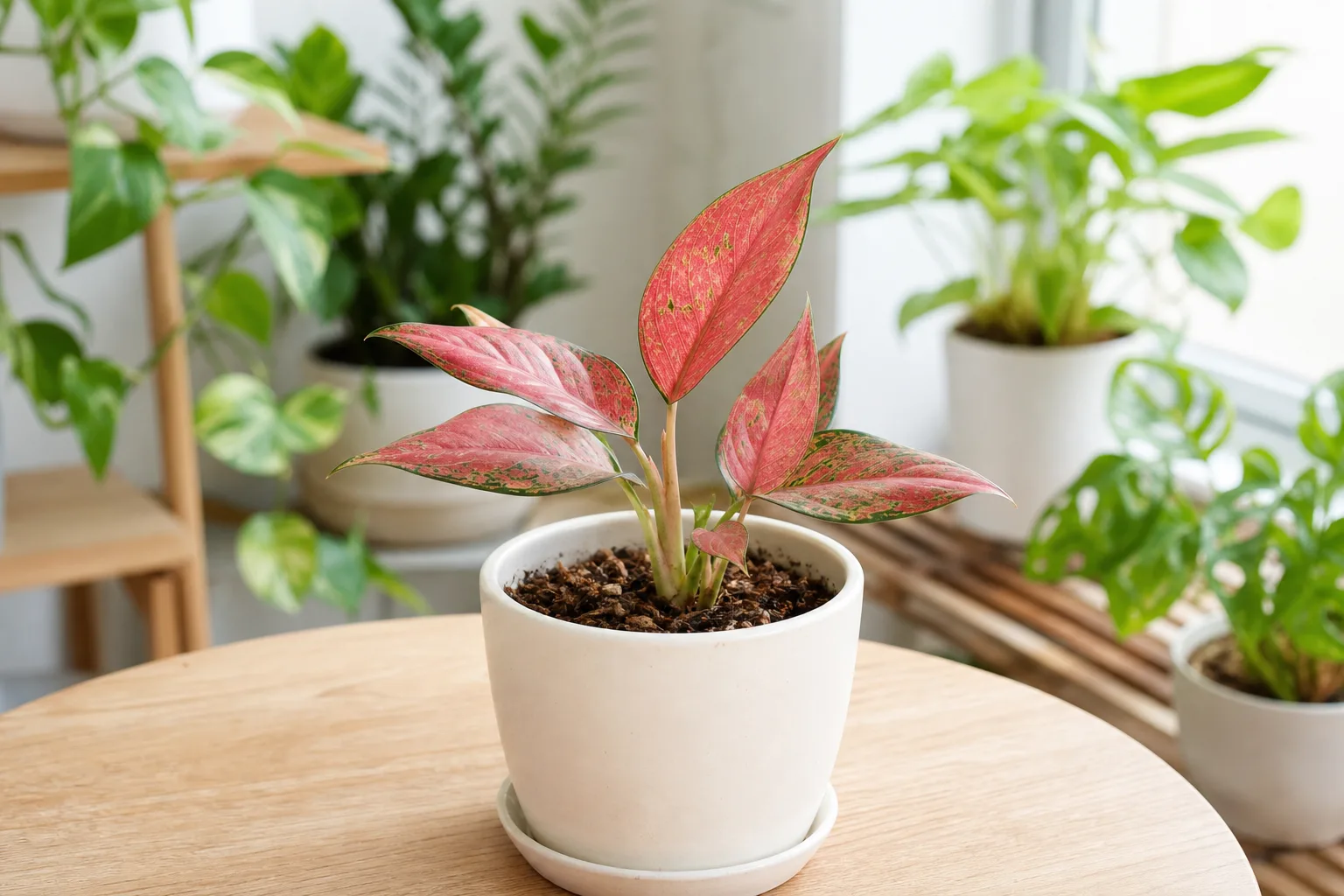
Slow Growth on Aglaonema Red Valentine: Causes, Checks & Fixes
This guide covers slow growth on Aglaonema Red Valentine. See also the general Slow Growth guide, watering, and light pages for this plant.
Slow Growth on Aglaonema Red Valentine: Causes, Checks & Fixes
Quick answer
Aglaonema Red Valentine (Aglaonema commutatum ‘Red Valentine’) is supposed to grow slowly. This tissue-cultured pink cultivar forms a compact upright clump with a slow-to-moderate growth rate-not pothos speed. In bright indirect light, many healthy specimens push one new leaf every six to eight weeks during active growth while new foliage keeps a pink-red blush.
First step: read the newest leaf, not the calendar. Firm petioles, occasional crown growth, and pink-tinged young leaves in a bright spot usually mean normal compact habit. No new leaves across an entire warm bright season, new leaves emerging mostly green in a dim room, or wet soil that never dries points to light limitation, root stress, cold, or genetic reversion-not ordinary slow biology.
This page covers growth pace and stall diagnosis on Red Valentine. For stretch toward windows with long petioles, see leggy growth. For fading pink and dim-corner placement, see not enough light. For wet-soil collapse, see root rot.
What normal slow growth looks like on Aglaonema Red Valentine
Healthy slow growth on Red Valentine is quiet, compact, and colorful when light is adequate.
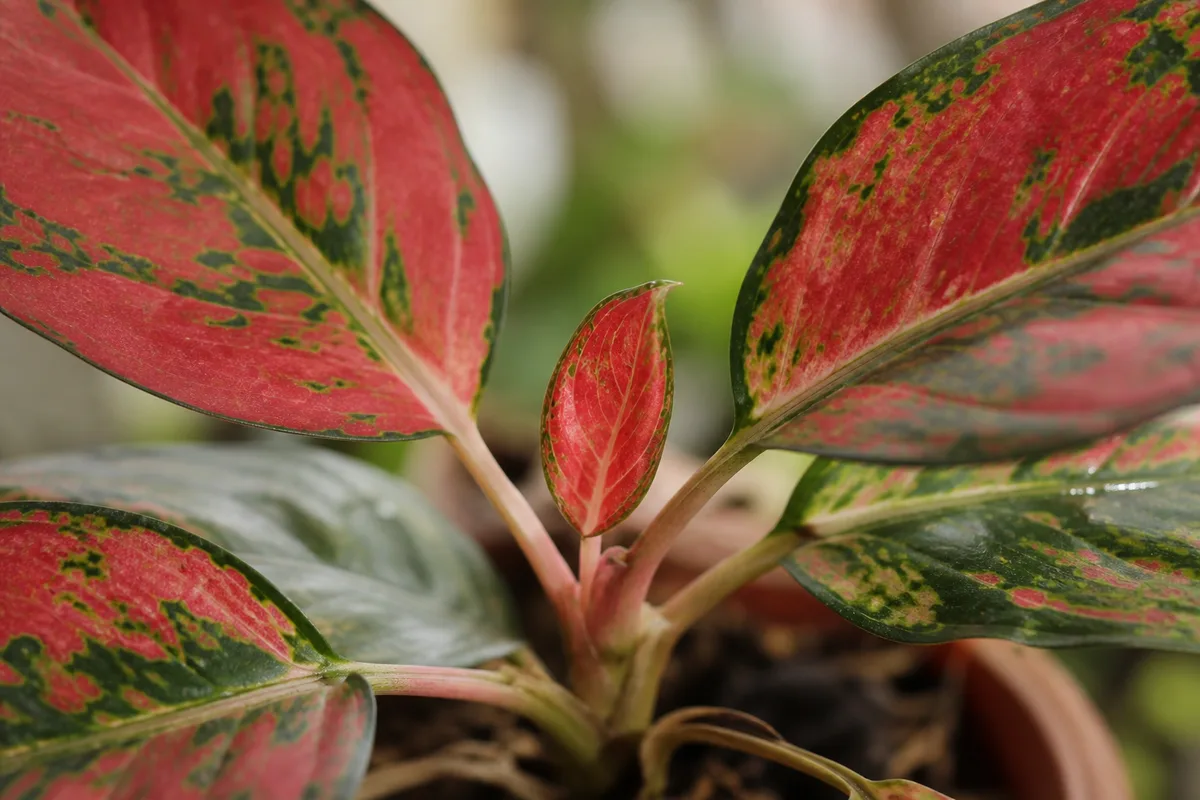
Slow Growth symptoms on Aglaonema Red Valentine - compare with healthy tissue on the same plant.
Typical signs of normal pace:
- One new leaf every six to eight weeks from the central crown during spring through early fall in bright indirect light
- Pink-red or rosy new leaves that may mature toward deeper red with green margins-a normal color shift, not a stall signal
- Short, firm petioles and a dense clumping silhouette without dramatic lean toward one window
- Overall height building slowly toward roughly 40–60 cm indoors over several years rather than inches per month
- Seasonal winter slowdown with few or no new leaves between November and February in temperate homes
A desk Red Valentine that adds three to five leaves across a full growing season in a good east window is often perfectly healthy. Chinese evergreens evolved as understory tropical plants with restrained vertical ambition-explosive speed is not part of the species profile, and colorful Thai-style hybrids add anthocyanin maintenance on top of that baseline.
Expected leaf interval indoors
Growth interval ties directly to light. At 150–300 foot-candles of bright indirect exposure-the practical target for good color and pace-Red Valentine typically unfurls a new leaf roughly every six to eight weeks in active growth. At 50–100 foot-candles, the plant often holds its size but produces little or no new growth while existing pink gradually dulls. Below the light compensation point near 10 foot-candles, photosynthesis barely matches respiration and growth stops entirely even if leaves stay green.
Use the newest unfolding leaf as your pace meter. Compare its petiole length and pink intensity to the previous two leaves. Shorter stalks with stronger color after a window move confirm healthy slow growth resuming-not a crisis.
Seasonal winter slowdown
Shorter days and cooler room temperatures slow metabolism even when watering is unchanged. A Red Valentine that produces zero or one leaf between late fall and early spring in a north-temperate home is often following a normal seasonal rhythm-not signaling root rot. Chinese evergreens prefer warm indoor temperatures and grow most actively when days are long and rooms stay consistently warm.
Resume concern if growth stays absent through late spring and summer in a verified bright spot, or if winter pause comes with yellow lower leaves on constantly wet soil.
Signs Red Valentine is healthy despite slow pace
- New leaves emerge with visible pink-red pigment, even if color softens as leaves age
- Petioles feel firm and waxy, not soft or limp
- Soil dries on a predictable rhythm after each thorough watering
- No sour smell from drain holes and crown feels solid at the base
- Lower leaf drop is occasional and slow-not a rapid yellowing cascade on wet mix
When slow growth is actually a problem
Slow pace becomes a diagnosis when growth stops entirely or leaf quality declines.
Abnormal stall patterns:
- Zero new leaves across a full warm bright season in a room with reasonable indirect light
- New leaves emerging mostly green in a dim hallway or interior shelf-anthocyanin fade before expansion signals light limitation
- Persistent green reversion on new leaves despite verified 150+ foot-candles of good light-possible tissue-culture genetic change, not reversible care
- Wet soil for a week or more after a normal drink, with no crown growth and sometimes yellow lower leaves
- Shrinking new foliage noticeably smaller and thinner than mature leaves below
- Cold exposure below about 55 °F (13 °C) pausing growth without obvious wilt
Healthy despite slow: firm leaves, occasional crown growth with pink-tinged young tissue, predictable dry-down, stable placement in adequate light.
| Pattern | Likely meaning | First branch |
|---|---|---|
| Firm leaves, rare new crown leaves, good light | Normal compact habit | None needed-adjust expectations |
| Green-dominated new leaves, dim shelf | Light-limited stall | Move to brighter indirect exposure |
| Green new leaves persist in bright spot | Possible genetic reversion | Accept or replace plant |
| No growth, yellow lower leaves, soggy mix | Root stress from chronic wetness | Stop watering; inspect roots |
| Long petioles, lean toward window | Etiolation-not pure slow growth | See leggy growth |
| Winter pause, firm leaves, appropriate dry soil | Seasonal dormancy | Resume checks in spring |
Why Aglaonema Red Valentine grows slowly
Understanding the biology explains why “speed up my plant” advice often backfires on this cultivar.
Naturally slow-to-moderate cultivar biology. Aglaonema commutatum and its hybrids form compact clumps rather than vining stems. Red Valentine is bred for anthocyanin-rich foliage, not rapid height gain. Indoors it builds density slowly-a feature, not a defect.
Higher light demand than green Aglaonemas. Solid-green cultivars like ‘Maria’ or ‘Silver Bay’ tolerate deeper shade because every leaf cell carries chlorophyll. Red Valentine’s pink tissue contains very little chlorophyll and depends on brighter indirect light to photosynthesize and maintain pigment. Owners who treat Red Valentine like a generic “low-light Chinese evergreen” often see slow growth with fading pink-the plant is energy-starved, not lazy.
Light compensation and maintenance bands. Below roughly 10 foot-candles, growth stops. At 50–100 foot-candles, the plant survives but adds few leaves. The sweet spot for pace and color sits at 150–300 foot-candles-within the commercial shade range for variegated Aglaonema-bright enough for anthocyanin expression without scorching pale pink tissue.
Low light beyond tolerance. Dim placement slows photosynthesis and how fast the potting mix dries. A dark plant drinks less, soil stays wet longer, and crown growth stops-a double problem that looks like “slow growth” but is really insufficient energy plus root-zone stress.
Root-bound and pot size. Chinese evergreens tolerate slight root constriction, but a severely pot-bound plant with circling roots and little fresh mix may stall despite good light. Conversely, an oversized fresh pot with wet depths can stall growth while roots sit in saturated mix.
Overwatering in shade. Root rot follows kept-too-moist soils and poor drainage. Red Valentine in a dim corner uses water slowly; calendar watering keeps mix wet and damages fine roots. Damaged roots cannot support new leaves even when older foliage still looks fine for weeks.
Cold and acclimation stress. Chinese evergreens are sensitive below about 55 °F (13 °C) and prefer roughly 65–80 °F indoors. A night near a cold windowpane or AC vent can pause crown growth without obvious wilt. Recent repotting or a long move from greenhouse to home also pauses new leaves for weeks.
Anthocyanin reversion in tissue-cultured stock. Commercial Red Valentine is produced through tissue culture. A small percentage of plants revert toward green-dominant foliage genetically. If new leaves stay green in a verified bright spot across several flushes, care corrections will not restore pink-distinguish this from reversible light fade.
Nutrient excess in low light. Fertilizer cannot replace photons. Feeding a dim, stalled plant adds salt stress on roots without increasing growth rate.
Lookalike symptoms to rule out
Leggy stretch vs slow compact growth. Long petioles with wide gaps between leaves and a lean toward the brightest window are etiolation from insufficient light-not the same as healthy compact slow growth. Open leggy growth or not enough light if stretch and fade dominate.
Light fade vs genetic reversion. Reversible light fade produces greener new leaves in dim rooms; moving to brighter indirect light restores pink on subsequent leaves within two to four flushes. Reversion produces persistently green new growth even after a confirmed bright move.
Winter dormancy vs year-round stall. A firm plant that pauses in winter but resumes crown growth in spring is seasonal. A plant that never wakes up in a bright summer window needs deeper diagnosis.
Root rot collapse vs slow pace. Root rot usually brings yellow lower leaves, mushy stems at the soil line, sour smell, and sometimes sudden wilt-not merely absence of new leaves on an otherwise firm plant. Wet-soil stall can precede collapse; catch it before the crown softens.
Over-fertilizer stretch vs light stall. Excess nitrogen in already-bright conditions can push weak pale growth, but the classic Red Valentine stall in shade is green-dominated new leaves with wet slow-drying soil-not salt crust alone.
How to confirm the cause
Work through these checks in order so you do not fertilize a light-starved plant or water a rotting one.
- Growth history - Note when the last crown leaf appeared. Zero growth through a warm bright season is abnormal; zero growth in winter alone may be seasonal.
- Newest leaf color and size - Compare the smallest unfolding leaf to the previous two. Mostly green tissue in a dim spot implicates light. Persistently green in a bright spot suggests reversion.
- Light level and distance - Measure distance from the nearest window. Variegated and red Aglaonema cultivars need low to moderate indirect light at minimum-brighter than solid-green types. More than six feet from the only window is usually too dim for healthy pace and color.
- Top-inch moisture and pot weight - Push a finger into the top inch. Heavy pots with damp mix for many days fit overwatering or oversized containers. Bone-dry lightweight pots fit underwatering slowdown.
- Petiole length and lean - Short firm stalks with occasional new leaves fit normal slow growth. Long arching stalks toward glass fit low light etiolation.
- Pot size vs root ball - Slide the plant out gently. Circling roots with little fresh mix explain stall despite good light. A tiny root mass in a huge pot explains chronic wet depths.
- Root firmness - If wet stall persists, inspect roots. Healthy Aglaonema roots are firm and pale; rotted roots are brown, translucent, or mushy.
- Temperature and recent changes - Cold draft, repotting within two weeks, or a move from bright greenhouse to dim office all pause growth temporarily.
Confirmed normal slow growth: firm leaves, occasional pink-tinged crown leaves in adequate light, appropriate dry-down. Confirmed light stall: dim placement, green-dominated new leaves, soil staying wet. Confirmed root stall: persistent damp mix, yellow lower leaves, mushy roots. Suspected reversion: green new leaves persist across several flushes in verified 150+ foot-candles.
First fix for Aglaonema Red Valentine
First step: match one correction to the most likely cause-do not stack repot, feed, and prune the same week.
If light is the limiter (dim shelf, green-dominated new leaves, wet soil surface, slow dry-down): move the pot to the brightest indirect spot available-typically within one to three feet of an east window, or filtered west or south glass. Increase exposure gradually over seven to ten days if the plant lived in deep shade. See the Red Valentine light guide for foot-candle targets and window placement. Do not jump to direct midday sun; pink tissue scorches easily.
If soil stays wet too long (heavy pot, damp top inch many days after watering, yellow lower leaves): stop watering until the top one to two inches of mix dry. Confirm drainage holes are open and saucers are emptied. If growth remains absent after the mix dries properly, inspect roots for rot. Do not repot on day one unless roots are clearly mushy.
If the pot is root-bound (circling roots, little fresh mix, stall despite good light): plan a repot into a slightly larger container with airy well-drained mix-but only after soil moisture is corrected and roots are assessed. See repotting.
If soil is bone-dry and the pot is light with slightly thin leaves: water thoroughly once, drain fully, then resume the top-dry rhythm from the watering guide.
If light is already good, moisture is correct, and new leaves keep emerging green: suspect genetic reversion. Care will not restore cultivar pink. You can keep a healthy green plant or replace it.
If light is already good and moisture is correct but growth is merely slow with pink-tinged new leaves: no intervention needed. Adjust expectations; this cultivar is not a fast grower.
Make one change, then wait six to eight weeks through a warm season before adding another treatment.
Recovery timeline
Normal slow growth does not need recovery-you are watching a compact cultivar do what it does.
Light correction on a stalled plant: first noticeably pinker or larger new leaves may take six to eight weeks after improved placement during active growth months-roughly one leaf cycle. Existing green-dominated or faded leaves do not regain pink; judge progress on the next one or two crown leaves, not on older foliage.
Corrected overwatering with mostly firm roots: crown growth may resume in eight to twelve weeks once the mix dries on a healthy rhythm. Severe root loss can take a full growing season.
Seasonal winter pause resolves naturally as days lengthen-expect crown growth to restart in late winter to spring without extra fertilizer.
Repot shock can pause new leaves for two to four weeks even when done correctly. Avoid repotting and feeding simultaneously on an already-stalled plant.
Judge success by new firm leaves from the crown with improving pink color, not by old foliage size.
What not to do
Do not fertilize a stalled plant in a dim corner hoping to force growth or restore pink. Salt buildup on roots in low light worsens stall without adding photons for anthocyanin production.
Do not repot and fertilize on the same day as a watering or light correction. Stack one stressor at a time.
Do not prune healthy leaves because “nothing is happening.” Removing photosynthetic tissue slows recovery on an already slow cultivar.
Do not assume slow growth means thirst and water on a calendar. Overwatering wet soil is a common mistake when leaves look tired-wet soil with no new growth is more dangerous on Aglaonema than brief dryness.
Do not compare pace to pothos or spider plants nearby. Different species, different speeds.
Do not move a shade-adapted Red Valentine into hot direct afternoon sun in one step-acclimate to brighter filtered light gradually.
Do not buy a second Red Valentine hoping for faster growth without fixing light placement-the cultivar biology is the same.
How to prevent abnormal slow growth next time
Place the plant where it receives bright indirect light year-round-see the Red Valentine light guide for the 150–300 foot-candle target. Rotate the pot weekly for even growth. Supplement with a full-spectrum LED in winter if windows are weak.
Water when the top one to two inches of mix dry, not on calendar days. Light level changes how fast soil dries; dimmer spots need longer intervals. Full rhythm is in the watering guide.
Use a snug pot with drainage and airy aroid mix. Oversized containers are a common hidden stall trigger when paired with dim placement.
Fertilize lightly only during active crown growth in bright conditions-see the fertilizer guide. Skip feed in winter and on stressed plants.
Expect seasonal slowdown and stretch watering intervals from fall through late winter when new leaves are scarce.
For complete species context-anthocyanin biology, reversion risk, and cultivar comparisons-see the Red Valentine overview.
Related Red Valentine guides
- Red Valentine overview - colorful cultivar light needs and slow-to-moderate habit
- Light requirements - foot-candle targets and growth benchmarks
- Not enough light - fade and stretch vs compact slow growth
- Leggy growth - etiolation differential
- Fertilizer - when feeding helps vs hurts
- Repotting - root-bound diagnosis
- Root rot - wet-soil stall escalation
Conclusion
Most Red Valentine owners who worry about slow growth are watching a healthy compact cultivar do exactly what it was bred to do-build a dense clump with occasional pink-flushed new leaves, not race for height. Worry when growth stops entirely across a warm season, new crown leaves emerge mostly green in dim light, wet soil never dries, or green reversion persists despite good light. Match your first fix to light, moisture, or pot size-one correction at a time-and judge recovery by the next crown leaf’s color and firmness, not by comparison to faster houseplants on the same shelf.