Brown Tips on Aglaonema Red Valentine: Causes, Checks &
Quick answer
On Aglaonema Red Valentine the dead cells are almost always on pink margins, not green centers. Those rose-red borders carry very little chlorophyll, so fluoride, dry air, and salt burn show up there days before the green tissue. First step: slide the pot off any heating vent or AC draft and probe the top 2 to 3 cm of mix before deciding whether to add water or switch sources.
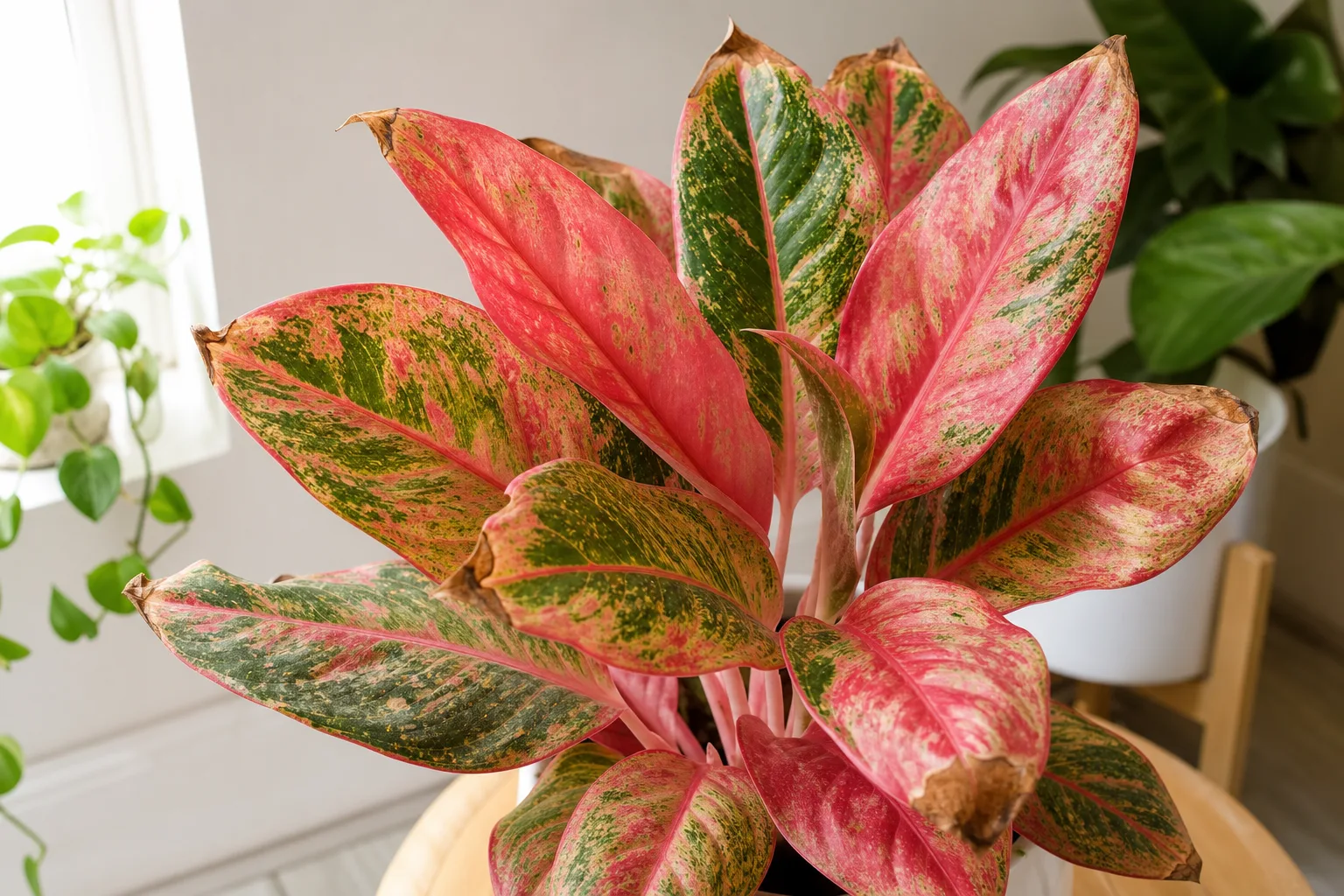
Brown Tips on Aglaonema Red Valentine: Causes, Checks & Fixes
This guide covers brown tips on Aglaonema Red Valentine. See also the general Brown Tips guide, watering, and light pages for this plant.
Brown Tips on Aglaonema Red Valentine: Causes, Checks & Fixes
Quick answer
Aglaonema ‘Red Valentine’ is a compact Chinese evergreen bred for broad leaves with deep green margins framing a rose-pink, cherry-red, or hot-pink center. New leaves often emerge nearly all pink; mature leaves hold the color in bands and speckles around green islands. That color is anthocyanin, the same flavonoid pigment that colors red maple leaves and blueberries, and anthocyanin-rich tissue has very little chlorophyll. The trade-off is real: pink margins photosynthesize slowly, which is exactly why brown-tip damage shows up there first when fluoride, dry air, or salt reaches the leaf before the green centers.
The cultivar’s color also shifts under stress in ways green Aglaonemas do not. Pink fades when the plant is chronically underwatered or kept too dim (chlorophyll floods back into the pigmented cells to compensate for low light); pink deepens under bright, indirect light at roughly 150 to 300 foot-candles; and red pigments do not return once a leaf has browned - only new leaves emerging from the central crown can re-express the cultivar’s color. That recovery delay is the single biggest reason Red Valentine feels slower to bounce back from tip burn than Silver Bay, Maria, or Pink Dalmatian.
First step: move the pot off any heating vent or AC draft and probe the top 2 to 3 cm of mix. Brown tips on this cultivar almost always trace to one of three drivers - fluoride in tap water, dry airflow, or wet soil - and the fastest diagnostic is placement plus a moisture check, not a treatment bundle. If the mix is still damp near the surface, do not add water. If the upper layer has dried through and the plant sits in stable room air, switch to filtered or rested water for the next four to six weeks and watch for clean-tipped new leaves before changing anything else.
For the shared physiology of leaf-tip necrosis across Chinese evergreens, see our brown-tips symptom hub. What follows on this page is the Red-Valentine-specific path - the parts that would not apply to Silver Bay’s silver centers, Maria’s narrow silver streaks, or Pink Dalmatian’s spotted pattern.
What brown tips look like on Aglaonema Red Valentine
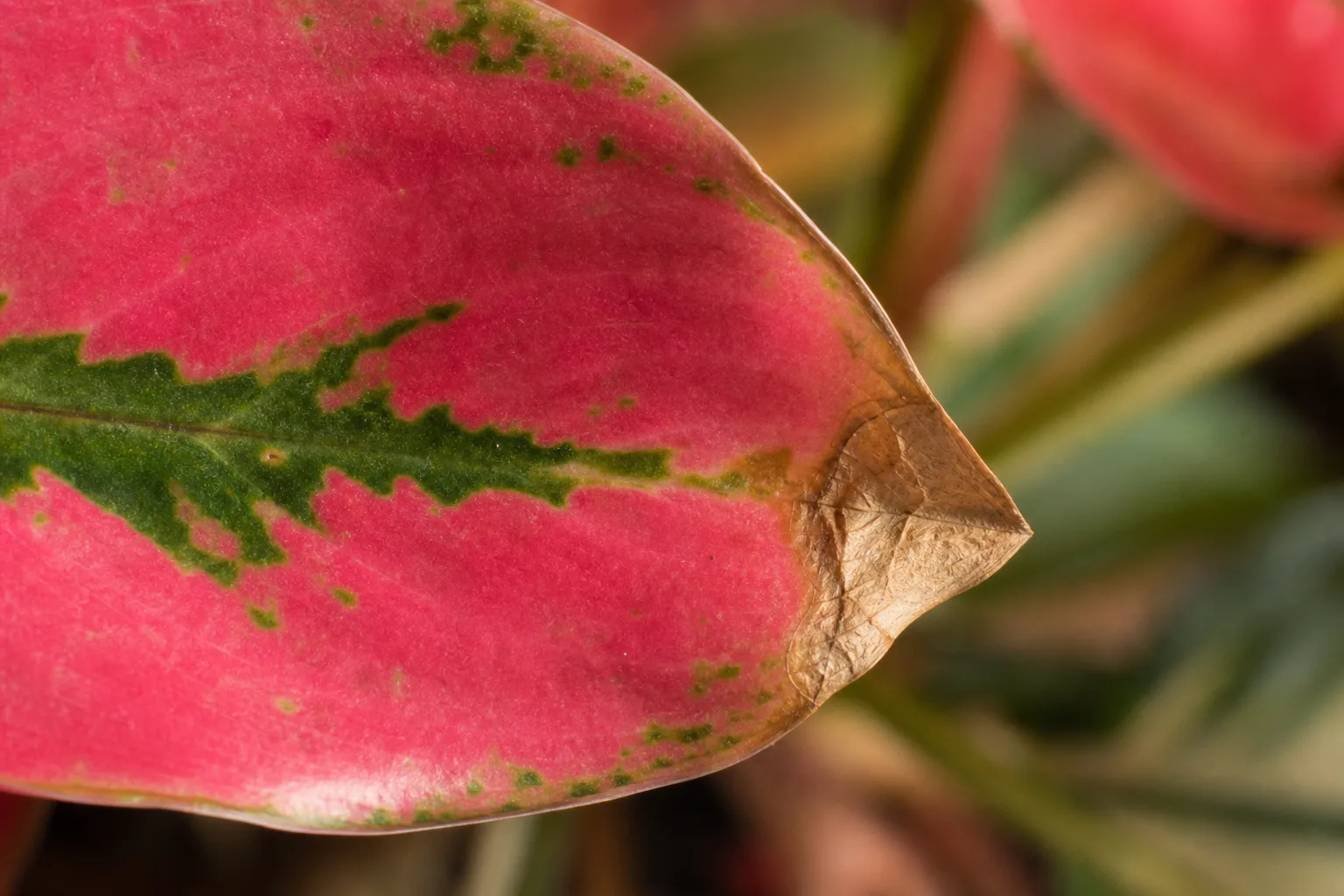
Dry crispy brown tips on a Red Valentine pink margin - papery necrosis at the leaf edge while the green center tissue stays firm.
Red Valentine’s damage pattern is distinct from other Aglaonema cultivars because of how its pigment is laid down:
- Pink-margin tip burn - Crispy brown necrosis that begins on the rose-pink border and rarely crosses into the green center. This is the most common pattern on Red Valentine and is almost always mineral or dry-air driven, not root-driven. Anthocyanin-pigmented cells operate at a lower light-compensation point and are more sensitive to fluoride and chloride accumulation in leaf tissue.
- Whole-margin scorch from direct sun - Pink margins bleach to tan first, then crisp along the entire sun-facing edge rather than only at the tip. Distinct from tip burn because the damage starts mid-leaf and tracks the light angle. See not enough light vs. direct sun on Aglaonema Red Valentine when the rest of the plant is fading.
- Tip burn that turns into whole-leaf yellowing - Brown tips on lower leaves paired with yellowing of the same blades and a heavy, damp pot indicates root failure, not isolated tip burn. See yellow leaves on Aglaonema Red Valentine and root rot on Aglaonema Red Valentine before changing water.
- Tip burn on new pink center growth - When a leaf tips brown within days of unfurling, before the green islands mature, the cause is almost always fluoride or salt, not humidity. The window to switch water sources is this flush - older leaves will not show the same pattern until damage has accumulated for months.
- Cosmetic aging on oldest bottom leaves - One or two oldest outer leaves with a few millimeters of tan tip on an otherwise stable plant is low priority. New pink growth above stays clean; pot weight is normal; no white crust. Mention it during seasonal care, not as an emergency.
Worry when browning climbs down the pink margins on multiple leaves at once, hits new pink center growth within days, or pairs with a heavy damp pot and limp lower foliage - those patterns point to a systemic cause, not isolated tip burn.
Why Aglaonema Red Valentine gets brown tips
Pink margins carry less chlorophyll than green centers
The defining trait of Red Valentine - anthocyanin-pigmented rose-pink bands - is also its vulnerability. Anthocyanin absorbs green and blue light and reflects red wavelengths, which makes the pink sections visually striking but photosynthetically less efficient than chlorophyll-loaded green tissue. When fluoride, chloride, sodium from a water softener, or dry-air stress reaches a leaf, the cells with the smallest energy reserve die first. On Silver Bay, the silver centers are still chlorophyll-loaded; on Maria, the narrow silver streaks carry enough green backing that tip burn distributes evenly across the blade; on Pink Dalmatian, the spots are isolated enough that damage appears dot-by-dot. Only Red Valentine concentrates its vulnerability in continuous pink margins, which is why tip burn on this cultivar reads as a hard pink-vs-brown boundary instead of scattered flecking.
Fluoride and chloride accumulate in pink tissue faster
Chinese evergreens in the Araceae family are sensitive to fluoride and chloride in municipal tap water. Sensitive indoor plants irrigated with city water can develop fluoride toxicity that shows up first as tip burn, because fluoride moves with the transpiration stream and concentrates at the leaf tip - the point farthest from the roots. On Red Valentine, that point is almost always pink, so necrosis appears on the pigmented margin within weeks of consistent tap watering. Resting tap water overnight reduces chlorine but not fluoride; switching to filtered, distilled, or collected rainwater is the only reliable fix when new pink leaves keep tipping.
White crust on the soil rim can come from either hard-water minerals or sodium from a home water softener. Softener discharge is especially hard on houseplants because sodium displaces potassium and calcium at root exchange sites. If your tap runs through a softener, switch to unsoftened cold tap, filtered water, or rainwater for four to six weeks before assuming the problem is only low humidity.
Dry indoor air and harsh airflow hit pink margins first
Leaf tips are the farthest point from the roots, so they lose moisture first when dry air or a draft pulls water from the margins faster than roots can replace it. Red Valentine’s pink cells transpire more slowly than green cells but recover more slowly once they lose turgor, so vents and AC drafts produce a sharp, dry pattern of tan-to-brown tips on the rose-red bands rather than a gradual whole-leaf wilt. Pots above radiators, beside floor vents, or in the direct path of AC are frequent triggers; this pattern usually affects older outer leaves first while new pink growth stays clean unless the draft is constant enough to hit everything.
Fertilizer salt buildup concentrates at pink margins
Red Valentine is a light feeder that needs only modest fertilizer during active growth. Overfeeding or skipping seasonal flushes lets salts concentrate in the root zone, and excess salts draw water away from roots and burn leaf edges and tips. Because Red Valentine’s pink margins are already operating on a thinner energy budget, salt burn on this cultivar tends to crisp along the pigmented bands before the green tissue shows any damage. Do not increase fertilizer to “pink up” tipped leaves on a stressed plant - that deepens the exact problem you are trying to fix.
Overwatering impairs water delivery to pink leaf tips
Like every Aglaonema, Red Valentine’s plant-specific weakness is wet soil, not drought. When the mix stays saturated, roots lose oxygen and stop functioning efficiently, and the plant cannot move water to leaf margins even though the pot is wet. Pink tissue is the first to show this failure: tips crisp while soil is damp, and the pattern often starts on the pink margin that is the farthest point from a compromised root system. Owners who see brown tips and water more deepen the exact problem. Red Valentine should be watered when the upper 1 to 2 inches of mix have dried - not when tips look dry on an already-wet root ball.
Insufficient light starves the pink cells first
Green Aglaonema cultivars like Maria survive low light; Red Valentine needs brighter indirect light to maintain pink color and produce strong new leaves. In dim conditions, variegated and pink-leaf cultivars lose pigmentation as chlorophyll floods the anthocyanin cells to compensate, and the marginal tissue becomes structurally weaker. Tipping that starts on pink margins of older leaves while the green centers stay healthy often has a light component alongside water quality or humidity. Move to 150 to 300 foot-candles of bright, indirect light - not a dark hallway and not direct sun - before adding humidity tools.
Direct sun on pink variegation
Red Valentine belongs in bright, filtered indirect light. Direct sun bleaches variegated foliage and burns the pigment system on pink-leaf cultivars faster than on green-leaf cultivars. Move the plant out of direct rays before treating water quality or humidity. Placement targets are in the light guide.
Why Red Valentine recovers more slowly than Silver Bay, Maria, or Pink Dalmatian
This is one of the three plant-only sections for this page. Recovery from tip damage on Red Valentine takes longer than on green-leaf Chinese evergreens because of how the cultivar partitions its energy budget across pigment types. Silver Bay’s silver centers, Maria’s narrow silver streaks, and Pink Dalmatian’s pink spots are all backed by chlorophyll-loaded cells - even when the variegation looks dramatic, most of the leaf can still photosynthesize at full strength. Red Valentine’s pink margins have almost no chlorophyll, so the green islands carry the entire energy load for the leaf. When tip burn kills pink margin cells, the green centers have to compensate for the rest of the blade’s water and sugar demand while the plant rebuilds the lost margin - a process that can take two to three flushes of new growth before the original leaf shape returns.
The second consequence is that red pigments do not come back on the same leaf. Silver Bay scorch can fade to a paler green as new chlorophyll fills in; Maria’s silver streaks re-stabilize on the next flush; Pink Dalmatian’s spots may shift slightly in size. Red Valentine’s brown tips stay brown. New pink emerges only from the central crown, and only when the plant is in bright, indirect light at the right intensity. This is why the recovery benchmark on this cultivar is clean pink-tipped new leaves, not green regrowth on existing leaves.
The third consequence is that Red Valentine hides slow root failure behind healthy-looking green centers. Pink margin tip burn is often the only above-soil symptom of a root system that has been losing function for weeks. On Silver Bay, the entire blade yellows when roots fail; on Maria, silver streaks dull uniformly; on Pink Dalmatian, multiple leaves wilt together. On Red Valentine, the green islands keep photosynthesizing while the pink margins burn, which can delay the diagnosis until the underlying root issue has advanced. Treat pink margin tip burn as a possible root signal even when the green centers look fine.
How to confirm the cause
Work through this inspection in order. Each step eliminates a possible cause before you stack treatments:
- Which leaves are affected - Old leaves only, with new pink growth clean, suggests dry air or aging. New pink leaves tipping within days of unfurling suggests water quality or salts. Most leaves, with a heavy damp pot, suggests root failure.
- Moisture below the surface - Probe the top 2 to 3 cm. Cool and damp means pause watering. Dry through that zone with a lightweight pot suggests drought is possible. A heavy pot days after watering confirms slow dry-down and points back to root function.
- Placement and airflow - Is the pot above a radiator, beside a vent, or in an AC stream? Cold draft from a window at night? Pink margin tip burn without any airflow cause means the diagnosis is more likely water quality.
- Soil surface and pot rim - White crust or gritty deposits suggest salt buildup from fertilizer, hard water, or a water softener. Salt crust plus new pink leaf tip burn is a strong combination for fluoride or chloride sensitivity.
- Water source - Months of untreated tap water with recurring new-leaf tip burn supports fluoride or mineral sensitivity. A home water softener in the supply line should be treated as a separate, more aggressive cause.
- Light exposure - Direct sun on pink leaves bleaches margins and produces patchy tan damage. A very dark corner with weak, small new leaves points to insufficient light, where pink fades but margins do not typically crisp.
- Root spot-check - If the pot is heavy and tip burn is spreading on most leaves, slide the plant partway out. Firm pale roots support a dry-down fix. Mushy brown roots confirm rot and need trimming before recovery - follow the protocol on root rot.
Cause vs. symptom decision table
| Suspected cause | Leaf pattern | Soil / pot | Urgency | Confirms when |
|---|---|---|---|---|
| Tap-water / fluoride burn | New pink leaves tip within days | Normal weight; no sour smell | Monitor | Clean new growth after filtered water for 4-6 weeks |
| Dry-air burn | Oldest leaves only; papery tips | Normal; pot near vent or dry room | Low | New crown leaves stay clean after relocation |
| Salt buildup | Multiple leaves; white crust on rim | Normal to heavy; recent heavy feeding | Medium | Flush and skip feed; crust reduces |
| Overwatering | Tips plus yellow lower leaves | Heavy; damp top 2-3 cm for days | Medium-high | Dry-down cycle; firm roots on spot-check |
| Direct sun scorch | Sun-facing patchy margins | Normal | Medium | Damage stops after move to indirect light |
| Root rot | Widespread pink margin burn; limp foliage | Wet; sour smell; mushy roots | High | Same-week root rot protocol |
First fix for Aglaonema Red Valentine
Move the pot off heating vents and AC drafts, then check whether the upper 2 to 3 cm of mix have dried before adding water.
That single step addresses the two most common mistakes - treating dry-air tips with extra water, and leaving the plant in airflow that keeps pink margins desiccating. If the mix is still damp near the surface, do not water until it dries. If the mix is appropriately dry and placement is stable, water thoroughly until runoff exits the drainage holes, then empty the saucer and return the pot to its spot.
Do not compensate with fertilizer, misting marathons, or an immediate repot unless roots are mushy or salt crust is thick. Red Valentine’s pink cells recover more slowly than green tissue, so adding more interventions on day one usually sets recovery back rather than speeding it up.
After placement and moisture check:
- If new pink leaves keep tipping within weeks, switch to filtered, distilled, or well-rested tap water for the next four to six weeks and skip fertilizer until new growth stays clean.
- If white crust covers the soil rim, plan a single plain-water flush during the next watering - not on the same day you moved the plant if it is already stressed.
- If multiple leaves are tipping and the pot feels heavy days after watering, follow the overwatering branch before switching water sources.
Make this one correction first. Wait two to three weeks before repotting, heavy feeding, or multiple water-source experiments unless salt buildup is obvious or roots are mushy.
Step-by-step recovery
Match follow-up steps to what you confirmed.
Dry air and drafts (older pink tips only, clean new growth)
- Keep Red Valentine away from radiators, vents, and cold glass. Pink margins show dry-air damage before green tissue, so this single move is the highest-leverage fix.
- If room humidity stays below about 40% in winter, run a small humidifier near the plant (not directed at leaves) or set the pot on a pebble tray above the water line. Grouping with other plants helps modestly but rarely fixes a constant vent draft alone. See low humidity on Aglaonema Red Valentine when margins crisp despite correct watering.
- Watch for new pink leaves emerging with clean tips for two to three consecutive weeks before judging success.
Tap-water or fluoride sensitivity (new pink leaves tipping)
- Switch to filtered, distilled, or well-rested tap water for four to six weeks.
- Skip fertilizer until new growth stays clean.
- Trim old brown tips for appearance if desired, following the natural leaf curve and leaving a thin brown edge so you do not wound healthy green or pink cells.
Salt buildup (white crust, tips on multiple leaves)
- Water slowly with plain room-temperature water until it runs freely from drainage holes - about two to three times the pot volume in one session - to leach accumulated salts from the root zone.
- Let the pot drain fully and empty the saucer.
- Resume half-strength balanced fertilizer only during spring and summer active growth, not while the plant is recovering from tip damage.
Overwatering (wet soil, heavy pot, limp lower leaves)
- Let the upper 2 to 3 cm of mix dry fully between waterings.
- Adjust winter frequency - Red Valentine often needs water every 14 to 21 days in cool months versus every 7 to 10 days in active summer growth.
- Ensure drainage holes are open and saucers stay empty.
Direct sun scorch (sun-facing patchy damage on pink margins)
- Shift to bright indirect light - never direct rays on pink variegated foliage.
- Remove severely scorched leaves; new growth should show stronger pink color in correct light within one to two flushes.
Insufficient light (weak new growth, fading pink, fragile pink margins)
- Move to an east-facing window, a bright west-facing spot set back from glass, or a south window with a sheer curtain.
- Wait for two to three new leaves before judging whether tip problems resolve alongside improved color. Faded pink on existing leaves will not return.
Recovery timeline
Brown tip tissue on Red Valentine does not turn green or pink again. The anthocyanin pigment system in mature leaf tissue is not regenerated; only new leaves emerging from the central crown can re-express the cultivar’s color. Recovery is therefore measured by new growth from the center of the crown showing clean pink margins, not by old tipped leaves changing color.
| Cause | First clean-tipped new leaf |
|---|---|
| Dry-air tip burn | 2 to 3 weeks after placement improves |
| Water quality or salt burn | 4 to 8 weeks after switching water and flushing salts |
| Overwatering-related tip stress | 2 to 4 weeks after dry-down if roots are still firm |
| Advanced root rot | 6 to 12 weeks, partial recovery possible |
Signs of improvement: new pink leaves with clean tips, pot weight dropping on a normal schedule, and browning that does not spread down margins. Signs of worsening: sour smell, soft pink stem bases, tipping on every new leaf despite filtered water, or soil that never dries past the surface.
What not to do
- Do not water more because pink tips look dry when soil is already wet - that deepens root stress and is a common misread of brown tips near heating season.
- Do not mist as the only humidity fix for Red Valentine. Brief misting does not sustain the stable moisture that pink margins need near vents; move the pot, add a humidifier, or use a pebble tray instead.
- Do not fertilize a tipped, stressed plant to force new pink growth. Salt buildup from overfeeding causes the same tip burn you are trying to fix.
- Do not repot on day one unless roots are mushy, salt crust is severe, or drainage has failed. Repotting a waterlogged plant into a bigger pot often slows drying further.
- Do not trim brown tips back into green or pink tissue. Cut along the natural leaf shape and leave a thin brown edge to avoid wounding healthy cells.
- Do not ignore wet soil while treating water quality. Fluoride sensitivity and overwatering can overlap - fix saturation before stacking multiple remedies.
How to prevent brown tips on Aglaonema Red Valentine
Prevention comes down to stable placement, clean water, and a watering rhythm that matches how fast the pot dries in your home:
- Placement first - Keep Red Valentine off radiators, away from AC and heat vents, and out of direct sun on pink leaves. Stable room air matters more on this cultivar than on green-leaf Aglaonemas because pink margins show dry-air damage first.
- Water on dryness, not calendar - Check the upper 2 to 3 cm of mix every time. Summer may mean every 7 to 10 days; winter often means every 14 to 21 days.
- Use appropriate water - Filtered, distilled, or well-rested tap water if new pink leaves repeatedly tip; avoid softened water on sensitive foliage. Most municipal water is fine if new pink growth stays clean.
- Feed lightly - Half-strength balanced fertilizer during spring and summer only; skip feeding in fall and winter.
- Flush salts occasionally - One thorough plain-water flush during active growth if you feed regularly.
- Bright indirect light - 150 to 300 foot-candles of indirect light to maintain pink color without direct rays that scorch margins.
- Humidity in dry winters - Below about 40% RH with heat running, a humidifier near the plant beats misting alone.
- Remove spent lower leaves promptly - Makes new pink tip problems easier to spot early on this slow-growing cultivar.
When to worry
Treat brown tips as urgent when:
- Browning spreads from pink margins down most leaf edges on many leaves at once.
- Soil smells sour or stems feel soft at the soil line while tips crisp - open the root rot protocol the same week.
- New center growth tips brown within days of unfurling despite filtered water and good placement - inspect roots the same week.
- The plant collapses despite moist soil - roots may be failing to absorb water.
A few tan tips on one or two oldest leaves near a winter vent on an otherwise stable Red Valentine is cosmetic. Widespread pink margin browning with wet soil is not - inspect roots promptly.
When to use this page vs other Aglaonema Red Valentine guides
- Aglaonema Red Valentine overview - Full care hub and placement guidance.
- Aglaonema Red Valentine light guide - Use when pink margin browning pairs with faded or washed-out color across the plant.
- Watering guide - Use for routine moisture checks before assuming water quality is the cause.
- Low humidity on Aglaonema Red Valentine - Different entry point when symptoms overlap with brown tips but the pot is drying fast.
- Yellow leaves on Aglaonema Red Valentine - Different entry point when whole leaves fade on wet soil.
- Root rot on Aglaonema Red Valentine - Different entry point when pink stem bases soften or the pot smells sour.
- Brown-tips symptom hub - Shared physiology of tip necrosis across indoor plants.
Related Aglaonema Red Valentine guides
- Aglaonema Red Valentine overview
- Aglaonema Red Valentine watering
- Aglaonema Red Valentine light
- Aglaonema Red Valentine soil
- Low Humidity on Aglaonema Red Valentine
- Yellow Leaves on Aglaonema Red Valentine
- Overwatering on Aglaonema Red Valentine
- Root Rot on Aglaonema Red Valentine
- Aglaonema Red Valentine problems