No Flowers on African Violet: Causes, Checks & Fixes
Quick answer
Healthy African violet foliage without buds almost always traces to insufficient bloom-inducing light or a broken light–dark cycle-not a missing fertilizer dose. First step: confirm leaf posture (flat rosette vs. reaching upward) and total daily light hours before you repot, feed harder, or move the plant again.
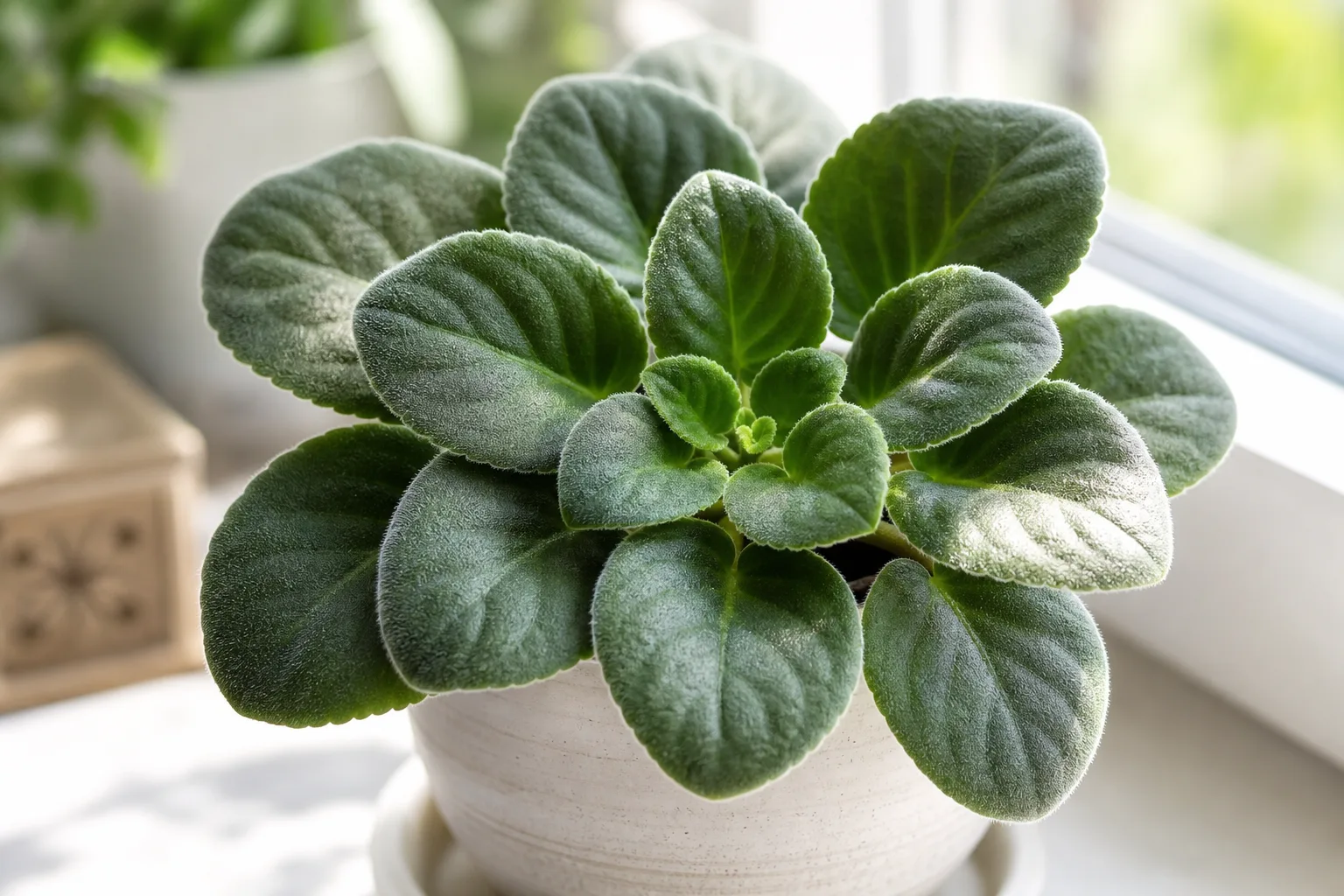
No Flowers on African Violet: Causes, Checks & Fixes
This guide covers no flowers on African Violet. See also the general No Flowers guide, watering, and light pages for this plant.
No Flowers on African Violet: Causes, Checks & Fixes
Quick answer
No flowers on African violet means a healthy-looking leaf rosette runs for weeks without bud stalks-not buds that formed and fell (that is bud drop) and not pale bleached foliage from sunburn (see not enough light vs. excess exposure in the posture section below).
First step: read leaf posture and daily light hours before you repot, fertilize harder, or relocate the pot. A flat, horizontal wheel of leaves under adequate light is what bloom-ready plants look like; leaves that reach upward with visibly longer petioles mean the plant is still hunting for photons even if the window looks bright to you.
For most homes, the fix is bright indirect light for 14–16 hours daily with 8–10 hours of uninterrupted darkness-east or bright north exposure within 12–18 inches of the glass, or supplemental LEDs 8–12 inches above standard rosettes on a timer. Keep watering and mild feeding steady during a two-week light reset; do not repot on day one.
What no flowers looks like on African violet
The classic presentation is a full velvet rosette with zero bud stalks for six weeks or longer while leaves stay green and new center growth continues.
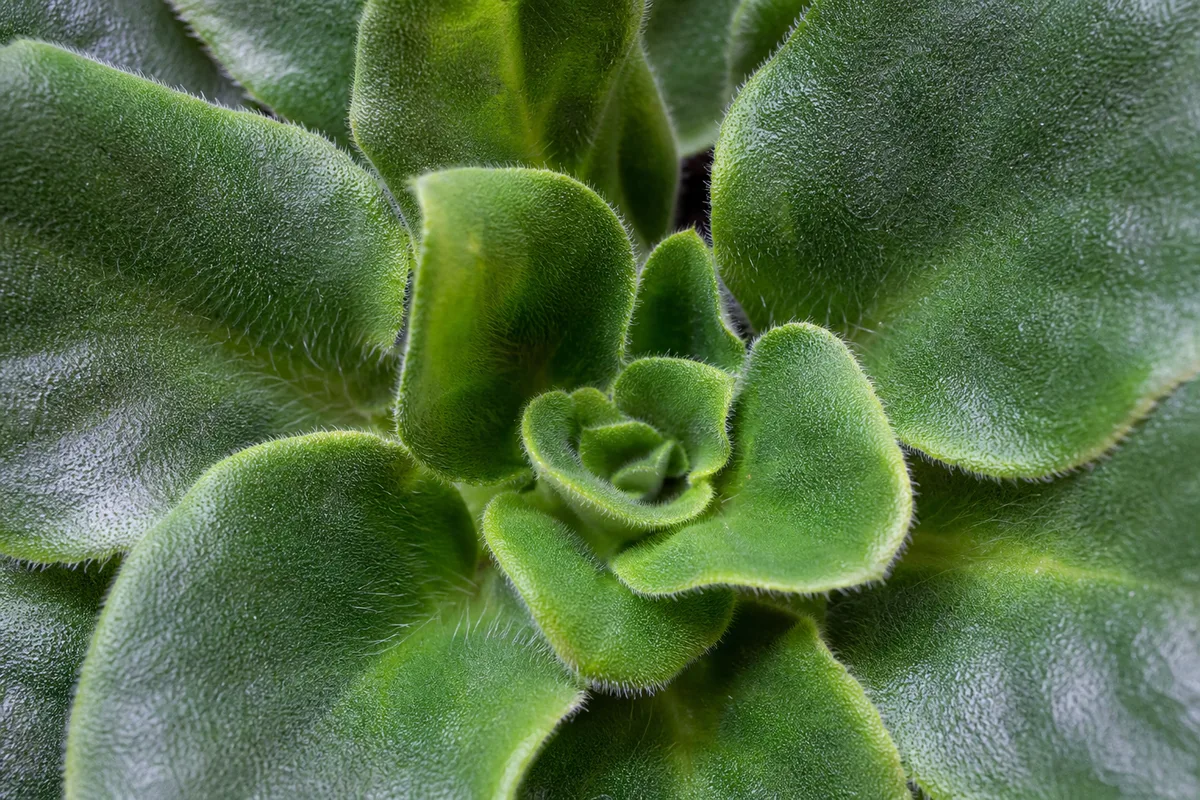
No Flowers symptoms on African Violet - compare with healthy tissue on the same plant.
Typical no-bloom signs:
- No peduncles (flower stalks) emerging from leaf axils despite active leaf production
- Upward-reaching leaves with longer, thinner petioles-the plant tilts toward the brightest spot (UF/IFAS)
- Dark green, thin leaves in deep shade positions rather than the medium green of well-lit plants (UF/IFAS)
- Lush center growth without the tight rusty center that overfeeding can cause
- Single crown symmetry breaking when hidden suckers compete for the same light
What distinguishes no flowers from nearby problems:
| What you see | Likely issue | Key differentiator |
|---|---|---|
| No stalks ever appear; leaves reach upward | Low light | Long petioles, dark thin leaves; flat rosette returns after light fix |
| Bud stalks form, then dry or fall | Bud drop | Peduncles visible first-see bud drop guide |
| Pale, bleached, or yellow-green upper leaves | Too much direct sun | Growth slows; see posture section for excess-light cues |
| Limp plant, wet soil, soft crown | Root or crown stress | Bloom is secondary-see root rot or crown rot |
| Tight rusty center, twisted new leaves | Overfertilization | Foliage problem first-see overfertilization |
| Recent repot into larger pot, strong roots | Vegetative rebound | Energy diverted to roots; bloom delay normal for several weeks |
Standard cultivars in a 4-inch pot that has not bloomed for two months on a dim north sill fit the low-light pattern far more often than nutrient deficiency.
Why African violet stops flowering
African violets (Saintpaulia hybrids) bloom when light duration, darkness, temperature, crown structure, pot size, and nutrition align. One missing trigger can leave foliage perfect and flowers absent.
Light deficit and broken day length
Light is the primary bloom gate. Plants need roughly 1,000 foot-candles of bright indirect light for best flowering-about what you find within three feet of a southeast or west window, or under supplemental fixtures. Too little light produces thin, deep green leaves that reach upward and few or no flowers. Duration matters as much as intensity: African violets need 8 to 12 hours of light (up to 16 under supplementation) and about 8 hours of darkness daily to complete the flowering hormone cycle. A plant near a bright window for only six hours behaves worse than one in moderate light for fourteen hours.
Temperature drift
African violets grow across 60–80°F, with nights near 65–70°F ideal. Prolonged heat above the upper band or cool rooms that stay below 60°F for weeks slow bloom initiation even when light looks adequate. Winter bloom gaps on cold windowsills often pair low temperature with marginal light-both need correction.
Nutrient imbalance
Small pots hold little nutrient reserve. Skipping feed for months can leave a plant without phosphorus to spend on flowers (Penn State Extension). The opposite failure-high-nitrogen fertilizer or heavy doses-pushes leaves and tight centers at the expense of buds. Balanced violet formulas at quarter label strength each watering on moist soil is the usual indoor pattern.
Sucker crowding and crown competition
Except on trailing types, growers aim for one symmetrical crown. Suckers-secondary rosettes at the base-steal light from inner leaves and divert energy from bloom stalks. A plant that once bloomed freely can go silent after suckers fill the pot center.
Pot size and root-state effects
African violets bloom best when roots fill the pot without drowning in excess mix. Pots wider than one-third the rosette diameter often delay flowering while the plant expands root mass. Fresh repots into larger containers commonly pause blooms for several weeks while roots re-establish-even when culture is otherwise correct (AVSA).
How to confirm the cause
Work through this checklist in order. Stop when one branch clearly fits-do not stack repot, feed, and light changes the same week.
- Leaf posture check (30 seconds). View the rosette from the side. Flat horizontal leaves with short petioles suggest adequate light direction. Leaves angled upward with long stems strongly indicate insufficient light-treat light as primary until posture normalizes for two weeks.
- Light hours and darkness. Count artificial light time on your timer or estimate window exposure. Target 14–16 hours on, 8–10 hours fully dark. Night interruptions from room lights can break the dark period lamps are meant to provide.
- Distance to glass or fixture. Window plants should sit 12–18 inches inside the pane; LED or fluorescent shelves 8–12 inches above standard foliage, 6–8 inches above miniatures.
- Temperature trend. Note overnight lows on the sill or shelf. Sustained below 60°F or hot spots above 80°F for days suppress bloom even under lights.
- Watering rhythm. Soil should feel like a well-wrung sponge-not bone dry for days, not soggy constantly. Alternating drought and saturation stresses roots and sacrifices flowers.
- Fertilizer history. No feed for three-plus months on a mature plant, or recent heavy nitrogen, both stall buds. Inspect center leaves for rusty tight growth from overfeeding.
- Crown and sucker audit. Look straight down at the center. Multiple leaf clusters, offset growth, or a widening flat crown suggest suckers-remove before chasing other fixes.
- Pot fit. Measure rosette width versus pot diameter. If the pot is much wider than one-third the plant width, or you repotted within the last month into a larger container, expect vegetative delay.
Decision outcomes:
| After checks 1–3 | Next action |
|---|---|
| Upward leaves + under 12 light hours | Increase light first; hold other variables 14 days |
| Flat rosette + 14–16 h light + 8 h dark | Move to temperature, then feed, then suckers/pot |
| Pale bleached leaves + slow growth | Reduce intensity; may be excess light, not deficit |
| Wet wilt + no buds | Stop bloom chase; investigate roots |
If posture and hours are clearly weak, light is the working diagnosis until a two-week correction proves otherwise.
First fix for African violet
Increase effective light and stabilize the day–night cycle for fourteen days-change nothing else.
- Move the plant to bright indirect light within 12–18 inches of an east or bright north window, or position LEDs 8–12 inches above the leaves.
- Set a timer for 14–16 hours on and 8–10 hours off if you use artificial light.
- Keep watering at your normal even-moisture rhythm-see the African violet watering guide.
- Do not repot, remove healthy leaves, or increase fertilizer during this reset window.
Judge progress by leaf posture flattening and the first tiny peduncle nub at a leaf axil-not by older outer leaves changing color.
If no buds return after initial fixes
When light, temperature, and watering have been stable for four to six weeks and posture is flat but still no stalks, branch in this order:
Step A - Audit suckers and crown symmetry. Remove all secondary rosettes with tweezers or a sterile blade. Wait three weeks before evaluating-blooms often follow the first uninterrupted light reaching the true center.
Step B - Review fertilizer. If you have not fed in months, start quarter-strength balanced violet fertilizer on pre-moistened soil each watering. If you have been feeding heavily, flush with plain water for two cycles, then resume mild feed. Avoid urea-heavy formulas; African violet roots are sensitive to urea nitrogen burn.
Step C - Check pot size. If the container is much larger than one-third the rosette width, downsize or same-pot refresh with fresh mix rather than jumping wider. Expect three to six weeks of bloom pause after root disturbance.
Step D - Rule out root and crown stress. Gently lift the root ball. Firm white roots support bloom recovery; mushy brown roots mean survival comes first-see root rot. Soft crowns with sour mix point to crown rot.
Step E - Escalate for persistent failure. If posture is flat, light hours are correct, suckers are gone, feed is mild, roots are firm, and still no peduncles after eight weeks, contact your local cooperative extension office or an African violet society chapter for cultivar-specific advice. Some genetic lines bloom less freely; others need seasonal light boosts.
Do not change light distance, fertilizer, and pot size in the same week-stacked variables hide which fix worked.
Recovery timeline
Timelines depend on which blocker you corrected:
Low light corrected: First visible peduncles often appear in 3 to 6 weeks after posture flattens and day length stabilizes. Full clusters may need one additional bloom cycle.
Temperature corrected: Once nights stay in the 65–75°F band for two weeks, expect buds in 4 to 8 weeks if light was already adequate.
Sucker removal: Bloom return commonly takes 3 to 5 weeks after the crown is single and center leaves receive direct light.
Repot or pot downsizing: Plan for 4 to 8 weeks minimum; disturbed roots prioritize establishment over flowers.
Fertilizer correction: Mild feed on a light-stable plant may show buds in 3 to 6 weeks; recovery from overfeed tight centers can take longer.
Winter without supplemental light: Even corrected culture may slow until day length naturally lengthens-LED supplementation usually shortens the wait.
Judge success by new peduncles and balanced center growth, not by forcing old leaves to bloom.
Documented recovery example
A standard violet in a 4-inch plastic pot sat on a north kitchen windowsill for eight weeks in late winter-healthy green leaves, zero buds. Side view showed petioles stretching upward about 30° above horizontal. Window exposure totaled roughly nine hours of indirect light; overnight lows on the glass dropped to 58°F.
Intervention: Moved to a wire shelf with a two-tube LED fixture 10 inches above leaves, 14 hours on / 10 hours off via timer. Watering unchanged (wick tray, quarter-strength feed every watering). No repot.
Results: Rosette flattened within 10 days. First peduncle visible at day 22. First open bloom at day 38. Second stalk followed two weeks later.
The misstep would have been repotting or doubling fertilizer while light and temperature were still marginal-both would have delayed the actual fix.
Lookalike problems to rule out
- Bud drop: Stalks form, buds abort-different timing and fixes.
- Not enough light: Chronic stretch and weak rosette shape; overlaps heavily with no flowers but focuses on foliage correction.
- Leggy growth: Elongated neck and spaced leaves from age or light; may bloom poorly until re-rooted.
- Transplant shock: Recent repot with wilt or stalled growth-wait before expecting blooms.
- Root rot / crown rot: Wet collapse-blooms are not the immediate goal.
What not to do
- Repot into a much larger pot to force flowers-oversized pots delay bloom.
- Apply strong fertilizer to dry soil-moisten mix first to avoid root burn.
- Run grow lights more than 16 hours-darkness triggers the bloom response.
- Change light, feed, and pot in one weekend-you will not know which variable mattered.
- Let the pot sit in standing water-root damage sacrifices flowers.
- Ignore suckers while chasing brighter windows-competing crowns block center bloom.
How to prevent repeat bloom failure
Prevention is measurable stability, not a vague “keep care steady” reminder:
- Light: 14–16 hours daily plus full darkness; flat rosette posture as your weekly check. Details in the African violet light guide.
- Temperature: Keep nights above 60°F; avoid hot drafts above 80°F for prolonged periods.
- Water: Even moisture like a wrung sponge-see watering.
- Feed: Quarter-strength balanced violet fertilizer on moist soil during active growth-fertilizer guide.
- Crown: Remove suckers when small; one symmetrical crown per standard plant.
- Pot: Stay near one-third rosette width; refresh mix without unnecessary upsizing-repotting guide.
- Season: Add or extend supplemental light in short winter days before blooms stall.
Related African violet troubleshooting
- African violet overview
- African violet light
- African violet watering
- African violet fertilizer
- Bud drop on African violet
- Not enough light on African violet
- Leggy growth on African violet
- Root rot on African violet
- Crown rot on African violet
- Transplant shock on African violet
- Overfertilization on African violet
When to worry
A bloom pause on an otherwise firm plant is low urgency. Escalate when:
- Soft crown, sour soil, or wet wilt accompany no buds-investigate roots before light tweaks.
- All leaves pale and bleached-likely excess light; move promptly to indirect exposure.
- No peduncles after eight weeks of documented correct light, single crown, mild feed, and firm roots-seek local expert review.
- Mushy brown roots when you inspect the ball-the plant may not be saveable for bloom restoration.
No flowers alone rarely kills an African violet; chasing blooms with repots and heavy feed on a stressed root system can.
How this guide was reviewed: Written by sai-ananth and reviewed by the LeafyPixels Review Board on 2026-06-16. Species data and bloom physiology cross-checked with UF/IFAS, Penn State Extension, University of Minnesota Extension, UVM Extension, and African Violet Society of America publications cited inline above. See methodology note in frontmatter.
When to use this page vs other African Violet guides
- African Violet watering guide - Use for routine moisture checks before assuming no flowers is the main issue.
- African Violet problems hub - Browse all 52 common issues on this species.