Overfertilization on African Violet: Causes, Checks & Fixes
Quick answer
Overfertilization on African Violet usually shows as a tight rusty center, salt crust on the soil or pot rim, and burned tips while the mix is still moist. First, stop feeding and flush thoroughly from the top with plain room-temperature water. Restart at quarter-strength only after fresh green growth appears.
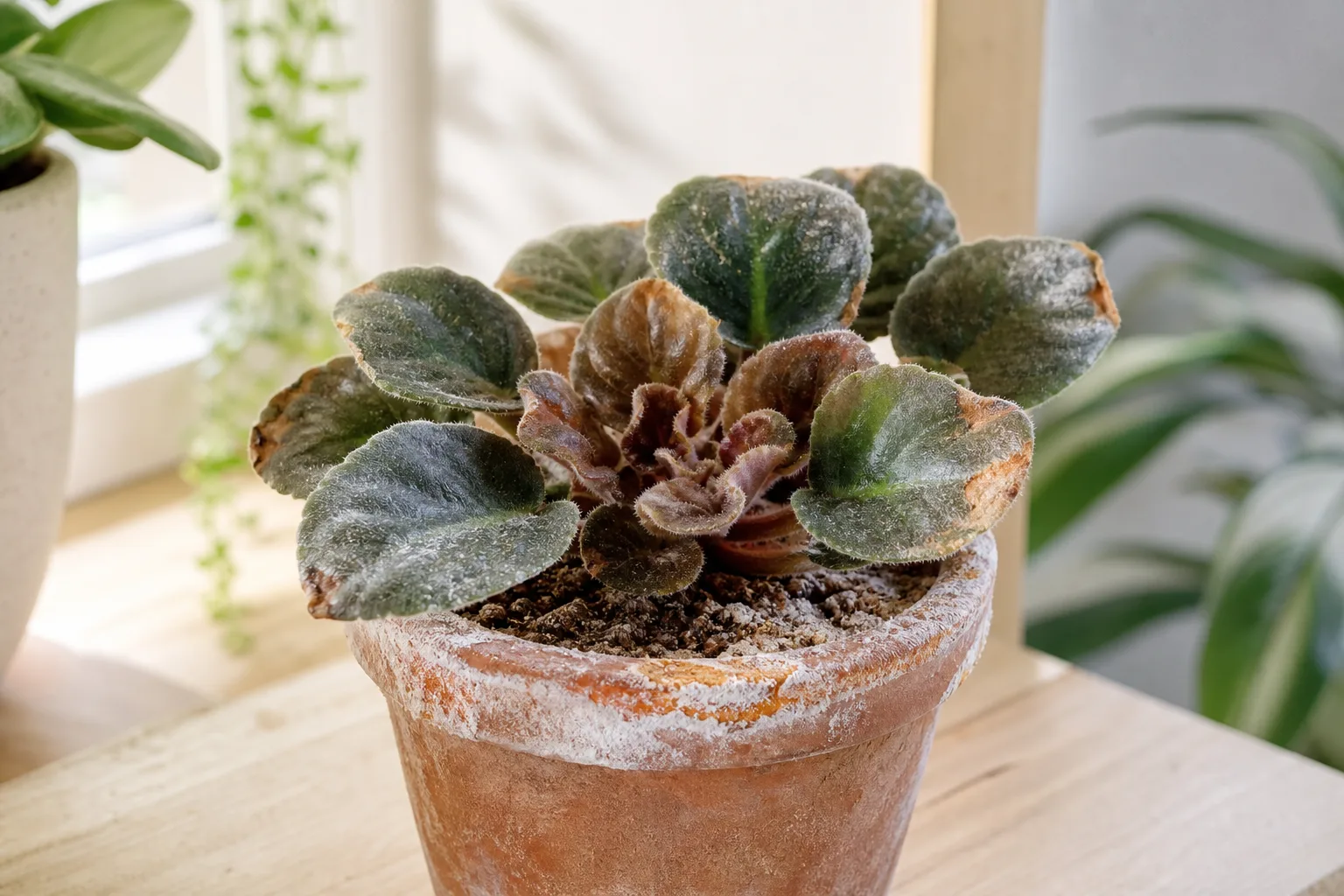
Overfertilization on African Violet: Causes, Checks & Fixes
This guide covers overfertilization on African Violet. See also the general Overfertilization guide, watering, and light pages for this plant.
Overfertilization on African Violet: Causes, Checks & Fixes
Quick answer
Overfertilization on African Violet is a salt problem before it is a nutrient problem. In a small violet pot, dissolved fertilizer minerals can build up faster than roots can use them, especially with frequent feeding. UF/IFAS notes that over-fertilized African violets develop tight centers and rusty new leaves, and UMN gives the same pattern with center crowding and rust tone in new growth. First action: stop fertilizer and flush from the top with plain room-temperature water until it drains freely (UMN Extension).
Why African Violet gets overfertilization
African violets are usually fed “weakly, weekly” for a reason: roots are fine and sensitive, and pot volume is small. UF/IFAS recommends mixing fertilizer at one-fourth label strength and applying to moist media, while AVSA also emphasizes diluted constant feeding and avoiding over-application (AVSA Violets 101).
Common triggers on this species:
- Full-strength feeding after a dry spell.
- Increasing dose when blooms slow in low-light seasons.
- Feeding in self-watering or wick setups without regular top flushing.
- Letting runoff or reservoir solution remain concentrated for long periods.
In wick or reservoir setups, UF/IFAS specifically advises occasional top watering to flush accumulated fertilizer salts. Without that leaching step, salts can concentrate even while the pot looks evenly moist.
What overfertilization looks like on African Violet
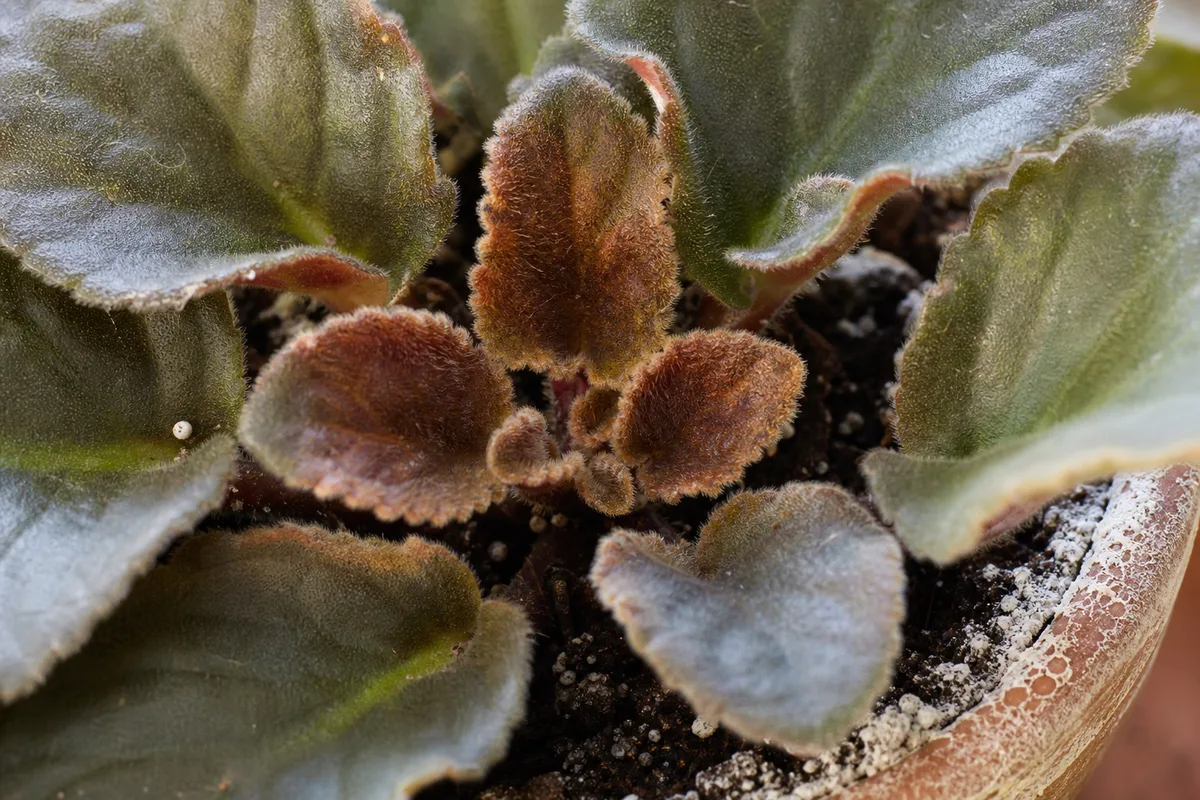
Tight rusty-toned new leaves crowding the crown with white salt crystals on the pot rim - stop feeding and flush before resuming at quarter strength.
The most reliable visual pattern is tight center growth plus rusty or bronzed new leaves, described by both UMN Extension and UF/IFAS. You may also see:
- White or orange crust on the mix surface, rim, or saucer edge.
- Browned leaf tips or margins while soil is still moist.
- Slower flowering even though light and temperature are unchanged.
- Localized brown lesions where petioles touch a salty clay rim (UF/IFAS petiole-rot pattern).
On African violets, this center pattern is especially useful because many other stressors first affect outer leaves, not the crown.
How to confirm the cause in 5 checks
- Trace your feed rate: compare what you used with a true quarter-strength program.
- Inspect for residue: check the top layer, pot rim, and wick entry point for crystal deposits.
- Check center behavior: tight, rusty new growth supports overfertilization.
- Run one thorough flush test: if symptoms stop progressing after leaching, excess salts were a major driver.
- Inspect roots only if needed: firm pale roots suggest recovery potential; dark mushy roots point to rot risk, which UMN highlights as a common cause of collapse when media stays too wet (UMN Extension).
The first fix to try
Stop fertilizer now, then leach salts:
- Scrape off obvious crust from the surface.
- Water from the top with plain room-temperature water until runoff is generous.
- Discard all runoff and old reservoir solution.
- Repeat one more plain-water top flush within a few days if crust was heavy.
This follows extension/society guidance to use top watering as a salt-removal step in violet culture (UF/IFAS, AVSA watering guidance).
Step-by-step recovery after the flush
Week 1
Hold fertilizer. Keep the mix evenly moist but not saturated. If your violet is in a wick setup, refill with plain water only until signs stabilize.
Week 2 to 3
Look for less center crowding and cleaner new growth. Remove only leaves that are fully necrotic; leave partly functional leaves in place so the plant can keep photosynthesizing.
Week 3 to 6
If new growth is normal, restart feeding at quarter-strength. Keep leaching in your routine. UMN advises monthly flushing to remove excess buildup (UMN Extension).
If the center still tightens or roots smell sour, repot into fresh violet mix and reassess watering/aeration instead of increasing fertilizer.
Recovery timeline
Mild cases often show improvement within 2 to 4 weeks; moderate cases may need 4 to 8 weeks before crown growth looks normal. Existing tip burn and old scarred leaves do not “heal.” Recovery means new leaves open green and proportionate, salts stop returning quickly, and bloom set resumes over time.
Escalate when:
- Crown darkens and softens.
- Wilting continues despite correct moisture.
- Roots are mostly brown/mushy after inspection.
Those signs are not typical of simple overfeeding and may indicate root or crown disease.
Lookalike symptoms to rule out
| Problem | What it can look like | Key difference from overfertilization |
|---|---|---|
| Crown/root rot on African Violet | Limp plant, poor growth, center decline | Tissue is soft/mushy; UMN notes root rot risk with constantly wet roots |
| Nitrogen deficiency | Pale leaves, slow growth | Center usually stays open green rather than tight rusty |
| Cold-water spotting | Marked leaves after watering | Distinct spotting pattern after cold water events, not salt crust trend |
| Petiole rot from rim salts | Brown contact lesions on stems | Local injury at clay rim contact points; often coexists with overfeeding |
What not to do
Do not “correct” stress by adding more fertilizer. Do not apply fertilizer to dry media; both UF/IFAS and UMN caution to moisten first to reduce root burn risk (UF/IFAS, UMN Extension). Do not leave old concentrated solution in a reservoir after flushing. And do not keep leaves resting on a salty clay rim; barrier or pot choice matters for this species.
How to prevent overfertilization next time
Use a low-dose system you can repeat consistently:
- Quarter-strength feed, not full-strength spikes (UF/IFAS).
- Keep media slightly moist before fertilizing.
- Top flush monthly (or at least every 6 to 8 weeks in lower-demand periods) to remove salts (UMN Extension).
- In wick systems, keep periodic top leaching in the routine rather than relying only on reservoir refills (UF/IFAS).
- Reduce contact burn risk by avoiding unprotected salty clay rims.
If this issue repeats, tighten your fertilizing plan and cross-check your general care routine in the African Violet care guide and related pages on fertilizer burn and crown rot.
When to use this page vs other African Violet guides
- African Violet watering guide - Use for routine moisture checks before assuming overfertilization is the main issue.
- African Violet problems hub - Browse all 52 common issues on this species.
- Fertilizer Burn on African Violet - Different entry point when symptoms overlap with overfertilization.
- Salt Build-up on African Violet - Different entry point when symptoms overlap with overfertilization.
- Brown Tips on African Violet - Different entry point when symptoms overlap with overfertilization.