Ponytail Palm Care Guide: Beaucarnea recurvata Indoors
Beaucarnea recurvata
Ponytail Palm is one of the most drought-tolerant houseplants-water every 2–4 weeks when soil is completely dry. Its swollen trunk stores water. It needs a sunny window, is non-toxic to pets, and requires almost no attention.
Ponytail Palm Care Guide: Beaucarnea recurvata Indoors
Start with wateringThe most common care mistake for Ponytail PalmWatering guide →Ponytail Palm care essentials
Light
bright light with direct sun, bright indirect light
Water
Water deeply every 2–4 weeks; the swollen trunk base is a water reservoir. Overwatering is fatal.
Soil
Fast-draining cactus and succulent mix; drainage is critical.
Humidity
Low (30–40%)
Temperature
18–27°C (65–80°F)
Fertilizer
Feed lightly during active growth. Balanced cactus fertilizer at quarter strength and stop if the plant is stressed, newly repotted, or not actively growing.
About Ponytail Palm
Ponytail Palm has a upright growth habit.
| Detail | Information |
|---|---|
| Growth habit | Upright |
| Scientific name | Beaucarnea recurvata |
Ponytail Palm Care Guide: Beaucarnea recurvata Indoors
Walk into a plant shop looking for something sculptural, slow, and hard to kill, and you will eventually land on a ponytail palm. The name promises a tropical palm. The swollen base and cascading leaf crown deliver the look. What the label rarely explains is that Beaucarnea recurvata is not a palm at all, that the bulbous trunk is a drought-adapted water tank, and that the fastest way to lose the plant is to love it with a watering can. This guide covers the full indoor care picture: what the plant actually is, how the caudex changes every watering decision, where to put it for light, how to feed and repot it without rot, how to propagate offsets, and why the ASPCA lists it as non-toxic to cats, dogs, and horses - with the practical caveats pet owners still need.
What Ponytail Palm Actually Is (Not a True Palm)
Ponytail palm is the common name for Beaucarnea recurvata, an evergreen caudiciform tree native to semi-desert areas of southeastern Mexico, Belize, and Guatemala. The Missouri Botanical Garden Plant Finder places it in Asparagaceae - the same broad family as agave and asparagus - and notes that despite the name, it is not a true palm in the Arecaceae sense. University of Wisconsin Horticulture describes the taxonomic history cleanly: the genus Beaucarnea (sometimes grouped with Nolina) has bounced between Nolinaceae, Agavaceae, and Ruscaceae in older references, but modern classification treats it as Asparagaceae.
That family placement matters for care expectations. True palms generally want steady moisture, high humidity, and tropical warmth. Beaucarnea recurvata evolved on dry slopes and rocky semi-desert, storing water in its base and tolerating long dry intervals. Treat it like a succulent with a tree habit, not like a parlor palm. Other common names - elephant’s foot tree, bottle palm, pony tail plant - all refer to the same species or close lookalikes in trade. If your tag says Nolina recurvata, that is a synonym for the same plant.
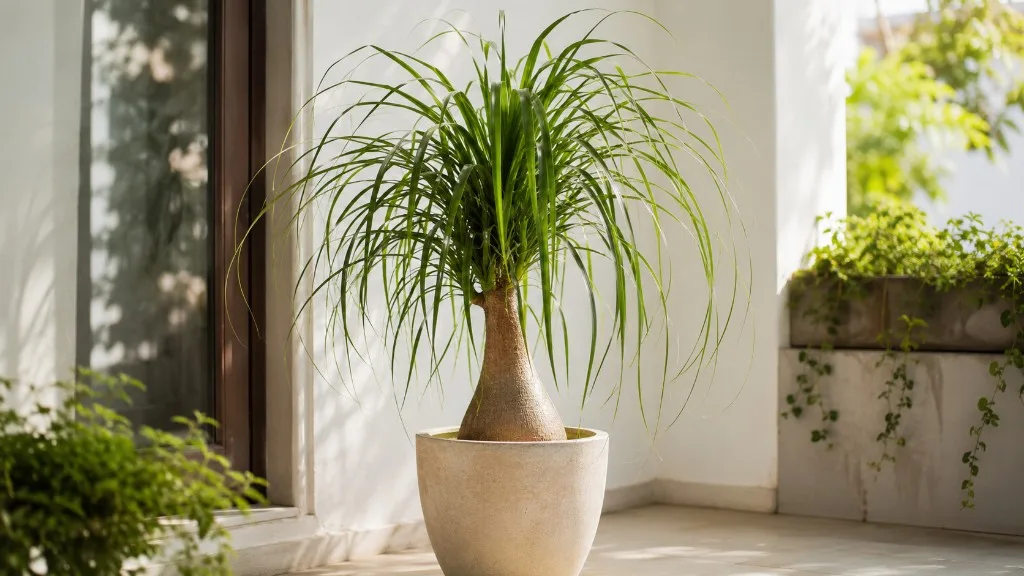
Indoors, the silhouette is unmistakable: a single stem rising from a greatly swollen base, topped with a fountain of long, thin, recurved strap leaves that cascade like hair in a ponytail. Young nursery plants are usually unbranched. Older specimens - especially landscape plants in warm climates - can branch after flowering or after the stem is cut while small. Growth is slow. In a container, expect something on the order of 6–8 feet over many years, not a fast floor-to-ceiling climber. The NParks Singapore flora entry notes trees can reach about 9 m outdoors with a massively swollen base up to 3.7 m wide - scale that mental image down for a living-room pot, but keep the proportions: most of the visual weight sits in the caudex, not the leaves.
The Caudex and Why It Changes How You Water
The feature that defines ponytail palm care is the caudex - the swollen, water-retaining base sometimes described as flask-shaped or elephant-foot-like. University of Wisconsin Horticulture explains that the enlarged base stores water so the plant can survive extended drought in its native range. In the wild, old caudices can become enormous; indoors, even a modest bulb signals the same biology on a smaller scale.
The caudex is not decorative ballast. It is the plant’s primary drought insurance. Roots pull in water when you irrigate; the caudex holds reserves for weeks when soil is dry. That is why ponytail palm earns a reputation for forgiveness - and why overwatering is the main killer. A chronically wet mix keeps roots oxygen-starved while the caudex still looks firm for a while. By the time the trunk feels soft or leaves pull out cleanly, rot has often advanced.
Read the plant through the caudex, not through guilt. A healthy specimen has a firm, smooth or lightly fissured base, leaves that resist a gentle tug, and soil that goes fully dry between deep waterings. A stressed, overwatered plant may show yellowing lower leaves, a spongy or collapsing base, or offsets that blacken at the attachment point. When in doubt, wait to water. The caudex can bridge a dry spell far more safely than roots can survive a wet one.
Light: Bright, Sunny, and Forgiving
Ponytail palm is not a low-light plant. It wants bright light for most of the day, and it tolerates direct sun better than many popular houseplants - especially when acclimated gradually. University of Florida IFAS describes it as a fine-textured evergreen that performs well as a container and houseplant, with creamy yellow flowers on mature outdoor specimens; indoors, the limiting factor for vigor is usually insufficient light, not humidity.
A strong placement is within a few feet of a south- or west-facing window, or directly in an east window with morning sun. If you move a plant from a dim corner to a sunny sill, do it over one to two weeks, adding an hour or two of direct exposure per day or filtering through a sheer curtain at first. Unacclimated leaves can bleach or scorch at the tips when slammed into hot afternoon glass.
Low light does not usually kill ponytail palm quickly, but it weakens the whole system. Leaves stay thinner, new growth is sparse, and - critically - the pot dries more slowly while the plant uses less water. That combination mimics overwatering stress even when your calendar says you are being conservative. If the plant looks dull and the soil stays damp, fix light before you change the watering interval.
Artificial light works if it is strong enough. A high-output LED grow panel or a very bright shop fixture 12–14 inches above the crown for 12–14 hours daily can sustain a compact plant where window light is weak. Rotate the pot a quarter turn weekly so the leaf fountain stays even rather than leaning hard toward the window.
Watering: Soak-and-Dry, Not a Calendar
The watering rule for Beaucarnea recurvata is simple to state and easy to get wrong in practice: water deeply only after the soil has dried out completely, then let all excess drain away. LeafyPixels plant-care data and multiple extension-aligned sources converge on a rough indoor interval of every 2–4 weeks, but pot size, mix, light, and season change that number so much that a calendar alone will eventually rot the roots.
Think soak-and-dry, not a little sip every few days. When the mix is dry, water until it runs freely from the drainage holes. For a small pot you can lift, a second short pass after the first drain helps eliminate dry pockets in chunky cactus mix - then empty the saucer and return the plant to its spot. Never leave the caudex sitting in a cache pot of standing water.
How to Read Dry Soil in a Thick Mix
Fast-draining cactus mix is deceptive. The surface can look dusty while the center still holds moisture, or the top can crust dry while the bottom stays damp in an oversized pot. Use more than one check:
Finger or chopstick test: Insert to two knuckles or about 5 cm. If you feel coolness or cling, wait. If it is uniformly dry and the pot feels noticeably lighter, water.
Weight test: Lift the pot before and after a thorough watering a few times until your hands learn the difference. A dry ponytail palm pot is distinctly lighter than a freshly watered one, even when the caudex itself still looks plump.
Moisture meter (optional): In a thick mix, aim for dry deep readings before watering - not “slightly moist” halfway down. Meters lie in very airy mixes unless you verify against touch at first.
Signs you watered too soon: soil that never dries, musty smell, fungus gnats, lower leaves turning yellow, or leaves that detach with a gentle pull. Signs you waited too long: crispy brown tips, slight leaf curl, or very slow growth in otherwise good light - still less urgent than rot.
Seasonal Water Adjustments
Ponytail palm slows in cooler, dimmer months. The same interval that worked in summer will overwater the plant in winter. Stretch the dry window, keep the plant away from cold window panes that slow evaporation, and do not compensate for gray weather with extra water. Resume your active-season rhythm when new leaf growth is clearly visible and the pot dries on a predictable schedule again.
Heat waves and strong summer sun can shorten the dry window slightly, but the caudex still buffers demand. Increase frequency only when repeated checks show the mix going fully dry faster - not because the room feels hot.
Humidity and Temperature Indoors
This is one of the easiest sections in the whole guide: ponytail palm does not want a humid jungle. It prefers low to average household humidity, roughly 30–40%, and it does not benefit from misting. Wet leaf crowns in stagnant air invite fungal issues; several care sources explicitly warn against misting foliage on Ponytail Palm overview. If you run a humidifier for other plants, ponytail palm will tolerate moderate humidity, but it is not a requirement for healthy growth.
Temperature is equally straightforward. 65–80°F (18–27°C) matches most homes. Wisconsin Horticulture and multiple nursery guides set a minimum around 50°F (10°C); below that, growth stalls and cold damage becomes a real risk. Watch for sudden cold drafts from winter windows, air-conditioning vents pointed at the caudex, and porch doors that drop the temperature overnight. Stable average warmth beats perfect humidity every time.
Soil and Pot Choice
Use a fast-draining cactus or succulent mix with plenty of perlite, pumice, or coarse sand. The exact brand matters less than the outcome: water enters quickly, drains quickly, and leaves air around the roots. Heavy peat-heavy indoor mixes compact over time, hold water too long, and are the silent partner in most ponytail palm failures.
A workable DIY blend: two parts cactus mix, one part perlite or pumice, adjusted up if your home runs cool and dim. Repot into fresh mix every one to two years, or when water runs straight through without soaking in.
Pots must have drainage holes. Terra-cotta dries faster and suits heavy-handed waterers; plastic retains moisture slightly longer and suits growers who lean dry. Avoid sealed decorative outer pots without drainage - the caudex can look fine while roots suffocate below. When you do repot, go up only one size; an oversized pot holds water the root system cannot use, mimicking chronic overwatering.
Fertilizer: Light and Seasonal
Ponytail palm is not hungry. It evolved for lean soil and long dry spells. Feed lightly during active growth - typically once or twice in the growing season with a balanced cactus or succulent fertilizer at quarter strength, or a diluted balanced houseplant formula applied to already-moist soil. UF IFAS and general succulent practice align: modest nutrition supports leaf color; excess salt accumulation burns tips and stresses roots.
Never fertilize a dry plant, a newly repotted plant, or a plant recovering from rot or pest damage. Pause entirely in winter when growth is minimal. If white crust builds on the mix surface or leaf tips brown uniformly despite good watering, flush the pot with plain water and skip the next feeding cycle.
Ponytail Palm repotting guide Without Damaging the Caudex
Repot when the plant is clearly outgrowing its container - roots circling the surface, emerging from drainage holes, or water running through without absorption - or when the mix has broken down and compacted. The best timing is spring or early summer as active growth resumes. Slow-growing ponytail palms often stay put for two to three years between repots.
Work carefully around the caudex. Slide the plant out, loosen only the outer crust of old mix, and move it to a pot one size larger with fresh draining mix. Set the caudex at the same depth it grew before; burying the swollen base deeper than it was can trap moisture against bark that expects air exposure. Water lightly once after repotting, then return to a cautious dry cycle for two to three weeks while roots heal.
Do not repot on day one after purchase unless the mix is clearly failing or pests are present. A quarantine month that teaches you how fast the pot dries in your light prevents most post-purchase rot stories.
Propagation by Offsets and Seed
Home propagation is usually offset division, not leaf cuttings. Mature ponytail palms occasionally produce pups at the base. University of Wisconsin Horticulture notes that offsets can be removed while young; if you wait too long, the pup develops its own swollen base that fuses with the parent caudex, making clean separation harder and riskier.
When a pup is roughly 10–15 cm (4–6 inches) tall with some roots of its own, unpot the parent and use a clean, sharp knife to cut through the attachment, keeping as much root as possible. Let cut surfaces callus for two to three days in bright, indirect light. Pot the pup in dry cactus mix, water lightly once to settle soil, then keep barely moist - not wet - until new growth confirms independence. Spring and early summer give the highest success rate.
Seed propagation is possible but slow - germination can take weeks to months, and years pass before a seedling develops a meaningful caudex. Offsets are the practical home method. You can also leave pups attached to build a multi-stemmed specimen; that is an aesthetic choice, not a health requirement.
Pet Safety: ASPCA Non-Toxic
For cat and dog households, ponytail palm is one of the rare large architectural plants with a clean safety profile. The ASPCA toxic and non-toxic plant list lists Beaucarnea recurvata - common names pony tail, elephant-foot tree, bottle palm - as non-toxic to dogs, non-toxic to cats, and non-toxic to horses. That matches the LeafyPixels toxicity audit and is one of the plant’s strongest selling points for pet-aware buyers.
Cats, Dogs, and What Chewing Still Means
Non-toxic is not the same as good to eat. Cats that chew houseplants can still vomit from fiber and mechanical irritation, knock over heavy pots, or damage the leaf crown. Dogs that strip leaves create cosmetic damage and mess, not a poison-control emergency. For birds, horses, and less-common pets, check species-specific lists before assuming safety.
Practical placement still matters: secure tall specimens so a climbing cat cannot pull them over, and accept that puppy teething on stiff leaves will scar the plant. If ingestion happens and your pet shows persistent vomiting, lethargy, or distress, contact your veterinarian - not because Beaucarnea is classified as toxic, but because any unusual ingestion deserves professional judgment.
Common Problems and Real Fixes
Most ponytail palm problems trace back to water, light, or pot geometry. Pests happen, but they are usually secondary to stress. Start every diagnosis at the caudex and the mix moisture, then move outward.
Brown Tips, Yellow Leaves, and Mushy Trunks
Brown tips often mean underwatering, salt buildup from tap water or over-fertilizing, or sudden light stress. Flush the pot with plain water if salts are suspected, adjust the soak-and-dry rhythm, and trim dead tips with clean scissors for appearance only - new growth tells you whether the fix worked.
Yellow leaves on the lower crown can be natural aging - old leaves die as new ones emerge - or a sign of overwatering and root decline. If yellowing spreads quickly, leaves pull out easily, or the base softens, stop watering, unpot if needed, trim black mushy roots, and repot into dry mix.
A mushy trunk is an emergency. It indicates stem or root rot on Ponytail Palm from chronic wet soil, poor drainage, or a too-large pot. Cut watering immediately, inspect roots, remove all soft tissue, and repot into fresh fast-draining mix. Recovery depends on how much caudex tissue remains firm; prevention is far easier than salvage.
Pests and Root Rot
Indoor ponytail palms most often encounter scale, mealybugs, and spider mites - especially when light is weak and air is stagnant. Scale shows as hard brown bumps on stems and leaf bases; mealybugs as white cottony clusters; mites as fine webbing and stippled leaves in dry air.
Treat early: manual removal with a cotton swab dipped in 70% isopropyl alcohol on scales and mealybugs, a shower rinse for mites, then insecticidal soap or neem oil applied to stems and leaf bases following label directions. Repeat weekly until clear. Isolate the plant while treating so pests do not spread to neighbors.
Root rot is not a pest but behaves like one - sudden decline, foul soil, black roots. Fix the environment first: better light, smaller dry cycle, smaller pot if oversized. Chemicals do not replace drainage.
Growth, Branching, and Flowers on Mature Plants
Be patient with ponytail palm. Indoor growth is slow but steady when light is strong. Wisconsin Horticulture notes that plants flower on mature specimens, producing large branched panicles of small creamy-white to pinkish flowers attractive to bees outdoors. Indoor flowering is uncommon and usually requires age, bright light, and size - often a decade or more in good conditions. Plants are dioecious, meaning male and female flowers occur on separate individuals; do not expect viable seed from a single houseplant unless you have both sexes or a pollinated source.
Branching typically appears with age, after flowering, or when a young stem is cut during nursery production to create multi-head specimens. Do not chop your only stem at home unless you accept a long recovery and altered shape. Offsets left in place naturally create a multi-caudex clump over time - often the prettiest outcome for casual growers.
Outdoor Use and Hardiness Zones
Outdoors, Beaucarnea recurvata suits warm, dry climates - commonly cited as USDA Hardiness Zones 10–11, with some sources extending zone 9 in very protected, dry sites. Missouri Botanical Garden notes outdoor cultivation in warm, dry regions where plants can eventually reach much taller landscape size than indoor specimens. In temperate climates, treat it as a summer patio plant that must come inside before frost; even brief exposure below 50°F (10°C) stresses the plant.
Choose outdoor spots with Ponytail Palm light guide, excellent drainage, and no winter soggy soil. A caudex that survives drought can still rot in cold, wet winter ground. In pots, the same soak-and-dry rules apply - outdoor rain is not a substitute for your judgment if the mix stays wet for days.
Conclusion
Ponytail palm rewards a simple contract: give Beaucarnea recurvata strong light, fast-draining soil, and a true dry window between deep waterings, and the caudex does the hard drought work for you. It is not a true palm, it does not need tropical humidity, and the ASPCA classifies it as non-toxic to cats and dogs - but overwatering, sealed pots, and dim corners still kill it faster than neglect ever will. Watch the swollen base for firmness, let pups callus before you pot them, feed lightly, and repot on a slow schedule. Get those basics right and this plant stays one of the most sculptural, low-drama specimens you can grow indoors - a bottle-shaped survivor from Mexican semi-desert slopes, not a fussy parlor palm.
When to use this page vs other Ponytail Palm guides
- Ponytail Palm overview - Canonical hub for this species - care topics and problems branch from here.
- Ponytail Palm problems - Symptom-first path when you already know something is wrong.
Related Ponytail Palm guides
- Ponytail Palm watering
- Ponytail Palm light
- Ponytail Palm soil
- Ponytail Palm propagation
- Ponytail Palm fertilizer
- Ponytail Palm repotting
- Ponytail Palm pruning
- Brown Tips on Ponytail Palm
- Root Rot on Ponytail Palm
- Purple Leaves on Ponytail Palm
- Scale Insects on Ponytail Palm
- Yellow Leaves on Ponytail Palm
How to care for Ponytail Palm?
How much light does Ponytail Palm need?
bright light with direct sun, bright indirect light
- bright light with direct sun, bright indirect light - bright light with direct sun, bright indirect light.
When should you water Ponytail Palm?
Water deeply every 2–4 weeks; the swollen trunk base is a water reservoir. Overwatering is fatal.
- Check top 2 inches - Water deeply every 2–4 weeks; the swollen trunk base is a water reservoir.
- Drain excess water - Water deeply every 2–4 weeks; the swollen trunk base is a water reservoir.
What soil works best for Ponytail Palm?
Fast-draining cactus and succulent mix; drainage is critical.
- Well-draining mix - Fast-draining cactus and succulent mix; drainage is critical.
Grower notes for Ponytail Palm
What matters most with Ponytail Palm
Ponytail Palm stores water in leaves, stems, roots, or a swollen base, so overcare is usually more dangerous than short dry spells. Strong light and drainage are the safety net. In practice, the care checkpoint is simple: bright light with direct sun, bright indirect light. Pair that with fast-draining cactus and succulent mix; drainage is critical, and avoid changing water, pot size, and placement all at once.
Best placement in a real home
Ponytail Palm belongs where bright light with direct sun, bright indirect light is realistic for most of the day, not only where the pot looks good. Water deeply every 2–4 weeks; the swollen trunk base is a water reservoir. Overwatering is fatal. If the pot stays wet longer than expected, move the plant into better light or reassess the mix before watering again. Humidity target: Low (30–40%). Temperature comfort zone: 18–27°C (65–80°F).
Before you buy this plant
Choose Ponytail Palm with firm new growth, clean leaf undersides, and soil that does not smell sour or feel compacted. Be cautious if you see brown-tips, sticky residue, collapsed crowns, or a pot that is wet in poor light. Cosmetic old-leaf damage is less worrying than weak roots or active pests.
First month after bringing it home
Do not repot Ponytail Palm on day one unless the mix is failing or pests are obvious. Quarantine it, learn how fast the pot dries, and keep care boring while it adjusts. Watch especially for brown-tips, root-rot, and yellow-leaves. If problems appear, correct the condition first rather than stacking fertilizer, repotting, and pruning together.
Safety note for Ponytail Palm
Ponytail Palm is not a plant to keep within reach of pets or children. Treat it as an inaccessible display plant. Use gloves if sap or plant tissue is irritating, and pick a pet-safe alternative for floor pots or low shelves.
How to tell Ponytail Palm is settling in
If you plan to multiply it later, common methods include Division of offsets (pups). If root-rot shows up early, inspect light, watering, and roots before assuming the plant is permanently weak.
Is it pet safe?
Ponytail Palm is generally considered pet safe.
Watering Ponytail Palm
Water deeply every 2–4 weeks; the swollen trunk base is a water reservoir. Overwatering is fatal.
Soil & potting for Ponytail Palm
Fast-draining cactus and succulent mix; drainage is critical.
Humidity & temperature for Ponytail Palm
Ponytail Palm prefers low (30–40%), though normal home humidity is usually fine. Keep temperatures around 18–27°C (65–80°F).
| Detail | Information |
|---|---|
| Humidity | Low (30–40%) - normal home humidity is fine. |
| Ideal temperature | 18–27°C (65–80°F) |
Fertilizer & pruning for Ponytail Palm
Use feed lightly during active growth. Balanced cactus fertilizer at quarter strength and stop if the plant is stressed, newly repotted, or not actively growing. for Ponytail Palm.
| Detail | Information |
|---|---|
| Fertilizer type | Feed lightly during active growth. Balanced cactus fertilizer at quarter strength and stop if the plant is stressed, newly repotted, or not actively growing. |
Common problems on Ponytail Palm
Brown Tips
LowLikely cause: Underwatering, low humidity, or mineral accumulation from tap water
Quick fix: Trim tips with clean scissors; switch to filtered water; check soil moisture
Full fix guide →Root Rot
HighLikely cause: Overwatering the swollen trunk base causes the entire base to rot-often fatal
Quick fix: Unpot immediately; remove all rotted material; repot in very dry cactus mix; do not water for 2 weeks
Full fix guide →Purple Leaves
MediumLikely cause: May 1, 2025 · Beaucarnea recurvata is a caudiciform tree with a distinctive trunk and green drooping leaves arranged in dense clusters at the ends of the branches. It can grow up to 30 feet (9 m) tall. The …
Quick fix: Confirm diagnosis on your Ponytail Palm, then address the most likely care or pest factor described in current extension guidance.
Full fix guide →Scale Insects
MediumLikely cause: Scale can attach to the tough strap-like leaves
Quick fix: Wipe leaves with a cloth dampened with isopropyl alcohol; apply neem oil
Full fix guide →Yellow Leaves
MediumLikely cause: Overwatering, insufficient light, or the natural ageing of older leaves
Quick fix: Reduce watering frequency; improve light; remove naturally yellowing older leaves
Full fix guide →Aphids
MediumLikely cause: Aphids on Ponytail Palm cluster on soft new strap leaves at the crown, causing curled tips and sticky honeydew. First step: isolate the plant and rinse crown growth with a firm water spray-tilt the po
Quick fix: See plant-specific guide for step-by-step fixes.
Full fix guide →Drooping Leaves
MediumLikely cause: Drooping leaves on Ponytail Palm usually mean water stress - underwatering on dry soil or root failure from overwatering on wet soil. First step: lift the pot and press the caudex before you add or wi
Quick fix: See plant-specific guide for step-by-step fixes.
Full fix guide →Fungus Gnats
MediumLikely cause: Fungus gnats on Ponytail Palm mean soil has stayed too wet too long - larvae breed in moist organic mix while adults are mostly a nuisance. First step: let the top 1–2 inches dry completely before you
Quick fix: See plant-specific guide for step-by-step fixes.
Full fix guide →Leggy Growth
MediumLikely cause: Leggy growth on Ponytail Palm means an elongated thin trunk between strap-leaf tufts, a crown leaning toward the window, and pale sparse foliage. Beaucarnea survives dim corners but etiolates without
Quick fix: See plant-specific guide for step-by-step fixes.
Full fix guide →Low Humidity
MediumLikely cause: Low humidity on Ponytail Palm usually shows as brown crispy leaf tips and increased spider mite risk in winter. First step: trim damaged tips, keep the plant away from heating vents, and water correct
Quick fix: See plant-specific guide for step-by-step fixes.
Full fix guide →Mealybugs
MediumLikely cause: Mealybugs on Ponytail Palm appear as white cottony clusters where strap leaves emerge from the crown and in caudex crevices near the soil line. First step: isolate the plant and dab every visible colo
Quick fix: See plant-specific guide for step-by-step fixes.
Full fix guide →Mold on Soil
MediumLikely cause: White or gray fuzz on Ponytail Palm soil is almost always harmless saprophytic mold feeding on damp organic mix. The real problem is moisture culture on a drought-tolerant caudex plant. First step: st
Quick fix: See plant-specific guide for step-by-step fixes.
Full fix guide →Not Enough Light
MediumLikely cause: Not enough light on Ponytail Palm causes pale stretched growth, weak crowns, and soil that stays wet too long. First step: move the plant to the sunniest window with several hours of direct sun.
Quick fix: See plant-specific guide for step-by-step fixes.
Full fix guide →Overwatering
MediumLikely cause: Ponytail Palm overwatering shows as a heavy wet pot, yellow lower strap leaves, and a soft spongy caudex base while soil stays damp. First step: stop watering immediately, then check caudex firmness a
Quick fix: See plant-specific guide for step-by-step fixes.
Full fix guide →Slow Growth
MediumLikely cause: Slow growth on Ponytail Palm is often normal - this species grows very slowly indoors. Worry when no new crown leaves appear for a full warm growing season while light is dim, soil stays wet, or the c
Quick fix: See plant-specific guide for step-by-step fixes.
Full fix guide →Spider Mites
MediumLikely cause: Spider mites on Ponytail Palm cause stippled, dusty strap leaves and fine webbing near the crown. First step: isolate the plant, rinse strap leaves in lukewarm water while tilting the pot so runoff dr
Quick fix: See plant-specific guide for step-by-step fixes.
Full fix guide →Underwatering
MediumLikely cause: Underwatering on Ponytail Palm shows as brown crispy strap-leaf tips, a very light pot, dry soil pulling from the walls, and a firm but slightly wrinkled caudex. First step: water deeply until runoff,
Quick fix: See plant-specific guide for step-by-step fixes.
Full fix guide →Wilting
MediumLikely cause: Wilting on Ponytail Palm starts with one check: healthy strap leaves cascade fountain-like with firm turgor - stress wilt is limp and dull. Then lift the pot and press the caudex. Wet heavy soil with
Quick fix: See plant-specific guide for step-by-step fixes.
Full fix guide →