Ponytail Palm Light Needs: Best Window, Sun & Warning Signs
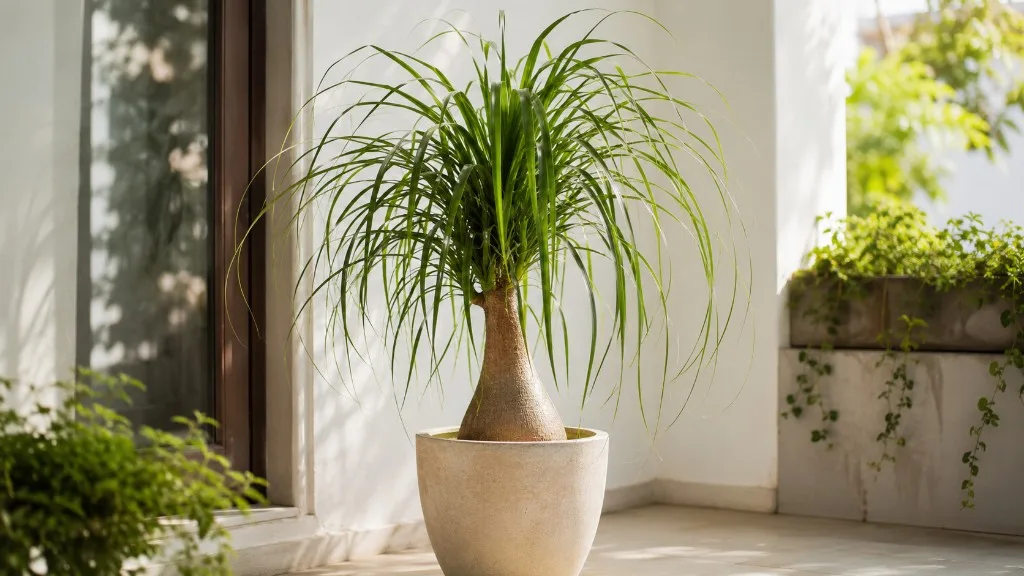
Ponytail Palm Light Needs: Best Window, Sun & Warning Signs
Ponytail Palm Light Needs: Best Window, Sun & Warning Signs
Ponytail palm earned a reputation as an easy, drought-proof houseplant - and that reputation creates one of the most common care mistakes growers make with Beaucarnea recurvata: treating tolerance for mediocre light as proof the plant prefers dim corners. It does not. Ponytail palm is a semi-desert caudiciform from southeastern Mexico and neighboring Central America. In nature it grows in full sun on well-drained ground. Indoors, the practical goal is not to find the spot where the swollen base refuses to collapse immediately. The goal is to place the pot where the fountain rosette produces firm new strap leaves without bleach, stretch, or the slow wet-soil decline that happens when a drought-adapted plant sits in a dark room with a generous watering schedule.
Wisconsin Horticulture Extension is direct about placement: ponytail palm is adapted to bright light, so put it in a window where it receives as much light as possible. Missouri Botanical Garden lists the species as full sun and recommends houseplants be placed in a sunny window. UF/IFAS classifies Beaucarnea recurvata with a full sun light requirement. That trio of extension and botanical-garden guidance tells you what experienced caudiciform growers already know: ponytail palm survives moderate indoor light longer than many tropical foliage plants, but it grows, thickens its caudex, and holds its fountain shape best when brightness is high.
This guide covers window placement, direct sun tolerance, honest low-light limits, grow-light starting specs, safe relocation, and the warning signs that tell you to move the pot before cosmetic damage becomes a root problem. For watering rhythm tied to light level, see the ponytail palm watering guide. For mix and drainage that keep bright-light watering safe, see soil guidance.
How Much Light Ponytail Palms Actually Need
Ponytail palm sits closer to full-sun succulents than to shade-loving forest floor plants. It is not a true palm - it belongs to Asparagaceae and stores water in a swollen caudex that can keep the plant alive through drought. That storage organ also masks low-light decline for months. Existing strap leaves may look fine while new growth slows, internodes stretch, and soil stays wet because transpiration dropped.
Indoors, the closest match to native conditions is bright light with several hours of direct sun after acclimation - the kind you get 12 to 24 inches (30 to 60 cm) from an unobstructed south or east pane, or back from west glass with heat monitoring. Bright indirect light farther into the room can maintain a mature plant, but growth is usually softer and the caudex expands more slowly than on a windowsill specimen.
Tolerance Is Not Preference
Marketing copy calls ponytail palm low-maintenance because it forgives missed waterings. That is caudex biology, not a vote for dim rooms. In insufficient light, a healthy base lets the plant enter survival mode: existing leaves persist on stored water while new straps emerge smaller, paler, or farther apart. Neither state looks like sudden death, which is why light problems hide until leggy growth or yellow leaves appear alongside chronically damp mix.
Judge light by new growth at the crown, not by whether old leaves remain green. The newest strap tells you whether today’s placement works. Old damage from a previous location will not repair itself.
Foot-Candles and Lux at the Crown
Extension sources describe ponytail palm as full sun without publishing indoor foot-candle targets. The bands below are editorial heuristics for home placement - useful reference points, not laboratory requirements.
| Placement (typical home) | Approximate foot-candles at leaf crown | Approximate lux | Expected response |
|---|---|---|---|
| On east sill, morning direct + bright day | 400–800 fc | 4,000–8,000 lux | Compact fountain rosette; steady caudex growth |
| 12–18 in. from south glass, acclimated | 600–1,200 fc | 6,000–12,000 lux | Strongest indoor form; watch hot glass in summer |
| 4–6 ft. back from south window | 150–300 fc | 1,500–3,000 lux | Maintenance light; slower caudex expansion |
| North window or interior shelf | 50–150 fc | 500–1,500 lux | Long-term survival possible; stretch and wet soil risk |
Field test without a meter: on a clear day, hold your hand between the crown and the window. A soft shadow with readable edges near the plant usually lands in the bright-indirect to partial-direct range ponytail palm prefers. A faint or absent shadow means the room looks lit to your eyes but the crown is underpowered for vigorous growth.
Lux-meter vignette: if you own a phone lux app, measure at the top of the fountain rosette, not at desk height six feet away. A reading of 8,000–12,000 lux at the crown on a south windowsill is common on a clear midday; the same room may read only 800–1,500 lux at the sofa - too dim for the plant you moved “near the window” but actually placed across the room.
Why Beaucarnea recurvata Wants Real Brightness
Ponytail palm evolved in semi-desert areas of southeastern Mexico, Belize, and Guatemala - open, rocky habitats with intense sky brightness and periodic drought. Wisconsin Horticulture notes the species comes from semi-desert areas and does best in full sun in a well-drained mix. That habitat maps to indoor culture differently from tropical understory houseplants: you are mimicking high light plus dry roots, not filtered shade plus constant moisture.
Semi-Desert Origins and the Water-Storing Caudex
The elephant-foot caudex is not decorative ballast. It is a water reservoir that lets the plant survive weeks without rain. High light drives photosynthesis and transpiration; low light throttles both while the caudex still supports existing tissue. That combination creates the dangerous loop dim-room growers miss: soil stays wet, roots lose oxygen, and root rot follows - often blamed on watering alone when light was the throttle.
Strap leaves cascade from the trunk tip in a fountain rosette. In strong light they stay gracefully arching but relatively stiff. In low light they elongate and pale, opening wider gaps between straps as the plant searches for photons. Brown tips on older leaves are common indoors from salt or moisture swings, but new pale straps plus wet soil point to light first.
Best Window Placement for Ponytail Palm
Window direction is a starting point. Overhangs, tint, sheer curtains, outdoor tree shade, and pot distance all change intensity at the crown. Still, compass orientation gives a reliable first guess in the northern hemisphere.
Place ponytail palm where plant-facing brightness is high for most of the day - not where the room looks sunny to you. Human vision adapts to dim interiors; the caudex does not. A pot on a side table “near” a window often receives a fraction of sill light. Rotate the container a quarter turn every two to three weeks if growth leans toward the glass.
East vs South: Which Window Wins?
Both exposures can produce excellent ponytail palms indoors. The tradeoff is gentle direct morning sun versus higher total daily intensity.
| Factor | East window | South window |
|---|---|---|
| Direct sun | Usually 2–4 hours cool morning rays | Often 4–8+ hours; hottest midday in summer |
| Heat on caudex | Lower risk at glass contact | Monitor caudex against hot pane in July |
| Best pot distance | 12–24 in. from glass after acclimation | 12–24 in. acclimated; 4–6 ft. if unfiltered and new |
| Growth character | Steady, compact fountain; safe default | Fastest caudex thickening when acclimated |
| Shop-plant acclimation | Easier first upgrade from dim retail shelf | Requires staged 7–14 day protocol |
An east-facing window is the safest default for most homes: enough direct sun to satisfy full-sun classification without the midsummer heat load south glass can place on a caudex sitting against the pane. A south-facing window is the performance choice when you want maximum indoor growth and can manage distance or sheer fabric.
West, North, and Distance Rules
A west window delivers strong late-afternoon sun and heat. It works when the pot sits far enough back that leaf surfaces do not heat past comfort during the brightest hour, or when a sheer curtain softens direct beams. Treat west like south with extra heat caution, not like east with bonus hours.
A north window provides gentle indirect light all day. Ponytail palm may persist there for years on caudex reserves, but Wisconsin’s guidance to give as much light as possible is a warning: north is usually below the growth threshold for compact form. If north is your only option, reduce watering frequency to match slower dry-down and expect slower caudex development - or add a grow light.
Distance is a dimmer switch. Closer increases intensity and heat; farther softens direct sun but can drop below useful brightness. Practical starting points: 12 to 24 inches from east or filtered south/west glass for acclimated plants; 4 to 6 feet back from unobstructed south panes for plants still hardening off; as close as possible to north glass if that is the only window, with expectations adjusted. Seasonal nudge beats permanent guessing - move closer in winter when sun angle drops, slightly back in midsummer if the caudex feels hot against glass.
Direct Sun and Safe Acclimation
Yes - ponytail palm can take direct sun indoors when acclimated. MOBOT lists full sun; Wisconsin Horticulture recommends gradual acclimation when moving plants outside for summer to prevent sunburn. The same principle applies when upgrading from a dim shop shelf to a south sill: intensity can jump faster than leaf tissue adjusts.
Problems start when brightness increases in one afternoon. Straps formed in lower light lack the pigment and structural tolerance for harsh midday beams through south or west glass. Bleached patches, crisp sun-facing zones, and sudden crown stress after a move mean you advanced too fast - not that ponytail palm rejects sun altogether.
Seven- to Fourteen-Day Acclimation Protocol
Use this staged approach when moving from moderate to strong light:
- Days 1–3: Place the pot in the target room but 4 to 6 feet back from the final window position. Watch for midday leaf curl on the window-facing side.
- Days 4–7: Move halfway to the intended distance. Confirm newest strap color stays green without widespread bleach.
- Days 8–14: Settle at 12 to 24 inches from east or filtered south/west glass unless heat or bleach appears. Hold another week at the last safe distance if stress shows.
- After day 14: Treat stable new growth as confirmation. Old scorch does not green up; judge success on post-move straps only.
Store-bought plants often arrive from low-light retail displays. Quarantine in moderate bright indirect light for a week before pushing toward your sunniest window. Do not stack repotting, fertilizing, and a major light jump in the same week - change light first, then adjust other care after new growth confirms success. See repotting guidance when the mix - not light - is the limiting factor.
Summer Patio and Bringing Plants Back Indoors
In frost-free climates (USDA Zone 10–11 per MOBOT), ponytail palm grows outdoors in full sun with sharp drainage. In cooler zones, many growers summer pots on patios. UF/IFAS Gardening Solutions advises transitioning slowly when moving indoor plants outdoors because temperature and sun exposure differ sharply from interior conditions.
Outdoor move: over 7 to 14 days, shift from bright indoor window to dappled patio shade, then to full morning sun before all-day exposure. Indoor return before frost: reverse the steps - part shade for several days, then the brightest interior window - so leaves hardened outside do not scorch against hot glass. Ponytail palm tolerates furnace-dry winter air per MOBOT, but sudden light collapse from patio to dim corner still triggers stretch and wet-soil stress. Match watering to the brighter summer pace outdoors and cut back indoors when light drops.
Low-Light Limits and What Happens Over Time
Ponytail palm can persist in lower light longer than many tropicals because the caudex subsidizes metabolism. Persistence is not the same as health. UF/IFAS ST093 lists full sun as the light requirement; long-term dim placement produces elongated straps, pale new growth, absent caudex thickening, and soil that stays wet for weeks because transpiration fell.
How dark is too dark for a plant you want to grow rather than maintain? If no meaningful new strap has emerged in 12 or more months, if the rosette opens wider and looser each year, or if the pot takes more than three weeks to dry at normal indoor temperatures, light is likely below the active-growth threshold. Short-term dim holding - during a room renovation, for example - is reasonable for mature plants. Multi-year dark-corner storage is not.
Not enough light on ponytail palm often pairs with overwatering symptoms because the same dim placement slows water use. Fixing water alone without improving light treats the symptom while the throttle stays closed.
Grow Lights When Windows Fall Short
When the brightest window still lands in the low hundreds of foot-candles at the crown - windowless rooms, deep offices, north-only winter exposures - a full-spectrum LED grow light is the reliable fix. Ponytail palm responds well because it needs intensity, not flowering-specific spectra.
Starting framework (adjust after two weeks of observation):
- Spectrum: full-spectrum white LED, roughly 4000K–6500K, labeled for houseplants or seedlings
- Duration: 10 to 14 hours daily on a timer for active growth; 8 to 10 hours for maintenance
- Distance: 12 to 18 inches (30–45 cm) above the tallest strap tips; raise if edges crisp only under the lamp, lower slightly if new growth stretches toward the fixture
- Coverage: span the full rosette; rotate the pot if a clip-on lamp leaves one side in shadow
Integrate artificial light with natural windows rather than treating lamps as winter-only tools. When total daily brightness rises, check soil moisture more often - the caudex still stores water, but transpiration increases with light.
Warning Signs: Bleach, Stretch, and Slow Decline
Ponytail palm communicates light stress quietly. The caudex keeps the plant upright while crown symptoms develop. Use a two-week observation window after any move: old scars are historical; new straps tell you whether current light works.
| Symptom | Likely light issue | What to do |
|---|---|---|
| Bleached or white-yellow patches on sun-facing straps | Too much direct sun, too fast | Pull back; filter glass; restart acclimation |
| Crisp brown zones on exposed straps after a move | Sunburn / heat at glass | Increase distance; avoid caudex contact with hot pane |
| Longer, paler, wider-spaced new straps | Too little light (etiolation) | Move closer or add grow light; reduce watering |
| No new growth 12+ months, soil stays wet | Chronic low light | Upgrade brightness; inspect roots if base softens |
| Sudden crown limpness with wet soil in dim room | Light-throttled roots + overwatering | Improve light; pause water; check for rot |
Bleach vs stretch are opposite diagnoses with opposite fixes. Bleaching means reduce intensity or slow acclimation. Stretching means increase plant-facing brightness and lengthen dry intervals to match slower metabolism in the interim. Do not prune aggressively until placement stabilizes and new growth looks normal.
If bleach coincides with softening at the caudex and sour soil, inspect roots promptly - light stress and rot can overlap after months in a dim, wet corner.
How Light Changes Watering on a Caudiciform
Light is the metabolic throttle on ponytail palm even though watering gets blamed first. Wisconsin Horticulture recommends deep, infrequent watering with significant reduction in winter to avoid root rot. Brighter placement increases transpiration; dim placement slows it while the caudex still holds water.
After any light increase, check moisture more frequently for the first month, but still let the mix dry deeply between drinks - the swollen base is not a license for soggy soil. After a light decrease, extend dry intervals and skip fertilizer until new growth confirms the plant remains active. A watering rhythm that worked on a sunny sill will overwater the same plant in a dim corner because the root zone stays saturated longer.
Growth pace should match light level. In strong window light, a few new straps per year and visible caudex expansion is normal - ponytail palm is slow even when happy. In low light, zero visible growth for a year may still mean survival on reserves. Match expectations and watering to that reality. For propagation timing tied to active growth, see ponytail palm propagation.
Conclusion
Ponytail palm light needs reduce to a distinction beginners skip and caudiciform growers respect: tolerance is not preference. Beaucarnea recurvata will endure moderate indoor light on caudex reserves, but it grows best in bright light with direct sun - roughly the brightness 12 to 24 inches from an acclimated east or south window, or supplemented with a full-spectrum LED when natural glass falls short.
Place the pot where new straps prove the light works, not where the room looks decorated. Acclimate shop plants over 7 to 14 days before parking them against hot south glass. Treat north windows and interior shelves as survival placements unless you add artificial light. When something looks wrong, read the newest leaf, distinguish bleach from stretch, and adjust one variable at a time - light first, then water. Old sunburn never heals, but the right window today still produces clean new fountain growth tomorrow. For the full care picture, start with the ponytail palm overview.
When to use this page vs other Ponytail Palm guides
- Ponytail Palm overview - Start here for whole-plant context before deep-diving this topic.
- Ponytail Palm problems hub - Jump to symptom-specific fix guides when this care topic does not resolve the issue.