Philodendron Melanochrysum Care Guide: Light, Humidity &
Philodendron melanochrysum
Philodendron Melanochrysum needs bright indirect light, watering every 7–14 days, 60–70 % humidity, and a tall moss pole for best leaf development. Toxic to pets.
Philodendron Melanochrysum Care Guide: Light, Humidity & Climbing
Start with wateringThe most common care mistake for Philodendron MelanochrysumWatering guide →Philodendron Melanochrysum care essentials
Light
bright indirect light, medium indirect light
Water
Every 7–14 days - allow top 3–5 cm to dry. Reduce in winter. Large leaves mean slower drying.
Soil
Chunky aroid mix: potting mix + perlite + orchid bark. Excellent drainage. pH 5.5–7.0.
Humidity
High humidity (60–70%)
Temperature
18°C to 30°C (65–86°F)
Fertilizer
Feed lightly during active growth. Use monthly in spring and summer..
About Philodendron Melanochrysum
Philodendron Melanochrysum has a upright growth habit.
| Detail | Information |
|---|---|
| Growth habit | Upright |
| Scientific name | Philodendron melanochrysum |
Philodendron Melanochrysum Care Guide: Light, Humidity & Climbing
You bought a Philodendron melanochrysum for the velvety, near-black leaves and the golden veins that catch light like brushed metal. A few months later the same plant is putting out small heart-shaped leaves on a tangled vine, and you are wondering what went wrong. Usually nothing is “wrong” - the plant is simply being honest about its needs. Philodendron melanochrysum is a Colombian rainforest climber that wants bright indirect light, a chunky draining mix, steady warmth, humidity above average household levels, and - this is the part most care pages bury at the bottom - a vertical support it can root into. Give it those conditions and the leaves size up, darken, and develop the dramatic venation that earned it the common name Black Gold philodendron. Skip the pole or run the humidity too low and you still have a healthy philodendron, just not the one you saw on social media.
For deeper dives, use this hub alongside dedicated guides: light, watering, soil, fertilizer, repotting, and propagation. If something goes wrong, start with the matching problem guide - brown tips, yellow leaves, root rot, low humidity, or thin stems - before changing everything at once.
For related Philodendron Melanochrysum care, see Plant Leaning on Philodendron Melanochrysum, Slow Growth on Philodendron Melanochrysum.
What Philodendron Melanochrysum Actually Is
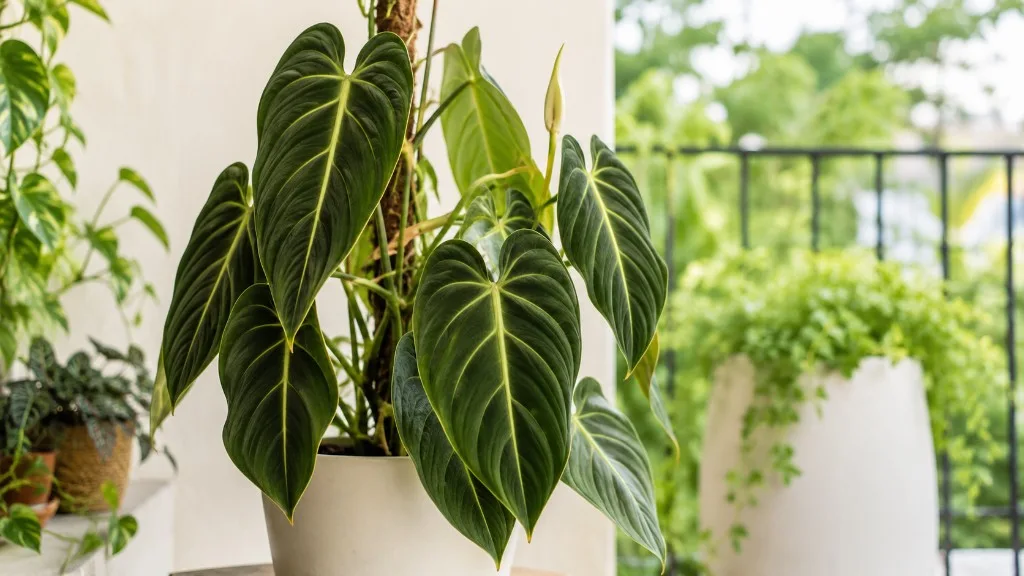
Philodendron melanochrysum is a flowering plant in the Araceae (arum) family, first published by Jean Jules Linden and Édouard André in 1873. The name combines Greek roots: melano (dark or black) and chryseus (golden), which maps cleanly onto the mature foliage - velvety deep green to blackish leaves with prominent pale golden or silvery veins. Young leaves often emerge salmon-red or bronze before hardening to the dark adult color, which is one of the plant’s most photogenic traits and also one of the main reasons buyers confuse it with other velvety philodendrons early on.
In cultivation, melanochrysum is a scandent climber - Iowa State Extension lists it among specialty velour philodendron climbers: it produces a slender stem with internodes roughly 6–10 cm apart and climbs toward brighter light in the wild by attaching aerial roots to tree bark. It is hemiepiphytic, meaning it can start life on a branch and send roots down to soil, or grow from the forest floor and climb from there. That growth habit is not decorative trivia. It is the operating manual. A melanochrysum allowed to trail from a hanging basket will live, but its leaves typically stay smaller, internodes may lengthen, and the vine tangles and dries unevenly. A melanochrysum tied to a textured pole with its aerial roots encouraged to attach will produce the long, velvety, heart-shaped to oblong leaves that make the species desirable - mature blades can reach roughly 60 cm long and 30 cm wide on well-grown specimens per botanical descriptions, with historical nursery accounts describing even larger foliage under ideal greenhouse conditions.
The plant is native to Colombia, primarily in wet tropical forests of the Andean foothills in departments such as Chocó and Antioquia, at elevations around 500–800 metres. Kew’s Plants of the World Online lists it as a climber growing primarily in the wet tropical biome. It is widely cultivated as an ornamental elsewhere. Indoors, it is best thought of as a collector-grade aroid: more forgiving than Philodendron verrucosum for many growers, less forgiving than Philodendron hederaceum ‘Micans’, and absolutely not a set-and-forget beginner plant like a golden pothos.
Native Habitat and Why It Matters Indoors
Colombian lowland and foothill rainforest is warm, humid, and dim at the understory level but brighter where climbers ascend tree trunks. Rainfall is consistent, but epiphytic roots dry quickly between showers because bark does not hold water like a peat-heavy potting mix. Air moves through the forest even when humidity is high. Translating that indoors means four non-negotiable themes: bright but filtered light, moisture without waterlogging, humidity well above dry-office levels, and airflow that prevents stagnant damp around velvet leaf surfaces.
Temperature in the native range stays warm year-round. Cold snaps are rare; frost is absent. Your home does not need to become a greenhouse, but it does need to avoid the spots that break tropical plants in winter: window ledges that drop below 10°C overnight, air-conditioning vents blowing directly on foliage, and front doors that admit cold drafts every time they open. If you can keep the plant in a comfortable human temperature band and push humidity toward 60% or higher, you have already solved the hardest part.
Botany, Naming, and the “Black Gold” Label
Retail tags sometimes list synonyms such as Philodendron andreanum or trade names like “Black Gold philodendron.” The accepted species name is Philodendron melanochrysum per Kew POWO. The “black gold” common name refers to the contrast between the dark velvety blade and the luminous venation, not to a separate cultivar. Inflorescences - the arum-family spadix and spathe - are rarely seen indoors because they require mature size, strong light, and seasonal cues that house conditions often do not provide. Do not use flowering as a health benchmark; steady leaf progression on a climbing stem is the better signal.
Velvet texture on aroids is not just aesthetic. The tiny hairs that create the suede-like surface reduce glare in dappled forest light and hold a thin humid micro-layer against the leaf. That same texture makes melanochrysum more sensitive to hard water spots, pesticide burns, and direct sun scorch than smooth-leaved philodendrons. Handle leaves gently when wiping dust; a soft dry brush is safer than a wet cloth on velvet.
Philodendron Melanochrysum vs Micans and Other Velvety Philodendrons
Misidentification is common because juvenile melanochrysum and Philodendron micans both produce small bronzy heart-shaped leaves on thin vines. Shops also reuse “velvet philodendron” labels across species. The care differs enough that identification matters: micans tolerates average household humidity and looks fine trailing; melanochrysum wants more humidity and a pole if you care about mature size.
| Feature | Philodendron micans | Philodendron melanochrysum | Philodendron verrucosum |
|---|---|---|---|
| Mature leaf size indoors | Typically 5–10 cm | 20–60+ cm when climbing | Large, similar scale |
| Habit | Trailing, scrambling | Vertical climber when supported | Climber |
| Venation | Subtle, iridescent bronze-green | Bold pale veins, light margins | Strong contrast, often red undersides |
| Petioles | Thin, smooth | Thicker, smooth | Hairy or warty |
| Humidity demand | Moderate | High (60%+) | High |
Philodendron gloriosum is a crawler with a horizontal rhizome - it does not climb a pole at all. Philodendron ‘Splendid’ is a popular hybrid of melanochrysum × verrucosum, combining large climbing growth with verrucosum-style venation and reddish undersides.
How to Identify a True Melanochrysum at Any Size
On a juvenile plant, look at the vein contrast and stem thickness rather than leaf size alone. Melanochrysum veins lighten as leaves expand; micans keeps a more uniform bronzy-green field. As melanochrysum ages, internodes on a supported plant shorten relative to leaf size and new leaves emerge wrapped in a cataphyll (a protective sheath) that must unfurl cleanly - stuck cataphylls are a classic melanochrysum stress signal in dry air. If you are buying online, ask for photos of the stem, node spacing, and leaf venation, not just a single dramatic mature leaf that may not represent the plant being sold. Tissue-culture juveniles often look nearly identical to micans for the first few leaves; stem thickness and vein contrast after the second or third flush are more reliable than a single bronzy leaf photo.
Light: Bright Indirect, Never Harsh Direct Sun
Philodendron melanochrysum wants bright, indirect light for most of the day. In rainforest terms, that is the light on a tree trunk below the canopy - not the forest floor, not the open sky at noon. Indoors, place it within roughly 1–2 metres of an east-facing window, or behind a sheer curtain on south- or west-facing glass. A few hours of gentle morning sun is tolerable in many homes; midday or afternoon direct sun bleaches velvet, scorches edges, and produces pale patches that do not revert.
Insufficient light is just as common and more insidious. Long internodes, small new leaves, and deepening vine length without leaf size increase mean the plant is searching for photons. Growers sometimes respond with more fertilizer; that does not fix etiolation. Move the plant brighter first, acclimate over a week so existing leaves do not shock, then evaluate. If the only bright location has too much direct sun, filter it - a linen curtain or a few feet of setback from the glass is enough. Window placement detail and seasonal adjustment are expanded in the melanochrysum light guide.
Artificial light works well. A full-spectrum LED grow panel or bar light at moderate intensity, run 10–12 hours daily, can support melanochrysum in rooms without good windows. Keep fixtures far enough to avoid leaf heat; velvet aroids show burn before smooth ones do. Rotate the pot weekly for even growth, and keep the moss pole oriented so new leaves do not tangle into a wall or shelf.
Watering: Let the Mix Breathe Between Drinks
Watering calendars fail on melanochrysum because large leaves transpire heavily in bright light but dry slowly in cool, dim, or humid corners. The reliable rule: water when the top 3–5 cm of mix is dry, then soak until water runs from drainage holes and empty the saucer within 30 minutes. In many homes that works out to roughly every 7–14 days in active growth and longer in winter, but the pot tells the truth, not the schedule.
The species enjoys consistent moisture at the root zone without ever sitting soggy. That sounds contradictory until you pair it with the right mix and pot. Chunky aroid media holds a moisture reservoir in bark and moss while freeing excess water through perlite channels. Roots access water and oxygen simultaneously - the epiphytic ideal. Overwatering still happens when light is too low, pots are too large, or the mix has compacted. Chronic wet soil produces yellowing lower leaves, soft stems, and blackened roots that smell sour when you unpot - see overwatering and root rot if several signs appear together.
Underwatering shows up as limp leaves, crispy brown edges, and stalled cataphylls. Velvet leaves do not wilt as dramatically as thin foliage; they dull and feel less supple. If you are unsure, lift the pot. A dry pot is noticeably lighter. When in doubt, wait a day on large specimens - a brief dry spell is safer than another soak on already-wet roots. Full soak-and-drain rhythm and winter cutbacks are in the watering guide.
Reading Soil Moisture on Large-Leaved Climbers
Use a finger or dry wooden chopstick to probe 3–5 cm down. If the probe comes up clean and dry, water. If soil clings and feels cool, wait. Moisture meters help in deep pots, but learn the pot weight as a backup. Large-leaf climbers also dry unevenly when vines trail outside the pot shadow - another reason vertical growth on a pole keeps the plant structurally balanced and makes watering response more predictable.
Water quality matters on dark velvet. Hard tap water leaves white mineral spots that are nearly impossible to remove without damaging texture. Filtered, rain, or distilled water reduces spotting and salt buildup. If you must use tap water, flush the pot monthly with plain water until runoff is clear. Always water the moss pole if you use one, not just the pot - aerial roots that dry out repeatedly abort, and the plant slows upward growth.
Humidity and Temperature for Velvet Leaves
Philodendron melanochrysum is honest about humidity. 60–70% relative humidity is the practical indoor target for strong growth and clean leaf unfurling; many collectors run higher in cabinets or tents. The plant may survive at 40–50% with excellent light and careful watering, but stuck leaves, torn cataphylls, brown tips, and desiccated aerial roots are common at the low end. Below 40% for extended periods, spider mites appear with depressing regularity.
Raise humidity with tools that change the room or zone, not just the leaf surface for five minutes. A small humidifier near the plant is the most reliable fix. Grouping plants raises local humidity a few points through shared transpiration. A pebble tray helps marginally if the pot sits above the water line on stones, not in standing water. Misting is optional; it does not substitute for ambient humidity and wet velvet overnight in cool corners can invite fungal spotting. If you mist, do it in bright morning conditions so leaves dry quickly.
Temperature comfort aligns with typical indoor living: about 18–30°C (65–86°F) with best growth in the low-to-mid 20s°C. The RHS philodendron guide sets a minimum around 15°C (59°F); avoid sustained exposure below that. Heat stress above 32°C without proportional humidity shows as curled margins and rapid soil drying - compensate with humidity and possibly a slight shade adjustment, not more water by reflex alone.
Air circulation is the overlooked partner of high humidity. A gentle fan in the room - not pointed directly at the plant - reduces stagnant pockets that encourage fungal issues and makes humidity feel less “swampy” to human occupants. Good airflow plus 60% humidity beats 80% humidity with dead still air around crowded shelves. Advanced growers sometimes use grow cabinets or tents with cork panels, a humidifier set to 65–75% RH, and a low-speed circulation fan - the same pole-and-humidity logic, just in a controlled zone.
Soil, Pots, and Drainage
Melanochrysum is an epiphytic aroid, not a terrestrial mud lover. It wants a chunky, airy aroid mix that drains fast and re-wets evenly. A proven home recipe: equal parts quality potting mix, perlite, and orchid bark, with a small handful of horticultural charcoal optional for long-term root health. Some growers add sphagnum or coco chips for moisture retention in very dry homes. The goal is a handful you can squeeze that loosens immediately afterward - not a brick that holds an imprint. Mix ratios and refresh timing are expanded in the soil guide.
Target pH 5.5–7.0, which most peat- or coir-based aroid blends already land near. Precise pH chasing is rarely necessary unless you are seeing persistent micronutrient issues on new growth despite correct watering and light. Repot into fresh mix every 1–2 years because bark breaks down, perlite floats, and the root zone slowly suffocates even if you water perfectly.
Pot selection is functional. Drainage holes are mandatory. Terracotta dries faster and suits heavy-handed waterers in humid rooms; plastic retains moisture longer and suits dry climates or busy schedules. Choose a pot only slightly larger than the root ball - melanochrysum does not need a mansion. Oversized pots stay wet in the centre while the surface looks dry, which is how experienced growers rot roots on “careful” watering schedules. Step-by-step repot timing is in the repotting guide.
Climbing Support and Moss Poles
If you remember one sentence from this guide: Philodendron melanochrysum sizes its leaves to how it grows. Climbing stems with attached aerial roots produce progressively larger foliage. Trailing stems produce smaller leaves and messy tangles. This is not optional styling; it is plant physiology copied from tree trunks in Colombia.
Supports that work include sphagnum-filled moss poles, coco-fiber poles, cedar or hardwood planks, and tree-fern or cork panels in cabinet setups. Smooth bamboo stakes provide mechanical lift but do not feed aerial roots; textured, moisture-holding surfaces perform better. The Royal Horticultural Society notes that climbing philodendrons can be trained onto moss poles into which they will eventually root if kept moist - that rooting is exactly what triggers mature leaf morphology in melanochrysum.
Installing and Maintaining a Support System
Install the pole while the plant is still manageable, not after the vine has wrapped itself around a shelf. Set the pole firmly in the pot without spearing major roots. Tie the stem loosely at nodes with soft velcro plant ties or twine in a figure-eight loop so pressure is on the tie, not the leaf petiole. Orient aerial roots toward the pole; you can gently press them against damp moss. Keep the pole consistently moist by pouring or misting water down the column when you water the pot, or by using a self-wicking system in advanced setups.
If internodes stretch and leaves shrink despite a pole, light is still too low - fix that before adding fertilizer. When the plant reaches the top of a pole, extend it or let the vine top and prune for bushier regrowth. Prune just above a node with a sterile blade; wear gloves because sap irritates skin on sensitive individuals. Leggy growth with a pole usually means light, not support failure.
Fertilizer During Active Growth
Fertilizer supports growth; it does not replace light, humidity, or roots. Feed monthly in spring and summer with a balanced liquid fertilizer diluted to half or quarter label strength on already-moist soil. Pause in late autumn and winter unless you are running grow lights and seeing continuous new leaves. Resume when new cataphylls appear reliably. Dilution ratios and pause rules are in the fertilizer guide.
Never feed a newly repotted, shipped, or visibly stressed plant. Salt burn on velvet shows as crisped leaf margins and stalled roots and is slow to outgrow. Slow-release granules at low dose in spring are an alternative for growers who forget monthly liquids. Organic options like diluted fish emulsion work if the smell is acceptable indoors. If new growth is pale with green veins despite good care, verify light and roots before assuming micronutrient deficiency; magnesium issues exist but are less common than overwatering misdiagnosed as hunger.
Repotting and Root Health
Repot every 1–2 years, or when roots circle the pot surface, water runs straight through, or the plant dries out within a day of watering. Spring or early summer is ideal - active roots heal faster in warm bright conditions. Move up one pot size only. Tease away old compacted bark on the outer root ball without bare-rooting a healthy plant unless you are correcting rot.
During repotting, inspect roots: healthy aroid roots are firm, white to tan, and flexible. Black, mushy, or hollow roots get cut away with sterile shears. Let severe root-loss plants rest in slightly drier conditions for a week before normal watering resumes. Do not fertilize for four to six weeks after repotting. If you must repot a climber, reinstall the moss pole in the same orientation to avoid twisting the vine. Leaf size sometimes dips for one flush after repotting - that is often a light-and-humidity response, not permanent regression.
Propagation from Stem Cuttings
Propagation is straightforward when the parent is healthy. Take a stem cutting with at least one node and preferably one aerial root, using sterile scissors or a blade. Cut just below the node. Remove leaves that would sit below the rooting medium. Let the cut callus for a few hours to overnight to reduce rot risk.
Root in moist sphagnum moss inside a clear box or bag for humidity, or in perlite with a humidity dome, or in water with the node submerged and leaf out of water. Bright indirect light and 22–28°C speeds rooting, typically 2–4 weeks for melanochrysum under good conditions. Transfer to a small pot of chunky aroid mix when roots are several centimetres long and hold the medium when you tug gently. Keep humidity high for the first month after potting so the cutting does not desiccate while establishing. Full protocols and air-layering detail are in the propagation guide.
Air layering on thick stems is an option if you want a rooted top without sacrificing the whole vine. Wrap moist sphagnum around a node, seal with plastic, and cut below once roots fill the moss. Do not propagate from plants with thrips, mealybugs, or root rot - fix the parent first or you multiply problems.
Toxicity to Pets and People
Philodendron melanochrysum is toxic to cats, dogs, and other pets if chewed or ingested. Like other Araceae, it contains insoluble calcium oxalate crystals (raphides) that penetrate soft mouth tissues on contact. The ASPCA lists philodendrons broadly under toxic plants for dogs and cats, with signs including oral irritation, excessive drooling, pawing at the mouth, vomiting, and difficulty swallowing. Severity is usually moderate and proportional to amount ingested, but airway swelling is possible and warrants urgent veterinary care. ASPCA Animal Poison Control: 888-426-4435 (US).
Keep melanochrysum on high shelves, in closed cabinets, or in pet-free rooms. Trailing vines are especially dangerous because they enter browsing range. The plant is not a safe choice for households with plant-chewing animals even if toxicity is “mild” on paper - predictable risk is still risk.
For humans, sap may irritate skin and eyes on contact, especially during pruning. Wear gloves, wash hands after handling, and keep away from toddlers who mouth objects. Ingestion causes the same crystalline irritation pattern as in pets; contact poison control or a clinician if ingestion occurs.
Common Problems and Real Fixes
Most melanochrysum problems trace to humidity, light, or root moisture - not mysterious philodendron curses. Diagnose in that order before repotting, fertilizing, and moving all at once. Stacking stress responses is how healthy plants become project plants.
Small new leaves almost always mean insufficient light, no usable climbing support, or both. Increase brightness and confirm the aerial roots can attach to a moist pole. Fertilizer will not enlarge leaves on a weak vine. See not enough light and thin stems.
Stuck or torn cataphylls during unfurling signal low humidity or inconsistent moisture at the growing tip. Raise humidity, keep the pole moist, and wait patiently if the leaf is partly free - forced surgery tears velvet permanently. If a cataphyll has been stuck for weeks in dry air, you can slit it gently with a sterile blade along the seam, but prevention beats surgery. Full triage: low humidity.
Brown leaf tips and edges point to low humidity, underwatering, or salt buildup. Humidifier first, then water quality, then flush the pot. Trim brown tips cosmetically with clean scissors if they bother you; they will not heal green. See brown tips.
Yellow lower leaves may be normal senescence on an older leaf or a warning on several leaves at once. Multiple yellow leaves with wet mix smell mean overwatering/root rot. Multiple yellow leaves on dry mix mean underwatering or heat stress. Single old yellow leaf on an otherwise healthy climber is often just turnover. Follow yellow leaves and overwatering guides if the pattern spreads.
Spider mites thrive in dry winter air. Look for stippling, fine webbing, and dull velvet. Shower the plant, increase humidity, and treat with insecticidal soap or horticultural oil per label, testing a small area first because velvet can react to oils. Thrips scar new leaves silver; mealybugs hide at nodes. Quarantine and treat before pests reach your whole collection - dark leaves hide infestations until damage is advanced.
Root rot from chronic wet soil is the serious failure mode. Unpot, trim black roots, repot in fresh airy mix, and reduce watering frequency while improving light. Severe cases may not recover; prevention through mix and pot size is cheaper than surgery. Step-by-step recovery: root rot.
Buying, Acclimating, and the First Month Home
Melanochrysum prices have dropped as tissue culture and imports increased, but quality varies. Buy for active nodes and firm new growth, not a single oversized leaf on a weak stem. Imported or recently shipped plants often drop older leaves while rebuilding roots - that can be normal if the growing tip stays firm and green. Yellowing at the newest leaf is a red flag. Velvet shows shipping scars; cosmetic blemishes on mature foliage matter less than root health and pest cleanliness.
Quarantine new plants two to three weeks away from your main collection. Inspect leaf undersides, nodes, and soil surface with a light. Pests are harder to spot on dark matte foliage. Do not repot on day one unless the mix is genuinely failing or you see root rot. Let the plant tell you how fast its pot dries in your humidity and light.
The first month should be boring: stable placement, consistent watering checks, humidity support, and a moss pole installed early. Watch for transplant shock, acclimation leaf drop, and stuck first new leaf - all humidity and patience problems. Avoid changing water rhythm, pot size, and window placement in the same week. A practical acclimation rhythm many collectors use: week one in slightly dimmer light than the final spot with steady humidity; week two begin inching toward the target window; week three install or firm up the pole and keep it moist as the first post-shipping leaf tries to unfurl.
Guide recommendations were checked against Kew POWO, Missouri Botanical Garden Araceae resources, the RHS philodendron growing guide, Iowa State Extension philodendron culture, Clemson HGIC houseplant watering guidance, University of Maryland indoor fertilizer guidance, and the ASPCA philodendron toxicity listing, then aligned with LeafyPixels plant-care data and practical indoor constraints. Author: sai-ananth. Reviewer: LeafyPixels Review Board. Reviewed: 2026-06-15.
Related melanochrysum guides: Light · Watering · Soil · Fertilizer · Repotting · Propagation · Pruning · Brown tips · Yellow leaves · Root rot · Low humidity · Thin stems · Spider mites · Mealybugs
Conclusion
Philodendron melanochrysum is one of the most striking velvet aroids you can grow indoors without a full greenhouse - if you treat it as a climbing Colombian rainforest plant, not a trailing micans. Wire the basics through the light, watering, and soil guides, keep humidity honest, install a moist pole early, and let the first month after purchase stay boring. The leaves size up on their own schedule once the environment matches the biology.
When to use this page vs other Philodendron Melanochrysum guides
- Philodendron Melanochrysum overview - Canonical hub for this species - care topics and problems branch from here.
- Philodendron Melanochrysum problems - Symptom-first path when you already know something is wrong.
Related Philodendron Melanochrysum guides
- Philodendron Melanochrysum watering
- Philodendron Melanochrysum light
- Philodendron Melanochrysum soil
- Philodendron Melanochrysum propagation
- Philodendron Melanochrysum fertilizer
- Philodendron Melanochrysum repotting
- Philodendron Melanochrysum pruning
- Ants on Plant on Philodendron Melanochrysum
- Brown Tips on Philodendron Melanochrysum
- Leaf Miners on Philodendron Melanochrysum
- Leaf Spot Disease on Philodendron Melanochrysum
- Leaf Drop on Philodendron Melanochrysum
How to care for Philodendron Melanochrysum?
How much light does Philodendron Melanochrysum need?
bright indirect light, medium indirect light
- bright indirect light, medium indirect light - bright indirect light, medium indirect light.
When should you water Philodendron Melanochrysum?
Every 7–14 days - allow top 3–5 cm to dry. Reduce in winter. Large leaves mean slower drying.
- Check top 2 inches - Every 7–14 days - allow top 3–5 cm to dry.
- Drain excess water - Empty the saucer after watering so the roots are not sitting in standing water.
What soil works best for Philodendron Melanochrysum?
Chunky aroid mix: potting mix + perlite + orchid bark. Excellent drainage. pH 5.5–7.0.
- Well-draining mix - Excellent drainage.
Grower notes for Philodendron Melanochrysum
What makes Melanochrysum different
Philodendron Melanochrysum is a true climber, and the leaf shape changes when it can attach and climb. Small juvenile leaves on a dangling stem are normal, but they are not the plant people usually want when they buy Melanochrysum. Give it a firm pole, bright indirect light, and humid moving air if you want the long dark velvet leaves to size up. Without support, it stays smaller, tangles faster, and dries unevenly along the vine.
Melanochrysum support note
Install support while the plant is still manageable. Tie the stem loosely at nodes, keep aerial roots facing the support, and avoid forcing brittle sections against the pole. A dry decorative stake gives shape, but a textured pole that roots can grip gives better leaf progression. If internodes stretch, fix light first; fertilizer will not make a weak vine compact.
Melanochrysum buying note
Buy for active nodes and healthy new growth, not just leaf size. Imported or recently shipped Melanochrysum may drop older leaves while it rebuilds roots, so ask how long the plant has been established. Velvet surfaces show shipping marks, but yellowing at the newest growth point is more concerning. Quarantine is worth it because pests are harder to see on dark matte foliage.
What matters most with Philodendron Melanochrysum
Philodendron Melanochrysum is easiest to understand by its growth habit. Climbers need support for larger leaves, self-heading types need stable root moisture, and delicate velvet forms punish stale air faster than basic green philodendrons. In practice, the care checkpoint is simple: bright indirect light, medium indirect light. Pair that with chunky aroid mix: potting mix + perlite + orchid bark. Excellent drainage; pH 5.5–7.0, and avoid changing water, pot size, and placement all at once.
Best placement in a real home
Philodendron Melanochrysum belongs where bright indirect light, medium indirect light is realistic for most of the day, not only where the pot looks good. Every 7–14 days - allow top 3–5 cm to dry. Reduce in winter. Large leaves mean slower drying. If the pot stays wet longer than expected, move the plant into better light or reassess the mix before watering again. Humidity target: High humidity (60–70%).. Temperature comfort zone: 18°C to 30°C (65–86°F).
Before you buy this plant
Choose Philodendron Melanochrysum with firm new growth, clean leaf undersides, and soil that does not smell sour or feel compacted. Be cautious if you see yellow-leaves, sticky residue, collapsed crowns, or a pot that is wet in poor light. Cosmetic old-leaf damage is less worrying than weak roots or active pests.
First month after bringing it home
Do not repot Philodendron Melanochrysum on day one unless the mix is failing or pests are obvious. Quarantine it, learn how fast the pot dries, and keep care boring while it adjusts. Watch especially for yellow-leaves, brown-tips, and root-rot. If problems appear, correct the condition first rather than stacking fertilizer, repotting, and pruning together.
Is it pet safe?
Philodendron Melanochrysum is toxic to cats and dogs.
Toxic - calcium oxalate crystals.
Watering Philodendron Melanochrysum
Every 7–14 days - allow top 3–5 cm to dry. Reduce in winter. Large leaves mean slower drying.
Soil & potting for Philodendron Melanochrysum
Chunky aroid mix: potting mix + perlite + orchid bark. Excellent drainage. pH 5.5–7.0.
Humidity & temperature for Philodendron Melanochrysum
Philodendron Melanochrysum prefers high humidity (60–70%), though normal home humidity is usually fine. Keep temperatures around 18°C to 30°C (65–86°F).
| Detail | Information |
|---|---|
| Humidity | High humidity (60–70%) - normal home humidity is fine. |
| Ideal temperature | 18°C to 30°C (65–86°F) |
Fertilizer & pruning for Philodendron Melanochrysum
Use feed lightly during active growth. Use monthly in spring and summer.. for Philodendron Melanochrysum.
| Detail | Information |
|---|---|
| Fertilizer type | Feed lightly during active growth. Use monthly in spring and summer.. |
Common problems on Philodendron Melanochrysum
Likely cause: Philodendron is a large genus of flowering plants in the family Araceae. As of September 2025, the Plants of the World Online accepted 625 species; [2] other sources accept different numbers. [3][4] …
Quick fix: Confirm diagnosis on your Philodendron Melanochrysum, then address the most likely care or pest factor described in current extension guidance.
Full fix guide →Brown Tips
HighLikely cause: Low humidity - critical for this species
Quick fix: Increase humidity to 60%+; use humidifier
Full fix guide →Leaf Miners
MediumLikely cause: Feb 21, 2024 · Philodendron Types with Pictures and Care Guide The green heartleaf Philodendron is a vining type of plant with dark-green leaves in a heart’s shape. This type of Philodendron can be …
Quick fix: Confirm diagnosis on your Philodendron Melanochrysum, then address the most likely care or pest factor described in current extension guidance.
Full fix guide →Leaf Spot Disease
MediumLikely cause: Feb 21, 2024 · Philodendron Types with Pictures and Care Guide The green heartleaf Philodendron is a vining type of plant with dark-green leaves in a heart’s shape. This type of Philodendron can be …
Quick fix: Confirm diagnosis on your Philodendron Melanochrysum, then address the most likely care or pest factor described in current extension guidance.
Full fix guide →Leaf Drop
MediumLikely cause: Feb 21, 2024 · Philodendron Types with Pictures and Care Guide The green heartleaf Philodendron is a vining type of plant with dark-green leaves in a heart’s shape. This type of Philodendron can be …
Quick fix: Confirm diagnosis on your Philodendron Melanochrysum, then address the most likely care or pest factor described in current extension guidance.
Full fix guide →Plant Leaning
MediumLikely cause: Philodendron is a large genus of flowering plants in the family Araceae. As of September 2025, the Plants of the World Online accepted 625 species; [2] other sources accept different numbers. [3][4] …
Quick fix: Confirm diagnosis on your Philodendron Melanochrysum, then address the most likely care or pest factor described in current extension guidance.
Full fix guide →Root Rot
MediumLikely cause: Waterlogged soil
Quick fix: Repot in fresh chunky draining mix
Full fix guide →Slow Growth
MediumLikely cause: Insufficient humidity or light
Quick fix: Address both - this species requires high humidity for active growth
Full fix guide →Thin Stems
MediumLikely cause: Feb 6, 2025 · If you are thinking of adding a philodendron to your indoor or outdoor garden, choosing the right variety can be a challenge because there are so many different options. Some are more …
Quick fix: Follow extension or botanical guidance for Philodendron Melanochrysum thin stems; adjust care before applying broad treatments.
Full fix guide →Yellow Leaves
MediumLikely cause: Overwatering or insufficient light
Quick fix: Allow soil to dry more; improve light
Full fix guide →