Philodendron Imperial Red Care Guide
Philodendron erubescens 'Imperial Red'
Philodendron Imperial Red needs medium to bright indirect light for vivid red new leaves, watering every 7–10 days when top 3–5 cm is dry. Toxic to pets. No climbing support needed.
Philodendron Imperial Red Care Guide
Start with wateringThe most common care mistake for Philodendron Imperial RedWatering guide →Philodendron Imperial Red care essentials
Light
medium to bright indirect light, low indirect light (colour dulls)
Water
Every 7–10 days in summer - allow top 3–5 cm to dry. Every 10–14 days in winter.
Soil
Standard potting mix + 20–25 % perlite. Well-draining. pH 5.5–6.5.
Humidity
Moderate humidity (50–60%)
Temperature
18°C to 29°C (65–85°F)
Fertilizer
Feed lightly during active growth. Use monthly in spring and summer..
About Philodendron Imperial Red
Philodendron Imperial Red has a upright growth habit.
| Detail | Information |
|---|---|
| Growth habit | Upright |
| Scientific name | Philodendron erubescens 'Imperial Red' |
Philodendron Imperial Red Care Guide
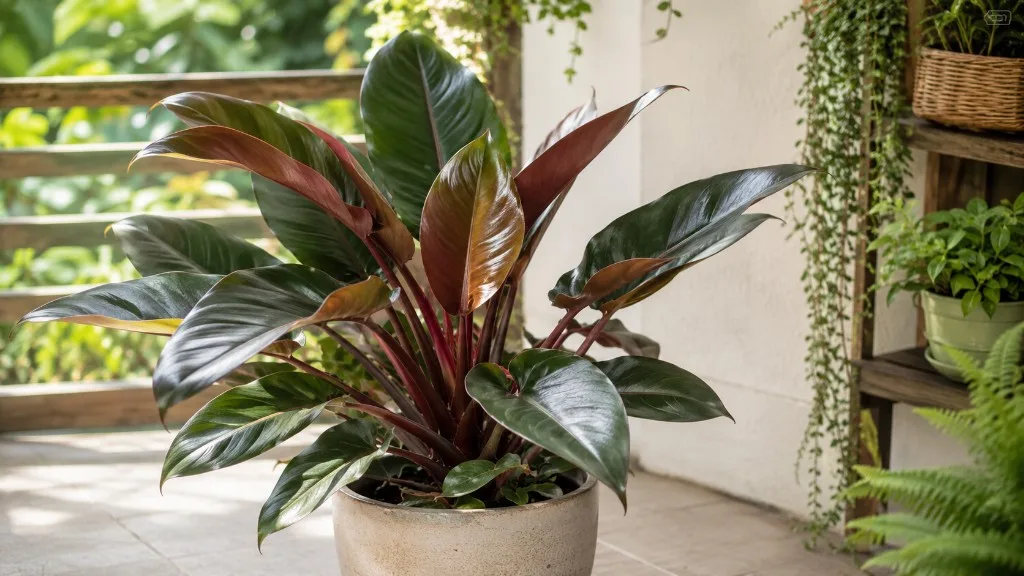
Philodendron Imperial Red is one of those houseplants people buy for a single visual trick: new leaves that unfurl in deep burgundy and bronze-red, then settle into glossy dark green as they age. When the light is right, you can see three color stages on one plant at once - bright red at the crown, wine tones on mid-age leaves, and mature green below. When the light is wrong, the trick disappears and every new leaf arrives a tired, anonymous green.
This guide is built around that reality. Philodendron erubescens ‘Imperial Red’ is a patented, self-heading hybrid - not a vine - and it behaves differently from the heartleaf philodendrons most beginners know. You do not need a moss pole. You do need enough indirect light to justify the red pigment, a potting mix that drains fast, and enough restraint with the watering can that the roots never sit in stale moisture. Get those three things aligned and Imperial Red is a compact, low-drama statement plant for offices, living rooms, and anywhere you want dark foliage with a flash of color at the top.
What Philodendron Imperial Red Actually Is
Philodendron Imperial Red is a cultivated hybrid sold under the botanical name Philodendron erubescens ‘Imperial Red’. It belongs to the Araceae (arum) family, the same family as monsteras, peace lilies, and pothos. The parent species, Philodendron erubescens - commonly called blushing philodendron or red-leaf philodendron - is a climbing tropical plant native to Colombia. In the wild it sends out long stems and uses trees for support. Imperial Red does not do that. It was selected and propagated for a completely different shape.
The cultivar was discovered in the late 1970s among a batch of random philodendron seedlings obtained from the Bamboo Nursery in Apopka, Florida, and was patented in 1988 as US Plant Patent 6337P. The patent describes Imperial Red as a rosette, self-heading plant with relatively large leaves that are brown-maroon when immature and dark green-maroon when mature, with dark green petioles and red-purple sheaths, compact symmetrical internodes, and efficient propagation by tissue culture. Parentage of the original seedling was unknown then and remains unknown now - Imperial Red is best understood as a selected hybrid from the McColley-era philodendron breeding lines in central Florida, not as a simple color variant you can recreate from seed at home.
Indoors, Imperial Red typically reaches about 60–90 cm (2–3 ft) tall and wide - compact by philodendron standards. Growth is moderate and upright. The leaves are thick, glossy, and broadly oval to heart-shaped, arching outward from a central crown. That crown is the whole plant: every leaf emerges from the same base, which is why Imperial Red reads as a dense bush rather than a trailing or climbing specimen. If you wanted a philodendron for a floor pot that holds its shape without training, this is one of the clearest options in the trade.
Self-Heading Growth vs. Climbing Philodendrons
The word self-heading sounds like marketing copy until you have owned both types. A climbing Philodendron erubescens - the species form, or vining cultivars like many classic red-stem types - produces long internodes, aerial roots, and smaller leaves unless you give it a moss pole or trellis. The plant is literally built to attach and climb. Imperial Red was bred out of that habit. The patent compares its form to other self-heading rosette types like Black Cardinal and commercial cultivars in the same breeding cluster. Stems are rigid enough to support the leaves without external support, and the internodes stay short and symmetrical.
That matters for placement and expectations. You are not waiting for a vine to fill in. You are maintaining a crown - a single growing point that pushes leaves upward and outward in a roughly symmetrical rosette. The plant will not grab your bookshelf. It will not send out runners across the soil surface. If you see long, thin stems with small leaves and gaps between nodes, you are either looking at a different cultivar, a mislabeled plant, or an Imperial Red that has been kept in too little light for too long and is etiolating in a last-ditch effort to find brighter conditions.
Why the Growth Habit Changes Your Care
Self-heading philodendrons concentrate growth at one crown, which changes how they use water and how they fail. A vining philodendron with long stems can sometimes keep going on one healthy section even if another part struggles. Imperial Red has one main engine. If the crown softens, if lower leaves yellow in a pattern rather than one at a time, or if new leaves emerge small and pale, the problem is usually systemic - roots, light, or both - not a single bad leaf.
You also do not need to plan for vertical support, which simplifies pot choice and Philodendron Imperial Red repotting guide. What you do need is stable root moisture around that crown. Self-heading aroids are less forgiving of wet, airless mix than many trailing philodendrons because the dense leaf mass sheds less light onto the soil surface and the pot can stay damp longer than you expect. Pair a self-heading plant with a pot that is too large, a mix that holds too much water, and a dim corner, and root stress shows up at the crown first: limp petioles, stalled new growth, and yellowing from the bottom up.
The Burgundy-to-Green Leaf Color Cycle
The signature of Imperial Red is ontogenetic color change - the leaf changes color as it ages. A newly unfurling leaf is bright red to burgundy, sometimes described in patents and nursery literature as brown-maroon. As the leaf hardens, it passes through deeper wine and bronze tones. Fully mature foliage settles into glossy dark green, often with darker green-maroon coloration retained on the upper surface and reddish or purplish tones lingering on the underside or along the petiole sheath. On a well-grown plant in good light, it is normal to see all three stages at once.
This is not the same plant “losing” its color because it is unhealthy - maturation to green is part of the cultivar’s design. The plant patent describes immature brown-maroon leaves maturing to dark green-maroon, with fully mature foliage settling into glossy dark green. What is a problem is when new leaves skip the red phase entirely and open weak green from the start. That usually means the plant is not getting enough light to invest in anthocyanin pigments, or it is under general stress from overwatering, cold, or root damage. Old leaves being green while new leaves are red is correct. New leaves being green while old leaves are also green in a plant that should be actively growing is a light or health signal.
Imperial Red carries bronze-red new growth that matures darker, so it needs better light than Imperial Green to keep the color interesting. Weak color usually means weak light. Soft petioles usually mean wet roots. Buy the plant for a strong crown and active red-toned new growth, not for one old dark leaf that looked good under grow lights at the nursery.
How Light Controls New Leaf Color
Red and burgundy pigments in young leaves - anthocyanins - function as photoprotection for developing tissue. They are expensive for the plant to produce. In bright, indirect light, Imperial Red can afford the display. In low light, the plant prioritizes chlorophyll and surface area over pigment, and new leaves arrive green because that is the efficient choice in dim conditions. Philodendron erubescens prefers partial shade indoors, and Imperial Red needs brighter indirect light than plain-green cultivars to maintain vivid burgundy new growth.
Direct sun is the other mistake. Harsh midday sun through a south window can bleach or scorch developing leaves, and scorched new growth often opens faded or brown at the edges. If the newest leaves scorch or wash out to pale green-yellow, the plant is too close to harsh sun, not too far from it. The workable band is medium to Philodendron Imperial Red light guide - enough to keep new leaves red, not so much that the crown cooks.
Light Requirements for Vivid Red New Growth
For most homes, the best placement is within 1–2 m of an east-facing window for gentle morning light, or several feet back from a south- or west-facing window with a sheer curtain to filter midday sun. A north-facing window can work if the room is bright and you rotate the pot weekly so all sides of the crown receive light. Imperial Red tolerates lower light better than many red-leaf tropicals in the sense that it will survive - but survival and burgundy new growth are different goals. If color is why you bought the plant, treat bright indirect light as a requirement, not a bonus.
A practical brightness test costs nothing. Look at new growth over two to three weeks after a stable placement. Healthy Imperial Red new leaves should be firm, glossy, and distinctly red or burgundy at unfurling. If internodes lengthen, leaves shrink, or the crown looks flat and green, move the plant closer to the window or add filtered light - acclimate over a week so you do not shock it. A quarter-turn of the pot every week keeps the rosette symmetrical. Self-heading plants can lean hard toward the window if you leave one face in shade for months.
Artificial light works if natural light is insufficient. A full-spectrum LED grow light positioned roughly 30–45 cm above the crown for 12–14 hours daily can maintain color in an office or interior room. The goal is not blistering intensity; it is consistent, moderate brightness across the crown. If you would not comfortably read a book at the plant’s location without switching on a lamp, Imperial Red probably will not keep red new leaves there without supplemental lighting.
Watering Without Drowning the Roots
Imperial Red wants moisture without swamp conditions - the classic aroid compromise. Water when the top 3–5 cm (1–2 inches) of soil has dried, which typically works out to roughly every 7–10 days in summer and every 10–14 days in winter in a standard indoor pot with drainage holes. Those intervals are starting points. A plant in stronger light, a smaller pot, or a warm dry room will dry faster. A plant in low light, a oversized pot, or air-conditioned stillness will dry slower. The calendar is a hint; the soil is the answer.
The failure mode to respect is chronic overwatering in low light. Self-heading philodendrons look thirsty when their roots are actually suffocating - limp leaves, soft petioles, yellow lower foliage, and a pot that stays heavy day after day. Underwatering shows up as dry, crispy leaf edges, lighter pot weight, and soil pulling away from the sides. Imperial Red has some drought tolerance once established - thick leaves and a compact root system store a little buffer - but repeated dry cycles stress the crown and produce smaller new leaves.
When you water, water thoroughly until excess runs from the drainage holes, then empty the saucer within 30 minutes. Never let the pot sit in standing water. If the mix is still wet at the 3–5 cm check point, wait. If you are on your “weekly watering day” and the soil is cool and damp two knuckles down, skip it. That single habit prevents more Imperial Red losses than any product labeled “philodendron food.”
How to Read Soil Moisture by Touch
The finger test remains the most reliable tool. Insert your index finger to the second knuckle - about 3–5 cm. If the soil at that depth feels cool and slightly damp, do not water. If it feels dry and the surface is lighter in color, water. A bamboo chopstick pushed to the bottom of the pot and left for ten minutes tells the same story: damp stick, wait; dry stick with no soil cling, water.
Learn the pot’s weight. Lift it the day after a thorough watering and again when you know the soil is dry. A dry pot is noticeably lighter. Over time you will recognize the halfway point where the top is dry but the bottom still holds moisture - that is usually the correct moment for Imperial Red in an airy mix. If you use a moisture meter, treat it as a second opinion, not gospel; compacted or salt-heavy mix can lie to cheap probes.
Use room-temperature water. Cold water can shock roots in smaller pots. If your tap water is very hard, occasional flushing with plain water reduces salt buildup that shows up as brown leaf tips unrelated to humidity. Letting tap water sit overnight helps dissipate chlorine in some municipalities, though fluoride will remain; if tips persist despite good humidity, switch to filtered or rainwater for a month and compare new growth.
Humidity and Temperature Indoors
Imperial Red is a tropical plant, but it is not a humidity diva compared to calatheas or velvet anthuriums. Moderate humidity around 50–60% is the target for best growth and clean leaf edges. Average household humidity in the 40–50% range is usually acceptable if light and watering are correct. Below about 30% for long stretches - common in heated winter air - you may see more brown tips and a higher risk of spider mites on the undersides of older leaves.
Raise humidity the boring ways that work: a pebble tray with the pot base above the water line, grouping plants together, or a small humidifier in the room. Misting is optional and temporary; it does not replace ambient humidity and wet foliage in stagnant corners can encourage fungal spotting. Good air circulation matters as much as the number on a hygrometer. A fan on low in the room, or occasional gentle airflow from an open door, reduces the stale, damp microclimate that pests and leaf spot enjoy.
Temperature comfort tracks normal indoor life: about 18–29°C (65–85°F). Growth slows below roughly 15°C (59°F) and cold damage becomes a real risk near 10°C (50°F). Avoid placing the pot against a cold window glass in winter, directly under a blasting AC vent, or above a radiator that cooks the crown on a nightly cycle. Imperial Red hates sudden changes more than it hates any single imperfect number. Moving it, repotting it, and changing its light all in the same week is how healthy plants look sick without any one factor being extreme.
Soil, pH, and Pot Choice
Use standard indoor potting mix amended with 20–25% perlite for drainage and air around the roots. The exact brand matters less than the structure: light, porous, and quick to drain while still holding some moisture between waterings. A workable recipe is three parts quality all-purpose potting mix to one part perlite, or two parts potting mix, one part perlite, and one part orchid bark if you tend to water heavily. Avoid garden soil, dense “moisture control” mixes that stay wet for days, and pots without holes.
Target pH roughly 5.5–6.5 - mildly acidic, typical of peat- or coir-based indoor mixes. Imperial Red is not picky enough to require pH testing in most homes. If you repot every one to two years with fresh mix, pH drift is rarely the reason leaves yellow. When drainage fails, you see it first in the pot: water sitting on the surface, sour smell, fungus gnats, and yellow lower leaves on a plant you have been “careful” to water.
Pot material is a trade-off. Terracotta dries faster - helpful in low-light rooms where you need the mix to breathe. Glazed ceramic or plastic retains moisture longer - fine if the plant sits in bright light and you tend to underwater. Size up only one pot size at repotting, roughly 2–5 cm wider in diameter. An oversized pot holds water the root ball cannot use and is the most common post-repurchase path to root rot on Philodendron Imperial Red. For a floor statement, a 25–30 cm pot is often enough to carry a mature Imperial Red for years without turning the soil into a wetland.
Fertilizer Schedule and Strength
Imperial Red is a moderate feeder, not a hungry monster. During active growth - typically spring through early fall - apply a balanced liquid houseplant fertilizer at half the label strength, about once a month. Clemson HGIC recommends dilute water-soluble fertilizer for philodendrons during active growth. Always apply to already-moist soil, never to a dry or stressed plant. Water first, then fertilize, so salts move through the root zone without burning fine roots.
Pause fertilizer in winter when growth slows, for four to six weeks after repotting, and while the plant is recovering from root rot, pest treatment, or a major move. Fertilizer cannot fix low light or wet roots; it only adds salts when the plant is not using nutrients. Signs of overfeeding include brown crispy tips, a white crust on the soil surface, and stalled new growth despite “doing everything right.” Flush the pot with plain water until runoff runs clear, skip the next two feedings, and fix light and watering before resuming.
If you prefer low input, a single application of slow-release fertilizer at the start of the growing season at half the labeled rate is often enough for a potted Imperial Red that is not pushing maximum size. Watch the crown, not the calendar: if new leaves are coming in firm and well-colored, your feeding level is probably adequate.
Repotting and Root Health
Repot Imperial Red roughly every one to two years, or when roots circle the drainage holes, water runs straight through without soaking in, or the plant becomes top-heavy for the pot. The best timing is early in the active growing season - spring into early summer - when the plant can rebuild roots in warm, bright conditions. Avoid repotting in deep winter unless the mix is clearly failing or root rot demands emergency action.
Slide the plant out and inspect the root ball. Healthy roots are firm, white or tan, and smell like soil. Mushy, black, or foul-smelling roots need trimming with clean shears before repotting into fresh mix. Go up one pot size, maintain the same planting depth - do not bury the crown - and water lightly once, then resume normal checks after a week. Heavy watering immediately after repotting fills air pockets with mud and suffocates cut surfaces.
Do not repot on day one after bringing a new Imperial Red home unless the nursery mix is genuinely waterlogged or you see active pests. Quarantine new plants for two weeks, learn how fast the existing mix dries in your conditions, and let the plant acclimate. Retail environments often use peat-heavy mixes that dry on a different schedule than your home. Changing water, pot size, and placement all at once is how a healthy nursery plant arrives looking sick in your living room.
Propagation by Division
The practical home method for Imperial Red is division at repotting, not stem cuttings. The patent notes efficient propagation by tissue culture in commercial production; at home you work with the natural clumping of the root mass. When the plant has multiple growth points or offsets around the base of the crown, you can separate them - each division needs its own stems, roots, and at least one active growth point to succeed.
Water the parent plant a day before dividing so roots are flexible. Unpot, loosen the outer mix gently, and look for natural separation lines between crowns or offset shoots. Use a clean, sharp knife if you must cut through rhizome tissue, but prefer teasing apart sections that already want to split. Pot each division in its own container with the same perlite-amended mix, water lightly, and keep in bright, indirect light with stable humidity while new growth resumes. Divisions often stall for a few weeks; patience beats overwatering during that pause.
Do not propagate from a plant with active root rot, spider mite infestation, or crown collapse. Weak divisions fail at a high rate and carry the parent’s problems forward. Restore the parent first, then divide from healthy new growth. Seed propagation is irrelevant for this patented cultivar in home settings - seedlings will not come true to Imperial Red’s selected traits.
Imperial Red vs. Imperial Green and Lookalikes
Philodendron erubescens ‘Imperial Green’ is Imperial Red’s sibling selection from the same breeding era - patented as USPP6086P from a separate seedling in the same Apopka batch. The patent comparison is useful: Imperial Green has dark green foliage without the maroon immature coloration, a somewhat faster growth habit, and a more concave leaf face; Imperial Red has brown-maroon immature leaves maturing to dark green-maroon, somewhat slower growth, and longer, less concave leaves. Care requirements overlap - both are self-heading rosette types - but Imperial Red is the one that punishes low light with plain green new growth. Imperial Green is the easier choice if you only want a glossy green bush and never cared about red unfurling.
Do not confuse Imperial Red with Prince of Orange, Rojo Congo, or Black Cardinal, other popular self-heading philodendrons from related breeding lines. Prince of Orange opens orange-red and passes through copper; Rojo Congo runs larger with wider leaves and a more open habit; Black Cardinal stays darker overall. Tags at big-box stores are wrong often enough that the leaf color cycle is your best ID tool: Imperial Red’s new burgundy → mature green arc on a compact rosette, without vining stems or a moss pole in the pot.
If your plant looks similar but every new leaf is medium green with no red phase despite bright light, verify the label. You may have Imperial Green, a generic “philodendron hybrid,” or a plant that was grown under shade cloth at the supplier and has not yet produced a colored leaf in your home - give it one month in brighter indirect light before deciding.
Toxicity to Pets and People
Philodendron Imperial Red is toxic to cats and dogs. Like all philodendrons, it contains insoluble calcium oxalate crystals (raphides) in leaves, stems, roots, and sap. The North Carolina Extension Gardener Plant Toolbox lists Philodendron erubescens as poisonous to humans with low severity: mouth and stomach irritation if ingested, and sap that may cause skin irritation. The ASPCA classifies philodendron species as toxic to dogs and cats, with clinical signs including oral irritation, intense burning of the mouth and tongue, excessive drooling, vomiting, and difficulty swallowing.
This is not a plant for floor pots in homes with plant-chewing pets or toddlers who grab leaves. Display it on a stable stand, tall shelf, or enclosed room pets cannot access. Severity is usually moderate and self-limiting for small nibbles, but airway swelling is very rare and still an emergency if breathing changes. Pet Poison Helpline notes that insoluble oxalate plants in the Araceae family release crystals when chewed, causing immediate tissue irritation.
Cats, Dogs, and Contact Dermatitis
Cats tend to encounter philodendrons on counters and shelves; dogs less often, but both can be affected. If you suspect ingestion, call ASPCA Animal Poison Control at (888) 426-4435 (a consultation fee may apply) and your veterinarian. Do not induce vomiting unless a professional tells you to. For people, sap on skin can irritate sensitive individuals - wear gloves when pruning or repotting if you react to other aroids. Wash hands after handling cut tissue. Imperial Red is a strong visual plant and a poor fit for “pet-safe indoor jungle” goals; choose a non-toxic alternative for low shelves and accept Imperial Red as an out-of-reach display piece.
Common Problems and Real Fixes
Most Imperial Red problems map to a short diagnostic list: check soil moisture, then light, then pests, then recent changes. Fix the environment before you fertilize, repot, and prune in the same weekend.
Yellow lower leaves often mean overwatering, natural senescence of old foliage, or root stress. One yellow lower leaf on an otherwise healthy plant is usually normal aging. Multiple yellow leaves climbing the stem, especially with soft petioles and a heavy pot, mean wet roots - unpot, trim mushy roots, repot into fresh airy mix, and move to brighter light so the soil cycle speeds up. Yellow leaves on a dry, light pot suggest underwatering or salt stress.
Weak green new leaves in an otherwise healthy plant mean insufficient light almost every time. Move to brighter indirect light and wait for the next two unfurlings before judging success. Brown tips and edges point to low humidity, underwatering, or fluoride and salt buildup - flush the pot and review humidity in winter. Scorched or bleached patches on new leaves mean too much direct sun; filter or move back.
Spider mites appear in dry winter air as stippling, fine webbing, and dull bronze leaves. Shower the plant, raise humidity, and treat with insecticidal soap on a weekly cycle for three weeks. Mealybugs hide at the crown and leaf axils - alcohol on a swab plus soap follow-up. Root rot smells, looks black, and kills from the bottom up; surgery and fresh mix are the only honest fix. Slow growth alone is not a disease - check whether the plant is dormant in winter, root-bound, or sitting in dim light with wet soil.
Watch especially for yellow leaves, brown tips, root rot, and slow growth as patterns, not isolated events. A single blemish on an old leaf is cosmetic. Mushy bases, limp petioles, or several yellow lower leaves at purchase point to root or watering stress - pass on that plant if you have a choice.
Buying, Placement, and the First Month
At the nursery, pick the Imperial Red with the richest new leaf color and a firm crown, not the tallest pot with one dark old leaf and no active growth. Old scratches on mature foliage are cosmetic. Mushy bases, limp petioles, several yellow lower leaves, or sour-smelling soil are reasons to choose a different plant. You are buying the growing point, not the trophy leaf.
Place Imperial Red where medium to bright indirect light is realistic for most of the day, not only where the pot looks good in the room layout. If the pot stays wet longer than expected after purchase, move it into better light or reassess the mix before watering again on a schedule you used for a different plant. Confirm the pot has drainage holes; decorative cache pots without drainage are a common silent killer.
The first month should be boring. Quarantine from other plants briefly, match watering to how this specific mix dries, and avoid stacking changes. If brown tips or yellow leaves appear early, inspect light, watering, and roots before assuming the plant is permanently weak. If you plan to divide later, note that division works best when the parent is clearly healthy and root-bound - not when it is recovering from transit shock.
Conclusion
Philodendron Imperial Red rewards a simple, consistent routine: bright indirect light to keep burgundy new leaves coming, water when the top 3–5 cm of soil dries, airy potting mix with perlite, moderate humidity, and light feeding during active growth. It is a self-heading hybrid - no moss pole, no vine management - just a crown to protect from wet soil and dim corners. Mature leaves will turn green; that is normal. New leaves should not.
It is toxic to pets and belongs out of reach. It is a stronger choice for offices and statement corners than for homes where cats treat every leaf as a snack. If you can give it stable light and restrained watering, Imperial Red stays compact, glossy, and visually interesting for years - three color stages on one plant, without the drama of a climbing aroid. If color fades and the crown stalls, fix light and roots first. The plant usually tells you exactly which one is wrong.
When to use this page vs other Philodendron Imperial Red guides
- Philodendron Imperial Red overview - Canonical hub for this species - care topics and problems branch from here.
- Philodendron Imperial Red problems - Symptom-first path when you already know something is wrong.
Related Philodendron Imperial Red guides
- Philodendron Imperial Red watering
- Philodendron Imperial Red light
- Philodendron Imperial Red soil
- Philodendron Imperial Red propagation
- Philodendron Imperial Red fertilizer
- Philodendron Imperial Red repotting
- Philodendron Imperial Red pruning
- Ants on Plant on Philodendron Imperial Red
- Brown Tips on Philodendron Imperial Red
- Leaf Drop on Philodendron Imperial Red
- Leaf Spot Disease on Philodendron Imperial Red
- Leaf Miners on Philodendron Imperial Red
How to care for Philodendron Imperial Red?
How much light does Philodendron Imperial Red need?
medium to bright indirect light, low indirect light (colour dulls)
- medium to bright indirect light, low indirect light (colour dulls) - medium to bright indirect light, low indirect light (colour dulls).
When should you water Philodendron Imperial Red?
Every 7–10 days in summer - allow top 3–5 cm to dry. Every 10–14 days in winter.
- Check top 2 inches - Every 7–10 days in summer - allow top 3–5 cm to dry.
- Drain excess water - Empty the saucer after watering so the roots are not sitting in standing water.
What soil works best for Philodendron Imperial Red?
Standard potting mix + 20–25 % perlite. Well-draining. pH 5.5–6.5.
- Well-draining mix - Well-draining.
Grower notes for Philodendron Imperial Red
Imperial Red identity note
Imperial Red carries bronze-red new growth that matures darker, so it needs better light than Imperial Green to keep the color interesting. The plant is still self-heading, not a vine, and should be grown as a sturdy upright rosette. Weak color usually means weak light, while soft petioles usually mean wet roots. Buy it for a strong crown and active red-toned growth rather than for one old dark leaf.
Buying check for Imperial Red
Pick the plant with the richest new leaf color and a stable crown. Old scratches are cosmetic, but mushy bases, limp petioles, or several yellow lower leaves point to root or watering stress.
What makes Imperial Red different
Philodendron Imperial Red is grown for warm red-bronze new leaves that mature darker. If new growth comes in weak green, light is probably too low. If the newest leaves scorch or fade, the plant is too close to harsh sun.
What matters most with Philodendron Imperial Red
Philodendron Imperial Red is easiest to understand by its growth habit. Climbers need support for larger leaves, self-heading types need stable root moisture, and delicate velvet forms punish stale air faster than basic green philodendrons. In practice, the care checkpoint is simple: medium to bright indirect light, low indirect light (colour dulls). Pair that with standard potting mix + 20–25 % perlite. Well-draining; pH 5.5–6.5, and avoid changing water, pot size, and placement all at once.
Best placement in a real home
Philodendron Imperial Red belongs where medium to bright indirect light, low indirect light (colour dulls) is realistic for most of the day, not only where the pot looks good. Every 7–10 days in summer - allow top 3–5 cm to dry. Every 10–14 days in winter. If the pot stays wet longer than expected, move the plant into better light or reassess the mix before watering again. Humidity target: Moderate humidity (50–60%).. Temperature comfort zone: 18°C to 29°C (65–85°F).
Before you buy this plant
Choose Philodendron Imperial Red with firm new growth, clean leaf undersides, and soil that does not smell sour or feel compacted. Be cautious if you see yellow-leaves, sticky residue, collapsed crowns, or a pot that is wet in poor light. Cosmetic old-leaf damage is less worrying than weak roots or active pests.
First month after bringing it home
Do not repot Philodendron Imperial Red on day one unless the mix is failing or pests are obvious. Quarantine it, learn how fast the pot dries, and keep care boring while it adjusts. Watch especially for yellow-leaves, brown-tips, and root-rot. If problems appear, correct the condition first rather than stacking fertilizer, repotting, and pruning together.
Safety note for Philodendron Imperial Red
Philodendron Imperial Red is not a plant to keep within reach of pets or children. Treat it as an inaccessible display plant. Use gloves if sap or plant tissue is irritating, and pick a pet-safe alternative for floor pots or low shelves.
How to tell Philodendron Imperial Red is settling in
If you plan to multiply it later, common methods include Division. If brown-tips shows up early, inspect light, watering, and roots before assuming the plant is permanently weak.
Is it pet safe?
Philodendron Imperial Red is toxic to cats and dogs.
Toxic - calcium oxalate crystals.
Watering Philodendron Imperial Red
Every 7–10 days in summer - allow top 3–5 cm to dry. Every 10–14 days in winter.
Soil & potting for Philodendron Imperial Red
Standard potting mix + 20–25 % perlite. Well-draining. pH 5.5–6.5.
Humidity & temperature for Philodendron Imperial Red
Philodendron Imperial Red prefers moderate humidity (50–60%), though normal home humidity is usually fine. Keep temperatures around 18°C to 29°C (65–85°F).
| Detail | Information |
|---|---|
| Humidity | Moderate humidity (50–60%) - normal home humidity is fine. |
| Ideal temperature | 18°C to 29°C (65–85°F) |
Fertilizer & pruning for Philodendron Imperial Red
Use feed lightly during active growth. Use monthly in spring and summer.. for Philodendron Imperial Red.
| Detail | Information |
|---|---|
| Fertilizer type | Feed lightly during active growth. Use monthly in spring and summer.. |
Common problems on Philodendron Imperial Red
Likely cause: Philodendron is a large genus of flowering plants in the family Araceae. As of September 2025, the Plants of the World Online accepted 625 species; [2] other sources accept different numbers. [3][4] …
Quick fix: Confirm diagnosis on your Philodendron Imperial Red, then address the most likely care or pest factor described in current extension guidance.
Full fix guide →Brown Tips
MediumLikely cause: Low humidity
Quick fix: Increase humidity
Full fix guide →Leaf Drop
MediumLikely cause: Feb 21, 2024 · Philodendron Types with Pictures and Care Guide The green heartleaf Philodendron is a vining type of plant with dark-green leaves in a heart’s shape. This type of Philodendron can be …
Quick fix: Confirm diagnosis on your Philodendron Imperial Red, then address the most likely care or pest factor described in current extension guidance.
Full fix guide →Leaf Spot Disease
MediumLikely cause: Feb 21, 2024 · Philodendron Types with Pictures and Care Guide The green heartleaf Philodendron is a vining type of plant with dark …
Quick fix: Confirm diagnosis on your Philodendron Imperial Red, then address the most likely care or pest factor described in current extension guidance.
Full fix guide →Leaf Miners
MediumLikely cause: Feb 21, 2024 · Philodendron Types with Pictures and Care Guide The green heartleaf Philodendron is a vining type of plant with dark-green leaves in a heart’s shape. This type of Philodendron can be …
Quick fix: Confirm diagnosis on your Philodendron Imperial Red, then address the most likely care or pest factor described in current extension guidance.
Full fix guide →Plant Leaning
MediumLikely cause: Philodendron is a large genus of flowering plants in the family Araceae. As of September 2025, the Plants of the World Online accepted 625 species; [2] other sources accept different numbers. [3][4] …
Quick fix: Confirm diagnosis on your Philodendron Imperial Red, then address the most likely care or pest factor described in current extension guidance.
Full fix guide →Slow Growth
LowLikely cause: Low light
Quick fix: Move to brighter indirect position
Full fix guide →Root Rot
MediumLikely cause: Wet soil
Quick fix: Repot in draining mix
Full fix guide →Thin Stems
MediumLikely cause: Feb 6, 2025 · If you are thinking of adding a philodendron to your indoor or outdoor garden, choosing the right variety can be a challenge because there are so many different options. Some are more …
Quick fix: Follow extension or botanical guidance for Philodendron Imperial Red thin stems; adjust care before applying broad treatments.
Full fix guide →Yellow Leaves
MediumLikely cause: Overwatering
Quick fix: Allow top 3–5 cm to dry
Full fix guide →Aphids
MediumLikely cause: Aphids on Philodendron Imperial Red cluster on soft burgundy new leaves and petiole tips at the crown, sucking sap and leaving sticky honeydew. First step: isolate the plant, blast colonies off with l
Quick fix: See plant-specific guide for step-by-step fixes.
Full fix guide →Drooping Leaves
MediumLikely cause: Drooping leaves on Philodendron Imperial Red usually trace to water stress, damaged roots, or heat-often with wet heavy soil or a bone-dry pot behind the same limp burgundy petioles. First step: lift
Quick fix: See plant-specific guide for step-by-step fixes.
Full fix guide →Fungus Gnats
MediumLikely cause: Fungus gnats on Philodendron Imperial Red mean the soil surface has stayed wet too long-often from calendar watering, low light, or an oversized pot. First step: let the top 3–5 cm (1–2 inches) dry co
Quick fix: See plant-specific guide for step-by-step fixes.
Full fix guide →Leggy Growth
MediumLikely cause: Leggy growth on Philodendron Imperial Red is usually caused by insufficient light-the plant stretches petioles and opens weak green leaves while the rosette thins out. First step: move it to brighter
Quick fix: See plant-specific guide for step-by-step fixes.
Full fix guide →Low Humidity
MediumLikely cause: Low humidity on Philodendron Imperial Red shows up as brown tips, crispy leaf edges, and slowed new growth when indoor air drops below 50% RH-common near heating vents and AC. First step: move the pla
Quick fix: See plant-specific guide for step-by-step fixes.
Full fix guide →Mealybugs
MediumLikely cause: Mealybugs on Philodendron Imperial Red hide as white cottony clusters in petiole axils of the self-heading rosette and along burgundy stem sheaths. Isolate the plant, dab visible bugs with 70% alcohol
Quick fix: See plant-specific guide for step-by-step fixes.
Full fix guide →Mold on Soil
MediumLikely cause: Mold on soil on Philodendron Imperial Red is usually harmless saprophytic fungus on chronically damp peat mix-often from overwatering or poor airflow in low light. First step: scrape off visible mold,
Quick fix: See plant-specific guide for step-by-step fixes.
Full fix guide →Not Enough Light
MediumLikely cause: Not enough light on Philodendron Imperial Red shows as weak green new leaves, dull color, slow growth, and a rosette leaning toward windows-this cultivar needs brighter filtered light than Imperial Gr
Quick fix: See plant-specific guide for step-by-step fixes.
Full fix guide →Overwatering
MediumLikely cause: Overwatering on Philodendron Imperial Red usually means the self-heading crown sits in wet mix too long-often from calendar watering, low light, or an oversized pot. Stop watering immediately, check t
Quick fix: See plant-specific guide for step-by-step fixes.
Full fix guide →Spider Mites
MediumLikely cause: Spider mites on Philodendron Imperial Red show as fine stippling and dull patches on large leathery leaves-often bronze or silvery on burgundy-red new growth-with webbing at the crown in dry winter ai
Quick fix: See plant-specific guide for step-by-step fixes.
Full fix guide →Underwatering
MediumLikely cause: Underwatering on Philodendron Imperial Red usually means the self-heading crown went too long without a full drink-often from fear of overwatering, fast-drying perlite mix, or bright light without adj
Quick fix: See plant-specific guide for step-by-step fixes.
Full fix guide →Wilting
MediumLikely cause: Wilting on Philodendron Imperial Red usually means water stress at the roots-not always too little water. First step: lift the pot and probe the top 3–5 cm of mix; a heavy wet pot calls for a dry-back
Quick fix: See plant-specific guide for step-by-step fixes.
Full fix guide →