Philodendron Imperial Red Fertilizer: When, How
Philodendron Imperial Red Fertilizer: When, How, and Mistakes
Philodendron Imperial Red Fertilizer: When, How, and Mistakes
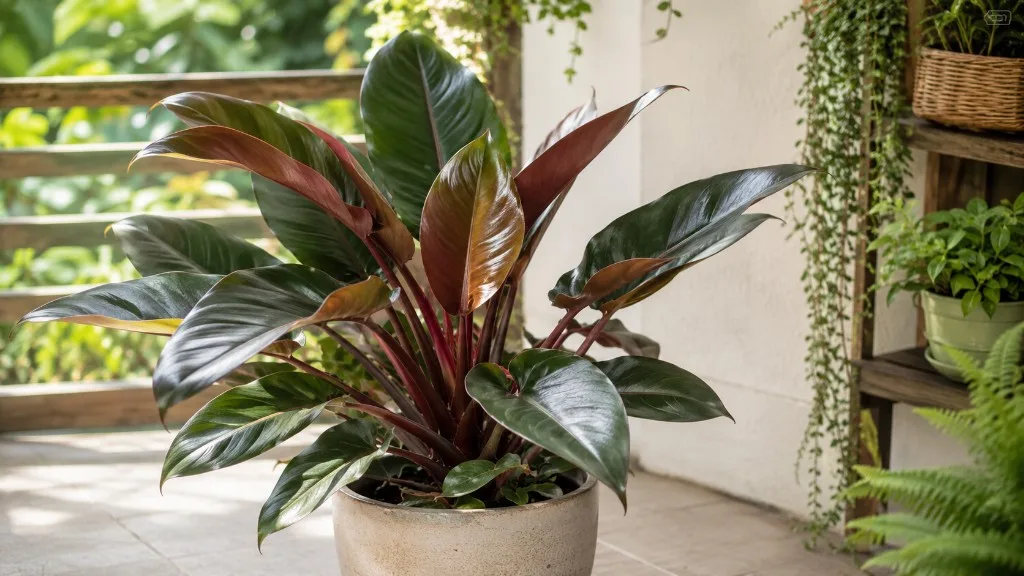
Philodendron Imperial Red (Philodendron erubescens ‘Imperial Red’, USPP6337P) is a patented self-heading cultivar - not a vining philodendron - grown for warm burgundy-red new leaves that mature to dark red-green. That compact upright rosette changes how fertilizer behaves in the pot: salts concentrate in a smaller root zone, crown growth color tells you whether feeding and light are aligned, and overfeeding stalls the burgundy unfurling that makes Philodendron Imperial Red overview worth keeping. Clemson HGIC notes that self-heading philodendrons have brittle petioles and that too much fertilizer curls and browns leaf tips - problems that show fast on a floor-statement plant where every new leaf is visible.
This guide covers when to feed, half-strength dilution with real math, seasonal pauses, post-repot withholding, salt-flush recovery, Imperial Red versus Imperial Green feeding under different light levels, and the mistakes that turn firm burgundy crown growth into pale, stalled leaves. For watering rhythm and soil drainage that make feeding safe, see Imperial Red watering and soil. For the full species picture, start with the Imperial Red overview.
Quick answer: light feeding during active burgundy growth
Feed Philodendron Imperial Red with balanced liquid fertilizer at half the label strength, about once a month during active spring and summer growth when you see firm burgundy new leaves unfurling from the crown. Pause in autumn and winter when growth slows in cool, dim rooms. Water first, then fertilize moist soil only. Hold feeding for four to six weeks after repotting, root-rot recovery, or major stress. If white salt crust appears on the soil surface, flush with plain water until runoff runs clear and skip the next two feedings. Fertilizer cannot fix low light or wet roots - fix those first.
Why Imperial Red feeding is different from other philodendrons
Most online philodendron fertilizer advice assumes a trailing heartleaf in a hanging basket. Imperial Red is a dense self-heading rosette that sends leaves upward from a central crown, typically reaching 60–90 cm (2–3 ft) indoors per its patent description. Fewer stems share one pot volume, so the same monthly dose that suits a vining philodendron in a 15 cm pot can salt-burn a compact Imperial Red whose roots occupy a smaller fraction of a 25–30 cm floor container. UF/IFAS research on container media explains that soilless potting mixes hold and release nutrients differently than garden soil - container plants need supplemental fertilizer, but also careful salt management because excess minerals have nowhere to leach except your saucer.
Imperial Red is also grown for color on new growth, not generic green leaf mass. Weak green unfurling usually means insufficient light first; adding nitrogen before you brighten placement often produces soft petioles and salt buildup without restoring burgundy tone. The cultivar is not variegated - it has solid burgundy-to-dark foliage, so “more feed for more color” is a common trap.
Self-heading moderate feeder biology
NC State Extension describes Philodendron erubescens as a tropical aroid preferring moist well-drained organic soil, partial shade, and temperatures between 65 and 85 °F. Imperial Red inherits that moderate metabolism: it is a moderate feeder, not a hungry monstera. Clemson HGIC recommends dilute water-soluble fertilizer for philodendrons during active growth rather than full-strength bursts. Self-heading types concentrate leaf mass at the crown; when salts accumulate, the newest burgundy leaf shows damage first - tip burn, stalled unfurling, or pale green tissue - while older lower leaves may look fine for weeks. That makes the crown your best feeding diagnostic, not the oldest foliage.
When Philodendron Imperial Red needs fertilizer
Fertilize when three conditions align: the plant is in active growth, the soil is evenly moist (not drought-dry or waterlogged), and no recent stress has shut down the root system. Active growth on Imperial Red usually runs from late winter or early spring - when the first burgundy spear unfurls - through early fall. Clemson HGIC indoor plant guidance states that fertilizer applications should be more frequent when plants are growing, typically spring and summer when days lengthen and light intensifies; during short winter days with little supplemental light, many indoor plants enter a resting stage and should not receive fertilizer.
Pause feeding entirely when:
- You repotted within the last four to six weeks (fresh mix often contains starter nutrients; damaged roots need time to heal)
- The plant is recovering from root rot, pest treatment, or a major move
- Soil is bone dry or the plant is wilted on wet mix (roots are not functioning)
- Room temperatures stay below roughly 18 °C (65 °F) with no new leaves for a month
- A white mineral crust covers the soil surface (flush first, feed later)
Exception: If Imperial Red continues pushing burgundy leaves under grow lights in a warm room through winter, a monthly quarter- to half-strength dose may be appropriate - but only while new growth is visible. Missouri Botanical Garden indoor fertilizer guidance notes that brighter light and faster growth increase nutrient demand; dim winter rooms need less feed, not more to “force” growth.
Signs feeding is working on your Imperial Red
Healthy feeding shows up at the crown, not on leaves that unfurled last year. Look for:
- Firm burgundy-red new leaves unfurling at normal size relative to the previous leaf
- Sturdy reddish petioles without limpness on moist - not soggy - soil
- Steady but not explosive growth: one new leaf every few weeks in bright indirect light through summer
- No white salt crust on the soil surface or pot rim
- Mature leaves holding dark red-green color without widespread tip burn
Imperial Red’s patent lineage selected for upright self-heading habit and burgundy immature foliage. When light and feeding align, that color sequence continues: burgundy spear → expanding bronzed leaf → mature dark green-red. If older leaves look fine but new ones arrive small, pale green, or soft, suspect light or salt before you increase fertilizer.
Signs something is off (and what to do)
Over-fertilizing is the most common feeding failure on Imperial Red. Clemson HGIC lists curled and brown leaf tips as a sign of too much fertilizer on philodendrons. On this cultivar, also watch for:
- Stalled burgundy unfurling - a spear that opens partway then stops, often with brown margins
- White or yellow mineral crust on soil surface, especially in glazed floor pots that dry slowly
- Sudden leaf drop from the lower crown after a heavy feed
- Wilting on wet soil right after fertilizing (salt-damaged roots)
Under-fertilizing is rarer but possible in the same pot for years without repotting: new leaves noticeably smaller than older ones, uniform pale yellow-green new growth (after ruling out overwatering), or no new leaves for months in warm bright conditions. Rule out slow growth from low light and yellow leaves from wet roots before you feed - Clemson HGIC ties yellowing lower leaves and dead growing tips to too little light or overwatering, not nutrient deficiency alone.
| Symptom | Likely cause | First action |
|---|---|---|
| Brown tips + salt crust | Over-fertilizing / salt buildup | Flush until runoff clear; pause 4–6 weeks |
| Stalled burgundy spear after feed | Salt burn or stressed roots | Flush; check moisture and roots |
| Weak green new leaves | Low light (primary) | Improve light; then reassess feed |
| Small pale new leaves, good light, old pot | Possible lean soil | Half-strength balanced feed once; reassess in 3 weeks |
| Limp petioles, wet heavy pot | Overwatering / root rot | Do not fertilize - see root rot |
Step-by-step: dilute, water first, apply to moist soil
- Check the pre-feed list below - if any “hold” condition applies, stop.
- Water lightly if needed so the top half of the mix is moist. Never pour fertilizer concentrate onto dry peat - it burns fine aroid roots.
- Mix fertilizer at half label strength in your watering can (see dilution math below).
- Pour evenly across the soil surface, not directly on the crown or leaf axils.
- Let drain fully; empty the saucer so salts do not wick back up.
- Record the date on a pot tag or calendar - easy to double-feed after a skipped month.
Clemson HGIC recommends balanced complete fertilizer for foliage houseplants (such as 20-20-20) and notes that water-soluble forms reduce burn risk because dilute solutions are easier to control than heavy granular dumps.
Dilution math for common liquid fertilizers
Most indoor liquid concentrates list a rate such as 1 teaspoon (5 ml) per gallon (3.8 L) of water at full strength. For Imperial Red, cut that in half:
| Product label rate | Imperial Red dose | Per 1 L water (approx.) |
|---|---|---|
| 1 tsp per gallon full strength | ½ tsp per gallon | ~¼ tsp per 1 L |
| 2 tsp per gallon full strength | 1 tsp per gallon | ~½ tsp per 1 L |
Example: a 10-10-10 or 20-20-20 liquid labeled 1 tsp/gallon → mix ½ tsp in 1 gallon (or ¼ tsp in 2 L) for one monthly feed on a 20 cm self-heading pot. A 25–30 cm floor pot with active summer growth can use the same concentration; do not double the dose for pot size - increase frequency only if the plant pushes steady burgundy growth and shows no salt crust.
Pre-feed checklist: moisture, salt crust, crown growth, season
| Check | Feed? | Notes |
|---|---|---|
| Soil moist top to mid-depth | Yes | Water first if dry |
| White crust on soil | No - flush first | Salts already elevated |
| Firm burgundy new growth | Yes | Crown confirms active metabolism |
| Repotted < 4–6 weeks ago | No | Roots healing; fresh mix may have nutrients |
| Winter, cool room, no new leaves | No | Resting stage |
| Grow lights + warm + new leaves | Cautious yes | Quarter- to half-strength monthly |
| Wilted on wet soil | No | Root damage - not a nutrient problem |
| Recent brown tips spread on new leaves | No | Flush and pause |
Monthly routine and seasonal adjustments
Use this framework as a starting point, then adjust from crown growth color and salt signals - not the calendar alone.
| Season | Light context | Feeding approach |
|---|---|---|
| Late winter – early spring | Days lengthening; first burgundy spear | Resume half-strength monthly when new growth appears |
| Spring – summer | Bright indirect; active unfurling | Monthly half-strength balanced liquid |
| Late summer – autumn | Growth slowing | Reduce to every 6–8 weeks; watch for salt crust |
| Winter | Cool dim room; no new leaves | Pause unless grow lights maintain active growth |
| After repot | Fresh mix, root recovery | Pause 4–6 weeks |
Worked vignette: In a 20 cm self-heading pot on an east-facing windowsill with bright indirect light, monthly half-strength 20-20-20 through June–August produced firm burgundy new leaves roughly every three to four weeks. The same plant in an 18 °C room from November–February with no grow light pushed no new foliage - feeding was paused entirely, which prevented the salt crust that had appeared the prior winter when monthly feeds continued on a dormant plant. That pattern matches Clemson HGIC’s seasonal growth guidance: feed when growing, not when resting.
Monthly salt management: In warm rooms with regular feeding, flush with plain water once between fertilizer applications - run water until it drains clear from the bottom. This matters more in floor pots where evaporation leaves minerals at the soil surface.
Grow-light winter exception: If you run supplemental lamps 10–12 hours daily and the room stays above roughly 20 °C (68 °F), Imperial Red may continue unfurling burgundy leaves through December and January. In that case, maintain quarter- to half-strength monthly feeding - the same conservative dose, not an increased rate. If lamps are weak or the plant shows no new spears for four weeks, treat it as dormant and pause feed entirely until spring lengthening resumes.
Nursery pot versus floor pot: A 15 cm starter pot dries faster and shows salt crust sooner; a 25–30 cm floor pot hides mineral buildup longer because the upper soil layer stays damp. Check the soil surface on large pots monthly even when lower leaves look fine - self-heading rosettes shade their own mix, and the first warning is often crust at the crown edge, not tip burn on mature foliage.
Common Imperial Red fertilizer mistakes
- Feeding to fix low light - weak green new growth needs brighter placement, not more nitrogen
- Full-strength doses because “indoor plants are starving” - half strength is the default for aroids
- Fertilizing dry soil after a missed watering week
- Doubling up after a growth slump - Imperial Red tolerates a skipped month better than a salt shock
- Feeding during root rot recovery - salts on damaged roots accelerate decline
- Using bloom booster for burgundy color - color is genetic; balanced NPK is appropriate
Mistake: feeding every watering in a small or floor pot
Constant low-dose fertilizer - even at quarter strength every week - builds salts faster than a self-heading rosette uses them, especially when winter slow-down reduces uptake. Clemson HGIC offers alternatives including dilute every-watering programs at one-tenth label rate, but that demands consistent flushing and bright active growth. For most Imperial Red homes, a clear monthly pulse with plain water between feeds is safer. Small 12–15 cm nursery pots and large 30 cm floor pots both fail this way: the small pot has little buffer volume; the large pot dries slowly and concentrates minerals at the surface.
Mistake: ignoring salt load on a self-heading rosette
Dense leaf mass shades the soil surface in a self-heading pot, slowing evaporation and leaving white mineral rings around the crown. Those salts pull moisture from roots and burn new tissue. Smelling sour mix or seeing crust together with brown tips on the youngest leaf means flush now - not another feed. Self-heading philodendrons cannot shed salts by growing a long vining runner into fresh soil; everything happens in one crowded crown zone.
Imperial Red vs Imperial Green: light and feeding interaction
Both cultivars are P. erubescens hybrids with similar half-strength balanced liquid schedules, but Imperial Red needs brighter light to keep burgundy new growth vivid. Under the same feed rate in a dim corner, Imperial Green may hold acceptable green foliage while Imperial Red produces weak green spears - a light problem that fertilizer will not solve. In brighter placement, Imperial Red uses nutrients slightly faster when pushing colored new leaves; still, do not exceed monthly half-strength unless you are flushing regularly and see no salt crust. Compare details on the Imperial Green fertilizer guide. Color depth is genetic, not a phosphorus switch - avoid high-P “bloom” products hoping to intensify burgundy indoors.
Slow-release option at half rate for low-input growers
If monthly mixing is not realistic, slow-release granules at half the container label rate at the start of the growing season can sustain a moderate feeder through summer. Clemson HGIC lists slow-release forms as convenient but notes they are harder to reverse if over-applied. Use caution in small pots where a single pellet cluster can locally overdose roots. In 25–30 cm floor pots, half rate at spring repot or top-dress is often enough for steady - not maximum - growth. Skip slow-release entirely on stressed or newly repotted plants.
Recovery after over-fertilizing Imperial Red
- Stop feeding immediately.
- Flush with plain room-temperature water until runoff runs clear - repeat once after the pot drains if crust was heavy. Missouri Botanical Garden guidance recommends flushing when toxic salts are suspected, then keeping the plant dryer than usual for several weeks.
- Pause fertilizer for 4–6 weeks minimum.
- Move to appropriate light if growth was already weak - recovery needs photosynthesis, not more salts.
- Watch the next burgundy unfurling - firm healthy tissue means the salt load dropped; continued stall means more root inspection.
Badly burned mature leaves will not green out - judge success on new crown growth only. Persistent brown tips on every new leaf after recovery may mean permanent concentration reduction (quarter strength) or repotting into fresh mix.
When to use this page vs other Philodendron Imperial Red guides
- Philodendron Imperial Red overview - Start here for whole-plant context before deep-diving this topic.
- Philodendron Imperial Red problems hub - Jump to symptom-specific fix guides when this care topic does not resolve the issue.
Related Philodendron Imperial Red guides
- Philodendron Imperial Red overview
- Philodendron Imperial Red watering
- Philodendron Imperial Red light
- Philodendron Imperial Red soil
- Philodendron Imperial Red propagation
- Philodendron Imperial Red repotting
- Philodendron Imperial Red problems
Conclusion
Philodendron Imperial Red rewards a conservative feeding routine tied to burgundy crown growth, not a rigid calendar. Use half-strength balanced liquid fertilizer monthly during active spring and summer growth, water before you feed, pause after repotting and through winter dormancy, and flush salts when crust or tip burn appears on the newest leaves. Fix light and watering before you chase nutrients - fertilizer supports a healthy self-heading rosette; it cannot rescue a stressed one. When in doubt, skip a month rather than double the dose: this cultivar forgives lean feeding far better than salt burn on its showpiece crown.