Yellow Leaves on Philodendron Imperial Red: Causes, Checks
Quick answer
Yellow leaves on Philodendron Imperial Red are usually caused by overwatering or soil that stays wet too long, which stresses the single crown and roots. First step: stop watering and let the top 3–5 cm of mix dry completely before the next drink.
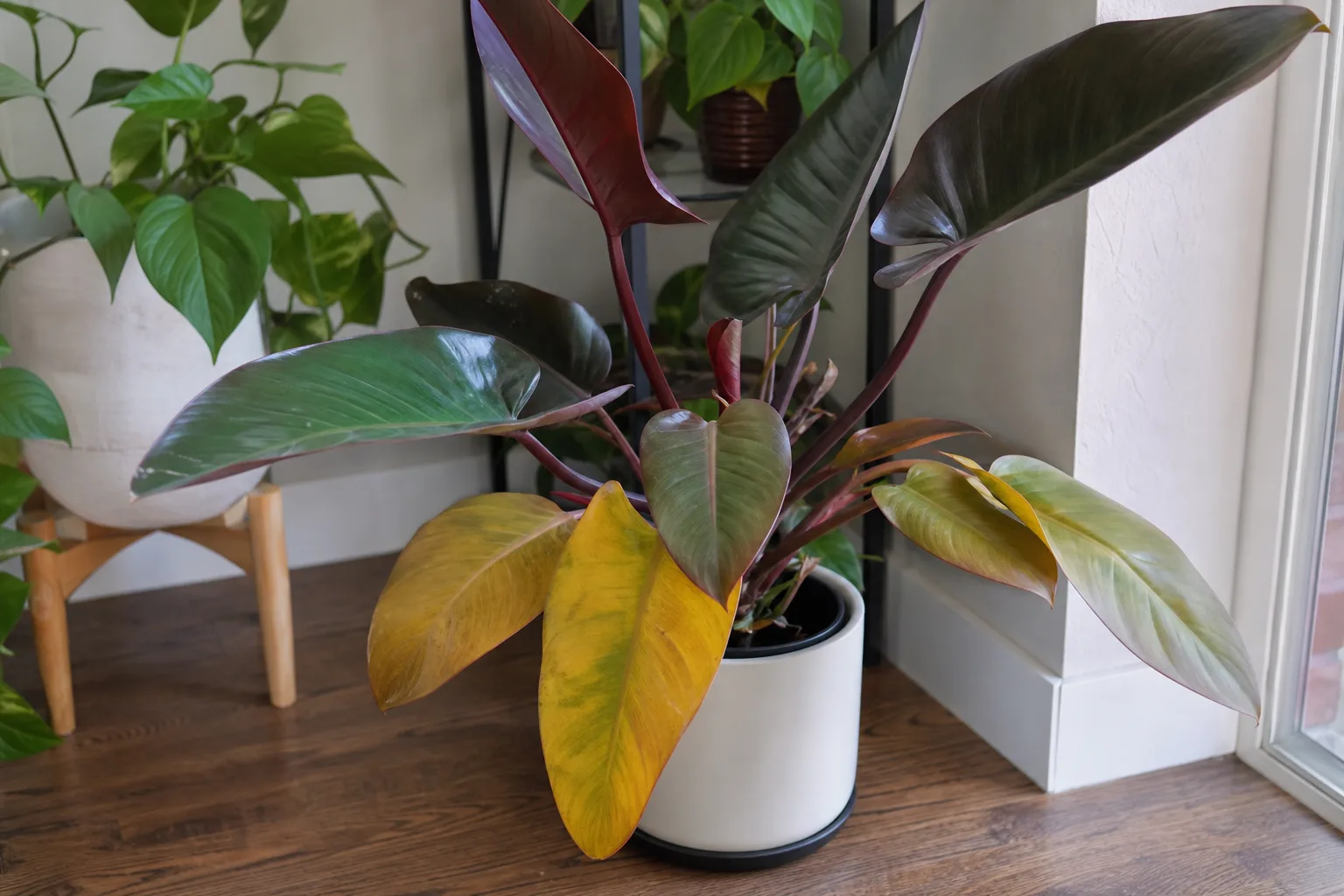
Yellow Leaves on Philodendron Imperial Red: Causes, Checks & Fixes
This guide covers yellow leaves on Philodendron Imperial Red. See also the general Yellow Leaves guide, watering, and light pages for this plant.
Yellow Leaves on Philodendron Imperial Red: Causes, Checks & Fixes
Quick answer
Yellow leaves on Philodendron Imperial Red are usually caused by overwatering or soil that stays wet too long, which stresses the single crown and roots. First step: stop watering and let the top 3–5 cm of mix dry completely before the next drink.
Philodendron erubescens ‘Imperial Red’ is a self-heading hybrid that grows as an upright rosette from one central crown - not a trailing vine. That shape concentrates water demand at a single growing point. When roots sit in saturated mix, they lose oxygen, uptake falters, and the plant sheds older leaves from the bottom up while the crown may stall. The confusing part is that mature Imperial Red foliage naturally fades from red-bronze to dark green as leaves age, so you must separate normal color maturation from sickly yellowing before you change care.
Why Imperial Red gets yellow leaves
Overwatering is the primary trigger on Philodendron Imperial Red overview. RHS guidance for philodendrons is explicit: saturated compost can cause root rot, which shows up as yellowing leaves and eventual collapse. Imperial Red amplifies that risk because self-heading types hold a dense leaf mass over the pot, shading the soil surface and slowing evaporation. A summer Philodendron Imperial Red watering guide that felt fine in bright light can become excessive by winter when the plant uses less water and the mix dries more slowly.
Dense or poorly draining soil makes the pattern worse. Standard peat-heavy potting mix in an oversized plastic pot can stay damp for a week or more in a dim corner. Clemson Extension notes that root rot usually results from soil that does not drain quickly or from watering too often. For Imperial Red, aim for standard potting mix amended with 20–25% perlite and a slightly acidic pH around 5.5–6.5 - close to the loose, free-draining compost RHS recommends for philodendrons.
Low light and cool rooms compound overwatering damage. When growth slows, roots use less oxygen and the mix stays wet longer. Clemson Extension lists yellowing of lower leaves among symptoms of too little light or overwatering. On Imperial Red, weak light also dulls the signature red-bronze new growth, so you may see pale green spears alongside yellow lower leaves - two stress signals at once.
Blocked drainage holes, saucers holding standing water, and watering on a calendar instead of checking soil dryness also push yellowing forward. NC State Extension notes that Philodendron erubescens prefers moist, well-drained soil - moist, not constantly wet. Imperial Red tolerates brief dryness far better than chronic saturation.
Red-bronze new growth vs true yellowing
Do not panic when lower mature leaves look greener than the crown. Imperial Red was bred for leaves that start out red and mature to deep purple before settling into glossy dark green. Seeing wine, bronze, and green tones on one plant at the same time is normal ontogenetic color change, not a diagnosis by itself.
True yellowing looks different:
- Sickly chartreuse or pale yellow, not rich burgundy or bronze-red
- Lower leaves yellowing in a batch rather than one old leaf senescing at a time
- Limp or soft petioles at the crown while soil stays wet
- New growth emerging small, pale, or green with no red phase
- Leaf edges or whole blades turning uniform yellow before browning
If the newest spear at the crown is still firm and opening with red-bronze pigment, the plant is often stressed but not failing. If that spear stalls, yellows, or rots while lower leaves drop, treat root moisture as the priority.
What yellow leaves look like on Imperial Red
Early overwatering stress on this self-heading philodendron often follows a bottom-up pattern:
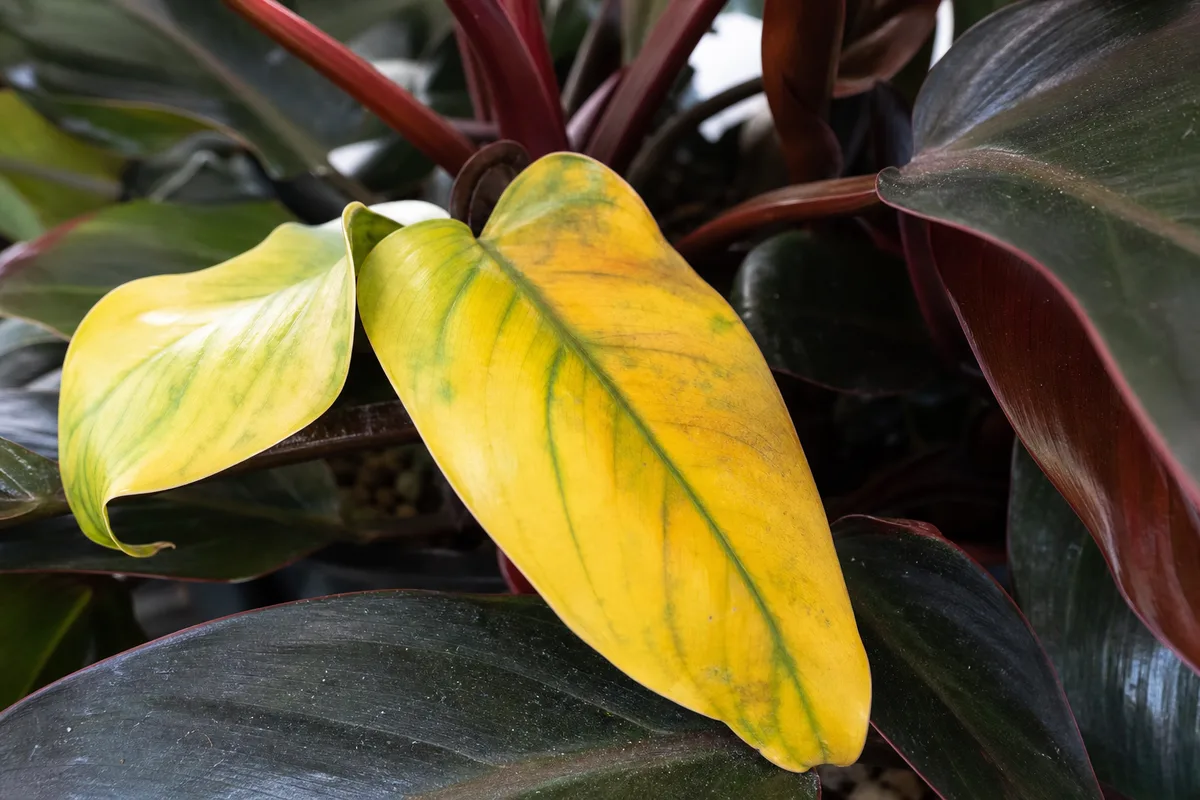
Yellow Leaves symptoms on Philodendron Imperial Red - compare with healthy tissue on the same plant.
- Lowest, oldest leaves turn yellow first, sometimes with green veins lingering briefly
- Petioles stay attached but feel less rigid than healthy burgundy stems
- Soil surface stays dark and cool several days after you last watered
- Pot feels heavy when lifted; saucer may hold water
- New red-bronze growth slows or opens smaller than usual
- No pests visible, but fungus gnats may hover over persistently wet soil
On Imperial Red, crown health matters more than any single yellow leaf. A firm central growing point with one yellow lower leaf is often normal aging. Several yellow leaves climbing the rosette while the crown softens points to systemic root stress - usually wet soil, sometimes combined with dim light.
How to confirm the cause
Do not treat from one yellow leaf alone. Use this inspection order:
- Soil dryness at 3–5 cm depth - Push a finger or dry chopstick into the mix. If it comes out wet or clinging while lower leaves yellow, overwatering is likely.
- Pot weight and drainage - Lift the pot. Heavy days after watering, or water pooling in the saucer, confirms saturation.
- Soil smell - A sour odor from the drainage hole suggests anaerobic, decaying root tissue. Penn State Extension links root rot to overwatering and notes wilting with blackened, mushy roots.
- Crown and petiole firmness - Press gently where new leaves emerge. Firm burgundy sheaths are good; soft, collapsing tissue is not.
- New growth color - Healthy Imperial Red pushes red-bronze spears. Pale green-only new growth with yellow lower leaves suggests light plus moisture stress.
- Light check - Confirm medium-Philodendron Imperial Red light guide for several hours daily. Color dulling and etiolation support a light contribution; wet soil confirms overwatering.
If soil is wet, yellowing is spreading, and the crown feels soft, unpot and rinse roots the same day. Delay lets decay move into the only growing point this cultivar has.
Lookalike symptoms to rule out
Normal leaf aging - One lowest leaf yellowing and dropping while the crown pushes red new growth is typical senescence. No sour smell, soil dries normally, petioles stay firm.
Natural color maturation - Mid-age leaves turning darker green while the crown stays red-bronze is the cultivar’s design, not yellowing.
Underwatering - Pot feels light, soil is dusty dry throughout, leaf edges may crisp, but roots stay firm on inspection. Rehydrate thoroughly once, then resume the dry-top check - do not confuse with overwatering.
Low light alone - Leggy spacing, small pale new leaves, no red pigment - but soil dries on schedule and roots are firm. Move to brighter indirect light; yellowing from pure etiolation is less common than wet-root stress on Imperial Red.
Nutrient deficiency - Rare on recently repotted plants. Tips may brown or curl with excess fertilizer per Clemson guidance; yellowing from starvation usually follows long-term neglect, not a sudden crown decline with wet soil.
Pests - Spider mites cause stippling and bronzing; mealybugs leave cottony patches. Confirm with leaf undersides and sticky residue before assuming watering alone.
First fix for Imperial Red
Stop watering immediately and let the top 3–5 cm of mix dry completely before the next drink. That single correction matches RHS advice to let the compost dry out slightly between waterings and directly addresses the most common cause on this plant.
While the mix dries:
- Empty any water sitting in the saucer
- Move the plant to medium-bright indirect light if it has been in a dim spot - better light helps the root zone dry evenly
- Do not fertilize, repot, or prune heavily on the same day
- Snip only fully yellow or brown leaves that pull away easily; leave mostly green foliage in place
If soil still smells sour after ten days of dry-back, or petioles soften at the crown, unpot, rinse roots, trim mushy tissue, and repot into fresh, perlite-amended mix in a pot with drainage holes only slightly larger than the rootball.
Make one correction at a time so you can read the plant’s response over the next two weeks.
Step-by-step recovery
After the initial dry-back:
- Resume watering only when dry - Check 3–5 cm down every few days. In summer that may mean every 7–10 days; in winter, every 10–14 days - always confirm dryness, never a fixed calendar.
- Water thoroughly, then drain - Soak until water runs from the drainage hole, then empty the saucer. Never leave Imperial Red standing in water.
- Watch the crown - New red-bronze spears emerging firm and full-sized are your best recovery marker.
- Remove only dead tissue - Fully yellow leaves will not re-green; clip them once the plant stabilizes so energy goes to new growth.
- Reassess mix and pot size - If the pot stays wet more than a week after each watering, add perlite or downsize to a smaller container.
Mild cases with firm roots often stabilize within two to four weeks. Moderate root stress may need six to eight weeks before confident new growth returns. Severe crown rot with mushy tissue at the growing point rarely recovers fully - honest progress means no spreading softness and at least one firm section of root and crown.
What not to do
- Do not keep watering because leaves look limp while soil is still wet.
- Do not mistake normal burgundy-to-green maturation for a crisis and overhaul care unnecessarily.
- Do not repot into a much larger pot; extra wet soil volume slows drying and raises rot risk.
- Do not fertilize a stressed Imperial Red before fixing moisture and light.
- Do not place the plant in direct sun to “fix” yellowing - scorched leaves add a second problem.
- Do not assume all philodendrons behave the same; self-heading Imperial Red fails at the crown, not along a trailing stem you can simply cut back.
Imperial Red care cross-check
Align these baseline needs before chasing secondary causes:
- Light - Medium-bright indirect light keeps red-bronze new growth vivid. Too little light dulls color and slows drying; harsh direct sun scorches leaves.
- Water - Top 3–5 cm dry between drinks; roughly 7–10 days in summer and 10–14 days in winter indoors, adjusted to your pot and room.
- Soil - Standard potting mix plus 20–25% perlite, well-draining, pH 5.5–6.5.
- Humidity - 50–60% is ideal; philodendrons tolerate average home humidity but stagnant wet soil matters more than air moisture here.
- Temperature - Comfortable room range; protect from cold drafts that slow drying and stress roots.
If one of these shifted recently - new larger pot, moved to a darker corner, winter heating drying the air but you kept summer watering frequency - correct that first and wait for two clean new leaves before a second change.
How to prevent yellow leaves next time
Match watering to how fast your specific pot dries, not a habit or app reminder. Use a pot only slightly larger than the root mass, perlite-amended mix, and bright indirect light so the top 3–5 cm actually dries between drinks. Pour away saucer runoff every time.
Reduce watering frequency sharply in autumn and winter when growth slows. Refresh compacted mix every 12–24 months so drainage does not silently fail. Weekly glance checks - pot weight, soil smell at the drainage hole, firm burgundy petioles, red tone on the newest spear - catch trouble while a dry-back fix still works.
Keep Imperial Red out of reach of pets; like all philodendrons it contains calcium oxalate crystals that cause oral irritation if chewed. Toxicity is not a cause of yellow leaves, but worth remembering when pruning dropped foliage.
When to worry
Treat yellowing as high severity on Imperial Red when:
- Several lower leaves yellow within seven to ten days
- Yellowing climbs toward the crown, not just the lowest tier
- Petioles soften or collapse at the central growing point
- Soil smells sour despite dry-back attempts
- New growth stalls, yellows, or emerges abnormally small and pale
- Roots on inspection are brown, blackened, or mushy
If only one old lower leaf yellows while the crown pushes firm red-bronze growth and soil dries normally, odds are good. If the crown softens or multiple leaves fail together, unpot and inspect roots the same day - self-heading plants have limited salvage paths once the single growing point is compromised.
Conclusion
Yellow leaves on Philodendron Imperial Red are almost always a watering and drainage problem, not bad luck or normal burgundy fading. Separate true sickly yellowing from the cultivar’s red-to-green maturation, confirm with wet soil, pot weight, and crown firmness, then let the top 3–5 cm dry before watering again. Prevent recurrence by checking soil dryness, using well-draining perlite-amended mix, and giving enough indirect light for both color and healthy root respiration. Judge success by firm new red-bronze growth at the crown - not by old leaves returning to perfect green.
When to use this page vs other Philodendron Imperial Red guides
- Philodendron Imperial Red watering guide - Use for routine moisture checks before assuming yellow leaves is the main issue.
- Philodendron Imperial Red problems hub - Browse all 10 common issues on this species.
- Root Rot on Philodendron Imperial Red - Different entry point when symptoms overlap with yellow leaves.