Money Tree Care Guide: Pachira aquatica Indoors
Pachira aquatica
Money Tree needs bright indirect light, deep watering every 7–14 days followed by full drying at root depth, and rotation for even growth. Non-toxic to pets.
Money Tree Care Guide: Pachira aquatica Indoors
Start with wateringThe most common care mistake for Money TreeWatering guide →Money Tree care essentials
Light
bright indirect light
Water
Deep water every 7–14 days in summer. Allow to dry at 5+ cm depth before next watering. Every 14–21 days in winter. Never let pot sit in water.
Soil
Standard potting mix with 20–30 % perlite. Well-draining - critical. pH 6.0–7.5.
Humidity
Moderate to high (50–70%); appreciates misting or pebble tray in dry conditions
Temperature
18°C to 30°C (65–86°F)
Fertilizer
Use balanced liquid fertilizer at half strength and stop if the plant is stressed, newly repotted, or not actively growing.
About Money Tree
Money Tree is native to Central and South America (wetlands), typically reaches 1.5–2 m indoors; up to 18 m in natural habitat indoors, with moderate growth. Money Tree has a tree like growth habit and part of the Malvaceae family. It is also known as Guiana Chestnut, Water Chestnut Tree, Malabar Chestnut, and Lucky Plant.
| Detail | Information |
|---|---|
| Also known as | Guiana Chestnut, Water Chestnut Tree, Malabar Chestnut, Lucky Plant |
| Native region | Central and South America (wetlands) |
| Mature size | 1.5–2 m indoors; up to 18 m in natural habitat |
| Growth rate | Moderate |
| Growth habit | Tree Like |
| Scientific name | Pachira aquatica |
| Family | Malvaceae |
Money Tree Care Guide: Pachira aquatica Indoors
Walk into a garden centre, a supermarket plant aisle, or a corporate lobby and you will almost certainly see a money tree - a small indoor tree with a plaited trunk and glossy, hand-shaped leaves. What the label rarely tells you is that the plant is Pachira aquatica, a wetland tree from Central and South America that is being asked to live in a pot on a windowsill; that the famous braided trunk is handmade, not a natural growth form; and that the number-one killer indoors is not drought but overwatering, often compounded by hidden nursery bindings that strangle the trunk as it thickens. This guide covers all of that, plus the light, water, soil, humidity, feeding, Money Tree repotting guide, propagation, and pet-safety facts you need to keep the plant healthy for years.
The goal is practical: by the end you should know how to identify a true money tree, inspect the braid on day one, place the plant in Money Tree light guide, water on a flood-and-dry rhythm that matches how your pot actually dries, catch overwatering before the trunk goes soft, and confirm ASPCA non-toxic status for cats and dogs - without confusing Money Tree overview with the toxic jade that shares the “money plant” name.
What Money Tree Actually Is (and What It Is Not)
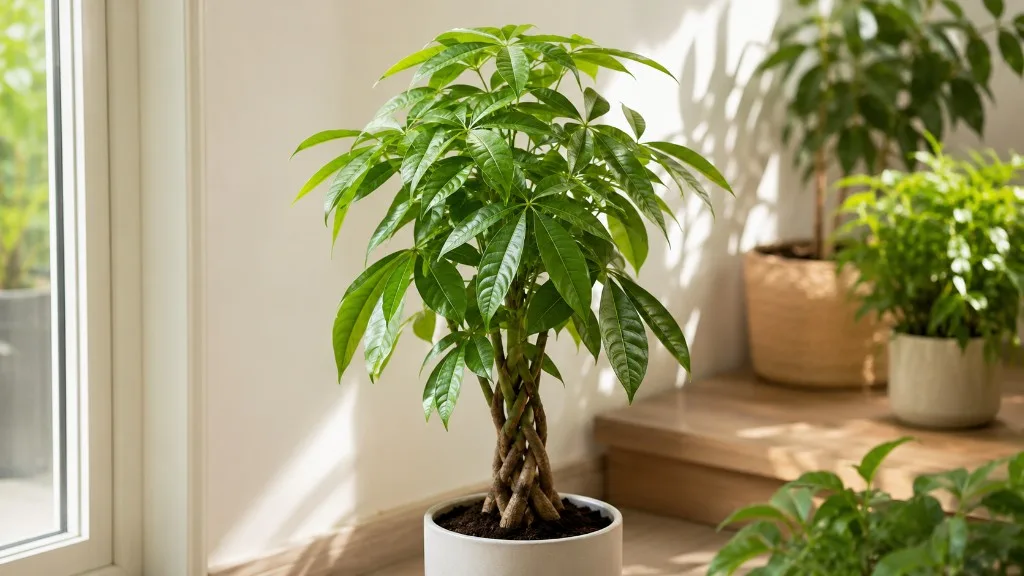
Money tree is the commercial name for Pachira aquatica, a broadleaf evergreen in the Malvaceae family. The Missouri Botanical Garden describes it as a tropical estuarine species native to freshwater swamps, estuaries, and river banks in rainforests from Mexico to northern South America. In the wild it can reach 60 feet; as a houseplant it typically grows 6 to 8 feet over many years, though most indoor specimens stay in the roughly 1.8 to 2.4 meter (6 to 8 foot) range in ordinary homes. Each leaf is palmately compound - a long petiole ending in a fan of five to nine shiny green leaflets that look like an open hand, which is part of why the plant became associated with fortune and feng shui symbolism.
Here is the paradox that confuses new owners: Pachira grows in wetlands outdoors, yet in a container it behaves more like a plant that wants excellent drainage and a real dry-down between waterings. Missouri Botanical Garden notes that in native flood zones the species tolerates periodic inundation, but houseplants perform best in bright light with moderate, even moisture - and in practice, “even moisture” indoors still means never letting the root zone stay soggy for days. North Carolina Extension adds that standing water is not tolerated and causes root rot on Money Tree. The wetland label on the tag is not permission to keep the pot wet.
Indoors, money trees rarely flower or fruit. NC Extension states that braided specimens will not flower indoors, and the large night-fragrant blooms with shaving-brush stamens are mostly an outdoor phenomenon in frost-free climates (USDA zones 10–12). Your care goal is foliage and a firm, healthy trunk, not nuts or blossoms.
Common Names and the Jade Plant Confusion
Pachira aquatica accumulates common names - Guiana chestnut, Malabar chestnut, water chestnut tree, French peanut, Mexican fortune tree - and is sold interchangeably as money tree or money plant. That last name is the dangerous one, because Crassula ovata, the jade plant succulent, is also called lucky plant, money plant, and money tree in casual speech. The ASPCA explicitly warns about this overlap: jade is toxic to cats and dogs, while Pachira aquatica is non-toxic. The visual difference is straightforward once you know what to look for: Pachira has a woody trunk (often braided), thin stems, and thin, multiple leaflets on each leaf; jade has thick, fleshy, oval leaves on a succulent stem with no braid. If you are buying for pet safety, read the botanical name on the tag, not the marketing name alone.
The Braided Trunk: How It Is Made and Why It Matters
The interwoven trunk is the money tree’s signature look, and it is entirely human-made. Nurseries braid three to five flexible saplings while the stems are still green and pliable, usually when they are under roughly 30 cm tall, then plant them together so the stems fuse as they lignify. This is a cultivation technique, not something you would find in a Central American swamp. The Missouri Botanical Garden and NC State Extension describe the braid as a decorative form popularised for gift sales and feng shui displays.
From a care standpoint, the braid changes how you diagnose problems. Multiple stems share one pot and one root system (or closely intertwined roots), so one rotting stem can threaten the others. The trunk also acts as a water storage tissue - healthy Pachira trunks feel firm, like a young tree. When owners describe a “squishy” or “mushy” trunk, that usually means rot has entered the stem, not that the plant is thirsty. NYBG and Missouri Botanical Garden note that trunk softness is among the most alarming money tree symptoms because it often indicates advanced root or cambium damage rather than a simple watering mistake you can fix with one skipped drink.
The braid also creates crevices where moisture can sit against bark if you pour water directly onto the trunk or keep the plant in stagnant humidity without airflow. Water the soil surface, not the braid, and keep the plant in a spot with gentle air movement so the trunk surface dries between waterings.
Hidden Rubber Bands and Trunk Rot at the Root Flare
The single most overlooked money tree care step happens within the first week of ownership: inspect the root flare - the point where the braided stems meet the soil - for rubber bands, wire, zip ties, or electrical tape left by the nursery to hold the braid in place during shipping. Multiple growers and extension-adjacent troubleshooting guides report the same pattern: the binding sits just below the soil line, invisible at purchase; as the trunk expands, the material does not stretch; it cuts into the cambium, blocks sap flow, traps moisture against the bark, and creates an entry point for rot. The plant can look fine for months, then collapse rapidly once the constriction wins.
Action on day one: gently scrape away the top 2 to 5 cm of soil at the base of the braid. If you find any binding material, cut it off completely with clean scissors or a knife. Replace the displaced soil and water lightly. This one step prevents more sudden deaths than almost any other money tree tip in circulation. If a stem is already soft above the binding, that stem may not be salvageable; remove the dead portion from the braid so rot does not spread to firm stems, then repot into fresh, dry mix after trimming blackened roots.
Light: Bright, Indirect, and Stable
Money trees need bright, indirect light to grow steadily and resist disease. NYBG recommends positioning near a south- or east-facing window with filtered light for several hours daily. NC Extension specifies indirect sunlight or a mix of sun and shade, warning that direct sun causes leaf scorch. Missouri Botanical Garden states houseplants perform best in bright light - not dim corners.
A practical placement map for most homes:
- East-facing window: Often ideal. Gentle morning sun, then bright indirect light the rest of the day.
- South- or west-facing window: Works if the plant sits 1 to 1.5 meters back from the glass or behind a sheer curtain, especially during harsh afternoon sun.
- North-facing window: Usually marginal in temperate climates. The plant may survive but growth slows, internodes stretch, and the plant becomes more vulnerable to overwatering because it is not using water actively.
Rotate the pot a quarter turn weekly so all sides of the canopy receive light and the plant does not lean dramatically toward the window. If new growth is pale, sparse, or on long thin stems, the plant wants more light. If leaflets show bleached patches, brown crispy edges, or curling at midday, pull it back from direct sun. Acclimate any major light change over one to two weeks rather than moving from a dark corner to a south window in one day.
Money trees tolerate medium light better than many finicky tropicals, but tolerance is not thriving. In lower light, leaves may stay smaller, the braid adds height slowly, and the interval between waterings must stretch because the plant simply uses less moisture - a detail owners often miss when they keep summer watering frequency through a dim winter.
Watering: Flood-and-Dry Without Overwatering
Overwatering is the most common money tree mistake, and it kills more plants than underwatering. The correct mental model comes from the plant’s native estuary rhythm: periods of heavy saturation followed by real drying, not a permanently damp root zone. Indoors, that translates to water deeply, then let the soil dry substantially before watering again - not a shallow sip every few days, and not ice cubes melting slowly on the surface.
LeafyPixels plant-care data and multiple authoritative sources converge on a practical check: insert your finger 5 cm deep and water only when the mix is completely dry at that depth. In active growth, that often means roughly every 7 to 14 days in summer; in cooler, dimmer months, every 14 to 21 days in winter is a common range. Treat those numbers as starting points. A small pot in bright light may dry in five days; a large ceramic pot in a cool office may need three weeks. The pot tells you when to water, not the calendar.
When you do water, soak until excess runs freely from drainage holes, then empty the saucer within 30 minutes. Never let the pot sit in standing water. Discard the ice cube watering method sometimes printed on gift tags - cold ice shocks tropical roots and delivers uneven moisture that keeps the surface wet while the core stays unpredictably dry or vice versa. Use room-temperature water.
Signs you are overwatering include yellowing leaves, soft or mushy trunk tissue, sour-smelling soil, fungus gnats hovering at the surface, and black, mushy roots if you unpot. Signs of underwatering include drooping leaflets, a slightly wrinkled or shrivelled trunk, and soil pulling away from the pot edge. Pachira will drop leaves if soils become too dry, per Missouri Botanical Garden - but chronic wet soil is the harder problem to reverse.
How to Read Soil Moisture Before You Water
The finger test remains the most reliable tool. Push your index finger to the second knuckle - about 5 cm. Dry at depth means water; cool and damp means wait. Lift the pot regularly to learn its weight: a dry pot is noticeably lighter than a freshly watered one. A moisture meter can help if you distrust touch, but verify it against your finger for a few cycles because cheap probes misread chunky mixes.
If the top crust looks dry but the core stays wet - common in peat-heavy mixes that have hydrophobic dry pockets - water may channel down the pot sides without rewetting the root ball. In that case, bottom-water for twenty minutes, then let drain fully, or repot into fresher, chunkier mix. When in doubt during recovery from overwatering, wait an extra day. Pachira forgives short dry spells better than another week of soggy soil.
Humidity and Temperature Indoors
Money trees prefer moderate humidity, roughly 50 percent or higher, and temperatures between 65 and 85°F (18 to 29°C) - the normal comfort range of most homes. NC Extension cites 65 to 75°F as the sweet spot and recommends bringing outdoor plants in before temperatures fall to 45°F. Protect from cold drafts, air-conditioning vents blowing directly on the canopy, and winter window ledges that drop below 50°F (10°C) at night.
In dry winter heating, leaf edges may brown and spider mites become more likely. A pebble tray - water below pot level so roots never sit in it - or grouping plants raises local humidity modestly. A small humidifier is the most reliable fix. Misting gives a brief humidity bump and wet leaves invite fungal spotting; skip the spray bottle unless you are using it as a pest wash, not a humidity strategy.
Good airflow matters as much as humidity percentage. Stagnant, damp, dim corners encourage rot and gnats. A ceiling fan on low or an open room with gentle movement is enough.
Soil, Drainage, and Pot Choice
Container culture demands well-draining, airy mix even though the species is wetland-native outdoors. NC Extension recommends moist, well-drained potting mix of peat, perlite, loam, or sand for containers. A practical home recipe aligned with LeafyPixels data: 50 percent quality potting mix, 30 percent perlite, 20 percent coco coir, in a moist but well-drained mix tolerating acid, neutral, or alkaline conditions. The perlite and coir keep oxygen at the roots; the potting base holds enough moisture that you are not watering daily.
Drainage holes are non-negotiable. Decorative cache pots without holes are death traps for Pachira. Terracotta dries faster and forgives heavy-handed waterers; glazed ceramic or plastic retains moisture longer - adjust your interval accordingly. Money trees prefer slightly snug pots; an oversized container holds water the root system cannot use and is a classic post-repot rot trigger. Repot up one size only when roots emerge from drainage holes or the plant dries out within a day or two of every watering.
If soil smells sour, stays wet for more than a week after a single watering, or white crust builds on the surface, assume root stress and plan a repot into fresh mix rather than adding more water or fertilizer.
Fertilizer During Active Growth
Money trees are moderate feeders, not hungry monsters. Feed monthly from spring through early fall (roughly March through September in the Northern Hemisphere) with a balanced liquid fertilizer at half strength. Stop feeding in late fall and winter when growth slows, and never fertilize a dry, stressed, or newly repotted plant - water first, feed second, or skip until new growth confirms the plant has recovered.
Over-fertilizing causes salt buildup and brown leaf tips that mimic low humidity. If you see crust on the pot rim, flush the soil with plain water until runoff runs clear, then pause feeding for a month. A single slow-release granular application at half label rate in spring is enough for owners who prefer low-input care. Healthy new leaflet clusters are the only score that matters; fertilizer cannot fix bad light, a soft trunk, or chronic overwatering.
Repotting on a Snug Schedule
Repot every two to three years in spring, when the plant enters active growth. Signs it is time: roots circling or exiting drainage holes, water running straight through without absorbing, or the plant becoming top-heavy. Choose a pot 2 to 5 cm wider in diameter - not a dramatic jump. Disturb the braid as little as possible; keep the fused stems upright and at the same soil depth as before.
After repotting, water lightly once, then let the mix approach dry before the next soak so torn roots heal. Skip fertilizer for four to six weeks. If you discovered rot during repotting, trim all black or mushy roots with sterile pruners, dust cuts if you wish with cinnamon or sulfur (optional household practice), and use fresh mix only - never reuse sour soil. Recovery can take one to two months; keep humidity moderate and light bright but avoid hot direct sun during stress.
Propagation by Stem Cuttings and Air Layering
Home propagation works best from healthy, firm parent plants. The two reliable methods are stem cuttings and air layering.
For stem cuttings, take a 10 to 15 cm section with two to three nodes, remove lower leaflets, and root in moist, well-draining mix or water changed weekly. Keep in bright, indirect light and stable humidity. Roots typically form in four to eight weeks. NC Extension and RHS list stem cuttings, air layering, or seed as standard propagation routes for the species.
Air layering suits thicker stems on larger plants: ring a section of bark, pack moist sphagnum, wrap in plastic, and cut below roots once visible. Do not propagate from a plant with soft trunk, active rot, or heavy pest load - cuttings inherit the parent’s problems.
Pet Safety and ASPCA Non-Toxic Status
For cat and dog households, money tree is one of the larger pet-safe statement plants available. The ASPCA lists Pachira aquatica as non-toxic to dogs, cats, and horses, with toxic principles listed as none. That is a meaningful advantage over many popular indoor trees and over Crassula ovata jade, which the ASPCA classifies as toxic and which is often confused under “money plant” marketing.
The ASPCA entry still notes that ingestion may cause nausea, vomiting, and loose stool - not from specific plant toxins in Pachira’s case but from eating non-food plant material, a pattern the ASPCA applies broadly to non-toxic plants. Non-toxic is not a recommendation to let pets treat the tree as salad. Large ingestions of any foliage can upset a stomach; puppies and kittens are the usual offenders.
Non-Toxic Does Not Mean Chew-Proof
Practical pet-aware placement still matters. A floor-standing money tree in a sunny living room may be within reach of dogs; cats will climb to most shelves. Pet safe means you do not need to panic about toxicity if a leaf is sampled; it does not mean the plant will survive repeated shredding or that soil digging is harmless to your furniture. Elevate young plants, use stable heavy pots if dogs bump trunks, and redirect chewers with appropriate toys. If you are unsure which “money plant” you have, verify Pachira aquatica on the label or with a plant ID app before relying on ASPCA classification. When in doubt after any ingestion, call ASPCA Animal Poison Control at 888-426-4435 (consultation fee may apply) or your veterinarian.
Feng Shui Placement and Home Design
Money tree’s five-leaflet hand shape and braided trunk made it a natural fit for feng shui traditions linking the plant to prosperity and positive energy. Folklore often cites five leaves as especially lucky. Horticulturally, the symbolism is human; the care is still biology. The best “lucky” placement is simply where the plant receives bright indirect light, stable temperature, and a watering routine you can maintain - a dying tree in the wealth corner is not doing symbolic work.
As a design element, Pachira reads as a small indoor tree: useful for softening corners, anchoring a bright living room, or adding vertical interest without the toxicity concerns of many large tropicals. Pair it with a cache pot that has internal drainage or use a saucer you empty reliably. Avoid tight, unventilated cubicles with only artificial light unless you supplement with a quality grow lamp for fourteen to sixteen hours daily.
Common Problems and Real Fixes
Most money tree problems trace to water, light, or trunk integrity. Use the same diagnostic order every time: soil moisture, trunk firmness, light level, then pests.
Yellow leaves. If soil is wet and trunk soft, suspect overwatering or rot - unpot, trim black roots, repot dry, wait before watering again. If soil is dry and leaflets droop, underwatering or low humidity may be the cause. Uniform yellow on older lower leaflets alone is often natural senescence; yellow on new growth points to roots, light, or nutrition.
Leaf drop. Sudden drop after purchase usually means environment change - give stable light and conservative water for a month. Persistent drop in winter may combine lower light and cooler temps; reduce water frequency. Drop with wet soil means rot risk.
Soft or mushy trunk. Emergency. Stop watering. Inspect bindings at base. Unpot and examine roots. Remove rotted stems from braid. Repot firm stems in fresh mix. Recovery is slow; do not compensate with extra water.
Brown or scorched leaf tips and edges. Often direct sun or low humidity; sometimes salt buildup from hard water or over-fertilizing. Adjust placement, flush soil, trim damaged leaflet tips for appearance only.
Leggy, sparse growth. Insufficient light. Move closer to a bright window with filtration, or add supplemental lighting.
Pests. NC Extension lists aphids, mealybugs, scale, and fungus gnats. Mealybugs show as white cottony clusters; scale as brown bumps; aphids as soft green or black insects on new growth. Treat with insecticidal soap or horticultural oil per label, repeating weekly for three cycles; isolate the plant. Fungus gnats signal surface moisture - let the top 5 cm dry and consider a peroxide drench (one part 3% hydrogen peroxide to four parts water) on the soil surface.
Root rot. Foul smell, black mushy roots, wet mix that never dries. Trim damage, repot, withhold water until mix dries at depth. Severe cases may not recover; prevention via drainage and dry-down is easier.
Buying Checklist and First-Month Routine
Before you buy, choose specimens with firm braided trunks, glossy green leaflets without widespread yellowing, and no sour soil smell. Avoid plants with collapsed stems, sticky residue (honeydew from pests), or saturated mix in a dim shop corner - that combination often means rot already started.
Your first month should be boring in a good way: quarantine from other plants briefly if pests are a concern in your home, inspect and remove trunk bindings, learn how many days your pot takes to dry at 5 cm depth, and do not repot, fertilize, and move all in the same week. Watch for yellow leaves, soft trunk, and leggy growth as early warnings. Fix one variable at a time.
Seasonal Care Through the Year
Spring and summer: Active growth. Brightest light without scorch, shortest dry-down interval, monthly half-strength feed, occasional rotation. Fall: Taper watering as light drops; stop fertilizer. Winter: Longest dry-down interval, protect from drafts, avoid repotting unless emergency. Resume spring feeding only when new leaflet clusters appear.
The seasonal rule is simple: match water to how fast the plant uses it, which tracks light and temperature even when your calendar does not. A money tree in a heated, brightly lit room in January may still drink actively; one in a dim office may need winter intervals closer to three weeks. Touch the soil every time.
Conclusion
A money tree is a beautiful, pet-friendly indoor tree when you treat Pachira aquatica as a container plant that wants bright indirect light, a well-draining mix, and a deep soak followed by real dry-down - not permanent dampness because of its wetland name. Inspect the braided trunk base for hidden bindings on day one, keep the trunk firm, and take soft stems seriously. Confirm you have Pachira, not toxic jade, when pet safety matters. Get those pieces right and the money tree becomes one of the more forgiving architectural houseplants in a bright home; skip them and no amount of ice cubes or luck symbolism will save a rotting braid.
When to use this page vs other Money Tree guides
- Money Tree overview - Canonical hub for this species - care topics and problems branch from here.
- Money Tree problems - Symptom-first path when you already know something is wrong.
Related Money Tree guides
How to care for Money Tree?
How much light does Money Tree need?
bright indirect light
- bright indirect light - bright indirect light.
When should you water Money Tree?
Deep water every 7–14 days in summer. Allow to dry at 5+ cm depth before next watering. Every 14–21 days in winter. Never let pot sit in water.
- Insert finger 5 cm deep - water only when completely dry at that depth - Allow to dry at 5+ cm depth before next watering.
- Drain excess water - Deep water every 7–14 days in summer.
What soil works best for Money Tree?
Standard potting mix with 20–30 % perlite. Well-draining - critical. pH 6.0–7.5.
- 50% potting mix - Standard potting mix with 20–30 % perlite.
- 30% perlite - Standard potting mix with 20–30 % perlite.
- 20% cocopeat
Grower notes for Money Tree
What matters most with Money Tree
Money Tree is easiest to grow when you judge the whole plant: new growth, root-zone moisture, light exposure, and how quickly the pot dries after watering. In practice, the care checkpoint is simple: bright indirect light. Pair that with standard potting mix with 20–30 % perlite. Well-draining - critical; pH 6.0–7.5, and avoid changing water, pot size, and placement all at once.
Best placement in a real home
Money Tree belongs where bright indirect light is realistic for most of the day, not only where the pot looks good. Deep water every 7–14 days in summer. Allow to dry at 5+ cm depth before next watering. Every 14–21 days in winter. Never let pot sit in water. If the pot stays wet longer than expected, move the plant into better light or reassess the mix before watering again. Humidity target: Moderate to high (50–70%); appreciates misting or pebble tray in dry conditions. Temperature comfort zone: 18°C to 30°C (65–86°F).
Before you buy this plant
Choose Money Tree with firm new growth, clean leaf undersides, and soil that does not smell sour or feel compacted. Be cautious if you see root-rot, sticky residue, collapsed crowns, or a pot that is wet in poor light. Cosmetic old-leaf damage is less worrying than weak roots or active pests.
First month after bringing it home
Do not repot Money Tree on day one unless the mix is failing or pests are obvious. Quarantine it, learn how fast the pot dries, and keep care boring while it adjusts. Watch especially for root-rot, yellow-leaves, and leggy-growth. If problems appear, correct the condition first rather than stacking fertilizer, repotting, and pruning together.
Pet-aware note for Money Tree
Money Tree is a better choice for pet-aware homes than toxic ornamentals, but pet safe does not mean the plant should be chewed. Use hanging, shelf, or room placement if pets dig in soil or shred leaves, and choose sturdier plants for high-traffic pet zones.
How to tell Money Tree is settling in
Also sold as Guiana Chestnut, Water Chestnut Tree, and Malabar Chestnut, this plant should be judged by stable new growth rather than label names alone. If you plan to multiply it later, common methods include Stem cuttings and Air layering. Repot only when you see roots emerging from drainage holes and rapid drying after watering. If yellow-leaves shows up early, inspect light, watering, and roots before assuming the plant is permanently weak.
Is Money Tree safe for pets?
Pachira aquatica (Money Tree) is non-toxic to cats, dogs, and humans. Safe for pet-friendly households.
ASPCA lists Pachira aquatica as non-toxic to cats and dogs. It is a safe choice for households with pets and children.
Watering Money Tree
For Money Tree, insert finger 5 cm deep - water only when completely dry at that depth and water every 7–10 days in summer; every 2–3 weeks in winter. Reduce watering significantly in winter - the most common mistake.
| Detail | Information |
|---|---|
| How often | Every 7–10 days in summer; every 2–3 weeks in winter |
| How to check | Insert finger 5 cm deep - water only when completely dry at that depth |
| Seasonal changes | Reduce watering significantly in winter - the most common mistake |
Signs of overwatering
- yellow leaves
- soft mushy braided trunk
- root rot
- fungus gnats
Signs of underwatering
- drooping leaves
- wrinkled trunk
- dry soil pulling away from pot edges
Soil & potting for Money Tree
Use a mix of 50% potting mix, 30% perlite, 20% cocopeat for Money Tree. Excellent drainage essential - Pachira is paradoxically drought-tolerant in containers despite being a wetland plant. Target soil pH around 6.0–7.5. Repot every 2–3 years; prefers snug pots, ideally in spring.
| Detail | Information |
|---|---|
| Recommended mix | 50% potting mix, 30% perlite, 20% cocopeat |
| Drainage | Excellent drainage essential - Pachira is paradoxically drought-tolerant in containers despite being a wetland plant |
| Soil pH | 6.0–7.5 |
| Repotting frequency | Every 2–3 years; prefers snug pots |
| Best season to repot | Spring |
Signs it needs repotting
- roots emerging from drainage holes
- rapid drying after watering
Humidity & temperature for Money Tree
Money Tree prefers moderate to high (50–70%); appreciates misting or pebble tray in dry conditions, though normal home humidity is usually fine. Keep temperatures around 18°C to 30°C (65–86°F).
| Detail | Information |
|---|---|
| Humidity | Moderate to high (50–70%); appreciates misting or pebble tray in dry conditions - normal home humidity is fine. |
| Ideal temperature | 18°C to 30°C (65–86°F) |
Fertilizer & pruning for Money Tree
Use use balanced liquid fertilizer at half strength and stop if the plant is stressed, newly repotted, or not actively growing. for Money Tree.
| Detail | Information |
|---|---|
| Fertilizer type | Use balanced liquid fertilizer at half strength and stop if the plant is stressed, newly repotted, or not actively growing. |
Common problems on Money Tree
Brown Tips
LowLikely cause: Low humidity or salt build-up from over-fertilising
Quick fix: Increase humidity; flush soil with plain water
Full fix guide →Leggy Growth
LowLikely cause: Insufficient light
Quick fix: Move to brighter indirect light; rotate quarterly
Full fix guide →Root Rot
HighLikely cause: Persistently wet soil from frequent shallow waterings
Quick fix: Repot in fresh draining mix; adopt deep-water-then-dry cycle
Full fix guide →Yellow Leaves
MediumLikely cause: Overwatering - most common issue
Quick fix: Stop watering; allow to dry; resume correct cycle
Full fix guide →Aphids
MediumLikely cause: Aphids on Money Tree (Pachira aquatica) colonize the newest palmate leaf clusters at the crown and tender shoot tips. First step: isolate the plant and rinse insects off every leaflet underside and le
Quick fix: See plant-specific guide for step-by-step fixes.
Full fix guide →Drooping Leaves
MediumLikely cause: Drooping leaves on Money Tree mean roots are not delivering water to the leaflets. Before watering, probe soil 5 cm deep and lift the pot-dry and light means thirst; wet and heavy means pause and insp
Quick fix: See plant-specific guide for step-by-step fixes.
Full fix guide →Fungus Gnats
MediumLikely cause: Fungus gnats on Money Tree almost always mean the soil surface stays wet too long-especially around braided stems and cachepots. First step: stop watering until the top 5 cm of mix dries completely, a
Quick fix: See plant-specific guide for step-by-step fixes.
Full fix guide →Low Humidity
MediumLikely cause: Dry indoor air stresses Money Tree leaflets and invites spider mites. First step: move the plant away from heating or AC vents and run a humidifier until humidity near the canopy stays above 50%.
Quick fix: See plant-specific guide for step-by-step fixes.
Full fix guide →Mealybugs
MediumLikely cause: Mealybugs on Money Tree (*Pachira aquatica*) show as white cottony clusters tucked into palmate leaflet axils where five to seven glossy leaflets meet the central petiole, along braided-stem crotches,
Quick fix: See plant-specific guide for step-by-step fixes.
Full fix guide →Mold on Soil
MediumLikely cause: White or gray fuzz on Money Tree soil is usually harmless saprophytic mold on a damp surface-not a leaf disease. First step: scrape the top 1–2 cm, then let the top 5 cm of mix dry before you water ag
Quick fix: See plant-specific guide for step-by-step fixes.
Full fix guide →Not Enough Light
MediumLikely cause: Money Tree (*Pachira aquatica*) in too little light stretches between whorls, produces smaller compound leaflets, and leans toward windows. First step: move to bright indirect light-east or filtered s
Quick fix: See plant-specific guide for step-by-step fixes.
Full fix guide →Overwatering
MediumLikely cause: Overwatering on Money Tree shows as a heavy wet pot, limp palmate leaves on damp mix, and sometimes yellow lower leaves-with fungus gnats hovering nearby. First step: stop watering until the top 5 cm
Quick fix: See plant-specific guide for step-by-step fixes.
Full fix guide →Slow Growth
MediumLikely cause: Slow growth on Money Tree is often normal in winter or a sign of too little light-not hunger. First, check the season and whether the plant gets bright indirect light most of the day before changing w
Quick fix: See plant-specific guide for step-by-step fixes.
Full fix guide →Spider Mites
MediumLikely cause: Spider mites on Money Tree (*Pachira aquatica*) show as fine stippling across glossy palmate leaflets and silk webbing at petiole bases-often after dry winter heating near a braided lobby specimen. Fi
Quick fix: See plant-specific guide for step-by-step fixes.
Full fix guide →Underwatering
MediumLikely cause: Underwatering on Money Tree shows as a light pot, dusty dry mix 5 cm deep, and limp compound leaflets on a firm braided trunk. First step: confirm dryness with a finger probe and pot weight, then give
Quick fix: See plant-specific guide for step-by-step fixes.
Full fix guide →Wilting
MediumLikely cause: Wilting on Money Tree almost always means roots are not moving water-check soil moisture 5 cm deep and pot weight before you water. Wet soil with limp leaves needs drying and root inspection; dry soil
Quick fix: See plant-specific guide for step-by-step fixes.
Full fix guide →