Brown Tips on Money Tree: Causes, Checks & Fixes
Quick answer
Brown tips on Money Tree usually trace to dry air near vents, inconsistent watering, or fertilizer salts-not disease. First step: measure humidity at the canopy, check soil moisture at 5 cm depth, and move the plant away from heating or AC blasts.
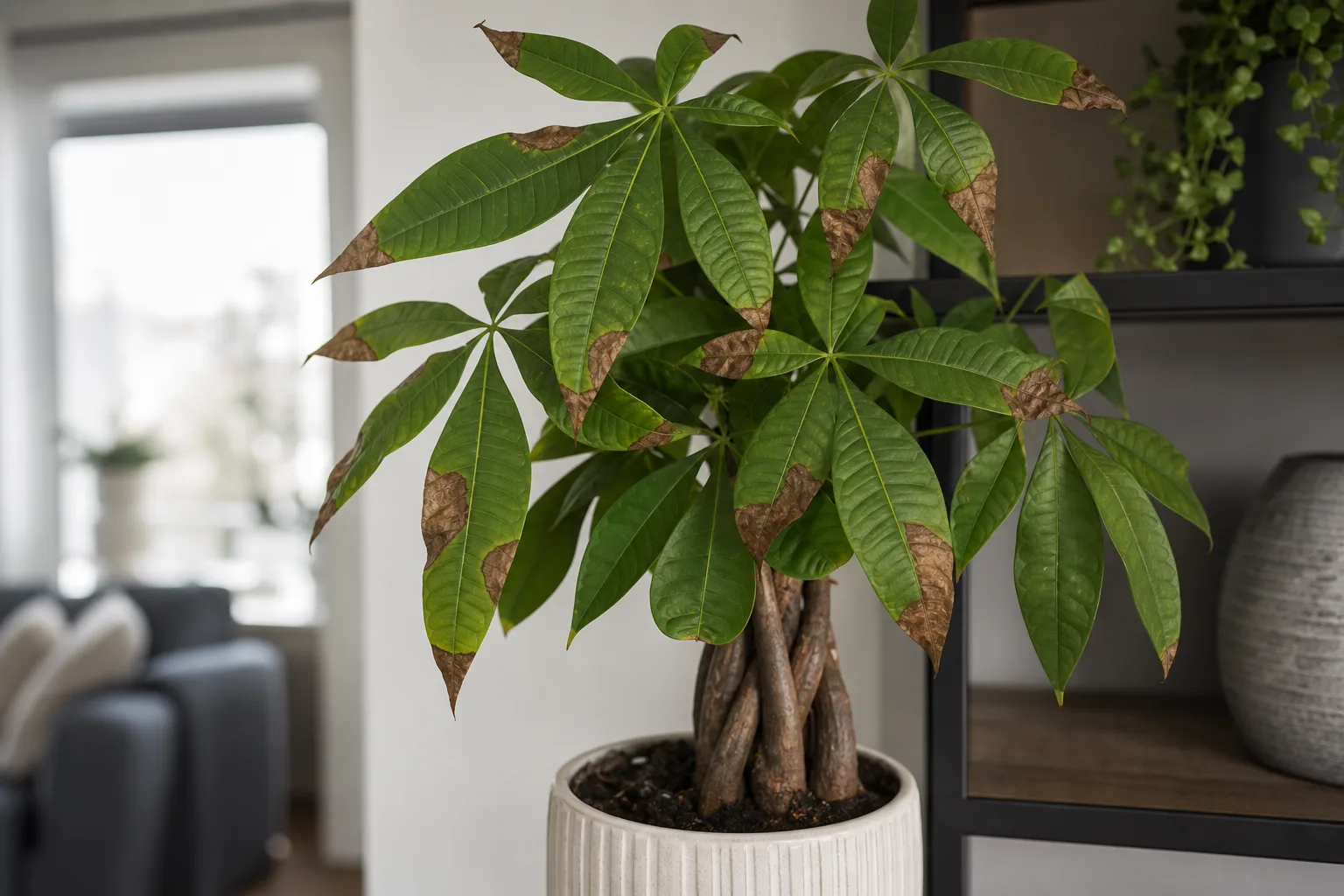
Brown Tips on Money Tree: Causes, Checks & Fixes
This guide covers brown tips on Money Tree. See also the general Brown Tips guide, watering, and light pages for this plant.
Brown Tips on Money Tree: Causes, Checks & Fixes
Quick answer
Money Tree (Pachira aquatica) is the braided desk tree with glossy, hand-shaped compound leaves-not a succulent or a fern. Brown tips here usually mean dry air near HVAC vents, inconsistent watering, or salt buildup from fertilizer-not a mysterious deficiency. The wetland label on the tag does not mean you should pour extra water because margins look crispy; that mistake pushes you toward root rot.
First step: place a hygrometer at canopy height and insert your finger 5 cm into the mix. If humidity reads below 40% or soil swings between bone-dry and soggy, fix those before trimming or fertilizing. Move the tree away from heating registers and AC blasts. Full species context: Money Tree overview. Watering rhythm: Money Tree watering guide.
This page covers reactive tip-burn diagnosis. For chronic dry-air management, see low humidity on Money Tree. For heavy salt crust or post-feeding burn, see the Money Tree fertilizer guide.
What brown tips look like on Money Tree
Each leaf is palmately compound-a long petiole ending in a fan of five to nine lance-shaped leaflets that look like an open hand. Tip burn shows as tan or brown crispy margins on one or more leaflets while the leaflet center and neighboring leaflets on the same hand often stay green.
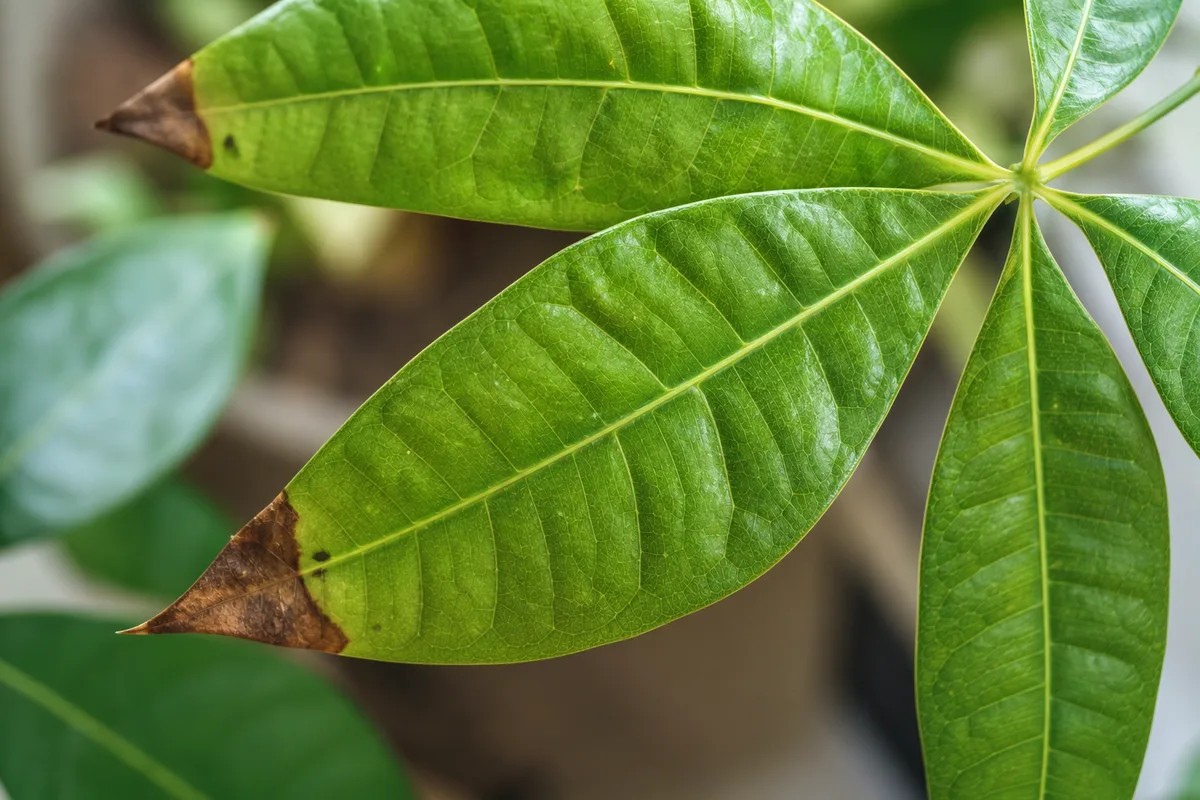
Brown Tips symptoms on Money Tree - compare with healthy tissue on the same plant.
Typical patterns:
- Symmetrical dry edges at leaflet tips and margins, dry to the touch-not wet brown patches with yellow halos
- Outer or vent-facing leaflets browning first on a compound leaf, while inner leaflets stay green longer
- Slow progression on older whorls before new terminal growth is affected
- Uniform tip necrosis across many leaflets after winter heating season or heavy fertilizer on dry soil
- Sun-side scorch on leaflets facing a hot window-bleached patches mixed with crisp edges, not margin-only burn on every leaflet
Unlike fungal leaf spot, tip burn does not spread as round lesions with concentric rings. Unlike root rot, tips can brown while the braided trunk still feels firm and soil moisture is inconsistent rather than permanently wet.
Why Money Tree gets brown tips
Desk and lobby placement near dry air
Commercial Money Trees are sold as feng-shui desk and reception plants, often within a meter of radiators, heat vents, or AC registers. Forced-air systems drop indoor humidity to 20–30% in winter while Pachira evolved in humid tropical wetlands. NYBG recommends roughly 50% humidity and notes that crispy, curling leaves in winter often trace to dry home conditions, inadequate light, or inconsistent watering-not always a single cause.
Large compound leaves transpire heavily. When air at the canopy is too dry, leaf margins lose water faster than roots replace it, and the thinnest tissue-tips and edges-dies first.
The wetland watering paradox
Pachira aquatica grows in freshwater swamps and estuaries outdoors, yet in a container standing water is not tolerated. Missouri Botanical Garden notes that houseplants perform best in bright light with moderate, even moisture-which still means a real dry-down between soaks.
Owners see brown tips and water more often, keeping mix wet at the surface while deeper soil cycles unpredictably. That pattern stresses roots without fixing margin desiccation and can invite rot. Chronic underwatering also browns tips when soil pulls away from the pot edge and leaflets droop between soaks-see underwatering on Money Tree when the pot feels light and dusty at 5 cm depth.
Salt buildup and heavy feeding
Fertilizer salts accumulate at the root zone and leaf margins, especially when feed is applied to dry soil or at full strength. Braided specimens in small pots concentrate salts quickly because multiple stems share one root mass. Widespread tip burn days after feeding strongly suggests salt stress-flush protocol below and the fertilizer guide for prevention.
Hard tap water and mineral crust
Hard municipal water leaves white crust on pot rims and soil surfaces over months. Mineral salts behave like fertilizer burn at leaflet margins. If crust returns after you flush, switch to filtered or rainwater for two to three watering cycles and compare new leaflet edges-see the Money Tree fertilizer guide for salt-management detail that overlaps with tip burn.
Direct sun on palmate leaflets
NC State warns that leaf scorch can occur from direct sunlight exposure. Afternoon sun through glass heats thin leaflets and burns the sun-facing side, sometimes with bleaching-not the symmetric margin pattern of humidity stress alone.
How to confirm the cause
Work through these checks in order. Stop when one cause clearly matches; you do not need every box checked.
- Hygrometer at canopy height - Readings below 40% with crisp margins support dry-air stress. Above 50% with ongoing tip burn shifts suspicion to salts or watering.
- Vent and window proximity - Is the braid or lowest leaflets within 1–2 m of a heat vent, radiator, or AC register? Is a south or west window baking one side of the canopy?
- 5 cm soil moisture - Insert your finger to the second knuckle. Bone-dry at depth with light pot weight points to underwatering. Damp days after watering with firm trunk but brown tips suggests salt or humidity, not rot. Wet and sour-smelling with soft braid-pivot to root rot, not humidity alone.
- Fertilizer history - Did tips appear within one to two weeks of heavy feeding or repotting with pre-charged mix?
- Tap water and salt crust - White residue on the pot rim or soil surface? Hard tap water and accumulated fertilizer both scorch margins over time.
- Trunk firmness at the braid base - Firm wood supports environmental tip burn. Spongy give means stop flushing and inspect roots immediately.
- Pattern on compound leaves - All leaflets on many hands with symmetric dry tips: humidity or salts. One sun-facing side only: light scorch. Stippling on undersides before edges brown: check for spider mites per spider mites on Money Tree.
- New growth check - If the newest terminal leaflets already show tips browning, the active stressor is still present-water chemistry, humidity, or light has not been corrected yet.
Confirmed tip burn: crispy symmetric margins, firm braid, no sour smell, pattern matches vent/humidity/salt/watering history. Not tip burn: soft trunk on wet mix, wet brown spots with halos, or stippling with webbing-use sibling guides instead.
First fix for Money Tree
Move the plant away from heating and AC blasts and measure humidity at the canopy.
That single placement fix addresses the most common desk-tree trigger without stacking repot, flush, and fertilizer changes on the same day. If humidity reads below 45%, add a pebble tray or room humidifier-NYBG suggests a tray of wet pebbles releasing moisture into the canopy to reduce winter crisping.
Only after placement and a hygrometer reading should you adjust watering to the 5 cm dry-down rhythm in the watering guide or flush salts if fertilizer timing matches the damage.
Step-by-step recovery
- Relocate at least 1 m from heat vents, AC registers, and hot window glass. Bright indirect light-not a dark corner where slow evaporation masks watering mistakes.
- Measure humidity at leaflet height for three days. Target 50–60% near the canopy during heating season.
- Trim dead tips with clean scissors, cutting only fully dry brown tissue and following the natural leaflet curve. Pachira aquatica is non-toxic to cats and dogs if you trim many leaflets-verify the tag says Pachira, not toxic jade.
- Correct watering - Water thoroughly when the top 5 cm of mix is completely dry, soak until runoff, then empty the saucer within 30 minutes. Do not increase frequency solely because tips are brown.
- Salt flush if needed - When tips followed heavy feeding and no trunk softness: slowly pour room-temperature water equal to roughly twice the pot volume through the mix until it runs clear from drain holes. Empty saucer immediately. Skip flushing if soil is already soggy or the braid feels soft.
- Hold fertilizer for four to six weeks after tip burn. Resume at half strength during active growth only-see the fertilizer guide.
- Watch the next two terminal whorls - New leaflet clusters should emerge with clean margins. Old damaged edges stay brown until trimmed.
Example recovery case
A 45 cm braided Money Tree on a reception desk 2 m from a radiator showed symmetric tan tips on outer leaflets of the three lowest palmate hands while inner leaflets stayed green. Canopy hygrometer read 28% RH; soil at 5 cm was dry but not pulling from the pot edge; braid base was firm.
Actions taken: moved the tree to a bright interior corner away from the vent, added a pebble tray, and held the existing 5 cm dry-down watering rhythm without extra soaks. No fertilizer flush-feed had not been applied in six weeks.
Outcome: new terminal whorls at branch tips emerged with clean margins in 18 days; older browned leaflet edges were trimmed for appearance. Humidity at canopy stabilized near 52% after relocation.
This pattern-outer leaflet tips first, low RH, firm braid-is the classic desk-placement tip burn, not root rot.
Recovery timeline
Existing brown tissue does not re-green. Expect clean margins on new leaflets within two to four weeks after humidity and watering stabilize. Chronic winter dry air may require a full heating season with consistent humidification before every whorl looks perfect.
If tips spread to new growth despite fixes, re-run the confirmation checklist-especially salt crust, trunk firmness, and whether overwatering is keeping mix wet too long.
Causes to rule out
| Symptom pattern | Likely cause | What to check | Guide |
|---|---|---|---|
| Crispy symmetric leaflet margins, firm braid | Low humidity, salt, or watering swings | Hygrometer, vent distance, 5 cm moisture, feed history | This page |
| Leaflets wilt on wet soil, soft braid | Root rot | Smell, trunk give, root color | Root rot |
| Droopy leaflets, light pot, dry 5 cm | Underwatering | Pot weight, soil gap from edge | Underwatering |
| Sun-facing bleached patches, one side only | Direct sun scorch | Window exposure, afternoon heat | Not enough light (placement) |
| Stippling + fine webbing on undersides | Spider mites | Mite inspection in dry air | Spider mites |
| White crust on soil, post-feed tip burn | Salt buildup | Rim residue, feed timing | Fertilizer guide |
What not to do
Do not increase watering frequency solely because tips are brown-the wetland label is not permission to keep mix soggy, and chronic wet soil kills Pachira roots. Do not apply full-strength fertilizer to “green up” tips on a stressed tree. Do not flush salts when the braid is soft or soil is already waterlogged-that can worsen rot. Do not mist heavily onto crowded leaflet whorls if fungal spots appear; fix humidity with a humidifier or pebble tray instead. Do not assume every brown edge is humidity-confirm watering and salts before buying another humidifier.
How to prevent brown tips next time
Keep the tree in bright indirect light away from HVAC drafts. Maintain 50–60% humidity at the canopy in winter with a humidifier or pebble tray. Water on the 5 cm dry-down schedule from the watering guide-not a fixed calendar. Fertilize lightly during active growth only, and flush salts occasionally if you feed regularly. Use filtered water in hard-water regions if white crust keeps returning on the pot rim.
Inspect new purchases after the move from greenhouse to dry office-acclimation tip burn in the first month is common and does not mean the plant is dying if you correct air and water quickly.
When to worry
Brown tips alone on a firm braid are usually cosmetic and low urgency. Escalate immediately when:
- Tips appear on most leaflets together with soft trunk tissue or sour-smelling soil-treat as possible rot, not humidity
- Widespread tip burn follows repotting plus heavy feed on dry mix-review watering and flush only if drainage is good and wood is firm
- New terminal leaflets keep browning for more than four weeks after humidity and watering fixes-re-check salts, light, and mites
Related Money Tree guides
- Money Tree overview - species biology, braided form, and baseline care rhythm
- Money Tree watering guide - 5 cm dry-down schedule and saucer protocol
- Low humidity on Money Tree - chronic dry-air management beyond one-time tip burn
- Money Tree fertilizer guide - salt buildup, flush timing, and feed dilution
- Root rot on Money Tree - when soft braid and wet soil override tip-burn diagnosis
- Overwatering on Money Tree - wetland paradox and oxygen-depleted mix
Conclusion
Money Tree brown tips are a localized stress signal on palmate leaflets-most often dry desk air, watering inconsistency, or fertilizer salts-not a death sentence. Confirm humidity at the canopy, soil moisture at 5 cm depth, and braid firmness, then move the plant off the vent path and stabilize water before trimming. Judge success by new leaflet margins, not old brown edges. For ongoing care rhythm, return to the Money Tree overview.