Money Tree Fertilizer: When, How & Mistakes
Money Tree Fertilizer: When, How & Mistakes
Money Tree Fertilizer: When, How & Mistakes
Money tree fertilizer is one of the easier houseplant feeding routines - until a braided Pachira aquatica in a small decorative pot shows brown leaflet tips, white crust on the soil rim, and sudden leaf drop after what felt like a harmless monthly dose. The species is a moderate feeder, not a hungry tropical, but retail specimens are often three to five saplings fused in one root zone with limited soil volume. Salts accumulate faster than owners expect, especially when hard tap water and half-strength liquid fertilizer stack in the same pot through a heated winter.
This guide is the dedicated feeding reference for Pachira aquatica. For active salt-burn rescue and tip-by-tip diagnosis, see brown tips on Money Tree. For pale or yellow leaves where light and water are the prime suspects, start with yellow leaves on Money Tree. The Money Tree overview covers the full care hub; here the focus is when to feed, what NPK to use, how to dilute safely, when to pause, and how to recover after over-feeding.
Reviewed by LeafyPixels Review Board · Author: sai-ananth · Methodology: botanical and extension references cross-checked against LeafyPixels plant-care data · Last reviewed: 2026-06-15
Why Fertilizer Matters for Pachira aquatica
Pachira aquatica - money tree, Guiana chestnut, Malabar chestnut - is a Malvaceae broadleaf tree native to freshwater swamps and riverbanks from southern Mexico to northern Brazil. Outdoors it can grow rapidly in wet soils; indoors it becomes a foliage houseplant in a few liters of potting mix, typically reaching 6 to 8 feet over many years in bright homes. Fertilizer does not replace good light, watering, or soil drainage - but once those are stable, light feeding during active growth replaces nutrients that watering and root uptake remove from a finite root zone.
Wetland Tree Biology and Indoor Pot Limits
The wetland label on the tag confuses feeding decisions. In habitat, nutrients arrive with flood cycles through open soil volumes. In a 20 cm nursery pot - often inside a cachepot - the same tree cannot dilute fertilizer salts across meters of soil. NC State Extension notes that yellow leaves can occur if humidity is too low or nutrients in the soil are inadequate, which is why pale new growth sometimes responds to conservative feeding after you have ruled out chronic overwatering. Missouri Botanical Garden adds that houseplants perform best in bright light with moderate but even moisture; fertilizer only supports growth that light and water already permit.
Braided retail specimens compound the salt problem. Several stems share one confined root mass, so the effective soil-to-foliage ratio is tighter than a single-trunk tree. Salts concentrate at the soil surface and along braid crevices where evaporation is slow - the same zones that trap moisture during overwatering. Feed lightly, dilute consistently, and treat white crust as a warning rather than a cosmetic flaw.
Compound-Leaf Flush as Your Feeding Signal
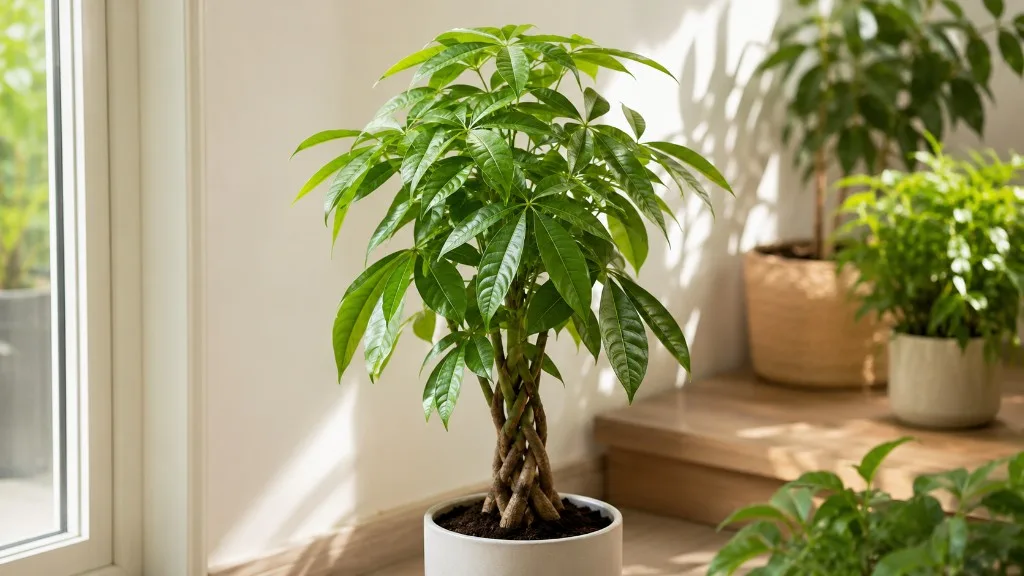
Money tree leaves are palmately compound - a petiole carrying five to nine glossy leaflets in a hand-shaped whorl. New whorls emerging at stem tips mean the plant is in active growth and can use diluted nutrients. No new leaves for weeks, winter dimness, or post-repot stress mean pause feeding regardless of what the calendar says. Healthy feeding produces deep green new leaflets on firm stems; fertilizer cannot fix a soft braided trunk or leggy stretch from low light.
When to Fertilize: Active Growth vs. Winter Rest
Feed Pachira aquatica only during its active growing season. New York Botanical Garden recommends a balanced organic fertilizer at half strength during the growing period (March through September) only. NYBG’s libguide specifies application every two weeks for vigorous specimens in ideal light - a reasonable ceiling for bright, actively flushing trees. For typical indoor braided plants in moderate light, a conservative monthly half-strength feed during the same window is safer and matches what most owners can sustain without salt creep.
Spring–Summer Feeding Window (March–September)
Resume feeding when you see new leaflet clusters swelling at branch tips - usually as days lengthen and the plant sits in adequate light. March through September is the Northern Hemisphere framework; adjust if your room runs hot and bright year-round with grow lights. Pair feeding with the flood-and-dry watering rhythm: a tree that is not using water is not ready for nutrients.
| Month | Feeding status | Notes |
|---|---|---|
| March–April | Resume at half strength | Start only after visible new growth; skip if recently repotted |
| May–August | Monthly half-strength feed | Peak compound-leaf production; brightest light period |
| September | Taper or final feed | Reduce if growth slows early; watch for autumn leaf drop |
| October–February | Pause | Dormant or slow roots cannot process surplus salts |
Fall Taper and Winter Pause
Stop fertilizer in late autumn when growth slows, even if your heated living room still feels tropical. Shorter days reduce photosynthesis and nutrient demand; continuing to feed invites soluble salt buildup that shows up as brown tips in January while owners blame watering. Exception: if the tree sits under strong supplemental grow lights fourteen to sixteen hours daily and keeps pushing new whorls through winter, you may feed once at half strength mid-season - then watch for crust and tip burn. When in doubt, skip.
Best Fertilizer Type for Money Trees
Use a balanced water-soluble fertilizer - equal or near-equal nitrogen, phosphorus, and potassium. Common label ratios such as 10-10-10 or 20-20-20 work well because Pachira wants foliage and structural growth, not heavy bloom feeding. The Royal Horticultural Society lists standard indoor culture in open, free-draining compost with bright light or partial shade; a balanced liquid fits that generalist houseplant profile.
Balanced Liquid NPK and Half-Strength Dilution
Always dilute to half the label’s recommended strength for container culture. Concentrated doses burn fine feeder roots and leave fertilizer salts that compete for soil moisture and scorch leaf margins. NYBG’s guidance to feed at half strength is the non-negotiable baseline for money trees.
Worked example: A standard 20-20-20 powder label often calls for 1 teaspoon per gallon (roughly 3.8 liters) of water for outdoor or greenhouse use. For your indoor money tree, use ½ teaspoon per gallon instead. For a 15–20 cm nursery pot that holds about 1–2 liters of mix, prepare one gallon of diluted solution, pour slowly until a little excess drains from the bottom, and discard runoff - do not let the cachepot reabsorb it. One diluted gallon feeds several small pots in the same session if you time them together.
Organic vs. Synthetic Options
NYBG recommends a balanced organic fertilizer at half strength - fish emulsion, seaweed blends, or organic balanced liquids are fine if you dilute equally. Synthetic 20-20-20 is not harmful when halved; it is predictable and easy to measure. Organic products sometimes smell and can attract fungus gnats if over-applied on constantly damp soil - another reason to feed only on a moist but not soggy root zone and to align with proper dry-down watering.
Liquid vs. Slow-Release for Braided Indoor Specimens
Liquid fertilizer at a known dilution is the default for braided indoor trees because you control dose per application. Slow-release pellets or spikes release unpredictably in small pots - heat, watering frequency, and pot volume all change release rate. One conservative option: a single half-rate granular application in early spring for owners who want low input, then plain water the rest of the season. If you choose pellets, bury them away from the braid base and never combine with monthly liquid unless the label explicitly allows it. When pellets and monthly liquid stack, salt burn follows.
How Often to Fertilize Indoor Money Trees
For most indoor braided Pachira aquatica in bright indirect light, once per month at half strength from March through September is the sweet spot between under-feeding and salt accumulation. That is slightly less aggressive than NYBG’s every-two-weeks schedule for vigorously growing plants in excellent conditions - appropriate because many retail trees live in moderate light and sealed display pots.
Trees in dim corners use fewer nutrients; feeding every six to eight weeks at half strength - or skipping entirely until light improves - beats monthly doses that build crust while slow growth persists. Trees in very bright, warm rooms flushing leaves weekly can move toward the biweekly NYBG cadence only if new growth stays deep green and no white rim crust appears. Skipping one month is safer than doubling after a missed application.
Step-by-Step: How to Feed Safely
- Check the calendar and the plant. Active new whorls? Not within four to six weeks of repotting? Not drought-stressed or dropping leaves from a recent move?
- Confirm soil moisture. The mix should be moist at root depth - not desert-dry, not waterlogged.
- Mix fertilizer at half label strength in a watering can. Stir thoroughly.
- Pour slowly across the soil surface, avoiding the braided trunk crevices.
- Stop when a little excess drains from the nursery pot holes. Empty the saucer or cachepot within fifteen minutes.
- Log the date. Plain water only until the next scheduled feed or until symptoms tell you otherwise.
Pre-Feed Checks and the Moist-Soil Rule
Never apply fertilizer to dry, stressed, or newly repotted roots. Dry fertilizer solution pulls moisture from root tissues and causes burn. Water the plant lightly the day before if the mix is dry at 5 cm depth, or feed immediately after a regular deep watering cycle once excess has drained. NYBG’s moist-soil-before-feed principle is the same logic extension services use for all container plants: nutrients need water as the carrier, but the carrier must not be a salt shock on desiccated roots.
If you see white crust on the soil surface, skip the scheduled feed and flush first using the recovery protocol below. Feeding on top of crust layers concentrates salts against stem bases - especially risky on braided trunks.
Worked Dilution Example for a 15–20 cm Pot
Assume a 10-10-10 liquid label reads 1 tablespoon (15 ml) per gallon for houseplants. Halve to 1½ teaspoons (7.5 ml) per gallon. Prepare the gallon, then pour approximately one-quarter to one-third of the gallon slowly through a 15–20 cm pot - enough to moisten the full root ball with a little drainage. Store unused diluted solution no more than a day; salts settle and organic mixes can sour. Never save undiluted concentrate in an unlabeled bottle.
Signs Your Feeding Schedule Is Working
The scorecard is visible growth quality, not fertilizer bottle emptiness. You are on track when:
- New compound-leaf whorls emerge at branch tips on a predictable seasonal rhythm
- Leaflets are deep, even green without widespread pale wash (after ruling out new light changes)
- Stems stay firm along the braid; no sudden leaflet drop after feeds
- Soil surface stays free of thick white crust between applications
- Growth rate feels steady relative to your light level - not explosive, not stalled for months
Moderate indoor trees may add only a few whorls per growing season. That is normal. Fertilizer supports the rhythm; it does not force bonsai-sized pots into ceiling-height trees in one summer.
Signs of Over-Fertilizing and Salt Buildup
Over-feeding is more common than under-feeding on money trees. University of Maryland Extension lists typical fertilizer toxicity symptoms: brown or dead leaf tips and margins, reduced growth, lower leaf drop, dead root tips, and wilting even when soil is moist. You may also see:
- White or yellow crust on the soil surface, pot rim, or drainage hole
- Sudden leaflet drop within days of feeding
- Stem softness at the soil line when salts damage roots and water uptake fails - distinguish from braid rot by checking whether the event followed a heavy feed on dry soil
- Tip burn that mimics low humidity but persists after humidity improves
Pale leaves alone often mean too little light or inconsistent water before they mean too little fertilizer. Run the diagnostic order from the overview: moisture, trunk firmness, light, then nutrition.
How to Flush and Recover After Over-Feeding
When crust or tip burn appears, pause all fertilizer for four to six weeks and leach accumulated salts. Nebraska Extension recommends leaching houseplants every four to six months as standard prevention, using roughly twice the pot’s water volume poured slowly until free drainage runs clear. University of Maryland Extension advises flushing with several volumes of pure water until excess drains - not a quick splash.
Flush protocol:
- Scrape off surface crust without removing more than 6 mm of soil.
- Move the pot to a sink. Water slowly with plain room-temperature water until drainage runs.
- Repeat until you have passed roughly two to three pot volumes of water through the mix.
- Let drain fully; empty saucers. Do not bottom-water during recovery.
- Resume half-strength feeding only after new healthy whorls appear and tips stay clean through one full growth cycle.
Badly burned leaflets will not green up retroactively; trim for appearance only after the plant stabilizes. If flush cycles fail and crust returns within weeks, repot into fresh well-draining mix and withhold feed through the establishment window described in the repotting guide.
Seasonal and Situational Adjustments
After Repotting, Stress, and Braided-Trunk Specimens
Skip fertilizer for four to six weeks after repotting so torn roots heal. NYBG notes money trees drop leaves when roots are disturbed too much; stacking fertilizer on that stress accelerates loss. The same withholding applies after major pruning, pest treatment with soap/oil, or a cold-draft relocation that triggered leaf drop. Resume only when new growth confirms recovery.
On braided specimens, pour at the soil perimeter, not down the braid channel. Salts and moisture trapped against fused stems cause localized burn that liquid feeding can worsen. If one stem in the braid weakens while others stay firm, reduce feeding and inspect for hidden bindings at the root flare - the same inspection the overview recommends on day one.
Hard Water and Double Mineral Load
Tap water high in calcium and magnesium leaves its own mineral salt deposits independent of fertilizer. Hard water plus monthly feeding doubles the crust risk on pot rims. If white deposits appear even when you feed lightly, leach with plain water between feeds and consider filtered or rainwater for sensitive specimens. University of Maryland Extension notes softened water can also carry elevated sodium - problematic for some houseplants - so know your water source before blaming fertilizer alone.
Fertilizer and Other Money Tree Care
Light, Water, and Soil Coupling
Fertilizer is the last layer, not the first fix. A money tree in dim light cannot metabolize monthly nutrients fast enough; salts accumulate while leggy growth continues. A tree in soggy mix cannot uptake nutrients even when fed on schedule - root rot follows. Bright indirect light, a chunky well-draining mix, and thorough dry-down watering must be stable before feeding matters.
Nutrient demand scales with photosynthesis. Move a tree to a brighter window in spring, and you may justify the monthly half-strength cadence. Move it to a dim corner for décor season, and pause or reduce feeds even if the calendar says June. Fix overwatering before increasing dose when soil stays wet and leaflets yellow.
Soil texture controls how salts move. Perlite-rich mix lets irrigation carry minerals through drainage holes; dense, compacted peat traps salts at the root crown where braided specimens show evaporation crust. Repot into fresh airy mix when crust returns after repeated leaching, and withhold feed for four to six weeks per the repotting guide.
Pruning and propagation cuttings follow the same stress logic - no fertilizer for the first month after major trim or while roots form. When tip burn persists after correct feeding and leaching, route to brown tips; when growth stalls despite good light, see slow growth before doubling dose.
Common Money Tree Fertilizer Mistakes
Feeding on dry soil after a missed watering week - instant root burn risk.
Full-strength label doses because “indoor plants look hungry” - half strength exists for containers.
Winter feeding on autopilot when no new whorls appear - salts accumulate while growth is idle.
Doubling the dose after skipping a month - causes tip burn; just resume normal half strength.
Slow-release pellets plus monthly liquid in the same small pot - unpredictable salt spikes.
Ignoring white crust and feeding on schedule anyway - crust is a stop signal, not decoration.
Treating every brown tip as fertilizer fault when sun scorch, low humidity, or hard water are equally likely - see brown tips before escalating feeds.
Foliar feeding as a shortcut - Pachira takes nutrients primarily through roots; foliar sprays add little for established potted trees and can spot leaflets in direct sun.
Money Tree vs. Jade Plant: Name Confusion and Safety
“Money tree” and “money plant” labels collide in shops and online listings. Pachira aquatica is a woody Malvaceae tree, often braided, with thin compound leaflets. Crassula ovata (jade plant) is a succulent with thick oval leaves on fleshy stems - different family, different feeding biology (jade wants leaner, less frequent feeding). The ASPCA lists Pachira aquatica as non-toxic to cats and dogs; jade is toxic to pets. Verify the botanical name on the tag before choosing fertilizer strength or trusting pet-safety assumptions.
Concentrated fertilizer solution is not the same as the plant itself - keep bottles capped, store out of pet reach, and rinse spills. Ingestion of fertilizer products warrants veterinarian contact regardless of plant toxicity status.
Author: sai-ananth. Reviewed by: LeafyPixels Review Board (2026-06-15). Methodology: Recommendations were checked against NC State Extension, New York Botanical Garden libguides, Missouri Botanical Garden, RHS Pachira aquatica guidance, and University of Maryland Extension salt-management bulletins, then mapped to braided indoor retail constraints.
Related Money Tree Care
- Money Tree overview - full care hub
- Money Tree watering - flood-and-dry rhythm before feeding
- Money Tree light needs - light drives nutrient use
- Money Tree soil - drainage and salt movement
- Money Tree repotting - post-repot withholding window
- Brown tips on Money Tree - salt burn vs. humidity
- Yellow leaves on Money Tree - overwatering first
- Slow growth on Money Tree - when feed is not the fix
Conclusion
Pachira aquatica rewards a boring feeding rule: balanced liquid fertilizer at half strength, roughly monthly from March through September, on moist soil, with a full winter pause. Braided indoor specimens tolerate less salt than the label suggests, so watch for white crust and brown leaflet tips, flush with plain water when deposits build, and withhold feed for weeks after repotting or stress. Fertilizer supports compound-leaf flushes that good light and watering already make possible - it cannot rescue a soft trunk, a sealed cachepot, or a dim-corner display tree. Confirm you are feeding a true money tree, not toxic jade, when pets share the room; then tune the calendar to new whorls, not guilt over a skipped month.
When to use this page vs other Money Tree guides
- Money Tree overview - Start here for whole-plant context before deep-diving this topic.
- Money Tree problems hub - Jump to symptom-specific fix guides when this care topic does not resolve the issue.