Money Tree Light Needs: Best Window, Sun & Warning Signs
Money Tree Light Needs: Best Window, Sun & Warning Signs
Money Tree Light Needs: Best Window, Sun & Warning Signs
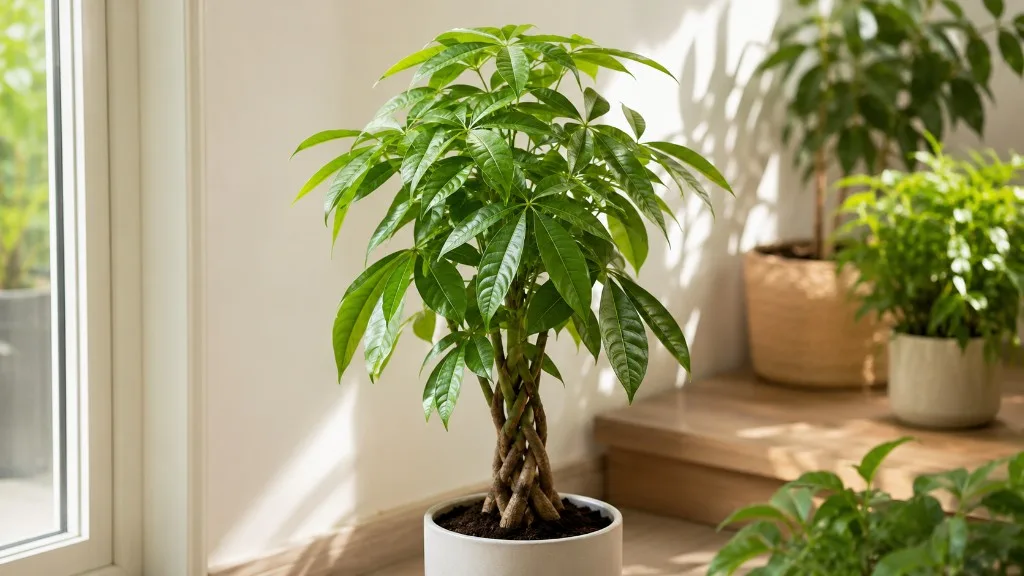
A braided money tree on the wrong windowsill does not fail dramatically - it stretches quietly, drops lower whorls, and leaves you wondering whether the problem is water, luck, or feng shui. The real variable is usually plant-facing light, not room brightness. Pachira aquatica is a wetland tree grown indoors as a foliage specimen; it wants bright indirect light strong enough to push compact new whorls without scorching leaves that formed under store lighting. Place the pot where new growth proves the exposure works, then adjust watering to match the brighter or dimmer metabolism you created.
Why Light Matters for Pachira aquatica
Money tree is not a low-light foliage mat like some philodendrons, and it is not a full-sun succulent. It is a broadleaf evergreen tree from freshwater swamps and river banks in Mexico and northern South America - habitat where juvenile plants grow under taller canopy with filtered brightness rather than all-day blazing exposure. Indoors, that biology translates to bright indirect light: strong ambient brightness at the leaf surface without prolonged harsh direct beams through glass.
Light controls how fast the braided trunk pushes new leaf whorls, how tightly those whorls stack, and how quickly the pot dries after you water. A money tree in insufficient light may look fine for months while internodes stretch and lower leaves yellow from shade-induced senescence. A plant moved too fast into hot south glass can show bleached or crisp patches within days. Both outcomes trace to light, not mystical “luck.”
Wetland Origins and Indoor Brightness
In native range, Pachira experiences seasonal flooding and high humidity - conditions that do not map to a dim apartment corner. Missouri Botanical Garden notes that houseplants perform best in bright light with moderate, even moisture. Outdoors they accept full sun to part shade; indoors the practical target is the part-shade end: bright ambient light without baking leaf tissue against hot glass.
NYBG reference staff describe store-bought specimens as juvenile plants that would be shaded by taller vegetation in habitat - a useful mental model for why a tree held under fluorescent retail lighting scorches when you set it on a south sill the first weekend home. The plant is not fragile; it is not acclimated to the intensity jump.
Tree Form, Whorls, and Canopy Density
Unlike trailing vines, money tree grows as an upright tree with palmate whorls at stem tips. Each whorl needs enough photons to stay compact; when light is weak, internodes lengthen, stems lean toward the brightest vector, and the canopy opens so lower whorls receive even less light and drop. That pattern is easy to misread as leggy growth caused by fertilizer or age when the throttle is simply photons.
Canopy density also changes how you read stress. A dense top whorl in good light shades lower leaves - some lower yellowing is normal senescence. In low light, the whole plant thins from the bottom up while the top whorl stretches toward the window. Judge by newest whorl spacing and color, not by whether older lower leaves eventually fall.
Best Light for Money Tree
The baseline recommendation across botanical references is bright indirect light. RHS advises growing indoors in bright light or partial shade. NC State lists cultural light as partial shade - direct sunlight only part of the day, roughly two to six hours - a range that includes gentle morning direct sun on an east exposure plus strong indirect brightness the rest of the day, not a dark hallway.
In practical home terms, bright indirect light means the leaf surface receives strong, readable ambient brightness without the leaf heating up under continuous direct beams. On a clear day, hold your hand between the plant and the window: a soft but defined shadow usually indicates bright indirect range. If the shadow is faint, you are in low light - survivable short term, weak for long-term tree form. If the leaf feels hot within an hour of sun hitting it, you are in direct exposure that may need filtering or distance.
Money tree tolerates medium indirect light for a while, especially if watering is conservative, but growth slows, whorls space out, and the plant becomes more vulnerable to root stress because transpiration drops. Treat medium light as a holding zone, not the goal for a braided display specimen.
Best Window Placement by Exposure
Window direction is a starting point, not the whole answer. Overhangs, neighboring buildings, tree shade outside, sheer curtains, and pot distance all change intensity at the leaf. These notes assume northern-hemisphere glass; southern-hemisphere readers should mirror exposures (your north sun behaves like northern south sun).
Place the pot where leaves receive light, not where the room looks bright to your eyes. A money tree on a console across the room is decoration. A pot within a few feet of appropriate glass is horticulture.
North, East, South, and West Compared
| Exposure | Typical intensity | Money tree suitability | Notes |
|---|---|---|---|
| North | Low to moderate indirect | Survival, not ideal | Growth slows; pair with grow light for vigor |
| East | Moderate direct morning + bright day | Best default | Morning sun is cooler; whorls stay compact |
| South | High; strong direct mid-day | Good with distance or sheer | Best 0.9–1.5 m back or behind curtain |
| West | High late-day heat load | Use caution | Filter afternoon sun; watch summer scorch |
An east-facing window is the safest default for most homes. Two to three feet from an unobstructed east pane often delivers the bright indirect range where new whorls stay tight without constant scorch monitoring. NC State’s partial-shade guidance maps cleanly to morning direct period + bright indirect day length.
A south-facing window delivers the highest total daily light - valuable in winter at mid latitudes, risky in midsummer when glass concentrates heat. Set the pot roughly 3 to 5 feet (0.9–1.5 m) back from the pane, or hang a sheer curtain to soften direct beams. Watch top whorls facing the glass for bleached patches - the first sign to pull back.
A west-facing window can work in spring and fall and become stressful in midsummer when late-afternoon sun carries heat. Treat west like south with extra filtration, not like east with bonus hours.
A north-facing window provides gentle indirect light all day but often lands below the growth threshold for tree-form specimens. Money tree may persist but push little new growth; NYBG notes that poor light can trigger leaf drop and decline over time. If north is your only option, plan supplemental lighting rather than hoping tolerance equals preference.
Distance From the Glass Matters
Compass labels fail when distance is wrong. A south window six feet away on an open floor may deliver less usable light at the whorl than an east window two feet away with a pale wall reflecting brightness behind the plant.
Use distance as a dimmer switch. Closer increases intensity and heat; farther softens direct sun but may drop below the growth threshold. Practical starting points for average home windows: 2 to 3 feet (0.6–0.9 m) from east or filtered west panes; 3 to 5 feet (0.9–1.5 m) from unobstructed south panes; as close as possible to north panes if that is your only option, with expectations adjusted for slow growth.
Seasonal adjustment beats permanent guessing. Move the pot closer in winter when sun angle drops and slightly back in midsummer if leaf surfaces heat up. One foot of movement can matter more than switching exposures.
Can Money Tree Take Direct Sun?
Yes - with conditions. Money tree can handle some direct sun, especially gentle morning exposure on an east windowsill or filtered direct light through sheer fabric. NC State warns that leaf scorch can occur from direct sunlight when intensity exceeds what acclimated tissue tolerates - particularly on leaves formed under dim store lighting.
Problems start when intensity jumps faster than the plant adjusts. A braided specimen grown under fluorescent retail display and then placed on an unfiltered south sill in July may develop permanent bleached or crisp patches on the top whorl within 48 to 72 hours. Direct sun through glass also concentrates heat at the leaf surface. Money tree leaves do not recover from scorch; damaged tissue stays cosmetic until replaced by new growth.
Treat direct sun as a tool after acclimation, not a default for every window. MOBG notes outdoor culture in full sun to part shade; indoors, part-shade behavior - bright indirect with optional morning rays - is the safer match for container specimens.
A 7–14 Day Acclimation Timeline
Acclimation is non-negotiable when upgrading light. Move a low-light plant toward brighter exposure in stages over one to two weeks, not in one afternoon.
Days 1–3: Place the pot in the target room but several feet back from the final window position. Watch the top whorl for curling during brightest hours.
Days 4–7: Move halfway to the intended distance. If you see bleaching, step back and hold for three more days.
Days 8–14: Settle at the final spot unless stress appears. New whorls should emerge firm and evenly green - not pale, not crisp at margins.
Worked example: A braided 15 cm nursery money tree placed 0.5 m from an unfiltered south window developed bleached top whorls within 72 hours. Moved 1 m back behind a sheer curtain, with no other care changes, it pushed firm new leaves over the following three weeks. Old bleached tissue remained visible; the diagnostic win was healthy new whorls.
Store-bought trees often arrive from low-light retail displays. Quarantine in moderate indirect light for a week before pushing toward your brightest window. Do not combine a major light jump with repotting and feeding in the same week - change light first; let new growth confirm success.
Low-Light Limits and Warning Signs
Money tree puts up with lower light longer than many flowering tropicals, but NYBG is clear: specimens in poor light may slowly decline and lose attractive form, sometimes dropping leaves seasonally as if entering dormancy. Low light is a poor long-term setup, not a personality trait.
The common failure mode is not instant death but slow stretch masked by thick stems. Soil stays wet longer because transpiration drops. Lower whorls yellow and fall while the top whorl reaches toward the window. By the time the trunk looks bare, beginners blame watering alone and miss the light root cause.
Too little light typically shows as absent or very slow new whorls, longer internodes on new growth, smaller or paler new leaflets, overall lean toward the brightest vector, soil that stays moist too long, and increasing resemblance to the leggy growth pattern. Office ceiling fluorescents alone, with no window within a few meters, usually land here within months.
Too much light or heat shows as bleached white or yellow patches on sun-facing leaflets, crisp brown edges on the top whorl, sudden leaf collapse after an unacclimated move, and curling during brightest hours that repeats daily. Unlike low-light pale stretch, sunburn creates permanent cosmetic damage on affected tissue.
How dark is too dark for a tree you actually want to grow? If no new whorl has opened in nine or more months and stems lean sharply, you are below the growth threshold. If the pot takes more than three weeks to dry at root depth in normal indoor temperatures, light is likely too low for safe metabolism. Short-term dim placement during a room renovation is reasonable; multi-year dark-corner storage is not.
Using Grow Lights
When windows cannot deliver enough daily brightness - windowless rooms, deep interior offices, north-only exposures in winter, or shelves far from glass - full-spectrum LED grow lights close the gap more reliably than hoping tolerance equals preference. Money tree responds well to supplementation because it needs moderate PAR levels, not flowering-crop intensity.
Choose a fixture labeled for houseplants or seedlings, not a standard room bulb optimized for human lumens. UF/IFAS notes that fluorescents and LEDs are appropriate grow-light sources, with broad-spectrum or cool-white tubes suitable for foliage maintenance.
Distance, Hours, and Spectrum
University of Minnesota Extension recommends positioning supplemental lights 12 to 24 inches (30–60 cm) above foliage houseplants as a starting range, adjusting based on leaf response. Run lights 12 to 14 hours daily on a timer to mimic natural day length; consistency matters more than chasing exact photoperiod science at home.
Practical starting protocol for a tabletop braided money tree under a single full-spectrum LED panel:
- Height: 18 inches (45 cm) above the top whorl
- Duration: 12 hours on, 12 hours off
- Adjustment: If new whorls stretch toward the lamp, lower slightly or add an hour; if leaf edges crisp only under the beam, raise the fixture 2–3 inches
Coverage beats pinpoint intensity. A narrow bulb over the center of a wide canopy leaves outer leaflets in shadow. Use a bar or panel that spans the pot, or rotate the plant a quarter turn every week under a clip-on lamp. Integrate grow lights with seasonal natural light - a mediocre north window plus supplemental LED often outperforms either source alone.
When you add a lamp, revisit watering checks after two weeks; brighter total daily light increases dry-down rate even if the window did not change.
How to Move or Rotate Safely
Sudden light shifts stress Pachira more than gradual ones. Moving from a dim corner to a bright east window in one step usually succeeds; jumping to unfiltered south glass in one step often does not. Change one placement variable at a time, then wait two to three weeks to read the newest whorl before adjusting water or fertilizer.
Rotation keeps braided specimens symmetrical. NYBG recommends rotating each time you water for balanced development - a simple rule that prevents permanent lean without over-handling the pot. A quarter turn per week is enough for most homes if you water weekly; twice-monthly rotation works if growth is slow in winter.
When relocating rooms, match temperature stability where possible. Drafty HVAC blasts and hot radiator sills compound light stress even when foot-candles look acceptable. Avoid placing the trunk where it presses against cold glass in winter - leaf tissue can damage from chill even under bright light.
Read Light Stress on New Growth
Old damage is historical. New whorls tell you whether today’s placement works. After any move, ignore pre-existing yellow lower leaves or old scorch patches; watch the newest five-leaflet whorl for spacing, color, and firmness.
A healthy light response looks like compact whorl spacing, glossy deep green leaflets, and firm texture when you gently flex a new leaflet. A low-light response looks like smaller leaflets on longer stems, lighter green color, and visible lean within one growth cycle. A high-light or heat response looks like bleaching at leaflet tips, dry crisp margins, or stalled whorl opening after scorch shock.
Give each placement 14 days minimum before verdict in spring and summer, 21 days in winter when growth slows. Money tree is not a fast-feedback plant like a coleus; whorl cycles take time.
Light and Watering Together
Light is the throttle on money tree metabolism even though watering gets blamed first. Brighter light increases photosynthesis and transpiration; dim light slows both. A watering rhythm that worked on a bright windowsill will overwater the same plant in a dim corner because the root zone stays saturated longer - especially in a large pot that already dries slowly.
After any light increase, check moisture more frequently for the first month, but still follow the finger-depth dry test before soaking - wetland native biology does not mean roots want constant sogginess indoors. After a light decrease, extend dry intervals and skip fertilizer until new growth confirms the plant is still active. Do not feed your way out of insufficient light.
This page stays focused on photons. Pot mix, drainage, and saucer hygiene live on the Money Tree soil guide; repot timing on the repotting guide.
Braided Money Tree: Display, Lean, and Rotation
Most indoor money trees are multiple stems braided when young for ornamental trunks. Braiding does not change light requirements, but it changes how you read lean. The fused trunk base cannot twist toward the window; instead, individual stems above the braid arc, and the top whorl compensates with directional growth.
Correct lean with rotation and light, not aggressive pruning. Move the pot so the brightest exposure is even across the whorl plane, rotate a quarter turn on a regular schedule, and avoid placing the tree where one side sits in shadow behind furniture. Persistent lean with long internodes on the shaded side confirms insufficient light - see the leggy growth guide if whorls keep spacing out after light improves.
Display aesthetics often conflict with horticulture: a money tree looks balanced on a central coffee table but receives fractional window light compared with a sill placement. If you choose a low-light display location for design reasons, commit to a grow light rather than expecting the braid to stay full on ambient room brightness alone.
Related Money Tree Guides
Light sits at the center of money tree care, but it never acts alone. Use these sibling guides when placement changes ripple into other routines:
- Money Tree overview - hub for habit, size, and quick reference
- Watering Money Tree - moisture checks that shift when light changes
- Money Tree soil and drainage - why dim corners plus heavy mix fail together
- Repotting Money Tree - snug pots and when to upsize
- Leggy growth on Money Tree - when stretch persists after light improves
Conclusion
Money tree light needs reduce to one practical rule: bright indirect light proven by compact new whorls, not by how bright the room looks. Pachira aquatica tolerates medium light and some acclimated morning sun, but tree-form indoor specimens look and grow best near east windows or filtered south and west exposures with enough setback to avoid hot glass. Move brighter in stages over 7–14 days, read stress on the newest whorl, and pair any light upgrade with adjusted watering checks.
When natural windows fall short, a full-spectrum LED 12 to 24 inches above the canopy for 12–14 hours daily beats years in a dim corner. Rotate braided plants on a regular schedule, link stretch and lean to photons before reaching for scissors, and remember that old scorch scars never green up - but the right placement today still produces clean new leaves tomorrow.