Leggy Growth on Money Tree: Causes, Checks & Fixes
Quick answer
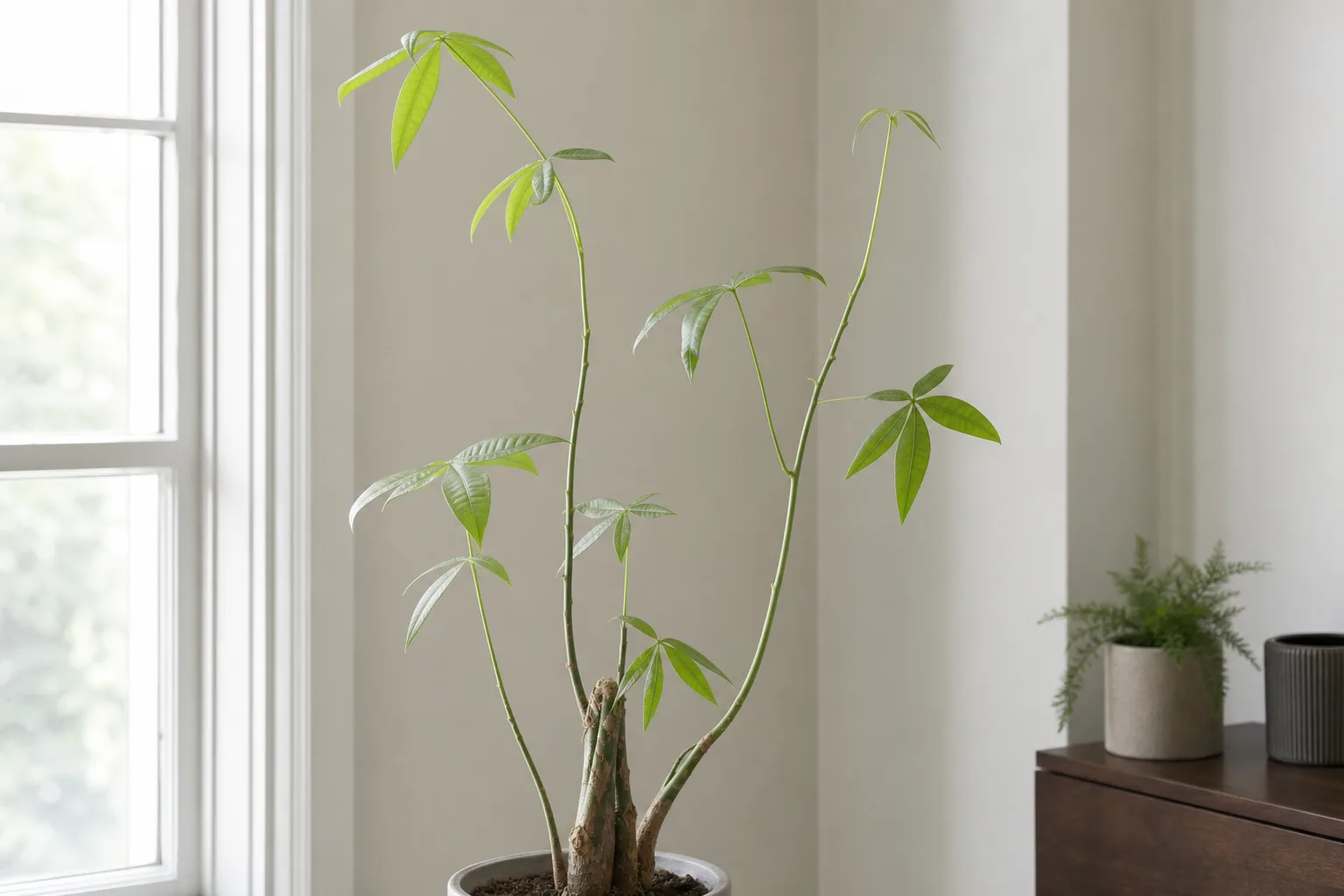
Leggy Money Tree (*Pachira aquatica*) shows long petioles, smaller compound leaflets, and stems leaning toward the brightest window-almost always from insufficient bright indirect light. First step: move to brighter filtered exposure (east or filtered south/west) and rotate weekly; prune stretched stems above a node only after new growth proves light is adequate.
Leggy Growth on Money Tree: Causes, Checks & Fixes
This guide covers leggy growth on Money Tree. See also the general Leggy Growth guide, watering, and light pages for this plant.
Leggy Growth on Money Tree: Causes, Checks & Fixes
Quick answer
Leggy growth on Money Tree is etiolation-the plant stretching toward usable light because photosynthesis is limited. On Pachira aquatica, that shows up as long petioles, smaller leaflets on compound leaves, sparse whorls along upright stems, and often a one-sided lean toward the brightest window. Braided store specimens can look top-heavy when one free stem outgrows the others.
First step: increase bright indirect light before you prune. Move the pot within one to three feet of an east window, or a filtered south or west exposure, and rotate a quarter turn weekly. Wait two to three weeks and watch the newest whorl-tighter spacing means light was the limiter. Only then shorten the longest free stems above a node.
This page covers leggy form and stretch recovery-etiolation diagnosis, light correction, and trunk pruning on tree-form Pachira. If your main symptom is a dim-room placement with washed-out color and almost no growth, start with not enough light on Money Tree first; if growth has stalled entirely in warm weather, see slow growth.
What leggy growth looks like on Money Tree (Pachira aquatica)
Money Tree is a woody tree-like houseplant with palmately compound leaves of five to nine leaflets on long petioles-not a vine and not a typical moss-pole climber. Leggy etiolation is a shape and light-response pattern, not a single damaged leaflet.
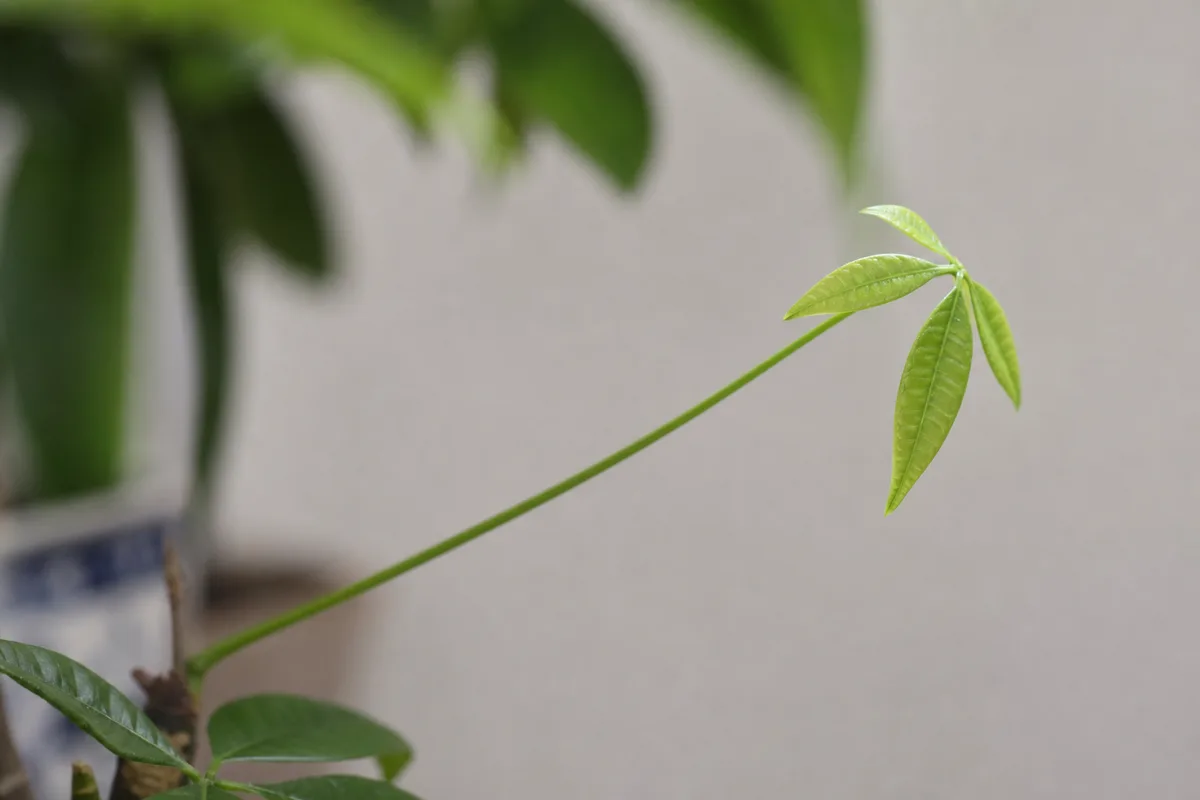
Leggy Growth symptoms on Money Tree - compare with healthy tissue on the same plant.
Typical leggy-growth signs:
- Long gaps between leaf whorls on free stems above the braided base-internodes visibly longer on new growth than on older compact sections
- Smaller leaflets on the same compound leaf compared with leaves formed in brighter light
- Strong lean toward one window or light source; the canopy grows asymmetrically
- Thin upright stems racing upward with foliage concentrated at the top
- One dominant stretched trunk on braided specimens while shorter stems stay compact below
- Top-heavy silhouette that may need the pot repositioned or a stem shortened after light improves
Compare with not enough light on Money Tree: that guide covers broader light deficiency-pale color, stalled flowering expectations, and dim-room survival. Leggy growth emphasizes stretch geometry (long petioles, sparse whorls) even when the plant still produces new tissue.
Leggy form differs from slow growth on Money Tree: a stalled plant adds almost no new leaves for weeks. A leggy Money Tree often grows upward quickly while refusing to stay compact.
Why Money Tree gets leggy growth
Insufficient bright indirect light (primary cause)
Pachira aquatica prefers indirect sunlight or a mix of sun and shade and houseplants perform best in bright light with moderate, even moisture. When light at the leaf surface is too weak, the plant elongates petioles and stems to reach a brighter zone-a survival response called etiolation.
Interior corners, north rooms with no supplemental lighting, shelves far from windows, and winter short days are common triggers. Money Tree may survive low light for a while but loses vigor and produces smaller, stretched growth rather than the compact tree form you see in nurseries.
One-sided exposure and seasonal dimming
Even adequate rooms can produce leggy lean when only one side receives usable light. Growth follows photons; the canopy tracks the brightest direction. Autumn and winter shorten effective daylight-plants that looked fine in summer can stretch by February without a window or grow-light adjustment. See Money Tree light needs for window targets and grow-light setup.
Lack of corrective pruning after stretch
In native habitat, Pachira grows as an upright tree with a rounded canopy. Indoors, without occasional heading cuts on free stems, one leader can dominate and look “skinny” even after light improves. Pruning does not replace light-it reshapes the tree once energy intake is adequate. Full cut placement and braid rules live on the Money Tree pruning guide.
Low light plus wet soil (overlap, not a separate cause)
Dim light slows water use. A leggy Money Tree in a dark corner with chronically wet mix may also be heading toward root stress. If yellow leaflets, sour smell, or a soft trunk base appear alongside stretch, inspect moisture before heavy pruning. See overwatering and root rot when wet soil and decline dominate.
Leggy growth vs not enough light - which guide to read
| What you see most | Start here | Why |
|---|---|---|
| Long petioles, sparse whorls, top-heavy lean, stretch geometry | This page (leggy growth) | Etiolation shape + recovery pruning path |
| Dim room, pale color, poor vigor, flowering stopped | Not enough light | Broad light deficit |
| Almost no new leaves for weeks in warm weather | Slow growth | Stall, not just stretch |
| Window placement, grow lights, acclimation | Money Tree light | Full light baseline |
| Node cuts, braid limits, one-third rule | Money Tree pruning | Structural shaping detail |
Both pages can apply to the same plant. When stretch and window lean are obvious, work light first, then prune once compact new whorls prove the fix.
How to confirm the cause
Run this Money Tree–specific checklist before Money Tree repotting guide or fertilizing:
- Newest whorl spacing - Compare the gap between the last two compound-leaf sets on the tallest free stem. Longer gaps on new growth than on older sections below confirm ongoing etiolation.
- Window distance - Is the pot within one to three feet of an east window or filtered south/west glass? Distant shelf placement strongly supports light as the limiter.
- Lean direction - Growth pointing toward one window confirms phototropism from uneven or weak light. Note which side stays shaded.
- Leaflet size trend - Smaller leaflets on the newest compound leaf versus slightly older leaves in the same whorl pattern suggests light stress, not nutrient deficiency alone.
- Two-week light test - Move to the brightest safe indirect spot (not harsh unfiltered south sun). Rotate weekly. Tighter new whorls within two to three weeks confirm light was the cause.
- Soil moisture in dim spots - Push a finger 5 cm into the mix. Wet soil for many days while stems stretch suggests low light slowing dry-down-cross-check watering rhythm and overwatering guides.
- Trunk firmness at the braid - Press the base. Firm wood supports a light-first plan. Spongy give means escalate to root rot assessment before pruning living canopy.
Confirmation signal: The next compound leaf emerges with shorter petioles and fuller leaflets after brighter placement. If new growth stays pale and widely spaced after a light upgrade, add supplemental lighting per Money Tree light needs before the next corrective step.
First fix: increase bright indirect light before heavy pruning
Move the plant to bright indirect light-the same target as Money Tree light needs: east window, bright north exposure, or filtered south/west light where leaflets receive strong ambient light without scorch.
Acclimate gradually. Leaves formed in deep shade burn if jumped to harsh direct sun. Increase exposure over one to two weeks-closer to the window by inches every few days, or a sheer curtain on strong south/west glass. Direct sun can scorch Pachira leaves without acclimation.
Rotate the pot a quarter turn weekly so all sides of the canopy receive light and the tree does not keep leaning one direction.
Hold fertilizer until new compact growth appears. Feeding a stressed, etiolated plant does not shorten internodes.
Grow-light setup for dim rooms
When natural light is insufficient-especially in winter-add a full-spectrum LED grow light 30–45 cm (12–18 inches) above the canopy for 12–16 hours daily, matching guidance on not enough light on Money Tree. Timer consistency matters more than all-day random exposure. Watch leaf temperature; bulbs too close can scorch leaflets even when stretch stops.
Pruning stretched trunks after light improves
Pruning alone in shade produces weak side shoots that stretch again. Once two to three weeks of brighter light produce tighter new whorls:
- Identify free stems above the braid-never cut into the fused braided trunk section; severing the braid destabilizes the plant.
- Shorten the longest stretched stems with clean, sharp shears, cutting about ½ inch (1.3 cm) above a healthy node where a leaf petiole meets the stem.
- Limit any single session to one-third of total foliage-stage severe reduction across two spring sessions if multiple stems need shortening.
- Remove one dominant leader on braided specimens if one trunk outgrew the others-balance the canopy, do not strip all leaves at once.
- Pinch or remove base suckers separately if they compete with the main form.
Best timing for structural cuts: late spring through early summer when active growth resumes. Emergency dead or yellow material can be removed anytime. Step-by-step diagrams and braid photos: Money Tree pruning guide.
Staking note: Money Tree does not need a moss pole. If a top-heavy braided specimen leans dangerously before you can prune, stabilize the pot temporarily-not as a substitute for light and heading cuts.
Recovery timeline
Expect tighter new whorls within two to three weeks after a meaningful light upgrade in warm indoor conditions (roughly 18–27°C / 65–80°F). New shoots after heading cuts typically appear within two to four weeks during active growth.
Old stretched petioles and internodes never shorten. Elongated sections above the braid remain long; success means compact new compound leaves and optional side branching below your cuts.
If no improvement appears after three weeks in a clearly brighter spot, add grow lights, verify roots are firm in appropriately dry mix, and review slow growth if the plant adds almost no tissue.
Lookalike symptoms to rule out
Not enough light (general) - Broader dim-room syndrome: pale color, poor vigor, flowering unlikely indoors. See not enough light on Money Tree.
Slow growth - Little or no new tissue for weeks despite warm temperatures. Different from vigorous upward stretch. See slow growth on Money Tree.
Overwatering in dim corners - Yellow leaflets, soggy mix, soft trunk base. Stretch can coexist; root trouble needs separate treatment. See overwatering and root rot.
Normal winter pause - Slower whorl production in cool, short-day months without dramatic internode gap increase may be seasonal, not etiolation. Re-check light in February if stretch accelerates.
What not to do
Do not prune heavily before fixing light-side shoots need photosynthesis to stay compact.
Do not move a shade-grown Money Tree to unfiltered south-window sun in one step; acclimate to prevent leaf scorch.
Do not over-fertilize to compensate for low light; salts stress roots without shortening internodes.
Do not install a moss pole expecting a tree-form Pachira to climb-it will not fix etiolation.
Do not cut into the braided trunk base; prune only free stems above the braid.
Do not stack repotting, heavy pruning, and pesticide on the same day-one major stress at a time.
How to prevent leggy growth next time
Place for bright indirect light first, décor second-within one to three feet of suitable window glass per Money Tree light needs.
Rotate weekly so the canopy grows evenly and does not lean permanently toward one side.
Reassess light each autumn when daylight shortens; add grow lights before internode gaps widen.
Schedule light corrective pruning in spring if free stems outpace the braid-shorten above nodes before one leader dominates the silhouette.
Match watering to dry-down in brighter light; faster photosynthesis means faster water use. See Money Tree watering.
Keep species context handy on the Money Tree overview when diagnosing new symptoms.
When to worry
Pure legginess is a cosmetic and light-management issue-your Money Tree is not dying because stems stretched.
Escalate when:
- Soft or spongy trunk tissue at the braid with wet soil and yellow leaflets-possible root rot, not etiolation alone
- Rapid leaf drop after a harsh light move without acclimation
- No tighter whorls after three to four weeks in bright indirect light plus supplemental lighting-reassess roots, pests, or true stall
- Top-heavy lean that risks pot tip-over-shorten free stems or stabilize the pot while you correct light
Gradual stretch over weeks is fixable with light and optional pruning-no panic, but do not wait until lower stems are bare wood with all foliage at the ceiling.
Conclusion
Leggy Money Tree growth is the plant telling you it needs more usable light, not a moss pole or fertilizer boost. Move to bright indirect exposure, rotate weekly, and confirm tighter new whorls before you shorten stretched free stems above nodes. Old elongated petioles will not shrink-compact new compound leaves are the proof the fix worked. For window targets and grow lights, use Money Tree light needs; for cut placement and braid rules, use Money Tree pruning. Related problems: not enough light, slow growth, overwatering.
When to use this page vs other Money Tree guides
- Money Tree watering guide - Use for routine moisture checks before assuming leggy growth is the main issue.
- Money Tree problems hub - Browse all 4 common issues on this species.
- Yellow Leaves on Money Tree - Different entry point when symptoms overlap with leggy growth.