Mealybugs on Fittonia: Causes, Checks & Fixes
Quick answer
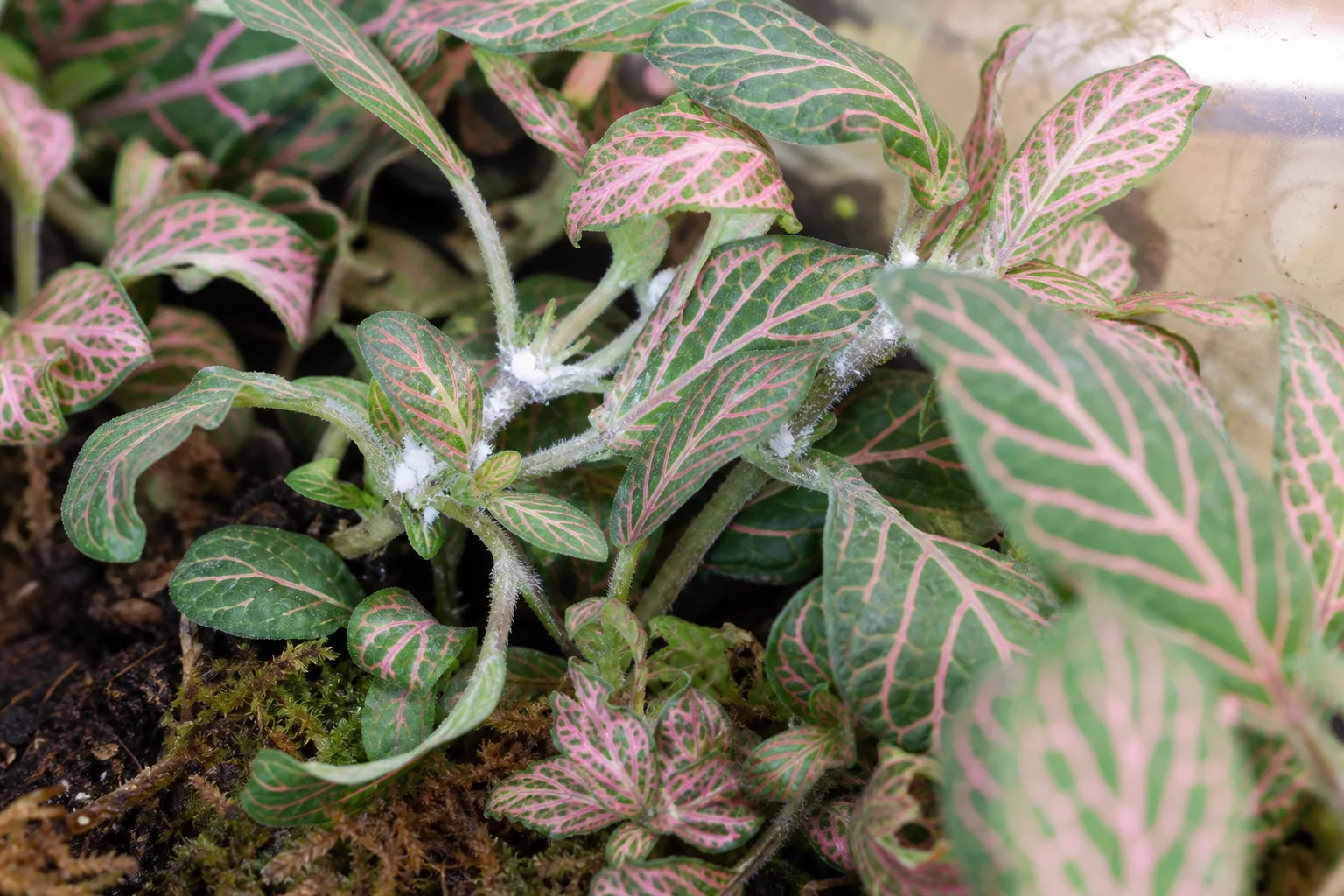
Mealybugs on Fittonia show up as white cottony masses tucked into leaf axils, along creeping stems, and in the compressed crown-often with sticky honeydew on nearby leaves or terrarium glass. First step: remove the plant from any closed terrarium, isolate it, and dab every visible cluster with a cotton swab dipped in 70% isopropyl alcohol before spraying anything.
Mealybugs on Fittonia: Causes, Checks & Fixes
This guide covers mealybugs on Fittonia. See also the general Mealybugs guide, watering, and light pages for this plant.
Mealybugs on Fittonia: Causes, Checks & Fixes
Quick answer
Mealybugs are soft-bodied sap feeders that cover themselves in white, waxy cotton. On Fittonia (Fittonia albivenis, nerve plant), they settle in the tight spaces a low, spreading mat creates-where oval leaves meet creeping stems, in the compressed crown, and under overlapping foliage in terrariums or dense pots. You may notice sticky honeydew on leaf surfaces, ants on the pot rim, or black sooty mold on glass or neighboring plants before you spot the insects themselves.
First step: pull the plant out of any closed terrarium, isolate it from shelf neighbors, and dab every visible cottony cluster with a cotton swab dipped in 70% isopropyl alcohol. Work into leaf axils and the crown center where sprays miss. Confirm live bugs-not nerve-vein patterning or mineral dust-before moving to insecticidal soap or repeat treatments.
Baseline species context: Fittonia overview. Sticky leaves without cotton may be aphids on new shoots; stippling and webbing point to spider mites in dry air instead of wax clusters.
What mealybugs look like on Fittonia
Healthy Fittonia forms a low, creeping mat of oval leaves with bold contrasting veins-white on Argyroneura cultivars, pink or red on Verschaffeltii types. Mealybugs exploit every crevice that mat structure offers.
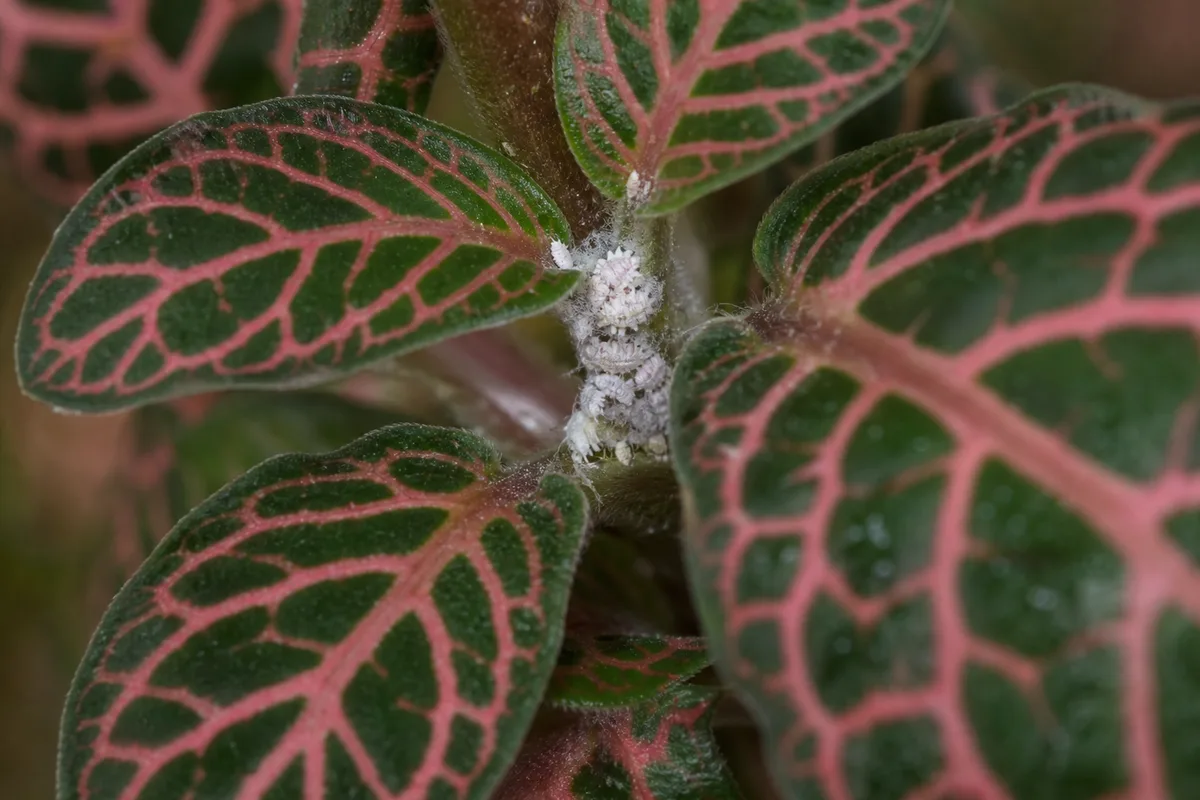
Mealybugs symptoms on Fittonia - compare with healthy tissue on the same plant.
Typical signs:
- White, cottony or waxy clusters tucked into leaf axils-the point where each leaf joins the stem
- Slow-moving oval insects under the wax, sometimes with fine white filaments at the edges
- Sticky, shiny honeydew on leaves, pot rims, terrarium glass, or shelves below
- Ants on the container or nearby surfaces, often arriving before you notice the insects
- Black sooty mold growing on honeydew-coated leaves or glass
- Yellowing, curling, or stunted new leaves when feeding is heavy; older leaves may look dull but stay attached on thin foliage longer than on thick-leaved houseplants
Mealybugs differ from Fittonia’s natural nerve veining, which follows each leaf’s vein network evenly from base to tip. Wax sits in three-dimensional clumps at joints and feels sticky or crumbly when touched. Unlike dramatic thirst wilt-which collapses the whole plant and recovers within an hour of watering-mealybug stress builds with visible wax, stickiness, or sooty mold over days.
Why Fittonia gets mealybugs
Mealybugs are not caused by high humidity alone, but Fittonia’s growth habit and typical placement make infestations easy to miss and slow to treat.
Protected hiding spots. Mealybugs prefer somewhat protected areas-crowns, branch crotches, and stem joints near soil. Fittonia’s compressed rosette, overlapping leaves, and creeping stems give them exactly that cover. In terrariums and closed jars, one colony can spread to ferns, moss, and other humidity lovers before you open the lid.
Indoor conditions favor them. Mealybugs thrive in warm settings without cold winters-the same environment where nerve plants live year-round as houseplants, bathroom specimens, and terrarium centerpieces. Missouri Botanical Garden notes Fittonia is commonly grown in containers, hanging baskets, and terrariums indoors, where natural predators are absent.
Top-down watering misses axil colonies. Fittonia’s low spreading habit means you often water from above and glance at the colorful top layer. Mealybugs feeding deep in the crown can build for weeks before honeydew drips onto terrarium glass or lower leaves-by then crawlers may already have reached neighbors.
Stressed plants recover more slowly. Fittonia wilts dramatically when thirsty but also suffers when soil stays wet too long in dim light. Chronically overwatered plants with soft stems at the soil line are easier targets than firm specimens in Fittonia light guide with evenly moist-not soggy-mix per the watering guide.
Introduction from outside. New nursery plants, reused terrarium hardscape, shared pruning scissors, and adjacent infested pots are common entry routes. Skipping quarantine before placing a nerve plant in a terrarium or shelf display is the fastest way mealybugs spread through a collection.
How to confirm the cause
Work through these checks in order:
- Location pattern - Cottony masses concentrated at leaf bases, the crown, creeping stem nodes, or the soil line point to mealybugs. Even white nerve veining on Argyroneura types follows veins across the whole leaf, not clumps at one joint.
- Touch test - Press a cluster with a cotton swab dipped in alcohol. Mealybugs feel waxy and may smear pink or orange when crushed; mineral deposits or perlite wipe away dry.
- Movement check - Young crawlers lack heavy wax and can move. Watch leaf axils with a hand lens for tiny yellowish or pink nymphs near white masses.
- Honeydew and ants - Sticky residue on leaves or ant trails on the pot strongly support sap-feeder diagnosis.
- Wilt cross-check - If the whole plant collapsed suddenly, water first and wait 30–60 minutes. See wilting on Fittonia for the full wet-vs-dry fork-thirst wilt resolves quickly without wax clusters; mealybugs do not.
- Terrarium neighbors - If one plant in a closed display has wax, inspect every species touching it or sharing the same humid air space.
If you find white cottony insects in axils with honeydew or ants, mealybugs are confirmed. Treat before colonies spread to runners and neighboring pots.
First fix for Fittonia
Remove the plant from any closed terrarium, isolate it from neighbors, and dab every visible mealybug with a cotton swab dipped in 70% isopropyl alcohol.
Isolate infested plants away from terrarium mates, shelf neighbors, and hanging baskets immediately-mealybugs crawl short distances and hitchhike on hands, tools, and touching leaves. In a closed terrarium, pull the affected Fittonia out entirely rather than treating in place.
Dab each cottony cluster directly. Alcohol dissolves the waxy coating and kills exposed adults on contact. Work systematically through:
- The compressed crown where new leaves emerge
- Both sides of each leaf base along creeping stems
- Undersides of overlapping leaves in dense mats
- The soil line and any exposed stem tissue at the pot edge
Test alcohol on one leaf first and wait a day to check for burn before treating the whole plant. Fittonia foliage is thin and can scorch if alcohol sits on tissue in hot direct light or under a closed terrarium lid.
Do not spray insecticide on day one if you have not confirmed live mealybugs. Do not repot immediately unless you find colonies below the soil surface on stems or roots. Do not fertilize a pest-hit plant; tender new growth gives mealybugs more places to feed.
Step-by-step recovery by severity
Match your next steps to how far the colony has spread:
| Severity | What you see | First-week actions | Escalation if wax returns |
|---|---|---|---|
| Light - one or two axil clusters on an otherwise firm mat | Small cottony tufts, little or no honeydew, no ants | Isolate, alcohol dab every 3–5 days, inspect crown weekly | Add insecticidal soap at label intervals after two alcohol rounds |
| Moderate - multiple runners, sticky leaves, early sooty mold | Wax on several stem nodes, dull new growth, ants occasional | Alcohol dab plus soap every 5–7 days; trim one badly infested runner if needed | Test horticultural oil on one leaf; repot only if wax appears at soil line |
| Terrarium outbreak - wax on Fittonia plus neighbors | Honeydew on glass, matching colonies on moss or ferns | Remove every affected plant from the display; treat each host on a schedule; space pots so leaves do not touch | Consider discarding the worst host to protect the collection; contact local extension if multiple rooms are involved |
After the initial alcohol pass for any severity level:
- Repeat manual removal every three to five days until you stop finding new cottony masses. Egg sacs and hidden crawlers survive a single pass.
- Apply insecticidal soap if colonies persist after several dabbing sessions. Coat leaf axils, crown, stem bases, and undersides where sprays reach. Repeat at label intervals through at least two mealybug generations.
- Rinse lightly in a sink if the pot drains well and soil is not already soggy. A gentle rinse knocks crawlers off delicate leaves-but let foliage dry in bright indirect light the same day and avoid waterlogging mix Fittonia already struggles in when overwatered.
- Manage ants on shelves or terrarium rims. Ants protect mealybugs from natural enemies while harvesting honeydew.
- Trim heavily infested stems if cottony masses cover most of a creeping runner. Removing one bad section is faster than saving it while colonies spread through the mat-and propagating runners during active infestation spreads crawlers to new pots.
- Repot only if root or stem mealybugs are confirmed-white wax near the soil line with clean foliage above may still mean belowground feeding. Use fresh mix, clean pots, and wash soil from roots before replanting.
When soap is not enough
If three full soap cycles still leave fresh wax in the crown, test horticultural oil or neem oil on one older leaf and wait 24 hours before wider use. Concentrated oils can burn thin tropical leaves, especially under a closed lid where fumes and residue cannot vent. Never apply oil or soap inside a sealed terrarium. A systemic houseplant insecticide labeled for ornamentals is a last resort-follow the product label exactly, treat in a ventilated area, and never use near food surfaces without confirming the active ingredient is appropriate for indoor plants.
Isolate until you see no new activity for at least two weeks after the last treatment. In terrariums, do not return Fittonia until every neighbor has been inspected clean.
Treatment timeline observation
A tabletop Argyroneura Fittonia in a 4-inch pot with cottony axil clusters on two creeping runners-isolated March 10, alcohol dabbed every four days-showed the first clean new crown leaf by week three (April 2). One soap pass at label interval followed two alcohol rounds that still left a single hidden tuft under overlapping leaves. Two more weekly inspections with zero new wax were required before returning it beside moss in an open dish terrarium. Yellowed lower blades never regained full contrast; recovery was judged by unsticky new growth, not cosmetic repair of old leaves.
Recovery timeline
Manual alcohol removal shows progress within a few days when infestations are light and localized to one or two axils. Moderate cases on dense mats or terrarium specimens often need two to three weeks of repeated dabbing plus soap at label intervals because crawlers hatch on a rolling schedule.
Judge recovery by clean new leaves emerging from the crown and unsticky creeping stems-not by old yellowed blades, which may stay marked. Firm new growth in stable humidity is the best sign the plant is winning.
If colonies return within days of treatment, you missed hidden pockets in the crown or under overlapping leaves. Re-inspect with bright sidelight before assuming the product failed.
Lookalike symptoms to rule out
| Sign | Mealybugs | Nerve veins (Argyroneura) | Spider mites | Powdery mildew | Mineral deposits | Thirst wilt |
|---|---|---|---|---|---|---|
| Appearance | Cottony white clumps in axils | Flat white/pink vein pattern across leaf | Stippling, fine webbing | Dry white powder on leaf face | Crusty white spots on rim/edges | Whole plant flops flat |
| Smear test | Pink/orange when crushed | N/A - part of leaf | N/A - moving dots on paper | Wipes as dry powder | Flakes dry, no smear | N/A |
| Honeydew | Common | Absent | Rare | Absent | Absent | Absent |
| Fittonia context | Crown, stem joints, terrarium glass | Even vein network on each leaf | Dry heated rooms, open shelves | Stagnant wet leaves overnight | Hard tap water, pot rim | Dry top inch, light pot |
| Sibling guide | This page | - | Spider mites | - | Brown tips | Wilting |
Brown soft scale on thin Fittonia stems looks like tan or brown glued bumps-not fluffy wax. Scale stays firmly attached when you scrape; mealybugs smear when crushed.
Mistakes to avoid
Do not treat once and assume mealybugs are gone. Multiple life stages hide in the crown across several weeks.
Do not return an isolated plant to a terrarium or shelf after a single clean-looking day. Two weeks without new masses is a safer threshold.
Do not skip creeping runners and the crown center. Mealybugs on one hidden axil can reinfect the whole mat.
Do not overwater during recovery. Wet soil weakens Fittonia roots and does not drown mealybugs in leaf axils-see overwatering if soil stays heavy.
Do not use homemade soap sprays. Commercial insecticidal soap is formulated to reduce phytotoxicity on thin foliage.
Do not ignore ants. Controlling mealybugs alone is harder while ants protect colonies.
Do not confuse dramatic wilt with pest damage. Water a collapsed plant once, then inspect for wax if it does not recover within an hour.
Do not propagate creeping runners while wax is still active. New pots become secondary outbreak sites.
Fittonia care cross-check
Mealybug recovery lasts longer when baseline care supports the plant.
Fittonia prefers low to medium indirect light and soil that stays evenly moist without staying waterlogged-water when the top inch of mix begins to dry, not on a fixed weekly calendar per the watering guide. Chronically wet pots in dim corners produce weak stems that pests exploit, while bone-dry soil causes collapse that makes inspection harder because the plant already looks distressed.
Maintain moist air during recovery-nerve plants in dry rooms lose turgor fast; see low humidity if margins crisp even when mix is moist. In terrariums, match humidity to the plant without trapping completely stagnant air. Open lids briefly after treatment so alcohol and soap residues dry and so you can inspect neighbors.
Avoid heavy fertilizing during active infestations. Over application of nitrogen stimulates tender new growth where mealybugs prefer to lay eggs-conditions that do not help pest control.
Because Fittonia is non-toxic to cats and dogs, many growers keep nerve plants within reach of pets. That is fine for the plant itself, but keep alcohol-treated foliage away from pets until it dries completely.
Terrarium reintroduction checklist
After two weeks with no new wax on the isolated Fittonia:
- Inspect every plant that shared the display-ferns, moss, Selaginella, and other Fittonia mats included.
- Wash terrarium glass to remove dried honeydew and sooty mold residue.
- Replace or bake any contaminated hardscape that held wax in crevices.
- Confirm foliage is fully dry before closing the lid-no pooled rinse water at the crown.
- Leave the lid cracked or open briefly for the first 48 hours so any residual alcohol or soap odor vents.
- Space plants so creeping runners do not touch between species.
- Resume weekly axil checks for one month-terrarium outbreaks often rebound from one missed crawler.
How to prevent mealybugs next time
Quarantine new Fittonia at least two to three weeks before placing them in terrariums or on shelves near existing specimens. Inspect leaf axils, crown, and creeping stem tips on arrival-not just the colorful top layer.
Add mealybug checks to routine watering. Lift overlapping leaves and look into the crown with bright light every week or two.
Keep soil from staying soggy. Use pots with drainage, empty saucers, and avoid letting terrarium substrate stay saturated at the crown.
Scout every plant in a shared humid display when one shows wax. Terrarium infestations rarely stay on a single species.
Preserve beneficial insects if plants summer outdoors in shaded humid spots. Lady beetles, lacewings, and parasitic wasps reduce mealybug numbers when broad-spectrum sprays have not eliminated them.
When to worry
Treat as urgent when cottony masses cover most of the crown, honeydew and sooty mold coat most leaves, or ants swarm the pot daily. Mealybugs are difficult to control once populations explode in hidden crevices.
Consider discarding a severely infested Fittonia if two full treatment cycles fail and the crown stays soft, yellow, or declining despite corrected watering. Protecting terrarium neighbors and the rest of your collection often matters more than saving one stressed mat.
Act quickly when mealybugs reach multiple creeping runners-those runners root easily into new pots or terrarium sections and spread the problem across the room.
A few isolated clusters at one leaf base on an otherwise vigorous plant is manageable. Isolate, dab, and monitor before escalating.
Contact your local cooperative extension office or master gardener helpline if infestations persist across multiple terrariums or rooms despite quarantine and repeated treatment.
Indoor treatment safety
Mealybugs themselves are not a pet hazard, but 70% isopropyl alcohol and insecticidal soap should be applied in a ventilated room, away from pet food bowls and surfaces animals lick. Let treated foliage dry before curious cats return to the shelf. Wash hands after handling heavily infested plants.
Related Fittonia problems
- Fittonia overview - species care hub: light, humidity, terrarium culture
- Watering - top-inch dry-down rhythm and moist-not-soggy target
- Low humidity - margin crisping when mix is moist
- Wilting - dramatic thirst collapse vs pest stress
- Overwatering - wet-soil stress during recovery
- Spider mites - stippling and webbing in dry air, not wax clusters
- Aphids - honeydew without cottony wax on new shoots
- Root rot - mushy roots if crown stayed soggy during treatment rinses
FAQs
How do I tell mealybugs from white nerve veins on Argyroneura Fittonia?
Argyroneura nerve veins follow each leaf’s vein network evenly from base to tip-they are flat, fixed, and part of the leaf pattern. Mealybugs sit in three-dimensional cottony clumps at leaf axils and stem joints; they feel waxy, smear pink or orange when crushed with a swab, and often come with sticky honeydew. Mineral dust wipes off dry without a smear.
Can I treat mealybugs on Fittonia inside a closed terrarium?
No-remove the affected nerve plant before dabbing alcohol or applying soap. Alcohol fumes and pooled rinse water accumulate under closed lids, thin Fittonia leaves scorch easily, and crawlers spread to ferns, moss, and neighboring humidity lovers before you finish one pass. Return the plant only after two weeks of clean inspections with dry foliage.
How can I confirm mealybugs on Fittonia?
Look for white, waxy cottony masses where leaves meet stems, especially in the tight crown and along creeping runners. Crush a cluster with a swab-mealybugs smear pink or orange. Sticky honeydew on nearby leaves or pot rims without cottony clusters may point to aphids or scale instead.
When is a mealybug infestation urgent on Fittonia?
Act immediately when cottony colonies appear on multiple creeping runners, ants trail to the pot, sooty mold spreads across leaf surfaces, or nearby plants in the same terrarium show matching white wax. Root-zone mealybugs that persist after foliar treatment also need urgent Fittonia repotting guide and root washing.
Is insecticidal soap safe on Fittonia’s thin leaves?
Commercial insecticidal soap is generally safer than homemade soap mixes on thin nerve-plant foliage, but always test one leaf and wait 24 hours before coating the whole mat. Coat leaf axils, crown, and undersides completely; repeat at label intervals. Avoid treating inside a sealed terrarium where soap and rinse water cannot dry.
Conclusion
Mealybugs on Fittonia hide where low, creeping leaves crowd the crown and stem joints-not where you glance from above a terrarium or shelf. Pull the plant out of closed displays first, isolate, dab visible clusters with alcohol, and repeat until new growth comes in clean and stems stay sticky-free. That sequence catches the pest early without unnecessary sprays and keeps your nerve plant’s delicate foliage intact enough to recover.
When to use this page vs other Fittonia guides
- Fittonia watering guide - Use for routine moisture checks before assuming mealybugs is the main issue.
- Fittonia problems hub - Browse all 16 common issues on this species.
- Yellow Leaves on Fittonia - Different entry point when symptoms overlap with mealybugs.
- Slow Growth on Fittonia - Different entry point when symptoms overlap with mealybugs.
- Spider Mites on Fittonia - Different entry point when symptoms overlap with mealybugs.