Spider Mites on Fittonia: Causes, Checks & Fixes
Quick answer
Spider mites on Fittonia cause pale stippling across nerve-vein leaves and fine webbing when dry, warm air stresses the plant-common on open shelves in winter heating season. First step: isolate the nerve plant and rinse every leaf underside with lukewarm water before applying any spray.
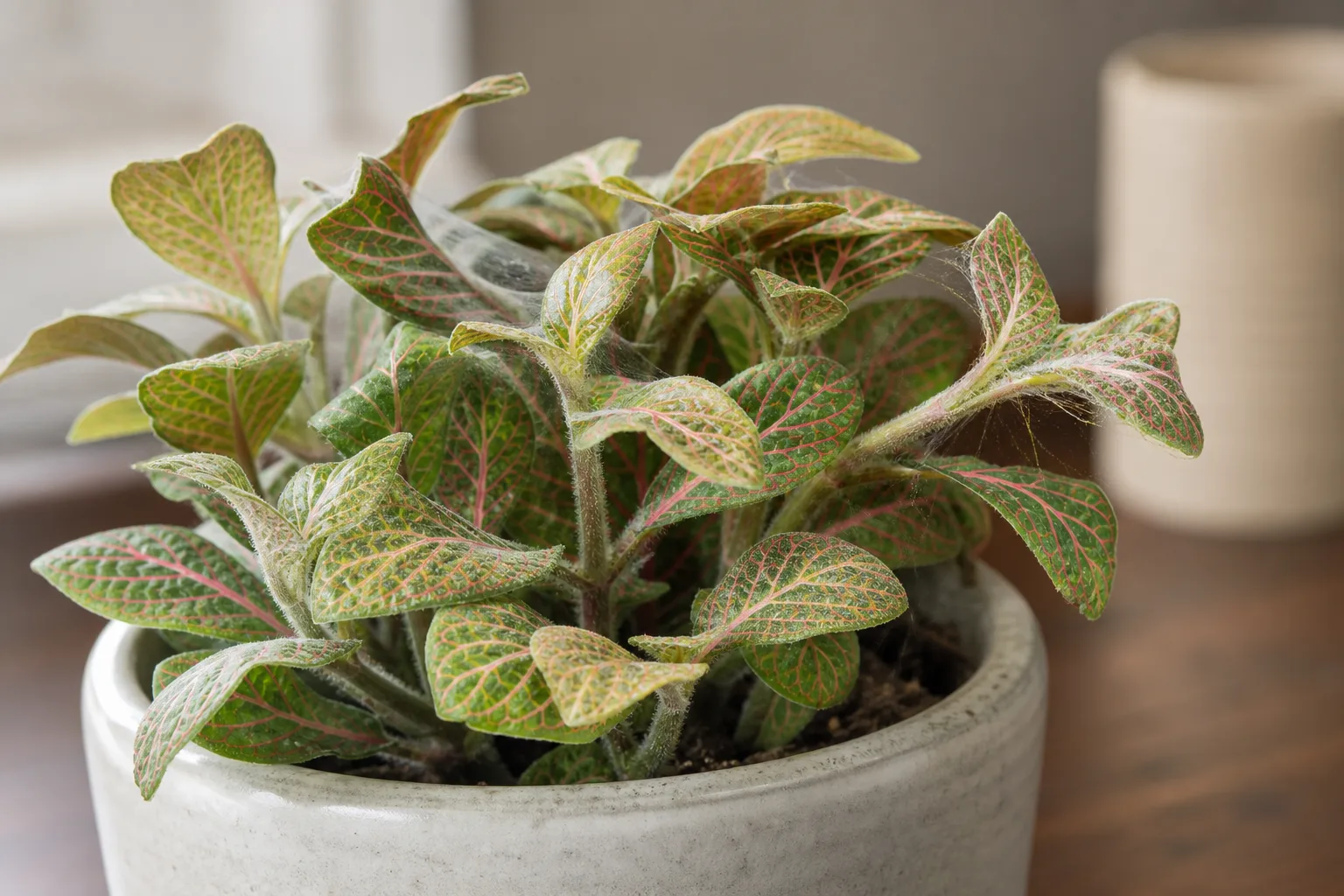
Spider Mites on Fittonia: Causes, Checks & Fixes
This guide covers spider mites on Fittonia. See also the general Spider Mites guide, watering, and light pages for this plant.
Spider Mites on Fittonia: Causes, Checks & Fixes
Quick answer
Spider mites on Fittonia albivenis (nerve plant) almost always trace to dry, warm indoor air-not random bad luck. The two-spotted spider mite thrives in the same winter conditions that stress Fittonia: heating vents, sunny glass, and room humidity that drops below what this humidity-loving rainforest-floor species needs.
On nerve plants, feeding shows up as pale stippling across the bold vein pattern-especially visible on white-veined Argyroneura cultivars-plus dull bronzed patches and eventually fine silk webbing at stem joints and leaf bases. The mites themselves stay hidden on undersides until populations build.
First step: isolate the plant and rinse every leaf underside with lukewarm water. Knock down live mites and webbing before reaching for soap or oil. One rinse is not a cure-eggs hatch in cycles-but isolation plus a thorough underside wash is the correct opening move.
Photo check: Compare stippling to a white-paper tap test before you spray-macro photos of nerve-vein pinpricks and creeping-stem webbing are the fastest way to confirm mites versus dry-air margin burn. Original symptom images for this page are pending; use the paper-tap test and underside inspection until they are added.
What spider mites look like on Fittonia
Healthy Fittonia forms a low, creeping mat of thin oval leaves with bold contrasting veins-white on Argyroneura types, pink or red on Verschaffeltii selections. That thin foliage and nerve-vein pattern make mite damage easy to spot once you know what to look for.
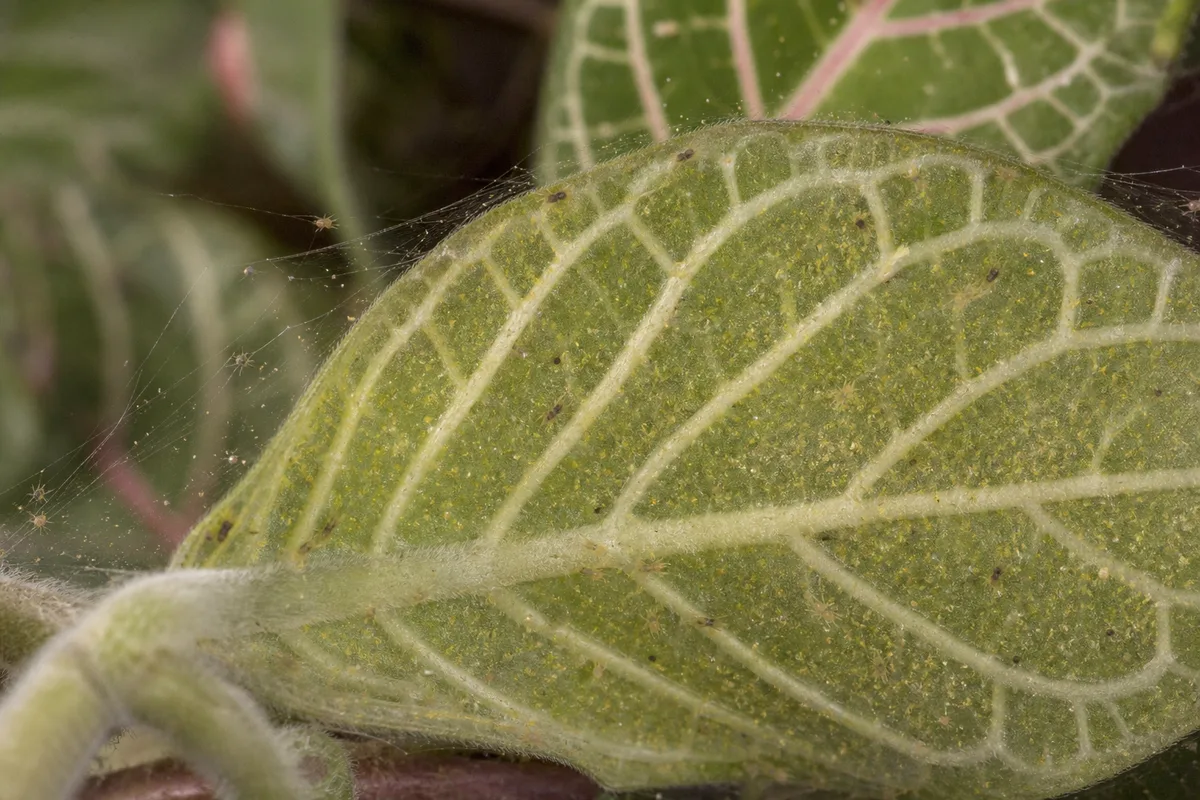
Spider Mites symptoms on Fittonia - compare with healthy tissue on the same plant.
Cultivar visibility: On Argyroneura white-vein types, yellow pinpricks break up the pale mosaic against dark green tissue-you often notice stippling days before webbing. On Verschaffeltii pink- or red-vein cultivars, early dots can blend into the colored vein network; lift overlapping stems and inspect undersides with a hand lens rather than trusting the top view alone.
Early signs:
- Tiny yellow or white dots scattered across green leaf surfaces, breaking up the nerve-vein mosaic
- Leaves looking dusty, dull, or slightly bronzed even after a gentle wipe
- Slight curling at margins when feeding is heavy-sometimes mistaken for low humidity alone
Established infestation:
- Fine silk threads between petioles, at leaf bases, or along creeping stems where the mat overlaps
- Amber-colored eggs, whitish cast skins, or black fecal specks on undersides
- Newest leaves opening with stippling already present
- Webbing visible without magnification at the crown or where stems touch soil
The paper-tap test: Hold white paper under a leaf and tap the surface firmly. Moving specks that smear red-brown when crushed are spider mites. Mites are eight-legged arachnids, not insects-oval bodies, often greenish-yellow or reddish.
Damaged stippled tissue does not fully green up again. Judge recovery by clean new leaves emerging from creeping stems and stopped spread-not by old pinpricked patches reverting.
Why Fittonia gets spider mites
Fittonia evolved on the humid rainforest floor of Peru, where leaf litter stays damp and ambient humidity rarely dips. Indoors it wants bright filtered light, evenly moist soil, and moist air-conditions that terrariums, bottle gardens, and steamy bathrooms provide well. When winter heating drops room RH below 40%, two problems stack:
- The plant is stressed - leaf margins crisp, growth slows, and thin foliage is less resilient to piercing pests.
- Mites reproduce faster - warm, dry air shortens their life cycle and lets populations double within days.
Fittonia’s creeping mat structure hides undersides beneath overlapping leaves. Mites colonize the lower surface first-out of sight from the colorful nerve pattern you admire from above. In terrariums, dry micro-pockets near glass, vents, or a cracked lid can still harbor mites even when the center feels humid. On open shelves near radiators, the whole pot dries out faster than a closed jar.
Missouri Botanical Garden notes Fittonia is commonly grown in containers, hanging baskets, and terrariums indoors, where natural predators are absent. Crowded displays of humidity lovers-ferns, moss, pilea-let mites walk or drift on silk from pot to pot.
Other triggers that make nerve plants vulnerable:
- Placement near radiators, forced-air vents, or south-facing winter sun that dries leaf edges
- Letting soil go dry while air stays hot and dry (thirst wilt plus mite-favorable air)
- Bringing home an infested plant without quarantine
- Skipping underside checks because the top layer of the mat looks healthy
Spider mites are not a sign you failed at watering alone. They are an environmental pest that exploits the gap between what Fittonia needs and what many homes provide in January.
How to confirm the cause
Work through these checks before spraying anything:
- Stippling pattern - Uniform tiny dots across multiple leaves, worse on older foliage first, points to mites. Single yellow leaves with wet soil suggest overwatering on Fittonia instead.
- Vein vs. margin damage - Stippling scatters across the nerve-vein network. Low-humidity browning usually affects leaf edges evenly without pinpricks across green tissue.
- Underside inspection - Lift creeping stems and check with a hand lens. Look for moving specks, webbing, eggs, and cast skins along veins.
- Paper-tap test - Confirms live mites versus dust, perlite, or mineral deposits from hard water.
- Humidity reading - A hygrometer near the pot below 40% RH in winter strongly supports mite-friendly conditions on a plant that needs moist air for healthy foliage.
- Webbing location - Fine silk at petiole joints and leaf bases is mite-specific. White cottony clusters in axils may be mealybugs instead.
- Neighbor plants - Check every specimen in a terrarium or shelf grouping. Mites rarely stay on one pot once webbing appears.
- Wilt cross-check - If the whole mat collapsed suddenly, water once and wait 30–60 minutes. Thirst wilt resolves quickly without stippling; mites do not.
If stippling is absent, webbing is absent, and the paper-tap test shows nothing moving, look at thrips (silver streaks with a scrape test), mealybugs (white cotton clusters), or margin crisping from dry air before treating for mites.
First fix for Fittonia
Isolate the plant and rinse all leaf undersides with lukewarm water.
Move the nerve plant away from terrarium mates, shelf neighbors, and hanging baskets immediately. Mites spread on hands, tools, and breeze-caught silk. In a closed terrarium, remove the affected Fittonia entirely rather than treating in place.
Carry the pot to a sink or shower and spray undersides with moderate pressure-enough to dislodge mites and webbing, not so hard that you tear thin Fittonia leaves.
Important nerve-plant cautions during rinsing:
- Keep water out of the compressed crown - Fittonia stems rot easily when water pools where creeping leaves meet the soil line.
- Let foliage dry the same day - wet leaves in cool, stagnant air invite fungal problems on an already stressed plant.
- Wash the pot exterior and tray - mites can shelter on container rims.
Do not apply neem, soap, or oil on day one if you have not confirmed mites. Do not repot, fertilize, or prune heavily before the rinse-those add stress without removing pests.
After the rinse, set the plant in a humidified spot away from the collection and inspect again in 48 hours.
Step-by-step recovery
Once isolation and the first rinse are done, follow this sequence based on severity:
Light infestation (early stippling, no webbing)
- Repeat water rinses every two to three days for two weeks if mites are still visible on inspection. Focus on undersides and new growth tips.
- Raise ambient humidity to 60% or higher with a humidifier-not occasional misting alone, which dries in minutes and can worsen crown issues if water sits on thin leaves.
- Inspect neighbors in terrariums or shelf groupings before assuming the problem is contained.
Moderate infestation (webbing at leaf bases, spreading stippling)
- Apply insecticidal soap or horticultural oil after the first rinse if populations persist. Coat undersides completely; these products kill on contact and have little residual effect.
- Repeat soap or oil every five to seven days for at least three cycles to catch newly hatched mites. MSU Extension recommends two to three treatments at five-day intervals for thorough underside coverage on houseplants.
- Hold fertilizer until new growth looks clean for two weeks. Tender new tissue gives mites more places to feed.
Terrarium collection outbreak
- Remove every affected plant from the closed display before spraying. Treat on a counter or in a sink, not inside the jar.
- Inspect moss, ferns, and creeping neighbors for early stippling even before webbing appears.
- Vent the terrarium briefly after any treatment so residues dry and you can scout clean.
- Do not return Fittonia until two weeks pass without new stippling or webbing on the isolated plant and its neighbors.
For growers who want to avoid repeated oil on thin nerve-plant leaves inside humid displays, predatory mites such as Phytoseiulus persimilis can control twospotted spider mites in greenhouses and interior plantscapes. Relative humidities above 60% support predator survival, especially through the egg stage-pair releases with a humidifier in heated winter rooms. Release per supplier instructions at the first sign of stippling; predators work best before colonies blanket the creeping mat. Stop contact soaps and oils once predators are introduced-residues kill beneficial mites. Wait at least one to two weeks after the last oil or soap application before releasing predators, per supplier guidance.
For severe infestations where most leaves are webbed and new growth has stopped, discarding the plant in a sealed bag may protect the rest of the collection-especially in a dense terrarium where every surface touches another species.
Recovery timeline
A thorough first rinse should reduce visible mites within two to three days on a moderate infestation. Full control with repeated soap or oil typically takes two to three weeks with label-interval applications across at least three cycles.
Old stippled leaves remain cosmetically marked. Expect cleaner new leaves within three to four weeks once mites are gone and humidity stabilizes. Firm new growth along creeping stems is the best sign the mat is winning.
Recovery snapshot: In a typical winter terrarium case, raising a room humidifier to 62% at leaf height, rinsing undersides every three days, and applying labeled insecticidal soap on days 5 and 12 cleared webbing before clean new nerve-vein leaves emerged on day 21-outer stippled blades stayed marked, but the newest creeping growth showed full contrast (typical recovery pattern in humidified indoor conditions).
Escalate if webbing spreads after two full treatment cycles, or if neighboring plants develop stippling despite isolation.
Lookalike symptoms to rule out
| What you see | Likely cause | How to tell apart |
|---|---|---|
| Pale stippling with fine webbing | Spider mites | Paper-tap test shows moving specks; worse in dry winter air |
| Even brown leaf margins, no dots | Low humidity | Margin damage only; mites absent on underside inspection |
| Silver streaks or scuffed patches | Thrips | No webbing; scrape test-drag a fingernail across the leaf surface; thrips leave silvery scraped trails, mites do not |
| White cottony clusters in axils | Mealybugs | Waxy blobs, sticky honeydew, no stipple pattern |
| Whole mat collapsed, dry soil | Thirst wilt | Recovers within 30–60 minutes of watering; no stippling |
| Yellow leaves, wet soil, no stippling | Overwatering / root stress | Crown soft or soil sour; pest checks negative |
| Crusty white spots that wipe dry | Mineral deposits | Fixed spots, not moving specks on paper-tap test |
Low humidity and spider mites often occur together on Fittonia. Fixing humidity helps prevention but does not replace direct mite treatment once stippling and webbing are confirmed.
Mistakes to avoid
- Stopping after one rinse or one spray - eggs hatch continuously; schedule repeats before you declare victory.
- Spraying only the colorful leaf tops - mites live underneath; top-only treatment leaves colonies intact.
- Treating inside a closed terrarium - oil phytotoxicity, crown rot from pooled rinse water, and neighbor spread make in-jar treatment risky.
- Misting instead of humidifying - brief leaf wetness does not fix dry air and can rot Fittonia crowns.
- Using dish soap - homemade detergents burn thin nerve-plant foliage; use labeled insecticidal soap.
- Applying oil in hot direct sun - phytotoxicity shows as bleached or spotted leaves on already damaged tissue.
- Ignoring neighboring pots - mites on one Fittonia usually mean checks are due on the whole terrarium or shelf.
- Assuming insecticides labeled for insects will kill mites - mites need miticides, oils, or soaps labeled for mite control.
- Letting rinse water pool overnight on thin leaves - water spots and crown rot are permanent on delicate foliage.
- Releasing predatory mites on freshly oiled leaves - contact residues kill Phytoseiulus; wait one to two weeks after the last soap or oil pass.
How to prevent spider mites next time
- Run a humidifier through winter heating season near nerve plant groupings-not just a pebble tray, which helps marginally in dry rooms.
- Quarantine new Fittonia for two to three weeks; inspect undersides before placing in terrariums or on shelves.
- Tap-check leaves over white paper monthly, weekly during dry heating spells.
- Keep creeping mats slightly spaced so you can lift stems and see undersides.
- Rinse foliage with lukewarm water periodically in winter-the same technique as treatment, used preventively.
- Avoid placing open pots directly above or beside heating vents or sunny winter glass.
- Scout every plant in a shared humid display when one shows stippling.
Nerve plants that stay in stable humidity rarely see explosive mite outbreaks. The goal is catching the first stippled leaf on a nerve-vein pattern, not waiting for webbing across the whole mat.
When to worry or escalate
Treat as urgent if:
- Webbing spans multiple creeping stems and new growth stays damaged
- Mites appear on several plants in the same terrarium or room
- The plant loses more than a third of its foliage despite two treatment rounds
- Stippling returns within a week after you stopped sprays
Escalate beyond soap and oil if:
- After two full three-cycle treatment rounds (roughly three weeks), paper-tap tests still show moving specks every pass
- Oil spot tests mark thin leaves and mite populations remain high-consult your local extension office for labeled miticide options appropriate for indoor use
- A terrarium collection shows matching stippling on ferns and moss despite isolating the Fittonia-consider predatory mite release in an open quarantine zone with humidity above 60% RH, after all contact sprays have dried
Discard rather than treat if:
- More than half the creeping mat is webbed and no clean growth points remain
- The crown is soft, roots smell sour, and pest stress compounds root rot-salvage is unlikely
- The specimen is inexpensive, recently purchased, and sits in a dense closed terrarium where one missed mite risks reinfecting every neighbor
Terrarium re-entry criteria: Return Fittonia only after two weeks with no new stippling or webbing on the isolated plant and clean neighbor inspections-dry foliage, stable humidity, and two consecutive clean paper-tap tests.
A few isolated pinpricks on one older leaf on an otherwise vigorous mat is manageable. Isolate, rinse, and monitor before escalating.
FAQs
How do I tell spider mite stippling from low-humidity brown edges on Fittonia?
Low humidity browns leaf margins evenly without tiny dots across the vein pattern-see our low-humidity guide for that fork. Spider mites leave scattered yellow or white pinpricks across green tissue, often worse on older leaves first, plus fine silk at leaf bases when populations build. Tap a leaf over white paper; moving specks confirm mites, not dry air alone.
Can I treat spider mites on Fittonia inside a closed terrarium?
No-remove the affected Fittonia before rinsing or spraying. Oil and soap need full leaf coverage and drying time; treating inside a sealed jar risks phytotoxicity on thin leaves, crown rot from pooled rinse water, and spread to ferns and moss neighbors. Return the plant only after two weeks of clean inspections and dry foliage.
What humidity level prevents spider mites on nerve plants?
Fittonia prefers moist air-aim for 60% RH or higher at leaf level, matching what nerve plants need for healthy growth. That range discourages the warm, dry conditions mites favor but does not replace direct treatment once stippling and webbing are confirmed. A humidifier beats occasional misting in heated rooms.
How often should I repeat soap or oil on Fittonia leaves?
Repeat insecticidal soap or horticultural oil every five to seven days for at least three full cycles-roughly two to three weeks-because contact products kill only what they touch and mite eggs hatch on a rolling schedule. Rinse undersides between spray days if the label allows, and coat leaf undersides completely each time.
When should I throw away a webbed Fittonia instead of treating?
Discard when webbing blankets most of the creeping mat, new growth stays stippled after two full soap-or-oil cycles, and the plant sits in a dense terrarium where every fern and moss neighbor is at risk. Salvage is realistic when roots are firm, the crown is not soft, and unstippled growth points remain-but a heavily webbed nerve plant in a closed display may be cheaper to replace than to risk a collection-wide outbreak.
Related Fittonia problems
- Fittonia overview - Light, humidity, terrarium culture, and species context
- Low humidity - Margin browning vs. stippled nerve-vein pattern
- Underwatering - Dramatic thirst wilt and the wet-vs-dry fork
- Wilting - Collapse vs. pest stress on thin leaves
- Mealybugs - Alternate sap-sucking pest hiding in crowns
- Watering Fittonia - Recovery watering rhythm during pest treatment
When to use this page vs other Fittonia guides
- Fittonia watering guide - Use for routine moisture checks before assuming spider mites is the main issue.
- Fittonia problems hub - Browse all 16 common issues on this species.
- Low Humidity on Fittonia - Different entry point when symptoms overlap with spider mites.
- Slow Growth on Fittonia - Different entry point when symptoms overlap with spider mites.