Overwatering on Fittonia: Causes, Checks & Fixes
Quick answer
Overwatering on Fittonia shows as limp leaves on heavy wet soil, yellow dropping lower leaves, and sometimes a sour smell-not the fast perk-up you see with thirst. First step: stop watering, lift the pot, and check the top 1/2 inch; wet mix plus wilt means damaged roots, not a dry plant.
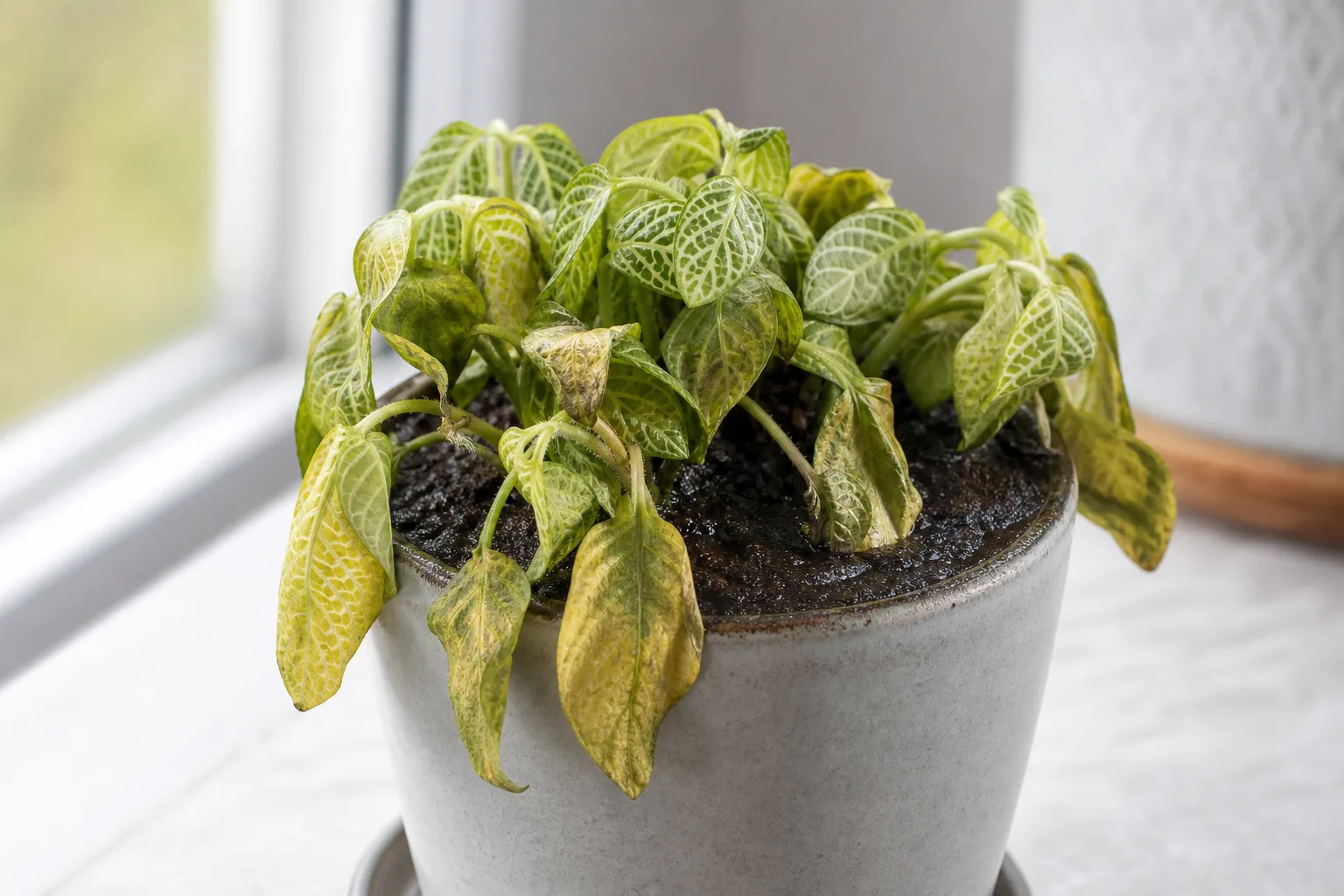
Overwatering on Fittonia: Causes, Checks & Fixes
This guide covers overwatering on Fittonia. See also the general Overwatering guide, watering, and light pages for this plant.
Overwatering on Fittonia: Causes, Checks & Fixes
Quick answer
Fittonia (Fittonia albivenis, nerve plant) is famous for dramatic collapse-but that same wilt reflex is the number-one reason growers overwater this species. When roots sit in soggy mix, oxygen is pushed out, feeder roots die, and the plant cannot take up water even though the soil is wet. The result looks exactly like thirst: limp stems and soft veined leaves lying flat against the pot.
First step: stop watering and lift the pot. If the container feels heavy and the top 1/2 inch of mix is cool and damp while leaves are limp, you are dealing with overwatering or early root damage-not underwatering. Let the surface dry before the next drink. If stems stay limp more than 24 hours on moist soil, inspect roots for mush and sour smell.
If the pot is light and the top 1/2 inch is dusty dry, the collapse is thirst-see the underwatering guide instead. Getting this fork right saves more Fittonias than any other single check.
What overwatering looks like on Fittonia
Overwatering on nerve plants rarely announces itself with one obvious flag. It builds through a pattern of wet soil, declining roots, and misleading wilt that owners often read as “needs water.”
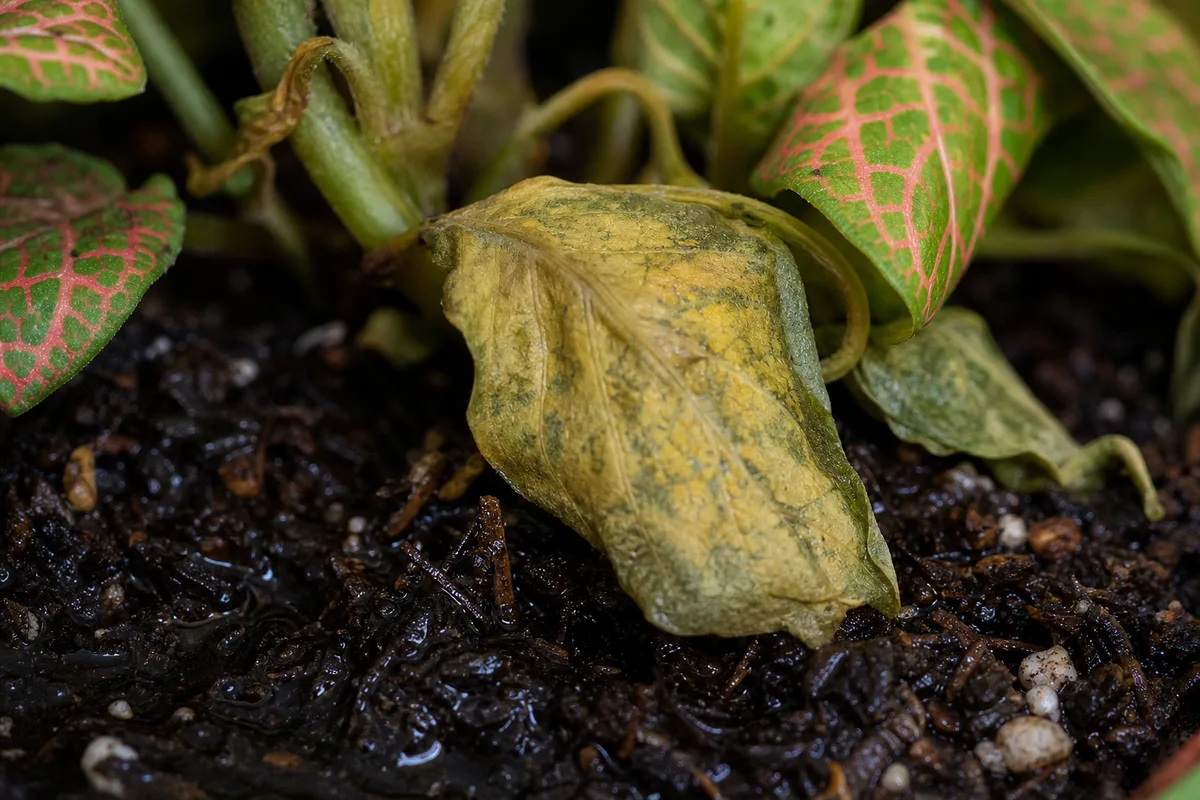
Overwatering symptoms on Fittonia - compare with healthy tissue on the same plant.
Limp leaves while soil stays wet (the paradoxical wilt trap)
The defining Fittonia overwatering sign is collapse on moist mix. Stems and leaves flop as if the plant has not been watered in days, but your finger probe shows damp soil and the pot still feels heavy from the last drink.
This happens because damaged roots lose the ability to move water into thin leaves. The foliage loses turgor pressure-the same mechanism that produces the famous thirst faint-only the cause is root failure, not dry soil. Overwatering can cause wilting that is mistaken for underwatering on many houseplants; on Fittonia the confusion is amplified because the species wilts faster than almost anything else on your shelf.
Yellow dropping lower leaves on heavy pots
Yellowing of leaves may indicate overwatering on Fittonia. The pattern usually starts at the base of the mat: older lower leaves turn yellow, soften, and drop while the crown may still look green for a few more days. On a heavy, slow-draining pot, yellow lower leaves plus limp upper growth strongly point to chronic wetness-not nutrient deficiency.
This differs from underwatering, where the whole mat collapses evenly on dry soil and perks up within an hour of soaking.
Fungus gnats and sour-smelling mix
When soil stays wet at the surface for days, fungus gnats often appear at the pot rim-larvae need consistently moist organic mix in the top layer. A sour or musty smell from the drain hole suggests anaerobic conditions and possible root decline. Neither pest nor odor alone proves rot, but together with wilt on wet soil they justify a root inspection.
White mold on the surface and stalled new growth at stem tips are additional clues that the root zone has been too wet too long.
Why Fittonia gets overwatered
Fittonia evolved on the humid rainforest floor of Peru and Colombia, where leaf litter stays damp but drains freely through loose forest soil. Indoors, growers recreate the humidity part easily and miss the drainage part-and the plant’s own body language makes the mistake worse.
The dramatic wilt reflex (watering limp plants on wet soil)
Most houseplants droop slightly when dry. Fittonia faints. Within hours of a missed watering, the entire mat lies flat-a visual alarm that trains owners to reach for the watering can. That reflex works until roots are already damaged from prior overwatering. The same limp posture appears, but adding water only keeps the mix saturated.
The cycle is common: slight overwatering weakens roots → plant wilts on wet soil → owner waters again → roots decline further. Breaking the cycle starts with pot weight and soil moisture, not leaf posture alone.
Terrarium slow dry-down and closed environments
Fittonia is a classic terrarium plant. The RHS recommends terrariums, bottle gardens, and steamy bathrooms where ambient humidity stays high. High humidity around leaves slows evaporation from the pot, so the same watering that worked in an open dish may keep terrarium mix soggy for a week.
Condensation on glass can make the surface look briefly dry while the center stays wet. Owners who water whenever the jar fogs or whenever leaves droop easily overshoot the narrow moist, not soggy band Fittonia needs.
Fear-of-overwatering drought-to-flood swings
Because nerve plants are sensitive to rot, cautious growers sometimes let pots go bone dry, see the dramatic faint, then flood the soil to compensate. Roots stressed by drought are more vulnerable to the next saturation event. Alternating extremes damages fine feeder roots faster than a steady rhythm of watering when the top 1/2 inch just begins to dry.
Oversized pots, heavy mix, and poor drainage
Fittonia has a shallow, mat-forming root system relative to its spread of foliage. An oversized container holds excess soil that stays cold and wet in the center while the surface looks acceptable. Heavy peat mix without perlite or coco coir drains slowly. Cachepots without drainage holes trap runoff. Saucers left full “so the plant can drink later” keep the bottom saturated-especially in dim light where evaporation is slow.
Calendar watering-every Sunday regardless of how fast this pot dried last week-ignores seasonal light, humidity, and container differences.
How to confirm the cause
Work through these checks in order before Fittonia repotting guide, fertilizing, or spraying anything:
- Pot weight test - Lift the pot. A heavy container with limp leaves points to overwatering. A light pot with collapse points to thirst.
- Finger probe at top 1/2 inch - Cool, dark, and clinging mix means do not add water. Dry, crumbly surface on a light pot means underwatering, not this guide.
- Skewer or chopstick depth check - Slide to the bottom, wait ten seconds, pull out. Persistently wet at depth days after watering suggests poor drainage or an oversized pot.
- Smell test - Sour odor from the drain hole supports rot suspicion. Neutral smell with only slightly heavy soil may mean mild overwatering correctable by dry-down.
- Recovery watch - If you dry the surface and stems firm within 24–48 hours, early overwatering was likely the cause. Wilt that does not improve on moist soil means inspect roots.
- Environment note - Terrarium, bathroom, sealed cachepot, or dim corner slows dry-down. Factor that in before labeling the plant “thirsty.”
Lookalikes: overwatering vs. underwatering vs. root rot
| Signal | Overwatering (early) | Underwatering | Advanced root rot |
|---|---|---|---|
| Pot weight | Heavy | Light | Heavy |
| Top 1/2 inch | Damp to wet | Dry | Wet |
| Leaf pattern | Limp on wet soil; yellow lower leaves | Whole mat flat on dry soil | Limp despite wet soil; soft stems |
| Smell | Neutral or slightly musty | Neutral | Sour, foul |
| After dry-down or soak | Improves in 1–2 days | Perks in 30–60 min on dry soil | No improvement; mushy roots |
| First action | Stop watering; let surface dry | Bottom-water thoroughly | Inspect, trim, repot-see root rot |
If dry soil and light weight align with collapse, read underwatering. If wet soil, sour smell, and mushy roots align, shift to root rot rescue. For wilt diagnosis alone, see wilting.
First fix for Fittonia
Stop watering and let the top 1/2 inch of mix dry before the next drink. Move the pot to Fittonia light guide if it sits in deep shade-slow evaporation worsens wet soil. Empty any standing water in saucers or cachepots. That single dry-down is the correct first response for most early overwatering cases when stems are still firm at the soil line.
Do not fertilize. Do not mist leaves as a substitute for fixing soil moisture. Do not repot into a larger container to “help drying.”
If soil is wet and the crown is still firm
Hold all watering until the top 1/2 inch feels dry and the pot noticeably lightens. In open pots, this often takes three to seven days depending on room humidity and light. In terrariums, crack the lid for an hour or two daily until the surface loses its slick wet sheen-high air humidity can remain while the top layer dries.
Improve airflow around the pot rim. Confirm drainage holes are open and not blocked by roots or pebbles. Check again with pot weight before you water-one cautious soak beats repeated small splashes that never dry.
If the crown is soft or the mix smells sour
Slide the plant gently from its pot. Fittonia roots are shallow; you should see most of the root mass without aggressive shaking.
- Firm white or tan roots with only slight browning: trim any clearly mushy tips, let cuts air-dry 30–60 minutes, and repot into fresh, well-aerated mix in the same size or slightly smaller pot.
- Mushy brown roots that pull away easily or a soft creeping stem at the crown: follow full root rot recovery-trim rot, repot dry, hold water briefly, then resume the top 1/2 inch dry-down rhythm.
Salvage may require stem cuttings above healthy tissue if the base is fully compromised.
If the plant is in a terrarium with stagnant moisture
Reduce watering frequency before you change anything else. Water less volume per session and verify the top 1/2 inch dries within a few days even while glass stays humid. Brief venting after each watering prevents the surface from staying saturated indefinitely.
Consider whether the container is too deep for the shallow root mass-a thick layer of wet substrate below the roots holds moisture the plant never uses.
Step-by-step recovery
After the initial dry-down:
- Track pot weight daily - Note when the container lightens enough that the top 1/2 inch is dry. That interval becomes your personal cue, not a calendar.
- Water one cautious full soak when dry-down completes - Use room-temperature water, flush until runoff clears, drain 15–20 minutes, empty the saucer completely.
- Watch for firming within 48 hours - Upright stems and brighter vein color mean roots are recovering. No change on still-moist soil means inspect roots.
- Trim yellow leaves only after new growth looks firm - Lower yellow leaves will not green up again; snip them once the plant is stable.
- Raise humidity around leaves if air is dry - A pebble tray or humidifier helps foliage without replacing soil dry-down. Fittonias need moist air and high humidity, but humid air does not fix waterlogged roots.
- Escalate if wilt returns on wet soil - Repeated collapse after each watering cycle means chronic root damage, not a one-time mistake.
Recovery timeline
Mild overwatering on an otherwise healthy Fittonia often shows visible firming within one to two days once the top 1/2 inch dries and oxygen returns to the root zone. Leaves that were only limp-not yellowed-usually look normal within a week if new growth stays firm.
Yellow lower leaves dropped during the wet spell do not regenerate on those stems. Judge success by upright new growth at the center of the mat, not by old damaged tissue.
A plant left in soggy soil for weeks with soft stems may take several weeks to recover after root trim and repot-or may not recover if the crown has collapsed. Fittonia tolerates short wet spells poorly when drainage is weak and light is dim.
If the plant perks up after dry-down but wilts again within days on moist soil, the pot may be too large, the mix too heavy, or roots still compromised from earlier damage.
Mistakes to avoid
Do not water a limp Fittonia automatically-confirm dry vs. wet soil first. The wilt trap kills more nerve plants than honest underwatering.
Do not leave saucers full or cachepots sealed with standing water. Fittonia wants moist mix, not a root reservoir.
Do not fertilize to “strengthen” waterlogged roots. Salts stress damaged tissue.
Do not repot into a bigger pot hoping excess soil will absorb moisture-that keeps the center wet longer.
Do not assume high terrarium humidity replaces drainage discipline. Leaves can look perfect while roots suffocate below.
Do not stack repot, prune, fungicide, and full soak on the same day during a crisis-sequence dry-down first, then escalate only if symptoms persist.
How to prevent overwatering next time
Check the top 1/2 inch of mix every two to three days during active growth-the same rhythm as the Fittonia watering guide. Water when that layer just begins to lose its cool damp feel, not when the whole plant has already collapsed and not on a fixed weekly date.
Use a pot sized to the shallow root mass with open drainage holes. A well-aerated peat-based mix with perlite or coco coir drains faster than straight peat. Empty saucers within 30 minutes of watering.
Keep ambient humidity at 60% or higher for foliage health, but treat humidity and soil moisture as separate variables. In terrariums, vent briefly after watering so the surface can dry while air stays steamy.
In winter, extend intervals between drinks but never let the routine become “flood whenever leaves droop.” Growth slows; evaporation slows; checks still matter.
When to worry
Treat as urgent when creeping stems feel soft at the soil line, the mix smells sour, or wilt persists more than 24 hours on moist soil without improvement after dry-down. Those patterns suggest advancing rot-inspect roots promptly.
Moderate concern: yellow lower leaves, heavy pot, fungus gnats, but firm crown tissue. Dry-down and drainage fixes often work if you act before stems soften.
Lower concern: one heavy watering in an otherwise healthy pot with firm stems. Surface dry-down and saucer discipline usually suffice.
If the base is bare, stems are shriveled, and no new growth appears after two weeks of corrected watering and drainage, propagation from firm stem tips may be the salvage path. Fittonia roots easily from cuttings when tissue is still healthy.
Conclusion
Overwatering on Fittonia is less about giving too much water once and more about misreading dramatic wilt on wet soil as thirst. The nerve plant’s theatrical collapse is a moisture signal-but only pot weight and the top 1/2 inch tell you which direction the problem runs. Stop watering when the mix is heavy and limp, dry the surface, drain saucers, and inspect roots if recovery stalls. Align every drink with the moist-not-soggy rhythm in the watering guide, and the same species that faints in hours will stay firm between checks instead of drowning quietly below the surface.
When to use this page vs other Fittonia guides
- Fittonia watering guide - Use for routine moisture checks before assuming overwatering is the main issue.
- Fittonia problems hub - Browse all 16 common issues on this species.
- Root Rot on Fittonia - Different entry point when symptoms overlap with overwatering.
- Yellow Leaves on Fittonia - Different entry point when symptoms overlap with overwatering.
- Wilting on Fittonia - Different entry point when symptoms overlap with overwatering.