Fittonia Light Needs: Bright Indirect, East Window & Sun
Fittonia Light Needs: Bright Indirect, East Window & Sun Burn Signs
Fittonia Light Needs: Bright Indirect, East Window & Sun Burn Signs
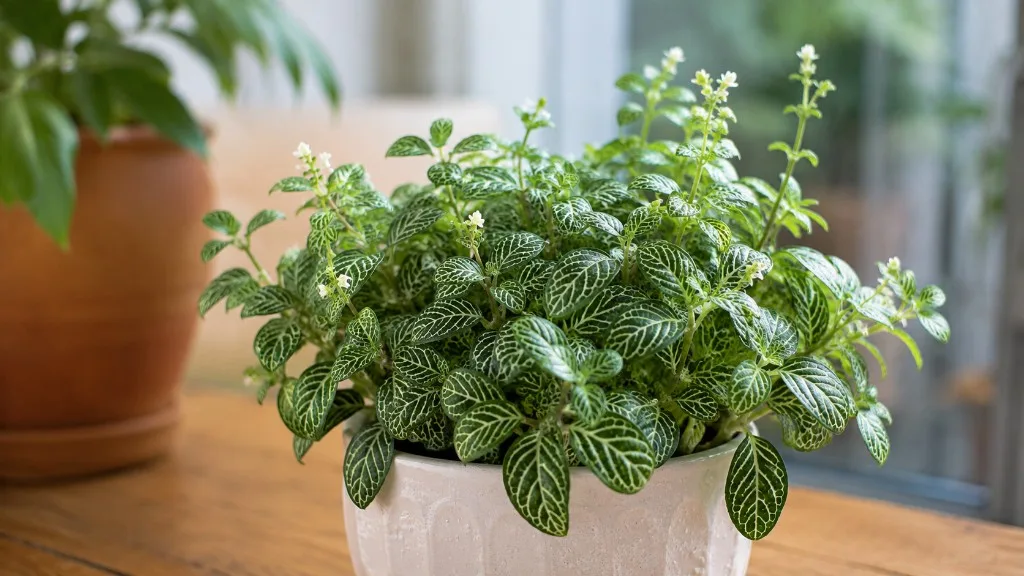
Fittonia - the nerve plant, mosaic plant, or network plant - is sold for one visual payoff: leaves traced with white, pink, red, or lime veins so sharp they look drawn on. That pattern is not permanent wallpaper. It is a living response to how much usable light reaches the leaf surface each day. Give Fittonia albivenis the bright, filtered exposure it evolved under on the tropical forest floor of Peru and Colombia, and you get a low, spreading mat of saturated foliage. Park it in harsh direct sun or a dim hallway shelf, and the same plant either burns crisp or stretches pale, losing the contrast that made you buy it.
The practical target for most homes is bright indirect light - strong ambient brightness without a direct sunbeam landing on the leaves for more than a few minutes of gentle morning exposure. That is not the same as “low light” even though Fittonia is often marketed as a dim-room plant. The Royal Horticultural Society places Fittonia in a bright spot away from direct sunlight, with north- or east-facing windows as ideal placements indoors. (RHS). Missouri Botanical Garden recommends bright indirect light (east or north window) or dappled part sun, with direct sun avoided.
This guide focuses on the decisions that protect vein color and compact growth: how much light Fittonia actually needs, why direct sun causes leaf burn, why low light dulls color, where to place pots for an east window or filtered light setup, when terrariums and bathrooms help, how to use grow lights, and how to read warning signs before damage becomes habit.
How Much Light Fittonia Actually Needs
Fittonia is a low-growing Acanthaceae ground cover in the wild, spreading slowly outward rather than climbing toward canopy gaps. It lives under bright tropical skies but behind physical shade - tree trunks, leaf litter, and neighboring plants filter the radiation before it hits the nerve plant’s thin leaf tissue. That ecology translates indoors to high room brightness with soft, indirect delivery, not darkness and not a sunbeam on the windowsill.
For home growers, the usable baseline is bright indirect light for most of the day. Missouri Botanical Garden notes that foliage will scorch in direct sun, while the RHS lists leaf scorch as a common problem when plants sit in direct sunlight.
Think in hours of usable brightness, not compass direction alone. A Fittonia that sees open sky through a sheer curtain for ten to twelve hours often outperforms one sitting two feet from an unshaded west window that receives three hours of punishing afternoon rays. The leaf cares about total photon flux and heat load, not whether the room feels bright to your eyes when you walk past at dinner.
Light also sets the pace for water use, humidity stress, and recovery from wilt. A nerve plant in correct bright indirect light drinks on a steady rhythm and snaps back from brief drought stress. A dim plant grows slowly, stays wet longer, and invites root problems if watered on a schedule copied from a sunny windowsill. Treat light as the throttle for the whole care system.
The Short Answer for Busy Growers
If you only remember four rules, use these. Default placement: an east-facing window where the plant receives morning brightness without midday sunbeams on the leaves, or any bright window softened by a sheer curtain or three to five feet of setback from unfiltered south or west glass. Avoid direct sun: unfiltered midday or afternoon rays on Fittonia foliage reliably produce bleached patches, crisp brown areas, and edge burn within days. Low light is a compromise, not a goal: Fittonia may survive dim corners temporarily, but vein color dulls, stems stretch, and new leaves stay small when light is chronically insufficient. Judge by new growth: firm, compact shoots with tag-matching vein contrast on the newest leaves mean the current light works; stretching, faded pattern, or scorch on fresh foliage mean adjust placement before changing water or fertilizer.
Give any placement change 10 to 14 days before deciding it failed. Old damaged leaves do not recover their pattern - only new ones tell the truth about the current spot.
Why Fittonia Rejects Direct Sun and Low Light Equally
Fittonia’s reputation as an easy terrarium plant creates a false binary: either tuck it in deep shade forever, or treat it like a sun-loving succulent because the leaves are small. Neither extreme matches the plant’s native niche. Rainforest floor plants under open tropical sky receive plenty of light - just not unfiltered direct radiation on delicate tissue. Indoors, that means the middle band of bright indirect exposure wins; the two failure modes at the edges are sunburn and etiolation.
Rainforest Floor Origins and What They Mean Indoors
In Peru and Colombia, Fittonia grows in warm, humid forest understory where light is bright but broken by canopy layers above. Humidity stays high; temperature swings stay moderate; and the plant spreads in mats rather than racing upward. The RHS notes that Fittonias originate in tropical forests shaded from the sun but in high humidity, and need similar conditions as houseplants - which is why bathrooms, bottle gardens, and terrariums work when they also deliver bright ambient light, not when they are dark glass boxes in an interior hallway. (RHS)
The indoor translation is not “hide it from photons.” It is filter photons. Sheer curtains, frosted glass, neighboring taller plants on a windowsill, and east exposures that deliver cool morning rays all recreate canopy filtering without starving the plant. A Fittonia on a dark bookshelf across from a window may see reflected room brightness but receive too little directional flux for vivid veins - the same way a forest floor far from a gap grows green but not boldly patterned.
Humidity and light interact. High humidity alone does not prevent sunburn if a direct beam hits the leaf; low humidity alone does not cause crisp scorch if light stays indirect. But direct sun plus dry air accelerates edge browning, which is why the RHS warns against south-facing windowsills and radiator-adjacent placements where leaves dry and heat quickly. (RHS)
How Direct Sun Triggers Leaf Burn and Bleaching
Fittonia leaves are thin, with high surface-area-to-mass ratio and vivid pale vein zones that lack the pigment shielding found in darker foliage. Direct sunlight - especially midday and afternoon rays amplified by window glass - overwhelms the leaf’s photoprotective capacity. Missouri Botanical Garden warns that foliage will scorch in direct sun. The RHS lists leaf scorch as a common problem and recommends positioning away from direct sunlight and heat sources. (RHS)
Sun damage on Fittonia rarely looks subtle at first exposure. Typical progression:
- Bleached or washed-out patches on the sun-facing side, especially in white- and pink-veined cultivars like White Anne or Pink Forest Flame
- Crisp tan or brown edges that feel dry to the touch, distinct from the soft wilt of underwatering on Fittonia
- Curling or folding during the brightest hours as the leaf sheds surface area to reduce heating
- Sudden collapse of newer leaves after a quick move from nursery shade to an unfiltered sill
Morning sun through east glass is sometimes tolerated for acclimated plants, but afternoon sun on west or south panes is the most common burn vector indoors. Hot glass radiates infrared; dark pots heat roots; and a nerve plant that never experienced direct rays at the grower bench has no hardened leaf tissue to absorb the shock.
If you see burn, reduce intensity before debating hours: move the pot back from glass, add a sheer curtain, or shift to an east exposure. Prune severely scorched leaves only after the plant sits in stable indirect light for a week - cosmetic trimming does not fix ongoing exposure.
How Light Controls Nerve Plant Vein Color and Compact Growth
Fittonia’s ornamental value is vein contrast - white, pink, or red reticulation against green, red, or lime leaf backgrounds. That contrast is metabolically expensive. The plant maintains bold patterning when it has enough light energy to spare on display tissue while still powering roots and spread. Drop below that threshold and Fittonia prioritizes reach over pattern.
When Bright Indirect Light Keeps Veins Vivid
Under bright, indirect light, Fittonia produces compact internodes, firm leaves, and sharp vein definition - the RHS recommends a bright spot away from direct sunlight to preserve foliage quality.
Bright indirect light supports:
- Shorter stems between leaf pairs, keeping the mat low and bushy as the species naturally grows
- Larger new leaves relative to light-starved plants, which improves the visual mass of the pattern
- Faster recovery from wilt episodes, because active photosynthesis fuels turgor restoration after watering
- Better stress signaling - when problems appear, you can separate light issues from humidity or root issues faster because growth is not suppressed
Cultivar genetics shift the exact saturation point. Forest Flame and Pink Forest Flame carry red and pink leaf fields that can look electric in good light. White Star and pale Skeleton types show washout sooner when exposure is wrong because pale tissue has less pigment buffer. Still, all cultivars share the same directional response: more usable brightness up to the burn threshold deepens contrast; insufficient brightness flattens it.
When Low Light Dulls Color and Stretches Stems
Fittonia is often sold as low-light tolerant, which readers misread as low-light preferred. Tolerance means survival - not vivid display. The RHS associates leaf yellowing with lack of light and recommends moving the plant to a brighter spot - not a darker one. (RHS)
Low-light failure signs develop over two to four weeks:
- Muted vein contrast - white veins turn cream, pink veins turn faint rose, and the leaf reads flat green or dull red
- Etiolation - visible lengthening between leaves, often directional lean toward the brightest corner of the room
- Smaller new foliage that never reaches the size of older leaves grown under better light
- Slower spread and thin stems that flop despite adequate watering
Low light also couples to overwatering on Fittonia risk. A dim Fittonia uses less water; if you maintain a bright-window Fittonia watering guide, roots sit wet, lower leaves yellow, and growers often misdiagnose nutrient deficiency. The first fix is more brightness, not more fertilizer.
If your only available spot is genuinely dim, choose between two honest strategies: add a grow light and keep color, or accept softer patterning and reduce water accordingly. Pretending a dark corner will produce tag-photo veins leads to repeated plant replacement.
Best Window Placement for Fittonia Indoors
Compass labels are starting guesses. A “south window” behind a deep porch roof may deliver less usable light than an open east pane. Fittonia placement succeeds when leaf-level brightness stays in the bright indirect band for enough hours daily without direct beam contact at peak intensity.
Place the pot within 12 inches (30 cm) of the glass on the chosen exposure, not on a distant table where the plant sees sky but collects few photons. Rotate a quarter turn every few days to prevent hard lean. Keep leaves from touching hot glass in summer - contact points burn even when the broader room light seems acceptable.
East Windows and Filtered Light Setups
An east-facing window is the best default for Fittonia indoors. Morning sun is bright but cooler than afternoon sun, delivering the high photon flux that supports vein color without the heat spike that bleaches pale cultivars. The RHS recommends near a north- or east-facing window as ideal; east satisfies the brightness requirement while minimizing scorch risk on most latitudes year-round. (RHS) Missouri Botanical Garden likewise recommends east or north windows with direct sun avoided.
Filtered light setups replicate east-window safety on brighter exposures:
- Hang a sheer white curtain on south or west windows so the plant sees luminous sky without a sharp beam
- Set the pot three to five feet back from unfiltered south or west panes, on a table still inside the room’s brightest zone
- Use frosted privacy film on workplace windows where direct afternoon sun is unavoidable
- Group Fittonia behind taller shade-tolerant plants on the same sill so leaves sit in bright ambient shadow
Filtered light is not weak light. It is de-risked bright light. A sheer-curtain south window often outperforms an unobstructed north window for vein intensity because total daily brightness remains high while peak radiation stays safe.
North, South, and West Exposures Compared
A north-facing window can maintain a healthy Fittonia in summer at higher latitudes where north exposures still receive long hours of open sky brightness. In winter or on shaded northern sides of buildings, north light alone often produces gradual color fade and stretch unless you supplement. Treat north as acceptable for survival, marginal for display color, and grow-light territory from late fall through early spring in many homes.
A south-facing window delivers the strongest indoor sun in the northern hemisphere. Fittonia can live on a south sill only with diffusion - sheer curtain mandatory in summer - or with the pot pulled back so leaves never enter the direct beam. Unfiltered south glass is the fastest route to bleached White Anne leaves and crisp Pink Forest Flame margins.
A west-facing window provides strong afternoon rays - the highest scorch risk of the four orientations. If west is your brightest option, filter peak hours and favor morning-light spill from the east side of the room if possible. Watch for one-sided fade on leaves facing the pane; that asymmetry is a diagnostic clue that direct glare, not general dimness, is the problem.
Office fluorescent lighting can support Fittonia when desk lamps deliver 10 to 12 hours of consistent brightness and the plant sits within a few feet of tubes - Missouri Botanical Garden notes dwarf forms suit terrariums where controlled bright placement replaces weak window light. Fluorescents alone rarely match a good east window for color intensity, but they prevent the worst etiolation in cubicle environments.
Terrariums, Bathrooms, and Other Bright Shaded Spots
Fittonia’s humidity needs make terrariums, bottle gardens, steamy bathrooms, and kitchens natural companions to correct lighting - but humidity does not replace photons. The RHS highlights terrariums as ideal Fittonia habitats because they combine high humidity with bright placement near glass. (RHS) A sealed terrarium on a dark shelf still fails; a open terrarium on an east windowsill often thrives with minimal watering because humidity slows dry-down while light drives color.
Bathrooms work when a window or strong grow light supplies brightness. A shower room with frosted glass can deliver excellent diffuse bright light all day. A windowless bathroom with only a heat lamp does not - humidity without flux produces pale stretchy mats that mold before they impress.
Why Glass Enclosures Change Light Intensity
Glass alters light in ways that help and hurt Fittonia. Clear terrarium glass near an east window raises ambient humidity and can slightly scatter incoming rays, reducing scorch risk while keeping brightness high inside. Sealed enclosures also reduce air movement, so heat buildup on south-facing terrarium glass becomes a hidden burn source - the leaves scorch even when the room air feels moderate.
Practical terrarium lighting rules:
- Place open or vented terrariums on east sills or filtered south/west locations, not unshaded afternoon glass
- If condensation constantly coats glass and blocks transmission, wipe panels or relocate - biofilm cuts light dramatically over weeks
- Under artificial terrarium LEDs, start with moderate intensity and 10–12 hour photoperiod; thin Fittonia leaves show LED burn as pale dry patches distinct from fungal spots
- Combine with small companions (Soleirolia, Selaginella, Callisia) only when shared light level suits all plants - do not let a tall partner shade Fittonia into dull growth
Kitchen windows above sinks often combine east or north brightness, humidity from cooking, and stable warmth - excellent when steam does not coat leaves nightly with grease film that blocks gas exchange.
Grow Lights When Windows Fall Short
When windows cannot deliver enough brightness for compact growth and saturated veins, a full-spectrum LED grow light is the most reliable indoor upgrade. Fittonia responds well to supplemental light in winter, north rooms, and office desks - contexts where natural photoperiod and intensity both drop below display quality thresholds.
Start conservatively. Nerve plant leaves burn under LEDs faster than under diffuse window light because fixtures deliver directional intensity without atmospheric scatter. Begin with the lamp 18 to 24 inches (45 to 60 cm) above the canopy, run 10 to 12 hours daily on a timer, and observe new growth for seven to ten days. If stems stay compact and veins sharpen, hold the setup. If leaves pale and crisp at the center of the rosette, raise the fixture or reduce hours before assuming disease.
Spectrum choice matters less than consistency for foliage display, but full-spectrum white LEDs in the 5000K to 6500K range mimic daylight balance and keep green and red leaf fields natural-looking. Cheap narrow-band purple panels can grow Fittonia but make color judgment harder when troubleshooting stress.
Distance, Hours, and Spectrum for Dense Mats
Use the new-growth test as your adjustment dial:
- Stretching toward the lamp with faded veins means increase brightness (lower fixture slightly) or extend photoperiod by one to two hours
- Pale dry spotting on leaves directly under the center beam means decrease intensity (raise fixture) even if edges look fine
- Compact growth with glossy firm leaves means hold steady and resist chasing more lumens
Winter supplementation should pair with reduced watering as growth slows - extra light without extra dry-down discipline causes the same root stress as overwatering in dim corners.
For propagation, cuttings root faster under bright indirect light or gentle LED exposure than in dark propagators. Match mother-plant light levels within one step when moving rooted divisions out of humidity tents so new leaves do not scorch on hardening day one.
Warning Signs Your Fittonia Has the Wrong Light
Fittonia communicates light stress clearly if you read newest leaves and directional asymmetry rather than oldest cosmetic damage. Old scars from the garden center do not tell you about today’s window; the top quarter-inch of growth does.
Separate light problems from humidity and watering by checking soil moisture and leaf texture in the same inspection. Soft wilt with dry soil is drought. Soft wilt with wet soil is roots. Crisp dry patches with moist soil are almost always light or heat.
Too Little Light Symptoms
Chronic under-lighting produces a recognizable cluster:
- Faded vein network - the signature pattern weakens before stems stretch obviously
- Long internodes and visible lean toward the brightest architectural feature in the room
- Small, thin new leaves that never match older foliage size from brighter growing conditions
- Yellowing lower leaves on plants that stay wet too long because metabolism slowed
- Slow spread and sparse mat formation despite fertilizer - feed cannot replace photons
Fix path: move toward an east window, add filtered brightness on a stronger exposure, or install a 10–12 hour LED. Reduce water slightly as growth accelerates. Pinch leggy tips only after light is corrected so regrowth branches compactly.
Too Much Direct Sun Symptoms
Over-lighting and direct sun produce a different cluster:
- Bleached white or pink zones that look sun-faded rather than naturally pale cultivar color
- Crisp brown patches on the window-facing leaf half, sometimes with dry texture unlike fungal brown spots
- Midday curling that relaxes at night but returns on sunny days - a heat-and-light overload signature
- Sudden damage after Fittonia repotting guide or moving from shaded nursery bench to unfiltered sill without acclimation
- Marginal browning on cultivars with high pale tissue percentage (White Star, Lemon) before greener types show symptoms
Fix path: remove direct beam contact immediately, add sheer diffusion, shift to east exposure, and wait for new growth before judging recovery. Do not increase watering to “heal” scorched leaves - damaged tissue will not re-green; only replacement foliage counts.
Acclimate intentional brightness increases over 7 to 14 days: move the pot closer to the window by inches per day, or open curtain sheer gradually, watching newest leaves each morning.
Conclusion
Fittonia light needs are precise even though the plant is small. It wants bright indirect light like the filtered floor of a tropical forest - not the dark corner implied by “low-light houseplant” marketing, and not the unfiltered windowsill that burns delicate leaves within days. An east-facing window is the cleanest indoor default; sheer-filtered south or west light is the backup when east is unavailable; and grow lights fill the gap when winter or room layout starves the mat of usable brightness.
Direct sun is the fastest way to lose vein contrast through bleaching and crisp scorch. Low light is the slow way to lose it through dull pattern and stretched stems. Place the pot close enough to glass that light lands on leaves, judge success by new growth over two weeks, and change light before you stack water, fertilizer, and repotting fixes on a plant that is simply telling you it cannot see the sky the way it needs to.
Get brightness right and Fittonia rewards you with the intricate, responsive foliage that earned the name nerve plant - a living surface that tracks your window decisions leaf by leaf.
When to use this page vs other Fittonia guides
- Fittonia overview - Start here for whole-plant context before deep-diving this topic.
- Fittonia problems hub - Jump to symptom-specific fix guides when this care topic does not resolve the issue.
- Not Enough Light on Fittonia - Escalate here when light adjustments are not enough.
- Leggy Growth on Fittonia - Escalate here when light adjustments are not enough.
Related Fittonia guides
- Fittonia overview
- Fittonia watering
- Fittonia soil
- Fittonia propagation
- Fittonia fertilizer
- Fittonia repotting
- Not Enough Light on Fittonia
- Leggy Growth on Fittonia
- Fittonia problems
Related tool
Try the Plant Problem Diagnosis Tool with fittonia pre-selected to estimate needs for your setup.