Ficus Elastica Ruby Care: Light, Water & Tips
Ficus elastica 'Ruby'
Ficus Ruby needs maximum bright light to maintain pink and cream variegation. Standard rubber plant watering: top 2–3 cm dry before watering. Clean leaves monthly for best colour.
Ficus Elastica Ruby Care: Light, Water & Tips
Start with wateringThe most common care mistake for Ficus Elastica RubyWatering guide →Ficus Elastica Ruby care essentials
Light
bright indirect light, some morning direct sun
Water
Water when top 2–3 cm dries. Every 7–10 days summer; 14–21 days winter.
Soil
Well-draining potting mix with 20% perlite.
Humidity
Average to moderate humidity (40–60%)
Temperature
18°C to 28°C (65–82°F)
Fertilizer
Feed lightly during active growth. Use monthly in spring and summer..
About Ficus Elastica Ruby
Ficus Elastica Ruby has a upright growth habit.
| Detail | Information |
|---|---|
| Growth habit | Upright |
| Scientific name | Ficus elastica 'Ruby' |
Ficus Elastica Ruby Care: Light, Water & Tips
What Is Ficus Elastica Ruby?
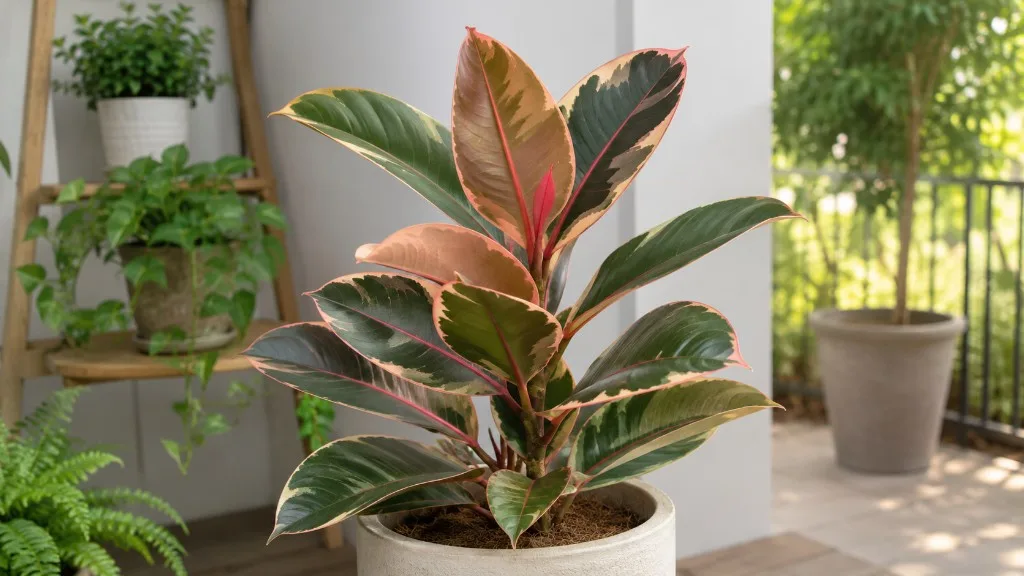
Ficus Elastica Ruby - botanically Ficus elastica ‘Ruby’ - is a variegated cultivar of the classic rubber plant, grown for glossy leaves that combine deep green, creamy white, and vivid pink-to-ruby-red in a single tricolor pattern. New leaves often emerge sheathed in bright pink-red before unfurling into the mature green-cream-pink mosaic that makes Ficus Elastica Ruby overview a statement piece in bright rooms. Unlike the solid burgundy or deep green forms of Ficus elastica, Ruby is a color-first plant: its care revolves around keeping enough light for pigment expression without scorching the chlorophyll-poor pale sections that cannot photosynthesize efficiently on their own.
Indoors, Ficus elastica Ruby typically reaches 6 to 8 feet (1.8 to 2.4 m) over several years in a floor pot, though many growers keep it smaller through pruning and moderate light. Growth is moderate - often 1 to 2 feet (30 to 60 cm) per year in bright, warm conditions - and slows noticeably in dim corners or cool winter rooms. The plant has an upright, tree-like habit with a single or lightly branched trunk and large, waxy, semi-succulent leaves that store moisture and give Ruby more drought tolerance than thin-leaved tropicals, but less forgiveness for chronic overwatering on Ficus Elastica Ruby than its tough appearance suggests.
If you are deciding whether Ruby fits your home, the honest summary is this: Ruby rewards Ficus Elastica Ruby light guide, dry-down watering, and stable placement - and it punishes low light, soggy soil, and sudden environmental changes. It is easier than a fiddle-leaf fig (Ficus lyrata) for most growers and slightly more demanding than the solid-green Burgundy rubber plant because variegation raises the light floor. The payoff is one of the most colorful foliage displays in the rubber plant family without waiting for flowers, which rarely appear indoors anyway. One critical caveat for pet owners: Ficus elastica is toxic to cats and dogs according to the ASPCA and Pet Poison Helpline, which surprises people who confuse it with the unrelated, non-toxic baby rubber plant (Peperomia obtusifolia).
Botanical Background and Native Range
Ficus elastica belongs to the family Moraceae - the mulberry and fig family - which includes weeping fig (Ficus benjamina), fiddle-leaf fig, and edible fig (Ficus carica). Moraceae houseplants share a few baseline patterns: they prefer well-drained soil, dislike cold drafts and sudden moves, and often drop leaves as a stress response before slower decline becomes obvious. The milky latex sap that oozes from cut stems is a defining family trait; it helps seal wounds in the wild but irritates skin and mucous membranes in pets and people.
The species is native from the Himalayas to Malaysia, Sumatra, and Java, where it grows as a large tree in warm, humid tropical forests. In USDA Hardiness Zones 10 through 12, Ficus elastica can grow outdoors as a landscape tree; everywhere else it is a container houseplant that cannot survive frost. Ruby is a selected cultivar, not a separate species - its tricolor pattern is maintained through propagation of vegetative cuttings rather than seed, because seed-grown offspring would not reliably reproduce the same variegation.
Retail naming can be loose. You may see this plant sold as Ruby rubber plant, Ruby rubber tree, Ficus Ruby, or variegated rubber plant. Tags that say only “rubber plant” without a cultivar name often mean a solid-green or burgundy form with lower light needs. If color is why you bought the plant, confirm the label reads ‘Ruby’ or matches the pink-cream-green pattern. Ficus elastica ‘Tineke’ is the closest lookalike: both are tricolor, but Ruby generally shows more pronounced pink and red, especially on new growth, and needs equal or slightly brighter light to hold that warmth.
Why Tricolor Variegation Changes How You Care
Variegation is not decorative paint - it is a physiological trade-off. Green leaf tissue contains chlorophyll and drives photosynthesis. Cream, white, and pink sections contain less chlorophyll, so the plant must compensate by either producing more green tissue or receiving more light on the remaining green areas. When light is insufficient, Ruby does not politely fade; it reverts toward green because building chlorophyll is the fastest path to survival. That is why a Ruby moved to a dim hallway can look like a washed-out Tineke within weeks, and why two identical pots in different rooms can diverge dramatically in color.
The pink and ruby tones are linked to anthocyanin pigments, which also serve a protective role under brighter light. Growers who track new leaves notice a useful pattern: in adequate light, emerging sheaths and young leaves show deep pink-red that softens as the leaf hardens. In low light, new leaves emerge pale cream or greenish from the start - a signal to increase filtered light, not fertilizer. The pale sections are also more sun-sensitive than solid green rubber plant leaves; Ruby needs the brightest spot you can offer without harsh midday sun burning unprotected tissue.
Ruby also photosynthesizes less efficiently per square inch of leaf than Burgundy or Robusta, the solid-green cultivars. That single fact drives most of the care differences in this guide: more light, slightly more careful watering checks, and patience after any move because variegated ficus often sheds older leaves while adjusting. Treat Ruby as a medium-difficulty houseplant - approachable for anyone who already keeps pothos or philodendrons thriving in bright rooms, but a poor first plant for a dark apartment or a home with curious pets.
Best Growing Conditions for Ficus Elastica Ruby
Ficus elastica Ruby performs best when your room approximates the warm, bright, moderately humid rhythm of its native range. The four variables that decide almost every outcome are light, water, soil, and temperature. Align those and feeding, Ficus Elastica Ruby repotting guide, propagation, and pruning become routine maintenance. Misalign any one - especially light or water - and the plant shows stress on the leaves long before the root cause feels obvious.
Light Requirements for Pink and Red Color
Bright indirect light is the non-negotiable requirement for Ficus elastica Ruby. Aim for roughly 6 to 8 hours of strong, filtered daylight daily - the kind of bright indirect light or part shade where you can read comfortably without turning on lamps, but where direct midday sun does not hit the leaves for hours. That typically means placing the pot within 3 to 5 feet (1 to 1.5 m) of an unobstructed east- or west-facing window, or 2 to 3 feet (60 to 90 cm) back from a south-facing window with a sheer curtain.
East-facing windows are often ideal for Ruby. One to two hours of gentle morning direct sun from an east window actually benefits color and compact growth without the scorch risk of afternoon rays. West-facing exposures work if harsh late-day sun is softened by filtering or distance. South-facing windows can be excellent in winter but may need the plant pulled back or curtained in summer, when glass intensifies heat and light - pale variegated sections burn first, showing bleached patches, brown crispy spots, or curled edges on the side facing the glass. North-facing windows alone are rarely enough to maintain pink variegation year-round; the plant may survive but will green out unless you supplement with a full-spectrum grow light on a 10–12 hour timer.
Use new leaves as your light meter, not old damage. Compact internodes, firm stems, and pink-red emerging sheaths mean the placement is working. Leggy stems, smaller new leaves, and dull greenish unfurling mean increase light gradually over one to two weeks - do not jump from a dim corner straight into unfiltered south window sun, because leaves formed in low light scorch easily. Rotate the pot every week or two so growth stays balanced; Ruby leans toward light sources like other ficus.
Dust matters more on variegated rubber plants than beginners expect. The broad, waxy leaves collect a film that blocks light from already less-efficient tissue. Wipe leaves monthly with a damp soft cloth to keep the surface clean and inspect for pests at the same time.
Temperature and Humidity
Ficus elastica Ruby prefers stable indoor temperatures between 65 and 82°F (18 and 28°C) during active growth. It tolerates brief excursions slightly above or below that band, but cold drafts and sudden drops below about 55°F (13°C) can trigger leaf drop - common after placing the pot on a winter windowsill touching cold glass or directly under an air-conditioning vent. Keep Ruby away from radiators, fireplace heat, and frequently opened exterior doors in winter; the goal is boring stability, not dramatic swings.
Humidity is moderately important for Ruby - more so than for solid-green Burgundy, but less critical than light. Target 40 to 60% relative humidity for best leaf margins and pest resistance. Average homes often sit in that range during summer; forced-air heating in winter can drop humidity to 20 to 30%, which encourages brown, crispy leaf tips, slight leaf curling, and spider mites. Grouping plants, using a pebble tray with the pot elevated above the water line, or running a small humidifier nearby all raise humidity more reliably than misting, which provides only minutes of benefit and can leave wet foliage that invites fungal spotting where airflow is poor.
If you mist despite that limitation, do it in the morning and avoid soaking variegated sections that sit in direct sun afterward - water droplets can act like lenses and cause spot burns on pale tissue. Humidity supports color indirectly by reducing stress; it does not replace adequate light for pink variegation.
Soil and Drainage
Use a well-draining potting mix with roughly 20% perlite or an equivalent airy amendment such as pumice or bark fines. The principle matters more than a branded recipe: the mix should drain freely, hold enough moisture for roots to access between waterings, and retain air space so roots breathe. A heavy, peat-compacted indoor mix that stays wet for a week is one of the fastest routes to root rot on Ficus Elastica Ruby on ficus, whose thick roots still need oxygen.
Target a mildly acidic to neutral pH around 5.0 to 7.0 - normal quality houseplant mixes fall within this range, so hobbyists rarely need to adjust pH chemically. What does need attention is refreshing compacted mix every one to two years through repotting, because old substrate that has collapsed into a dense block holds water longer than Ruby’s semi-succulent roots prefer.
Always plant in a container with a drainage hole. Decorative cachepots are fine only if you empty runoff after every watering and never let the inner pot sit in standing water. Ruby’s thick leaves suggest drought tolerance, but its roots still rot in stagnant wet mix - the leaves are misleading armor.
How to Water Ficus Elastica Ruby
The general rule for Ficus elastica Ruby is water when the top 2 to 3 cm (about 1 inch) of mix is dry - letting the soil dry slightly to the touch between waterings - then soak thoroughly until a small amount runs from the drainage hole. In warm, bright conditions that often translates to roughly every 7 to 10 days in summer and every 14 to 21 days in winter, but your calendar should be a reminder to check, not a rule to follow blindly. Pot size, soil texture, light intensity, humidity, and whether the plant is actively growing all change the interval - a Ruby in a bright bay window dries faster than the same pot in a shaded bedroom.
Check moisture with a finger, wooden skewer, or pot-weight lift before every watering. If the deeper mix still feels cool and damp, wait. If the top is dry and the pot feels noticeably light, water until the entire root zone is moistened, then empty the saucer. Ruby stores water in its leaves and stems, so it survives occasional dry spells better than constant wet feet - but repeated drought stress still damages fine roots and causes lower leaf drop that people often misread as a mysterious ficus mood.
Ficus Elastica Ruby watering guide During Active Growth
During the warm, bright months when new leaves unfurl regularly, Ruby uses water on a steady dry-down cycle. The goal is to let the upper root zone approach dryness between drinks while avoiding a fully desiccated block of old mix that repels water and runs straight through the pot. A thorough soak followed by a real dry-down matches how the plant behaves in nature far better than small daily sips that wet only the surface.
Watch the link between light and watering every time you move the plant. Brighter exposure increases transpiration and shortens the interval; dimmer placement means slower uptake - if you do not adjust, overwatering follows. New growth should look firm and glossy; soft, yellowing lower leaves on wet mix point to too much water, not too little.
If you just brought Ruby home from a greenhouse, expect a short adjustment period. Big-box ficus often arrive in peat-heavy mix with roots accustomed to high humidity and steady irrigation. Do not compensate for leaf drop by watering more unless the pot is genuinely dry; stabilize light first, then refine the rhythm based on how your specific container dries in your home.
Seasonal Adjustments
In cooler, dimmer months - roughly late fall through early spring in temperate climates - growth slows and the pot dries more slowly even when heating dries the air. Stretch the interval between waterings, check moisture at depth rather than trusting surface color alone, and pause or reduce fertilizer until new growth resumes clearly. The most common winter failure is continuing a midsummer schedule in lower light, which keeps mix waterlogged and produces yellow leaves, fungus gnats, and root rot.
Heated winter air adds a nuance: the surface may look dry while the center stays wet, especially in oversized pots or dense old mix. Weight the pot or use a skewer to the bottom third before deciding. If you run a humidifier for leaf-tip health, remember humidity does not replace the need for less frequent watering when the plant is metabolically slow.
Resume your active-season rhythm only when multiple new leaves or steady tip growth show the plant has woken up - usually as daylight lengthens and room temperatures stabilize in spring.
Common Watering Mistakes
The single most damaging mistake with Ficus elastica Ruby is watering on a fixed weekly schedule without checking the pot. The second is letting the plant sit in a full saucer or cachepot, which suffocates roots within days. The third is interpreting any leaf drop as thirst and adding water to already wet mix - ficus famously drops leaves after moves, light changes, and draft exposure while soil remains damp.
People also underestimate how pot upsizing changes watering. After repotting into a larger container, the extra mix holds moisture longer until roots fill the volume; many post-repot deaths are overwatering deaths. Conversely, a root-bound plant in a too-small pot may need water frequently yet still stress from drought in the center of the root ball - another reason to repot on time rather than only when crisis hits.
If stems feel soft at the base, leaves yellow widely, and the mix smells sour, stop watering, inspect roots, trim brown mushy tissue, and repot into fresh airy mix. Recovery is possible if firm white roots remain, but prevention through dry-down checks is far easier.
How to Feed Ficus Elastica Ruby
Ficus elastica Ruby is a moderate feeder during active growth, not a heavy one. A balanced water-soluble houseplant fertilizer - such as 10-10-10 or 20-20-20 - diluted to one-quarter to one-half of the label rate is sufficient for most indoor plants. Apply to already-moist soil roughly once a month from spring through early fall, or every six weeks if the plant is in rich mix and already pushing steady new leaves. If your potting soil contains a slow-release starter charge, hold supplemental feeding for the first four to six weeks after repotting to avoid salt buildup on vulnerable roots.
Hold fertilizer entirely during cool, low-light months, immediately after repotting until new growth appears, and while the plant recovers from root rot, major leaf drop, or pest damage. Overfeeding produces crisp brown leaf margins and tip burn that mimic drought or low humidity but persist even when watering is correct. If margins crisp despite good moisture and humidity, flush the pot with plain water at two to three times the pot volume and pause feeding for six to eight weeks.
Color intensity is driven primarily by light, not fertilizer. Extra nitrogen cannot substitute for insufficient brightness; it may only push green growth that dilutes the pink variegation visually. Feed to support healthy new leaves, not to “force” pigment.
Repotting and Root Health
Repot Ficus elastica Ruby roughly every one to two years, or whenever roots circle drainage holes, water runs straight through without soaking in, or the plant dries out within a day or two of watering despite a previously normal rhythm. The best timing is early spring as active growth resumes, giving Ruby a full warm season to colonize fresh mix. Avoid repotting during deep winter dormancy or mid-heat-wave stress unless emergency root rot requires it.
Choose a pot only one size larger - typically 1 to 2 inches (2.5 to 5 cm) wider than the current root ball. Oversized pots hold excess wet mix around roots that cannot use it, the most common trigger for rot after repotting. Use fresh well-draining mix with perlite, plant at the same depth as before, and water lightly for the first week while cut roots heal. Expect some leaf drop after repotting; stable bright light and restrained watering help more than moving the plant repeatedly.
Wear gloves or wash hands after handling cut stems; latex sap can irritate skin and surfaces.
Signs It Is Time to Repot
The clearest physical signs are roots emerging from drainage holes, roots visible on the soil surface, water channeling straight through dry pockets, or a plant that is top-heavy and unstable for its pot. Less obvious but equally important: mix that has compacted into a hard block, smells sour, or stays wet for unusually long despite unchanged watering habits.
If the plant is healthy but not root-bound, refreshing mix on the same size pot - repotting in place by trimming outer roots lightly and replacing old substrate - can solve compaction without encouraging overwatering in an oversized container.
Propagation Methods for Ficus Elastica Ruby
The most reliable home propagation method for Ficus elastica Ruby is stem cuttings taken during active growth. Division is uncommon because Ruby typically grows as a single trunk unless you have a multi-stem nursery specimen. Air layering works on larger plants but requires more setup; cuttings satisfy most growers who want a backup plant or a giftable offset.
Take a cutting 4 to 6 inches (10 to 15 cm) long with at least one leaf and one node, using clean, sharp shears. Remove the lower leaf if it would sit below the soil line. Blot the cut end - sap flows freely - and optionally let it callus for an hour to reduce rot risk. Root in moist, well-draining mix or water; water propagation lets you watch root formation but transition carefully to soil when roots are 2 to 3 inches (5 to 7 cm) long. Keep the cutting in bright indirect light, warm temperatures, and stable humidity without saturating the medium.
Do not propagate a stressed, pest-infested, or recently repotted parent until it has recovered; weak cuttings fail at higher rates and inherit the parent’s problems. Variegation on rooted cuttings generally matches the parent when propagated vegetatively, though extremely low-light-grown parents may produce less colorful juvenile leaves until light improves.
Common Ficus Elastica Ruby Problems
Most Ficus elastica Ruby problems are environmental, not mysterious diseases. Leaves are slow reporters - damage you notice today often started weeks earlier with light drift, a watering habit mismatch, or a draft. The practical approach is to check light and moisture first, then pests, then feeding - in that order - because that sequence matches how often each cause actually occurs.
Yellow Leaves, Brown Tips, and Pests
Yellow leaves are the most common complaint. Causes include overwatering (especially in low light), underwatering on Ficus Elastica Ruby, natural aging of lower leaves, sudden light or temperature change, root-bound stress, and pests. Check moisture at depth first: yellow leaves on wet, heavy mix point to root stress; yellow leaves on very dry, light mix point to drought. A few lower yellow leaves on an otherwise healthy plant may be normal shedding - ficus drops older foliage periodically, and variegated forms do it readily after moves.
Brown tips and margins usually indicate low humidity, salt buildup from fertilizer or hard tap water, underwatering, or fluoride/chlorine stress in sensitive setups. Flush the pot periodically with plain water, review humidity in winter, and confirm you are not overfeeding. Brown crispy patches on the sun-facing side are scorch - move the plant back or filter the window rather than increasing water.
Leaf drop after purchase or repotting is common ficus behavior if light and watering stay stable afterward. Repeated drop weeks later means something is still wrong - usually insufficient light, drafty placement, or chronic overwatering. Fix one variable at a time so you can read the plant’s response.
Pests to watch for include spider mites in dry air (fine webbing, stippled leaves), mealybugs in leaf axils, scale along stems, and fungus gnats if the mix surface stays wet. Inspect weekly during watering. Early infestations often respond to a strong shower, manual removal, and insecticidal soap applied to labeled directions; isolate affected plants until clear.
Green reversion - loss of pink variegation - is almost always insufficient light, not disease. Move Ruby brighter gradually, clean the leaves, and judge by new growth color over the next two to three unfurling leaves. Existing green-heavy leaves will not regain pink; pruning leggy green stems can redirect energy to colorful new growth if the light issue is fixed.
Is Ficus Elastica Ruby Safe for Pets?
No - Ficus elastica Ruby is toxic to cats and dogs. The Pet Poison Helpline lists rubber tree (Ficus elastica) as toxic to pets, citing irritating sap common to the genus. The ASPCA classifies Indian rubber plant (Ficus species including rubber fig) as toxic to dogs and cats, with toxic principles including proteolytic enzyme (ficin) and psoralen (ficusin). Ingestion can cause oral irritation, drooling, vomiting, diarrhea, and decreased appetite; skin contact with sap may irritate as well.
This matters because Ruby is often sold as a colorful, approachable houseplant without a prominent warning label. Do not confuse Ficus elastica with Peperomia obtusifolia, commonly called baby rubber plant - a different species in a different family that retailers often list as non-toxic to pets. The common name “rubber plant” applies to both, which creates real confusion at the garden center. Verify scientific names when pet safety is non-negotiable.
If you share your home with curious chewers, place Ruby out of reach - on a sturdy stand away from jumping zones - or choose a confirmed pet-safe alternative. If you suspect ingestion, contact your veterinarian or ASPCA Animal Poison Control at (888) 426-4435 (a consultation fee may apply). This article is general information, not veterinary advice.
Human handlers should also treat sap seriously: wear gloves when pruning or propagating, wash tools and hands afterward, and avoid getting latex in eyes or on broken skin.
Conclusion
The most useful thing to know about Ficus elastica Ruby is that it is a tricolor rubber plant from tropical Asia whose pink-red variegation is a living response to bright indirect light, not a permanent paint job. Give it 6 to 8 hours of strong filtered daylight - ideally with gentle morning sun - water when the top 2 to 3 cm of mix dries, keep temperatures between 65 and 82°F (18 and 28°C) with 40 to 60% humidity, and use well-draining mix with perlite in a pot that never sits in runoff. Judge success by new leaves: pink-red sheaths and firm, colorful unfurling mean the setup works; greenish new growth means move brighter before you change anything else.
Ruby is more light-hungry than Burgundy and more colorful than Tineke, but it follows the same Moraceae logic as every other ficus - stable placement, dry-down watering, and patience through leaf drop after changes. Propagate from stem cuttings in spring if you want a backup, repot on a one-size-up schedule before roots choke the mix, and treat pests and brown tips as environmental signals rather than random bad luck. Keep it away from cats and dogs, confirm you do not have a Peperomia masquerading under the rubber plant name, and you will have a plant worth the extra window real estate - one that rewards good light with foliage most houseplants cannot match.
When to use this page vs other Ficus Elastica Ruby guides
- Ficus Elastica Ruby overview - Canonical hub for this species - care topics and problems branch from here.
- Ficus Elastica Ruby problems - Symptom-first path when you already know something is wrong.
Related Ficus Elastica Ruby guides
- Ficus Elastica Ruby watering
- Ficus Elastica Ruby light
- Ficus Elastica Ruby soil
- Ficus Elastica Ruby propagation
- Ficus Elastica Ruby fertilizer
- Ficus Elastica Ruby repotting
- Ficus Elastica Ruby pruning
- Yellow Leaves on Ficus Elastica Ruby
- Mealybugs on Ficus Elastica Ruby
- Brown Tips on Ficus Elastica Ruby
- Root Rot on Ficus Elastica Ruby
- Overwatering on Ficus Elastica Ruby
How to care for Ficus Elastica Ruby?
How much light does Ficus Elastica Ruby need?
bright indirect light, some morning direct sun
- bright indirect light, some morning direct sun - bright indirect light, some morning direct sun.
When should you water Ficus Elastica Ruby?
Water when top 2–3 cm dries. Every 7–10 days summer; 14–21 days winter.
- Check top 2 inches - Water when top 2–3 cm dries.
- Drain excess water - Water when top 2–3 cm dries.
What soil works best for Ficus Elastica Ruby?
Well-draining potting mix with 20% perlite.
- Well-draining mix - Well-draining potting mix with 20% perlite.
Grower notes for Ficus Elastica Ruby
Ruby rubber plant identity note
Ficus Ruby needs more light discipline than Burgundy because the pink and cream sections are more delicate. It should be bright enough to hold color but protected from hot sun that scorches pale tissue. New leaves can emerge vivid, then settle into softer tones as they harden. If the plant starts producing dull greenish leaves, increase filtered light slowly rather than moving it straight into direct sun.
What makes Ruby Rubber Plant different
Ficus Ruby needs brighter filtered light than Burgundy to hold its pink and cream variegation. The pale leaf sections burn more easily, so the right spot is bright but not harsh midday sun through glass.
What matters most with Ficus Elastica Ruby
Ficus Elastica Ruby often reacts to change before it reacts to bad care. Leaf drop after a move is common, but repeated drop means light, drafts, watering, or root conditions are still unstable. In practice, the care checkpoint is simple: bright indirect light, some morning direct sun. Pair that with well-draining potting mix with 20% perlite, and avoid changing water, pot size, and placement all at once.
Best placement in a real home
Ficus Elastica Ruby belongs where bright indirect light, some morning direct sun is realistic for most of the day, not only where the pot looks good. Water when top 2–3 cm dries. Every 7–10 days summer; 14–21 days winter. If the pot stays wet longer than expected, move the plant into better light or reassess the mix before watering again. Humidity target: Average to moderate humidity (40–60%).. Temperature comfort zone: 18°C to 28°C (65–82°F).
Before you buy this plant
Choose Ficus Elastica Ruby with firm new growth, clean leaf undersides, and soil that does not smell sour or feel compacted. Be cautious if you see yellow-leaves, sticky residue, collapsed crowns, or a pot that is wet in poor light. Cosmetic old-leaf damage is less worrying than weak roots or active pests.
First month after bringing it home
Do not repot Ficus Elastica Ruby on day one unless the mix is failing or pests are obvious. Quarantine it, learn how fast the pot dries, and keep care boring while it adjusts. Watch especially for yellow-leaves, brown spots, and mealybugs. If problems appear, correct the condition first rather than stacking fertilizer, repotting, and pruning together.
Safety note for Ficus Elastica Ruby
Ficus Elastica Ruby is not a plant to keep within reach of pets or children. Treat it as an inaccessible display plant. Use gloves if sap or plant tissue is irritating, and pick a pet-safe alternative for floor pots or low shelves.
How to tell Ficus Elastica Ruby is settling in
If you plan to multiply it later, common methods include Stem cuttings and Air layering. If brown spots shows up early, inspect light, watering, and roots before assuming the plant is permanently weak.
Is it pet safe?
Ficus Elastica Ruby is toxic to cats and dogs.
Toxic; sap causes irritation.
Watering Ficus Elastica Ruby
Water when top 2–3 cm dries. Every 7–10 days summer; 14–21 days winter.
Soil & potting for Ficus Elastica Ruby
Well-draining potting mix with 20% perlite.
Humidity & temperature for Ficus Elastica Ruby
Ficus Elastica Ruby prefers average to moderate humidity (40–60%), though normal home humidity is usually fine. Keep temperatures around 18°C to 28°C (65–82°F).
| Detail | Information |
|---|---|
| Humidity | Average to moderate humidity (40–60%) - normal home humidity is fine. |
| Ideal temperature | 18°C to 28°C (65–82°F) |
Fertilizer & pruning for Ficus Elastica Ruby
Use feed lightly during active growth. Use monthly in spring and summer.. for Ficus Elastica Ruby.
| Detail | Information |
|---|---|
| Fertilizer type | Feed lightly during active growth. Use monthly in spring and summer.. |
Common problems on Ficus Elastica Ruby
Yellow Leaves
MediumLikely cause: Overwatering causes yellowing - variegated sectors show stress symptoms earlier than green areas
Quick fix: Allow soil to dry more; check drainage; reduce watering frequency
Full fix guide →Mealybugs
MediumLikely cause: Mealybugs establish in leaf axils of rubber plants, particularly in the dense variegated growth
Quick fix: Alcohol on cotton swab to remove; neem oil treatment; repeat weekly
Full fix guide →Brown Tips
MediumLikely cause: Common on this plant type; confirm with recent watering, light, and root checks.
Quick fix: Inspect the plant and correct the most likely care stressor before stacking treatments.
Full fix guide →Root Rot
MediumLikely cause: Common on this plant type; confirm with recent watering, light, and root checks.
Quick fix: Inspect the plant and correct the most likely care stressor before stacking treatments.
Full fix guide →Overwatering
MediumLikely cause: Common on this plant type; confirm with recent watering, light, and root checks.
Quick fix: Inspect the plant and correct the most likely care stressor before stacking treatments.
Full fix guide →Underwatering
MediumLikely cause: Common on this plant type; confirm with recent watering, light, and root checks.
Quick fix: Inspect the plant and correct the most likely care stressor before stacking treatments.
Full fix guide →Spider Mites
MediumLikely cause: Common on this plant type; confirm with recent watering, light, and root checks.
Quick fix: Inspect the plant and correct the most likely care stressor before stacking treatments.
Full fix guide →Aphids
MediumLikely cause: Common on this plant type; confirm with recent watering, light, and root checks.
Quick fix: Inspect the plant and correct the most likely care stressor before stacking treatments.
Full fix guide →Leggy Growth
MediumLikely cause: Common on this plant type; confirm with recent watering, light, and root checks.
Quick fix: Inspect the plant and correct the most likely care stressor before stacking treatments.
Full fix guide →Slow Growth
MediumLikely cause: Common on this plant type; confirm with recent watering, light, and root checks.
Quick fix: Inspect the plant and correct the most likely care stressor before stacking treatments.
Full fix guide →Wilting
MediumLikely cause: Common on this plant type; confirm with recent watering, light, and root checks.
Quick fix: Inspect the plant and correct the most likely care stressor before stacking treatments.
Full fix guide →Drooping Leaves
MediumLikely cause: Common on this plant type; confirm with recent watering, light, and root checks.
Quick fix: Inspect the plant and correct the most likely care stressor before stacking treatments.
Full fix guide →Low Humidity
MediumLikely cause: Common on this plant type; confirm with recent watering, light, and root checks.
Quick fix: Inspect the plant and correct the most likely care stressor before stacking treatments.
Full fix guide →Not Enough Light
MediumLikely cause: Common on this plant type; confirm with recent watering, light, and root checks.
Quick fix: Inspect the plant and correct the most likely care stressor before stacking treatments.
Full fix guide →Fungus Gnats
MediumLikely cause: Common on this plant type; confirm with recent watering, light, and root checks.
Quick fix: Inspect the plant and correct the most likely care stressor before stacking treatments.
Full fix guide →Mold on Soil
MediumLikely cause: Common on this plant type; confirm with recent watering, light, and root checks.
Quick fix: Inspect the plant and correct the most likely care stressor before stacking treatments.
Full fix guide →