Ficus Elastica Ruby Light Needs: Windows, Sun, Color
Ficus Elastica Ruby Light Needs: Windows, Sun, Color
Ficus Elastica Ruby Light Needs: Windows, Sun, Color
By: sai-ananth
Reviewed by: LeafyPixels Review Board
Method: Recommendations are checked against botanical-garden and extension references, then adapted for indoor growing constraints.
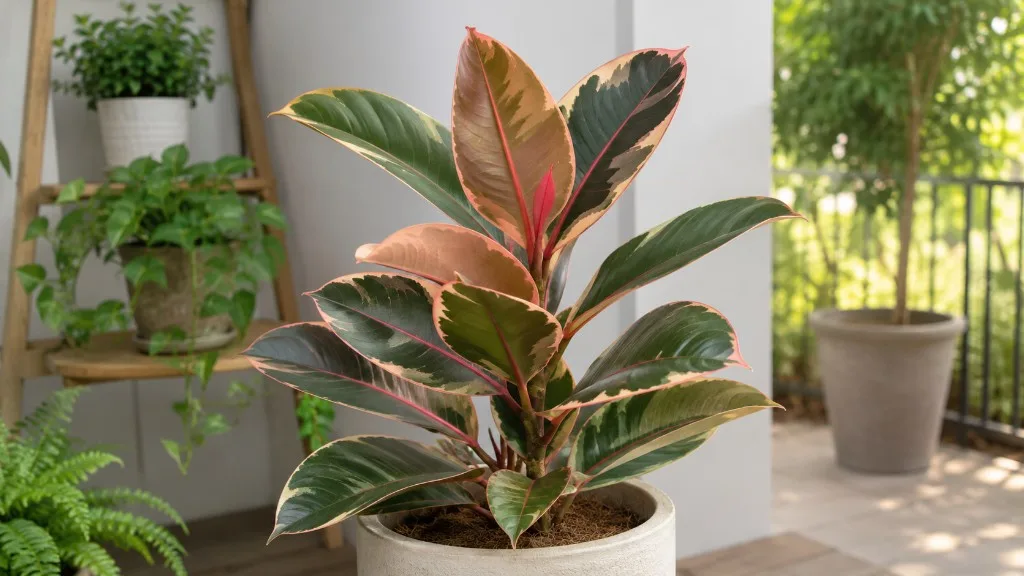
If you bought Ficus elastica ‘Ruby’ for pink and cream color, light is the care decision that matters most. Ruby is still a rubber plant, but its variegated leaf tissue makes it less forgiving than solid-green cultivars when brightness drops for weeks. In dim rooms, new growth often shifts greener. In harsh direct beam through hot glass, pale zones scorch first. The goal is not “maximum sun at all costs.” The goal is high filtered brightness that keeps color expression strong while protecting delicate tissue.
Clemson HGIC describes rubber plants as best in bright light, especially morning light from an east window, while warning against stress from poor conditions (Clemson HGIC). Missouri Botanical Garden similarly recommends bright indirect light with protection from afternoon sun for Ficus elastica as a houseplant (Missouri Botanical Garden). That combination is exactly the Ruby sweet spot.
If you are deciding between “plant stays alive” and “plant keeps cultivar color,” this guide focuses on the second goal. Ruby can survive lower light for a while, but long-term display quality depends on where new leaves open. In practical terms, the color story of your plant is written by the next leaf, not the one that opened three months ago in the greenhouse.
Quick Reference: Ruby Light Targets by Window and Season
Use this table first, then fine-tune with new-leaf feedback.
| Window exposure | Spring/summer | Fall/winter | Scorch risk | Practical move |
|---|---|---|---|---|
| East | Usually ideal at close range | Usually ideal | Low to medium | Keep near glass; monitor late-morning heat waves |
| South | Bright, often too intense at glass | Often excellent | Medium to high in summer | Use sheer curtain or move 30-90 cm back in hot months |
| West | Can work with diffusion | Useful if filtered | High in summer afternoons | Side placement plus curtain to avoid direct beam |
| North | Often insufficient alone | Usually insufficient | Low | Add full-spectrum grow light for color retention |
Treat these rows as defaults, not hard laws. A bright east window blocked by a neighboring tower can underperform, while a lightly shaded south window can be nearly perfect. Always calibrate with plant response after two to three weeks rather than committing to a direction label forever.
Why Light Controls Ruby Pink Variegation
Ficus elastica is native to tropical Asia and is grown indoors for large foliage, not deep-shade tolerance (NC State Extension). Ruby adds an extra challenge: cream and pink sections contain less chlorophyll than green sections, so each leaf has less fully productive photosynthetic area. When the plant cannot capture enough energy, it often compensates by producing greener new leaves.
This is why a Ruby can look healthy for months in moderate light but still lose cultivar character over time. You may see fewer bright pink sheaths, weaker cream windows, and a gradual shift toward darker green. That shift is not random; it is a long-term energy response.
Kew also records Ficus elastica as a tropical tree species rather than a shade-specialist houseplant type, which matches the need for sustained brightness in containers (Kew Plants of the World Online). Indoors, that means you should think in terms of “managed high light” rather than “shade tolerance.”
How Variegated Tissue Changes the Light Budget
Think of a Ruby leaf as a split system. Green zones do most energy capture, while cream and pink zones contribute less. Variegated cultivars therefore need a brighter overall placement than solid-green types to achieve the same growth pace. RHS care notes for variegated Ficus elastica selections also emphasize bright indirect light and caution against extended harsh sun on variegated leaves (RHS).
The practical result: if you must choose one premium window seat in your home, Ruby usually deserves it over Burgundy. Ruby is not impossible, but it is less tolerant of “good enough” brightness.
This is also why Ruby ownership rewards consistency. A plant that gets three excellent weeks and three dim weeks tends to look unstable in color expression. A plant that gets slightly less intensity but very steady daily exposure usually performs better over the season.
Bright Indirect Light: The Core Target Indoors
For most homes, Ruby does best with strong indirect brightness for most of the day, plus optional gentle morning direct sun when acclimated. Clemson’s east-window guidance fits this pattern well (Clemson HGIC). Missouri Botanical Garden’s “bright indirect with afternoon protection” guidance supports the same indoor strategy (Missouri Botanical Garden).
If you want a daily rule, aim for a placement that keeps leaves visibly bright for long daytime stretches without prolonged hot direct beam. Many growers find this corresponds to roughly six to eight hours of strong ambient brightness, but room geometry, glazing, and seasonal sun angles change outcomes. Treat hour counts as a guide and new leaves as the verdict.
If you use light-meter apps, focus on repeatability more than absolute precision. Check the same leaf zone at the same time of day for a week. Trend direction is what helps you decide whether to move the pot, add diffusion, or add supplemental light.
What Bright Indirect Looks Like in a Real Room
Room brightness and leaf brightness are not the same. A plant across the room from a window may “look near light” but still receive weak intensity at the canopy. Use simple checks: soft but readable hand shadow near the leaves at peak daylight, no leaf surface overheating on sunny days, and consistent variegated new growth.
Distance moves matter more than most people expect. Shifting a pot even 30-60 cm toward or away from the window can change leaf stress patterns significantly. Rotate quarterly if one side receives more daylight.
Another useful habit is weekly photo logging. Take one top-down photo and one side profile in similar daytime light. You will catch subtle internode stretch or color drift earlier than with memory alone.
Best Window Placement for Ficus Elastica Ruby
Window direction is a starting point, not a guarantee. External shade, overhangs, tinted glass, and seasonal sun angle all change actual leaf exposure.
East, South, West, and North Windows Compared
An east window is usually the most forgiving Ruby default because morning light is bright but cooler. A south window can be excellent in winter, then too intense in midsummer unless filtered. A west window often needs stronger summer diffusion because late-day beam can scorch pale tissue. A north window usually maintains survival but often underdelivers for sustained pink-and-cream expression without supplemental light.
PlantTalk Colorado advises medium to bright filtered light for rubber plants and warns unfiltered direct sunlight can damage leaves (Colorado State PlantTalk). That warning is especially relevant for Ruby’s pale sections.
If your household can only support one large ficus near the brightest window, place Ruby there and move Burgundy to the next-best light. This single decision often solves both color-fade complaints on Ruby and scorch complaints on less suitable placements.
Morning Sun and Protecting Pale Leaf Zones
Ruby can often handle one to two hours of gentle morning sun after acclimation, especially near east exposure. Problems usually appear when plants are moved abruptly from dim placement to strong direct beam, or when summer south/west glass heats leaves for long periods. If new cream areas show crisp tan patches, reduce direct beam immediately with a sheer curtain or short pull-back from glass.
A staged move works better than repeated emergency moves. Change one variable, hold for at least seven days, and inspect the newest leaf edge and center variegation zones. If no fresh damage appears, continue. If damage appears, step back one increment and hold.
Why Low Light Turns Ruby Green
Low light does not always kill Ruby quickly. It usually changes new growth first: less pink, smaller cream windows, longer internodes, and slower canopy renewal. NC State notes indoor Ficus elastica is best in bright indirect or partial shade with protection from intense afternoon sun (NC State Extension). In practice, Ruby thrives nearer the bright end of that range.
Low-light placement also changes watering behavior. A dim Ruby dries slower, so old watering frequency can become excessive. That is why “light problem” and “watering problem” often show up together.
Missouri Botanical Garden and Clemson both pair light guidance with cautions on overwatering risk in reduced growth periods (Missouri Botanical Garden, Clemson HGIC). When Ruby greens out and your pot stays wet longer, adjust light first and watering second rather than feeding harder.
Reversion, Leggy Growth, and Slow Leaves
Watch for pattern clusters: several greener new leaves in sequence, wider spacing between leaves, smaller new leaves, and slow warm-season growth. If these appear together, increase filtered brightness gradually and reassess based on the next one to two leaves.
Old green leaves usually do not recolor pink. Improvement appears in future growth, not retroactive cosmetic change.
For many homes, the cleanest recovery workflow is: move brighter in small steps, hold watering until dry-down normalizes, then reassess after two new leaves. This sequence avoids the common overreaction loop of moving, repotting, and fertilizing all at once.
Direct Sun Tolerance and Scorch Risk
Ruby benefits from high brightness but is less sunproof than fully green cultivars. Unfiltered direct sun, especially through heated glass, can produce permanent bleached or crisp areas on pale variegated tissue. PlantTalk’s direct-sun caution applies here directly (Colorado State PlantTalk).
Avoid all-or-nothing swings. “Dark corner to blazing south sill in one day” often causes the exact damage growers hoped to avoid.
RHS recommendations for variegated Ficus elastica forms similarly advise bright indirect conditions with only limited gentle direct sun windows (RHS). That convergence across sources is a strong signal that filtered intensity, not hard direct beam, is the long-term play.
When One Hour of Morning Sun Helps
Short morning direct sun can support compact growth and stronger color expression for some Ruby plants, but only with acclimation. A practical method is staged exposure over two to three weeks while monitoring the newest leaves for bleach or crisping. If damage appears, step back one level and hold.
Use weather-aware judgment. A setting that is safe during mild spring can become risky during heat spikes, especially if the plant is near uninsulated glass. Temporary midday diffusion is often enough; you do not need to banish Ruby to a dim room.
Ruby vs Burgundy and Tineke: Which Needs the Brightest Spot?
Use this simple hierarchy in mixed collections:
| Cultivar | Typical light flexibility | Color goal sensitivity | Direct-sun scorch sensitivity |
|---|---|---|---|
| Burgundy (solid green) | Highest | Lowest | Lowest of the three |
| Tineke (variegated cream/green/pink flush) | Medium | Medium-high | High |
| Ruby (pink/cream variegation emphasis) | Lowest flexibility | Highest | High |
All three are Ficus elastica cultivars, but Ruby typically demands more consistent filtered brightness to keep signature color expression. If one plant gets your best controlled-light position, Ruby is usually the right choice.
For growers choosing between similar-looking cultivars in stores, this hierarchy helps avoid mismatch. Burgundy generally forgives imperfect light better, while Ruby rewards stronger placement with higher visual payoff but less margin for error.
Seasonal Light Shifts and Simple Adjustments
Indoor light quality changes across the year. Winter lowers day length and intensity. Summer increases heat stress at glass. Instead of frequent major moves, use seasonal micro-adjustments: move slightly closer in winter, diffuse or pull slightly back in peak summer.
Clemson and Missouri Botanical Garden both pair bright-light recommendations with reduced winter watering cadence for rubber plants, reinforcing that light and water strategy should shift together (Clemson HGIC, Missouri Botanical Garden).
Set calendar reminders for two seasonal checks: one in late autumn and one in late spring. This simple system catches most reversion and scorch issues before they escalate.
Grow Lights for Ruby When Windows Fall Short
If your brightest option is north-facing or heavily obstructed, add a full-spectrum LED grow light rather than accepting steady reversion. Supplemental light is usually more reliable than repeated window shuffling in low-light apartments.
A practical starting range is 12-14 hours daily on a timer, with fixture distance adjusted per manufacturer guidance and observed leaf response. This range is a home-growing heuristic, not a universal lab prescription. Keep leaf surfaces warm-neutral, not hot, under the fixture.
Mixed-light setups are often best: daylight from a window plus evening fill from an LED. This can produce steadier color than relying on either weak daylight alone or an overly intense close lamp.
Setup Distance, Daily Hours, and Success Checks
Start high and step down in small increments if growth remains weak. If leaves pale or cup upward under the lamp, raise fixture height or reduce intensity duration. Judge success by compact, well-variegated new leaves over the next growth cycle.
If your lamp has dimming levels, change one setting at a time and hold for at least ten days. Rapid daily adjustments make it harder to identify which change actually improved growth.
Warning Signs Your Ruby Has the Wrong Light
Ruby usually reports light mismatch through repeated growth patterns, not one-off cosmetic flaws.
Too Little Light: Dull Green New Leaves
Common low-light pattern: greener new leaves, weaker pink expression, stretched spacing, slow growth, and slower pot dry-down. Response is gradual light increase and care recalibration, not fertilizer escalation.
If you see this pattern during winter, prioritize position and supplemental light before increasing nutrient inputs. Feeding cannot replace insufficient photons.
Too Much Sun: Bleached Patches and Crisp Edges
Common overexposure pattern: pale zones bleach first, then tan or brown crisping near sun-facing edges, especially after abrupt placement changes. Response is immediate diffusion and staged reacclimation, not permanent retreat to dim light.
Scorched areas are permanent on damaged tissue, so success is measured by clean future leaves. Once two consecutive new leaves open without scorch, you are usually back in a safe range.
Related Ruby Care Guides
Use these guides alongside light decisions:
- Full species profile and baseline care: /plants/ficus-elastica-ruby/
- Watering cadence and dry-down logic: /plants/ficus-elastica-ruby/watering/
- Pruning strategy for reverted or leggy growth: /plants/ficus-elastica-ruby/pruning/
- Common symptom diagnostics: /plants/ficus-elastica-ruby/plant-problems/not-enough-light/
- Cultivar context: /plants/ficus-tineke/light/ and /plants/ficus-burgundy/light/
Conclusion
Ruby color is a light management outcome, not a permanent trait independent of placement. Keep Ficus elastica ‘Ruby’ in your brightest controllable indirect zone, allow only gentle direct sun after acclimation, and use new leaves as your scoreboard. If windows underperform, supplement with a grow light rather than waiting for color to return on its own. Consistent filtered brightness, small seasonal adjustments, and staged moves are what keep Ruby looking like Ruby.
When in doubt, simplify the decision tree: protect from harsh afternoon beam, maximize filtered brightness, and evaluate only new growth. That disciplined approach prevents most Ruby light failures and keeps troubleshooting manageable.