Faded Leaves on Anacharis (Aquarium Elodea): Causes, Checks
Quick answer
Faded leaves on Anacharis / Elodea usually trace to low PAR, nitrogen shortage on older whorls, or iron shortage at new tips. First step: Note whether fade hits lower/older leaves or newest tips, then check photoperiod and nitrate before changing light or fertilizer.
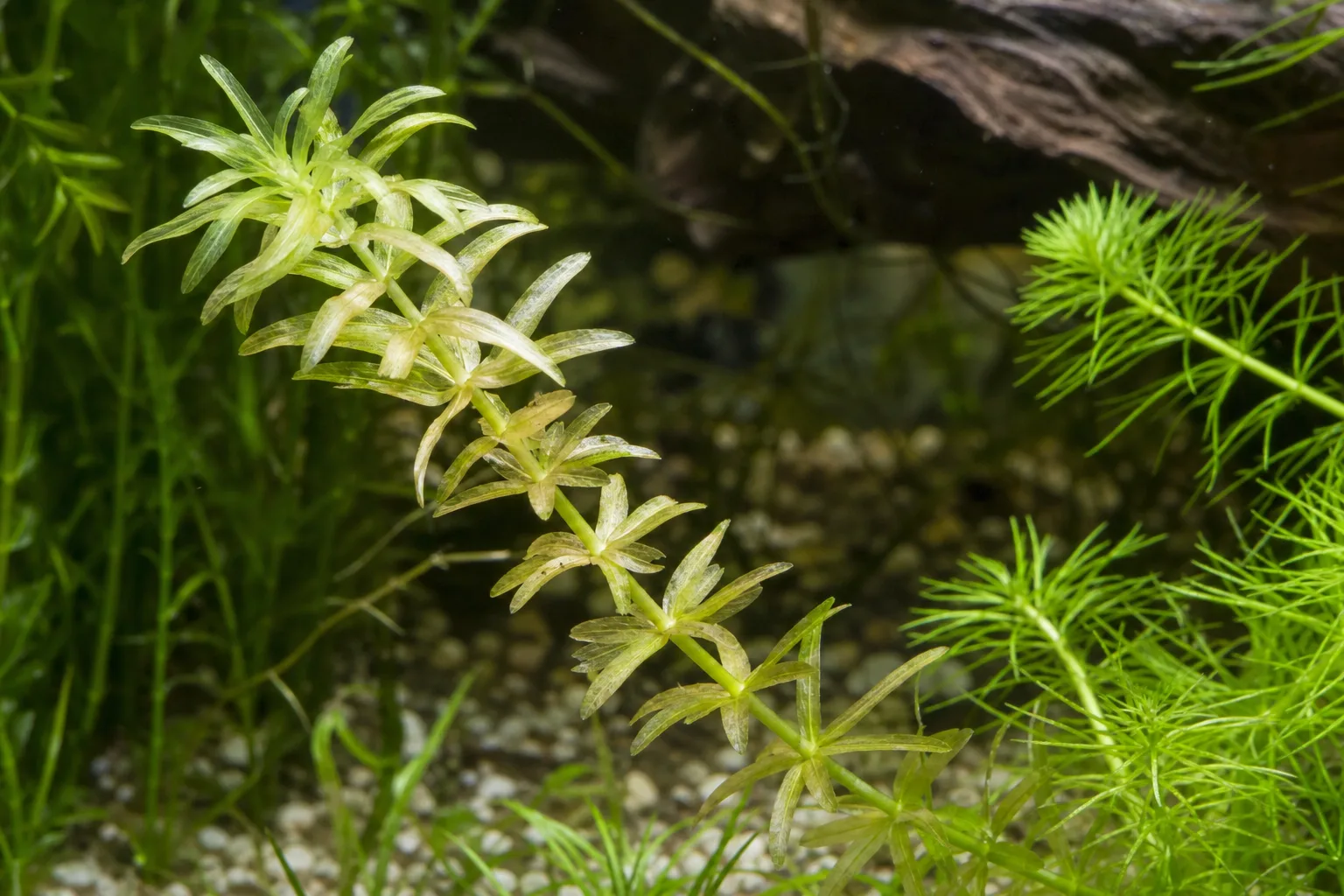
Faded Leaves on Anacharis / Elodea: Causes, Checks & Fixes
This guide covers faded leaves on Anacharis / Elodea. See also the general Faded Leaves guide, watering, and light pages for this plant.
Faded Leaves on Anacharis / Elodea: Causes, Checks & Fixes
Quick answer
Faded leaves on Anacharis (Egeria densa) mean submerged whorls look washed-out, pale green, or yellow-green while stems usually stay firm-not the translucent mush of melt or chemical burn.
First step: note whether fade hits lower/older whorls or the newest tips at the stem apex. That pattern tells you whether to raise usable light and trim shading, dose nitrogen-bearing fertilizer, or add chelated iron-before stacking three fixes on day one.
Scope note: This page covers dull, washed-out green on firm tissue. For very light or white-green color tank-wide, see pale leaves. For distinct yellow (not just dull green), see yellow leaves. For stretchy sparse growth toward the surface, see not enough light and leggy growth.
This guide covers submerged aquarium, turtle-tub, and pond-tub culture only. For dusty brown film, see brown leaves on Anacharis. For baseline culture, see the Anacharis light guide.
What faded leaves look like on Anacharis whorls
Anacharis leaves grow in whorls of four to six around a slender stem. Each leaf is thin and translucent-only about two cell layers thick-so color loss shows up fast as a general wash rather than crisp brown margins. Thinner leaf tissue loses visible chlorophyll faster than thicker stem plants, which is why fade on Egeria often looks sudden even when the cause built over days.
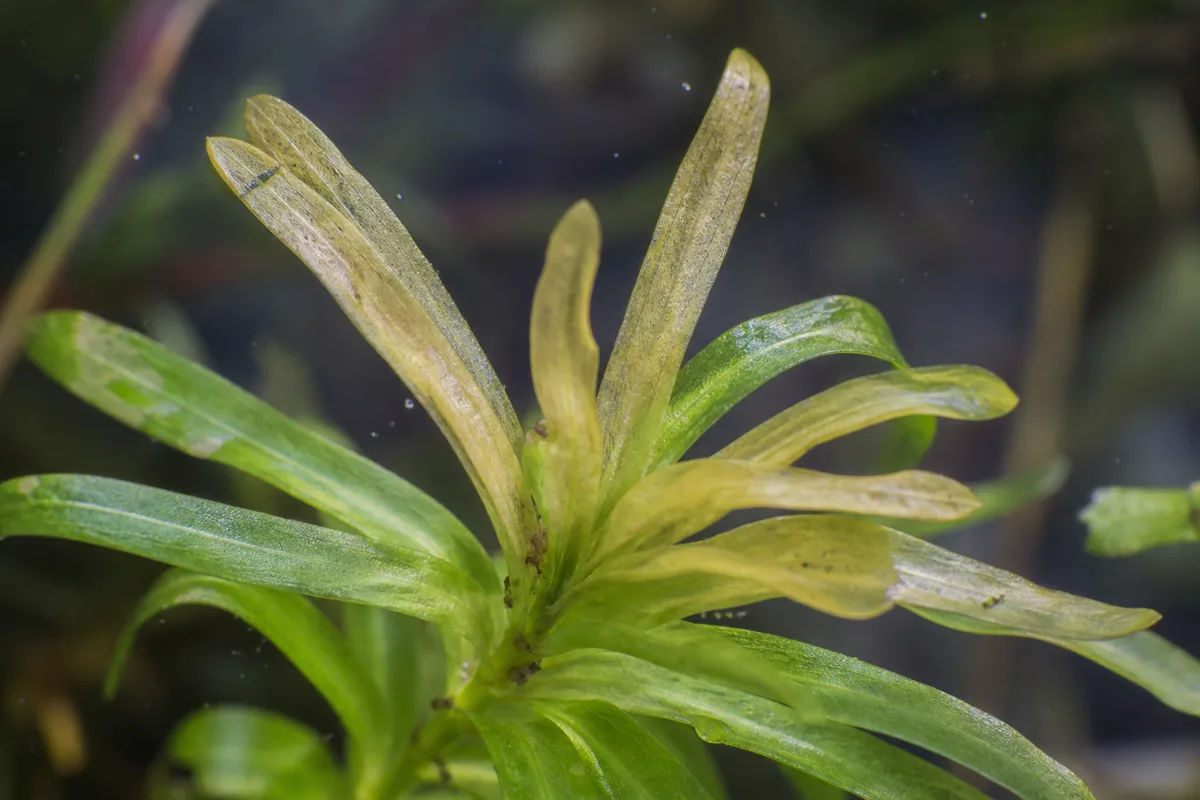
Faded Leaves symptoms on Anacharis / Elodea - compare with healthy tissue on the same plant.
Faded vs pale vs yellow vs melting
| Symptom | Color pattern | Stem texture | Likely cause |
|---|---|---|---|
| Faded (this page) | Washed-out light green; loss of rich emerald tone | Firm | Low PAR, N or Fe shortage, or self-shading |
| Pale | Very light green or white-green, often whole plant | Firm | Strong iron or macronutrient gap; see pale leaves |
| Yellow | Distinct yellow (not just dull green) | Firm | Nitrogen focus or advanced chlorosis; see yellow leaves |
| Melting | Translucent, dissolving tissue | Soft, collapsing | Parameter shock, liquid carbon, copper; see chemical damage |
Faded sits between healthy deep green and obvious yellow: the plant still photosynthesizes, but chlorophyll density drops enough that whorls look tired or sun-bleached underwater.
Tropica’s Egeria densa profile notes that in unfavourable conditions growth continues but the plant turns light in colour and tendrils grow thin-a classic low-light or nutrient-lag signature in display tanks.
Where fade appears on the plant
- Lower third of tall stems - dense canopy shades older whorls; not always a fertilizer problem.
- Newest tips only - immobile micronutrients (especially iron) often show here first.
- Whole stand evenly - tank-wide low PAR, zero nitrate, or chronic under-dosing in a heavily planted shrimp tank.
- One side of the bush - uneven light from a single-direction LED or afternoon sun on one glass panel.
Why Anacharis whorls fade
Anacharis is a fast column feeder that pulls nitrogen, iron, and other elements from the water, not from potting soil. UF/IFAS describes Brazilian waterweed as an aggressive submerged grower that forms dense surface canopies-exactly the habit that creates self-shading fade on lower stems when you skip weekly trims.
Low PAR and long photoperiod without uptake
Anacharis tolerates dim water thanks to an efficient photosynthetic pathway (Washington State Noxious Weed Board, 2014), with a low light compensation point around 7.5–16 µmol m⁻² s⁻¹ in peer-reviewed work. Survival in shade is not the same as rich green color: below roughly 30 PAR at the substrate in home tanks, whorls often lighten and internodes stretch toward the surface. The Anacharis light guide targets 30–50 PAR for compact, bushy green growth in low-tech setups.
Photoperiod past 10–12 hours without matching nutrients and carbon can also wash plants out while fueling algae-light energy enters faster than the plant can use it.
Nitrogen deficiency on older whorls
Nitrogen is mobile inside the plant. When tank nitrate is low-common in shrimp-only, nano, or heavily planted tanks with little fish waste-the plant exports nitrogen from older leaves to feed new tips. Lower whorls fade or yellow uniformly while tips may still look greener for a while. See the dedicated nitrogen deficiency page when older leaves are the main story.
Iron deficiency on new tips
Iron is immobile. New whorls at the stem apex turn pale or faded while veins stay relatively greener-interveinal chlorosis on the freshest growth. Hard, alkaline tap water can worsen uptake. Chelated iron in a balanced liquid aquarium fertilizer fixes new growth; old pale leaves typically do not re-green. See iron deficiency on Anacharis for tip-focused patterns.
Shading from your own canopy
When upper stems pearling at the surface block light, lower whorls fade even if tank-wide PAR is fine. This is a trimming and layout problem, not a disease. Thin the top third before buying a brighter fixture.
Lookalikes: algae film and post-shipping melt
A dusty coating on whorls dulls color but rubs off-often diatoms or green spot algae, not chlorosis. Translucent mush after a new purchase or glutaraldehyde dose is melt, not fade-hold off on fertilizer until you read transplant shock and chemical damage.
Confirm the cause: aquarium checks in order
Work through this checklist before stacking light upgrades and fertilizer:
- Symptom map - Lower/older whorls only → nitrogen or shading. New tips only → iron. Whole plant → light or tank-wide nutrients.
- Photoperiod log - Timer hours per day; note direct sunlight on glass. Target 8–10 hours unless you run injected CO₂ and daily dosing.
- Light at stem depth - Use a PAR meter, Photone app, or compare to the light guide ranges. Smartphone PAR estimates are useful for trend comparison but can read ±20% off calibrated meters-log relative changes at the same spot rather than treating one reading as gospel. Fade on lower stems with green tips above often means shade, not weak fixtures.
- Nitrate test - In moderate-light planted tanks, aim for roughly 10–20 ppm nitrate as a maintenance target when lower whorls fade with firm green tips; zero nitrate with pale lower leaves strongly suggests nitrogen shortage in planted displays.
- Stocking / bioload - Heavily fed community tanks may need less added nitrogen; shrimp-only tanks and turtle tubs with light fish load often need balanced aquarium fertilizer. In turtle tubs, whole-stand fade with firm stems sometimes tracks filtration gap before nutrient deficiency-test ammonia and nitrite before assuming the plant needs more macros.
- Recent changes - New LED, longer photoperiod, skipped doses after water changes, or liquid carbon (Flourish Excel) that can melt sensitive stems.
- New growth check - Bright green tips after a single change mean you found the lever. Stalled tips after dosing iron alone may mean macronutrients are still low.
CO₂-injected vs low-tech caveat: Low-tech tanks with weekly comprehensive liquid fertilizer usually correct fade with one macro or light adjustment. High-light tanks with injected CO₂ and daily dosing burn through nitrogen faster-if fade appears despite nitrate readings in the maintenance band, review dosing rhythm on the fertilizer guide before only raising PAR.
Change one variable at a time after you log baselines so you can read the plant’s response over the next 7–14 days.
Symptom comparison table
| Cause | First whorls affected | Vein pattern | Quick test |
|---|---|---|---|
| Low PAR | Whole stem or stretch toward surface | Even wash-out | Raise fixture or trim; check PAR at substrate |
| Nitrogen low | Older, lower whorls | Uniform pale/yellow | Nitrate test; dose N-bearing fertilizer |
| Iron low | Newest tips | Paler between veins | Dose chelated iron in complete formula |
| Self-shading | Lower third only | Upper whorls still green | Trim canopy; do not crank light first |
| Algae coating | Patchy on surface | Rub test removes dust | Wipe during water change; fix flow/light balance |
First fix for Anacharis faded leaves
First action today: identify fade location (older lower whorls vs newest tips), then run one matching correction.
- Lower whorls faded, tips still green, nitrate low or zero → Dose a balanced liquid aquarium fertilizer that includes nitrogen at label strength after your next water change. Review fertilizer guidance before doubling doses.
- New tips pale, lower leaves relatively green → Same balanced fertilizer with chelated iron, or a half-strength iron supplement if macronutrients already read fine. Do not mega-dose iron alone-excess iron fuels algae when uptake lags; see overfertilization.
- Lower whorls faded under a dense top bush, nitrate OK → Trim the top third to let light reach mid-stem whorls before buying a brighter LED.
- Whole stand washed out, long internodes, lean toward surface → Raise usable light toward 30–50 PAR at substrate and confirm 8–10 hour photoperiod per the light guide.
Do not apply terrestrial houseplant fixes-no soil moisture checks, repotting, or bright indirect window light apply to submerged Egeria densa.
Recovery timeline and trimming expectations
| Phase | Timing | Good signs | Bad signs |
|---|---|---|---|
| Baseline log | Days 1–2 | Clear photos of affected whorls; test results recorded | Guessing without nitrate or photoperiod data |
| Single correction | Days 3–10 | New whorls darker green at tips or cut ends | Tips stall; stems soften |
| Trim faded lower tissue | Week 2+ | Side shoots from firm nodes | Fade climbs into all new growth |
Faded whorls usually do not re-green in place. Iron-deficient leaves stay pale; only leaves that form after correction show full color. Lower shaded sections may never recover-trim them and judge success by new submerged whorls within one to two weeks in a stable tank.
Mild light-limited fade often improves within 7–10 days after a photoperiod or PAR adjustment. Nutrient-limited fade in shrimp tanks may need two weekly doses before new tips look rich green again.
What not to do in a planted tank
- Do not follow houseplant fade advice - Soil drying, pot drainage, and “bright indirect light” do not diagnose submerged Anacharis.
- Do not dump iron-only supplements on a whole-tank pale stand without checking nitrate-macronutrient gaps persist and algae can bloom.
- Do not stack a new LED, double fertilizer, and full-tank liquid carbon on day one - you will not know which change helped, and glutaraldehyde can melt stems mistaken for fade.
- Do not leave a thick dying canopy shading mid-stem whorls while cranking photoperiod-trim first.
- Do not dose copper ich medications in a display with fading Anacharis-copper kills this plant; see chemical damage.
- Do not release pale trimmings into ponds or streams-Egeria densa spreads vegetatively and is regulated in many states.
Prevent fade next time: light + dosing rhythm
- Run 8–10 hours on a timer and aim for 30–50 PAR at substrate in low-tech tanks-see the light guide.
- Dose balanced aquarium fertilizer in planted or shrimp-only tanks on a weekly rhythm tied to water changes; fish-heavy tanks may need less nitrogen-read fertilizer and overfertilization before increasing.
- Trim weekly on fast stands so lower whorls get photons and organics do not accumulate in the bush.
- Test nitrate monthly in moderate-light planted displays; adjust dosing when readings sit at zero for multiple weeks.
- Quarantine new stems from pale seller tanks before adding them to a green display.
- Dispose of trimmings in household trash per UF/IFAS guidance on invasive spread.
Related Anacharis guides
Routing: Use this page for washed-out dull green on firm whorls. For very pale or white-green color, see pale leaves. For distinct yellow, see yellow leaves.
- Light needs: PAR, photoperiod, algae control
- Fertilizer: liquid dosing, shrimp tanks, CO₂ balance
- Iron deficiency · Nitrogen deficiency
- Pale leaves · Yellow leaves · Not enough light · Leggy growth
- Water parameters and acclimation · Overview
When to worry
Most fade resolves with one targeted light or nutrient correction plus patience for new whorls. Escalate when:
- New growth stays pale after two weeks of balanced dosing and confirmed PAR - log parameters and follow the iron deficiency protocol before a third iron-only spike
- Stems soften, smell foul, or turn translucent-ammonia or chemical injury, not chlorosis
- You must medicate fish with copper while keeping Anacharis-plan a plant-safe quarantine tub first; do not dose copper in the display
- Fade overlaps with black fuzzy algae on stems-see black spots for trim-and-flow workflow
Escalation summary: dose, trim, raise light, or quarantine
When fade persists after your first correction, use symptom location-not guesswork-to pick the next lever:
| Pattern after 7–14 days | Next action | Avoid |
|---|---|---|
| Lower whorls still faded, tips green, nitrate under 10 ppm | Dose balanced N-bearing fertilizer; retest in one week | Iron-only mega-dose |
| New tips still pale, nitrate 10–20 ppm | Chelated iron in complete formula; review iron deficiency | Raising PAR without fixing micronutrients |
| Lower third faded, upper whorls deep green | Trim top third; reassess PAR at mid-stem | Buying a brighter LED before thinning canopy |
| Whole stand washed out, stretch toward surface | Raise PAR toward 30–50 at substrate; confirm 8–10 h photoperiod | Longer photoperiod without nutrient match |
| Fade plus planned ich treatment | Move Anacharis to quarantine tub; treat fish separately | Copper in planted display |
| Two weeks balanced dosing, confirmed PAR, tips still pale | Full parameter log; consider tissue-culture replacement stock | Stacking LED + double fertilizer + liquid carbon same day |
FAQs
Is faded Anacharis the same as melting?
No. Faded whorls stay firm and look washed-out or dull green-chlorophyll loss while tissue remains intact. Melting is translucent, mushy tissue that dissolves after parameter shock, liquid carbon, or copper medication. If stems stay firm and you can rub off a dusty film but tissue stays whole, you are dealing with fade or algae coating, not melt. See chemical damage and transplant shock guides when tissue turns glassy and collapses.
Should I trim faded lower stems or wait for them to re-green?
Trim faded lower whorls when upper growth blocks light or tissue has been pale for more than two weeks. Faded leaves rarely regain full emerald color in place-especially iron-starved tips and self-shaded lower sections. Cut above a firm node, let side shoots emerge, and judge recovery on new submerged whorls within seven to fourteen days. Do not leave a thick dying canopy shading mid-stem growth while cranking photoperiod.
How long after iron dose should new Anacharis tips look green?
Expect noticeably greener new whorls within seven to ten days after a balanced liquid fertilizer with chelated iron, assuming nitrate is not zero and PAR is adequate. Iron-deficient pale tips do not re-green-only leaves that form after correction show full color. If tips stay pale after two weekly doses with nitrate above roughly 10 ppm, review the iron deficiency guide and check whether macronutrients are still lagging.
When is faded leaves urgent on Anacharis / Elodea?
Act within a few days when fade climbs into firm upper whorls while tips stall, stems soften or turn translucent, or the whole stand washes out within a week after a large water change or medication. A few pale lower whorls under a dense canopy is routine shading-not urgent. Escalate when nitrate reads zero in a planted tank, photoperiod exceeds 12 hours with algae coating stems, or you planned copper fish medication while stems are already pale.
How do I prevent faded leaves on Anacharis next time?
Keep photoperiod at 8–10 hours on a timer, maintain moderate PAR at substrate depth per the light guide, dose balanced aquarium fertilizer in shrimp-only or lightly stocked tanks, and trim tall stems weekly so lower whorls receive light. Test nitrate monthly in planted displays. Avoid iron-only spikes without macronutrients and never release trimmings into local waterways.