Overfertilization on Anacharis / Elodea: Causes, Checks &
Quick answer
Overfertilization on Anacharis usually follows full-strength daily dosing in a low-tech tank, stacking liquid ferts with heavy fish bioload, or dosing during transition melt. First step: stop all liquid fertilizer immediately.
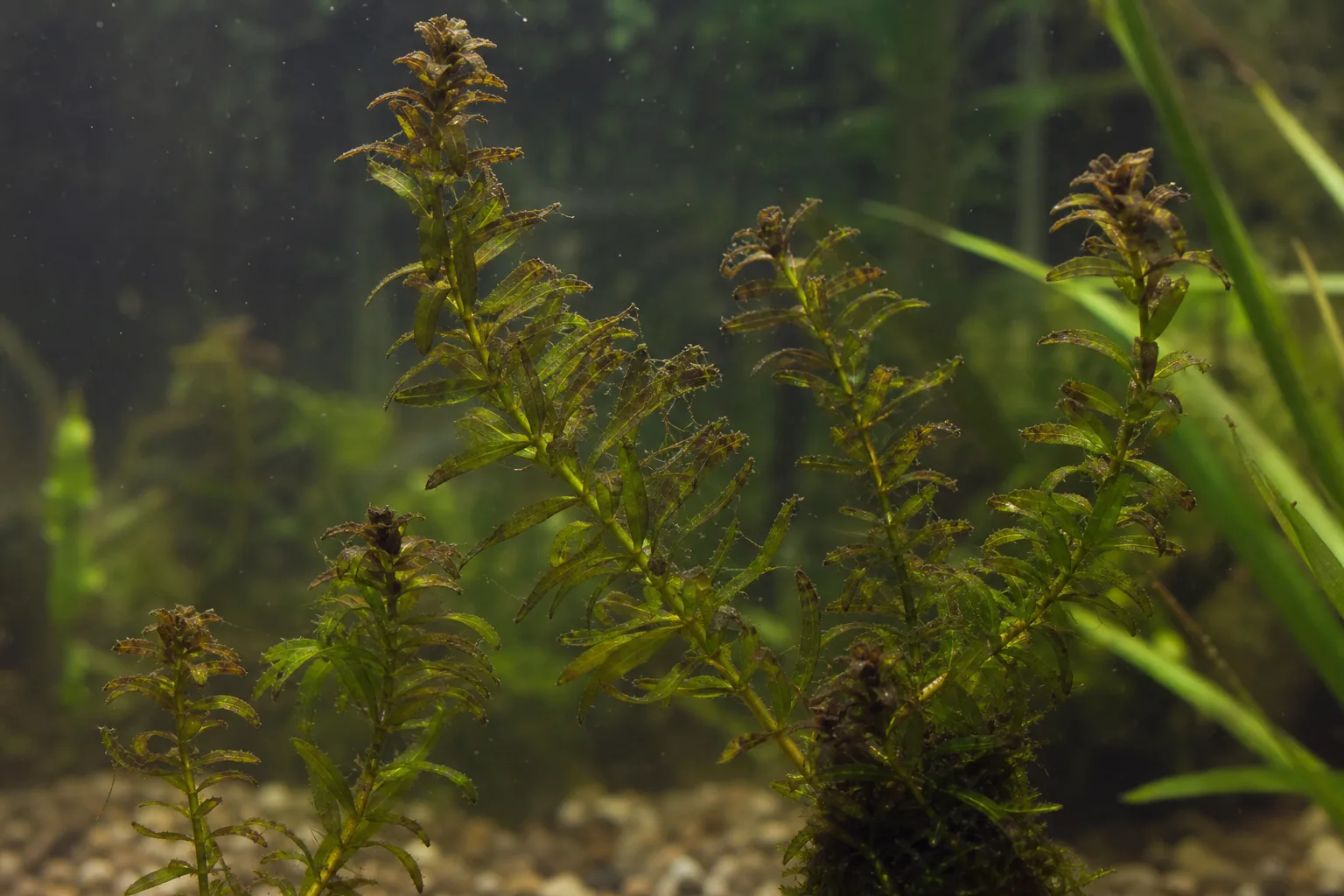
Overfertilization on Anacharis / Elodea: Causes, Checks & Fixes
This guide covers overfertilization on Anacharis / Elodea. See also the general Overfertilization guide, watering, and light pages for this plant.
Overfertilization on Anacharis / Elodea: Causes, Checks & Fixes
Quick answer
Overfertilization on Anacharis (Egeria densa) usually follows full-strength daily dosing in a low-tech tank, stacking liquid fertilizer with heavy fish bioload, or dosing during the first one-to-two-week transition melt after purchase. The classic mistake is treating a fast stem plant like a hungry houseplant and pouring macros into water the fish already loaded with nitrogen.
First step: stop all liquid fertilizer immediately. Do not “balance” the problem with more products. Anacharis absorbs nutrients through its water-column leaves, so excess dissolved nitrogen and phosphorus feed algae before the plant can use them-especially when light is strong and plant mass is still small.
This guide is for submerged aquarium culture only. For baseline dosing math, product choice, and fish-waste logic, see the Anacharis fertilizer guide. For water-change rhythm during recovery, see Anacharis watering parameters.
What overfertilization looks like in a planted tank
On healthy Anacharis, problems from too much food in the water usually show up in this order:
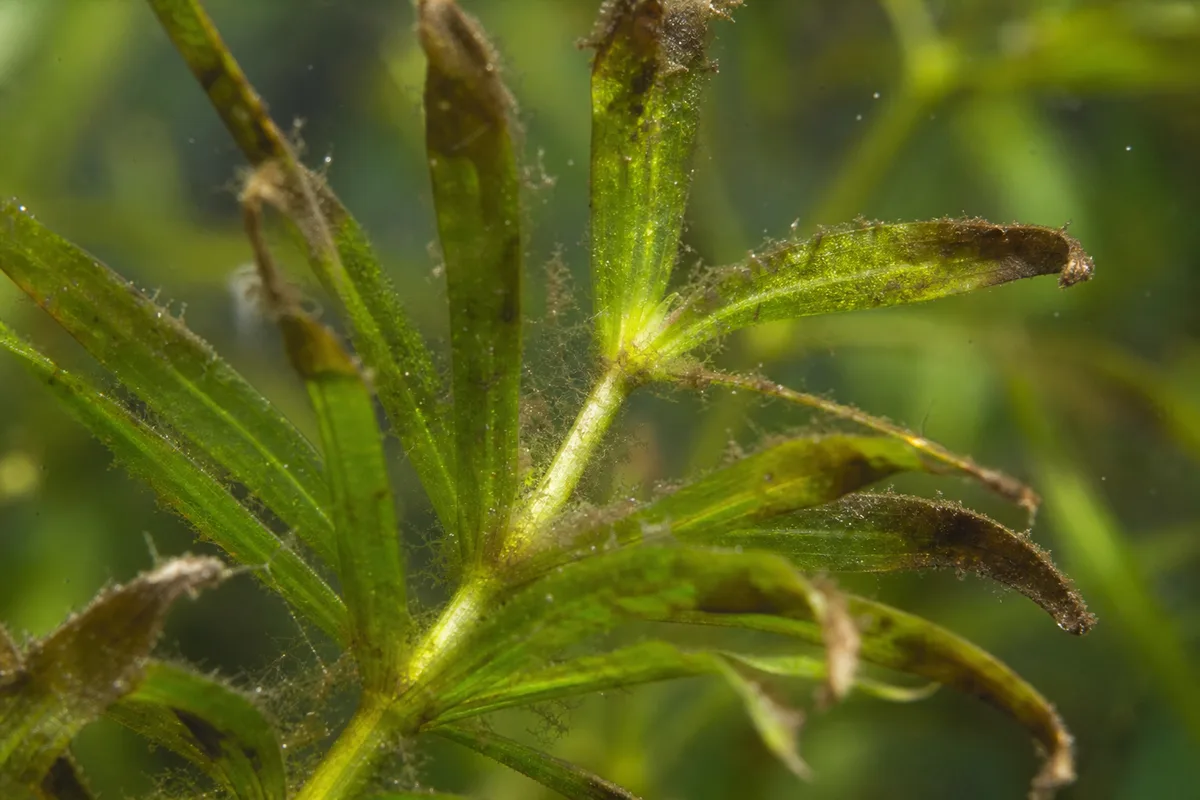
Overfertilization symptoms on Anacharis / Elodea - compare with healthy tissue on the same plant.
- Algae on leaves first - green dust, hair algae, or black beard algae coating whorls within three to seven days of a dose increase, often while stem tips still look green.
- Stringy, weak new growth - internodes stretch and leaves thin when nutrients and light are mismatched; the plant grows tall but not bushy.
- Lower whorl melt - older leaves turn translucent and detach; decaying tissue fouls the tank if left in place.
- Tank-wide algae bloom - green water or surface scum when nitrate and phosphate outpace what stems and beneficial bacteria remove.
- Pearling stops - oxygen bubbles from photosynthesis fade when algae coat leaf surfaces or melt reduces healthy tissue.
These signs differ from transition melt, which hits soon after shipping without a fertilizer change, and from nitrogen deficiency, where old leaves yellow uniformly while new tips stay green.
Why Anacharis is sensitive to excess nutrients
Anacharis is a column-feeding stem plant in the Hydrocharitaceae family. Its thin whorled leaves pull nitrogen, phosphorus, iron, and trace elements directly from the water. That efficiency is why it oxygenates tanks and pulls nitrate from fish waste-but it also means every milliliter of liquid fertilizer reaches every leaf at once.
A peer-reviewed study on Egeria densa found strong preference for ammonium over nitrate and documented that water is often the dominant nutrient source. In a stocked community tank, fish excretion already supplies significant nitrogen. Adding daily macro doses on top-especially all-in-one products with nitrogen and phosphorus-can push dissolved nutrients past what a low-tech setup with moderate light can consume.
Common overdose triggers on Anacharis:
- Label dosing on a small, lightly planted tank - manufacturer rates assume plant mass, not just gallon count. A 10-gallon tank with two stems does not need the same weekly load as a dense scape.
- Full-strength EI-style macros without matching CO₂ and light - high nutrients without high plant demand destabilize low-tech tanks.
- Stacking sources - liquid macros plus root tabs near swords, heavy fish feeding, and trace iron on the same day.
- Dosing during transition melt - fertilizer on dying emersed leaves fuels algae on decaying tissue; wait for new submerged whorls.
- Wrong product for stocking - comprehensive macro fertilizers in tanks that already run elevated nitrate from fish waste.
Overfeeding the tank does not produce faster Anacharis growth. It produces algae. More fertilizer is rarely more growth on Anacharis / Elodea overview.
How to confirm overfertilization (not melt or deficiency)
Work through this numbered checklist before changing anything beyond pausing fertilizer:
- Dosing timeline - Did algae or melt worsen within one week of increasing fertilizer, switching products, or adding root tabs? A yes strongly supports overdose.
- Test nitrate - In a typical planted community tank, nitrate of 10–20 ppm supports plant growth without chronic algae. Readings persistently above ~40 ppm with recent dosing and visible algae suggest excess nitrogen-especially if fish load is already high.
- Test phosphate - Phosphate above ~1 ppm with algae on leaves points to nutrient excess; planted-aquarium guidance often targets roughly 0.1–0.3 ppm for algae control in balanced tanks.
- Stocking audit - More than about one inch of fish per gallon often supplies enough nitrogen that trace-only products suffice. Shrimp-only tanks need fertilizer but are easier to over-dose with iron-heavy liquids.
- Symptom position - Algae on all whorls plus recent dose increase = overdose. Pale new tips with green veins = iron deficiency. Yellow old leaves with green tips = nitrogen deficiency, not excess.
- Transition window - Plants added in the last 14 days may melt without any fertilizer change; hold diagnosis until firm submerged tips appear.
- Light and CO₂ check - Strong light with low plant mass and heavy dosing creates algae even when individual test readings look “normal.” Review Anacharis light needs if algae persists after dilution.
Symptom comparison
| Pattern | Likely cause | Key check |
|---|---|---|
| Algae on leaves + recent dose increase | Overfertilization | Pause ferts; test nitrate/phosphate |
| Mushy lower leaves, no dose change, new purchase | Transition melt | Wait 7–14 days; no extra macros |
| Yellow old leaves, green new tips | Nitrogen deficiency | Low nitrate test; dose carefully |
| Pale new leaves, green veins | Iron deficiency | Target iron, not more macros |
| Algae + mush after Excel or copper med | Chemical damage | Stop product; not fertilizer issue |
Overlap with fertilizer burn is common-both respond to pause, water change, and half-dose restart. This page focuses on chronic or repeated over-dosing and algae linkage; fertilizer burn emphasizes shock dosing on new, melting plants.
First fix: pause, dilute, trim
First action: stop every liquid fertilizer and root-tab schedule for 10–14 days. One clear step-not a bundle of algicides, extra iron, and light changes on day one.
After the pause begins:
- Remove decay - Trim algae-coated, translucent, or mushy stems back to firm green tissue. Siphon fallen leaves so they do not ammonia-spike the tank.
- Dilute the water column - Perform a 30–50% water change with temperature-matched, dechlorinated water. Repeat once mid-week if nitrate or algae remain severe. Match change water to tank temperature within 2°F as described in the water parameters guide.
- Test again - Recheck nitrate and phosphate after the change. Aim to bring nitrate down toward the 10–20 ppm band before any restart.
- Reduce light temporarily - Shorten photoperiod to 6–8 hours while algae is active if you run long light cycles; restore gradually once stems recover.
- Do not add liquid carbon on Anacharis - Glutaraldehyde products like Flourish Excel are widely reported to melt Anacharis; they are not a safe fix for nutrient overdose.
In shrimp or sensitive-fish tanks, split large water changes across two days rather than one 50% change if livestock show stress.
Restart dosing without triggering another bloom
Wait until you see firm green tips on trimmed stems and algae stops spreading-not just the day nitrate hits a number. Then restart at half the label dose once weekly after your regular water change.
Dose math examples (verify against your bottle label):
- Seachem Flourish (trace micronutrients): 1 capful (5 mL) per 250 L (~60 US gallons) once or twice weekly-roughly 0.8 mL per 10 US gallons at full label strength; restart at ~0.4 mL in a 10-gallon tank with moderate plant mass.
- Tropica Specialised Nutrition (includes N and P): 6 mL per 50 L per week-about 4.5 mL per 10 US gallons (~38 L) at full strength; restart at ~2 mL after recovery in lightly stocked tanks.
Use a 1 mL syringe for small tanks. Increase only if new growth pales after two weeks at half dose and nitrate tests low-not because algae once cleared.
In well-stocked community tanks, consider trace-only products and let fish waste supply nitrogen. In shrimp-only tanks, a comprehensive liquid at half strength is usually enough.
Recovery timeline and what to watch
| Phase | Timing | Good signs | Bad signs |
|---|---|---|---|
| Pause + first change | Days 1–3 | Algae spread stops; water clears slightly | Green water worsens; ammonia detectable |
| Trim + second change | Days 4–10 | Firm nodes; small green tips | Mush climbing stem; foul odor |
| Half-dose restart | Week 3+ | Bushier new whorls; controlled pearling | Algae returns within 5 days of dose |
Damaged whorls do not revert to pristine green-judge success by new submerged growth, not old tissue. Mild cases often stabilize in one to two weeks; tanks that were dosed daily at multiples of label strength may need a full month of conservative feeding before dense growth returns.
Mistakes to avoid
- Doubling fertilizer when algae appears - Algae often means excess nutrients or light imbalance, not hunger.
- Dosing during transition melt - Yellowing on newly purchased Anacharis is usually acclimation, not a call for macros.
- Stacking root tabs and daily liquids - Tabs feed root-heavy neighbors; Anacharis leaves still absorb the water-column load.
- Using copper algicides - Anacharis is sensitive to copper-based aquatic herbicides; copper in some fertilizers plus medication can melt stems.
- Ignoring fish feeding - High-protein food in an overstocked tank adds phosphate and nitrate without any bottle dose.
- Checking substrate moisture - This plant does not grow in potting soil in normal aquarium use; water-column tests and dosing logs diagnose overdose.
How to prevent overfertilization next time
Match the product to stocking and plant mass, not the largest number on the label:
- Moderately stocked community tank - Weekly trace supplement after a water change; skip macros if nitrate stays above 10 ppm.
- Shrimp-only or sparse planting - Comprehensive liquid at half label strength weekly; test nitrate monthly.
- High-tech CO₂ tank with dense Anacharis - Full macro schedules only when light, CO₂, and trimming keep plant mass high enough to consume the dose.
Follow the weekly cadence and product-selection logic in the Anacharis fertilizer guide. Skip fertilizer entirely during the first one-to-two weeks after introducing new stems. Never release trimmings into ponds or streams-Egeria densa spreads aggressively outside tanks.
When to worry (fish, shrimp, chronic algae)
Escalate if ammonia or nitrite reads above zero during recovery water changes-fix the cycle before any fertilizer return. Chronic green-water algae that survives two weeks of paused dosing and repeated 40% changes usually needs a combined plan: lower light, review feeding, add fast-growing stem mass, and confirm filter flow-not another bottle.
If stems melt to mush despite zero dosing, rule out chemical damage and heat stress before assuming nutrients alone caused the crash.
For overview context on column feeding and legal disposal of trimmings, see the Anacharis care overview.
When to use this page vs other Anacharis / Elodea guides
- Anacharis / Elodea watering guide - Use for routine moisture checks before assuming overfertilization is the main issue.
- Anacharis / Elodea problems hub - Browse all 34 common issues on this species.
- Fertilizer Burn on Anacharis / Elodea - Different entry point when symptoms overlap with overfertilization.
- Brown Tips on Anacharis / Elodea - Different entry point when symptoms overlap with overfertilization.
- Root Rot on Anacharis / Elodea - Different entry point when symptoms overlap with overfertilization.