Anacharis Fertilizer Guide: Liquid, Root Tabs, and CO2
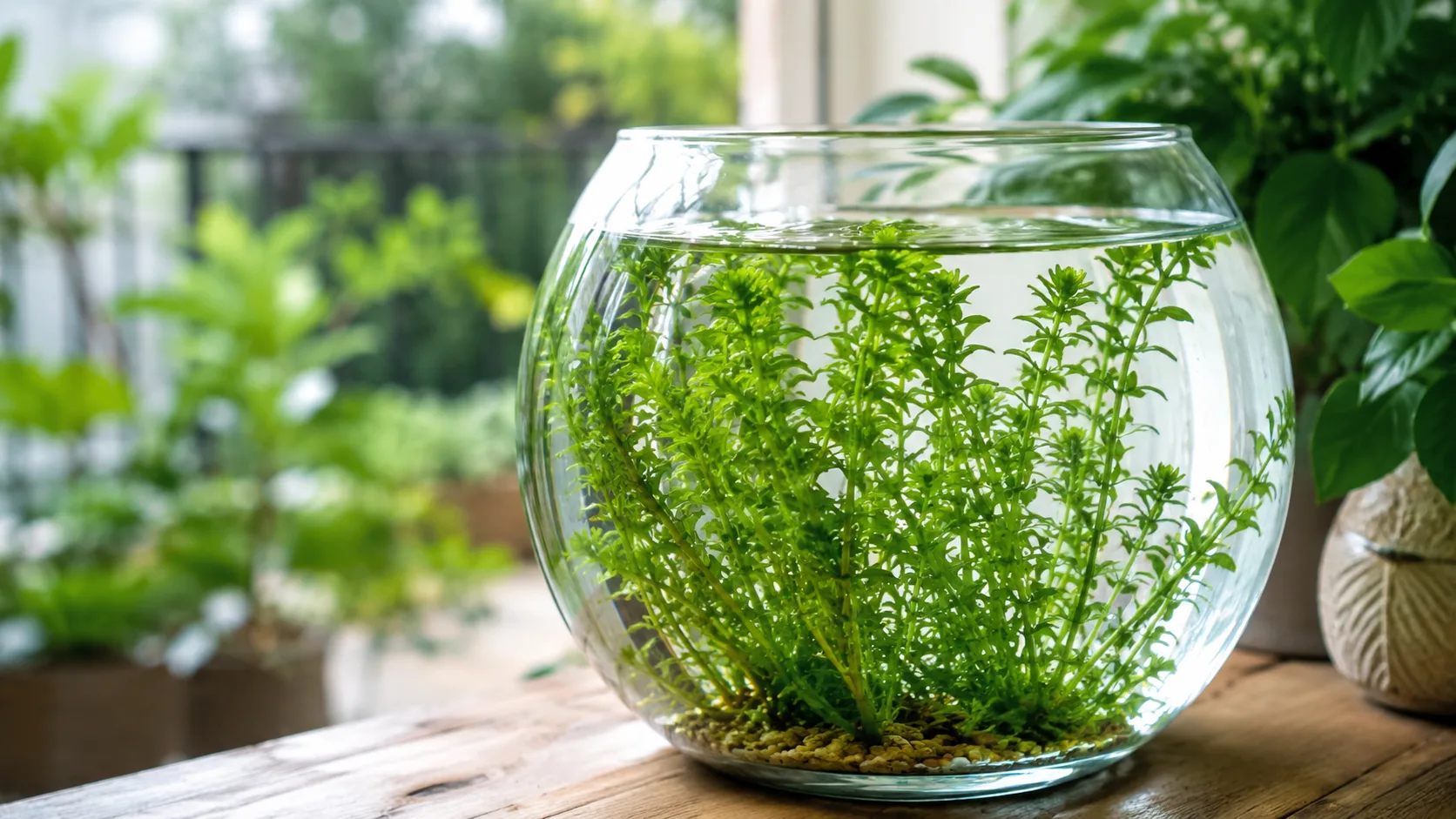
Anacharis Fertilizer Guide: Liquid, Root Tabs, and CO2
Anacharis Fertilizer Guide: Liquid, Root Tabs, and CO2
Anacharis is forgiving in almost every way except one: if you feed it like a houseplant, it will disappoint you. Egeria densa - Brazilian waterweed, the stem you bought as a quick oxygenator - has a completely different diet from the pothos on your windowsill, because the water column, not the substrate, is its primary plate. Get the fertilizer logic right and Anacharis grows 2 to 4 inches a week, out-competes algae, and pulls nitrate out of your tank faster than your filter does. Get it wrong and you get pale leaves, melting stems, or an algae bloom that has nothing to do with the plant being “hard to grow.”
This guide walks through exactly how to fertilize Anacharis in a planted aquarium: which liquid fertilizers work, when root tabs actually help, how much to dose by tank size, when CO2 is worth the cost, and how to read the leaves when something is off. For water parameters that affect nutrient uptake, see the Anacharis watering guide. For photoperiod and PAR targets, see the Anacharis light guide. For planting, melt, and propagation context, start with the Anacharis overview.
Reviewed by LeafyPixels Review Board · Author: sai-ananth
Why Anacharis Fertilization Works Differently Than Houseplants
A pothos absorbs most of its nitrogen and potassium through a dense root mass sitting in moist substrate. A fern in a terrarium does the same. Anacharis is built differently. Botanically, Anacharis is a fully submerged aquatic stem plant in the family Hydrocharitaceae, and it has spent its evolutionary history filtering nutrients from flowing water with its leaves. Its thin, ribbon-like leaves are dense with chloroplasts and have a high surface-area-to-volume ratio, which makes them efficient at pulling dissolved nutrients directly from the surrounding water.
That single anatomical fact is the reason most generic “houseplant fertilizer” advice fails Anacharis. The substrate is, at most, a backup feeding site. A 5-10-5 granule pushed into gravel is essentially invisible to the plant. A liquid fertilizer poured into the water column reaches every leaf in seconds. Once you flip the mental model - leaves first, substrate second - every fertilizer decision gets easier: pick a liquid product, dose into the water, and only consider root tabs if you also keep heavy root-feeders like Amazon swords in the same tank.
This also explains why Anacharis is so good at “cleaning” a fish tank. A peer-reviewed study on Egeria densa published in Limnetica found that the plant absorbs nutrients from both water and sediment, but that water is often the dominant source, and that Anacharis shows a clear preference for ammonium over nitrate. Translation: the plant is built to take the nitrogen-rich waste stream produced by fish and convert it into plant tissue before algae can claim it.
How Anacharis Absorbs Nutrients: Water Column vs. Substrate
The water-column-first feeding style is well documented across aquarium hobby publications and confirmed by academic research. To plan a fertilizer routine that actually works, you need to know the breakdown.
The Water Column Comes First
Anacharis leaves absorb nitrogen, phosphorus, potassium, iron, and a long list of micronutrients directly from the water they sit in. The mechanism is passive diffusion across the leaf cuticle, plus active uptake through leaf-surface transporters. Either way, the practical takeaway is the same: a comprehensive liquid fertilizer dosed into the water column reaches the plant immediately, no matter whether the stem is planted in gravel, weighted down with a rock, or floating at the surface.
This is the basis of every working Anacharis fertilization plan. If you take only one thing from this guide, take this: dose a liquid fertilizer into the water on a regular schedule, sized to your stocking level, and skip most of what you have read about substrate feeding for Anacharis / Elodea overview.
What Roots Actually Do for Anacharis
Anacharis does produce roots - thin, white, hair-like structures that emerge from the nodes on the lower portion of the stem. But these roots are mostly anchors. Modest Fish’s Anacharis care guide notes that Anacharis roots “don’t really absorb nutrients; they just serve to anchor the plant.” In inert substrates like sand or plain gravel, root feeding is effectively zero. In nutrient-rich aquasoils, the roots can pick up some iron and potassium near the base, but the contribution is small relative to leaf uptake.
That is why root tabs are a low-priority tool for Anacharis-only tanks. They can still earn a place if you share a tank with root-feeding species like Amazon swords, Cryptocoryne, or Vallisneria, in which case a root tab near those plants is a useful indirect feed that does very little for the Anacharis stems sitting above.
Ammonium vs. Nitrate Uptake (What the Research Shows)
Most terrestrial gardening advice assumes plants prefer nitrate as their nitrogen source. Aquatic stem plants often do not. The Limnetica experiments on Egeria densa compared ammonium and nitrate in the water column and found that nitrogen absorption from water was lower when nitrogen was supplied as nitrate than when it was supplied as ammonium. The plant still accumulated nitrogen in its tissues from both forms, but ammonium uptake was faster - which matters in a fish tank where fish excrete ammonia that beneficial bacteria convert first to nitrite and then to nitrate.
The same study found that biomass growth tracked more closely with phosphorus availability than with nitrogen form, suggesting that in some tanks phosphorus - not nitrogen - becomes the growth-limiting nutrient. That does not mean you should ignore nitrogen in a shrimp-only tank. It means that if Anacharis is growing slowly despite readable nitrates, test phosphate next, especially if you run phosphate-removing filter media.
For practical dosing, the ammonium preference reinforces the stocking-level rule: a well-fed community tank already supplies the nitrogen form Anacharis prefers, so trace-focused liquids like Seachem Flourish or Tropica Premium often suffice. A lightly stocked planted tank needs a macro-complete liquid like Tropica Specialised or an all-in-one with nitrogen on the label.
How Often to Fertilize Anacharis (and When to Skip It)
Frequency is where most beginners overshoot. Anacharis is a fast grower, and “fast grower” gets misread as “needs a lot of food.” The reality is closer to the opposite: Anacharis is a fast grower because it is efficient at pulling low concentrations of nutrients out of the water. Over-feeding does not produce more growth. It feeds algae.
A practical weekly cadence, sized to your tank type:
- Lightly stocked community tank with fish: dose a comprehensive liquid fertilizer at half to full label strength once a week, right after your regular water change. Anacharis in these tanks already gets a meaningful nitrogen boost from fish waste, so the fertilizer’s job is to round out micronutrients - iron, manganese, magnesium - that fish waste does not supply much of.
- Shrimp-only or sparsely planted tank: dose the same fertilizer at full label strength, because there is no fish waste to lean on. Plan to dose weekly and watch for pale new growth, the classic early sign of iron deficiency.
- High-tech planted tank with CO₂ and strong lighting: this is where you can push to a full Estimative Index (EI) routine if you want - dosing macronutrients three times a week, micronutrients on alternate days - because the CO₂ is unlocking much higher growth rates that pull nutrients out of the water fast enough to avoid overdosing.
There are also times to skip fertilizer entirely. The first is the first one to two weeks after you introduce new Anacharis. Most Anacharis sold online or at local fish stores is grown emersed (out of water) on a farm, and the existing leaves will often melt as the plant transitions to fully submerged growth in your tank. Yellowing during this window is almost always transition stress, not a deficiency. Wait until you see new, healthy, fully-submersed growth before you start a regular dose schedule.
The second time to pause is during a fishless treatment cycle, a heavy medication cycle, or any period when your tank’s biological balance is in flux. Most liquid fertilizers are safe for fish, shrimp, and beneficial bacteria, but if you are running copper-based medications, hold the fertilizer to avoid compounding the trace copper load - Anacharis is extremely sensitive to copper at concentrations often labeled safe for fish.
Liquid Fertilizers: Product Guide and Dosing Math
Liquid fertilizers are the workhorse of any Anacharis plan. The trick is that “comprehensive” means different things on different labels. Some products supply a full macronutrient profile (N, P, K) plus trace elements. Others supply only trace elements and assume you will cover N and P separately. The right pick depends on your stocking level and your water.
Seachem Flourish: The Trace-Element Baseline
Seachem Flourish is the most widely used trace-element supplement in the freshwater planted hobby. According to Seachem’s official dosing instructions, Flourish supplies iron, manganese, calcium, magnesium, potassium, and a long list of other micronutrients, but does not contain significant levels of nitrogen or phosphorus. The label dose is 1 capful (5 mL) per 250 L (about 60 US gallons), once or twice a week, with each cap thread holding about 1 mL for finer dosing in smaller tanks.
That labeling matters. Flourish is not a stand-alone fertilizer for a sterile or shrimp-only tank. It is a baseline that fills the gap between what fish waste supplies (mostly N and P) and what plants also need (everything else). In a stocked community tank, Flourish once a week after a water change is often the only product you need. In a shrimp-only or low-stock tank, pair it with a nitrogen source like Seachem Flourish Nitrogen or a comprehensive all-in-one like NilocG Thrive.
Worked example for a 10-gallon tank: 10 US gallons is roughly 38 L. The math is 5 mL × (38 L ÷ 250 L) ≈ 0.76 mL per dose, which rounds to roughly 0.8 mL - just under one cap thread on a standard Seachem bottle. Seachem’s own dosing table lists 0.85 mL for a 10-gallon / 40 L tank. Start at half that (~0.4 mL) and increase only if the plant shows clear deficiency symptoms after two weeks. A clean 1 mL syringe makes small doses painless.
Tropica Specialised vs. Tropica Premium: Choosing by Stocking Level
Tropica’s two-liquid lineup is the cleanest example in the hobby of products designed around stocking level rather than around “more is better.”
Tropica Specialised Nutrition contains nitrogen (1.3% w/w), phosphorus (0.1% w/w), potassium (1.0% w/w), magnesium, sulfur, and the full trace package including iron, manganese, copper, boron, molybdenum, and zinc, according to Tropica’s published declaration. Tropica recommends 6 mL per 50 L per week and markets it for aquariums with many fast-growing plants. It is the right pick for densely planted tanks, shrimp-only setups, and low-fish-bioload high-tech tanks.
Tropica Premium Nutrition contains no nitrogen and no phosphorus. It supplies potassium, magnesium, sulfur, and the same trace package. Tropica markets it for aquariums with many fish or few slow-growing plants, where adding more nitrogen and phosphorus would tip the tank into algae territory. The 6 mL per 50 L per week dose is identical.
Worked example for a 10-gallon shrimp tank on Specialised: 6 mL × (38 L ÷ 50 L) ≈ 4.6 mL per week, split into one dose after your water change or two half-doses mid-week if growth is aggressive.
Anacharis lives in both buckets. If your tank carries more than roughly an inch of fish per gallon of water - a rough hobby guideline, not a scientific law - default to Tropica Premium and let the fish load supply nitrogen. If you are running a planted tank with light stocking, switch to Tropica Specialised. Both products work; the one that matches your tank gives you cleaner results with less algae drama.
Quick-Reference Dosing Table by Tank Size
Use this table as a starting point. Adjust based on plant mass, light intensity, and CO₂ - heavily planted tanks need the higher end; sparse stems in low light need the lower end.
| Tank size | Stocking level | Product | Full label dose | Half-dose start |
|---|---|---|---|---|
| 5 gal (~19 L) | Moderate fish | Seachem Flourish | ~0.4 mL/week | ~0.2 mL/week |
| 10 gal (~38 L) | Moderate fish | Seachem Flourish | ~0.8 mL/week | ~0.4 mL/week |
| 20 gal (~76 L) | Moderate fish | Seachem Flourish | ~1.5 mL/week | ~0.75 mL/week |
| 29 gal (~110 L) | Moderate fish | Seachem Flourish | ~2.2 mL/week | ~1.1 mL/week |
| 5 gal (~19 L) | Shrimp-only / light fish | Tropica Specialised | ~2.3 mL/week | ~1.2 mL/week |
| 10 gal (~38 L) | Shrimp-only / light fish | Tropica Specialised | ~4.6 mL/week | ~2.3 mL/week |
| 20 gal (~76 L) | Shrimp-only / light fish | Tropica Specialised | ~9.1 mL/week | ~4.6 mL/week |
| 10 gal (~38 L) | Heavy fish (>1 in/gal) | Tropica Premium | ~4.6 mL/week | ~2.3 mL/week |
API Leaf Zone (iron + potassium only) doses at 5 mL per 10 gallons once or twice a week - use it as a targeted iron boost when comprehensive liquids have not cleared pale new growth within two weeks.
Root Tabs for Anacharis: When They Help and When They Don’t
Root tabs are slow-release fertilizer pellets that you push into the substrate near a plant’s root zone. Popular products include Seachem Flourish Tabs and API Root Tabs. They are excellent for heavy root-feeders like Amazon swords, Cryptocoryne, and Vallisneria.
For Anacharis, root tabs are largely a waste of money if Anacharis is your only plant. The roots do not absorb much. The leaves do. Modest Fish’s planted-tank guides reach the same conclusion for stem plants like Anacharis: dose the water column with a liquid fertilizer and skip the root tabs.
The exception is shared tanks. If you keep Anacharis in the background and a sword or crypt in the foreground, dropping a root tab near the sword does not hurt the Anacharis. It just does not help it much. Treat the tab as a feeder for the sword, and run a separate liquid fertilizer for the Anacharis.
Letting Fish Waste Do the Work: Stocking-Level Dosing
One of the underrated fertilizer strategies for Anacharis is to step back and let biology do the work. Fish excrete ammonia through their gills, and the nitrogen cycle converts that ammonia first to nitrite and then to nitrate. Anacharis is exceptionally good at grabbing ammonium directly before it cycles, and at pulling nitrate out of the water afterward. A well-stocked community tank can run Anacharis on fish waste alone for months, especially in mid-light setups.
A rough rule of thumb used in planted-tank hobby guides: in a tank with more than 1 inch of fish per gallon of water, you can often skip liquid macro fertilizer entirely and still see 1 to 2 inches of new growth per week, supplementing only with a trace liquid if new growth looks pale. Aquarium Science stocking guidance recommends judging capacity by water clarity and fish health rather than a fixed ratio alone - use the inch-per-gallon figure as a starting heuristic, not a ceiling. Below that stocking level, you need a comprehensive fertilizer. Shrimp-only tanks, betta-only tanks, and any lightly stocked setup should run a weekly comprehensive liquid fertilizer as a default.
The flip side is that overstocked tanks, or tanks fed heavily with high-protein foods, can have so much nitrogen that Anacharis can no longer keep up. Excess nitrate is more a water-quality problem than a plant problem in that case. Do regular water changes and let the plant do what it can.
CO2 Supplementation: The Optional Accelerator
CO₂ is the single most powerful growth lever in a planted tank, and Anacharis responds to it as well as almost any plant in the hobby. It is also completely optional.
Anacharis Growth With and Without CO2
In a low-tech setup without CO₂ injection, Anacharis reliably grows 1 to 3 inches per week under moderate light. The plant pulls the carbon it needs from the carbon dioxide that naturally equilibrates into the water from the air and from fish respiration. This is enough carbon for steady growth and good color.
In a high-tech setup with pressurized CO₂ injection, multiple sources report growth rates of 4 to 6 inches per week in the same plant. Stems thicken, internodes shorten, and the color deepens to a richer emerald. The mechanism is straightforward: CO₂ is a primary building block for photosynthesis, and adding it to a planted tank removes the carbon ceiling on growth.
A safe target CO₂ concentration for a planted tank is 20 to 30 ppm. Above about 30 ppm, dissolved CO₂ starts to drop the water’s pH and oxygen content enough to stress or kill fish, so most experienced aquarists cap the bubble rate well below that ceiling, a threshold Aquarium Science attributes to the reduced oxygen-carrying capacity of fish blood above roughly 30–40 ppm CO₂. A drop checker filled with 4 dKH reference solution that turns from blue to green over the photoperiod is the standard safety check.
Balancing Light, CO2, and Nutrients
Light, CO₂, and nutrients are three legs of a stool. Removing any one of them caps growth at the lowest of the three. Cranking one leg without the others does not accelerate growth; it feeds algae.
If you are running a high-light Anacharis tank with CO₂, dose a comprehensive liquid fertilizer at full strength (or run a full EI schedule) to keep up. If you are running a low-light Anacharis tank without CO₂, dose lightly and resist the urge to overdo it.
Warning - liquid carbon and Anacharis: Glutaraldehyde-based liquid carbon products (Seachem Flourish Excel, API CO₂ Booster, Easy Carbo) are widely reported to melt Anacharis and related Vallisneria within days of dosing. If you want supplemental carbon in an Anacharis tank, pressurized CO₂ is the safer path. If you want to keep dosing simple, skip carbon entirely.
Reading Deficiency Symptoms on Anacharis
Anacharis is unusually expressive for an aquarium plant: when something is off in the nutrient balance, the leaves tell you. The trick is learning to read the position of the symptom, because new growth and old growth tell different stories.
Iron Deficiency: Yellow New Growth With Green Veins
If the newest leaves at the tips of your stems are emerging pale yellow, almost white, but the veins of those leaves remain dark green, the plant is short on iron. Iron is largely immobile inside the plant, so the plant cannot pull iron out of older leaves to feed new growth. New growth suffers first. Aquarium Co-Op’s nutrient deficiency guide lists this as the textbook iron-deficiency pattern: pale newest leaves with darker veins while older leaves look normal.
The fix is a targeted iron supplement - API Leaf Zone, Seachem Flourish Iron, or a comprehensive liquid with iron in the mix. Within 7 to 14 days of consistent dosing, new growth should come in fully green. If it does not, review light intensity in the Anacharis light guide - iron is unusable if photosynthesis cannot run.
Nitrogen deficiency shows the opposite pattern: oldest leaves at the bottom turn yellow from the tip inward, often with a translucent or glassy look, while new growth at the top stays green. The fix is a nitrogen-containing comprehensive liquid or slightly increased feeding in a stocked tank. Transition melt - yellowing on stems delivered within the last two weeks - is neither: hold fertilizer, trim decaying tissue, and wait for new submersed growth.
Common Fertilizing Mistakes With Anacharis
Dosing on the label, not on the tank. Start at half the calculated dose and titrate up based on plant response. More is rarely better.
Using 0.2 mL Flourish in a 10-gallon tank when the label math calls for ~0.8 mL. Under-dosing trace elements produces persistent pale new growth that looks like a light problem.
Running high light with low CO₂ and no fertilizer. Either dial the light down, or add CO₂ and a comprehensive fertilizer so the plants can use the light you are giving them.
Using liquid carbon on Anacharis. Glutaraldehyde-based products are reported to melt this species. Use pressurized CO₂ or skip carbon.
Pushing root tabs on a stem-plant-only tank. Dose the water column instead.
Fertilizing during transition melt. Yellowing on freshly delivered Anacharis is not a deficiency. Hold the fertilizer until new submersed leaves appear.
Forgetting that a stocked tank may need only traces. A once-a-week comprehensive liquid dose is plenty in many community tanks. Extra doses feed algae more than the plant.
Conclusion
Anacharis is a forgiving plant, but the way you fertilize it matters more than the brand of fertilizer you buy. The single most useful shift is to stop thinking about substrate feeding and start thinking about water-column feeding. Pick a comprehensive liquid fertilizer - Seachem Flourish, Tropica Specialised, Tropica Premium, or an all-in-one like Thrive - match the product to your stocking level using the dosing table above, and dose weekly after a water change. Skip root tabs unless you also keep heavy root-feeders, and treat CO₂ as a powerful but optional accelerator rather than a requirement.
Read the leaves when something looks off: yellow new growth with green veins means iron; yellow old leaves with translucent tips means nitrogen; yellowing on a freshly delivered plant almost always means transition melt. Run the routine consistently, prune leggy stems per the Anacharis pruning guide, and your Anacharis will outcompete algae, oxygenate the water, and grow faster than almost any other plant in your tank.
When to use this page vs other Anacharis / Elodea guides
- Anacharis / Elodea overview - Start here for whole-plant context before deep-diving this topic.
- Anacharis / Elodea problems hub - Jump to symptom-specific fix guides when this care topic does not resolve the issue.
- Overfertilization on Anacharis / Elodea - Escalate here when fertilizer adjustments are not enough.
- Fertilizer Burn on Anacharis / Elodea - Escalate here when fertilizer adjustments are not enough.
- Nitrogen Deficiency on Anacharis / Elodea - Escalate here when fertilizer adjustments are not enough.
Related Anacharis / Elodea guides
- Anacharis / Elodea overview
- Anacharis / Elodea watering
- Anacharis / Elodea light
- Anacharis / Elodea soil
- Anacharis / Elodea propagation
- Anacharis / Elodea repotting
- Overfertilization on Anacharis / Elodea
- Fertilizer Burn on Anacharis / Elodea
- Nitrogen Deficiency on Anacharis / Elodea
- Anacharis / Elodea problems