Anacharis (Egeria densa) Water Parameters: Temperature, pH
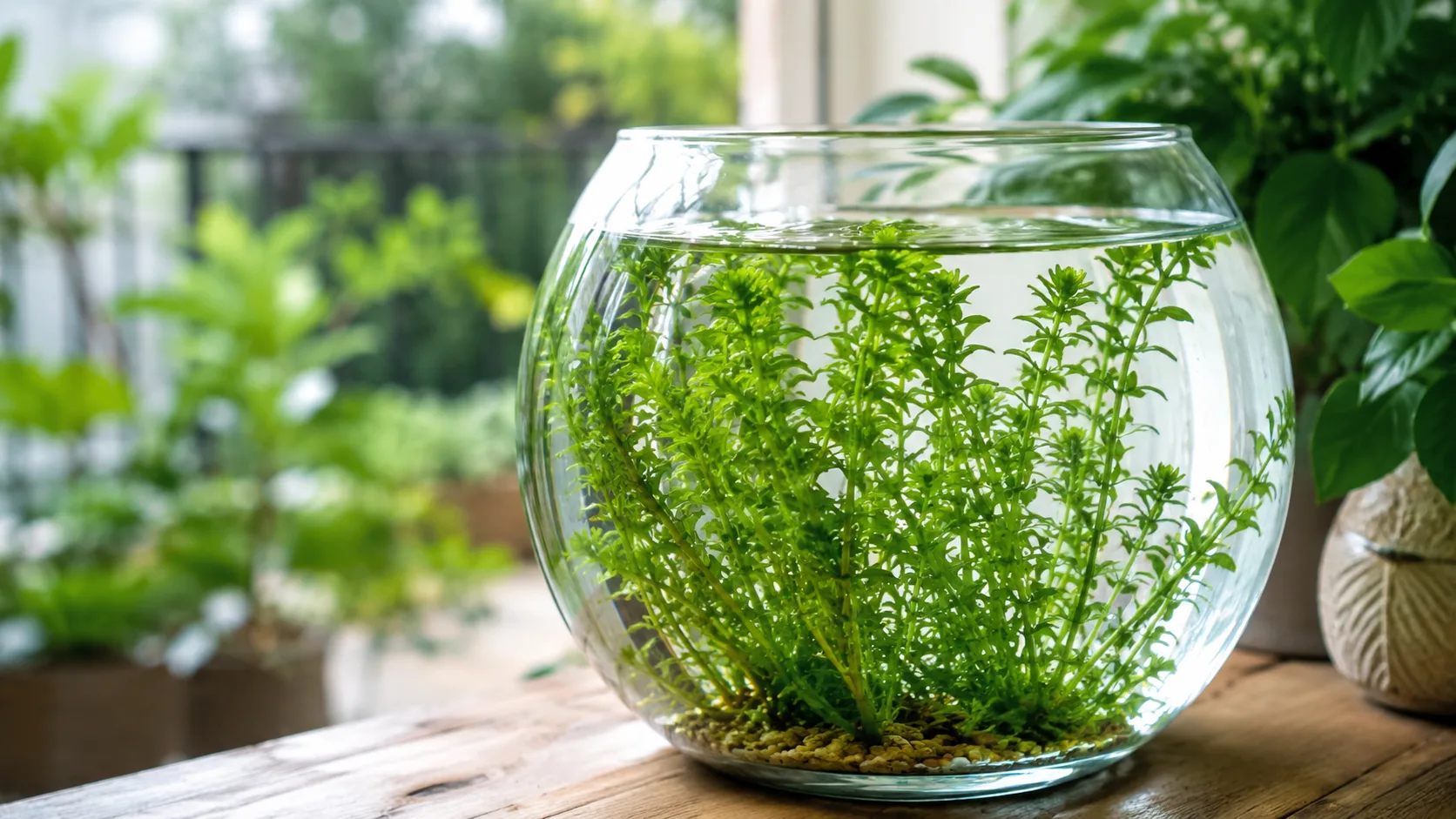
Anacharis (Egeria densa) Water Parameters: Temperature, pH, Hardness
Anacharis (Egeria densa) Water Parameters: Temperature, pH, Hardness
Anacharis does not get “watered” the way a pothos does. It lives entirely submerged, pulling every mineral it needs directly from the water column through leaves that are only two cell layers thick. That biology is why water parameters - temperature, pH, general hardness, carbonate hardness, and the nitrogen compounds dissolved alongside them - matter more for Anacharis / Elodea overview than almost any other care variable you can adjust. Get the chemistry stable and Anacharis grows 2 to 4 inches per week, pearls oxygen from its whorls, and outcompetes algae without fuss. Let a parameter swing after a careless water change and the same plant turns to brown mush within days. This guide gives you the numbers that work, the testing routine that catches problems early, and the acclimation steps that prevent the melt cycle most beginners hit twice before they figure it out.
Why Water Chemistry Matters More Than “Watering” for Anacharis
Egeria densa - the species sold everywhere as Anacharis, Brazilian waterweed, or large-flowered waterweed - is a column feeder. Its roots anchor the stem in gravel or sand, but the plant does not depend on substrate nutrition the way root-heavy species like Amazon swords do. Calcium, magnesium, potassium, nitrogen, and trace elements enter through the leaf surface and diffuse through those thin cell walls. When the water chemistry shifts, the plant cannot retreat into dry soil and wait things out. It responds immediately, and the response often looks like melting: lower leaves turn translucent, detach, and foul the tank.
The good news is that Anacharis tolerates a genuinely wide envelope of conditions. Dennerle lists a pH range of 5 to 9 and water hardness from very soft to very hard. LiveAquaria recommends 59 to 82°F, pH 6.5 to 7.5, and dKH 3 to 8. The Smithsonian NEMESIS invasive-species database records survival from 1°C to 32°C and pH 6.4 to 9.2. Those are not hobbyist guesses - they reflect decades of field observations across continents. The bad news is that tolerance is not the same as comfort, and comfort is not the same as stability. A plant that survives 82°F will grow noticeably slower and melt more readily than one kept at 68°F. A plant acclimated to pH 7.4 will shed leaves if you drop it into pH 6.2 overnight, even though both numbers are technically “fine.”
Understanding that distinction - survival range, ideal range, and the stability requirement that sits on top of both - is the core of Anacharis water care.
The Ideal Temperature Range for Anacharis
Temperature is the single parameter most likely to trigger visible problems, because it affects both the plant’s metabolic rate and the dissolved oxygen available in the water column. For aquarium use, the consensus across nurseries and databases converges on 60–77°F (15–25°C) as the ideal growth range, with 50–82°F (10–28°C) as the outer tolerance band before growth stalls or melt accelerates. Flowgrow’s aquatic plant database narrows the optimum further to 20–24°C (68–75°F), which matches what most experienced keepers observe in actively growing tanks.
Within that window, cooler water produces denser, bushier stems with shorter internodes. Warmer water pushes faster vertical growth but thins the leaf whorls and increases the risk of lower-leaf die-off. If your tank runs a standard tropical heater set to 78°F, Anacharis will usually survive - but it will not look as lush as the same plant in an unheated goldfish tank at 68°F. That is not a failure on your part; it is a physiological preference rooted in the plant’s native temperate-to-subtropical South American range.
Cold-Water Tolerance and Goldfish Tank Compatibility
Anacharis is one of the few popular stem plants that genuinely thrives in cold-water setups. Unheated indoor tanks in the low 60s°F, outdoor patio tubs in spring, and goldfish aquariums running 65–72°F are all environments where this plant routinely outperforms tropical alternatives like Hygrophila or Rotala. In outdoor ponds, established stands overwinter in many climates as long as the water body does not freeze solid; stems under an ice cap can survive where surface air temperatures drop well below freezing, though prolonged hard freeze will kill exposed tissue.
For goldfish keepers, the temperature match is almost ideal. Fancy goldfish prefer 65–74°F; common goldfish tolerate even cooler water. Anacharis at those temperatures grows fast enough to recover from grazing, pearls actively during daylight hours, and rarely melts unless a parameter other than temperature is off. If you are choosing a plant specifically for an unheated or goldfish tank, Anacharis is a stronger water-parameter fit than most stem plants sold alongside it.
When Warm Tropical Tanks Cause Melting
Heated community tanks in the 78–82°F range are workable but not optimal. Above 77°F (25°C), growth efficiency drops and melt episodes become more frequent, especially after shipping or a large water change. Biology Insights and multiple hobbyist guides note that prolonged exposure above 77°F causes the plant to “struggle” - a polite way of describing the thin, pale stems and lower-leaf shedding that warm-tank keepers report consistently.
If your display tank must run tropical for the fish, compensate with stable pH, moderate hardness, and consistent weekly testing rather than chasing a lower temperature the livestock cannot tolerate. Avoid placing the tank near a sunny window where summer afternoon heat spikes can push water temperature 5°F above the heater setting in a matter of hours. A simple stick-on thermometer checked during heat waves costs less than replacing melted bunches every month.
pH: Where Anacharis Feels Most Comfortable
pH 6.5–7.5 is the comfort band cited by LiveAquaria, Aquamarine Power, and most aquarium plant retailers. Anacharis leans slightly alkaline relative to some soft-water biotope plants, and it grows most vigorously when pH sits in the high 6s to mid 7s with stable daily fluctuation of no more than 0.2 to 0.3 units. The tolerated range extends from roughly 6.0 to 8.0 in aquarium practice, and the NEMESIS database records field survival from pH 6.4 to 9.2 - wider than any home aquarist needs to plan around.
In practical terms, pH matters for Anacharis because it controls the availability of carbon species (CO₂ vs bicarbonate) and the solubility of micronutrients like iron. In soft, acidic water below pH 6.5, iron and manganese stay soluble but phosphate can bind to substrates and become less available in the column. In hard, alkaline water above pH 7.8, iron precipitates and shows up as rusty leaf spotting if you dose chelated fertilizers. Neither extreme kills Anacharis quickly, but both produce visual symptoms that people misattribute to “bad light” or “not enough fertilizer.”
Stable pH vs. Perfect pH
The most important pH lesson for Anacharis is that stability beats precision. A tank locked at pH 7.6 with KH 5 will grow healthier stems than a tank that swings from pH 6.8 in the morning to pH 7.5 after the CO₂ shuts off at night - even if the average looks ideal on paper. If you run CO₂ injection, size the bubble rate so pH drop stays within 0.3 to 0.5 units and does not crash overnight when gas diffusion catches up. If you run low-tech, resist the urge to chase pH with chemical buffers every time a test strip reads slightly off. Repeated pH manipulation creates the swings that trigger melt far more reliably than a steady number one point away from the textbook ideal.
General Hardness (GH): Why Soft Water Stems Get Brittle
General hardness (GH) measures dissolved calcium and magnesium - the minerals that build cell walls and enzyme systems in aquatic plants. For Anacharis, the recommended GH range across hobby sources is 3–8 dGH (roughly 50–140 ppm), with tolerated extremes from very soft (2 dGH) to moderately hard (18 dGH and above per aqua-fish.net and Flowgrow). Dennerle simply lists “very soft to very hard,” which is accurate but not helpful when your stems are snapping.
The practical pattern is this: in very soft water below 3 dGH - common in RO-only setups, rainwater collections, and some Pacific Northwest tap supplies - Anacharis grows but stems become mechanically brittle. They snap during pruning, goldfish uproot them easily, and the plant looks pale despite adequate light and nitrate. Calcium and magnesium are not optional luxuries for this species; they are structural inputs absorbed through the leaves. If your GH test reads 1 to 2 dGH and your Anacharis keeps breaking, remineralize before you buy a stronger light.
In moderate to hard water from 4 to 12 dGH, Anacharis is in its element. Most municipal tap water in the United States and Europe falls here without modification. You do not need to soften water for this plant. If anything, hard-water keepers have the easier job: test once, confirm GH is above 3 dGH, and move on.
Carbonate Hardness (KH): The Buffer That Protects Your pH
Carbonate hardness (KH) measures bicarbonate and carbonate ions - the buffer system that prevents pH from crashing or spiking. LiveAquaria recommends dKH 3 to 8 for Anacharis. Flowgrow extends the range to 2–20 dKH. In tanks with KH below 2, pH tends to drift downward over time as organic acids accumulate, especially in heavily stocked or peat-influenced setups. In tanks with KH above 12, pH stays locked high and iron dosing becomes trickier, though Anacharis itself usually copes.
For most keepers, a KH of 3 to 6 dKH provides enough buffering to hold pH stable through a weekly 25 to 30 percent water change without chemical intervention. If you use RO water, remineralize to hit both GH and KH targets simultaneously - products like Seachem Equilibrium or Salty Shrimp GH/KH+ are designed for exactly this. Testing KH monthly (or after any remineralization change) takes thirty seconds and prevents the slow pH drift that causes melt two weeks after you thought the tank was settled.
TDS, Salinity, and Freshwater Limits
Total dissolved solids (TDS) is a composite measurement - the sum of every dissolved ion in the water - and it correlates loosely with GH, KH, and nitrate together. Anacharis tolerates TDS from soft-water readings around 100 ppm up to hard-water readings above 300 ppm in community tanks. A TDS pen is not a substitute for GH and KH tests, but it is useful for tracking drift over time: if your baseline TDS was 180 ppm and it reads 320 ppm three weeks later without a water change, nitrates or evaporation concentrate are building up and a partial change is overdue.
Salinity is a hard limit. Egeria densa is a strict freshwater species. The NEMESIS database records a salinity range of 0‰ - brackish conditions kill it. Do not attempt Anacharis in brackish setups, salt-treated hospital tanks, or marine sumps. Even short exposure to salt-based disease treatments at doses safe for fish can damage leaves; remove plants before medicating if the label mentions salt or sodium chloride.
Nitrogen Compounds: Ammonia, Nitrite, and Nitrate
Because Anacharis absorbs nitrogen directly from the water, it is both a beneficiary and an early warning system for nitrogen-cycle problems. Ammonia and nitrite above 0 ppm are toxic to fish and stress plants simultaneously. Anacharis in a cycling tank may grow initially - it uses ammonia as a nitrogen source - but sustained ammonia above 0.25 ppm produces yellowing, stunted new growth, and increased melt on lower leaves. Never add Anacharis to an uncycled tank and assume the plant will “handle” the cycle alone while fish suffer.
Nitrate is where Anacharis shines. It actively pulls nitrate from the column, which is why it works as a biological filter companion in stocked tanks. Flowgrow lists an optimal nitrate range of 10–50 mg/L for E. densa; in practice, anything from 5 to 40 ppm supports healthy growth in a community aquarium. Below 5 ppm in a high-light, CO₂-injected tank, the plant may yellow from nitrogen deficiency. Above 40 ppm, you are not hurting Anacharis - you are signaling that water changes are overdue and algae may follow.
Test ammonia and nitrite weekly in new tanks and monthly in established ones. Test nitrate weekly in any tank stocked with fish. Anacharis will tell you something is wrong visually, but by the time leaves yellow from ammonia burn, the fish have been stressed longer than you want.
How to Test Anacharis Water Parameters at Home
You do not need a laboratory. A liquid reagent test kit covering pH, ammonia, nitrite, nitrate, GH, and KH - brands like API, Salifert, or NT Labs - covers every parameter that matters for Anacharis health. Test strips exist but liquid kits give finer resolution on pH and hardness, which is where Anacharis problems usually hide.
Run this schedule in a tank with established Anacharis:
- Weekly: nitrate, temperature (digital thermometer or probe).
- Biweekly: pH, GH, KH (or weekly if you recently changed remineralization or CO₂).
- Monthly: ammonia and nitrite spot-check in established tanks; weekly during cycling.
- After every water change: temperature-match new water to tank water within 2°F before adding.
Record results in a notebook or phone note for the first month. Patterns - like pH dropping 0.4 units every week in a soft-water tank - are easier to spot in a log than from memory.
Which Tests Actually Matter for a Stem Plant Tank
If budget or time is limited, prioritize in this order: temperature, nitrate, pH, GH. Temperature swings cause the fastest visible damage. Nitrate tells you whether water changes are keeping pace with stocking. pH and GH catch the slow drifts that cause melt two weeks after a setup change. KH matters most in soft-water and CO₂-injected tanks. Ammonia and nitrite matter most during cycling and after filter crashes. TDS is optional context, not a primary decision tool.
Acclimating New Anacharis to Your Tank’s Water Chemistry
Store-bought Anacharis often arrives in water with different temperature, pH, and hardness than your tank. Dumping stems straight in is the most common cause of melt. Use this acclimation routine instead:
- Float the bunch in the tank for 15 to 30 minutes to equalize temperature.
- Open the bag or transfer to a cup with the store water; add a small amount of tank water every 5 to 10 minutes over 30 to 45 minutes (roughly 1 part tank water to 3 parts store water, then half-and-half, then mostly tank water).
- Check temperature one last time - the cup water should be within 2°F of the tank.
- Plant or float the stems; remove any rubber bands, lead weights, or damaged lower leaves first.
- Wait. Some lower-leaf melt in the first week is normal transition shock, not necessarily a parameter failure. Trim mushy tissue promptly so it does not ammonia-spike the tank.
If melt exceeds the bottom two whorls and climbs the stem after day five, test pH, GH, and temperature against the ranges in this guide before buying replacement plants.
Aquarium vs. Pond: Parameter Differences That Catch People Off Guard
The same species behaves differently in a closed aquarium and an open pond because the parameter stability mechanisms differ. In an aquarium, the heater, filter, and scheduled water changes keep conditions tight. In a pond, sun, rain, evaporation, and runoff swing parameters daily.
In outdoor ponds, Anacharis tolerates 50°F (10°C) spring water and summer peaks into the low 80s°F, matching the tolerated aquarium range but with slower spring startup and faster midsummer growth. Spring rain can dilute KH and drop pH; summer evaporation concentrates TDS and nitrate. Autumn leaf litter releases tannins and acids. None of these kill established Anacharis quickly, but each produces the kind of gradual drift that triggers partial melt if you are not watching.
For pond keepers: test pH and KH at spring startup and midsummer; skim decaying leaves weekly; avoid draining pond water into natural waterways (Egeria densa is invasive in much of the United States - Texas A&M AquaPlant notes it should not be introduced into new water bodies). In aquariums, your main seasonal risk is room-temperature swings from HVAC - a tank near a west-facing window in June can exceed 82°F by afternoon even with a heater set lower.
Common Water Parameter Mistakes and How to Fix Them
The mistakes that kill Anacharis are almost never “wrong pH by half a point.” They are sudden changes, untreated source water, and assumptions that clear water means stable chemistry.
Replacing more than 50 percent of the tank volume at once with tap water that differs significantly in temperature or pH shocks every plant and fish simultaneously. Scale back to 25 to 30 percent weekly changes, match temperature, and add dechlorinator to the new water before it enters the tank.
Ignoring GH in soft-water cities produces brittle stems that beginners blame on “bad genetics.” Test GH once; if it is below 3 dGH, remineralize.
Running a new heater without a thermometer check leads to cooked plants before cooked fish. Verify the set point with an independent thermometer after installation.
Dosing copper-based ich medication with Anacharis in the tank often melts the plant entirely. Copper is toxic to most aquatic plants at fish-safe doses. Remove Anacharis to a quarantine tub or accept that the stems may not survive treatment.
Sudden Temperature Swings After Water Changes
This is the number-one melt trigger in forum posts. You do a “big clean,” refill with water that feels “about the same” to your hand, and three days later the Anacharis base is mush. Fix: use a thermometer in the change bucket, not your wrist. Target ±2°F between new and tank water. In winter, let tap water sit until it matches room-temperature tank water or pre-warm with a small heater in the bucket. In summer, run cold tap briefly, then adjust - cold shock is as damaging as heat shock.
Over-Dechlorinating and RO Water Without Remineralization
Dechlorinator neutralizes chlorine and chloramine; it does not add minerals. RO and distilled water stripped of calcium and magnesium produce GH readings near zero - fine for car batteries, bad for stem cell walls. If you use RO for soft-water fish, remineralize to at least 3 dGH and 3 dKH before every water change. Over-dosing dechlorinator beyond label directions is rare but can bind oxygen in extreme cases; follow the bottle ratio for your change volume and do not double-dose “to be safe.”
Turtle Tanks, Medications, and Copper Sensitivity
Turtle aquariums combine warm temperatures (often 75–80°F for sliders), heavy bioload, and occasional salt or antibiotic treatments - a parameter environment where Anacharis survives but does not thrive without attention. Nitrates climb faster than in fish-only tanks; weekly 30 to 40 percent changes keep nitrate below 40 ppm and prevent the algae blooms that compete with Anacharis for light and nutrients.
If you keep turtles that nibble plants, Anacharis’s fast growth in the 68–74°F range still outpaces moderate grazing - but only if water quality keeps pace. For turtle setups running warmer than 77°F, expect thinner stems and plan to trim and replant cuttings more often.
Copper sensitivity deserves its own warning. Anacharis, like most Hydrocharitaceae species, does not tolerate copper-based algaecides or many ich medications. If your turtle or fish needs copper treatment, move the plants to a separate tub of matched tank water for the treatment duration. Even trace copper from outdated plumbing or decorative copper ornaments can cause leaf tip die-back over weeks.
Conclusion
Anacharis earns its beginner-plant reputation through tolerance, not through indifference to water chemistry. Target 60–77°F, pH 6.5–7.5, GH 3–8 dGH, and KH 3–8 dKH, keep nitrogen compounds in check with regular testing and water changes, and treat stability as the hidden fifth parameter that matters as much as the four on the test kit. Acclimate new stems slowly, match water-change temperature within 2°F, remineralize RO water before it touches the tank, and pull plants before copper medications go in. Do those things and Egeria densa rewards you with fast, oxygenating growth in everything from unheated goldfish tanks to outdoor ponds. Skip them and you will keep buying replacement bunches until you assume the plant is “just hard” - when the water was the problem all along.
When to use this page vs other Anacharis / Elodea guides
- Anacharis / Elodea overview - Start here for whole-plant context before deep-diving this topic.
- Anacharis / Elodea problems hub - Jump to symptom-specific fix guides when this care topic does not resolve the issue.
- Overwatering on Anacharis / Elodea - Escalate here when watering adjustments are not enough.
- Underwatering on Anacharis / Elodea - Escalate here when watering adjustments are not enough.
- Root Rot on Anacharis / Elodea - Escalate here when watering adjustments are not enough.
Related Anacharis / Elodea guides
- Anacharis / Elodea overview
- Anacharis / Elodea light
- Anacharis / Elodea soil
- Anacharis / Elodea propagation
- Anacharis / Elodea fertilizer
- Anacharis / Elodea repotting
- Overwatering on Anacharis / Elodea
- Underwatering on Anacharis / Elodea
- Root Rot on Anacharis / Elodea
- Wilting on Anacharis / Elodea
- Drooping Leaves on Anacharis / Elodea
- Anacharis / Elodea problems
Related tool
Try the Plant Watering Calculator with anacharis pre-selected to estimate needs for your setup.