Anacharis (Egeria densa) Light Needs: PAR & Photoperiod
Anacharis (Egeria densa) Light Needs: PAR & Photoperiod
Anacharis (Egeria densa) Light Needs: PAR & Photoperiod
Anacharis earns its reputation as a beginner-friendly aquarium plant because it tolerates a wide range of light levels. That same flexibility is also why new keepers struggle with it. A plant that survives anywhere rarely thrives anywhere, and the difference between dense green stems and leggy, algae-coated growth usually comes down to a few specific light choices - PAR at the substrate, photoperiod on a timer, and fixture height relative to tank depth. This guide focuses on those choices for aquarium and pond culture of Egeria densa.
Reviewed by the LeafyPixels Review Board. PAR bands and photoperiod targets are cross-checked against Tropica, Flowgrow, Rodrigues & Thomaz (2010), and practical planted-tank references before publication.
If you need holistic care - legality by state, melt biology, or copper sensitivity - start with the Anacharis overview. Light and water parameters move together in Anacharis / Elodea overview, and fast recovery from a bad light spell often depends on how you propagate and replant trimmed tops.
Quick Reference: PAR and Photoperiod Targets
| Setup type | Target PAR at substrate (µmol m⁻² s⁻¹) | Photoperiod | Notes |
|---|---|---|---|
| Low-tech aquarium (no CO₂) | 30–50 | 8 hours | Safe default; ramp from 6 hours in new tanks |
| High-tech aquarium (CO₂ + daily ferts) | 50–80 | 8–9 hours | Watch hair algae above 80 without balance |
| Survival / deep or shaded tank | 15–25 | 6–8 hours | Lives; expect stretched internodes |
| Floating stems | 40–60 at surface | 8–10 hours | Faster growth; may shade plants below |
| Outdoor pond (temperate) | Natural; partial afternoon shade in heat | Seasonal | Never release trimmings to wild water |
If you only remember one number, remember 40 PAR at the substrate for bushy low-tech growth. Peer-reviewed work reports a light compensation point around 7.5 to 16 µmol m⁻² s⁻¹ for E. densa (Rodrigues & Thomaz 2010, Aquatic Botany), which explains why the plant survives deep shade but does not look good there.
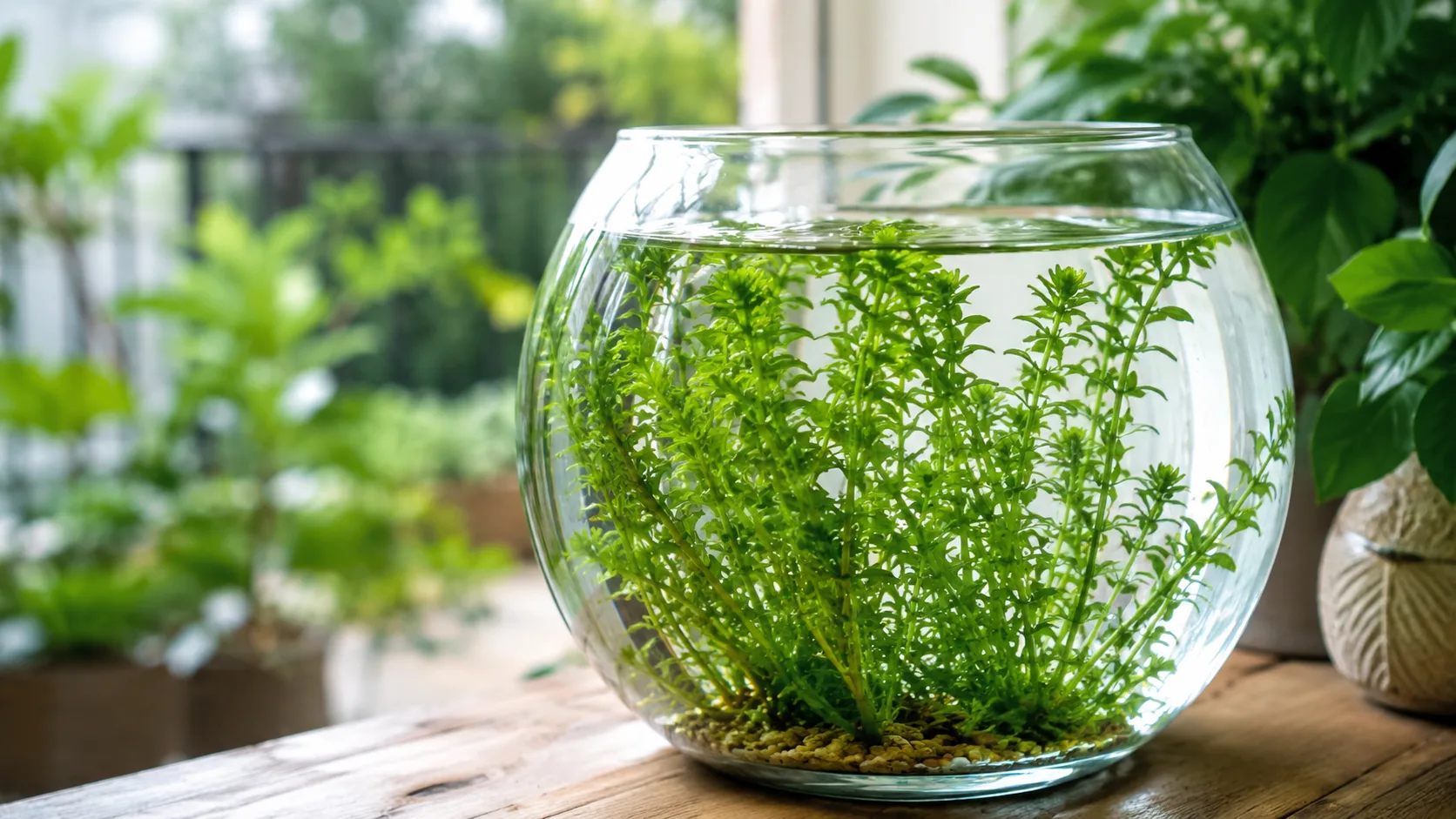
Visual reference (what to look for): Healthy anacharis at ~40 PAR shows short internodes (roughly 1–2 cm between leaf whorls), dark green leaves, and often pearling (oxygen bubbles on leaves within an hour of lights-on). The same clone at ~18 PAR substrate PAR typically shows internodes 4–6 cm apart, pale yellow-green leaves, and sparse whorls - classic shade etiolation, not disease.
Measurement vignette: In a standard 50 cm deep 20-gallon tank with a mid-range planted LED mounted 8 cm above the glass, a Photone app reading at the substrate often lands near 35–42 PAR when the fixture runs at 70% power - squarely in the bushy-growth band. The same fixture at the water surface may read 90+ PAR; always measure where the leaves actually grow.
Why Light Matters: C4-Like Carbon Fixation and Shade Tolerance
Anacharis is not a typical C3 aquarium stem. Under carbon-limiting conditions it can induce a C4-like mechanism of CO₂ fixation in individual cells (Casati et al. 2000, Plant Physiology). In plain language, it can concentrate inorganic carbon efficiently in dim, CO₂-poor water where many competitors stall. The U.S. Fish and Wildlife Service ecological risk summary notes this pathway helps E. densa photosynthesize when dissolved CO₂ is low - a major reason it invades turbid reservoirs.
That efficiency is not a free pass. The same plasticity lets the plant reallocate growth toward stem elongation when photons are scarce. Shading experiments document reduced branching, fewer roots, and longer shoots as light drops (Riis et al. 2012, Aquatic Botany). Your tank mirrors that: insufficient PAR produces leggy stems weeks before leaves yellow.
The PAR Sweet Spot for Anacharis
Photosynthetically active radiation (PAR), in micromoles per square meter per second (µmol m⁻² s⁻¹), is the metric that predicts plant growth. Watts, lumens, and kelvin describe electricity, human brightness, and color - not usable plant photons.
Tropica rates Egeria densa as low light demand (~0.5 W/L benchmark). Flowgrow lists medium-to-high demand. Hobby references converge on 30–50 PAR for compact low-tech growth and 50–80 PAR with CO₂ (Aquarium Co-Op PAR guide; Canton Aquatics anacharis guide). AquariumStoreDepot cites 100–150 PAR for maximum growth - realistic only with CO₂ and daily fertilization; without that balance, algae usually wins first.
Reading PAR Without a Meter
The Photone app estimates PAR from a smartphone camera when calibrated against a neutral white reference. It is imprecise but sufficient for comparing substrate vs surface in your own tank. Without any meter, the Aquarium Co-Op PAR framework places medium light at roughly 20–35 PAR and high light at 40–50+ PAR - anacharis sits comfortably in the medium band for low-tech and the lower high band with CO₂.
Tank depth matters more than fixture wattage. A 60 cm tall aquarium may deliver less than half the substrate PAR measured at the surface under a point-source LED.
Watts per Gallon Sanity Check
Watts per gallon is obsolete for LEDs but still works as a rough check: about 0.5–0.75 W per gallon of quality LED or 1–2 W per gallon of T5 HO for medium light. Budget LEDs often need higher wattage to match published PAR maps - verify at your depth, not from the box.
Photoperiod: 8 to 10 Hours and the Algae Balance
Photoperiod controls total daily energy entering the tank. For anacharis, 8 to 10 hours per day on a timer is the practical sweet spot (Recifart planted-tank lighting guide). Low-tech tanks without CO₂ should stay closer to 6–8 hours; pushing past 10 hours without matching CO₂ and nutrients fuels algae more than extra stem growth.
New-tank ramp: Start at 6 hours for two weeks, then add 30–60 minutes per week until you reach 8–10 hours. A dimmable LED with a 30-minute sunrise/sunset ramp reduces fish stress and avoids shocking emersed stems from the supplier.
When balancing nutrients, see the overview section on CO₂ and fertilization - photoperiod and dissolved carbon interact directly in this species.
Too Little Light: Etiolation and Internode Stretch
Anacharis will not die in low light. It will reshape itself. Internodes lengthen, leaves shrink and lighten, and stems lean toward the brightest zone. Riis et al. (2012) documented this shade response in invasive aquatic macrophytes including Egeria densa: reduced root mass, less branching, greater shoot elongation.
Fixes (safest first): Lower the fixture, upgrade LED output, or add a reflector - not an open-ended photoperiod extension past 10 hours. If lower leaves yellow while tops stay green, thin the canopy (shading from dense top growth), not more light blindly.
Too Much Light: Algae and the CO2/Nutrient Ceiling
Excess light rarely damages anacharis alone. Damage comes from photons arriving faster than the plant can use them, with surplus energy captured by algae. Classic signs: green hair algae or black beard algae on lower internodes and damaged leaf tips.
Response sequence: Shorten photoperiod by 1–2 hours, raise fixture 5–10 cm, then address CO₂ and nutrients. Without CO₂ injection, treat 50 PAR at the substrate as a practical ceiling. With CO₂ and daily macros/micros, 80–100 PAR is usable.
Direct sunlight through a south window can deliver PAR no indoor LED matches - expect green water within days. Block afternoon sun or move the tank.
Symptom Checklist: What the Plant Is Telling You
| Symptom | Likely cause | First action |
|---|---|---|
| Long internodes, pale leaves | Low PAR / etiolation | Lower fixture or upgrade LED |
| Lower leaves yellow, bare stem base | Self-shading canopy | Trim tops, replant |
| Mushy transparent melt | Parameter shock, emersed transition, liquid carbon | Stabilize water; see overview melt FAQ |
| Bushy dark green whorls, pearling | Target PAR + balanced nutrients | Maintain; trim weekly |
| Hair / BBA on stems | Light > CO₂/nutrients | Cut photoperiod; clean algae manually |
| No growth for weeks | Photoperiod too short or PAR near compensation | Verify timer; measure substrate PAR |
Melt is often not a light problem. Copper medications and glutaraldehyde-based liquid carbon can kill tissue regardless of PAR - cross-check water parameters before chasing fixtures.
Spectrum and Color Temperature (5000K–7000K)
Anacharis is not spectrum-fussy. Photosynthesis peaks in blue (~430–470 nm) and red (~640–680 nm). Full-spectrum 5000K–7000K daylight LEDs match what most stem plants use. Warmer 3000K bulbs still grow the plant but render leaves duller. A plain 6500K white LED is enough for low-tech and quarantine tanks.
LED vs T5 HO: Choosing a Fixture
Modern planted tanks default to LEDs for efficiency, dimming, and low heat. T5 HO remains credible on tanks 60 cm deep or shallower - even reflector spread, cheap bulb replacement, mature PAR data.
LED advantages: 30–50 W often delivers 50–80 substrate PAR on standard depths; dimming lets you ramp intensity during acclimation.
LED caveat: Box PAR specs are usually measured 15 cm below the surface, not at the substrate. Prefer fixtures with published PAR maps or third-party reviews.
T5 advantages: Predictable spread on wide tanks; hybrid T5 + LED rigs still appear in professional scapes.
T5 downsides: Heat, higher energy, bulb spectrum drift every 12–18 months.
Mounting Height and Tank Depth
PAR at the substrate is what rooted anacharis reads. A fixture delivering 100 PAR at the surface may deliver 35 PAR at 50 cm depth - enough to survive, not enough to stay bushy.
Mount as low as the hood allows, or hang 15–25 cm above open-top tanks. Measure at the densest part of the plant mass. If you cannot lower the fixture, a modest photoperiod increase (1 hour) can compensate briefly - watch upper-leaf algae as the signal you have overcompensated.
| Tank depth (cm) | Typical substrate PAR drop | Practical note |
|---|---|---|
| 30 | Minimal | Stock LED often sufficient |
| 45 | Moderate | Verify at substrate; float stems if low |
| 60+ | Severe | Second fixture, float tops, or accept slow lower growth |
The Light, CO2, and Nutrient Triangle
Anacharis does not require CO₂ injection, but injected CO₂ plus balanced light can produce roughly two to three times faster vertical growth than the same PAR in a low-tech tank - an approximate hobby range, not a controlled trial (Canton Aquatics; AquariumStoreDepot). The rule: as light rises, rise CO₂ and nutrients in proportion.
Low-tech ceiling: 30–50 PAR, weekly complete liquid fertilizer after water changes. High-tech band: 60–100 PAR, CO₂ on one hour before lights, daily macro/micro dosing. Pushing 80+ PAR with zero CO₂ is algae fuel.
Acclimating Emersed or Relocated Stems
Store-bought anacharis is often farm-grown emersed, then submerged in your tank. That transition alone causes melt. Sudden intensity jumps compound it.
- Float the bag 15–20 minutes for temperature match.
- Drip-acclimate with small cupfuls of tank water over ~1 hour.
- Plant with 2–3 cm bare stem in substrate; leave existing leaves.
- Run 6 hours photoperiod week one.
- Add 30–60 minutes per week to target.
- Trim melted tissue promptly.
Moving from a dim tank to a bright one: drop photoperiod to 6 hours for several days, then ramp. For melt patterns vs light, see the overview.
Photoperiod Schedules for Low-Tech, High-Tech, and Pond Setups
Low-tech 10–20 gallon, no CO₂, 30–45 PAR: 8 hours single block (e.g., 10:00–18:00). Weekly water change + weekly fertilizer.
High-tech 40–75 gallon, CO₂, 50–80 PAR: 8–9 hours with 30-minute ramp up/down. CO₂ starts one hour before lights; ends one hour before lights-off. Daily dosing.
Outdoor pond: Natural photoperiod is fine; use morning sun + afternoon shade in hot climates. Suspend 30–50% shade cloth when water exceeds 28°C (82°F). E. densa tolerates cool water but senesces in sustained heat above ~32°C (Washington State Noxious Weed Control Board).
Never dump trimmings into streams or ponds - E. densa is a regulated invasive in multiple regions. Bag and compost or green-waste only; the overview legality section lists state-level restrictions.
Floating vs Planted Light Differences
Floating stems intercept more PAR than the same stems rooted 30–50 cm down - floating growth is faster and can shade the rest of the tank. Hybrid approach: root lower sections, float upper portions for cycling boost. Turtle tubs often rely on ambient room light; 8–10 hours of indirect room lighting works if direct sun is blocked.
Outdoor Pond Sun, Shade, and Seasonal Shifts
In full sun, anacharis can grow inches per day in late spring and needs weekly trimming. Under tree shade it survives smaller with stretched internodes. Plan morning sun, afternoon shade in hot climates. Shade cloth cuts intensity without blocking useful wavelengths for photosynthesis.
Seasonal light shifts change growth rate more than most keepers adjust trimming - increase removal frequency in long summer days, ease back in winter unless the pond is heated.
Common Light Mistakes
- 100% LED intensity from day one - start 50–70% for two weeks.
- 12–14 hour photoperiod to compensate for low PAR - algae trigger; upgrade light instead.
- No timer - inconsistency favors algae spores.
- Single weak LED on a 60 cm tank - substrate PAR near 10–15; float or upgrade.
- Direct sun on low-tech glass - green water within days.
- Treating melt as too little light - check parameters and medications first.
- Skipping weekly trim - dense canopy self-shades in 2–3 weeks.
Step-by-step new tank (condensed): Choose LED with PAR map for your depth → mount and verify substrate PAR → 6-hour timer week one → plant clusters 3–5 cm apart → ramp photoperiod 30 min/week to 8 hours → weekly fertilizer after water change → adjust PAR or hours based on bushy new growth vs stretch.
Weekly observation: 30 seconds on new tip color and internode length; 30 seconds on lowest leaves; 30 seconds on glass algae. Top stretching = too dim; bare yellow base = too dense; fast glass greening = photoperiod too long.
Conclusion
Anacharis light care boils down to matching intensity to your CO₂ and nutrient level, then holding photoperiod steady on a timer. For most home aquariums that means 30–50 PAR at the substrate and 8 hours in low-tech setups, or 50–80 PAR with injected CO₂. Float stems when depth starves the substrate; shade outdoor ponds in summer heat; never release trimmings to wild water.
When growth looks right, move on to water stability and propagation rhythm - light gets you bushy stems; consistent chemistry keeps them.
When to use this page vs other Anacharis / Elodea guides
- Anacharis / Elodea overview - Start here for whole-plant context before deep-diving this topic.
- Anacharis / Elodea problems hub - Jump to symptom-specific fix guides when this care topic does not resolve the issue.
- Not Enough Light on Anacharis / Elodea - Escalate here when light adjustments are not enough.
- Leggy Growth on Anacharis / Elodea - Escalate here when light adjustments are not enough.
- Sunburn / Scorched Leaves on Anacharis / Elodea - Escalate here when light adjustments are not enough.
Related Anacharis / Elodea guides
- Anacharis / Elodea overview
- Anacharis / Elodea watering
- Anacharis / Elodea soil
- Anacharis / Elodea propagation
- Anacharis / Elodea fertilizer
- Anacharis / Elodea repotting
- Not Enough Light on Anacharis / Elodea
- Leggy Growth on Anacharis / Elodea
- Sunburn / Scorched Leaves on Anacharis / Elodea
- Leaf Drop on Anacharis / Elodea
- Anacharis / Elodea problems