Leggy Growth on Anacharis / Elodea: Causes, Checks & Fixes
Quick answer
Leggy Anacharis means long bare internodes and sparse whorls from insufficient PAR at stem depth-not a disease. First step: float stems under the fixture, trim tops above a node, and aim for 30–50 PAR and 8–10 hours of light daily.
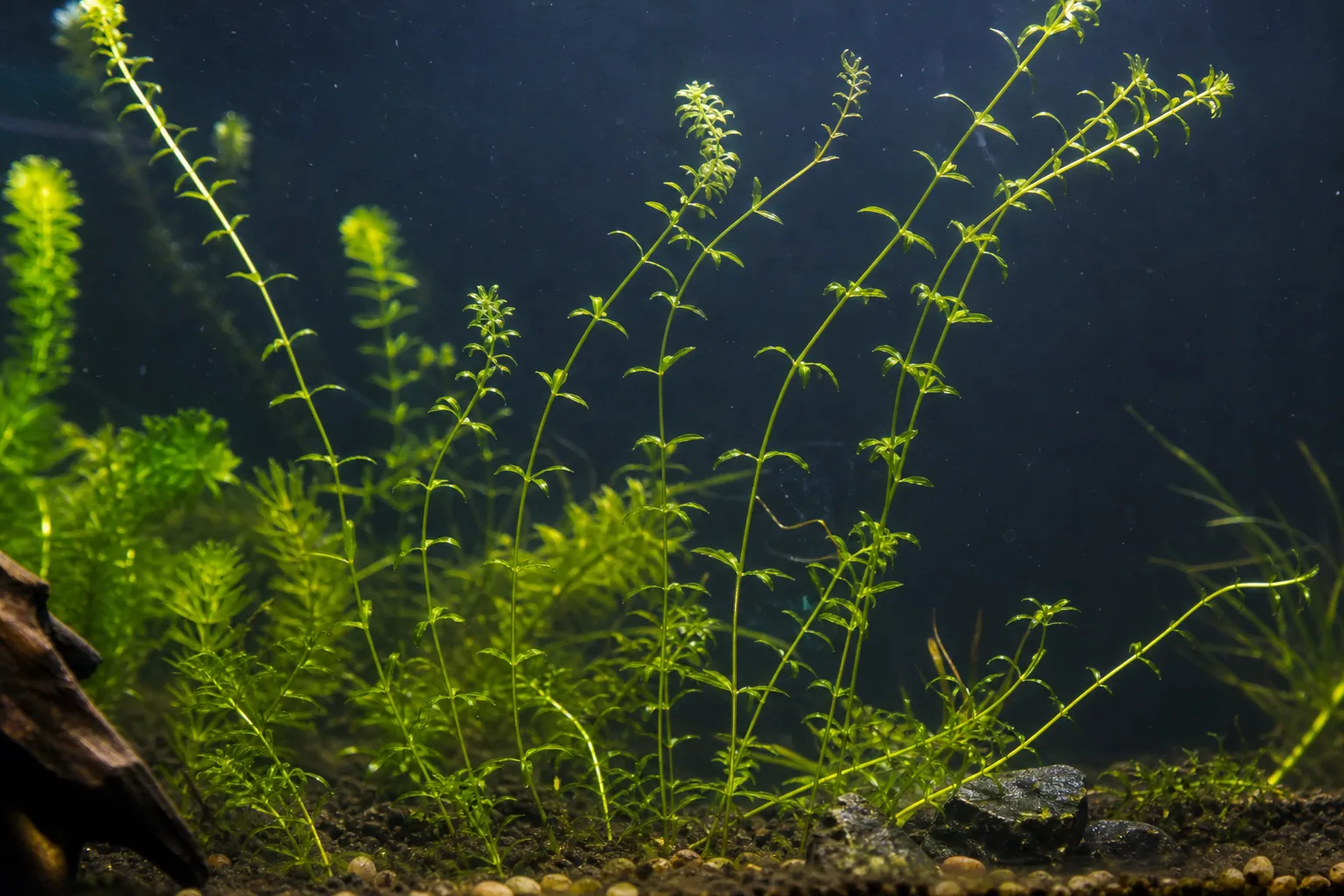
Leggy Growth on Anacharis / Elodea: Causes, Checks & Fixes
This guide covers leggy growth on Anacharis / Elodea. See also the general Leggy Growth guide, watering, and light pages for this plant.
Leggy Growth on Anacharis / Elodea: Causes, Checks & Fixes
Quick answer
Leggy growth on Anacharis (Egeria densa) means long bare internodes, small sparse whorls, and stems leaning toward the brightest zone-the plant’s shade response, not a disease. It follows insufficient PAR at stem depth, deep-tank shading, turtle hoods, or surface mats blocking light from reaching buried bases.
First step: float stems directly under the fixture, trim healthy tops above a node, and target 30–50 PAR at the substrate with 8–10 hours of light daily. Make one lighting correction, wait seven days, then reassess before stacking fertilizer or replanting.
This guide covers submerged aquarium and turtle-tank culture-not houseplant pots. For PAR maps, photoperiod ramps, and fixture choices, see the Anacharis light guide. For node cuts and replanting technique, see Anacharis pruning. For pale whorls before stems stretch, see not enough light on Anacharis. For everyday culture, see the Anacharis overview.
What leggy growth looks like on Anacharis
Stretched internodes: gaps between whorls widen to 1–3 cm or more-far beyond the compact 2.5–24 mm internodes on healthy submerged stems. Lower sections may be nearly bare while tips still carry small leaves.
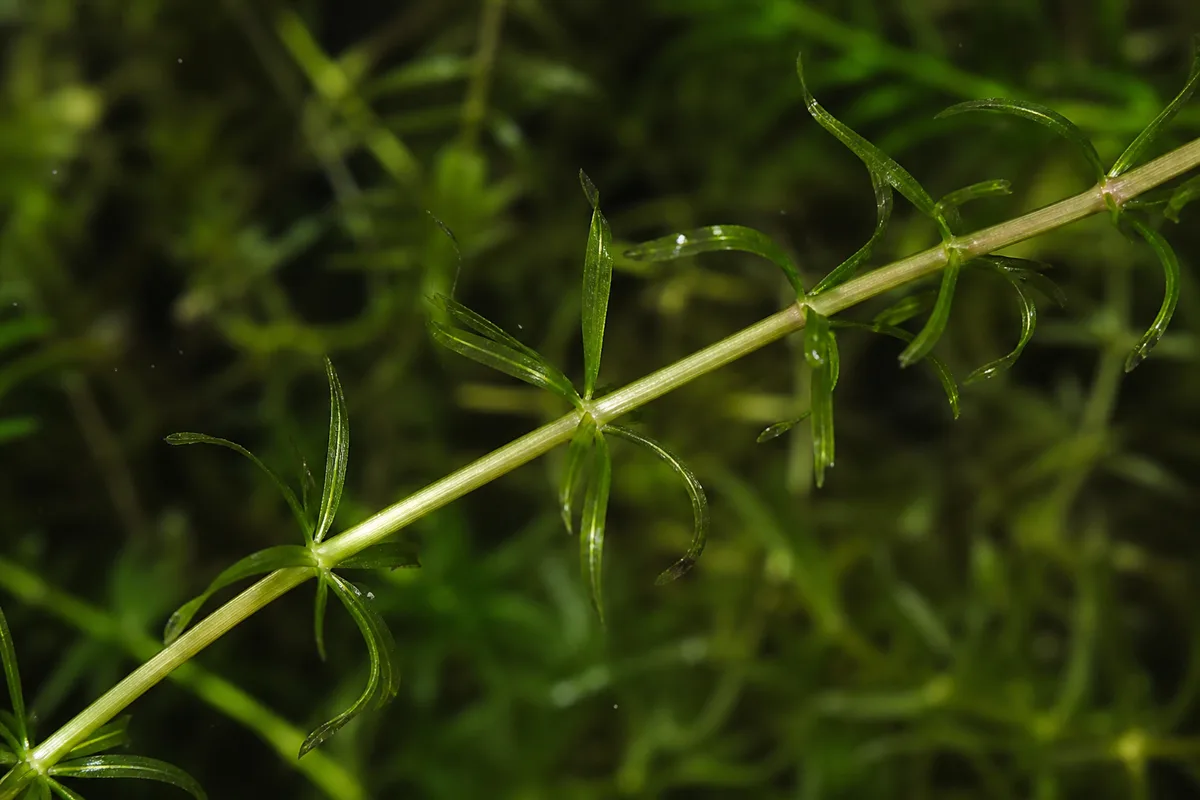
Leggy Growth symptoms on Anacharis / Elodea - compare with healthy tissue on the same plant.
Sparse bottle-brush whorls: leaves shrink, lighten to yellow-green, and point toward the light source instead of spreading evenly around the stem.
Reaching growth: stems lean horizontally or climb along the glass toward the fixture. In deep tanks, buried bases look leggy while floating tops stay bushy in the same aquarium-a classic PAR-at-depth split.
Rapid vertical race: in a 20-gallon with a default hood LED, stems can hit the surface in two weeks with only thin whorls along the way. That speed is growth, but it is etiolation, not healthy density.
Healthy Anacharis in moderate light shows short internodes, bright green whorls, and upright stems without a visible lean. Compare your newest tip growth: firm green tips mean the plant can recover even when lower sections look hopeless.
Why Anacharis gets leggy growth
Egeria densa acclimates to different light regimes, with low light causing shoot elongation so the plant reaches brighter water near the surface. In aquariums, that same plasticity produces stretched stems when PAR at depth falls below what the stand needs for compact growth.
Insufficient PAR at stem depth
Anacharis feeds from the water column and grows as a fast vegetative stem plant. It survives below 20 PAR but builds dense whorls around 30–50 PAR at the substrate in low-tech tanks-summarized in the Anacharis light guide. Below that window, the plant allocates energy to height over leaf mass.
Peer-reviewed work reports a low light compensation point around 7.5–16 µmol m⁻² s⁻¹ PAR, which explains why Anacharis tolerates dim water but still stretches indoors.
Deep tanks and hood shading
A 60 cm tank may deliver less than half the surface PAR at the substrate under the same LED. Stems planted deep stay in shade; floating cuttings directly under the fixture often look bushy while buried neighbors elongate.
Buried base vs. floating top split
When only the lower half is leggy and floating tips are green, the diagnosis is almost always light at depth, not nutrient deficiency. Self-shading from a dense canopy worsens the pattern-lower whorls drop as the top blocks PAR.
Turtle lids and surface mats
Turtle hoods, plastic lids, and floating plant mats cast shadows that aquarium keepers underestimate. Stems can look fine at the surface while submerged sections stretch. Basking lamps add heat but rarely deliver usable PAR to mid-tank stems.
Short photoperiod with weak intensity
A dim fixture on a six-hour timer keeps Anacharis alive but encourages reach-for-light growth. The light guide recommends 8–10 hours daily on a consistent timer for compact submerged growth.
Leggy growth vs. not enough light on Anacharis
These pages overlap because leggy stems are what you see, and insufficient light is usually what causes them-but the troubleshooting path differs.
| Focus | Leggy growth (this page) | Not enough light |
|---|---|---|
| Main symptom | Long bare internodes; stems already stretched | Pale whorls, bottom leaf drop, widening gaps before extreme stretch |
| First fix | Float, trim above nodes, replant tops | Raise PAR and photoperiod; float toward fixture |
| Reader stage | Plant already looks stringy; wants reshape technique | Fixture may be new; wants confirmation light is the issue |
If internodes are already 2 cm or longer with bare gaps, you are reshaping an etiolated stand-start here. If color fades and lower whorls drop before obvious stretch, read the not-enough-light page first, then use this guide after PAR improves.
How to confirm the cause
Work in this order:
-
Newest tip growth - Firm bright green tips mean recovery is possible. Translucent mush points to melt or chemical injury, not cosmetic legginess.
-
PAR at stem depth - Estimate with a PAR meter, Photone app, or the 30–50 PAR target from the light guide. Compare floating vs. planted sections in the same tank.
-
Water clarity and ammonia - Test new tanks for ammonia. Cloudy foul water with odor is urgent-see wilting on Anacharis when parameters fail.
-
Recent medication - Copper-based treatments and some algaecides melt Egeria densa. Leggy stretch from low light stays firm; copper injury turns tissue mushy within days.
-
Emersed vs. submerged tissue - Stems grown emersed at the nursery often melt after planting. Leggy submerged growth in stable water is a light problem; sheet melt on new purchases is acclimation.
UF/IFAS describes Egeria densa as a submerged aquatic plant-keep diagnosis inside aquarium culture, not terrestrial soil or window-sill pots.
The first fix: float, trim, and light targets
Make one change: float firm stems directly under the fixture and trim tops above a healthy node.
PAR and photoperiod summary
From the validated Anacharis light guide:
- Target 30–50 PAR at the substrate for compact low-tech growth; 50–80 PAR if you run CO₂ and full fertilization.
- Run 8–10 hours daily on a timer; start new tanks at 6 hours and add 30–60 minutes per week.
- Below 20 PAR, expect survival with stretched stems-not the bushy look most keepers want.
If your fixture cannot reach 30 PAR at depth, floating culture is the fastest correction while you upgrade lighting.
Trim-and-replant for branching
Once mush is removed, shorten leggy tops with clean scissors just above a leaf whorl (node). Strip leaves from the bottom 2–3 cm of each cutting, then replant or leave floating. Apical dominance suppresses side shoots until you remove the tip-lateral whorls typically emerge 3–14 days after a top cut in moderate light.
Discard bare lower stems that have not carried leaves for weeks; they rarely re-leaf. Replant only firm green tops. Full step-by-step cuts live in the Anacharis pruning guide.
Safe trim volume: remove about 20–30% of healthy mass per session. Leggy recovery needs repeated light topping every one to two weeks over three to six weeks-not a single haircut.
Wait seven days after the lighting change before adding fertilizer, mass replanting, or medications.
Recovery timeline
Days 3–7: stems should stop leaning further once floated under stronger light. No visible bushing yet-that is normal.
Days 7–14: lateral shoots often appear at nodes below top cuts. Internodes on new growth should shorten before old bare gaps fill in.
Weeks 3–6: repeated trim-and-replant cycles build bottle-brush density. Judge success by shorter internodes on new tips, not by old bare stems re-leafing.
Acclimation melt from new purchases may need 7–14 days before submerged whorls stabilize-do not trim aggressively during initial melt.
Mushy translucence after copper or ammonia requires saving only firm cuttings; cosmetic legginess on firm stems recovers with light and pruning alone.
Lookalike symptoms
| Pattern | Stem feel | Leaf color | Typical trigger |
|---|---|---|---|
| Leggy growth | Firm; long bare gaps | Small pale whorls; lean toward light | Low PAR at depth, hood shade, short photoperiod |
| Not enough light | Firm | Pale; bottom whorl drop before extreme stretch | Weak fixture, <8 h photoperiod |
| Transplant shock | Mixed firm and mush | Sheet melt on new stems | Emersed-to-submersed transition, parameter swing |
| Nitrogen deficiency | Firm | Pinholes, overall pale canopy in high light | Low nitrates despite strong PAR |
| Copper / chemical melt | Translucent mush | Rapid tissue collapse | Fish meds, algaecide, liquid carbon sensitivity |
Leggy Anacharis stays firm and green at the tips. Mush, odor, and spreading translucence are emergencies-not etiolation.
What not to do
Do not dose terrestrial pesticides or fungicides into aquarium water.
Do not leave melting tissue decaying in the tank-Anacharis fouls water quickly, especially in turtle setups.
Do not add heavy fertilizer to foul or cold water hoping to “bush out” stretched stems. Etiolation is a light problem first.
Do not plant in fertilizer-rich potting soil-use inert aquarium gravel or floating culture only.
Do not release trimmings into local waterways-UC ANR documents Brazilian egeria as an established invasive when fragments escape.
How to prevent leggy growth next time
Maintain clean dechlorinated water with regular partial changes, moderate aquarium lighting at 30–50 PAR, and 8–10 hour photoperiods per the light guide.
Trim before stems hit the surface-waiting for a dense canopy shades lower whorls and restarts the leggy cycle. Space stems 3–5 cm apart so light reaches the base.
Float new stems in tank water for acclimation before burying deep in substrate. In turtle tanks, remove hood shadows by floating trimmings under the brightest zone.
Check medication labels for copper before treating fish or turtles. Never dump aquarium contents into ponds or streams.
When to worry
Cosmetic legginess with firm green tips is low urgency-reshape with float, trim, and PAR correction over weeks.
Moderate urgency: rapid stretch after a fixture move, heater failure chilling the tank, or post-shipping limpness without mush.
High urgency: stems turn translucent, water clouds with odor, ammonia is detectable, or damage climbs into firm tissue within days. Those patterns point to wilting or chemical injury-not light alone.
Success checklist after two weeks
You are on track when:
- New tip growth shows shorter internodes than the old stretched sections
- Stems stand upright without leaning toward one corner
- Lateral whorls appear at nodes below recent top cuts
- Lower stems are either replaced by replanted tops or trimmed away-not left as long bare stubs
If internodes keep lengthening after PAR and photoperiod match the light guide, inspect for surface mats, turtle lid shade, or an undersized fixture before assuming a nutrient problem.
Related Anacharis guides
- Anacharis light needs - PAR targets, photoperiod, and fixture depth
- How to prune Anacharis - node cuts, replanting, and branching timeline
- Not enough light on Anacharis - pale whorls and fixture upgrades before extreme stretch
- Anacharis overview - everyday submerged culture and water parameters
- Anacharis fertilizer - when to dose after light is corrected