Not Enough Light on Anacharis / Elodea: Causes, Checks &
Quick answer
Not enough light on Anacharis / Elodea shows pale sparse whorls and bottom leaf drop in dim tanks. First step: Float stems under the fixture and set 8–10 hours on a timer while aiming for roughly 30–50 PAR at the affected stem depth.
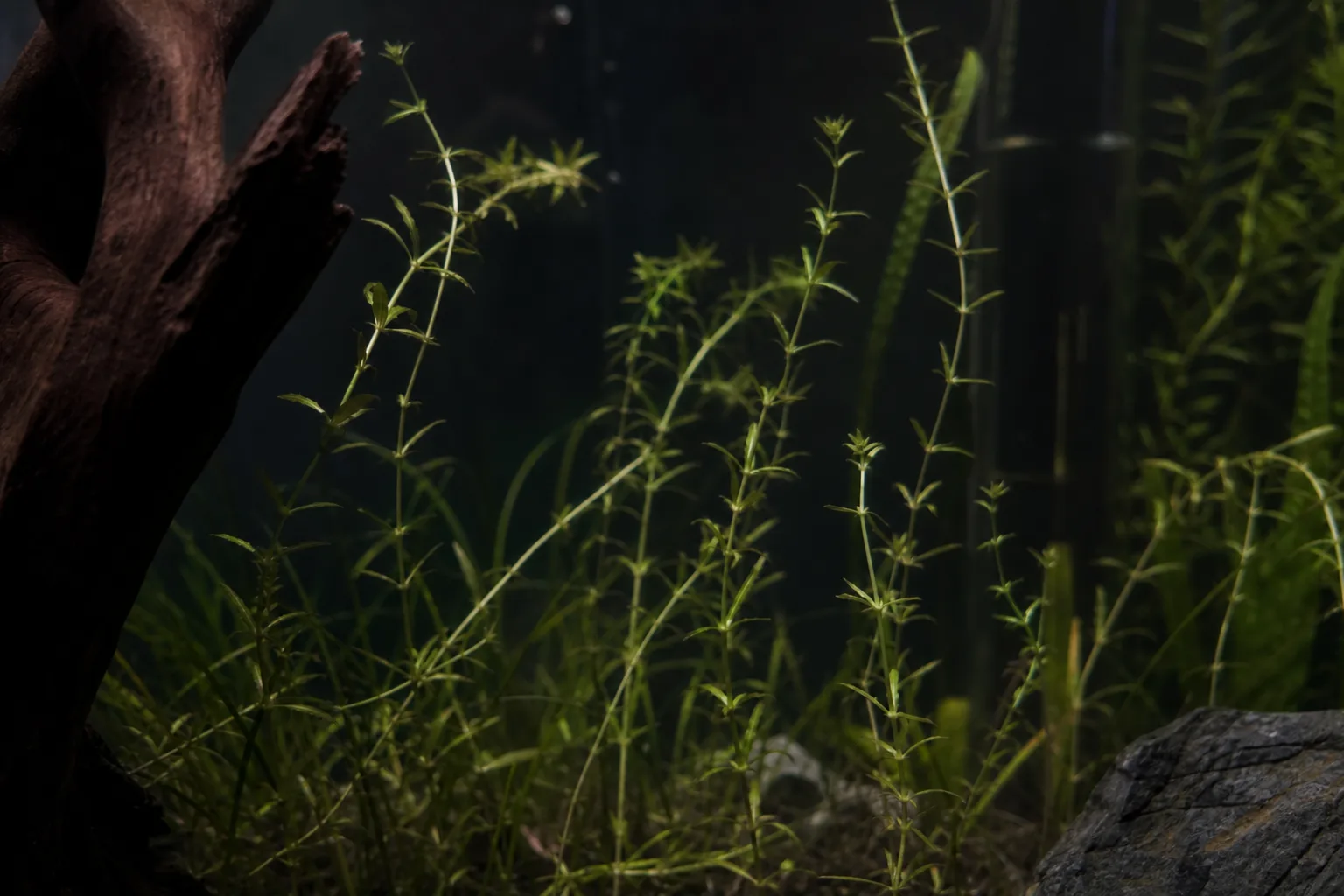
Not Enough Light on Anacharis / Elodea: Causes, Checks & Fixes
This guide covers not enough light on Anacharis / Elodea. See also the general Not Enough Light guide, watering, and light pages for this plant.
Not Enough Light on Anacharis / Elodea: Causes, Checks & Fixes
Quick answer
Not enough light on Anacharis (Egeria densa) shows pale sparse whorls, bottom leaf drop, and widening internodes in otherwise clean water. First step: Float stems directly under your fixture and set 8–10 hours on a timer while targeting roughly 30–50 PAR at the height of the affected stems.
This guide is for submerged aquarium and turtle-tank culture - not terrestrial houseplant pots. Anacharis feeds from the water column, grows as a fast vegetative stem plant, and shows light stress through whorl color, stem firmness, and new tip growth. For full PAR bands, photoperiod ramps, and fixture placement, see the Anacharis light guide.
Who this guide is for
Aquarium keepers with pale stems in deep or low-tech tanks, turtle-tank owners fighting dim plastic lids, and anyone whose floating mat shades lower whorls. If stems are already long and sparse after weeks of dim light, you are seeing the stretch outcome - read leggy growth on Anacharis after you apply the light fix here. For tank-wide pale wash that may be nutrients, see pale leaves on Anacharis. Baseline culture lives on the Anacharis overview.
Why Anacharis shows low-light stress
Anacharis tolerates dim water better than many stem plants thanks to a low light compensation point around 7.5–16 µmol m⁻² s⁻¹ - it can photosynthesize in turbid or deep conditions where competitors stall. That efficiency is also why it stretches instead of dying: under insufficient PAR, the plant allocates energy to elongating internodes and reaching the photic zone rather than building dense whorls. Researchers documented faster apical elongation under low light as stems race toward brighter water (Rodrigues & Thomaz 2010).
Common triggers on Anacharis / Elodea overview:
- Weak or distant fixtures - budget LEDs, single small bulbs on deep tanks, or hoods mounted too high deliver far less PAR at stem depth than at the water surface
- Short or irregular photoperiod - manual on-off without a timer, or fewer than 8 hours daily, limits total energy even when peak intensity looks adequate
- Self-shading surface mats - dense floating Anacharis blocks PAR to lower whorls on the same stems; pale bottoms with green tips often mean shade, not total tank darkness
- Turtle-tank lids - plastic covers and basking lamps rarely deliver 30–50 PAR to submerged stems along the tank wall
- Deep planting - rooted stems at the substrate in a 45–60 cm tank may read 10–20 PAR while floating tips in the same tank look healthy
Because Egeria densa is fully submerged in culture, the trigger is almost always light quantity, photoperiod, or placement - not soil moisture, pot drainage, or terrestrial watering schedules.
What insufficient light looks like
Expect this pattern: pale yellow-green whorls, bottom whorl loss, and widening internodes in otherwise clean water. Compare newest tip growth - healthy green tips mean the plant is still collecting enough photons at the apex even when lower sections look bad.
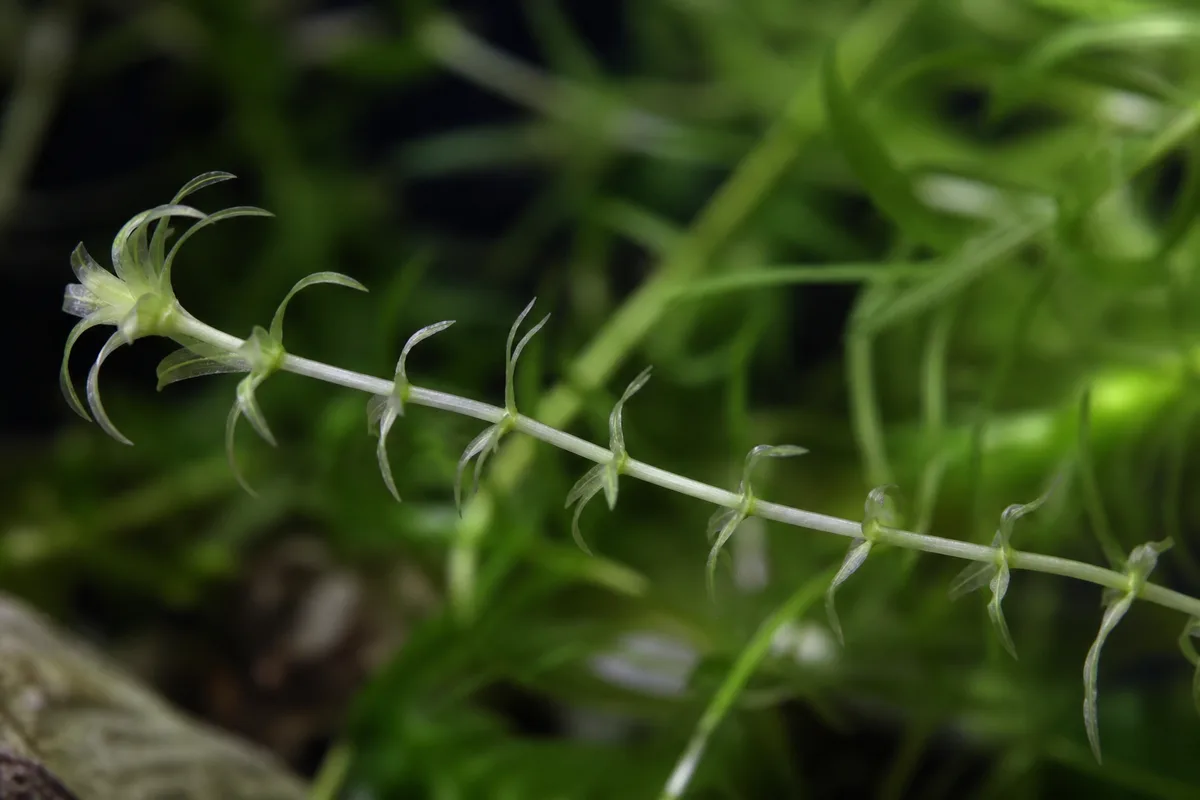
Not Enough Light symptoms on Anacharis / Elodea - compare with healthy tissue on the same plant.
Typical low-light cues:
- Bottom-up pale loss - lower whorls lighten and drop while tips stay greener (self-shading or depth gradient)
- Sparse whorls along stretched internodes - leaves shrink and space out as the stem reaches toward the fixture
- Stems leaning toward the brightest zone - window, open hood gap, or one strong LED corner
- Slow or stalled bushy growth - firm stems but no new whorl density for weeks despite stable water
- Floating tops bushy, planted bases pale - classic PAR drop with depth in the same tank
This is not the same as mushy melt from parameter shock, copper, or emersed-to-submersed transition - firm pale stems point to photons, not chemistry alone.
Not enough light vs leggy growth vs nutrient pale
| Pattern | Timeline | Stem shape | Whorl color | Water | Start here |
|---|---|---|---|---|---|
| Insufficient light (this page) | Days to weeks after dim setup or mat shading | Internodes widen; tips reach light | Pale lower whorls; tips may stay green | Usually clean | Float stems; 30–50 PAR; 8–10 h timer |
| Leggy growth | Weeks to months of chronic low PAR | Long thin stems; very sparse whorls | Overall pale stretch | Clean | Fix light first, then trim and replant tops |
| Pale leaves | Gradual tank-wide wash | Normal internode length | Uniform pale/yellow all levels | May test low nitrate | Test nutrients; rule out light at depth first |
| Acclimation melt | 7–14 days after purchase | Mushy sections possible | Translucent sheets | Often new tank | Stabilize parameters; see transplant shock |
| Copper injury | Days after medication | Mushy, translucent | Brown-tipped melt | Med history | Stop copper; consult vet for turtle tanks |
Rule of thumb: If you can name a recent dim fixture, short photoperiod, or dense float mat, treat as insufficient light before dosing fertilizer.
How to confirm the cause
Work through these checks in order. One light correction beats stacking fertilizer, replanting, and algicide on the same day.
- Newest tip color - Green firm tips with pale lower whorls support shade or depth, not total failure. Pale tips tank-wide suggest overall low PAR.
- Photoperiod - Note timer hours. Below 8 hours daily is a common driver; new tanks should ramp from 6 hours per the light guide.
- PAR at affected depth - Measure at the height of the palest whorls with a PAR meter or Photone app. Target 30–50 PAR for bushy low-tech growth; survival can continue near 20 PAR with stretch.
- Stem position - Are lower sections buried or shaded under a floating mat? Float or thin the canopy before upgrading the fixture.
- Water tests - If the tank is new or stock is heavy, rule out ammonia. Clean water with a pale light pattern still points to photons.
- Recent copper or temperature swings - Mushy translucence with medication history is not low light; see chemical damage. UF/IFAS describes Egeria densa as a submerged aquatic plant - keep diagnosis inside that context.
Lookalike quick table
| Symptom | Location | Likely cause | First fix |
|---|---|---|---|
| Pale lower whorls, green tips | Bottom/mid stem | Depth PAR drop, self-shade | Float stems; thin mat |
| Uniform pale all whorls | Whole plant | Low tank PAR or nutrients | Measure PAR; see pale leaves |
| Long sparse stems | Whole column | Chronic low light | Light fix + leggy growth trim |
| Mushy translucent melt | Stem sections | Copper, ammonia, melt | Stabilize water; trim mush |
| Bleached surface whorls | Waterline | Too much light | See sunburn |
First fix: light quantity and placement
Float stems directly under the fixture and set 8–10 hours on a timer while aiming for 30–50 PAR at the height of the palest whorls. This single placement + photoperiod correction is the first fix - not fertilizer, replanting, and a new LED on the same day.
Float stems under the fixture
Floating moves whorls into the strongest PAR zone immediately. In deep tanks, floating the pale section for 7–14 days often greens tips before you decide on a fixture upgrade. Leave firm rooted bases planted if they are not mushy - float only the struggling upper portions if the tank is shallow enough that tips already reach light (then the problem is photoperiod or fixture output, not depth).
Set photoperiod and check PAR at stem depth
- Timer: 8–10 hours daily on a consistent block (for example 10:00–18:00). New setups start at 6 hours and add 30–60 minutes per week until you reach 8–10 hours - details in the Anacharis light guide.
- PAR target: Roughly 30–50 PAR at affected stem depth for compact low-tech growth without CO₂. Below ~20 PAR, expect survival with stretch rather than dense whorls (Tropica plant profile; Flowgrow database).
- Deep tank workaround: Raise or add a planted-tank LED with a published PAR map, or keep stems floating until PAR at substrate meets target.
Thin floating mats if lower whorls are shaded
When green tips sit above pale bare stems on the same plant, the top is stealing light. Trim or redistribute the float mat so lower whorls receive PAR, or separate fast-growing floats from rooted stems you want bushy at the bottom.
Turtle-tank lid workaround
Clip-on aquarium LEDs, an open-mesh lid section, or positioning stems along the brightest wall often beats relying on the stock turtle hood. Run 8–10 hours on a timer aligned with room schedule. Consult your veterinarian before any copper-containing medication - copper-based treatments damage Brazilian waterweed and interact with turtle health protocols.
Make one targeted correction and wait seven days before stacking fertilizer, replanting, and chemical treatments.
Recovery timeline
Mild pale loss often stabilizes within one to two weeks once PAR and photoperiod are stable. New green submerged whorls at tips are the success signal - lower pale sections rarely re-green.
Rough expectations:
- Days 1–3: Stretching slows; tips hold color if the fix reached them
- Days 7–14: New whorls emerge greener when 30–50 PAR and 8–10 h photoperiod are consistent
- Weeks 3+: Trim persistently pale lower stems; replant healthy tops if needed
Acclimation melt from new purchases can overlap for 7–14 days - see transplant shock if pale tissue turned mushy right after unboxing. Mushy translucence after copper or ammonia is not a light problem.
What not to do
- Do not dose terrestrial pesticides or fungicides into aquarium water
- Do not add heavy fertilizer to fix pale whorls when PAR at stem depth is still below ~30 - nutrients without photons fuel algae, not leaves
- Do not extend photoperiod beyond 10 hours to “compensate” for weak fixtures - raise PAR or float stems instead
- Do not leave melting tissue decaying in the tank - trim and remove
- Do not plant in fertilizer-rich potting soil - use inert aquarium gravel or floating culture only
- Do not release trimmings into local waterways - Brazilian egeria spreads vegetatively and is invasive in many regions
How to prevent insufficient light next time
- Timer discipline: Lock 8–10 hours daily; ramp new tanks weekly per the Anacharis light guide
- Verify PAR at depth: Check at densest plant height, not only at substrate - especially in tanks 45 cm and deeper
- Manage canopy density: Trim floats before they shade rooted stems below
- Fixture planning: Prefer planted-tank LEDs with published PAR maps over wattage guesses on the box
- Turtle tanks: Plan a supplemental LED path before expecting dense wall growth under stock lids
- Stable water: Clean dechlorinated water with regular partial changes supports recovery after light fixes - match everyday care on the Anacharis overview
- Medication labels: Check for copper; consult a veterinarian for turtle-tank treatments
When to worry
Treat as urgent if stems turn translucent and mushy, water clouds with odor, ammonia is detectable, or damage climbs into firm tissue within days - those patterns point to melt or chemistry, not light alone.
Lower urgency: Slow cosmetic pale loss on lower whorls while tips stay firm and green - float, set the timer, and reassess in seven days.
Practical checks
Urgency check
High urgency - ammonia spike, copper exposure, rapid mush spreading into firm tissue. Moderate urgency - post-shipping limpness with pale but firm stems. Low urgency - stable tips, pale lower whorls only, clean water.
Best inspection order
Newest growth color → PAR at pale whorl depth → photoperiod hours → float mat density → water tests → recent medications.
Severity note
Insufficient light is marked medium severity for Anacharis in the symptom matrix - a triage clue, not a guarantee. Confirm PAR and photoperiod before escalating to chemical treatments.
Closing takeaway: When stems firm up and new tips green within 7–14 days after you hit 30–50 PAR and 8–10 hours on a timer, the light fix worked - trim old pale tissue and maintain the schedule from the light guide.
When to use this page vs other Anacharis / Elodea guides
- Anacharis / Elodea watering guide - Use for routine moisture checks before assuming not enough light is the main issue.
- Anacharis / Elodea problems hub - Browse all 34 common issues on this species.
- Leggy Growth on Anacharis / Elodea - Different entry point when symptoms overlap with not enough light.
- Slow Growth on Anacharis / Elodea - Different entry point when symptoms overlap with not enough light.
- Yellow Leaves on Anacharis / Elodea - Different entry point when symptoms overlap with not enough light.