Black Spots on Anacharis (Aquarium Elodea): Causes, Checks
Quick answer
Black spots on Anacharis / Elodea are usually black beard algae (BBA) or filamentous algae tufts on fast-growing whorls-often in slow-flow zones or when light outpaces CO₂ and nutrients. First step: trim and remove heavily coated stems, then improve circulation before changing photoperiod or dosing anything.
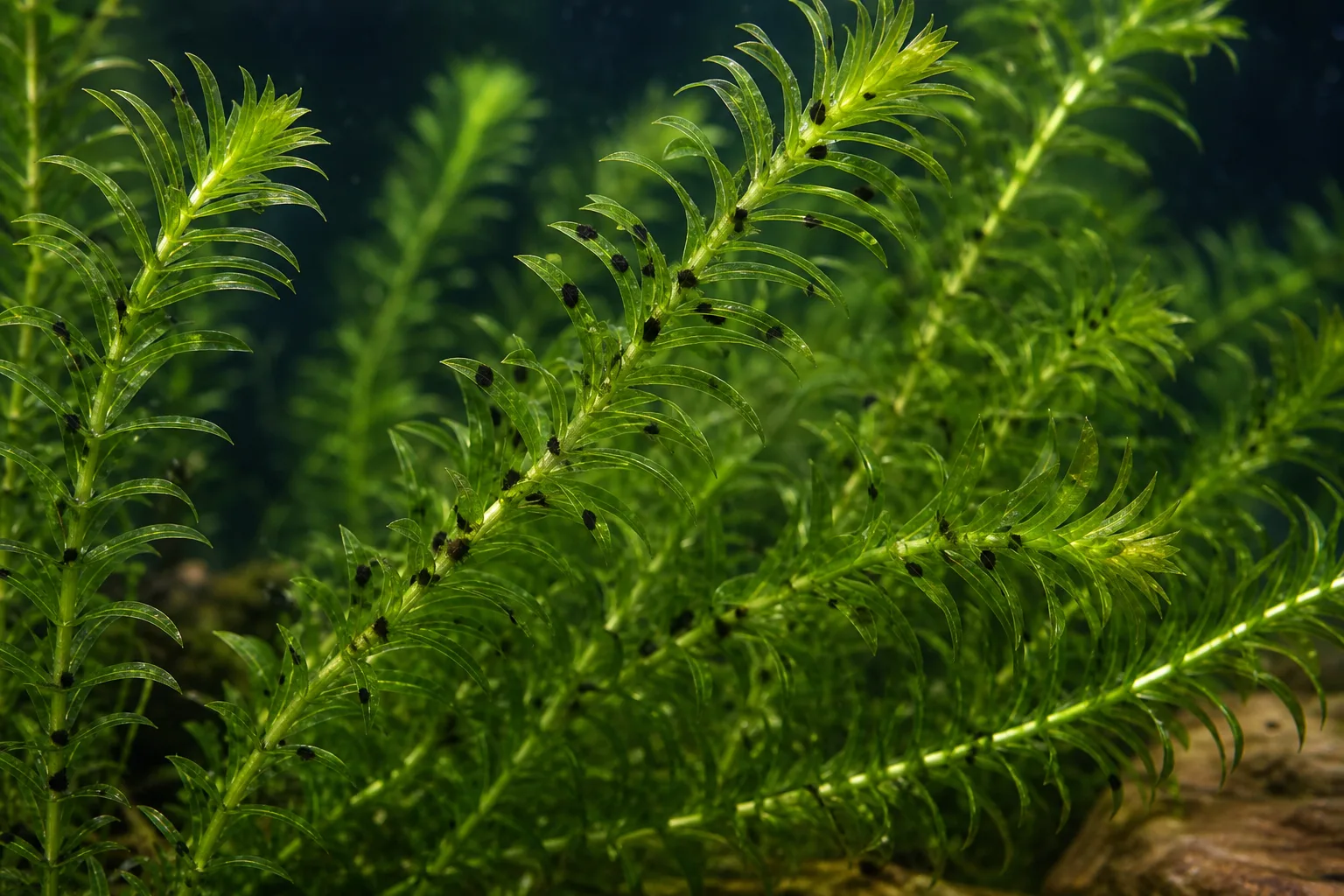
Black Spots on Anacharis / Elodea: Causes, Checks & Fixes
This guide covers black spots on Anacharis / Elodea. See also the general Black Spots guide, watering, and light pages for this plant.
Black Spots on Anacharis / Elodea: Causes, Checks & Fixes
Quick answer
Black spots on Anacharis (Egeria densa) are almost always algae on submerged stems-most often black beard algae (BBA) or other filamentous algae-not underwater fungus, soil disease, or houseplant leaf spots. Under tank light, BBA looks like dark, stiff, hair-like tufts clinging to whorl edges and stem joints; they do not wipe off like dust.
First step: trim and remove stems heavily coated in black tufts. Decaying algae holds nutrients and shades healthy tissue below. Once coated sections are out of the tank, you can adjust flow, photoperiod, or fertilization one change at a time.
This guide covers submerged aquarium, turtle-tub, and pond-tub culture only. For dusty brown film that wipes off, see brown leaves on Anacharis. For melt after medications, see chemical damage. For nutrient spikes that fuel algae, see overfertilization and the Anacharis overview.
What black spots look like on Anacharis whorls
Anacharis leaves grow in whorls of four to six around a slender stem. Each leaf is only about two cell layers thick, so algae on the surface looks like distinct spots or patches long before the whole plant browns.
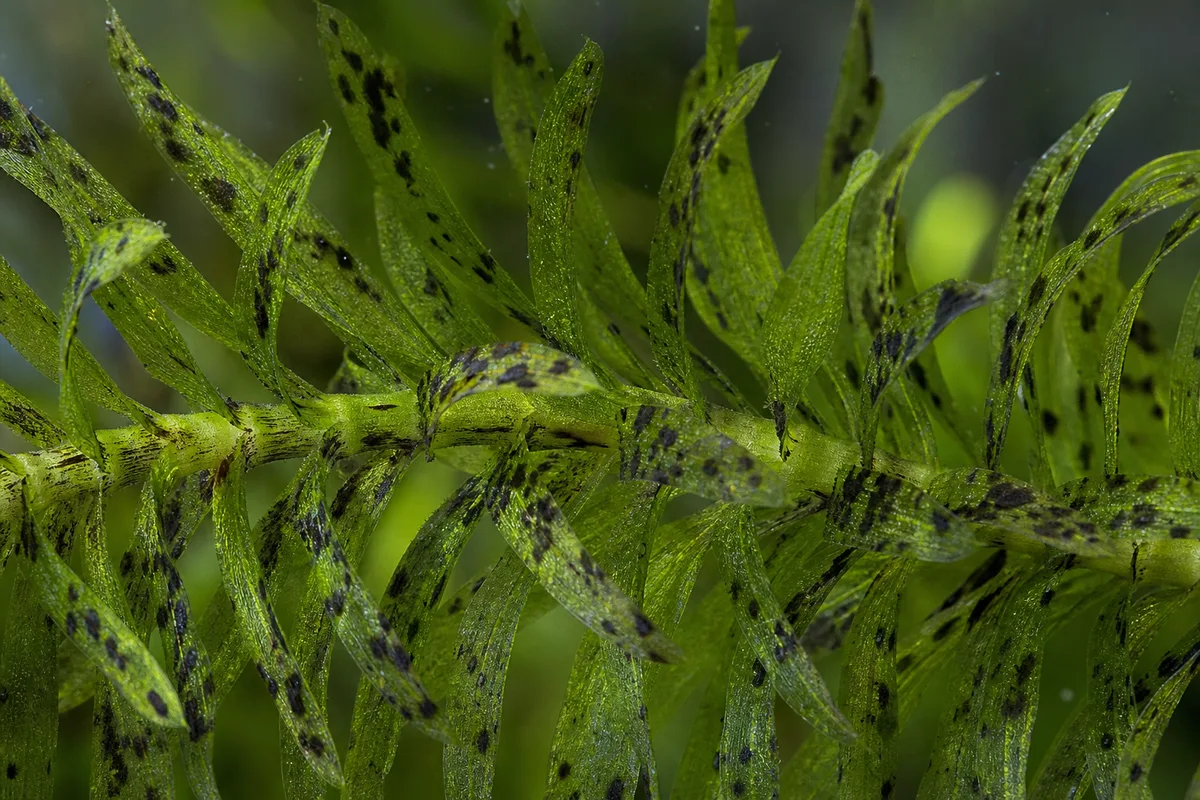
Black Spots symptoms on Anacharis / Elodea - compare with healthy tissue on the same plant.
Photo check - what to look for under tank light
You do not need a microscope to triage. Hold the stem at an angle to your light and compare:
- BBA / filamentous algae: Dark gray to black raised tufts with a brush-like texture on whorl margins or stem joints. Tufts stay attached when you gently rub with a finger-they must be trimmed or pulled. When treated, BBA often turns pink or red before dying-a hallmark of red algae (Rhodophyta) even though it looks black in the tank.
- Diatom film: Flat uniform brown dust on whorls that clears when you wipe the stem during a water change. No stiff hairs.
- Melt or chemical damage: Translucent mush without fuzzy structure. Stems soften and may liquefy within 24–72 hours after copper or algicide exposure.
If you are unsure between BBA and diatom dust, run the wipe test first-the management path differs completely.
Black beard algae tufts vs diatom film vs melt
| Pattern | Texture | Rub test | Likely cause |
|---|---|---|---|
| Dark gray to black fuzzy tufts | Stiff, hair-like, branched | Does not wipe off; must be pulled or trimmed | Black beard algae (BBA) or filamentous algae |
| Flat brown dust on whorls | Smooth film | Rubs off between fingers | Brown diatom algae |
| Brown-black mush, no fuzz | Soft, translucent | Tissue dissolves when pinched | Melt, ammonia, or copper damage |
| Pinpoint dark specks on new tips | Firm leaf tissue underneath | Specks may scrape; stem stays firm | Early green spot algae or mineral deposits |
BBA on Anacharis looks like a coarse beard clinging to whorl edges and stem joints-dark, raised, and firmly attached. Hobbyists often see it first on lower stems tucked behind hardscape or in corners where filter flow is weak.
Diatoms coat whorls in a uniform brown dust that clears when you gently wipe stems during a water change. They are common in new tanks and are not the stiff tufts this page focuses on-see the brown leaves guide for that path.
Melt produces translucent mush without fuzzy structure. If stems liquefy after an ich treatment or algicide dose, stop and read chemical damage before trimming for algae.
Where spots appear on the plant
- Lower third of tall stems - self-shading plus weak flow; algae wins where Anacharis grows slower.
- Behind rocks, wood, or filter intakes - dead zones with low oxygen exchange and accumulated organics.
- Anchored stems vs floating tips - planted lower sections stay still in the current; floating tops often stay cleaner unless the whole surface mat is stagnant.
- New growth first in severe outbreaks - when light and nutrients are badly out of balance, even fast-growing tips can show coating within days.
In turtle tubs and outdoor pond tubs, algae often colonizes stems in still corners where turtles disturb substrate and organics accumulate-flow and partial water changes matter more than in a filtered display tank.
Why Anacharis gets black spots
Healthy Anacharis is a fast column feeder that outcompetes nuisance algae when light, nutrients, and flow stay balanced. Black spots mean the tank tipped toward algae somewhere-usually localized, not random failure of the whole stand.
Uneven flow and CO₂ dead zones
Filamentous algae exploit areas where water movement is weak and dissolved organics accumulate. Anacharis whorls in a corner behind driftwood, or the downstream side of a dense bush, see less fresh water than stems in the filter outflow path. In injected-CO₂ tanks, unstable or uneven CO₂ through the photoperiod weakens plant uptake exactly where distribution is poorest-BBA often follows that pattern on stem edges.
Excess light or long photoperiod
Anacharis tolerates a wide PAR range but algae appears when light energy exceeds what plants can use without matching carbon and nutrients. Photoperiods past 10–12 hours, direct sunlight on the glass, or high PAR without CO₂ injection commonly coat slower-growing sections of fast stems first. The Anacharis light guide targets 7–10 hours for stable growth without fueling algae.
Nutrient imbalance
Anacharis pulls nitrate, phosphate, and trace elements from the water column. Iron-only dosing in a low-tech tank, overfeeding that raises phosphate, or skipping fertilizer in a heavily planted shrimp tank can all leave surplus nutrients algae uses. Brazilian waterweed forms dense surface canopies in the wild; when a tall stand shades itself and organics build up below, algae colonizes the stressed lower whorls.
Emersed-culture caveat
Store-bought Anacharis is sometimes grown emersed (leaves in air, roots wet) and transitions to submerged culture in your tank. Emersed leaves shed during acclimation-that melt can look like dark spotting until you confirm texture. If spots appear within the first week after planting and wipe off as mush without stiff tufts, see transplant shock before treating for BBA.
How to confirm the cause
Work through this tank checklist before stacking treatments:
- Texture ID - Fuzzy tufts that resist rubbing = trim for algae. Dusty film = diatoms. Mush = melt or chemicals.
- Location map - Mark slow-flow zones on a sketch or photo. Do coated stems share one corner?
- Photoperiod log - Timer hours per day; note any recent increase or sunlight on the tank.
- CO₂ consistency - If injected: same bubble rate all photoperiod? Drop checker color stable? If low-tech: note surface agitation and stocking bioload.
- Water tests - Nitrate (often 10–20 ppm in moderate-light planted tanks), phosphate if kits available, ammonia/nitrite zero in cycled tanks.
- Recent changes - New fertilizer product, iron boost, food increase, medication, or filter slowdown.
- New growth check - Green pearling tips with black lower stems = localized algae pressure. No tip growth = broader stress-review water parameters and medications.
Change one variable at a time after the first trim so you can read the plant’s response over the next week.
First fix: trim coated stems
First action today: remove stems or sections coated in black tufts with sharp, clean scissors. Cut above a firm node when salvageable tissue remains below the algae line. Bag trimmings and discard in household trash-Egeria densa spreads vegetatively in waterways and is regulated in many states; never flush stems or pour tank water into ponds or streams.
Do not start with copper algicides, full-tank peroxide, or aggressive liquid-carbon pours. Anacharis is extremely sensitive to copper and easily damaged by overtreatment-see chemical damage before any spot-dose.
After trimming, improve circulation to the area that was coated: angle a powerhead, raise the stem in the flow path, or thin neighboring plants blocking movement. That single step often stops spread before you touch photoperiod or fertilizer.
Step-by-step recovery
Once coated tissue is out and flow is improved, work secondary fixes in order:
Week 1 - Flow and cleanup
- Gently brush or pinch remaining light dust off firm whorls during a water change.
- Vacuum detritus from substrate near affected stems-organics feed filamentous algae in low-flow pockets.
- Confirm filter intake and sponge are not clogged; aim for even turnover without blasting shrimp.
Week 2 - Photoperiod and light balance
- Reduce photoperiod by 1–2 hours if you were above 10 hours-see light targets.
- Trim tall stems so lower whorls receive moderate light instead of permanent shade.
- Shade the tank from direct afternoon sun on glass.
Week 3 - Nutrients (only if plants look pale)
- Dose balanced aquarium fertilizer at label strength if nitrate reads low and tips are pale-not iron alone. Review fertilizer guidance and overfertilization before increasing doses.
- Reduce feeding if phosphate climbs and algae returns on new cuts.
Optional spot treatment (advanced)
Hobbyists sometimes syringe-dose liquid carbon (glutaraldehyde) or 3% hydrogen peroxide directly onto BBA tufts with the filter briefly off. These are contact algaecides that can melt Anacharis if overdosed. Peroxide reacts on plant surface tissue; copper algaecides damage submerged plants. Use label-strength products only, protect shrimp and sensitive fish, and never combine spot treatments with copper fish medication in the same tank.
Recovery timeline
| Phase | Timing | Good signs | Bad signs |
|---|---|---|---|
| Trim coated stems | Days 1–3 | No new tufts on cut ends; firm nodes | Black fuzz on every fresh cut within 48 hours |
| Flow + photoperiod adjust | Days 5–14 | Green whorls at tips; pearling returns | Tips stall; stems soften |
| Stand refill | Weeks 2–4 | Side shoots; lower stems stay clean | Algae coats all new growth within a week |
Coated whorls do not clear in place-judge success by clean new growth from firm nodes, not by the old spotted leaves greening up. In moderate light with 7–10 hour photoperiod, Anacharis commonly pushes new whorls within one to two weeks after algae pressure drops.
Recovery vignette: A six-stem stand in a 20-gallon community tank showed stiff black tufts on the lower third of stems tucked behind a driftwood wedge-tips still green and pearling. After trimming coated sections, angling a small powerhead into that corner, and reducing photoperiod from 11 to 9 hours, clean new whorls appeared at cut nodes within twelve days. Lower stems left unshaded stayed tuft-free through week three.
Lookalike symptoms
| Symptom | Black spots (algae) | Brown leaves (diatoms/melt) | Chemical damage |
|---|---|---|---|
| Texture | Fuzzy, stiff tufts | Dusty film or mush | Translucent melt |
| Timing | Gradual over weeks | New tank dust or sudden post-ship | Within 72 h of dosing |
| Stem firmness | Firm under tufts | Firm (diatoms) or soft (melt) | Soft, collapsing |
| First fix | Trim + flow | Wipe or remove mush | Water change + carbon |
What not to do
- Do not treat black spots like a houseplant disease - No soil checks, Anacharis / Elodea repotting guide, “bright indirect light,” or overwatering on Anacharis / Elodea advice applies to submerged Egeria densa.
- Do not dose copper ich cure or copper algicides in a planted Anacharis tank - copper is a registered aquatic herbicide that kills Brazilian waterweed.
- Do not stack five fixes on day one - Trim, then flow, then photoperiod, then nutrients. Stacking obscures what worked.
- Do not leave coated stems in the tank - BBA spreads along stems and sheds fragments that attach elsewhere.
- Do not confuse BBA with diatom dust - Wipe test first; diatom management differs-see brown leaves.
Prevention for next time
- Keep photoperiod in the 7–10 hour range unless you run full CO₂ and daily fertilization-see the light guide.
- Maintain flow to every stem - Rearrange hardscape or add gentle circulation so no whorl sits in a permanent dead zone.
- Trim weekly on fast-growing stands so lower leaves get light and organics do not accumulate in the bush.
- Dose balanced aquarium fertilizer in planted tanks; avoid iron-only spikes that algae uses when plant uptake lags.
- Let healthy Anacharis compete - dense, pearling stands pull nutrients from the water faster than algae when parameters stay stable; see the overview algae section for background on nutrient competition in planted tanks.
- Quarantine new stems from algae-heavy seller tanks before adding them to a clean display.
When to worry
Most black spots resolve with trim, flow, and photoperiod adjustment-not exotic chemicals. Escalate when:
- Algae re-coats all new growth within a week despite trim and flow fixes
- Stems melt rather than grow fuzzy tufts (medication or ammonia-see chemical damage)
- You must medicate fish with copper while keeping Anacharis
- You are unsure how to dispose of trimmings under local invasive-species rules
Fish-medication quarantine when copper is required
If ich or parasite treatment demands copper in the display tank, remove Anacharis before the first dose:
- Select firm stems - pinch nodes; discard mushy or heavily coated sections.
- Set up a medication-free tub - dechlorinated water matched to display temperature; moderate light or indirect window light; no fish or copper products.
- Float or anchor cuttings - change 30–50% of tub water every two to three days to prevent stagnation.
- Dose the display tank per medication label while plants remain isolated.
- Run activated carbon in the display filter after the treatment course ends; test that copper reads zero before returning any plants.
- Reintroduce only firm green stems - melt in the quarantine tub means copper exposure or tub neglect, not BBA alone.
Never treat a planted display with copper while Anacharis remains submerged.
Escalation summary - trim, rebalance, quarantine, or discard
| Your situation | First action | Next step if algae returns | When to quarantine plants or discard stand |
|---|---|---|---|
| Few small tufts on lower shaded stems; green pearling tips | Trim coated sections; improve flow to that corner | Reduce photoperiod 1–2 hours; thin tall stems for light penetration | N/A - routine algae pressure |
| Tufts spread to most lower stems within two weeks | Trim all coated tissue; vacuum detritus; rebalance flow | Adjust photoperiod and fertilizer one variable at a time | Discard stand if new growth re-coats within one week after trim + flow + photoperiod fix |
| Fish need copper ich treatment; Anacharis in same tank | Move firm stems to medication-free quarantine tub immediately | Treat display with copper; run carbon after course; zero copper before replanting | Discard liquefied stems in tub; do not return mushy cuttings |
| Stems soften to mush without stiff tufts | Stop all chemicals; 40–50% water change; activated carbon | See chemical damage guide - not an algae trim problem | Discard if firm nodes fail within five to seven days |
| BBA on driftwood and moss, not just Anacharis | Trim coated Anacharis; spot-treat hardscape separately | Address tank-wide CO₂ stability and organic waste | Remove and replace entire Anacharis stand if it re-infects clean hardscape after three trim cycles |
Routine lower-stem BBA resolves with trim plus flow-not day-one algicides. Plant quarantine belongs in the copper-medication column. Discard the stand when firm nodes cannot produce clean whorls after three weeks of disciplined parameter fixes.
Related Anacharis problems
- Anacharis overview - culture hub and algae-competition background
- Brown leaves · Transparent leaves - diatom film and melt differentials
- Chemical damage - copper, peroxide, and liquid-carbon melt
- Overfertilization · Fertilizer - nutrient balance for column feeders
- Light · Watering - photoperiod and water-parameter targets
- Transplant shock - emersed-to-submerged acclimation melt
FAQs
How can I confirm black spots on Anacharis are algae and not melt?
Run the rub test under tank light. Fuzzy black or gray tufts that resist rubbing and must be pulled or trimmed are black beard or filamentous algae. Flat brown film that wipes away between your fingers is diatom algae-not BBA. Translucent mush without fuzz points to melt or chemical damage; see the chemical damage guide if you medicated the tank recently.
What should I check first for black spots on Anacharis?
Inspect stems for texture (fuzzy tuft vs dusty film vs mush), location (slow-flow lower stems vs entire plant), and whether new tip growth is still green. Log photoperiod hours, filter turnover, CO₂ consistency if injected, and nitrate level. Anacharis is a submerged column feeder-check water parameters and light at stem depth, not soil moisture or pot drainage.
Will damaged Anacharis whorls recover from black spots?
Algae-coated whorls do not self-clean once BBA is established-you trim them off. Recovery means firm stem nodes and bright green new whorls at cut ends within one to two weeks after flow and light rebalance. Fast-growing Anacharis often replaces trimmed sections within two to four weeks in a healthy tank. Coated tissue left in place usually spreads along the stem.
Should I remove Anacharis before copper ich treatment?
Yes. Copper-based ich medications and copper algicides kill submerged Anacharis within days. Move firm stems to a medication-free quarantine tub with matched temperature, light, and dechlorinated water before dosing the display tank. Never treat a planted display with copper while Anacharis remains submerged-see chemical damage for recovery if melt already started.
How do I prevent black spots on Anacharis next time?
Cap photoperiod at 7–10 hours, maintain steady filter flow so no stem sits in a dead zone, dose balanced aquarium fertilizer instead of iron-only spikes, trim tall stems weekly so light reaches lower whorls, and avoid copper algicides in planted displays. Healthy Anacharis outcompetes algae when nutrients and light stay balanced-see the overview algae section and light guide for target ranges.
Can I use liquid carbon on Anacharis to kill black beard algae?
Liquid carbon (glutaraldehyde) is a contact algaecide at label strength and can melt Anacharis if overdosed or poured tank-wide on a low-tech setup. Syringe spot-dosing onto BBA tufts with the filter briefly off is an advanced option-not a first fix. Trim coated stems and fix flow before any chemical spot treatment, and never combine liquid carbon with copper fish medication in the same tank.
Will black beard algae harm my fish?
BBA itself is not toxic to fish-it is an algae colonizing plant surfaces and hardscape. The risk is indirect: heavy algae on stems shades plants, decaying coated tissue can raise organics, and overtreating with copper or peroxide to kill algae harms fish and invertebrates when dosed incorrectly. Trim and rebalance parameters before reaching for algicides.
When to use this page vs other Anacharis / Elodea guides
- Anacharis / Elodea watering guide - Use for routine moisture checks before assuming black spots is the main issue.
- Anacharis / Elodea problems hub - Browse all 34 common issues on this species.
- Overwatering on Anacharis / Elodea - Different entry point when symptoms overlap with black spots.
- Leaf Drop on Anacharis / Elodea - Different entry point when symptoms overlap with black spots.