Pale Leaves on African Violet: Causes, Checks & Fixes
Quick answer
Pale leaves on African Violet usually mean too much light bleaching the upper rosette, too little light darkening and stretching petioles, or months without mild fertilizer. First step: note whether paleness sits on sun-exposed upper leaves or on older outer foliage while the crown stays dark and stretched.
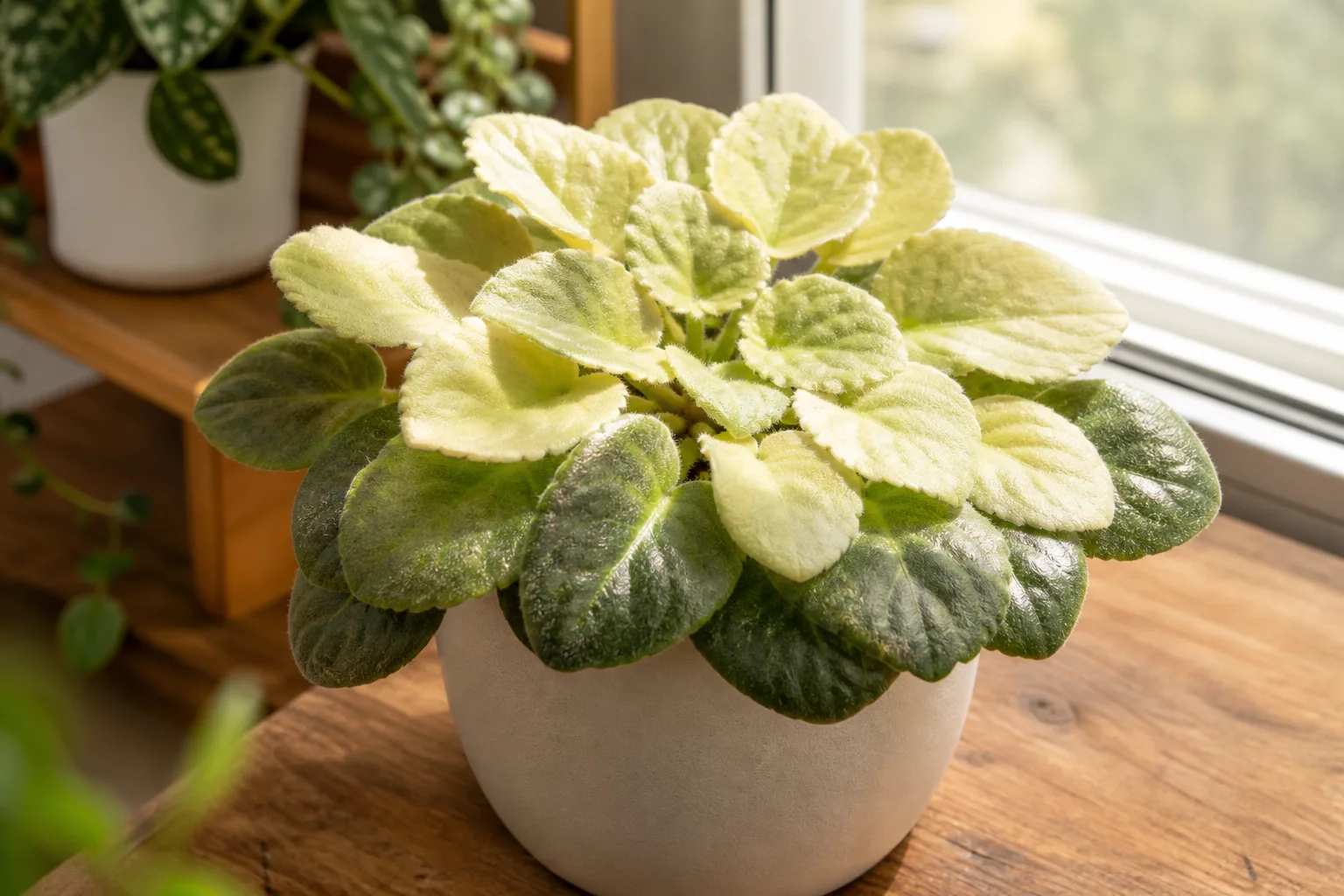
Pale Leaves on African Violet: Causes, Checks & Fixes
This guide covers pale leaves on African Violet. See also the general Pale Leaves guide, watering, and light pages for this plant.
Pale Leaves on African Violet: Causes, Checks & Fixes
Quick answer
When your Saintpaulia rosette looks washed-out or bleached-not the crisp yellow of aging lower leaves-the cause is usually where light hits the velvet foliage or how long feeding has been skipped. Upper leaves that turn pale yellow-green after a sunny window move point to excess light. Dark blue-green leaves on long, reaching petioles mean too little light, even before outer leaves fade. Older outer leaves that lose color while new center growth stays small and pale often trace to nutrient depletion in old mix.
First step: look at the rosette from above. Note whether paleness sits on sun-exposed upper leaves, stretched lower foliage, or the oldest row only. That pattern tells you whether to adjust light, start mild feeding, or read the yellow leaves guide when true yellowing-not just fade-is involved.
What pale leaves look like on African Violet
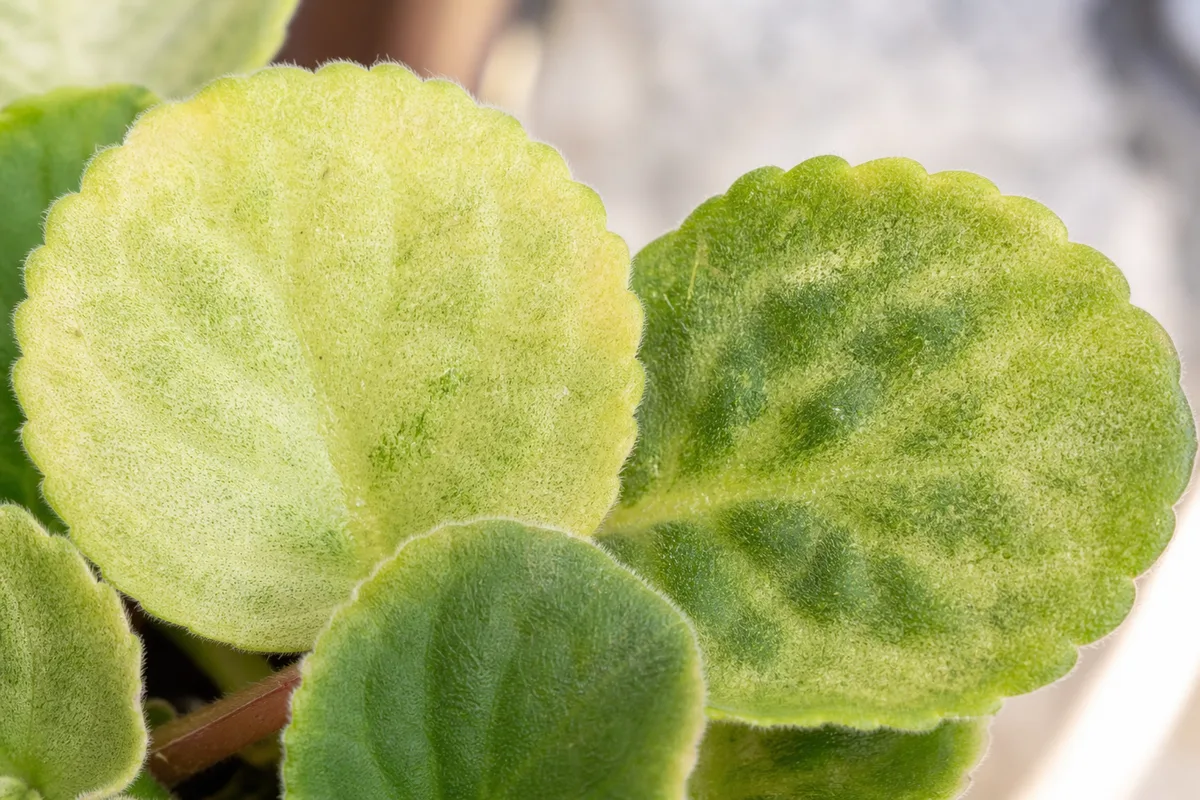
Washed-out pale yellow-green upper leaves with darker green patches where a leaf was shaded - excess light bleaching, not uniform aging yellow.
African violets grow as a flat, velvety rosette. Pale color is a loss of depth or saturation-bleached, chlorotic, or washed-out green-rather than the uniform yellow of spent lower leaves or cold-water ring spots.
Excess light bleaching - Upper and middle leaves turn pale, bleached, or greenish-yellow while the rosette stays compact. Leaves directly under another leaf may keep darker green patches where they were shaded. Growth slows; flowering drops off. Harsh south- or west-window sun can bleach tissue in days.
Low-light fade and stretch - Leaves become thin, dark blue-green, and stretched on long petioles before color washes out on older foliage. The plant still looks “green” from across the room, but the rosette opens up and blooms stall. See not enough light if this stretch is the main pattern.
Nutrient wash-out - A gradual loss of leaf color on older leaves with reduced growth and fewer blooms appears when mix is exhausted or feeding stopped for months. Center growth may stay acceptable briefly because African violets move nitrogen toward the crown-then new leaves emerge small and pale too.
Iron deficiency lookalike - The smallest crown leaves show yellow between dark green veins (interveinal chlorosis), not uniform bleaching. That pattern fits iron deficiency when pH or salts block uptake-not excess window sun.
Nitrogen deficiency lookalike - Older outer leaves fade with yellowing at the edges (“halo-ing”) while the crown may still look okay early on. Full pattern and fix live on the nitrogen deficiency page.
Spider-mite stippling - Fine speckled pale dots on leaf undersides with optional webbing mimic chlorosis but spread irregularly and worsen under dry air. Check with a magnifier; treat via the spider mites guide if confirmed.
Cultivar baseline - Some show varieties and variegated cultivars naturally run lighter green than standard rosette types. Compare against how the same plant looked last month-not an ideal photo online-before calling normal color a deficiency.
Compare pale leaves with yellow leaves, iron, and nitrogen
| What you see | Most likely cause | How to tell it apart |
|---|---|---|
| Upper leaves bleached pale yellow-green; compact rosette | Excess light | Follows sunny window or close grow lights; shaded leaf patches stay darker |
| Dark leaves on long petioles; open rosette; few blooms | Too little light | No scorch edges; whole plant reaches toward glass |
| Older outer leaves washed out; slow growth; skipped feed | Nutrient fade | Light placement unchanged; mix older than a year |
| Young crown leaves yellow between green veins | Iron deficiency | Vein pattern on smallest new leaves-not uniform bleach |
| Outer leaf edges yellow; “halo” at margins | Nitrogen deficiency | Lower rows first; see nitrogen guide for feed response test |
| Speckled stippling + webbing on undersides | Spider mites | Pattern is spotty, not whole-leaf fade; worsens in dry air |
| Bottom row yellowing slowly; firm crown | Normal aging | One leaf at a time; see yellow leaves hub |
Why African Violet gets pale leaves
African violets evolved in cloud-forest light-bright but filtered, never harsh midday sun on fuzzy leaves. Indoors, pale foliage usually means that balance broke, feeding lagged, or a lookalike stress mimics color loss.
Excess light bleaching
Velvety leaves lack the waxy cuticle many houseplants use to shrug off direct sun. Too much light produces stunted plants with small, crinkled, leathery, and yellow leaves; on pale-leaf cases the first sign is often bleached upper foliage before crinkling appears. South- and west-facing glass, reflected light from white sills, and grow lights mounted too close all bleach rosettes quickly. Summer sun is harsher than winter rays through the same window.
Low-light fade and stretch
Dim rooms force the rosette to reach for photons. Leaves darken first-thin, blue-green, elongated-then older ones lose vibrancy as the plant prioritizes stem length over pigment. Pale color here is a late stage of insufficient light, not a sudden bleach. underwatering on African Violet from slow photosynthesis and wet soil from reduced uptake can compound the look-cross-check the yellow leaves page if lower leaves yellow on soggy mix.
Nutrient wash-out
African violets in small pots with peat-based mix exhaust nutrients within a year or two of regular watering. Without mild feeding at most waterings, older leaves wash out while the crown still pushes small, pale new growth. Over-fertilizing is the opposite problem-tight rusty centers-not the fix for washed-out outer leaves. Product choice and dilution rates are covered on the fertilizer guide.
How to confirm the cause
Work through these checks before changing light, feed, and pot all at once.
- Which leaves are pale? Upper/middle only → excess light. Whole rosette dark-stretched → low light. Oldest outer row fading evenly → nutrient fade or nitrogen shortage. Crown interveinal yellow → iron issue.
- Recent moves - Did the plant shift closer to a window, receive new sheer-curtain removal, or sit under adjusted grow lights? Bleaching within days after a move strongly supports excess light.
- Light measurement by eye - Bright indirect light near a southeast or west window within about three feet suits flowering; pale upper leaves with good distance suggest intensity is still too high for hours per day. The light guide covers foot-candle targets and fixture placement.
- Feeding history - Months without fertilizer on year-old mix supports nutrient fade. If in doubt, fertilize one plant at quarter strength and wait ten days for darker new growth before treating the whole collection.
- Pest pass - Hold leaf undersides to the light. Stippling, webbing, or moving specks → mites, not light. Do not spray until pests are confirmed.
- Soil moisture - Pale leaves on wet, heavy mix with limp lower foliage suggest root stress, not simple bleaching. Pause watering and read yellow-leaves patterns before adding fertilizer to drowning roots.
Confirmed excess light: bleached upper leaves, compact growth, recent sun or close grow lights, darker patches only where leaves shaded each other.
Confirmed low light: dark stretched petioles, open rosette, poor blooming, dim placement.
Suspected nutrient fade: appropriate light, skipped feeding, gradual outer-leaf wash-out, small pale new leaves.
First fix for African Violet
If upper leaves look bleached or scorched, reduce light intensity first-do not repot, prune heavily, or fertilize dry soil on day one.
- Move the pot to north or east exposure, pull it farther from south or west glass, or raise grow lights so leaves are no longer receiving direct beam. Shift gradually over several days if the plant was in very dim light before-sudden deep shade after sun stress can shock the rosette.
- If leaves are dark and stretched with an open rosette, add bright indirect light or a grow light 4–8 inches above the foliage for 12–16 hours daily. See the light guide for seasonal adjustments.
If light placement is already correct and outer leaves have washed out over months, start fertilizing at one-quarter label strength with each watering using African violet formula-only on moist, not bone-dry mix. Wait ten days and judge new center leaf color, not old bleached tissue. Details on urea-free formulas and flush schedules sit on the fertilizer guide.
One correction at a time. Fix light before fertilizer when both might apply-feeding a sun-stressed plant masks which variable failed.
Recovery timeline
Bleached or scorched leaves do not re-green. Expect healthier color on new center leaves within two to four weeks after light correction. Bloom return may need another flowering cycle once the rosette stabilizes.
Nutrient-related paleness often shows a response on new growth within ten days to three weeks after proper diluted feeding-only after African Violet watering guide and light are already sound.
Low-light correction needs two to four weeks for tighter new leaves; old stretched petioles do not shorten.
Judge success by new crown foliage, not by old pale leaves turning dark again.
What not to do
Do not move a sun-bleached plant into deep shade overnight-shift exposure gradually so photosynthesis can recover without another shock.
Do not apply full-strength fertilizer to dry soil. Salts on dry roots burn fine African violet hairs; moisten lightly first or bottom-water, then feed at quarter strength.
Do not mist pale velvet leaves hoping to revive color-wet foliage invites leaf spots and crown rot. African violets prefer dry leaf surfaces.
Do not repot because leaves look pale unless mix is clearly exhausted, roots are failing, or you have confirmed nutrient lock from old alkaline soil. African Violet repotting guide stacks stress onto a plant that may only need light or feed adjustment.
Do not change light and fertilizer the same week-you will not know which fix worked.
How to prevent pale leaves next time
Place plants in bright indirect light-north, northwest, or northeast window exposures work well. Filter harsh afternoon sun with a sheer curtain. Excessive light levels can cause leaves to become pale or yellowish green-watch grow-light distance and daily hours against the light guide.
Feed lightly at each watering during active growth with African violet fertilizer at one-quarter label strength, following the fertilizer guide for flush intervals if you use hard tap water.
Repot into fresh mix every one to two years so pH stays near 5.5–6.5 and nutrients do not lock out. Keep pots appropriately small-violets bloom well slightly root-bound.
When color fades, read upper leaves, petiole length, and feeding history together-that trio separates bleach from hunger faster than any single pale leaf.
What to read next on African Violet color problems
- Yellow leaves - full rosette pattern guide for aging, root rot on African Violet, cold spots, and yellow-not just pale-color loss
- Iron deficiency - interveinal chlorosis on crown leaves
- Nitrogen deficiency - outer-leaf edge fade and halo-ing
- Not enough light - stretched petioles and open rosettes
- African violet light - placement, grow lights, and seasonal shifts
- African violet fertilizer - formulas, strength, and flush routines
When to use this page vs other African Violet guides
- African Violet watering guide - Use for routine moisture checks before assuming pale leaves is the main issue.
- African Violet problems hub - Browse all 52 common issues on this species.