Pebble Trays for Succulents and Cacti: Good Idea or Mistake?
Learn why succulents and cacti usually do not need pebble trays, plus safer ways to manage drainage and dry indoor air.
The Short Answer
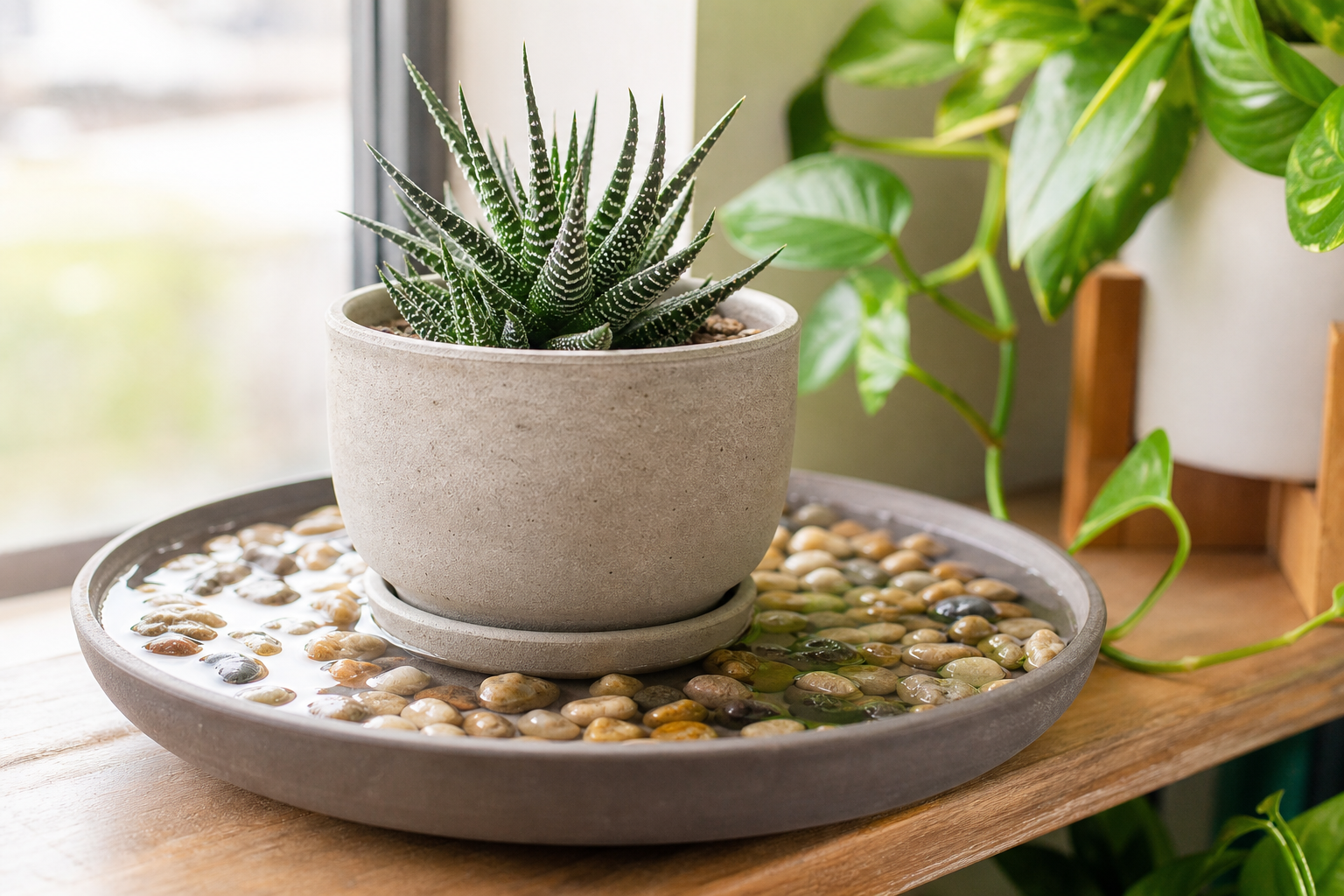
Usually, no - at least not for most desert succulents and desert cacti. A pebble tray raises humidity in the air immediately around a plant. That solves a real problem for many tropical houseplants, but most succulents and many cacti are not humidity lovers. University of Minnesota Extension notes that many cacti and succulents are well adapted to homes with low relative humidity, around 10% to 30%, and Iowa State Extension says it is rare for indoor conditions to be too dry for succulents. (University of Minnesota Extension) (Iowa State Extension)
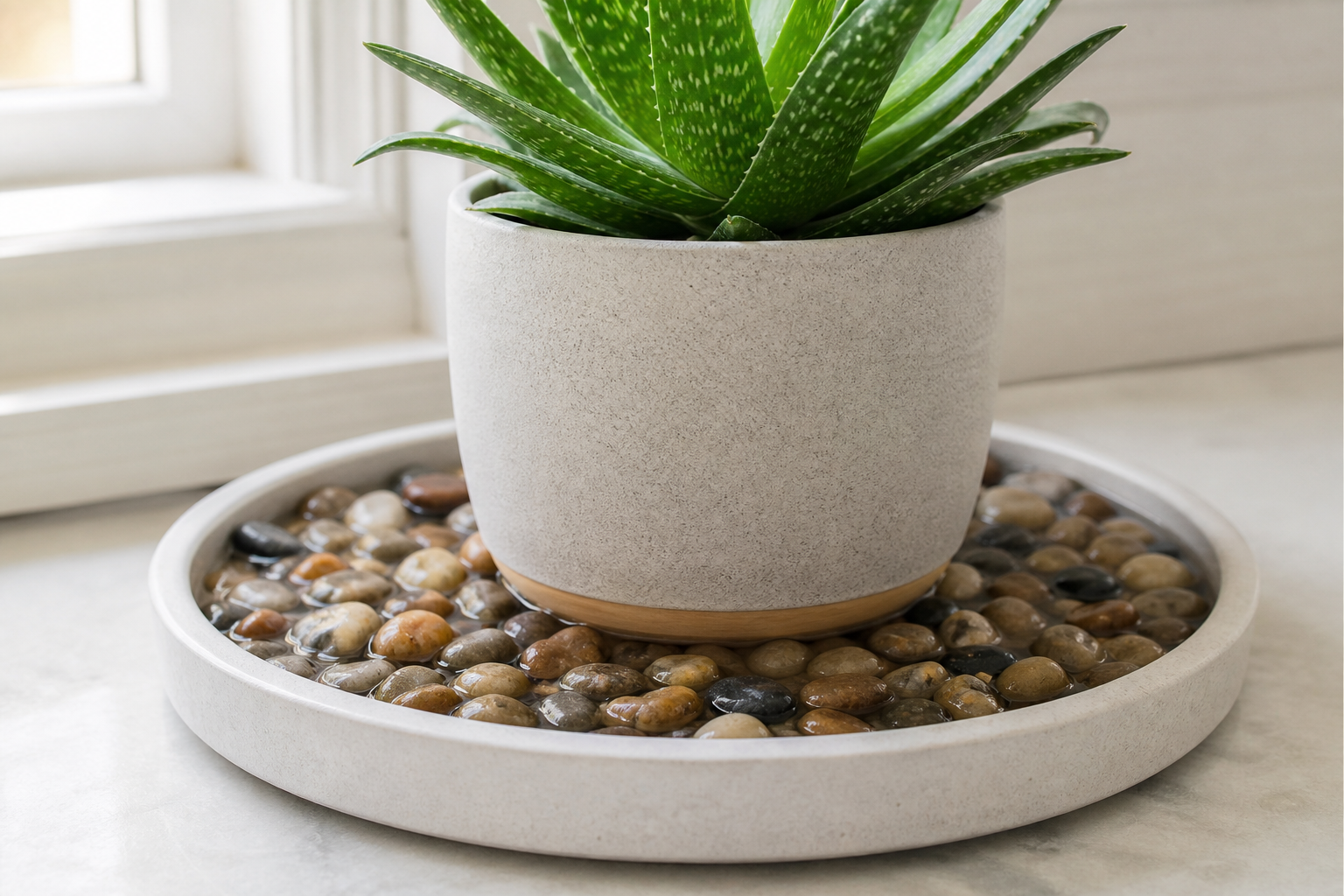
The word succulent or cactus on a label is not enough to decide. A jade plant, an Echeveria, a barrel cactus, and a Christmas cactus do not share the same humidity needs. Most desert-adapted types do better with strong light, fast drainage, careful watering, and airflow than with extra humidity. Holiday cacti and a few epiphytic exceptions may benefit from slightly more humid air when the tray is set up correctly. The species-fit table below is the fastest way to match your plant to the right call.
What a Pebble Tray Does (Brief)
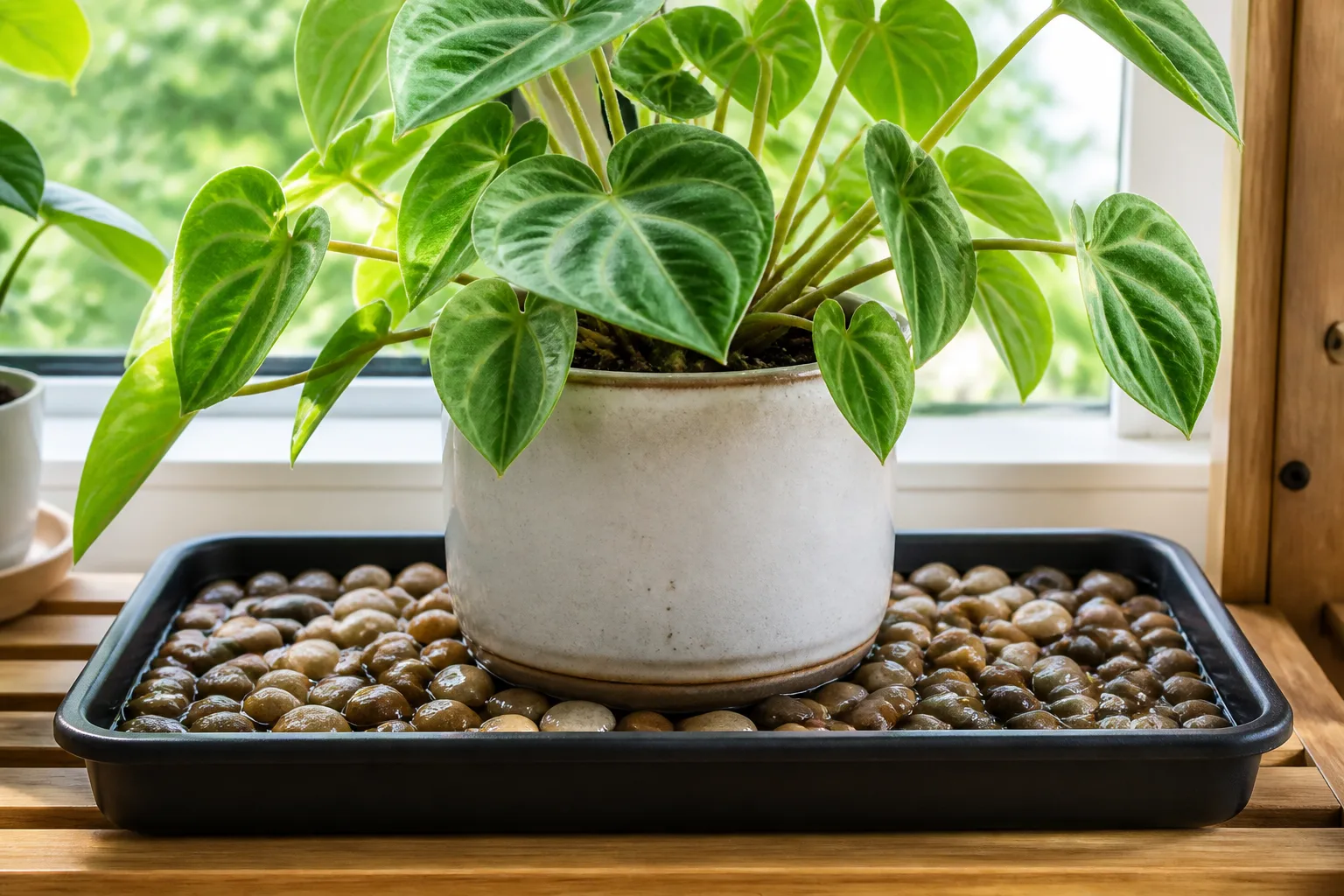
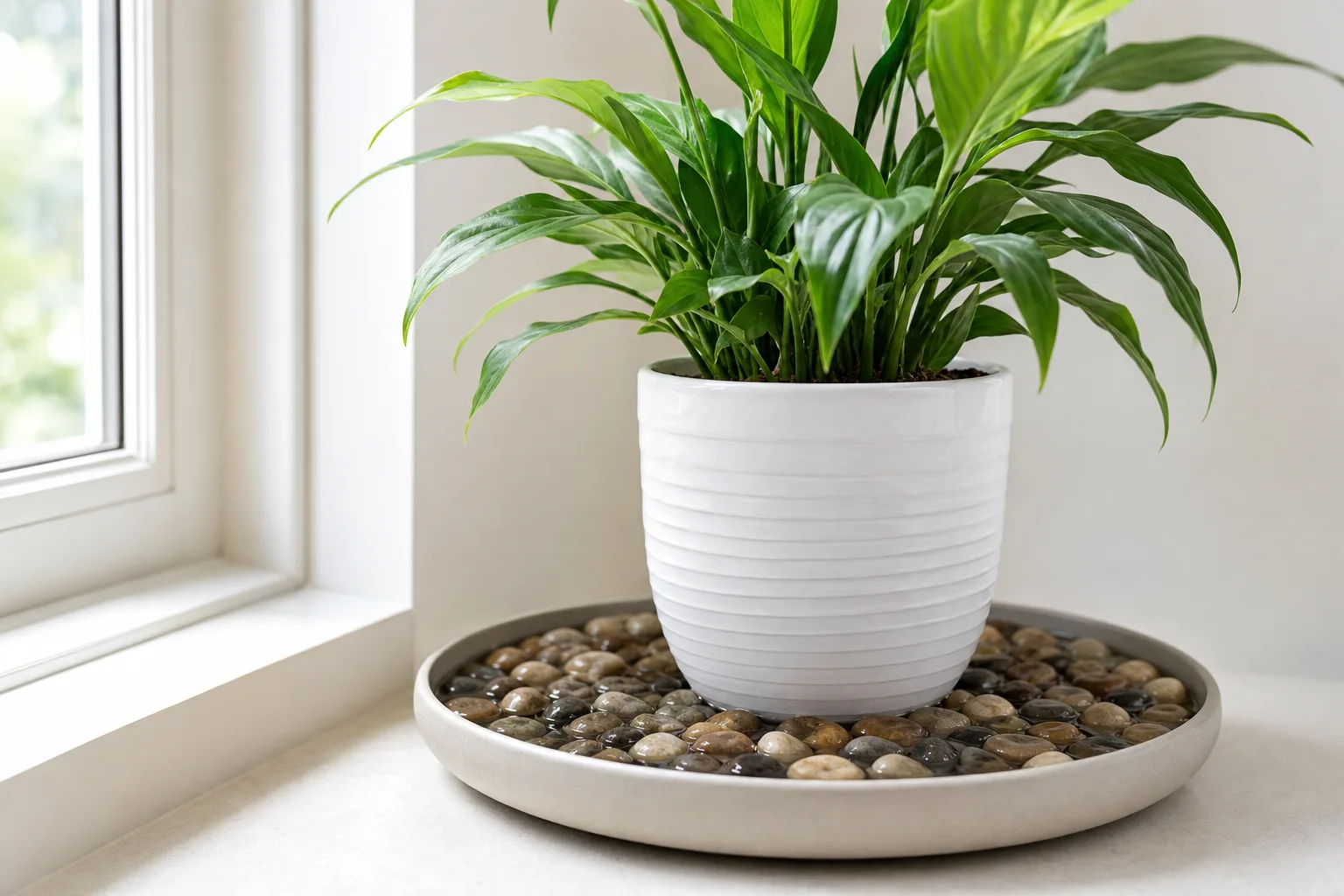
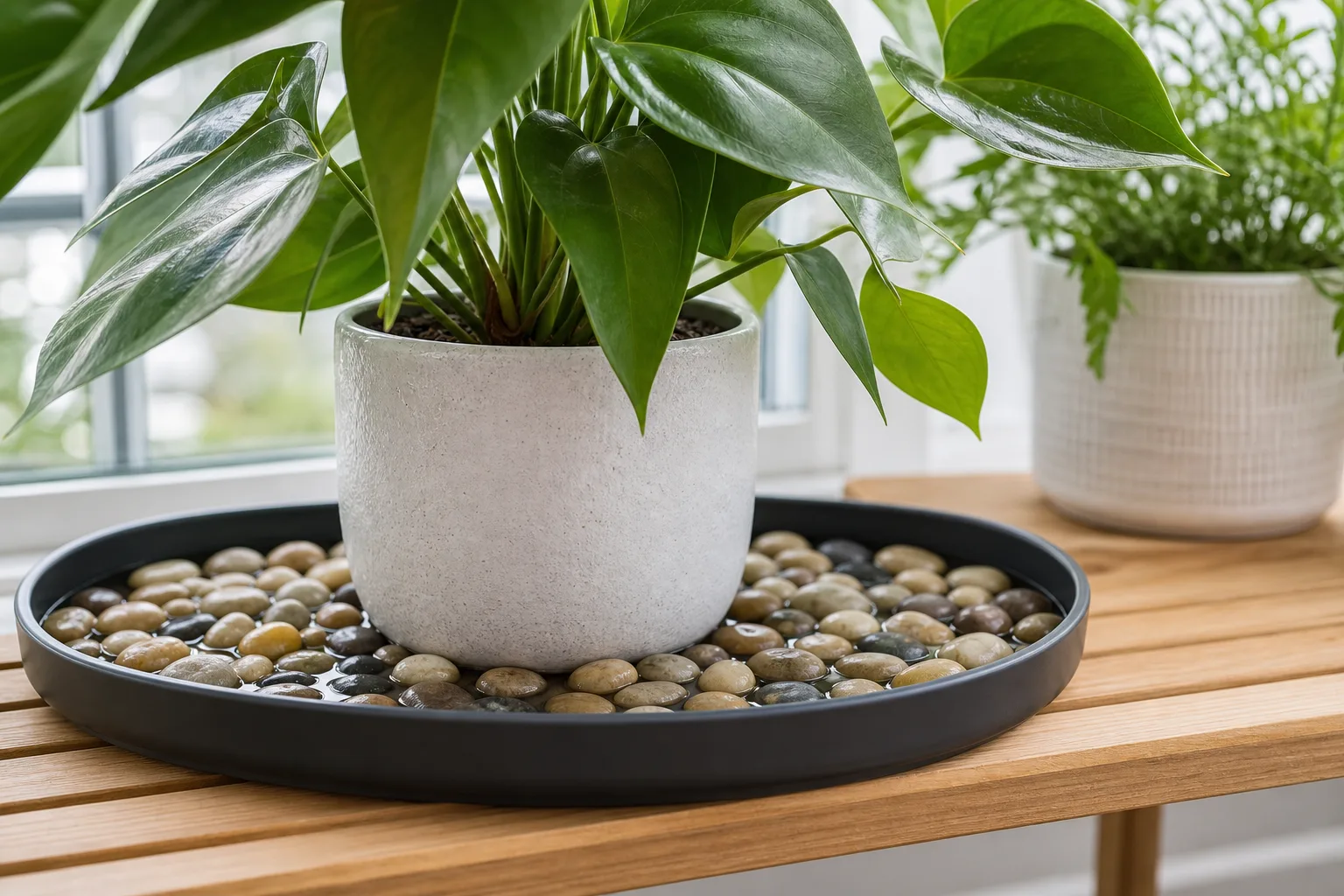
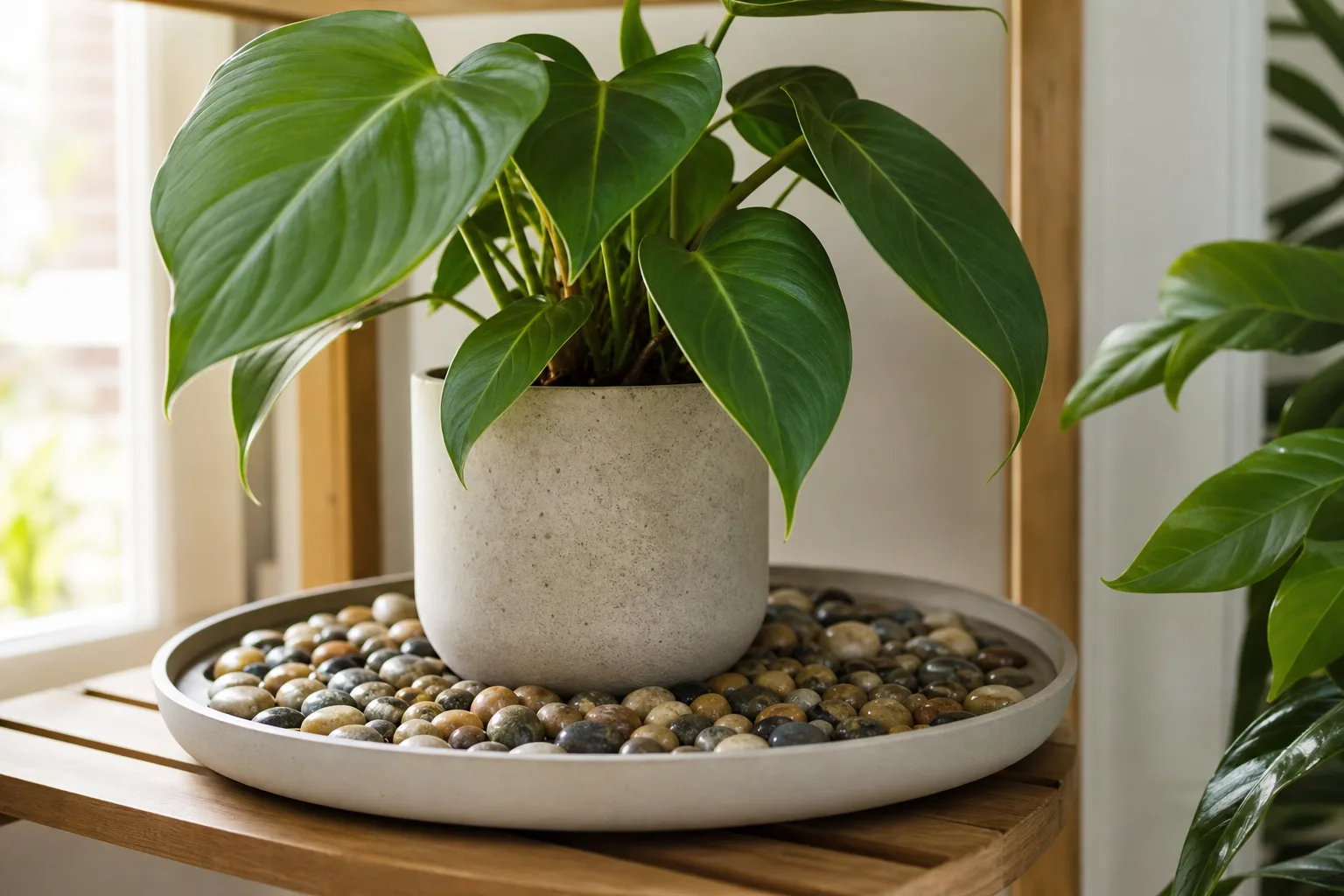
A pebble tray is a shallow dish of stones with water added below the stone tops. The pot sits on the pebbles, not in the water. Evaporation raises humidity in a small zone around the tray. It is not bottom watering and it does not replace soil, light, or watering discipline. For the full mechanism, sizing math, and refill cadence, see what is a pebble tray - this guide focuses on which succulents and cacti actually benefit.
Why Humidity Is Usually Not Your Succulent’s Problem
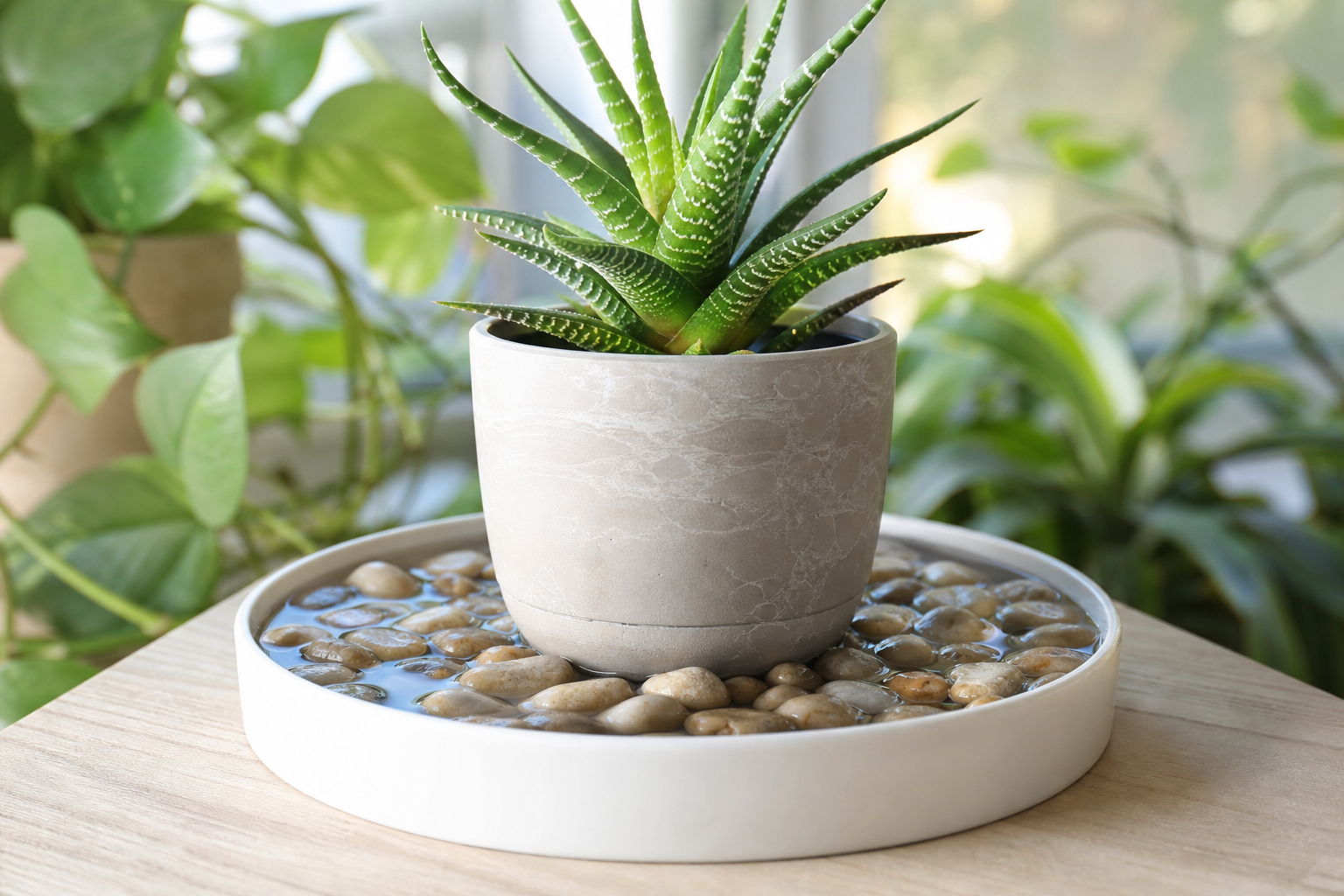
Brown tips, wrinkling, and stalled growth get blamed on “low humidity” constantly. For succulents and cacti, the cause is often watering, light, soil, roots, heat, or species mismatch instead. These plants store water in leaves or stems and tolerate drying cycles. Humidity is lower on the priority list than people assume. Chasing a humidity fix first can send you past the real problem.
Desert Succulents and Dry Indoor Air
Most common indoor succulents are comfortable in ordinary home humidity, especially in gritty mix with drainage holes. Iowa State Extension notes that low humidity helps soil dry faster, which benefits succulents. Missouri Extension horticulturist David Trinklein adds that succulents are well adapted to tolerate the low humidity typical of a home, especially in winter, and that good air circulation helps the medium dry and reduces pest pressure when humidifiers run nearby. (Iowa State Extension) (Missouri Extension)
Extremely dry air can occasionally contribute to wrinkling or dry leaf edges, and Iowa State says a humidifier or pebble tray can be considered in those rare cases - but only after you rule out underwatering, root loss, and poor light. If your Echeveria is struggling, inspect roots and watering before you build a humidity setup.
Desert Cacti Prefer Airflow Over Moist Air
The case is even stronger for desert cacti. University of Minnesota Extension describes cacti and succulents as adapted to low indoor humidity. Oklahoma State Extension is blunt about enclosed high-humidity setups: cacti and succulents are not well adapted to terrarium-level humidity; an open dish garden suits them better. (University of Minnesota Extension) (Oklahoma State Extension)
A cactus in dense soil, a decorative cachepot without drainage, or a dim corner is in trouble even with a tray underneath. Extra humidity does not fix weak light or wet roots. For string of pearls and similar trailers, Royal Horticultural Society guidance warns against misting and crowding because they dislike excess humidity and prefer airflow. (RHS)
The Holiday Cactus Exception
Holiday cacti - Christmas cactus, Thanksgiving cactus, and related Schlumbergera - are not desert cacti in the usual sense. University of Minnesota Extension says their need for high humidity, bright filtered light, and relatively moist soil sets them apart from most cacti and succulents. Washington State University Extension describes them as Brazilian cloud-forest epiphytes that prefer moderate humidity indoors; a pebble tray can help in dry winter air. Penn State Extension lists pebble trays among humidity options for holiday cacti. Missouri Botanical Garden adds that jungle cacti, including Christmas and Thanksgiving cacti, require higher humidities and should be placed on a tray of moistened rocks to promote flowering. (University of Minnesota Extension) (Washington State University Extension) (Penn State Extension) (Missouri Botanical Garden)
Even for holiday cacti, the goal is gentle humidity support, not wet roots. Drainage still matters, and the pot must never sit in standing water. See the Christmas cactus hub for watering and bloom timing that pair with any humidity tweak.
Not sure if your plant is a holiday cactus? Look for flat, segmented stems (not round spiny columns), areole-free smooth edges on each segment, and winter or early-spring blooms on the segment tips. Thanksgiving cactus (Schlumbergera truncata) has pointed segment teeth; Christmas cactus (S. bridgesii) has rounded segment margins. If that matches your plant, the tray exception may apply. If you have a barrel, columnar, or globular desert cactus, skip the tray.
Wrinkling vs Mush: Do Not Blame Humidity First
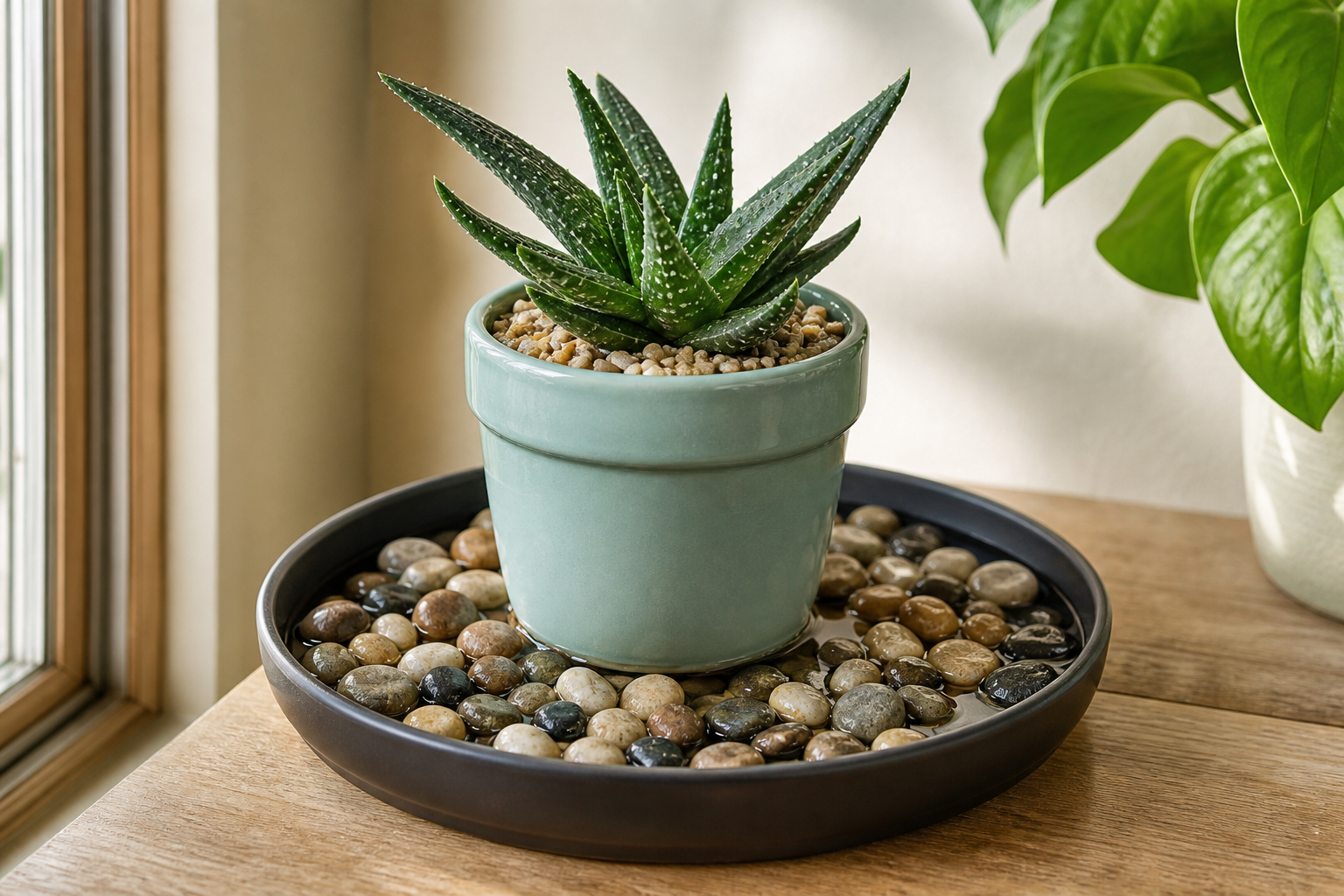
Before you add a tray, confirm what the leaves are actually telling you. Iowa State Extension distinguishes the two most common stress signals: wrinkled or drying lower leaves usually mean conditions are too dry (underwatering or root loss), while yellow leaves, soft stems, and collapse point to too wet (overwatering or poor drainage). (Iowa State Extension)
| Symptom | Likely cause | What to check first |
|---|---|---|
| Wrinkled, deflated leaves that feel firm but shriveled | Underwatering, dead roots, or poor light | Soil dryness, root health, pot weight at dryness |
| Mushy, translucent, yellowing leaves with soft stems | Overwatering, soggy mix, or root rot | Drainage holes, watering rhythm, soil structure |
| Dry brown tips only on otherwise firm leaves | Rare dry air, salt buildup, or physical damage | Water quality, light intensity, then humidity |
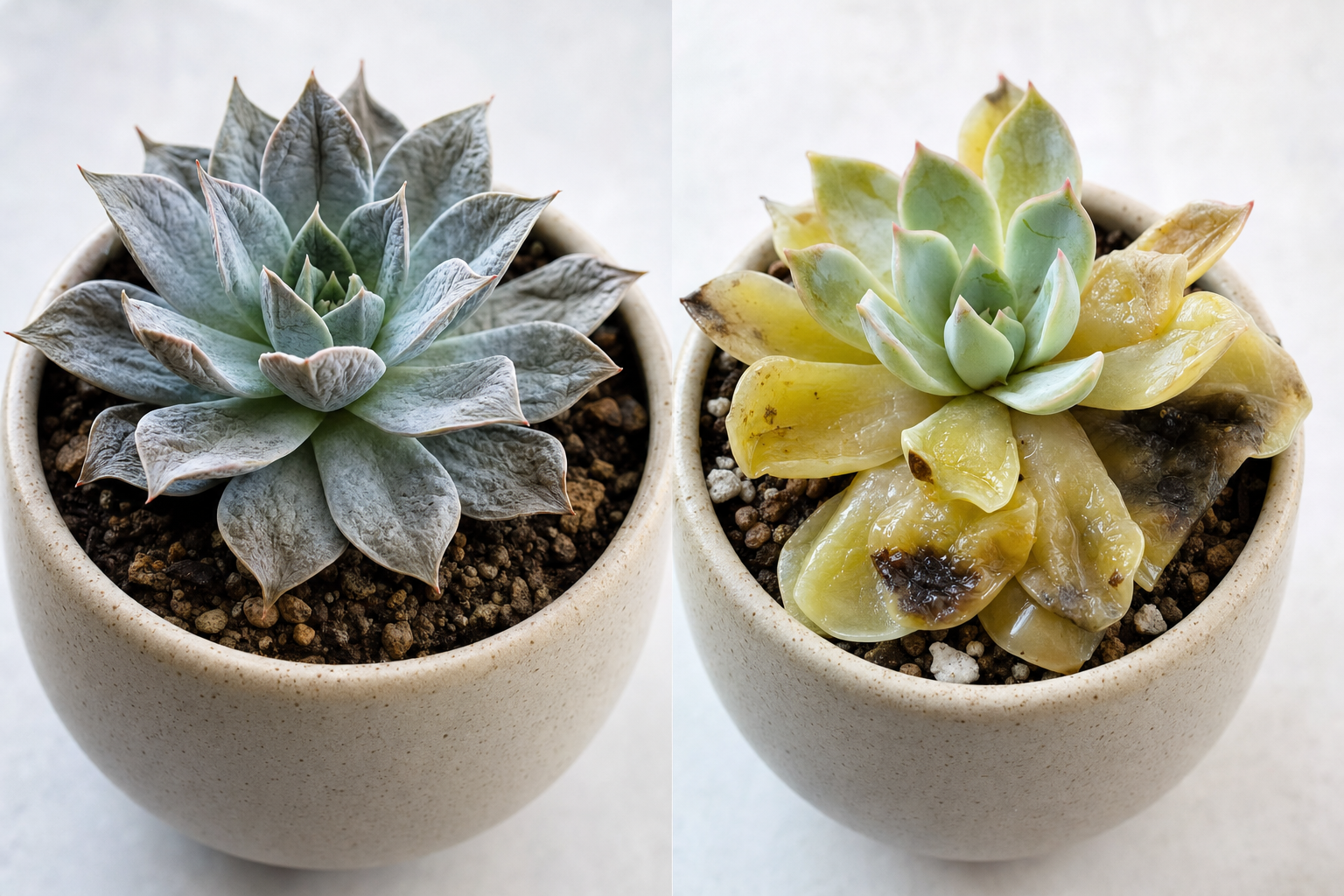
A pebble tray will not fix either pattern if the root zone is wrong. Fix watering and drainage first; add humidity only when species fit and symptoms trace to genuinely dry air.
Species Quick-Reference: Who Gets a Tray?
Use this table before you copy tropical-houseplant advice onto a fleshy plant. “Cactus” on the tag is not a care category by itself.
| Fit category | Pebble tray? | Why | Named examples |
|---|---|---|---|
| Desert succulent / desert cactus | Usually skip | Adapted to low indoor RH; faster soil dry-down is a feature, not a bug | Echeveria, jade plant, Haworthia, Aloe vera, barrel cactus, most columnar cacti |
| Holiday / epiphytic cactus | Often helpful | Cloud-forest natives; moderate humidity supports segments and buds in dry heated rooms | Christmas cactus, Thanksgiving cactus (Schlumbergera), some Rhipsalis |
| Humidity-averse trailing succulent | Avoid | Dislikes stagnant moist air; needs space and airflow more than a tray | String of pearls, string of beads (Senecio), some stacked Crassula trailers |
If your plant is not on the list, ask where it evolved: dry rocky slopes (skip the tray) or humid forest branches (tray may help). When symptoms persist, use the matching plant-care hub and problem pages before adding gadgets.
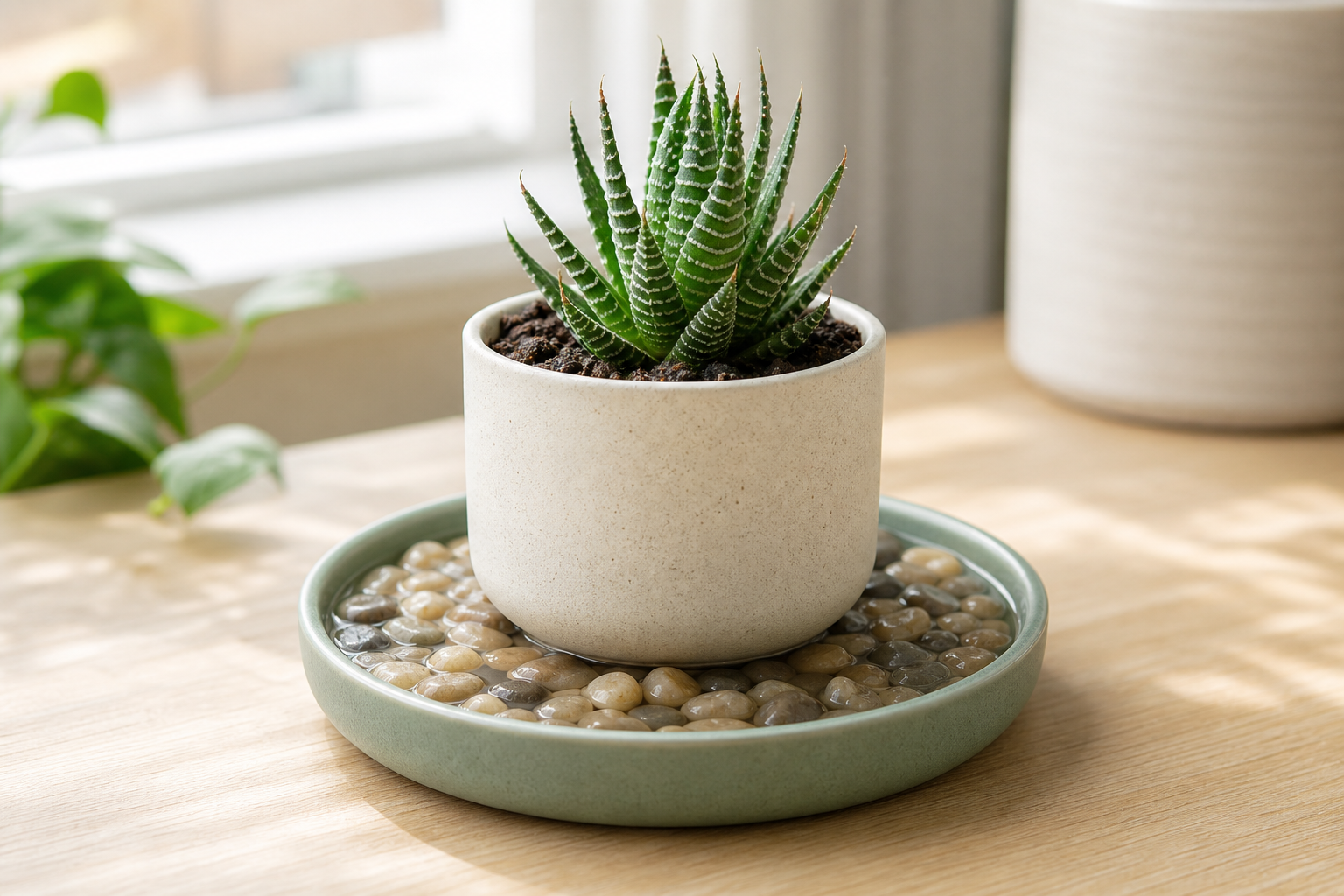
When a Pebble Tray Can Help Succulents or Cacti
A pebble tray can help in a narrow set of cases. First, holiday cacti and similar epiphytes in dry winter rooms - especially near heat vents. Second, a desert succulent in an unusually dry environment that shows stress you have traced to air dryness after checking roots, light, and watering. Third, a small local humidity bump when you do not want a whole-room humidifier for one compact plant.
Pebble trays work best with small, low-growing plants and wide trays, because indoor air circulation disperses the added moisture quickly. A compact Christmas cactus near the evaporating surface is a plausible match. A tall columnar cactus with foliage far above the tray is not. Treat the tray as a microclimate tool, not a cure for poor care.
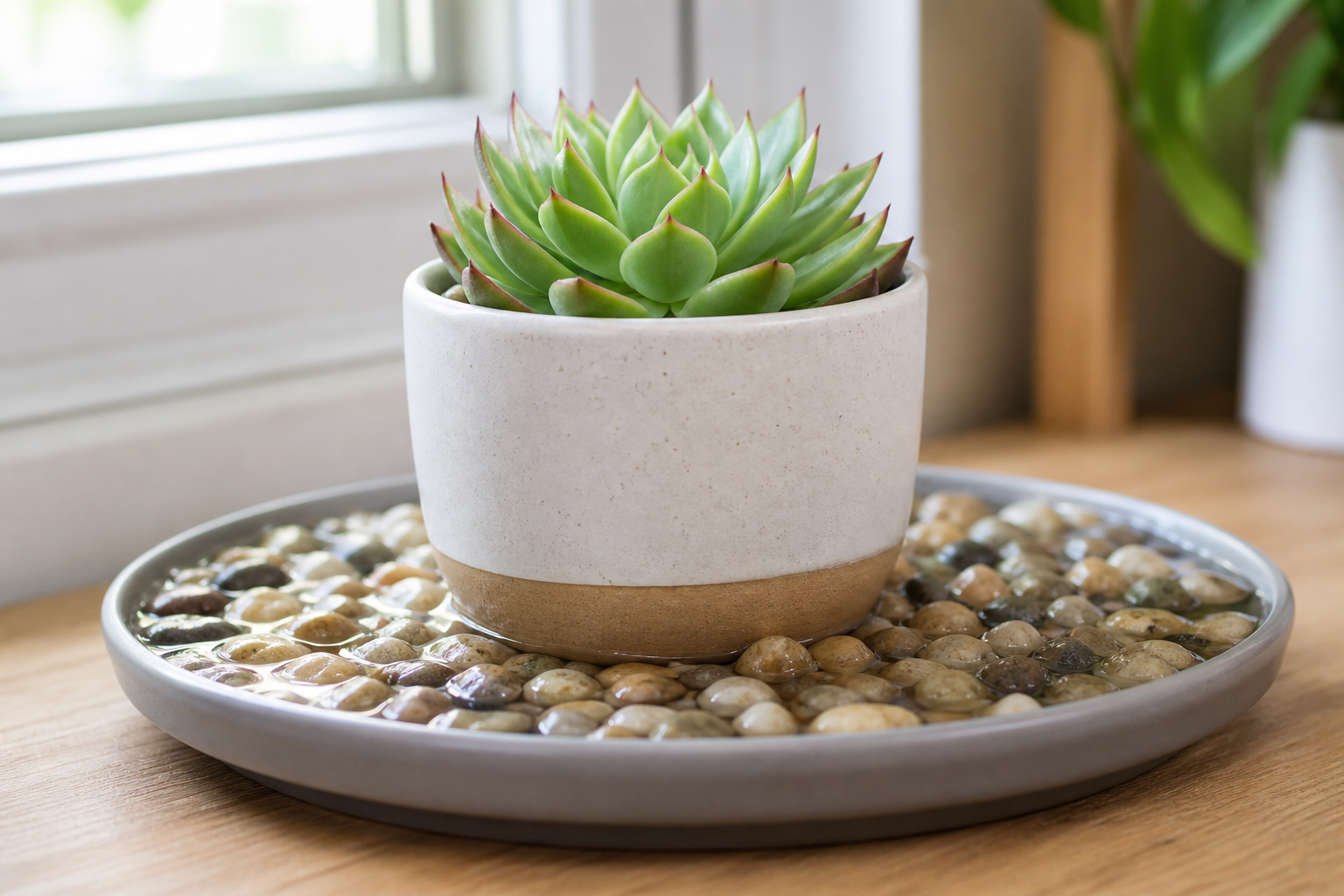
When a Pebble Tray Is a Bad Idea
Skip the tray when it substitutes for diagnosis. Stretching, pale growth, and leaning usually mean light. Mushy stems and blackening bases mean overwatering or rot. Soil that stays damp for days means drainage or watering rhythm - not a humidity deficit.
It is also a bad idea when the pot touches the water. Iowa State Extension warns that the pot must stay above the water line or the mix may never dry properly, raising root rot risk - especially serious for desert types. (Iowa State Extension)
Watch the cachepot combo: a nursery pot inside a sealed decorative outer pot plus a pebble tray can trap moisture at the root zone even when the tray is “correct.” For Aloe vera and other desert succulents that prefer dry air, a humidity tray often adds complexity without solving the real stressor.
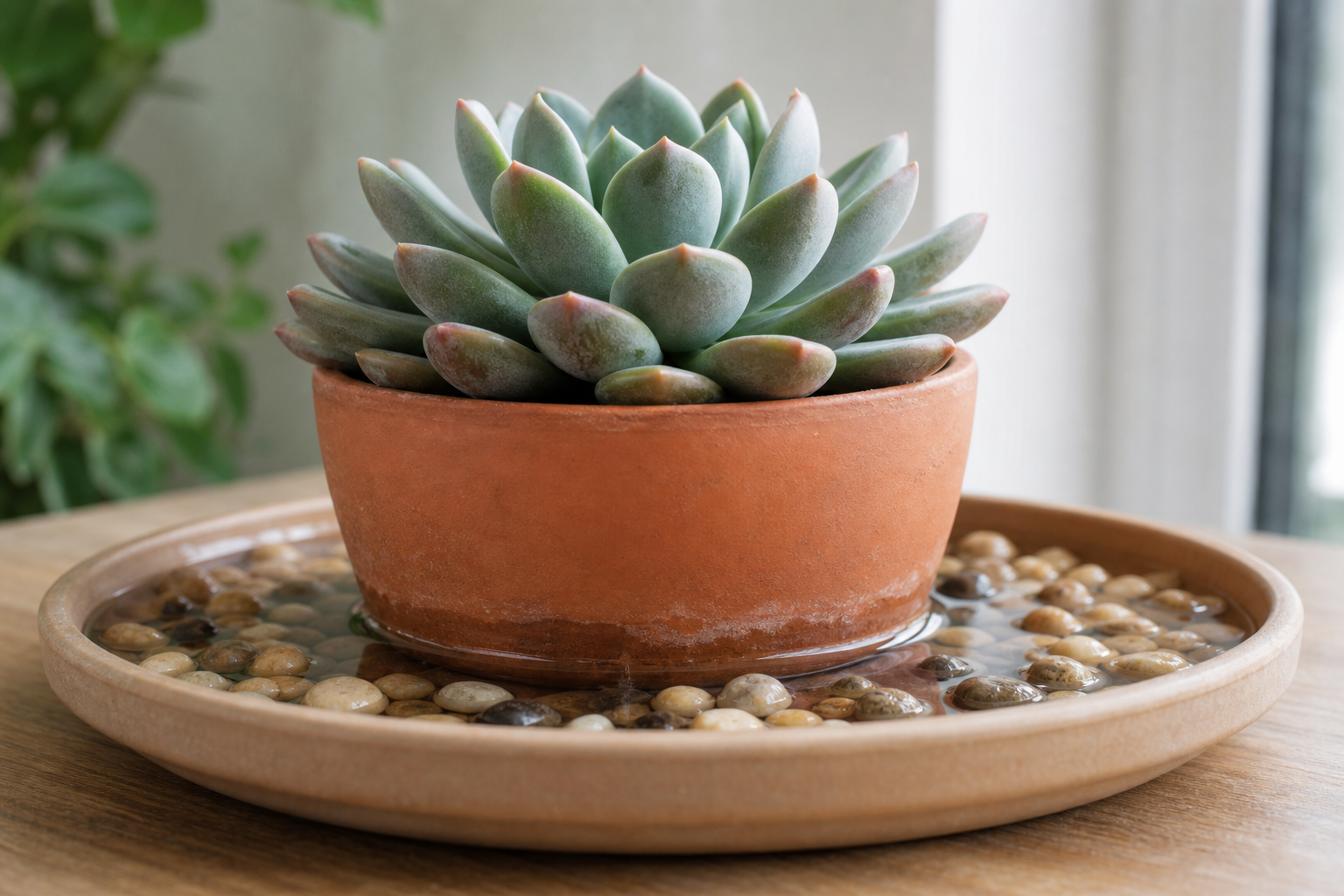
How Effective Pebble Trays Really Are
Pebble trays are mildly effective, not broadly powerful. They raise humidity in the immediate zone, then room air mixes that away. A wide tray and low foliage help; height and strong airflow reduce the effect.
LeafyPixels editorial check (winter 2026, forced-air heated room, ~21% baseline RH): With the same tray and fill level, a compact Schlumbergera at tray height read about 25% RH at lower segments - a modest local bump. An Echeveria in the same setup read near 21–22% at rosette height because the leaves sat several inches above the evaporating surface.
Summer 2026 retest (AC-cooled room, ~24% baseline RH): The same tray and plants read about 27% at Schlumbergera segments and ~23% at Echeveria rosette height. The pattern held - a small local bump for low foliage, almost nothing several inches above the tray - but absolute numbers shifted with season and HVAC. Treat these as one observed setup, not universal tray-performance data.
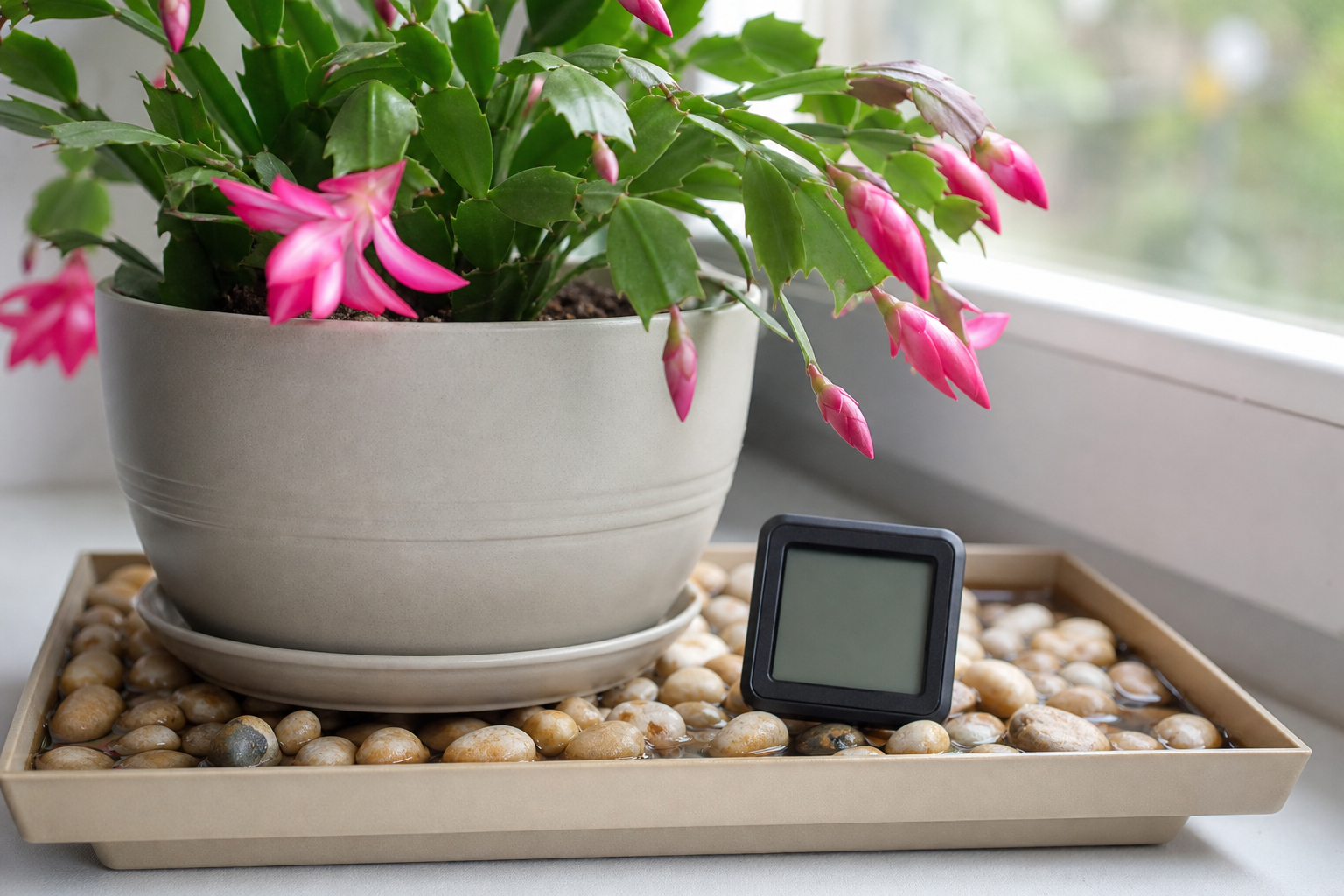
Place the hygrometer at leaf level, not on wet stones, when you judge whether a tray is doing anything useful. If you need consistent room-wide change, a humidifier usually outperforms a tray. For sizing, EPA humidity guardrails, and the full comparison framework, see pebble tray vs humidifier and do pebble trays really increase humidity.
Better Fixes That Matter More
For most succulents and cacti, the big wins come from basics - not humidity gadgets.
Light, Drainage, and Watering Checklist
Before any tray experiment, run this checklist:
- Light - Is the plant getting enough sun or bright indirect light for its species? Weak light slows drying and causes stretch. (University of Minnesota Extension)
- Drainage holes - Is water leaving the pot freely? No holes or sealed cachepots trap moisture regardless of tray use.
- Soil - Is the mix fast-draining and appropriate? Heavy peat holds water too long for most desert types.
- Water rhythm - Deep water, then enough dry time. Holiday cacti prefer more even moisture than Echeveria soak-and-dry, but neither wants soggy roots.
- Airflow and spacing - Avoid cramming humidity-averse succulents together in a stagnant corner. (RHS)
Fix the root zone and light first. Succulents do not care how elegant your humidity setup looks if their roots are suffocating.
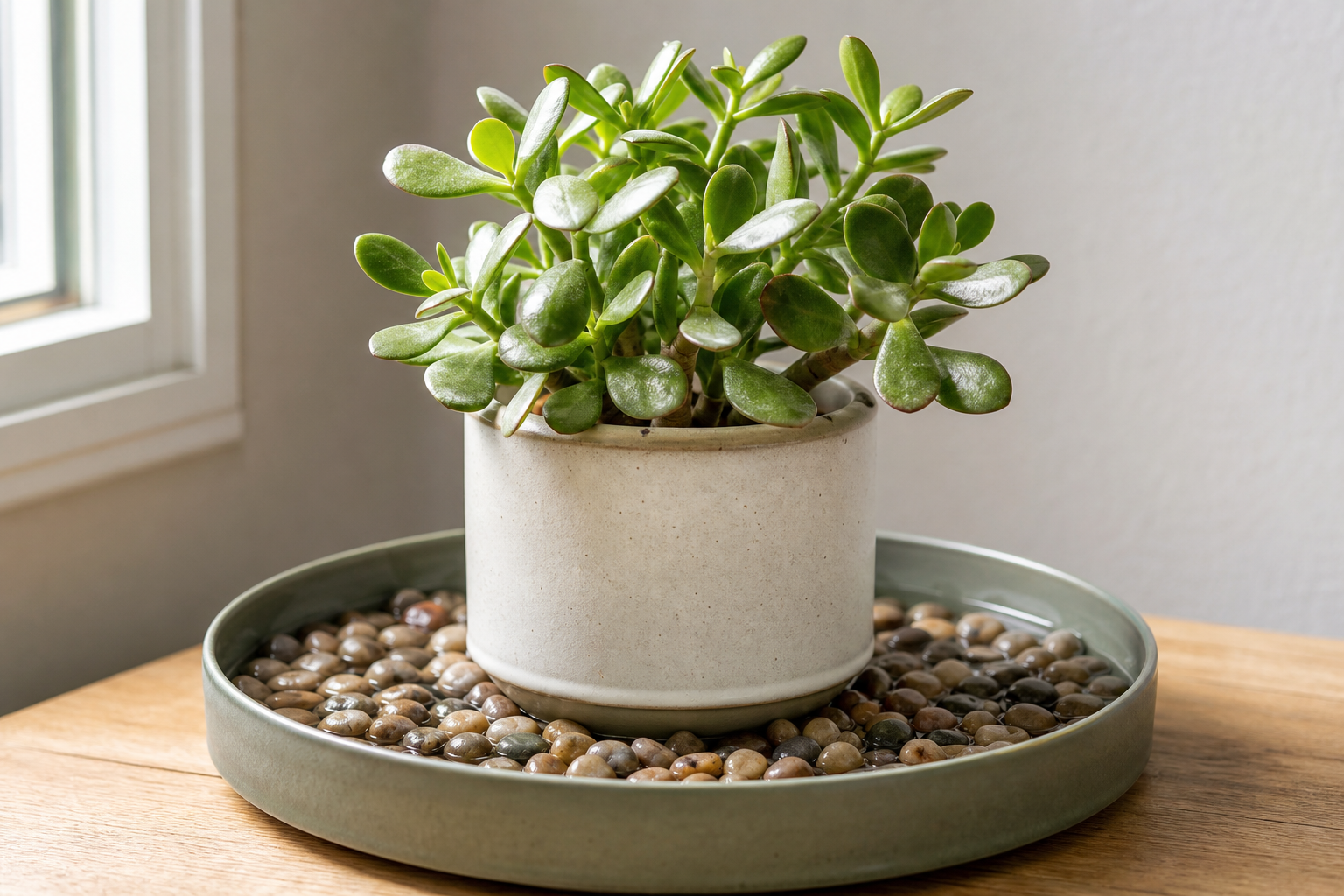
How to Set Up a Pebble Tray Safely (If You Proceed)
If species fit and symptoms justify a trial - usually a holiday cactus or a verified dry-air case - use precision, not hope.
Materials
| Item | Practical spec | Why it matters |
|---|---|---|
| Tray | Watertight, rigid, 1–2 inches deep, 2–3 inches wider than the pot | Exposes enough surface for evaporation |
| Pebbles | Washed, stable, 0.5–1 inch | Keeps pot base above water |
| Water | Below pebble tops | Prevents wicking into drainage holes |
| Hygrometer (optional) | At foliage height, not on wet stones | Shows whether the plant actually sees a change |
Step-by-Step Setup
- Wash tray and stones to remove dust and residue.
- Spread an even pebble layer and test pot stability before adding water.
- Add water below the pebble tops so the final line stays below the pot base. (Iowa State Extension)
- Set the pot on the stones - confirm no drainage hole contacts standing water.
- Place a hygrometer near lower foliage if you want data; record a baseline before judging success.
- Monitor for two weeks - watch new growth, soil dry-down, and whether the tray area stays too damp. Stop if roots stay wet or pests increase.
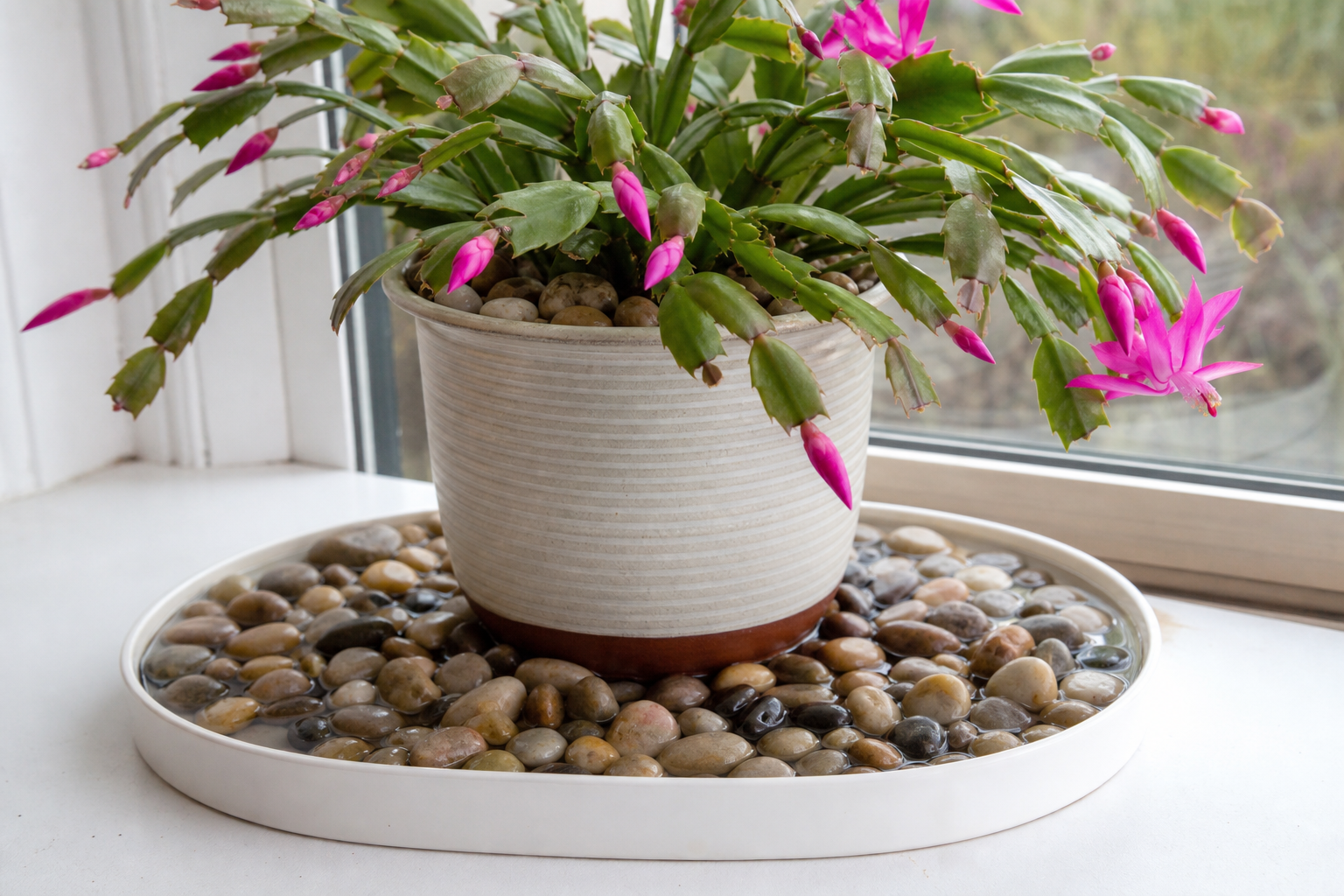
Refill when evaporation exposes the tray floor; empty and rinse if algae, film, or stale smell appear. Full build photos and refill math live in how to set up a pebble tray and DIY pebble tray.
Common Mistakes
Using a tray for the wrong species is the most common error. A Christmas cactus is not a barrel cactus, and a string of pearls is not asking for more humidity.
Letting the pot sit in water turns a humidity tray into an accidental bottom-watering disaster. Correct stone height immediately if the base touches the reservoir.
Adding humidity to fix wrinkling without checking roots fails often. Wrinkling can mean underwatering, dead roots from past overwatering, or poor soil - not dry air alone.
Pebble Tray vs Humidifier vs No Humidity Boost
| Plant type | Best starting choice | Notes |
|---|---|---|
| Desert succulent / desert cactus | No humidity boost | Focus on light, drainage, watering; home RH is usually adequate (University of Minnesota Extension) |
| Holiday / epiphytic cactus | Pebble tray or humidifier | Tray for modest local help; humidifier if room air stays very dry (Penn State Extension) |
| Rare dry-air stressed succulent | Measure first, then tray trial | Confirm with hygrometer at leaf level; fix watering and light in parallel (Iowa State Extension) |
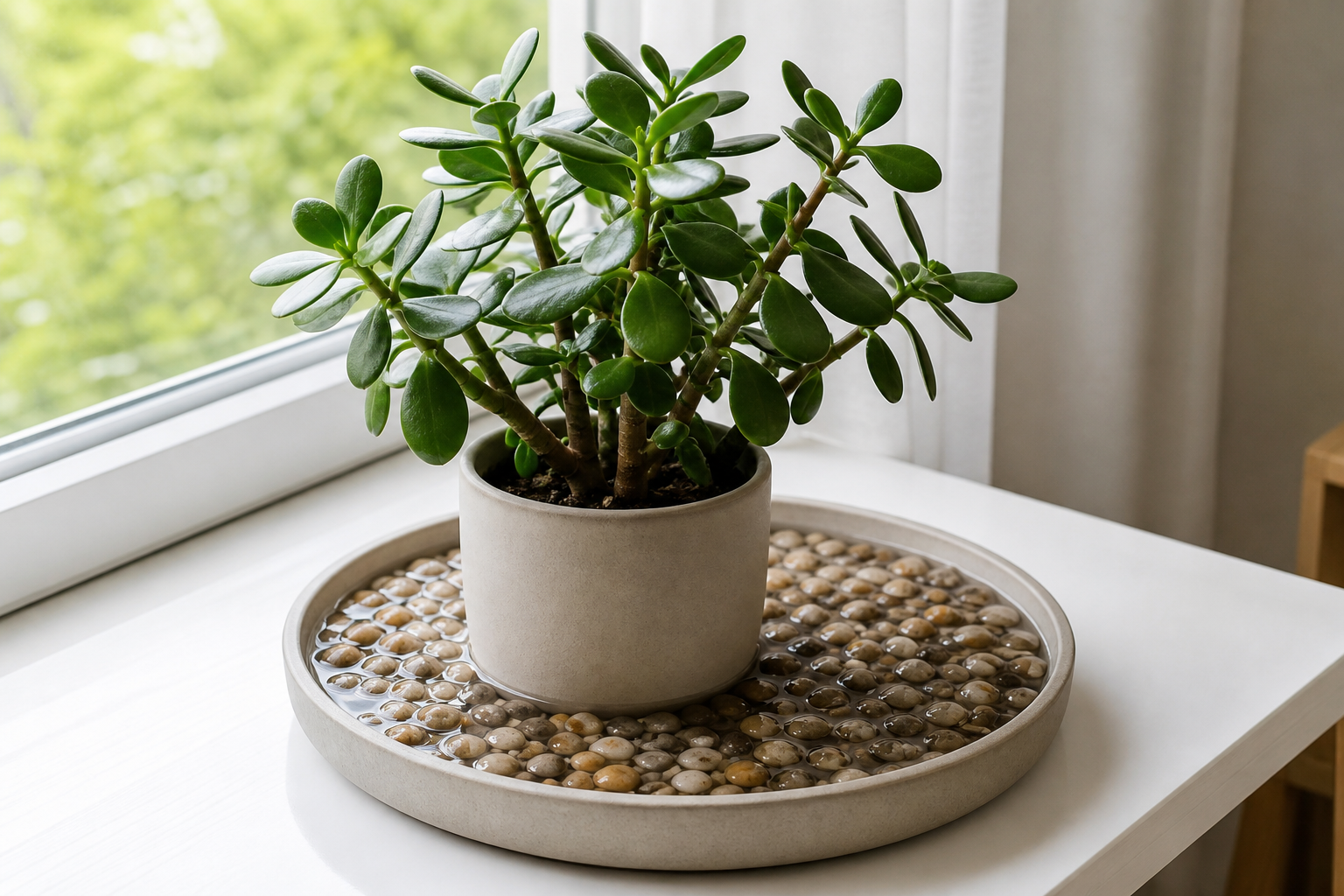
Think of a pebble tray as a small tool for a small job. Desert types rarely need it. Humidity-friendly exceptions may get a modest assist - not a substitute for species-correct care.
Conclusion
You can use a pebble tray for succulents and cacti - but for most desert types you usually should not. Match the tool to the species: skip trays for Echeveria, jade, aloe, and desert cacti; consider one for Christmas cactus in dry rooms; avoid trays for humidity-averse trailers like string of pearls. Fix light, drainage, and watering before you chase humidity - and keep the pot above the water line if you proceed.
Related Guides
This page is the species-fit advisory for fleshy plants. Use sibling guides for build details and general humidity math.
- What is a pebble tray - mechanism, sizing, and when the method fits tropical houseplants.
- How to set up a pebble tray - photo-led setup, refill cadence, and maintenance.
- Indoor humidity and pebble trays - measured RH examples and diagnostic logic for humidity problems.
- Pebble tray vs humidifier - when to upgrade from a tray to a humidifier.
- DIY pebble tray - materials hub for beginners building their first tray.
- Do pebble trays really increase humidity? - measured effectiveness for houseplants generally.