Overwatering on Tillandsia: Causes, Checks & Fixes
Quick answer
Tillandsia overwatering is chronic wetness at the leaf base-usually trapped soak water that never dried upside down, not too much water volume alone. First step: stop all soaking and misting, shake the plant dry upside down in bright airflow, and confirm the base feels firm before the next soak.
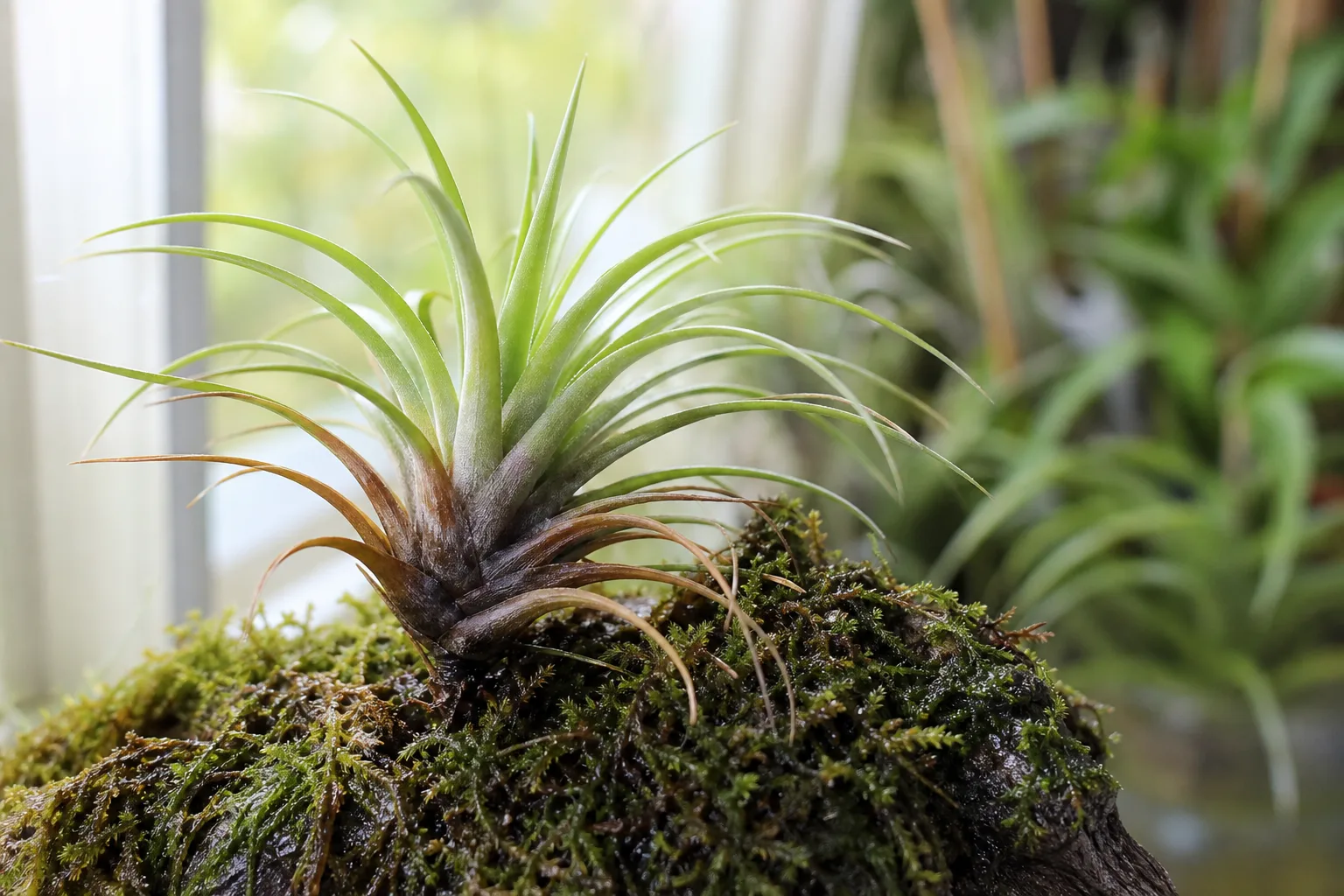
Overwatering on Tillandsia: Causes, Checks & Fixes
This guide covers overwatering on Tillandsia. See also the general Overwatering guide, watering, and light pages for this plant.
Overwatering on Tillandsia: Causes, Checks & Fixes
Quick answer
Overwatering on Tillandsia (Tillandsia spp.) is almost never about “too much soak water in one bath.” It is a duration-in-wetness problem at the overlapping leaf bases-the crown-where rosette shape funnels moisture inward. A normal 20-to-30-minute soak is fine when followed by upside-down drying within about four hours. Overwatering starts when water pools in the crown because the plant dried upright, sat in a closed globe while damp, was soaked on calendar autopilot before the last cycle dried, or was misted into stagnant air.
First step: stop all soaking and misting, shake trapped water out, and dry the plant upside down in bright airflow. Do not mount upright or return a damp tillandsia to its display-that repeats the failure mode. Only after the base feels firm and dry should you adjust soak frequency or trim soft tissue.
How this page differs from sibling guides: Crown rot on Tillandsia is the active rescue guide when the base is already soft, smelly, or pulling apart. This page covers overwatering habits and early wet-base stress-soak rhythm, drying failures, enclosed-display traps, and prevention before meristem collapse. Baseline soak technique lives in the Tillandsia watering guide.
Judge progress by firm new center growth, not by outer leaves returning to perfect posture. Advanced inner rot-center leaves pulling out with no resistance-usually means the overwatering window has closed; route to crown rot for trim and pup salvage.
What overwatering looks like on Tillandsia
Overwatering on air plants is a pattern at the base, not yellow tips alone. Tillandsia has no soil root zone-inspect crown firmness, smell, and recent wet-dry timing instead of anchor roots.
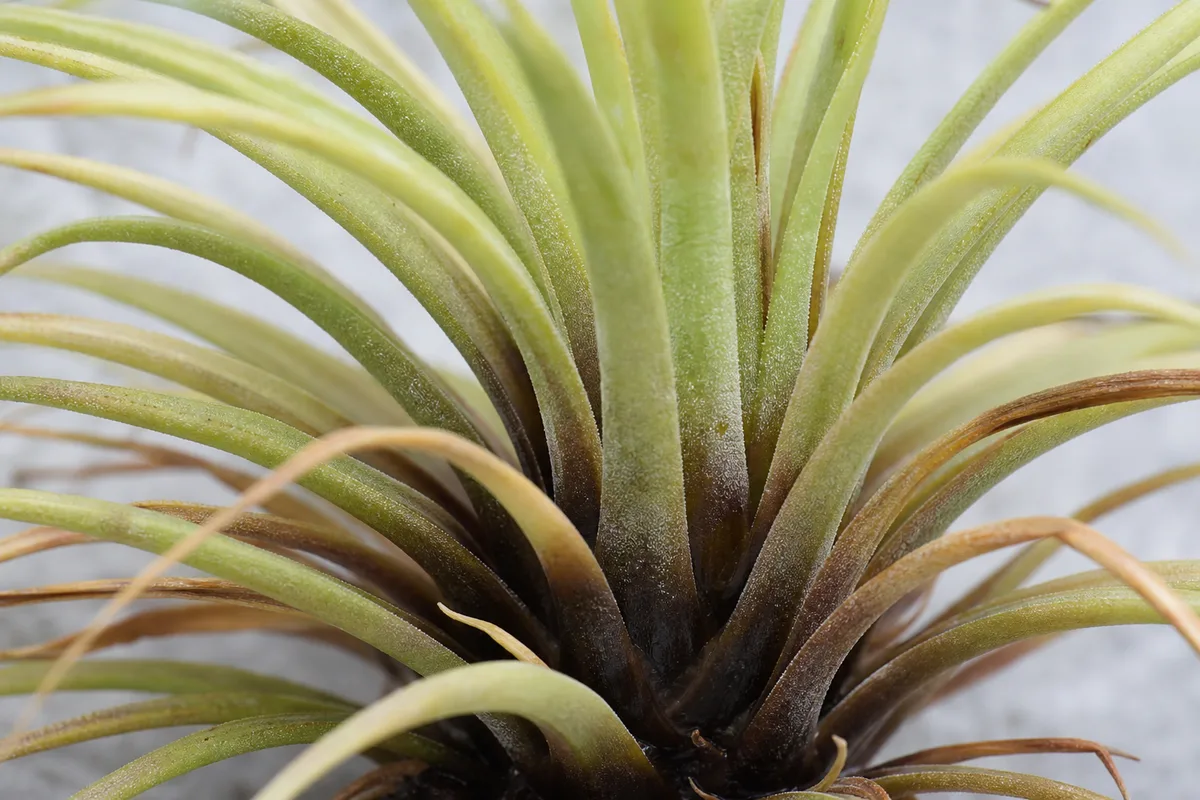
Overwatering symptoms on Tillandsia - compare with healthy tissue on the same plant.
Early overwatering (correctable if you stop water and dry aggressively):
- Base stays cool or damp to the touch many hours after a soak-past the four-hour dry target
- Slight softness on the lowest overlapping leaves only, without sour smell
- Center feels heavy or limp for a day after soaking while outer leaves still look green
- Translucent yellow-green inner leaves on mesic types like Tillandsia ionantha before tissue turns black
- Plant returned upright to a shell, globe, or moss mount while still wet
Established overwatering (overlap with crown rot-see root-rot guide):
- Soft dark base-purple, brown, or black tissue creeping up from the lowest leaves
- Sour or musty smell when you lift the plant to your nose
- Inner leaves pull out easily while outer blades stay green-the signature “fine above, dying below” tillandsia failure
- Closed terrarium or glass globe plants collapsing 1–3 days after soak without inverted drying
- Mist-only routines in humid rooms that keep leaf axils damp without ever fully charging trichomes
Display-specific clues:
- Tillandsia xerographica in an enclosed globe: wide outer leaves look healthy while the core softens-xeric trichomes mask stress longer than ionantha clusters
- Wire-mounted clusters where water cannot be shaken from inner overlaps
- Decorative moss or gravel wicking moisture upward into the crown-substrate watering kills air plants even when the soak itself was correct
Healthy tillandsia bases are firm, pale green or silvery, and dry between soaks. Overwatering is persistent dampness, softness, or odor at those overlapping leaf bases-not wiry brown anchor roots, which are normal and not the intake system.
Why Tillandsia gets overwatered
Tillandsia is an epiphytic bromeliad that drinks through trichomes on leaves, not roots in mix. Overwatering is therefore a crown moisture management failure, not classical “wet soil around roots.”
Rosette funnel + upright drying
Leaves overlap in a cup that funnels water to the center. In nature, wind and sun clear that pocket within hours. Indoors, drying upright or placing a wet plant in a tight holder lets droplets sit against tissue that epiphytes expect to breathe. University of Minnesota Extension notes that tillandsia crowns rot when water is not well drained after watering-overwatering is the habit stage before that rot becomes irreversible mush.
Calendar soaking without dry checks
Soaking every Wednesday regardless of whether last week’s base fully dried keeps the crown perpetually damp. Two soaks in three days because “that is the schedule” is overwatering even when each bath is only 20 minutes. Mesic Tillandsia ionantha in dry winter air may need twice-weekly soaks; xeric Tillandsia xerographica may go every 10–14 days-but every interval shares the same upside-down dry step, not the same calendar.
Mist-only and enclosed-display saturation
UF/IFAS air plant guidance treats soaking as the primary hydration method. Mist-only care in dry apartments often undercharges trichomes while still wetting leaf axils-chronic damp without full recharge. Misting into closed globes is worse: droplets run into the crown and never evaporate. That is overwatering without ever submerging the plant.
Substrate and moss traps
Burying or wedging tillandsia in damp moss, sand, or gravel “so it looks planted” wicks water into the base and blocks airflow. The plant reads as overwatered even when you only soaked the leaves correctly.
Species mismatch
Applying xeric timing (long dry windows) to mesic green forest species invites chronic underwatering-but applying mesic frequency to slow-drying xeric rosettes in low airflow invites overwatering. Silvery types dry slower when trichomes hold surface moisture; green types fail faster when the crown stays wet.
Lookalike symptoms to rule out
| Clue | Overwatering / wet crown | Underwatering | Post-soak normal heaviness | Crown rot (advanced) |
|---|---|---|---|---|
| Base texture | Damp hours later; softening | Firm and dry | Firm; dries within 4 hrs | Mushy, smelly |
| Leaf posture | Limp flop at center | Tight inward curl | Slight open droop, then firms | Center collapse |
| Smell | Musty if chronic wet | None | None | Sour, strong |
| Inner leaves | May tug slightly if wet long | Stay attached | Stay attached | Pull out freely |
| Timing | After soak/mist/display error | After dry spell | Right after soak, <4 hrs | 1–3 days post-wet care |
| First action | Stop water; dry upside down | Rescue soak + dry | Finish upside-down dry | Trim; pup salvage |
Underwatering shows inward curl and papery trichomes on a firm base-see underwatering on Tillandsia. Temporary post-soak heaviness resolves when you shake, flip, and dry-not when you soak again. Wilting can be dry or wet; squeeze the base before routing in the wilting guide.
How to confirm overwatering
Work through one variable at a time:
- Dry-down timing. When did you last soak or heavy-mist? Is the base still cool or damp more than four hours later? Chronic damp confirms overwatering rhythm, not thirst.
- Base squeeze test. Pinch the lowest overlapping leaves. Soft or spongy means wet stress-stop soaking. Firm and dry points away from overwatering.
- Smell check. Musty or sour odor at the crown is wet-tissue breakdown-treat as overwatering escalating toward rot.
- Display audit. Was the plant returned to a globe, shell, vertical mount, or moss bed before the base dried? Enclosed wet displays are a top tillandsia overwatering trigger.
- Soak frequency vs. environment. Count soaks in the last 7 days against room humidity and species. Mesic types in dry heated air may need two soaks; two soaks in three days in a humid bathroom with poor dry-down is often excessive.
- Inner vs. outer leaf contrast. Green outer leaves + limp center after recent wet care is tillandsia overwatering until proven otherwise-not underwatering.
If firm base + inward curl + no smell, suspect underwatering instead-do not stop water. If soft base + smell + recent trapped water, treat as overwatering now and read crown rot if tissue is already mush.
First fix for Tillandsia
Stop all soaking and misting immediately. Hold the plant at the base, turn it upside down, and shake until droplets fly from between the leaves. Rest it inverted on a towel or hang it from a dish drainer in bright indirect light with good airflow. Aim for a fully dry base within about four hours before you remount, trim, or soak again.
This is the opposite of mounting upright after soaking. Upright drying pools water in the crown-one of the most common causes of the overwatering this page addresses, not the fix for it.
Once dry:
- If base is firm - resume the soak-shake-flip-dry cycle at a corrected interval; remove the plant from enclosed displays for every soak and dry pass.
- If one or two outer lower leaves are slightly soft but center is firm - trim only mushy outer tissue with clean scissors after the base is dry; do not peel papery brown sheaths that are dry and crisp.
- If center is soft or smelly - route to crown rot rescue; overwatering correction alone is no longer enough.
- Make one change at a time - fix drying posture before changing soak length, frequency, or display.
Do not fertilize, do not “rescue-soak” a soft base, and do not stack trim + remount + new display on the same afternoon.
Recovery timeline
Early overwatering caught while the base is still firm or only slightly damp often stabilizes within one to two soak cycles (one to two weeks for weekly soakers) once upside-down drying is strict. Watch for firm new leaves emerging from the center-that is the recovery marker.
Outer limpness without smell may persist 24–48 hours after the first corrected dry-down; that is not automatic proof you need another soak. Reassess base firmness before adding water.
Chronic enclosed-display overwatering can take two to three weeks to show clean new growth even after you fix drying-old outer blades may stay cosmetically imperfect.
Once inner tissue is mushy with pull-out and odor, the overwatering phase has passed into crown rot-mother plants often fail in days. Check firm pups at the base early; salvage offsets per the root-rot guide.
What not to do
- Do not mount upright or return to a globe until the base is bone dry.
- Do not rescue-soak a soft, smelly, or collapsing center-water drives failure deeper.
- Do not water soil, moss, or gravel around the plant; tillandsia does not drink through substrate.
- Do not interpret limp outer leaves as thirst when the base is soft-see wilting routing.
- Do not soak on calendar autopilot without confirming the previous cycle fully dried.
- Do not mist into closed terrariums as a substitute for proper soak-and-dry.
- Do not fertilize a wet-stressed tillandsia before drying discipline is restored.
How to prevent overwatering next time
Prevention is drying discipline and display hygiene, not shorter soaks alone:
- Run soak → shake → flip → dry → display every time: 20–30 minute submersion, vigorous shake, upside-down drying within four hours, remount only when the base is dry.
- Remove plants from globes, shells, and tight wire for every soak and dry cycle.
- Never mist into closed containers where droplets run into the crown.
- Keep the base above wet moss in decorative planters-hydrate leaves only.
- Match soak frequency to dry-down speed, not a decorative calendar. Inspect bases during weekly care.
- Use bright filtered light and airflow so post-soak moisture evaporates predictably-see Tillandsia light.
Mesic Tillandsia ionantha in dry winter air often needs twice-weekly soaks; xeric Tillandsia xerographica may go every 10–14 days-but every schedule shares the same inverted dry step.
Related Tillandsia problems
- Watering - full soak-shake-flip-dry protocol and crown-rot prevention baseline
- Crown rot - active mush, trim protocol, and pup salvage when overwatering has advanced
- Stem rot - wet-base failure visible at the lowest leaf junctions
- Underwatering - firm-base drought that mimics overwatering stress from the wrong fix
- Wilting - dry vs wet limpness routing before you soak or trim
- Yellow leaves - outer aging vs crown yellow-green vs sun bleach
- Overview - mesic vs xeric species and display basics
When to worry
Treat overwatering as urgent when:
- The base is mushy, dark, or smells sour
- Inner leaves pull out with little resistance
- The rosette collapses within days of a soak or mist into a closed display
- Multiple air plants in the same enclosed holder show damp soft bases together
Lower urgency: base still firm but damp past four hours after soak-correct drying posture and skip the next scheduled soak until fully dry. Single outer leaf softness without odor may respond to trim and aggressive inverted drying within 48 hours.
Practical checks
Urgency check
Urgent: mushy base, sour smell, center pull-out, post-soak collapse in a closed globe. Less urgent: firm base still damp at hour six-finish inverted drying and audit display.
Best inspection order
Base firmness and dry-down timing → smell → inner vs outer leaf contrast → recent soak/display history → species soak interval → anchor roots (informational only) before soaking, trimming, or remounting.
Severity note
Judge severity by how long the crown stayed wet and whether tissue is soft, not by how green the outer leaves still look. Tillandsia can look fine from above while the center is waterlogged.
Overwatering vs crown rot intent
Use this page when the question is “Am I soaking too often, not drying enough, or trapping water in my display?” Use crown rot when the question is “My base is soft and smells-is it rot, and what do I trim or salvage right now?”
When to use this page vs other Tillandsia guides
- Tillandsia watering guide - Use for routine moisture checks before assuming overwatering is the main issue.
- Tillandsia problems hub - Browse all 19 common issues on this species.
- Root Rot on Tillandsia - Different entry point when symptoms overlap with overwatering.
- Yellow Leaves on Tillandsia - Different entry point when symptoms overlap with overwatering.
- Wilting on Tillandsia - Different entry point when symptoms overlap with overwatering.