Fungus Gnats on Tillandsia: Causes, Checks & Fixes
Quick answer
Fungus gnats on Tillandsia almost always come from wet moss, sphagnum, or organic debris in the display-not from the air plant leaves themselves. First step: set yellow sticky traps at the mount base and stop keeping decorative moss or substrate continuously damp around the crown.
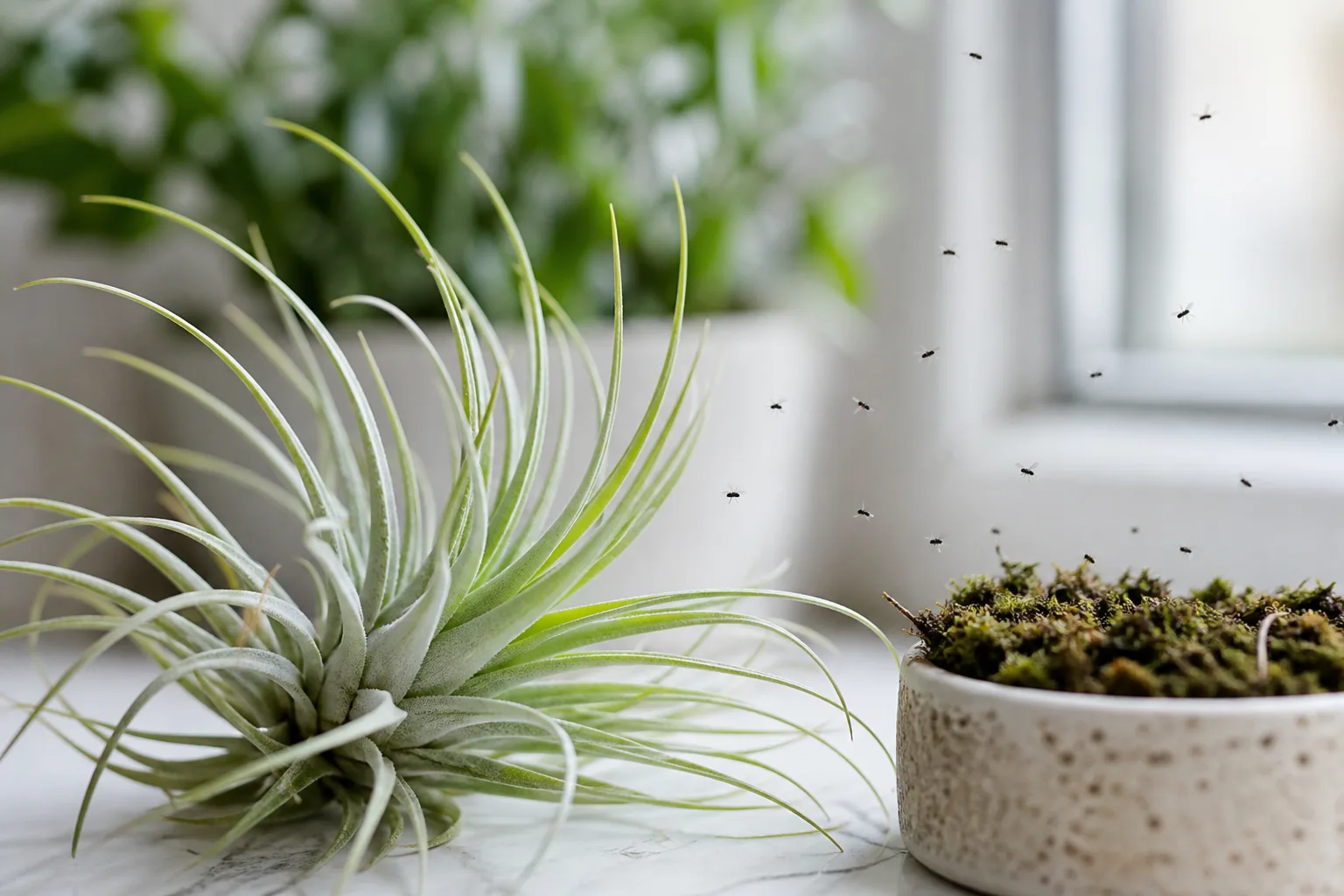
Fungus Gnats on Tillandsia: Causes, Checks & Fixes
This guide covers fungus gnats on Tillandsia. See also the general Fungus Gnats guide, watering, and light pages for this plant.
Fungus Gnats on Tillandsia: Causes, Checks & Fixes
Quick answer
Fungus gnats on Tillandsia (Tillandsia spp.) almost never mean your air plant leaves are infested. The small dark flies breed in damp organic matter around the display-wet sheet moss on a retail mount, sphagnum wrapped around the base, terrarium floor moss, or organic debris in decorative gravel. Tillandsia are epiphytic bromeliads that hydrate through leaf trichomes, not through roots in soil, so generic advice to “let the soil surface dry” misses how air plants are actually displayed.
First step: place yellow sticky traps at the base of the mount or display dish and stop keeping moss or substrate around the crown continuously wet. Do not mist the moss nest instead of soaking the leaves-see the Tillandsia watering guide for why substrate hydration fails.
| What you see | Likely cause | First action | Escalate when |
|---|---|---|---|
| Flies at moss rim; larvae in peeled sphagnum | Gnats breeding in wet display moss | Traps + remove or dry moss nest | Soft base or sour smell → stem rot |
| Flies only under mesh on neighbor pot | Misattributed from soil-potted plant | Dry neighbor soil; own traps there | Tillandsia base stays firm-no remount needed |
| White mold on damp moss, few flies | Mold on moss sharing wet habitat | Dry display; discard soggy moss | Mold returns with base softening → crown triage |
| Flies in kitchen, none at mount | Fruit flies from food waste | Clean kitchen; not air plant treatment | - |
| Base buried in potting mix, flies at crown | Setup failure-wet organic pocket | Unbury; remount openly per soil guide | Mushy core → overwatering rescue |
Judge progress by fewer flies on traps each week and a firm, dry base-not by expecting outer leaves to change appearance. Adult fungus gnats do not feed on or damage plants; the wet setup that breeds them is the threat.
New to air plants? Start with the Tillandsia overview for soak-and-dry basics before changing mount style.
When gnats mean crown rot - escalate here
Fungus gnats and crown rot on Tillandsia often share one cause: moisture trapped where the plant should sit in open air. Gnats alone are low urgency; a softening core is not.
| Signal | Gnats only (this page) | Crown rot emergency (escalate today) |
|---|---|---|
| Base firmness | Lowest leaf bases pinch firm and dry | Soft, spongy, or slimy when pinched |
| Smell | Neutral or earthy moss | Sour or musty from leaf core |
| Leaf pull test | Inner leaves resist | Inner leaves pull out while outer leaves still look green |
| Moss moisture | Dries within 48 hours after you stop misting nest | Stays wet despite dry-down; mold returns in days |
| Fly count | Traps trend down after moss fix | Flies present but base is failing-rot is the crisis |
If sour smell, soft base tissue, or easily detached inner leaves appear, stop all water, dry the plant upside down, and open the stem rot guide the same day. Gnat traps alone will not save a rotting core.
Gnats vs. fruit flies vs. drain flies on Tillandsia
Small flies around an air plant display are not all fungus gnats. Route the pest before you soak moss in larvicide.
| Fly type | Where you see it | Flight and behavior | Tillandsia action |
|---|---|---|---|
| Fungus gnats | Wet moss, soil, organic debris at mount base | Weak fliers; run on damp surface; rise when moss is misted | Dry or remove moss nest; traps + BTI on detachable moss only |
| Fruit flies | Kitchen, compost, overripe fruit | Quick darting flight; not tied to moss | Clean food sources-not an air plant problem |
| Drain flies | Bathroom drains, wet plumbing | Emerge from sink or shower | Tape-test the drain-not the Tillandsia mount |
| Shore flies | Algae on constantly wet surfaces | Prefer slimy green algae | Uncommon on typical indoor wire mounts |
If flies appear only when you open the kitchen bin, treat the kitchen. If stippling or webbing appears on leaves instead of flies at the moss rim, check aphids on Tillandsia and spider mites on Tillandsia before assuming gnats.
What fungus gnats look like on Tillandsia
Learn to ID the pest before you treat the wrong fly or the wrong substrate.
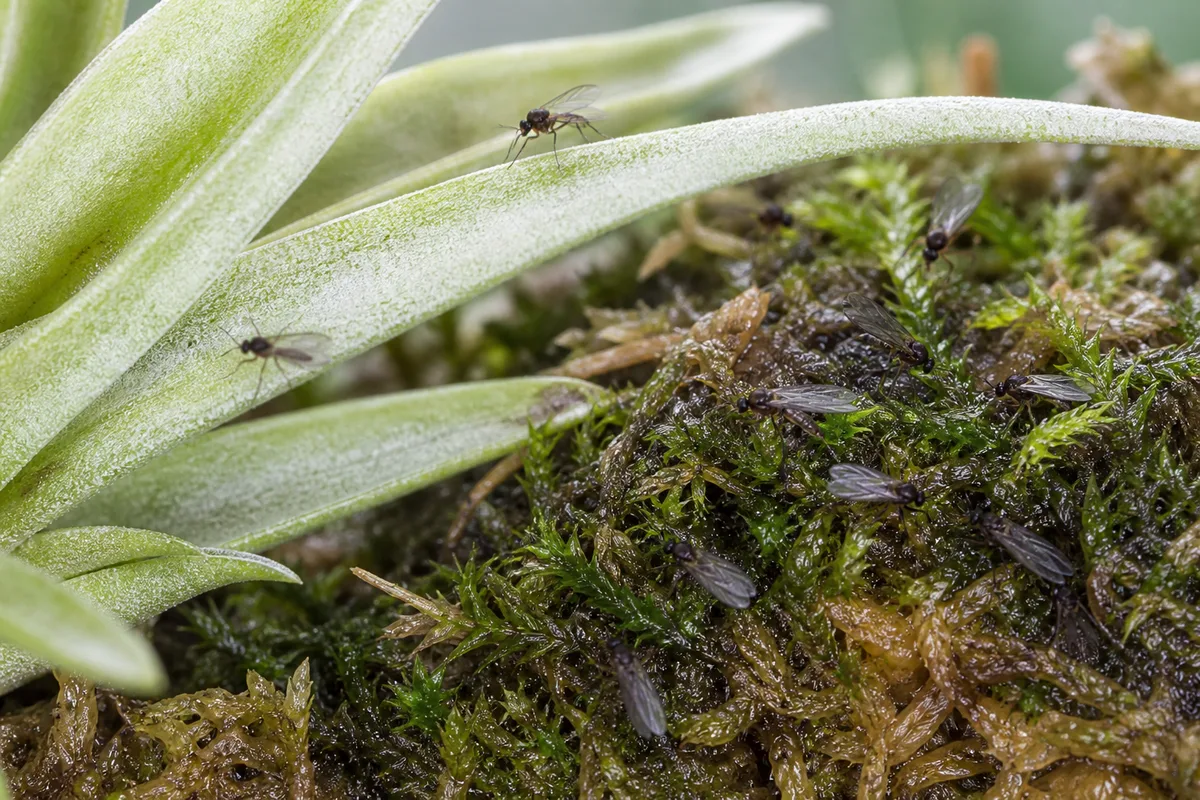
Fungus Gnats symptoms on Tillandsia - compare with healthy tissue on the same plant.
Adult flies
- Small dark flies about 1/8 inch long with long legs and narrow wings
- Weak fliers that hover near the display, keyboard, or window-not strong darting flight like fruit flies
- Run on wet surfaces - adults crawl on damp moss or mix rather than landing on dry leaf tips
- Rise in a cloud when you mist the moss, water a neighbor pot, or disturb the display dish
- Yellow sticky traps at the mount base catch adults within days when breeding is active
On Tillandsia, the “growing media” is usually display moss, not leaf tissue.
Larvae in moss and substrate
- Tiny translucent worms roughly 1/16 inch long in the top layer of wet sphagnum or potting mix
- Visible when you peel moss away from the base or lift the plant off its nest-look for white maggots with dark head capsules against damp green moss
- Feed on fungi and decaying organic matter in moist substrate - larvae rarely harm healthy Tillandsia leaves directly
- Not present on bare cork or dry driftwood mounts with no organic layer
If you find larvae only in moss below the plant and the Tillandsia base is firm, the infestation is in the display material, not the air plant itself.
What Tillandsia symptoms to expect
Mild gnat cases often show no leaf damage at all. Watch instead for:
- Flies concentrated at the moss rim or dish edge, not evenly across leaf surfaces
- Co-occurring white mold on damp moss - shared wet-organic habitat (see mold on moss around Tillandsia)
- Softening base or sour smell - that crossover is crown rot from wet moss, not gnat feeding
Why Tillandsia setups get fungus gnats
Tillandsia leaves are not larval habitat. Air plants absorb moisture through trichomes on leaves - larvae need continuously moist organic substrate, which Tillandsia should not provide when mounted correctly.
Wet moss mounts and kokedama-style wraps
Retail Tillandsia often arrive in damp sheet moss glued or wired to the base. Indoors, misting that moss for “humidity” keeps the top layer wet for days - ideal for egg laying. Sphagnum around an air plant behaves the same way as moist potting mix for fungus gnat reproduction.
Glued retail mounts and adhesive pockets
Big-box air plants are frequently hot-glued or wired into moss nests. Adhesive and moss together can form a water-retaining pocket at the base that never fully dries between soaks even when leaf tips look fine. If gnats persist after you stop misting moss, peel the nest back and check whether glue or compressed sphagnum is holding moisture against the crown-that pocket is larval habitat until you remount on open cork or wire.
Enclosed globes and terrariums
Glass globes and lidded terrariums trap humidity. Moss floors or nest moss at the base never dry fully, so gnats persist year-round. Open wire mounts on a bright shelf rarely have this problem.
Species-size note: Small rosettes like T. ionantha in tight moss nests dry slowly because the moss wraps the entire plant. Large xeric species like T. xerographica in open globes still need the base and any nest moss to dry within a few hours after soaking-big leaves do not excuse a permanently damp moss floor in a closed globe.
Misplanted or buried bases
Tillandsia pushed into potting mix, peat, or sand with only leaf tips showing create a wet organic pocket at the crown. Gnats, mold, and rot share that pocket. This is a setup failure - not normal air plant care.
Neighbor soil pots
A Tillandsia on a shelf above an overwatered pothos or fern may collect hovering gnats that bred in the neighbor’s pot, not in the air plant display. Cover suspect plants with screen overnight to find the true source before remounting your Tillandsia unnecessarily.
Mount-type risk at a glance
| Display type | Gnat risk | Why |
|---|---|---|
| Bare cork or driftwood, open air | Low | No wet organic layer for larvae |
| Wire mount, minimal dry moss | Low–medium | Risk only if moss stays damp after misting |
| Sphagnum-wrapped or kokedama nest | High | Continuously wet top layer |
| Glued retail moss nest | High | Adhesive + moss holds moisture at base |
| Enclosed globe with moss floor | High | Humidity prevents dry-down |
| Base buried in potting mix | High | Wet organic matter against crown |
| Neighbor overwatered soil pot | Medium (misattributed) | Flies hover near Tillandsia but breed elsewhere |
Lookalike pests to rule out
| Pest | Where you see it | Behavior | Tillandsia relevance |
|---|---|---|---|
| Fungus gnats | Wet moss, soil, organic debris | Run on damp surface; rise when moss misted | Breed in display moss or neighbor pots |
| Fruit flies | Kitchen, compost, overripe fruit | Quick darting flight; not tied to moss | Unrelated to air plant unless fruit nearby |
| Drain flies | Bathroom drains, wet plumbing | Emerge from sink or shower | Cover drain with tape test - not moss |
| Shore flies | Algae on constantly wet surfaces | Prefer slimy green algae | Uncommon on typical indoor mounts |
| Aphids | Leaf bases, new growth | Soft-bodied; no soil cloud on watering | See aphids guide |
| Spider mites | Leaf surfaces | Stippling, webbing; no larvae in moss | See spider mites guide |
How to confirm the cause
Work through this checklist in order:
- Fly location - Adults on moss rim, dish edge, or neighbor pot soil? Not on dry leaf tips alone?
- Moss moisture test - Press display moss. Does it stay wet for 48+ hours after misting? Wet moss confirms habitat.
- Larva check - Peel moss from the base. White worms in the top layer?
- Base firmness - Pinch lowest leaf bases. Firm and dry = gnat nuisance level. Soft or smelly = overwatering and rot crossover.
- Neighbor pot triage - Cover adjacent soil pots with mesh overnight. Flies under the cover implicate the neighbor.
- Sticky trap catch - Place yellow traps at display base for three days. Catches confirm active adults.
- Culture check - Are you misting moss instead of soaking leaves? That habit keeps both gnats and mold going.
Moss nest vs. neighbor pot vs. crown rot
| Check result | Diagnosis | Fix path | Urgency |
|---|---|---|---|
| Larvae in peeled moss; firm base; flies at mount | Gnats in display moss | Traps + remove or dry moss; BTI on detached moss only | Low - fix this week |
| Larvae under neighbor pot mesh; Tillandsia moss dry | Neighbor soil pot is source | Dry neighbor top inch; neighbor traps and BTI | Low for Tillandsia - treat neighbor |
| Wet moss + soft base + sour smell | Wet display causing rot risk | Stop water; dry upside down; stem rot triage | High - same day |
| No larvae anywhere; few trap catches | Incidental adults or wrong fly ID | Re-check kitchen, drains, fruit; confirm pest table above | Low |
Field example: retail moss nest removed (March 2026)
A grower reported flies rising whenever a wire-mounted T. ionantha was misted: 38 adults on a yellow trap in week 1, larvae visible in peeled sheet moss, base still firm. After discarding wet moss, remounting on bare cork, and soaking leaves only (no moss misting), trap counts fell to 11 by day 10 and 2–3 by day 21 without BTI. The takeaway: drying or removing the organic nest often clears gnats before larvicide is necessary when the crown is still firm.
First fix for Tillandsia
Deploy yellow sticky traps and dry out or remove the wet moss or substrate around the base - do not change leaf soak rhythm as if this were a potted fern.
Place yellow sticky traps at the mount base or display dish rim to catch adult flies and break the breeding cycle. Sticky traps reduce adult gnats laying eggs while you fix the moisture source.
Simultaneously, stop misting decorative moss around the plant. Tillandsia drinks through leaves - never hydrate through soil or moss at the base. Peel away chronically wet moss from the base and let the Tillandsia sit on an open dry mount while you assess.
This single step differs from houseplant advice (“let top inch of soil dry”). For air plants, the fix is remove or dry the organic nest, not slower watering of mix the plant should never touch.
Step-by-step recovery
After traps and moss dry-down:
- Identify the breeding site - Moss nest, terrarium floor, buried mix, or neighbor pot. Treat the site that holds larvae.
- Remove or replace wet moss - Discard soggy sphagnum; remount on cork, wire, or dry pebbles with crown exposed. Follow the soil and mounting guide.
- BTI on removable moss only - If you keep moss for aesthetics, detach it and soak in a BTI solution (Bacillus thuringiensis israelensis) per label, then let it dry fully before remounting. Apply BTI with adequate moisture so it reaches larvae; repeat every five to seven days until trap counts drop. Never pour BTI or any drench into the Tillandsia leaf crown.
- Treat neighbor pots separately - Dry the top inch of adjacent soil pots, deploy their own traps, and apply BTI to soil if larvae are present there.
- Resume proper soak rhythm - Submerge leaves 20–30 minutes weekly, shake inverted, dry upside down within about four hours, then return to an open display only.
- Scrape algae or decay from display dishes and discard organic debris in gravel layers.
- Monitor traps weekly - Replace when full. Two weeks of near-zero catches means the cycle is broken.
Discard vs. treat moss: If moss smells sour, breaks apart wet, or never dries within 48 hours after you stop misting, discard it-BTI cannot fix a permanently saturated nest. Treat-and-remount only when moss structure is sound and you are willing to remove it before every leaf soak.
Hold fertilizer while correcting moisture - a stressed Tillandsia does not need extra inputs during gnat cleanup.
Recovery timeline
Adult flies may linger one to two weeks as sticky traps catch stragglers even after larvae die in dried moss. Expect visible trap decline within 7–10 days once the moss or substrate dries or is removed.
Larval cycles in remaining damp moss need three to four weeks of BTI repeats if you keep treated moss rather than discarding it. BTI does not affect eggs or pupae, so spaced applications catch newly hatched larvae.
Tillandsia tissue should show no direct gnat damage. Improvement means fewer flies, firm base, and new clean leaf growth - not repaired old leaves.
What not to do
Do not pour larvicide, hydrogen peroxide, or soapy water into the leaf rosette - that causes crown rot faster than it kills gnats. Do not interpret “dry the soil surface” as cutting soaks on the leaves; air plants still need leaf hydration on schedule. Do not scrape mold on moss and leave the plant nested in the same wet pocket. Do not assume every small fly is a fungus gnat - check fruit bowls and drains first. Do not stack remounting, heavy pruning, and pesticide on the same day.
How to prevent fungus gnats next time
Mount openly on cork, wire, or dry decorative stone with the crown visible-whatever surface you use should not hold water at the base. Skip closed globes with moss floors unless you can maintain airflow that dries the base within hours after every soak.
Soak leaves directly, shake dry upside down, and return the plant to the mount only when the base is fully dry - the same routine that prevents overwatering and rot.
Never mist moss around the base for humidity. If you want moss for aesthetics, use a thin dry layer that you remove before soaking, or accept that wet nest moss requires periodic replacement.
Quarantine new plants with damp moss wraps for two to three weeks with their own sticky trap before placing them near open-mounted collections.
Keep sticky traps near display clusters as an early warning - a spike in catches means a moss nest or neighbor pot went too wet.
When crown rot is the real emergency
Gnats alone are low urgency on Tillandsia. Escalate immediately if:
- The base feels soft, spongy, or slimy while flies are present
- A sour or musty smell comes from the leaf core
- Inner leaves pull out easily while outer leaves still look green
- Moss stays wet despite dry-down attempts and mold returns within days
That pattern is wet-display crown rot, not a fly problem. Stop all water, dry upside down, inspect pups, and follow the stem-rot triage guide. Gnat traps alone will not save a rotting core.
Related Tillandsia guides
- Tillandsia overview - hub page for soak-and-dry basics and mount philosophy
- Tillandsia watering - leaf hydration; why moss misting fails
- Tillandsia soil and mounting - open cork, wire, and dry pebble displays
- Mold on moss around Tillandsia - shared wet-organic habitat with gnats
- Overwatering on Tillandsia - crown moisture when base stays wet
- Stem rot on Tillandsia - soft base escalation beyond gnat nuisance
- Root rot on Tillandsia - crown failure searches and rescue limits
- Aphids on Tillandsia - when flies are not the issue
- Spider mites on Tillandsia - stippling and webbing vs. soil-breeding flies
FAQs
Can Tillandsia get fungus gnats without soil?
Yes. Tillandsia do not need potting mix to host gnats-the larvae live in damp organic matter around the plant. Wet sheet moss on a wire mount, sphagnum kokedama wraps, terrarium floor moss, and decorative gravel with decaying debris all breed fungus gnats when they stay moist for days.
Should I remove the moss around my air plant to stop gnats?
Usually yes if the moss stays wet. Remove or replace chronically damp moss from the base, remount the Tillandsia openly on cork or dry wire, and hydrate leaves by soaking-not by misting the moss nest. Bare-mounted plants on open driftwood rarely breed gnats because there is no wet organic layer.
Are gnats near my air plant coming from a different pot?
Often. Fungus gnats are weak fliers that hover near any damp organic surface. A soil-potted plant on the same shelf may be the primary breeding site while your Tillandsia is innocent. Cover suspect neighbor pots with mesh overnight and check where adults accumulate before treating the air plant display.
Is BTI safe on moss around Tillandsia?
BTI drenches are safe for plants and pets when applied to removable moss or substrate away from the leaf crown. Soak detached moss in BTI solution per label, let it dry, then remount-or discard wet moss entirely. Never pour larvicide into the Tillandsia rosette where water already causes crown rot.
Will gnats kill my air plant or is it mainly the wet moss causing rot?
Adult gnats are mostly a nuisance on Tillandsia leaves. The real risk is the wet moss or substrate that breeds them-that same moisture causes crown rot at the base. Fix the display moisture trap and both problems usually fade together. Escalate if the base turns soft or smells sour regardless of fly count.
Action checklist
Before you close this tab, confirm you have:
- Set a yellow sticky trap at the mount base and noted today’s catch count.
- Stopped misting decorative moss and identified whether larvae live in the nest, a neighbor pot, or neither.
- Peeled back retail moss or glue pockets if flies persist after surface dry-down.
- Ruled out crown rot if the base feels soft or smells sour-stem rot guide if yes.
- Planned BTI only on detached moss or neighbor soil, never in the leaf rosette.
- Resumed leaf soaks per the watering guide without cutting hydration to punish gnats.
- Bookmarked the overview hub if this is your first air plant moisture fix.
Success looks like trap counts trending down, a firm dry base, and no larvae in peeled moss-not zero flies forever near a sunny window.